


Deuteronomy 31:8
Bible text: King James Version (1769 Blayney text) · Public domain
Bible text: Berean Standard Bible · Public domain
Bible text: American Standard Version (1901) · Public domain
Bible text: World English Bible, Messianic edition · Public domain
Bible text: Geneva Bible (1599) · Public domain
Bible text: Young's Literal Translation · Public domain
- וַיהוָהva·Yah·wehand YahwehH3068Conj-w ¦ N-properNoun Proper TitleוַandיהוָהYahweh
- הוּאhu'heH1931Pro-3msPronoun Personal 3rd Singular Masculine
- הַהֹלֵךְha·ho·Lekh[is] the [one who] goesH1980Art ¦ V-Qal-Prtcpl-msVerb Qal Participle Singular Masculine Absoluteהַ[is] theהֹלֵךְ[one who] goes
- לְפָנֶיךָle·fa·Nei·kha<to> before youH6440Prep-l ¦ N-mpc ¦ 2msNoun Plural Masculine Constructלְ<to>פָנֶיbeforeךָyou
- הוּאhu'heH1931Pro-3msPronoun Personal 3rd Singular Masculine
- יִהְיֶהyih·Yehhe will beH1961V-Qal-Imperf-3msVerb Qal Imperfect 3rd Singular Masculine
- עִמָּךְ'i·Makhwith youH5973Prep ¦ 2msPreposition Definiteעִמָּwithךְyou
- לֹאlo'notH3808NegParticle Negative
- יַרְפְּךָyar·pe·Khahe will abandon youH7503V-Hiphil-Imperf-3ms ¦ 2msVerb Hiphil Imperfect 3rd Singular Masculineיַרְפְּhe will abandonךָyou
- וְלֹאve·Lo'and notH3808Conj-w ¦ NegParticle Negativeוְandלֹאnot
- יַעַזְבֶךָּya·'az·Ve·kahe will forsake youH5800V-Qal-Imperf-3ms ¦ 2msVerb Qal Imperfect 3rd Singular Masculineיַעַזְבֶhe will forsakeךָּyou
- לֹאlo'notH3808NegParticle Negative
- תִירָאti·Ra'you must be afraidH3372V-Qal-Imperf-2msVerb Qal Imperfect 2nd Singular Masculine
- וְלֹאve·Lo'and notH3808Conj-w ¦ NegParticle Negativeוְandלֹאnot
- תֵחָתte·Chatyou must be dismayedH2865V-Niphal-Imperf-2msVerb Niphal Imperfect 2nd Singular Masculine
English is a literal word-by-word gloss of the Hebrew, not the KJV's wording. Why?
This is the original text the KJV's translators worked from — each Hebrew word with its own literal English meaning in this verse, prepared by scholars at Tyndale House, Cambridge. The KJV translates whole sentences, not word by word, so its wording differs: one Hebrew word can become several English words, and the KJV may choose “the LORD” where the gloss reads “Yahweh”. Both are faithful — they answer different questions. For the KJV's own rendering, switch to the KJV text.
Details
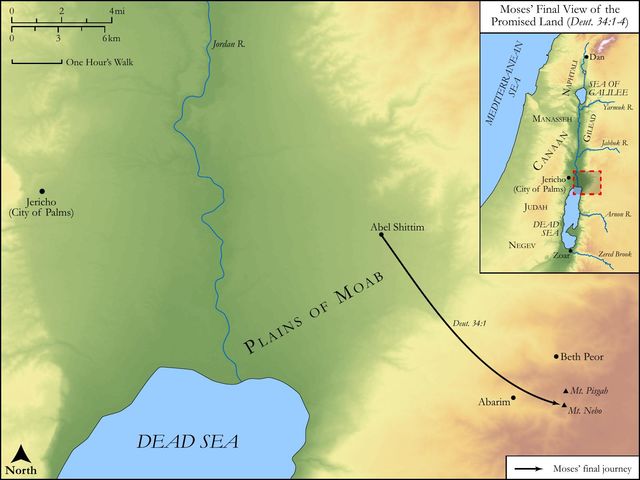
See on the biblical-era map
Study this verse
Public-domain commentary
Matthew Henry
From his Commentary on the Whole Bible. Henry comments on passages, not single verses — this entry covers Deuteronomy 31:1–8. His two-level outline is real structure in the source text, so it is rendered as structure.
Loth to part (we say) bids oft farewell. Moses does so to the children of Israel: not because he was loth to go to God, but because he was loth to leave them, fearing that when he had left them they would leave God. He had finished what he had to say to them by way of counsel and exhortation: here he calls them together to give them a word of encouragement, especially with reference to the wars of Canaan, in which they were now to engage. It was a discouragement to them that Moses was to be removed at a time when he could so ill be spared: though Joshua was continued to fight for them in the valley, they would want Moses to intercede for them on the hill, as he did, Exo 17:10. But there is no remedy: Moses can no more go out and come in, Deu 31:2. Not that he was disabled by any decay either of body or mind; for his natural force was not abated, Deu 24:7. But he cannot any longer discharge his office; for, 1. He is 120 years old, and it is time for him to think of resigning his honour and returning to his rest. He that had arrived at so great an age then, when seventy or eighty was the ordinary stint, as appears by the prayer of Moses (Psa 90:10), might well think that he had accomplished as a hireling his day. 2. He is under a divine sentence: Thou shalt not go over Jordan. Thus a full stop was put to his usefulness; hitherto he must go, hitherto he must serve, but no further. So God had appointed it and Moses acquiesces: for I know not why we should any of us desire to live a day longer than while God has work for us to do; nor shall we be accountable for more time than is allotted us. But, though Moses must not go over himself, he is anxious to encourage those that must.
I.He encourages the people; and never could any general animate his soldiers upon such good grounds as those on which Moses here encourages Israel.
1.He assures them of the constant presence of God with them (Deu 31:3): The Lord thy God. that has led thee and kept thee hitherto will go over before thee; and those might follow boldly who were sure that they had God for their leader. He repeats it again (Deu 31:6) with an emphasis: "The Lord thy God, the great Jehovah, who is thine in covenant, he it is, he and no less, he and no other, that goes before thee; not only who by his promise has assured thee that he will go before thee; but by his ark, the visible token of his presence, shows thee that he does actually go before thee." And he repeats it with enlargement: "Not only he goes over before thee at first, to bring thee in, but he will continue with thee all along, with thee and thine; he will not fail thee nor forsake thee; he will not disappoint thy expectations in any strait, nor will he ever desert thy interest; be constant to him, and he will be so to thee." This is applied by the apostle to all God's spiritual Israel, for the encouragement of their faith and hope; unto us is this gospel preached, as well as unto them He will never fail thee, nor forsake thee, Heb 13:5.
2.He commends Joshua to them for a leader: Joshua, he shall go over before thee, Deu 31:3. One whose conduct, and courage, and sincere affection to their interest, they had had long experience of; and one whom God had ordained and appointed to be their leader, and therefore, no doubt, would own and bless, and make a blessing to them. See Num 27:18. Note, It is a great encouragement to a people when, instead of some useful instruments that are removed, God raises up others to carry on his work.
3.He ensures their success. The greatest generals, supported with the greatest advantages, must yet own the issues of war to be doubtful and uncertain; the battle is not always to the strong nor to the bold; an ill accident unthought of may turn the scale against the highest hopes. But Moses had warrant from God to assure Israel that, notwithstanding the disadvantages they laboured under, they should certainly be victorious. A coward will fight when he is sure to be a conqueror. God undertakes to do the work - he will destroy these nations; and Israel shall do little else than divide the spoil - thou shalt possess them, Deu 31:3. Two things might encourage their hopes of this: - (1.) The victories they had already obtained over Sihon and Og (Deu 31:4), from which they might infer both the power of God, that he could do what he had done, and the purpose of God, that he would finish what he had begun to do. Thus must we improve our experience. (2.) The command God had given them to destroy the Canaanites (Deu 7:2; Deu 12:2), to which he refers here (Deu 31:5, that you may do unto them according to all which I have commanded you), and from which they might infer that, if God had commanded them to destroy the Canaanites, no doubt he would put it into the power of their hands to do it. Note, What God has made our duty we have reason to expect opportunity and assistance from him for the doing of. So that from all this he had reason enough to bid them be strong and of a good courage, Deu 31:6. While they had the power of God engaged for them they had no reason to fear all the powers of Canaan engaged against them.
II.He encourages Joshua, Deu 31:7, Deu 31:8. Observe,
1.Though Joshua was an experienced general, and a man of approved gallantry and resolution, who had already signalized himself in many brave actions, yet Moses saw cause to bid him be of good courage, now that he was entering upon a new scene of action; and Joshua was far from taking it as an affront, or as a tacit questioning of his courage, to be thus charged, as sometimes we find proud and peevish spirits invidiously taking exhortations and admonitions for reproaches and reflections. Joshua himself is very well pleased to be admonished by Moses to be strong and of good courage.
2.He gives him this charge in the sight of all Israel, that they might be the more observant of him whom they saw thus solemnly inaugurated, and that he might set himself the more to be an example of courage to the people who were witnesses to this charge here given to him as well as to themselves.
3.He gives him the same assurances of the divine presence, and consequently of a glorious success, that he had given the people. God would be with him, would not forsake him, and therefore he should certainly accomplish the glorious enterprise to which he was called and commissioned: Thou shalt cause them to inherit the land of promise. Note, Those shall speed well that have God with them; and therefore they ought to be of good courage. Through God let us do valiantly, for through him we shall do victoriously; if we resist the devil, he shall flee, and God shall shortly tread him under our feet.
Historical interpretation
Historical reception
1 surviving comment on this verse from the historical church.
Let brotherly love continue. Be not forgetful to entertain strangers: for thereby some have entertained angels unawares. Remember them that are in bonds, as bound with them; and them which suffer adversity, as being yourselves also in the body. Marriage is honourable in all, and the bed undefiled: but whoremongers and adulterers God will judge. Let your conversation be without covetousness; and be content with such things as ye have: for he hath said, I will never leave thee, nor forsake thee. [Deuteronomy 31:6-8] So that we may boldly say, The Lord is my helper, and I will not fear what man shall do unto me.
Continue studying Deuteronomy 31:8 across the web’s major study libraries — every link below opens this exact verse, chapter, or book on the destination site.
Read & Compare
 BibleGatewayThis verse in more than 200 translations and 70 languages.
 Bible.comThe YouVersion reader — hundreds of translations, reading plans, and highlights.
 ESV.orgCrossway's official English Standard Version reader.
 NET BibleThe NET translation with 60,000+ translators' notes on every rendering decision.
 STEP BibleTyndale House's free study tool — original text, vocabulary, and scholarly resources.
 BibliaLogos Bible Software's free web reader.
 USCCBThe New American Bible (Revised Edition) with the U.S. bishops' study notes.
Commentaries
 BibleHub CommentariesDozens of classic commentaries on this verse, gathered on one page.
 StudyLightMore than 100 commentary sets — the largest collection on the web.
 BibleRefPlain-English commentary on what this verse means, verse by verse.
 Enduring WordDavid Guzik's free commentary on this chapter, widely used by Bible teachers.
 Bible Study ToolsVerse commentary alongside Greek and Hebrew study aids.
Original Language & Research
- BibleHub InterlinearThe verse word by word — original language, transliteration, and English.
- BibleHub LexiconEvery word's original-language definition and Strong's entry.
 Blue Letter BibleDeep-study tools — Strong's numbers, concordance, and word studies.
 SefariaThe Hebrew text with Rashi and centuries of Jewish commentary.
Sermons, Hymns & Audio


TrulyRandomVerse is not affiliated with these sites and doesn’t control their content. They’re linked because they’re genuinely useful.
Summary
Deuteronomy 31:8 delivers a profound divine assurance from the LORD to His people, particularly as they stand on the precipice of a momentous transition into the Promised Land. This verse encapsulates God's unwavering commitment to His covenant people, promising His active leadership, intimate presence, and absolute faithfulness, which will never falter or abandon them. Consequently, it issues a powerful imperative to release all fear and discouragement, grounding human courage firmly in the unshakeable character and reliability of God Himself.
Context
ShowHideLiterary Context
Deuteronomy 31:8 is strategically positioned within the final, climactic section of Moses' farewell addresses to the Israelites, immediately preceding his death and their momentous entry into Canaan. Chapters 29-31 collectively detail a solemn covenant renewal and a comprehensive charge to the new generation that will inherit the land. Specifically, this verse follows Moses' public commissioning of Joshua as his successor in Deuteronomy 31:7, where Moses directly encourages Joshua to be strong and courageous. The promise in verse 8, while addressed primarily to Joshua in its immediate context as a personal assurance for his daunting leadership task, simultaneously serves as a foundational and comprehensive assurance for the entire nation as they face the formidable challenges of conquering the land and establishing themselves within it. It powerfully reinforces the enduring covenant relationship between God and Israel, emphasizing divine initiative and unwavering faithfulness as indispensable prerequisites for their success and well-being.
Historical & Cultural Context
At this pivotal moment, the Israelites are poised to cross the Jordan River, leaving behind forty years of wilderness wandering and confronting the formidable challenges of dispossessing the powerful and idolatrous Canaanite nations. This generation, unlike their parents, had not personally witnessed the miraculous events of the Exodus or the awe-inspiring giving of the Law at Sinai, but had grown up under the direct, miraculous care of God in the wilderness. Moses, their revered leader, prophet, and mediator of the covenant, is about to depart, creating a significant leadership void. The task ahead involved not only military conquest against seasoned, often larger, and deeply entrenched peoples, but also the immense responsibility of establishing a theocratic nation under God's intricate legal and moral framework. In such a volatile, uncertain, and humanly overwhelming environment, the promise of God's constant, active, and unfailing presence was not merely a comforting thought but a critical strategic and psychological necessity for a people facing seemingly insurmountable odds.
Key Themes
ShowHideThis verse powerfully articulates several core theological themes central to Deuteronomy and the broader Pentateuch. It highlights God's covenant faithfulness, emphatically stating that He "will not fail thee, neither forsake thee," thereby underscoring His unwavering commitment to His promises despite human weakness or potential failure. The theme of divine presence is paramount, portraying God as actively "going before" His people and being intimately "with" them, a concept central to Israel's unique identity as a people set apart by God (Exodus 33:14). Furthermore, it directly addresses the theme of leadership succession, providing crucial divine validation and empowerment for Joshua's new, daunting role, thereby ensuring the continuity of God's redemptive plan for His people. Finally, the imperative to "fear not, neither be dismayed" speaks directly to the theme of courage and trust in God, presenting it not as an inherent human trait, but as a direct and logical consequence of understanding and relying on God's unchanging character and immutable promises, particularly as seen in the broader context of warfare instructions in Deuteronomy 20:1-4.
Exposition and Analysis
ShowHideKey Word Analysis
ShowHideThis refers to the covenant name of God, Yahweh (H3068), emphasizing His self-existent, eternal nature. It signifies the God who is, who was, and who is to come, the One who reveals Himself and faithfully keeps His promises to His people. The use of this specific name here underscores the personal and relational aspect of the divine assurance.
This primitive root (H1980) denotes movement, often with purpose and direction, encompassing a wide range of applications from simply walking to actively leading or marching. In the context of "go before thee," it signifies God's active, pioneering leadership, where He is not merely preceding in time but actively clearing the path, removing obstacles, and guiding His people forward.
This verb (H7503) means to slacken, to abate, to become feeble, or to let go. When applied to God, its negation ("will not fail") emphatically denies any possibility of Him losing strength, becoming lax in His commitment, or withdrawing His support. It assures His sustained, vigorous, and undiminished engagement and provision for His people.
This term (H2865) describes a state of being prostrated, broken down, or utterly terrified, often by confusion and fear. It goes beyond simple fear to encompass a profound sense of hopelessness, despair, or utter collapse of spirit. The command "neither be dismayed" is a direct antidote to such crippling emotional and spiritual states, promising inner fortitude and resilience grounded in God's absolute reliability.
Verse Breakdown
ShowHide"And the LORD, he [it is] that doth go before thee"
This opening clause establishes God's sovereign initiative and active role as the divine leader. It emphasizes that Yahweh, the covenant-keeping God, is not a passive observer but the one who actively leads the way, charting the course, and ensuring safe passage into the unknown. This divine precedence is the foundational promise upon which all subsequent assurances rest.
"he will be with thee"
This phrase directly affirms God's intimate, constant, and empowering presence. It speaks to a personal, supportive, and immanent companionship. It's not just that God leads from afar, but that He is actively present alongside His people, sharing in their journey, challenges, and triumphs. This promise of "God with us" (Immanuel) is a recurring and central theme throughout Scripture.
"he will not fail thee, neither forsake thee"
This powerful double negative provides an absolute guarantee of God's unwavering faithfulness and steadfast commitment. Using two distinct but complementary verbs, "fail" (to slacken or weaken) and "forsake" (to abandon or desert), the text eliminates any possibility of God's support diminishing or His presence being withdrawn. It underscores the permanence, reliability, and enduring nature of His covenant love and relationship.
"fear not, neither be dismayed"
This is the imperative command that flows directly and logically from the preceding divine promises. Because the LORD is the active leader, constantly present, and absolutely faithful, there is no legitimate basis for fear or despair. This command is not a mere suggestion but a direct consequence of trusting in God's character, calling His people to courageous action rooted in divine assurance, rather than human strength.
Literary Devices
ShowHideDeuteronomy 31:8 employs several potent Literary Devices to amplify its message of divine assurance and its call to human faith. The verse exhibits strong Parallelism, particularly in the negative commands ("he will not fail thee, neither forsake thee" and "fear not, neither be dismayed"), which serve to reinforce the certainty of God's unwavering action and the resulting appropriate human response. The deliberate Repetition of "he will" ("he will be with thee, he will not fail thee, neither forsake thee") creates a rhythmic emphasis, building a cumulative sense of God's active, continuous, and reliable involvement. There is a clear Cause and Effect relationship established: because God acts in specific, reliable ways (going before, being with, not failing, not forsaking), the human response should logically be courage and trust (not fearing, not being dismayed). The verse also functions as a powerful Divine Oracle or a Promise Formula, characteristic of biblical covenant language, where God's solemn declaration serves as a binding guarantee. The structure progresses from God's initiating leadership to His sustained presence, to His unfailing commitment, culminating in the human imperative, creating a comprehensive and deeply reassuring statement of divine reliability and its call to faith.
Theological and Thematic Connections
ShowHideDeuteronomy 31:8 is a cornerstone text for understanding God's unwavering covenant faithfulness and His immanent presence with His people. It establishes a theological principle that reverberates throughout the entire biblical narrative: God's character is steadfast, and His promises are immutable. This verse underscores that human courage, success, and spiritual well-being are not predicated on inherent strength, wisdom, or favorable circumstances, but rather on the divine initiative and sustained companionship of Yahweh. It powerfully prefigures the concept of "Immanuel" (God with us) and serves as a foundational promise upon which future generations of believers, facing their own "promised lands" and transitions, can confidently stand. It affirms that the God who leads, empowers, and sustains His people is eternally reliable, providing the ultimate antidote to fear and discouragement in any situation.
Reflection and Application
ShowHideDeuteronomy 31:8 transcends its immediate historical context to offer timeless spiritual nourishment and practical guidance for believers navigating the uncertainties of contemporary life. In a world characterized by rapid change, economic instability, relational challenges, and pervasive personal anxieties, the profound assurance that "the LORD... doth go before thee; he will be with thee, he will not fail thee, neither forsake thee" provides an unshakeable anchor for the soul. This verse calls us to shift our focus from the daunting nature of our circumstances to the unchanging character and boundless power of our God. Whether facing a new career path, a significant life transition, a health crisis, the loss of a loved one, or simply the daily demands of life, we are reminded that we are never truly alone. The same faithful God who empowered Joshua to lead a nation into a formidable future is intimately present with us, actively leading, sustaining, and upholding us through every challenge. This liberating truth frees us from the paralysis of fear and the crushing burden of dismay, empowering us to step forward in faith, knowing that our ultimate security and success rest not in our limited abilities, but in His unfailing presence and omnipotent power.
Questions for Reflection
ShowHideFAQ
ShowHideIs this promise only for leaders like Joshua, or for all believers?
ShowHideWhile Deuteronomy 31:8 was initially given in the specific context of commissioning Joshua as Moses' successor, its theological principles extend far beyond a singular leadership role to encompass all believers. The promise of God's presence, active leading, and unfailing faithfulness is rooted in His unchanging character, not merely in the recipient's position or an individual's inherent merit. The New Testament explicitly affirms this broader application, as seen in Hebrews 13:5, which directly quotes and applies this Deuteronomic promise to all Christians, assuring them, "I will never leave thee, nor forsake thee." Therefore, while the immediate historical context is specific, the spiritual truth and divine guarantee are universal for all who are in covenant with God through faith.
How does God "go before" us today?
ShowHideToday, God continues to "go before" believers in various profound ways, though not always through visible, miraculous interventions as in the Exodus. He leads us primarily through the indwelling presence of His Holy Spirit, who guides, teaches, and empowers us from within (as promised in John 16:13). He also leads through His inspired and infallible Word, the Bible, which serves as "a lamp unto my feet, and a light unto my path" (Psalm 119:105). Furthermore, God orchestrates circumstances through His divine providence, opening doors, closing others, and directing our steps in ways we may not immediately perceive or fully understand (Proverbs 3:5-6). Ultimately, God's going before us means He has already prepared the way, knows the future, and is actively working all things together for the ultimate good of those who love Him and are called according to His purpose (Romans 8:28).
Christ-Centered Fulfillment
ShowHideDeuteronomy 31:8 finds its ultimate and most profound fulfillment in the person and redemptive work of Jesus Christ. He is the preeminent "one who goes before" us, not merely as a leader but as the pioneer and perfecter of our faith (Hebrews 12:2), having blazed the trail to salvation and eternal life. In His incarnation, Jesus is the very embodiment of "God with us" (Immanuel), as prophesied in Isaiah 7:14 and perfectly fulfilled in Matthew 1:23. Through His sinless life, sacrificial death on the cross, and glorious resurrection, Jesus perfectly demonstrated God's unwavering faithfulness; He did not fail in His mission to redeem humanity, nor did the Father forsake Him in His suffering, ultimately raising Him from the dead in triumph. His ascension to the right hand of the Father and His promise to send the Holy Spirit (John 14:16-18) ensure His continuous, empowering, and indwelling presence with believers until the consummation of the age. Thus, the command "fear not, neither be dismayed" is fully realized in Christ, who has definitively overcome the world and its trials (John 16:33) and promised His disciples, "I am with you alway, even unto the end of the world" (Matthew 28:20). He is the living guarantee that God will never fail or forsake His people, for in Him, all of God's magnificent promises are irrevocably "Yes" and "Amen" (2 Corinthians 1:20).