


Deuteronomy 34:7
Bible text: King James Version (1769 Blayney text) · Public domain
Bible text: Berean Standard Bible · Public domain
Bible text: American Standard Version (1901) · Public domain
Bible text: World English Bible, Messianic edition · Public domain
Bible text: Geneva Bible (1599) · Public domain
Bible text: Young's Literal Translation · Public domain
- וּמֹשֶׁהu·mo·Shehand MosesH4872Conj-w ¦ N-proper-mNoun Proper MasculineוּandמֹשֶׁהMoses
- בֶּןben[was] a son ofH1121N-mscNoun Singular Masculine Construct
- מֵאָהme·'Ahone hundredH3967N-fsNoun Singular Feminine Absolute
- וְעֶשְׂרִיםve·'es·Rimand twentyH6242Conj-w ¦ N-mpNoun Plural Masculine Absoluteוְandעֶשְׂרִיםtwenty
- שָׁנָהsha·Nahyear[s]H8141N-fsNoun Singular Feminine Absolute
- בְּמֹתוֹbe·mo·Towhen he dyingH4191Prep-b ¦ V-Qal-Inf ¦ 3msVerb Qal Infinitive Constructבְּwhenמֹתdyingוֹhe
- לֹאlo'notH3808NegParticle Negative
- כָהֲתָהkha·ha·Tahit had grown dimH3543V-Qal-Perf-3fsVerb Qal Perfect 3rd Singular Feminine
- עֵינוֹei·Nohis eyeH5869N-fsc ¦ 3msNoun Singular Feminine Constructעֵינeyeוֹhis
- וְלֹאve·lo'and notH3808Conj-w ¦ NegParticle Negativeוְandלֹאnot
- נָסnasit had fledH5127V-Qal-Perf-3msVerb Qal Perfect 3rd Singular Masculine
- לֵחֹהle·Chohhis vigorH3893N-msc ¦ 3msNoun Singular Masculine Constructלֵחֹvigorהhis
English is a literal word-by-word gloss of the Hebrew, not the KJV's wording. Why?
This is the original text the KJV's translators worked from — each Hebrew word with its own literal English meaning in this verse, prepared by scholars at Tyndale House, Cambridge. The KJV translates whole sentences, not word by word, so its wording differs: one Hebrew word can become several English words, and the KJV may choose “the LORD” where the gloss reads “Yahweh”. Both are faithful — they answer different questions. For the KJV's own rendering, switch to the KJV text.
Details
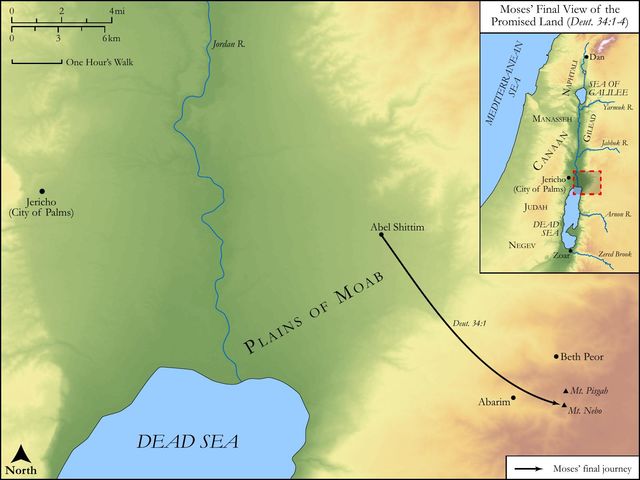
See on the biblical-era map
Study this verse
Public-domain commentary
Matthew Henry
From his Commentary on the Whole Bible. Henry comments on passages, not single verses — this entry covers Deuteronomy 34:5–8. His two-level outline is real structure in the source text, so it is rendered as structure.
Here is, I. The death of Moses (Deu 34:5): Moses the servant of the Lord died. God told him he must not go over Jordan, and, though at first he prayed earnestly for the reversing of the sentence yet God's answer to his prayer sufficed him, and now he spoke no more of that matter, Deu 3:26. Thus our blessed Saviour prayed that the cup might pass from him, yet, since it might not, he acquiesced with, Father, thy will be done. Moses had reason to desire to live a while longer in the world. He was old, it is true, but he had not yet attained to the years of the life of his fathers; his father Amram lived to be 137; his grandfather Kohath 133; his great grandfather Levi 137; Exo 6:16-20. And why must Moses, whose life was more serviceable than any of theirs, die at 120, especially since he felt not the decays of age, but was as fit for service as ever? Israel could ill spare him at this time; his conduct and his converse with God would be as great a happiness to them in the conquest of Canaan as the courage of Joshua. It bore hard upon Moses himself, when he had gone through all the fatigues of the wilderness, to be prevented from enjoying the pleasures of Canaan; when he had borne the burden and heat of the day, to resign the honour of finishing the work to another, and that not his son, but his servant, who must enter into his labours. We may suppose that this was not pleasant to flesh and blood. But the man Moses was very meek; God will have it so, and he cheerfully submits. 1. He is here called the servant of the Lord, not only as a good man (all the saints are God's servants), but as a useful man, eminently useful, who had served God's counsels in bringing Israel out of Egypt, and leading them through the wilderness. It was more his honour to be the servant of the Lord. than to be king in Jeshurun. 2. Yet he dies. Neither his piety nor his usefulness would exempt him from the stroke of death. God's servants must die that they may rest from their labours, receive their recompense, and make room for others. When God's servants are removed, and must serve him no longer on earth, they go to serve him better, to serve him day and night in his temple. 3. He dies in the land of Moab, short of Canaan, while as yet he and his people were in an unsettled condition and had not entered into their rest. In the heavenly Canaan there will be no more death. 4. He dies according to the word of the Lord. At the mouth of the Lord; so the word is. The Jews say, "with a kiss from the mouth of God." No doubt, he died very easily (it was an euthanasia - a delightful death), there were no bands in his death; and he had in his death a most pleasing taste of the love of God to him: but that he died at the mouth of the Lord means no more but that he died in compliance with the will of God. Note, The servants of the Lord, when they have done all their other work, must die at last, in obedience to their Master, and be freely willing to go home whenever he sends for them, Act 21:13.
II.His burial, Deu 34:6.
It is a groundless conceit of some of the Jews that Moses was translated to heaven as Elijah was, for it is expressly said that he died and was buried; yet probably he was raised to meet Elias, to grace the solemnity of Christ's transfiguration.
1.God himself buried him, namely, by the ministry of angels, which made this funeral, though very private, yet very magnificent. Note, God takes care of the dead bodies of his servants; as their death is precious, so is their dust, not a grain of it shall be lost, but the covenant with it shall be remembered. When Moses was dead, God buried him; when Christ was dead, God raised him, for the law of Moses was to have an end, but not the gospel of Christ. Believers are dead to the law that they might be married to another, even to him who is raised from the dead, Rom 7:4. It should seem Michael, that is, Christ (as some think), had the burying of Moses, for by him the Mosaical ordinances were abolished and taken out of the way, nailed to his cross, and buried in his grave, Col 2:14.
2.He was buried in a valley over against Beth-peor. How easily could the angels that buried him have conveyed him over Jordan and buried him with the patriarchs in the cave of Machpelah! But we must learn not be over-solicitous about the place of our burial. If the soul be at rest with God, the matter is not great where the body rests. One of the Chaldee paraphrasts says, "He was buried over against Beth-peor, that, whenever Baal-peor boasted of the Israelites being joined to him, the grave of Moses over against his temple might be a check to him." 3. The particular place was not known, lest the children of Israel, who were so very prone to idolatry, should have enshrined and worshipped the dead body of Moses, that great founder and benefactor of their nation. It is true that we read not, among all the instances of their idolatry, that they worshipped relics, the reason of which perhaps was because they were thus prevented from worshipping Moses, and so could not for shame worship any other. Some of the Jewish writers say that the body of Moses was concealed, that necromancers, who enquired of the dead, might not disquiet him, as the witch of Endor did Samuel, to bring him up. God would not have the name and memory of his servant Moses thus abused. Many think this was the contest between Michael and the devil about the body of Moses, mentioned Jde 1:9. The devil would make the place known that it might be a snare to the people, and Michael would not let him. Those therefore who are for giving divine honours to the relics of departed saints side with the devil against Michael our prince.
III.His age, Deu 34:7. His life was prolonged,
1.To old age. He was 120 years old, which, though far short of the years of the patriarchs, yet much exceeded the years of most of his contemporaries, for the ordinary age of man had been lately reduced to seventy, Psa 90:10. The years of the life of Moses were three forties. The first forty he lived a courtier, at ease and in honour in Pharaoh's court; the second forty he lived a poor desolate shepherd in Midian; the third forty he lived a king in Jeshurun, in honour and power, but encumbered with a great deal of care and toil: so changeable is the world we live in, and alloyed with such mixtures; but the world before us is unmixed and unchangeable.
2.To a good old age: His eye was not dim (as Isaac's, Gen 27:1, and Jacob's, Gen 48:10), nor was his natural force abated; there was no decay either of the strength of his body or of the vigour and activity of his mind, but he could still speak, and write, and walk as well as ever. His understanding was as clear, and his memory as strong, as ever. "His visage was not wrinkled," say some of the Jewish writers; "he had lost never a tooth," say others; and many of them expound it of the shining of his face (Exo 34:30), that that continued to the last. This was the general reward of his services; and it was in particular the effect of his extraordinary meekness, for that is a grace which is, as much as any other, health to the navel and marrow to the bones. Of the moral law which was given by Moses, though the condemning power be vacated to true believers, yet the commands are still binding, and will be to the end of the world; the eye of them is not waxen dim, for they shall discern the thoughts and intents of the heart, nor is their natural force or obligation abated but still we are under the law to Christ.
IV.The solemn mourning that there was for him, Deu 34:8.
It is a debt owing to the surviving honour of deceased worthies to follow them with our tears, as those who loved and valued them, are sensible of our loss of them, and are truly humbled for those sins which have provoked God to deprive us of them; for penitential tears very fitly mix with these. Observe,
1.Who the mourners were: The children of Israel. They all conformed to the ceremony, whatever it was, though some of them perhaps, who were ill-affected to his government, were but mock-mourners; yet we may suppose there were those among them who had formerly quarrelled with him and his government, and perhaps had been of those who spoke of stoning him, who now were sensible of their loss, and heartily lamented him when he was removed from them, though they knew not how to value him when he was with them. Thus those who had murmured were made to learn doctrine, Isa 29:24. Note, The loss of good men, especially good governors, is to be much lamented and laid to heart: those are stupid who do not consider it.
2.How long they mourned: Thirty days. So long the formality lasted, and we may suppose there were some in whom the mourning continued much longer. Yet the ending of the days of weeping and mourning for Moses is an intimation that, how great soever our losses have been, we must not abandon ourselves to perpetual grief; we must suffer the wound at least to heal up in time. If we hope to go to heaven rejoicing, why should we resolve to go to the grave mourning? The ceremonial law of Moses is dead and buried in the grave of Christ; but the Jews have not yet ended the days of their mourning for it.
Continue studying Deuteronomy 34:7 across the web’s major study libraries — every link below opens this exact verse, chapter, or book on the destination site.
Read & Compare
 BibleGatewayThis verse in more than 200 translations and 70 languages.
 Bible.comThe YouVersion reader — hundreds of translations, reading plans, and highlights.
 ESV.orgCrossway's official English Standard Version reader.
 NET BibleThe NET translation with 60,000+ translators' notes on every rendering decision.
 STEP BibleTyndale House's free study tool — original text, vocabulary, and scholarly resources.
 BibliaLogos Bible Software's free web reader.
 USCCBThe New American Bible (Revised Edition) with the U.S. bishops' study notes.
Commentaries
 BibleHub CommentariesDozens of classic commentaries on this verse, gathered on one page.
 StudyLightMore than 100 commentary sets — the largest collection on the web.
 BibleRefPlain-English commentary on what this verse means, verse by verse.
 Enduring WordDavid Guzik's free commentary on this chapter, widely used by Bible teachers.
 Bible Study ToolsVerse commentary alongside Greek and Hebrew study aids.
Original Language & Research
- BibleHub InterlinearThe verse word by word — original language, transliteration, and English.
- BibleHub LexiconEvery word's original-language definition and Strong's entry.
 Blue Letter BibleDeep-study tools — Strong's numbers, concordance, and word studies.
 SefariaThe Hebrew text with Rashi and centuries of Jewish commentary.
Sermons, Hymns & Audio


TrulyRandomVerse is not affiliated with these sites and doesn’t control their content. They’re linked because they’re genuinely useful.
Summary
Deuteronomy 34:7 provides a remarkable epitaph for Moses, highlighting his extraordinary physical and mental vitality at the advanced age of 120 years. This verse stands near the close of the account of his life, emphasizing God's unique sustaining power and Moses' unwavering strength and clarity, even as he stood on the threshold of death and the Israelites prepared to enter the Promised Land under new leadership. It serves as a powerful testament to divine faithfulness and the supernatural equipping of God's chosen servants.
Context
ShowHideLiterary Context
This verse serves as the poignant climax and conclusion to the life of Moses, the central figure of the Pentateuch, and marks the very end of the book of Deuteronomy. It immediately follows the divine command for Moses to ascend Mount Nebo to view the Promised Land, which he was forbidden to enter due to his disobedience at Meribah. The description of his undiminished physical and mental faculties directly precedes the account of his death, his unique burial by God, and the subsequent transfer of leadership to Joshua, as detailed in Deuteronomy 34:9. This epitaph emphasizes Moses' unique stature and divine favor, providing a fitting and powerful closure to his remarkable forty-year leadership of Israel.
Historical & Cultural Context
In Israel, advanced age was often regarded as a profound sign of divine blessing, wisdom, and favor: "The hoary head is a crown of glory, if it be found in the way of righteousness." While some patriarchal figures in Genesis are recorded as living for centuries, by the time of Moses, human lifespans had significantly shortened, making his age of 120 years truly exceptional. This longevity, coupled with his sustained vigor, points to a supernatural preservation by God, distinguishing Moses from ordinary men. His life spanned the entire wilderness wandering, from the miraculous Exodus from Egypt to the very brink of the Promised Land, a period during which he served as God's primary mediator, delivering the Law and guiding the nascent nation. His physical strength at such an advanced age underscores the divine empowerment necessary for his monumental and arduous task.
Key Themes
ShowHideThe verse powerfully illustrates the theme of Divine Sustenance, demonstrating God's supernatural power to preserve and empower His chosen servants beyond natural limitations. Moses' undiminished faculties at 120 years old are a testament to God's faithfulness to equip those He calls, enabling them to "finish strong" in their appointed tasks, as seen in his final blessings and exhortations in Deuteronomy 33. This also highlights Moses' Unique Status as God's preeminent prophet and mediator, whose life, from his miraculous birth to his divinely sustained death, was marked by extraordinary divine favor. Furthermore, the verse underscores the theme of Faithfulness to the End, as Moses remained physically and mentally capable of leadership and service until his very last moments, serving as a model of unwavering dedication. Finally, it subtly emphasizes Preparation for Transition, signaling that Moses' death was not due to weakness but was part of God's sovereign plan to usher Israel into the Promised Land under the new leadership of Joshua, as foreshadowed in Deuteronomy 31:7-8.
Exposition and Analysis
ShowHideKey Word Analysis
ShowHideFrom Strong's H3543, this primitive root means "to be weak, i.e. (figuratively) to despond (causatively, rebuke), or (of light, the eye) to grow dull; darken, be dim, fail, faint, restrain, [idiom] utterly." When applied to the eye, as it is here, it signifies impaired vision, a loss of sharpness or clarity. The negation "his eye was not dim" emphasizes perfect, unimpaired visual acuity, suggesting Moses' perception, both physical and perhaps spiritual, remained unclouded and fully functional.
From Strong's H3893, this word refers to "freshness, i.e. vigor; natural force." In ancient Hebrew thought, "moisture" or "sap" was understood as the vital fluid that gives life, freshness, and vigor, much like sap gives vitality to a tree. It represents the inherent, youthful energy and robust health of the body.
From Strong's H5127, this primitive root means "to flit, i.e. vanish away (subside, escape; causatively, chase, impel, deliver); [idiom] abate, away, be displayed, (make to) flee (away, -ing), put to flight, [idiom] hide, lift up a standard." When combined with "natural force," the phrase "nor his natural force abated" (וְלֹא נָס לֵחֹה, velo nas lecho) literally translates to "nor his moisture fled" or "nor his vigor vanished." This powerfully indicates that Moses retained his full physical strength, energy, and youthful vitality, not merely an absence of weakness, but a presence of robust, undiminished health until his death.
Verse Breakdown
ShowHide"And Moses [was] an hundred and twenty years old when he died"
This opening clause establishes the extraordinary chronological context for the verse's remarkable claim. It highlights Moses' advanced age at the time of his death, marking the culmination of his incredibly long and impactful life and setting the stage for the subsequent description of his unusual physical state.
"his eye was not dim"
This phrase specifically refers to Moses' visual acuity. The term "dim" (כָּהָה, kahah) implies a weakening or dulling, which is a common and expected effect of extreme old age. The emphatic negation here underscores that Moses' eyesight remained perfectly clear and sharp, signifying not only his physical clarity of vision but potentially also his spiritual insight and discernment, which remained unclouded to the very end of his prophetic ministry.
"nor his natural force abated"
This clause describes Moses' overall physical vigor and vitality. The Hebrew for "natural force" (לֵחֹה, lecho) refers to the vital "moisture" or "sap" of the body, symbolizing youthful energy and strength. To say it "abated" (נָס, nas, "fled" or "departed") would mean a loss of this inherent vitality. The negation emphasizes that Moses retained his full, robust physical strength and youthful energy, indicating a supernatural preservation of his physical capabilities until his very last breath, defying the natural decline associated with such an advanced age.
Literary Devices
ShowHideDeuteronomy 34:7 functions as a powerful Epitaph, providing a concise yet profound summary of Moses' extraordinary physical state at the end of his life. The description employs Hyperbole or, more accurately, a statement of divine enablement that transcends natural human experience, emphasizing the miraculous nature of his sustained vitality. This serves to underscore Moses' unique relationship with God and the divine power that sustained him throughout his monumental ministry. The verse also utilizes Contrast, setting Moses' robust health against the typical physical decline associated with extreme old age, thereby highlighting the exceptional nature of God's blessing upon him. Furthermore, the mention of "eye" and "natural force" carries rich Symbolism: the "eye" can represent not only physical sight but also spiritual discernment, prophetic vision, and clarity of purpose, while "natural force" symbolizes overall vigor, leadership capacity, and the divine anointing for his mission. The absence of dimness or abatement in these faculties underscores Moses' unwavering fitness for his divine commission until his very last moment.
Theological and Thematic Connections
ShowHideDeuteronomy 34:7 profoundly illustrates the theme of divine faithfulness and sustenance. Moses' undiminished strength at 120 years old is not merely a biological anomaly but a powerful testament to God's unique care for His chosen servant. It signifies that God fully equips and sustains those He calls for their appointed tasks, enabling them to fulfill their purpose with vigor until the very end. This divine preservation underscores Moses' unparalleled role as the mediator of the covenant and the leader who brought Israel to the brink of the Promised Land, ensuring his ministry concluded not in weakness, but in full strength, reflecting God's perfect timing and provision. It speaks to God's ability to defy natural limitations for His sovereign purposes.
Reflection and Application
ShowHideThe remarkable vitality of Moses in Deuteronomy 34:7 offers profound encouragement and challenge for believers today. It reminds us that God's power is not limited by human age or physical decline. Just as He supernaturally sustained Moses for his monumental task, He promises to empower and enable us to fulfill our unique callings throughout our lives. This verse encourages us to remain faithful and actively engaged in service to God, regardless of our stage in life, trusting that He will provide the necessary strength and clarity—whether physical, mental, or spiritual—to accomplish His will. It challenges us to consider what it truly means to "finish strong" in our spiritual journey, not necessarily in terms of physical prowess, but in unwavering devotion, clear spiritual vision, and sustained engagement with God's purposes. Moses' life, culminating in this powerful epitaph, calls us to embrace a vision of lifelong faithfulness, knowing that our ultimate strength comes from the Lord, who never "dims" or "abates" in His power or presence with His people.
Questions for Reflection
ShowHideFAQ
ShowHideWas Moses the only biblical figure to show such vitality in old age?
ShowHideWhile Moses' case is exceptionally highlighted in Deuteronomy 34:7, the Bible does present other figures who maintained significant strength or clarity into old age, often as a sign of divine blessing. For instance, Caleb at 85 years old declared himself as strong as he was at 40, ready to conquer mountains and drive out giants. The psalmist also speaks of the righteous who "still bear fruit in old age; they are ever full of sap and green" (Psalm 92:14). However, Moses' description is unique in its explicit statement of undiminished sight and vigor at 120, underscoring his unparalleled role and God's extraordinary sustaining power in his life as the mediator of the Old Covenant.
Does this verse imply that all faithful believers will retain full physical strength into old age?
ShowHideNo, this verse does not guarantee that all faithful believers will experience the same physical vitality as Moses. Moses' sustained strength was a unique manifestation of God's power for a specific, monumental purpose: to complete his task as the leader and lawgiver of Israel. It serves as a powerful illustration of God's ability to sustain His servants, but it is not a universal promise of physical immortality or exemption from the natural effects of aging. Rather, it emphasizes that God provides the necessary strength—whether physical, mental, or spiritual—for His people to fulfill their calling, regardless of their circumstances. The ultimate "strength" for believers is found in the Lord, as Isaiah 40:31 promises: "but they who wait for the Lord shall renew their strength; they shall mount up with wings like eagles; they shall run and not be weary; they shall walk and not faint." Our strength in Christ is spiritual and eternal, even if our physical bodies decline.
Christ-Centered Fulfillment
ShowHideMoses, as a prophet, lawgiver, and mediator of the Old Covenant, serves as a significant type of Christ, yet Deuteronomy 34:7 highlights a crucial point of contrast in their "strength" and "death." Moses' strength was divinely sustained by God, enabling him to fulfill his earthly mission until his appointed end. His death, though occurring in full vigor, was still a consequence of sin (Numbers 20:12) and marked the end of his physical presence and earthly ministry. In stark contrast, Jesus Christ's strength and vitality are not merely sustained but are inherent as the eternal Son of God (John 1:1-3). His "death" was not a consequence of physical decline or personal sin, but a voluntary, perfect sacrifice for the sins of humanity (John 10:18). Even in death, His divine "force" was not abated; rather, He conquered death and rose again with glorious, unconquerable power (Romans 1:4). Moses brought Israel to the edge of the Promised Land, unable to enter himself; but it is Christ who truly leads His people into the eternal rest and inheritance of God's heavenly kingdom (Hebrews 4:8-10). Moses' epitaph speaks of physical preservation for an earthly task; Christ's resurrection speaks of eternal, unconquerable life and spiritual salvation for all who believe, offering a life that death cannot diminish (John 11:25-26).