


Acts 7:36
- οὗτοςhoutosthis oneG3778D-NSMDemonstrative pronoun Nominative Singular Masculine
- ἐξήγαγενexēgagenled outG1806V-2AAI-3SVerb 2nd Aorist Active Indicative 3rd Singular
- αὐτοὺςautousthemG846P-APMPersonal pronoun Accusative Plural Masculine
- ποιήσαςpoiēsashaving doneG4160V-AAP-NSMVerb Aorist Active Participle Nominative Singular Masculine
- τέραταteratawondersG5059N-APNNoun Accusative Plural Neuter
- καὶkaiandG2532CONJConjunction
- σημεῖαsēmeiasignsG4592N-APNNoun Accusative Plural Neuter
- ἐνeninG1722PREPPreposition
- γῇgēa[the] land ofG1093N-DSFNoun Dative Singular Feminine
- ΑἰγύπτῳAiguptōEgyptG125N-DSF-LNoun Dative Singular Feminine Location
- καὶkaiandG2532CONJConjunction
- ἐνeninG1722PREPPreposition
- ἐρυθρᾷeruthra[the] RedG2063A-DSFAdjective Dative Singular Feminine
- θαλάσσῃthalassēSeaG2281N-DSF-LNoun Dative Singular Feminine Location
- καὶkaiandG2532CONJConjunction
- ἐνeninG1722PREPPreposition
- τῇtēatheG3588T-DSFDefinite article Dative Singular Feminine
- ἐρήμῳerēmōwildernessG2048A-DSFAdjective Dative Singular Feminine
- ἔτηetēyearsG2094N-APNNoun Accusative Plural Neuter
- τεσσεράκονταtesserakontafortyG5062A-NUIAdjective
English is a literal word-by-word gloss of the Greek, not the KJV's wording. Why?
This is the original text the KJV's translators worked from — each Greek word with its own literal English meaning in this verse, prepared by scholars at Tyndale House, Cambridge. The KJV translates whole sentences, not word by word, so its wording differs: one Greek word can become several English words, and the KJV may choose “charity” where the gloss reads “love”. Both are faithful — they answer different questions. For the KJV's own rendering, switch to the KJV text.
Details
See on the biblical-era map
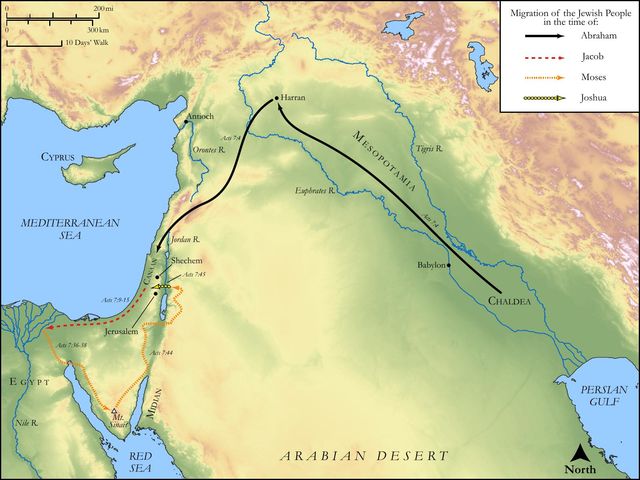
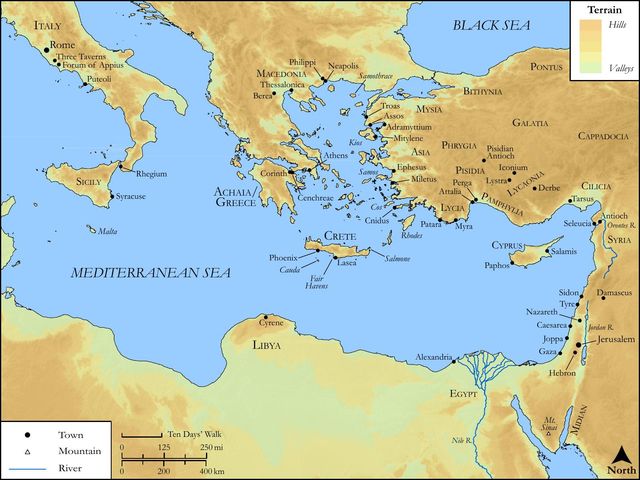
Study this verse
Public-domain commentary
Matthew Henry
From his Commentary on the Whole Bible. Henry comments on passages, not single verses — this entry covers Acts 7:30–41. His three-level outline is real structure in the source text, so it is rendered as structure.
Stephen here proceeds in his story of Moses; and let any one judge whether these are the words of one that was a blasphemer of Moses or no; nothing could be spoken more honourably of him. Here is,
I.The vision which he saw of the glory of God at the bush (Act 7:30):
When forty years had expired (during all which time Moses was buried alive in Midian, and was now grown old, and one would think past service), that it might appear that all his performances were products of a divine power and promise (as it appeared that Isaac was a child of promise by his being born of parents stricken in years), now, at eighty years old, he enters upon that post of honour to which he was born, in recompence for his self-denial at forty years old. Observe,
1.Where God appeared to him: In the wilderness of Mount Sinai, Act 7:30. And, when he appeared to him there, that was holy ground (Act 7:33), which Stephen takes notice of, as a check to those who prided themselves in the temple, that holy place, as if there were no communion to be had with God but there; whereas God met Moses, and manifested himself to him, in a remote obscure place in the wilderness of Sinai. They deceive themselves if they think God is confined to places; he can bring his people into a wilderness, and there speak comfortably to them.
2.How he appeared to him: In a flame of fire (for our God is a consuming fire), and yet the bush, in which this fire was, though combustible matter, was not consumed, which, as it represented the state of Israel in Egypt (where, though they were in the fire of affliction, yet they were not consumed), so perhaps it may be looked upon as a type of Christ's incarnation, and the union between the divine and human nature: God, manifested in the flesh, was as the flame of fire manifested in the bush.
3.How Moses was affected with this:
(1.)He wondered at the sight, Act 7:31. It was a phenomenon with the solution of which all his Egyptian learning could not furnish him. He had the curiosity at first to pry into it: I will turn aside now, and see this great sight; but the nearer he drew the more he was struck with amazement; and,
(2.)He trembled, and durst not behold, durst not look stedfastly upon it; for he was soon aware that it was not a fiery meteor, but the angel of the Lord; and no other than the Angel of the covenant, the Son of God himself. This set him a trembling. Stephen was accused for blaspheming Moses and God (Act 6:11), as if Moses had been a little god; but by this it appears that he was a man, subject to like passions as we are, and particularly that of fear, upon any appearance of the divine majesty and glory.
II.The declaration which he heard of the covenant of God (Act 7:32):
The voice of the Lord came to him; for faith comes by hearing; and this was it: I am the God of Isaac, and the God of Jacob; and therefore, 1. "I am the same that I was." The covenant God made with Abraham some ages ago was, I will be to thee a God, a God all-sufficient. "Now," saith God, "that covenant is still in full force; it is not cancelled nor forgotten, but I am, as I was, the God of Abraham, and now I will make it to appear so;" for all the favours, all the honours God put upon Israel, were founded upon this covenant with Abraham, and flowed from it. 2. "I will be the same that I am." For if the death of Abraham, Isaac, and Jacob, cannot break the covenant-relation between God and them (as by this it appears it cannot), then nothing else can: and then he will be a God, (1.) To their souls, which are now separated from their bodies. Our Saviour by this proves the future state, Mat 22:31, Mat 22:32. Abraham is dead, and yet God is still his God, therefore Abraham is still alive. God never did that for him in this world which would answer the true intent and full extent of that promise, that he would be the God of Abraham; and therefore it must be done for him in the other world. Now this is that life and immortality which are brought to light by the gospel, for the full conviction of the Sadducees, who denied it. Those therefore who stood up in defence of the gospel, and endeavoured to propagate it, were so far from blaspheming Moses that they did the greatest honour imaginable to Moses, and that glorious discovery which God made of himself to him at the bush. (2.) To their seed. God, in declaring himself thus the God of their fathers, intimated his kindness to their seed, that they should be beloved for the fathers' sakes, Rom 11:28; Deu 7:8. Now the preachers of the gospel preached up this covenant, the promise made of God unto the fathers; unto which promise those of the twelve tribes that did continue serving God hoped to come, Act 26:6, Act 26:7. And shall they, under colour of supporting the holy place and the law, oppose the covenant which was made with Abraham and his seed, his spiritual seed, before the law was given, and long before the holy place was built? Since God's glory must be for ever advanced, and our glorying for ever silenced, God will have our salvation to be by promise, and not by the law; the Jews therefore who persecuted the Christians, under pretence that they blasphemed the law, did themselves blaspheme the promise, and forsook all their own mercies that were contained in it.
III.The commission which God gave him to deliver Israel out of Egypt.
The Jews set up Moses in competition with Christ, and accused Stephen as a blasphemer because he did not do so too. But Stephen here shows that Moses was an eminent type of Christ, as he was Israel's deliverer. When God had declared himself the God of Abraham he proceeded, 1. To order Moses into a reverent posture: "Put off thy shoes from thy feet. Enter not upon sacred things with low, and cold, and common thoughts. Keep thy foot, Ecc 5:1. Be not hasty and rash in thy approaches to God; tread softly." 2. To order Moses into a very eminent service. When he is ready to receive commands, he shall have commission. He is commissioned to demand leave from Pharaoh for Israel to go out of his land, and to enforce that demand, Act 7:34. Observe, (1.) The notice God took both of their sufferings and of their sense of their sufferings: I have seen, I have seen their affliction, and have heard their groaning. God has a compassionate regard to the troubles of his church, and the groans of his persecuted people; and their deliverance takes rise from his pity. (2.) The determination he fixed to redeem them by the hand of Moses: I am come down to deliver them. It should seem, though God is present in all places, yet he uses that expression here of coming down to deliver them because that deliverance was typical of what Christ did, when, for us men, and for our salvation, he came down from heaven; he that ascended first descended. Moses is the man that must be employed: Come, and I will send thee into Egypt: and, if God send him, he will own him and give him success.
IV.His acting in pursuance of this commission, wherein he was a figure of the Messiah.
And Stephen takes notice here again of the slights they had put upon him, the affronts they had given him, and their refusal to have him to reign over them, as tending very much to magnify his agency in their deliverance.
1.God put honour upon him whom they put contempt upon (Act 7:35): This Moses whom they refused (whose kind offers and good offices they rejected with scorn, saying, Who made thee a ruler and a judge? Thou takest too much upon thee, thou son of Levi, Num 16:3), this same Moses did God send to be a ruler, and a deliverer, by the hand of the angel which appeared to him in the bush. It may be understood either that God sent to him by the hand of the angel going along with him he became a complete deliverer. Now, by this example, Stephen would intimate to the council that this Jesus whom they now refused, as their fathers did Moses, saying, Who made thee a prophet and a king? Who gave thee this authority? even this same has God advanced to be a prince and a Saviour, a ruler and a deliverer; as the apostles had told them awhile ago (Act 5:30, Act 5:31), that the stone which the builders refused was become the head-stone in the corner, Act 4:11.
2.God showed favour to them by him, and he was very forward to serve them, though they had thrust him away. God might justly have refused them his service, and he might justly have declined it; but it is all forgotten: they are not so much as upbraided with it, Act 4:36. He brought them out, notwithstanding, after he had shown wonders and signs in the land of Egypt (which were afterwards continued for the completing of their deliverance, according as the case called for them) in the Red Sea and in the wilderness forty years. So far is he from blaspheming Moses that he admires him as a glorious instrument in the hand of God for the forming of the Old Testament church. But it does not at all derogate from his just honour to say that he was but an instrument, and that he is outshone by this Jesus, whom he encourages these Jews yet to close with, and to come into his interest, not fearing but that then they should be received into his favour, and receive benefit by him, as the people of Israel were delivered by Moses, though they had once refused him.
V.His prophecy of Christ and his grace, Act 4:37.
He not only was a type of Christ (many were so that perhaps had not an actual foresight of his day), but Moses spoke of him (Act 4:37): This is that Moses who said unto the children of Israel, A prophet shall the Lord your God raise up unto you of your brethren. This is spoken of as one of the greatest honours God put upon him (nay, as that which exceeded all the rest), that by him he gave notice to the children of Israel of the great prophet that should come into the world, raised their expectation of him, and required them to receive him. When his bringing them out of Egypt is spoken of it is with an emphasis of honour, This is that Moses, Exo 6:26. And so it is here, This is that Moses. Now this is very full to Stephen's purpose; in asserting that Jesus should change the customs of the ceremonial law, he was so far from blaspheming Moses that really he did him the greatest honour imaginable, by showing how the prophecy of Moses was accomplished, which was so clear, that, as Christ told them himself, If they had believed Moses, they would have believed him, Joh 5:46.
1.Moses, in God's name, told them that, in the fulness of time, they should have a prophet raised up among them, one of their own nation, that should be like unto him (Deu 18:15, Deu 18:18), - a ruler and a deliverer, a judge and a lawgiver, like him, - who should therefore have authority to change the customs that he had delivered, and to bring in a better hope, as the Mediator of a better testament.
2.He charged them to hear that prophet, to receive his dictates, to admit the change he would make in their customs, and to submit to him in every thing; "and this will be the greatest honour you can do to Moses and to his law, who said, Hear you him; and came to be a witness to the repetition of this charge by a voice from heaven, at the transfiguration of Christ, and by his silence gave consent to it," Mat 17:5.
VI.The eminent services which Moses continued to do to the people of Israel, after he had been instrumental to bring them out of Egypt, Act 7:38. And herein also he was a type of Christ, who yet so far exceeds him that it is no blasphemy to say, "He has authority to change the customs that Moses delivered." It was the honour of Moses,
1.That he was in the church in the wilderness; he presided in all the affairs of it for forty years, was king in Jeshurun, Deu 33:5. The camp of Israel is here called the church in the wilderness; for it was a sacred society, incorporated by a divine charter under a divine government, and blessed with divine revelation. The church in the wilderness was a church, though it was not yet perfectly formed, as it was to be when they came to Canaan, but every man did that which was right in his own eyes, Deu 12:8, Deu 12:9. It was the honour of Moses that he was in that church, and many a time it had been destroyed if Moses had not been in it to intercede for it. But Christ is the president and guide of a more excellent and glorious church than that in the wilderness was, and is more in it, as the life and soul of it, than Moses could be in that.
2.That he was with the angel that spoke to him in the mount Sinai, and with our fathers - was with him in the holy mount twice forty days, with the angel of the covenant, Michael, our prince. Moses was immediately conversant with God, but never lay in his bosom as Christ did from eternity. Or these words may be taken thus: Moses was in the church in the wilderness, but it was with the angel that spoke to him in mount Sinai, that is, at the burning bush; for that was said to be at mount Sinai (Act 7:30); that angel went before him, and was guide to him, else he could not have been a guide to Israel; of this God speaks (Exo 23:20), I send an angel before thee, and Exo 33:2. And see Num 20:16. He was in the church with the angel, without whom he could have done no service to the church; but Christ is himself that angel which was with the church in the wilderness, and therefore has an authority above Moses.
3.That he received the lively oracles to give unto them; not only the ten commandments, but the other instructions which the Lord spoke unto Moses, saying, Speak them to the children of Israel.
(1.)The words of God are oracles, certain and infallible, and of unquestionable authority and obligation; they are to be consulted as oracles, and by them all controversies must be determined.
(2.)They are lively oracles, for they are the oracles of the living God, not of the dumb and dead idols of the heathens: the word that God speaks is spirit and life; not that the law of Moses could give life, but it showed the way to life: If thou wilt enter into life, keep the commandments.
(3.)Moses received them from God, and delivered nothing as an oracle to the people but what he had first received from God.
(4.)The lively oracles which he received from God he faithfully gave to the people, to be observed and preserved. It was the principal privilege of the Jews that to them were committed the oracles of God; and it was by the hand of Moses that they were committed. As Moses gave them not that bread, so neither did he give them that law from heaven (Joh 6:32), but God gave it to them; and he that gave them those customs by his servant Moses might, no doubt, when he pleased, change the customs by his Son Jesus, who received more lively oracles to give unto us than Moses did.
VII.The contempt that was, after this, and notwithstanding this, put upon him by the people.
Those that charged Stephen with speaking against Moses would do well to answer what their own ancestors had done, and they tread in their ancestors' steps.
1.They would not obey him, but thrust him from them, Act 7:39. They murmured at him, mutinied against him, refused to obey his orders, and sometimes were ready to stone him. Moses did indeed give them an excellent law, but by this it appeared that it could not make the comers there unto perfect (Heb 10:1), for in their hearts they turned back again into Egypt, and preferred their garlic and onions there before the manna they had under the guidance of Moses, or the milk and honey they hoped for in Canaan. Observe, Their secret disaffection to Moses, with their inclination to Egyptianism, if I may so call it. This was, in effect, turning back to Egypt; it was doing it in heart. Many that pretend to be going forward towards Canaan, by keeping up a show and profession of religion, are, at the same time, in their hearts turning back to Egypt, like Lot's wife to Sodom, and will be dealt with as deserters, for it is the heart that God looks at. Now, if the customs that Moses delivered to them could not prevail to change them, wonder not that Christ comes to change the customs, and to introduce a more spiritual way of worship.
2.They made a golden calf instead of him, which besides the affront that was thereby offered to God, was a great indignity to Moses: for it was upon this consideration that they made the calf, because "as for this Moses, who brought us out of the land of Egypt, we know not what is become of him; therefore make us gods of gold;" as if a calf were sufficient to supply the want of Moses, and as capable of going before them into the promised land. So they made a calf in those days when the law was given them, and offered sacrifices unto the idol, and rejoiced in the work of their own hands. So proud were they of their new god that when they had sat down to eat and drink, they rose up to play! By all this it appears that there was a great deal which the law could not do, in that it was weak through the flesh; it was therefore necessary that this law should be perfected by a better hand, and he was no blasphemer against Moses who said that Christ had done it.
Historical interpretation
Historical reception
2 surviving comments on this verse. Each one is dated, so this reads as a timeline rather than a list.
"Wonders and signs," etc. He shows, that the prophecy must by all means be fulfilled, and that Moses is not opposed to Him. "Which said unto the children of Israel, A prophet," etc. He shows, that the prophecy must by all means be fulfilled, and that Moses is not opposed to Him.
"This" same Moses, he says,-and observe how he points to his renown-"this" same Moses, he says, "brought them out, after that he had showed wonders and signs in the land of Egypt, and in the Red sea, and in the wilderness forty years. This is that Moses, which said unto the children of Israel, A prophet shall the Lord your God raise up unto you of your brethren, like unto me": set at naught like me. Him, likewise, Herod wished to kill, and in Egypt He found preservation just as it was with the former, even when He was a babe, He was aimed at for destruction.
Continue studying Acts 7:36 across the web’s major study libraries — every link below opens this exact verse, chapter, or book on the destination site.
Read & Compare
 BibleGatewayThis verse in more than 200 translations and 70 languages.
 Bible.comThe YouVersion reader — hundreds of translations, reading plans, and highlights.
 ESV.orgCrossway's official English Standard Version reader.
 NET BibleThe NET translation with 60,000+ translators' notes on every rendering decision.
 STEP BibleTyndale House's free study tool — original text, vocabulary, and scholarly resources.
 BibliaLogos Bible Software's free web reader.
 USCCBThe New American Bible (Revised Edition) with the U.S. bishops' study notes.
Commentaries
 BibleHub CommentariesDozens of classic commentaries on this verse, gathered on one page.
 StudyLightMore than 100 commentary sets — the largest collection on the web.
 BibleRefPlain-English commentary on what this verse means, verse by verse.
 Enduring WordDavid Guzik's free commentary on this chapter, widely used by Bible teachers.
 Bible Study ToolsVerse commentary alongside Greek and Hebrew study aids.
Original Language & Research
- BibleHub InterlinearThe verse word by word — original language, transliteration, and English.
- BibleHub LexiconEvery word's original-language definition and Strong's entry.
 Blue Letter BibleDeep-study tools — Strong's numbers, concordance, and word studies.
 CNTR CollationThe earliest Greek manuscripts of this verse, collated letter by letter.
Sermons, Hymns & Audio


TrulyRandomVerse is not affiliated with these sites and doesn’t control their content. They’re linked because they’re genuinely useful.
Summary
Acts 7:36 is a pivotal verse within Stephen's defense before the Sanhedrin, succinctly summarizing Moses' divinely empowered leadership in delivering the Israelites from Egyptian bondage. It highlights the miraculous interventions God performed through Moses in Egypt, at the Red Sea, and during the subsequent forty years of wilderness wandering, emphasizing God's sovereign power and faithfulness in establishing His covenant people.
Context
ShowHideLiterary Context
Acts 7:36 is embedded within Stephen's lengthy historical review, which constitutes his defense against charges of blasphemy against Moses, the Law, and the Temple. Stephen systematically recounts Israel's history, from Abraham to the building of the Temple, to demonstrate God's consistent working outside of human-made structures and Israel's recurring pattern of resisting God's chosen messengers. This verse specifically focuses on Moses' role as God's divinely appointed deliverer, following Stephen's assertion in Acts 7:35 that God sent Moses as a "ruler and deliverer" despite Israel's initial rejection. The recounting of the Exodus serves to underscore God's power and Moses' authority, setting the stage for Stephen's ultimate indictment of his audience for their own resistance to the Holy Spirit and the "Righteous One."
Historical & Cultural Context
The verse directly references the foundational narrative of the Exodus, a cornerstone of Israelite identity and a central theme in Jewish history and theology. "The land of Egypt" represents the crucible of Israel's formation as a nation, a place of severe slavery and oppression under Pharaoh. The "Red sea" (specifically the Sea of Reeds, Yam Suph) signifies the miraculous act of divine salvation and judgment, where God delivered His people while destroying their pursuers, as powerfully depicted in Exodus 14. The "wilderness forty years" refers to the period of wandering and testing in the Sinai desert, a time of both divine provision (e.g., manna in Exodus 16:35 and water from the rock in Exodus 17:6) and spiritual formation, where God disciplined and prepared Israel for entry into the Promised Land. This period also highlighted Israel's persistent rebellion, a theme Stephen skillfully weaves into his broader argument.
Key Themes
ShowHideThis verse powerfully contributes to several key themes within Stephen's speech and the book of Acts. Firstly, it emphasizes Divine Deliverance, showcasing God's absolute sovereignty and mighty power to rescue His people from seemingly insurmountable bondage. The "wonders and signs" are undeniable proof of His intervention. Secondly, it highlights Miraculous Power, demonstrating that God's actions during the Exodus were not random but purposeful, supernatural interventions that authenticated Moses' leadership and revealed God's active presence among His people. Thirdly, it underscores God's Sustaining Provision, as the forty years in the wilderness, a period of extreme hardship, are presented as a testament to God's faithful care and miraculous sustenance of millions of people. Lastly, the verse reinforces the theme of God's Chosen Leadership, portraying Moses as God's indispensable instrument, through whom divine power was channeled to achieve liberation and guide the nascent nation.
Exposition and Analysis
ShowHideKey Word Analysis
ShowHideFrom ἐκ (out of) and ἄγω (to lead); to lead forth, bring forth (out), fetch (lead) out. This verb emphasizes the active, deliberate, and powerful action of God, through Moses, in liberating Israel from bondage. It signifies a decisive, divinely orchestrated exodus, not a passive escape, highlighting God's initiative and authority over the forces of oppression.
A prodigy or omen. This term refers to extraordinary, awe-inspiring events that transcend natural explanation, often designed to evoke astonishment and fear. In the context of the Exodus, these were the plagues upon Egypt and the miraculous parting of the Red Sea, demonstrating God's overwhelming power and judgment against Pharaoh and his gods.
An indication, especially ceremonially or supernaturally; miracle, sign, token, wonder. Complementing "wonders," "signs" denote acts that serve as evidence or proof, validating a divine message or messenger. The "signs" confirmed Moses' divine commission and God's covenant faithfulness to Israel, serving as irrefutable evidence of His presence and power.
Verse Breakdown
ShowHide"He brought them out"
This refers to Moses, acting as God's chosen agent, leading the Israelites out of their slavery in Egypt. It underscores the active, powerful, and decisive nature of the Exodus, initiated and empowered by God.
"after that he had shewed wonders and signs"
This clause specifies the means by which the deliverance was accomplished. Moses, as God's instrument, performed extraordinary, supernatural acts that were both awe-inspiring (wonders) and served as undeniable proof of divine authority and presence (signs). These included the ten plagues and the parting of the Red Sea.
"in the land of Egypt"
This identifies the initial location where God's power was displayed through Moses, referring to the devastating plagues that afflicted Egypt, culminating in the death of the firstborn.
"and in the Red sea"
This indicates the second major location of miraculous intervention, where God miraculously divided the waters, allowing Israel to pass through on dry ground while engulfing the pursuing Egyptian army.
"and in the wilderness forty years"
This specifies the third phase and location of God's sustained miraculous provision and guidance. For four decades, God supernaturally provided for the Israelites in the harsh desert environment, demonstrating His faithfulness even amidst their rebellion and testing.
Literary Devices
ShowHideStephen employs several literary devices to enhance the impact of his historical summary. The repetition of the preposition "in" (Anaphora) before "the land of Egypt," "the Red sea," and "the wilderness forty years" creates a rhythmic emphasis, highlighting the distinct geographical stages of God's miraculous intervention and sustained presence. The pairing of "wonders and signs" is a classic biblical Merism, where two distinct but related terms are used to describe a comprehensive reality—in this case, the full spectrum of God's supernatural acts, both awe-inspiring and evidentiary. Furthermore, the entire verse functions as a concise Summary Narration, condensing decades of Israelite history and countless divine acts into a single, powerful statement, serving Stephen's broader rhetorical purpose of demonstrating God's consistent faithfulness and Israel's persistent resistance.
Theological and Thematic Connections
ShowHideActs 7:36 profoundly connects to the overarching biblical narrative of God's redemptive work. The Exodus, as recounted here, is the paradigmatic act of salvation in the Old Testament, establishing God as the great Deliverer who hears the cries of His people and acts decisively to free them from bondage. It foreshadows God's ultimate and greater act of deliverance through Jesus Christ, who liberates humanity from the bondage of sin and death. The "wonders and signs" underscore God's absolute sovereignty over creation and human powers, demonstrating that no force can thwart His redemptive purposes. The forty years in the wilderness, while a period of testing and discipline, also highlight God's faithful provision and patient guidance, teaching His people dependence on Him and preparing them for their inheritance.
Reflection and Application
ShowHideActs 7:36 serves as a powerful reminder of God's enduring faithfulness and His boundless capacity to deliver His people from any form of oppression. Just as He acted with mighty power to free Israel from physical slavery, He continues to work in our lives, offering spiritual liberation from the bondage of sin, fear, and despair. The narrative of the Exodus teaches us that God's deliverance is often accompanied by extraordinary demonstrations of His power, designed not only to rescue but also to reveal His character and purposes. Furthermore, the forty years in the wilderness illustrate that God's provision and guidance are not limited to moments of dramatic rescue but extend through prolonged periods of testing and waiting. Even in our own "wilderness" seasons—times of uncertainty, struggle, or spiritual dryness—we can trust that God is present, providing for our needs, shaping our character, and leading us toward His promised future. This verse encourages us to recall God's past faithfulness, strengthening our faith to trust Him with our present challenges and future hopes.
Questions for Reflection
ShowHideFAQ
ShowHideWhat is the significance of "wonders and signs" in this verse?
ShowHideThe phrase "wonders and signs" (Greek: terata kai semeia) is a common biblical pairing used to describe supernatural acts that are both awe-inspiring and serve as evidence or proof of divine authority or a divine message. "Wonders" (terata) emphasize the extraordinary, miraculous nature of the events, designed to evoke astonishment and wonder. "Signs" (semeia) highlight the purpose of these events: they are indicators or tokens that point to a deeper truth, validating the messenger (Moses) and confirming the divine origin of the message. In Acts 7:36, these terms underscore that God's actions during the Exodus were not random occurrences but purposeful, powerful demonstrations of His sovereignty, presence, and covenant faithfulness to Israel. They were God's way of revealing Himself and His power to Pharaoh, Israel, and the surrounding nations.
Why does Stephen emphasize the forty years in the wilderness?
ShowHideStephen emphasizes the "forty years" in the wilderness for several reasons within his broader argument. Firstly, it highlights God's sustained, miraculous provision and faithfulness to Israel, even in a harsh environment. This period demonstrated God's ability to care for His people's every need (e.g., manna, water, clothing) despite their lack of resources. Secondly, it serves as a backdrop for Israel's persistent rebellion and idolatry, which Stephen details in subsequent verses (e.g., Acts 7:39-43). By recounting God's unwavering faithfulness during this period, Stephen sharpens his indictment of the Sanhedrin, implying that their generation, like their ancestors, continued to resist God's appointed leaders and His will. The wilderness period was a time of testing and formation, where God sought to shape a holy nation, but it was also marked by their spiritual failures.
Christ-Centered Fulfillment
ShowHideActs 7:36, while recounting Moses' pivotal role in the Exodus, finds its ultimate and profound fulfillment in Jesus Christ. Moses, as the great deliverer, foreshadows Christ, the greater Deliverer, who brings about a spiritual exodus from the bondage of sin and death. Just as Moses led Israel through "wonders and signs" in Egypt and at the Red Sea, Jesus performed countless miracles and signs—healing the sick, casting out demons, raising the dead—that attested to His divine authority and inaugurated the kingdom of God, as seen throughout the Gospels (e.g., John 2:11 and Acts 2:22). The ultimate "Red Sea" experience is found in Christ's crucifixion and resurrection, where He decisively defeated the powers of sin and death, leading His people to freedom through His atoning sacrifice. Furthermore, the forty years in the wilderness, a period of divine provision and testing, points to the spiritual journey of believers who, having been delivered from the "Egypt" of sin, now walk through the "wilderness" of this world. In this journey, Christ is our faithful Provider and Guide, sustaining us by His Spirit and Word, preparing us for the ultimate "Promised Land" of eternal life and the new heavens and new earth, as promised in Revelation 21. The deliverance from Egypt was a type; Christ is the antitype, the Lamb of God who truly takes away the sin of the world (John 1:29).