


Exodus 17:6
- הִנְנִיhi·Nihere IH2005Prt ¦ 1csParticle InterjectionהִנְhereנִיI
- עֹמֵד'o·Med[will be] standingH5975V-Qal-Prtcpl-msVerb Qal Participle Singular Masculine Absolute
- לְפָנֶיךָle·fa·Nei·kha<to> before youH6440Prep-l ¦ N-mpc ¦ 2msNoun Plural Masculine Constructלְ<to>פָנֶיbeforeךָyou
- שָּׁםshamthereH8033AdvAdverb
- עַל'alonH5921PrepPreposition
- הַצּוּרha·Tzurthe rockH6697Art ¦ N-msNoun Singular Masculine Absoluteהַtheצּוּרrock
- בְּחֹרֵבbe·cho·Revat HorebH2722Prep-b ¦ N-properNoun Proper LocationבְּatחֹרֵבHoreb
- וְהִכִּיתָve·hi·Ki·taand you will strikeH5221Conj-w ¦ V-Hiphil-ConsecPerf-2msVerb Hiphil Consecutive Perfect 2nd Singular Masculineוְandהִכִּיתָyou will strike
- בַצּוּרva·Tzur<on> the rockH6697Prep-b ¦ N-msNoun Singular Masculine Absoluteבַ<on> theצּוּרrock
- וְיָצְאוּve·ya·tze·'Uand they will come outH3318Conj-w ¦ V-Qal-ConsecPerf-3cpVerb Qal Consecutive Perfect 3rd Plural common genderוְandיָצְאוּthey will come out
- מִמֶּנּוּmi·Me·nufrom itH4480Prep ¦ 3msPreposition Definiteמִמֶּfromנּוּit
- מַיִםMa·yimwatersH4325N-mpNoun Plural Masculine Absolute
- וְשָׁתָהve·sha·Tahand it will drinkH8354Conj-w ¦ V-Qal-ConsecPerf-3msVerb Qal Consecutive Perfect 3rd Singular Masculineוְandשָׁתָהit will drink
- הָעָםha·'Amthe peopleH5971Art ¦ N-msNoun Singular Masculine Absoluteהָtheעָםpeople
- וַיַּעַשׂvai·Ya·'asand he didH6213Conj-w ¦ V-Qal-ConsecImperf-3msVerb Qal Consecutive Imperfect 3rd Singular Masculineוַandיַּעַשׂhe did
- כֵּןkensoH3651AdvAdverb
- מֹשֶׁהmo·ShehMosesH4872N-proper-mNoun Proper Masculine
- לְעֵינֵיle·'ei·Neito [the] eyes ofH5869Prep-l ¦ N-fdcNoun Dual Feminine Constructלְtoעֵינֵי[the] eyes of
- זִקְנֵיzik·Nei[the] elders ofH2205Adj-mpcAdjective Plural Masculine Construct
- יִשְׂרָאֵלYis·ra·'ElIsraelH3478N-properNoun Proper Location
English is a literal word-by-word gloss of the Hebrew, not the KJV's wording. Why?
This is the original text the KJV's translators worked from — each Hebrew word with its own literal English meaning in this verse, prepared by scholars at Tyndale House, Cambridge. The KJV translates whole sentences, not word by word, so its wording differs: one Hebrew word can become several English words, and the KJV may choose “the LORD” where the gloss reads “Yahweh”. Both are faithful — they answer different questions. For the KJV's own rendering, switch to the KJV text.
Details
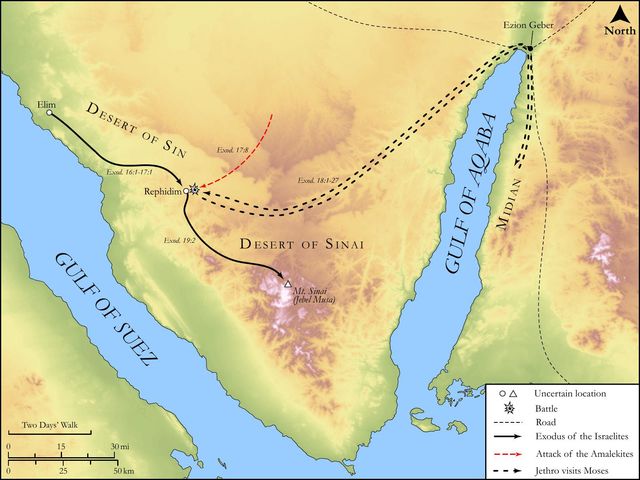
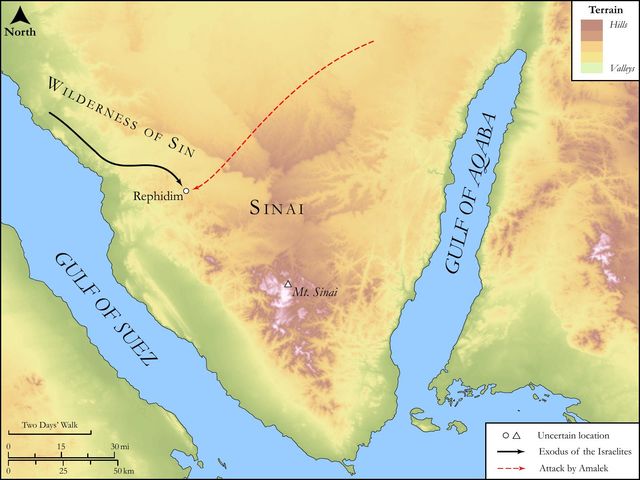
See on the biblical-era maps

Study this verse
Public-domain commentary
Matthew Henry
From his Commentary on the Whole Bible. Henry comments on passages, not single verses — this entry covers Exodus 17:1–7. His two-level outline is real structure in the source text, so it is rendered as structure.
Here is, I. The strait that the children of Israel were in for want of water; once before the were in the like distress, and now, a second time, Exo 17:1. They journeyed according to the commandment of the Lord, led by the pillar of cloud and fire, and yet they came to a place where there was no water for them to drink. Note, We may be in the way of our duty, and yet may meet with troubles, which Providence brings us into for the trial of our faith, and that God may be glorified in our relief.
II.Their discontent and distrust in this strait.
It is said (Exo 17:3), They thirsted there for water. If they had no water to drink, they must needs thirst; but this intimates, not only that they wanted water and felt the inconvenience of that want, but that their passion sharpened their appetites and they were violent and impatient in their desire; their thirst made them outrageous. Natural desires, and those that are most craving, have need to be kept under the check and control of religion and reason. See what was the language of this inordinate desire.
1.They challenged Moses to supply them (Exo 17:2): Give us water, that we may drink, demanding it as a debt, and strongly suspecting that he was not able to discharge it. Because they were supplied with bread, they insist upon it that they must be supplied with water too; and indeed to those that by faith and prayer live a life of dependence upon God one favour is an earnest of another, and may be humbly pleaded; but the unthankful and unbelieving have reason to think that the abuse of former favours is the forfeiture of further favours: Let not them think that they shall receive any thing (Jam 1:7), yet they are ready to demand every thing.
2.They quarrelled with him for bringing them out of Egypt, as if, instead of delivering them, he designed to murder them, than which nothing could be more base and invidious, Exo 17:3. Many that have not only designed well, but done well, for their generation, have had their best services thus misconstrued, and their patience thereby tried, by unthinking unthankful people. To such a degree their malice against Moses rose that they were almost ready to stone him, Exo 17:4. Many good works he had shown them; and for which of these would they stone him? Joh 10:32. Ungoverned passions, provoked by the crossing of unbridled appetites, sometimes make men guilty of the greatest absurdities, and act like madmen, that cast firebrands, arrows, and death, among their best friends.
3.They began to question whether God were with them or not: They tempted the Lord, saying, "Is the Lord among us or not? Exo 17:7. Is Jehovah among us by that name by which he made himself known to us in Egypt?" They question his essential presence - whether there was a God or not; his common providence - whether that God governed the world; and his special promise - whether he would be as good as his word to them. This is called their tempting God, which signifies, not only a distrust of God in general, but a distrust of him after they had received such proofs of his power and goodness, for the confirmation of his promise. They do, in effect, suppose that Moses was an impostor, Aaron a deceiver, the pillar of cloud and fire a mere sham and illusion, which imposed upon their senses, that long series of miracles which had rescued them, served them, and fed them, a chain of cheats, and the promise of Canaan a banter upon them; it was all so, if the Lord was not among them. Note, It is a great provocation to God for us to question his presence, providence, or promise, especially for his Israel to do it, who are so peculiarly bound to trust him.
III.The course that Moses took, when he was thus set upon, and insulted.
1. He reproved the murmurers (Exo 17:2): Why chide you with me? Observe how mildly he answered them; it was well that he was a man of extraordinary meekness, else their tumultuous conduct would have made him lose the possession of himself: it is folly to answer passion with passion, for that makes bad worse; but soft answers turn away wrath. He showed them whom their murmurings reflected upon, and that the reproaches they cast on him fell on God himself: You tempt the Lord; that is, "By distrusting his power, you try his patience, and so provoke his wrath." 2. He made his complaint to God (Exo 17:4): Moses cried unto the Lord. This servant came, and showed his Lord all these things, Luk 14:21. When men unjustly censure us and quarrel with us, it will be a great relief to us to go to God, and by prayer lay the case before him and leave it with him: if men will not hear us, God will; if their bad conduct towards us ruffle our spirits, God's consolations will compose them. Moses begs of God to direct him what he should do, for he was utterly at a loss; he could not of himself either supply their want or pacify their tumult; God only could do it. He pleads his own peril: "They are almost ready to stone me; Lord, if thou hast any regard to the life of thy poor servant, interpose now."
IV.God's gracious appearance for their relief, Luk 14:5, Luk 14:6.
He orders Moses to go on before the people, and venture himself in his post, though they spoke of stoning him. He must take his rod with him, not (as God might justly have ordered) to summon some plague or other to chastise them for their distrust and murmuring, but to fetch water for their supply. O the wonderful patience and forbearance of God towards provoking sinners! He loads those with benefits that make him to serve with their sins, maintains those that are at war with him, and reaches out the hand of his bounty to those that lift up the heel against him. Thus he teaches us, if our enemy hunger, to feed him, and if he thirst, as Israel did now, to give him drink, Rom 12:20; Mat 5:44, Mat 5:45. Will he fail those that trust him, when he was so liberal even to those that tempted him? If God had only shown Moses a fountain of water in the wilderness, as he did Hagar not far hence (Gen 21:19), that would have been a great favour; but that he might show his power as well as his pity, and make it a miracle of mercy, he gave them water out of a rock. He directed Moses whither to go, and appointed him to take some of the elders of Israel with him, to be witnesses of what was done, that they might themselves be satisfied, and might satisfy others, of the certainty of God's presence with them. He promised to meet him there in the cloud of glory (to encourage him), and ordered him to smite the rock; Moses obeyed, and immediately water came out of the rock in great abundance, which ran throughout the camp in streams and rivers (Psa 78:15, Psa 78:16), and followed them wherever they went in that wilderness: it is called a fountain of waters, Psa 114:8. God showed the care he took of his people in giving them water when they wanted it; he showed his power in fetching the water out of a rock; and he put an honour upon Moses in appointing the water to flow out upon his smiting the rock. This fair water, that came out of the rock, is called honey and oil (Deu 32:13), because the people's thirst made it doubly pleasant; coming when they were in extreme want, it was like honey and oil to them. It is probable that the people digged canals for the conveyance of it, and pools for the reception of it, in like manner as, long afterwards, passing through the valley of Baca, they made it a well, Psa 84:6; Num 21:18. Let this direct us to live in a dependence, 1. Upon God's providence, even in the greatest straits and difficulties. God can open fountains for our supply where we least expect them, waters in the wilderness (Isa 43:20), because he makes a way in the wilderness, v. 19. Those who, in this wilderness, keep to God's way, may trust him to provide for them. While we follow the pillar of cloud and fire, surely goodness and mercy shall follow us, like the water out of the rock. 2. Upon Christ's grace: That rock was Christ, Co1 10:4. The graces and comforts of the Spirit are compared to rivers of living water, Joh 7:38, Joh 7:39; Joh 4:14. These flow from Christ, who is the rock smitten by the law of Moses, for he was made under the law. Nothing will supply the needs, and satisfy the desires, of a soul, but water out of this rock, this fountain opened. The pleasures of sense are puddle-water; spiritual delights are rock-water, so pure, so clear, so refreshing - rivers of pleasure.
V.A new name was, upon this occasion, given to the place, preserving the remembrance, not of the mercy of their supply (the water that followed them was sufficient to do that), but of the sin of their murmuring - Massah, temptation, because they tempted God; Meribah, strife, because they chid with Moses, Exo 17:7. There was thus a remembrance kept of sin, both for the disgrace of the sinners themselves (sin leaves a blot upon the name) and for warning to their seed to take heed of sinning after the similitude of their transgression.
Historical interpretation
Historical reception
3 surviving comments on this verse. Each one is dated, so this reads as a timeline rather than a list.
Select a marker to jump to its quote. Markers stagger vertically where authors wrote within a few decades of each other.
It does not surpass faith that a virgin gave birth, when we read that even a rock poured out water and that the waves of the sea were made solid in the form of a wall.
The people of the fathers thirsted, Moses touched the rock, and water flowed out of the rock. Did not grace work a result contrary to nature, so that the rock poured forth water, which by nature it did not contain?
Then the Lord said to Moses, “Take the staff and strike the rock, that it may produce water for the people.” Behold, there is a rock, and it contains water. However, unless this rock is struck, it does not have any water at all. But when it has been struck, it produces fountains and rivers, as we read in the Gospel: “He who believes in me, from within him there shall flow rivers of living water.” When Christ was struck on the cross, he brought forth the fountains of the New Testament. Therefore it was necessary for him to be pierced. If he had not been struck, so that water and blood flowed from his side, the whole world would have perished through suffering thirst for the word of God.
Continue studying Exodus 17:6 across the web’s major study libraries — every link below opens this exact verse, chapter, or book on the destination site.
Read & Compare
 BibleGatewayThis verse in more than 200 translations and 70 languages.
 Bible.comThe YouVersion reader — hundreds of translations, reading plans, and highlights.
 ESV.orgCrossway's official English Standard Version reader.
 NET BibleThe NET translation with 60,000+ translators' notes on every rendering decision.
 STEP BibleTyndale House's free study tool — original text, vocabulary, and scholarly resources.
 BibliaLogos Bible Software's free web reader.
 USCCBThe New American Bible (Revised Edition) with the U.S. bishops' study notes.
Commentaries
 BibleHub CommentariesDozens of classic commentaries on this verse, gathered on one page.
 StudyLightMore than 100 commentary sets — the largest collection on the web.
 BibleRefPlain-English commentary on what this verse means, verse by verse.
 Enduring WordDavid Guzik's free commentary on this chapter, widely used by Bible teachers.
 Bible Study ToolsVerse commentary alongside Greek and Hebrew study aids.
Original Language & Research
- BibleHub InterlinearThe verse word by word — original language, transliteration, and English.
- BibleHub LexiconEvery word's original-language definition and Strong's entry.
 Blue Letter BibleDeep-study tools — Strong's numbers, concordance, and word studies.
 SefariaThe Hebrew text with Rashi and centuries of Jewish commentary.
Sermons, Hymns & Audio


TrulyRandomVerse is not affiliated with these sites and doesn’t control their content. They’re linked because they’re genuinely useful.
Summary
Exodus 17:6 records a pivotal moment of divine intervention in the wilderness, where God, in His unwavering faithfulness, commands Moses to strike a rock at Horeb, miraculously bringing forth abundant water for the thirsty Israelites. This event powerfully demonstrates God's immediate and tangible presence among His people, His steadfast commitment to provide for their most desperate needs, and the crucial role of Moses' obedient leadership in manifesting God's power. It stands as a profound testament to divine provision amidst human complaint and serves as a significant foreshadowing of greater spiritual realities, particularly the ultimate source of life in Christ.
Context
ShowHideLiterary Context
This miraculous provision of water at Rephidim (Exodus 17:1-7) is situated within a recurring narrative pattern of Israelite complaint followed by divine provision that characterizes their wilderness journey. Immediately preceding this event, the Israelites had murmured against God and Moses for lack of food, leading to the miraculous provision of manna and quails. The narrative in Exodus 17 shifts the focus from food to a desperate need for water, intensifying the people's grumbling to the point of questioning God's very presence among them (Exodus 17:7, "Is the Lord among us or not?"). God's response through Moses' striking of the rock is thus a direct, compassionate answer to their physical need, while simultaneously serving as a powerful rebuke to their spiritual doubt and lack of trust. The subsequent battle with Amalek (Exodus 17:8-16) further highlights the ongoing challenges and God's continued protection and vindication of His people.
Historical & Cultural Context
The wilderness journey from Egypt to Canaan was inherently perilous, marked by extreme scarcity of vital resources, especially water. Nomadic peoples such as the patriarchs understood that access to water sources was critical for survival, and its absence could lead to death for both humans and livestock. The Israelites' "thirst" (Exodus 17:3) was not a mere inconvenience but an existential threat, fueling their bitter complaints against Moses and, by extension, against God. Their murmuring reflected a deep-seated fear and a failure to remember God's past miraculous interventions, such as the crossing of the Red Sea. The location, Horeb, is significant as it is often used interchangeably with Mount Sinai, the very place where God would soon establish His covenant with Israel (see Exodus 19). God's appearance "upon the rock in Horeb" therefore prefigures His imminent, tangible presence and the giving of the Law from this sacred mountain, reinforcing His authority and commitment to His people even before the covenant formalization.
Key Themes
ShowHideExodus 17:6 contributes significantly to several key themes within the broader narrative of the Exodus and the Pentateuch. Primarily, it underscores the theme of Divine Provision and Faithfulness, demonstrating God's consistent care for His people despite their unfaithfulness and murmuring. This miracle reinforces God's Sovereignty over Creation, showing His ability to manipulate natural elements to meet human needs. It also highlights the theme of Obedient Leadership, as Moses' faithful execution of God's specific and seemingly illogical command is essential for the miracle to occur, thereby validating his role as God's chosen mediator. Furthermore, the event serves as a powerful instance of Testing and Doubt, as the Israelites' questioning of God's presence (Exodus 17:7) reveals their spiritual immaturity and lack of trust, setting a precedent for future wilderness rebellions. Ultimately, this passage contributes to the overarching theme of God preparing His people for the Promised Land, teaching them absolute dependence on Him for their very survival.
Exposition and Analysis
ShowHideKey Word Analysis
ShowHideFrom the root meaning "desolate," Horeb is a generic name for the Sinaitic mountains, often used synonymously with Mount Sinai (H2722). Ironically, this "dry place" becomes the site of abundant water. God's presence "in Horeb" emphasizes that this miracle is not random but occurs at a divinely designated, sacred location. This sets the stage for the upcoming giving of the Law and reinforces God's sovereign control over the wilderness environment and His people's destiny, establishing Horeb as a significant place of divine encounter and revelation.
A primitive root (H5221) meaning "to strike (lightly or severely, literally or figuratively)." In this context, it denotes a decisive, forceful, and physical blow. The act of "smiting" the rock is crucial for two reasons: firstly, it demonstrates Moses' complete and public obedience to God's specific, counter-intuitive instruction; secondly, it sets up a significant typological distinction from the later incident at Meribah (Numbers 20:11), where Moses was commanded to speak to the rock but instead struck it again, leading to severe consequences for his disobedience. Here, the single, decisive strike is the divinely ordained means of provision.
Properly, a cliff or sharp rock (H6697); generally, a rock or boulder. Figuratively, it denotes a refuge, strength, or stability, frequently used as a metaphor for God Himself (e.g., Deuteronomy 32:4). Here, it becomes the physical medium through which God's life-giving power is manifested. Its inherent solidity and apparent barrenness heighten the miraculous nature of the water flowing from it, making it a powerful symbol of God's ability to bring life from seemingly impossible circumstances.
Verse Breakdown
ShowHide"Behold, I will stand before thee there upon the rock in Horeb;"
This opening clause emphasizes God's personal, immediate, and visible presence. The "Behold" (הִנֵּה, hinnēh) draws attention to a significant divine declaration, signaling the gravity and miraculous nature of what is about to transpire. God is not merely issuing a command from a distance but is actively present, overseeing, and enabling the miracle. His standing "upon the rock" signifies His authority over creation and His intimate involvement in the provision, making the rock a literal and symbolic point of divine encounter and a testament to His immanence.
"and thou shalt smite the rock, and there shall come water out of it, that the people may drink."
This is the core command and promise, outlining the specific action and its miraculous outcome. Moses is the chosen instrument, instructed to perform a specific, physical action ("smite the rock"). The immediate and direct consequence is the miraculous outpouring of water, explicitly stated as being "out of it" (the rock), confirming its supernatural origin and divine source. The purpose is clear and compassionate: "that the people may drink," directly addressing their desperate, life-threatening thirst. This sequence highlights God's power to use humble and seemingly impossible means to achieve extraordinary, life-sustaining results.
"And Moses did so in the sight of the elders of Israel."
This concluding statement affirms Moses' immediate and public obedience to God's command. The presence of the "elders of Israel" serves as a crucial witness, validating both the divine instruction and the miraculous outcome. It underscores Moses' role as God's faithful servant and reinforces his authority as a leader, demonstrating that he acted directly under God's command. This public demonstration of obedience and divine power was intended to silence the people's murmuring and confirm God's active and present care among them.
Literary Devices
ShowHideExodus 17:6 employs several powerful literary devices that enrich its theological and narrative impact. Symbolism is profoundly at play, with the rock representing God's steadfastness, His unwavering presence, and His capacity to provide life from barrenness. The water, in turn, symbolizes life, sustenance, and divine blessing, directly addressing the people's existential need. The verse also utilizes Divine Command and Fulfillment, a common and powerful narrative pattern in the Pentateuch where God issues a specific instruction, and it is immediately followed by its successful execution. This pattern demonstrates divine authority, human obedience, and the certainty of God's word. The stark Contrast between the Israelites' desperate thirst and murmuring (Exodus 17:3-7) and God's immediate, abundant provision through the rock highlights His boundless grace, patience, and miraculous power. Furthermore, the entire event serves as a profound Foreshadowing or Typology, particularly in later New Testament interpretation, where the rock and its life-giving water are understood to prefigure Jesus Christ, the ultimate source of spiritual life and eternal sustenance.
Theological and Thematic Connections
ShowHideExodus 17:6 is rich in theological significance, primarily revealing God's unwavering faithfulness and sovereign provision for His people, even in their moments of doubt and rebellion. It underscores that God is not distant but intimately involved in the daily needs of His covenant people, demonstrating His power to bring forth life from impossible circumstances. The miracle at Horeb also highlights the importance of obedient leadership, as Moses' faithful execution of God's command was the conduit for the divine provision. Furthermore, the event profoundly foreshadows the ultimate spiritual provision found in Jesus Christ, who is the true "Rock" from whom living water flows, satisfying the deepest thirsts of humanity. This narrative reinforces the biblical theme of God sustaining His people in the wilderness, preparing them for the promised land, and teaching them dependence on Him alone through a visible demonstration of His power and presence.
Reflection and Application
ShowHideThe account of water from the rock at Horeb offers timeless lessons for believers navigating their own "wilderness" experiences. When faced with overwhelming needs, scarcity, or profound uncertainty, this passage calls us to remember God's enduring faithfulness and His power to provide in ways beyond our comprehension. Just as the Israelites' physical thirst was met by a miraculous outpouring, our spiritual and emotional thirsts can be quenched by turning to the true source of life. Moses' swift and public obedience, despite the seemingly illogical command to strike a rock, challenges us to cultivate a faith that trusts God's specific instructions, even when they defy human logic. This narrative encourages us to approach our difficulties not with murmuring and complaint, which betray a lack of trust in God's presence, but with patient expectation and faithful obedience, knowing that our God is able to make a way where there seems to be no way, satisfying our deepest needs through His abundant, miraculous grace.
Questions for Reflection
ShowHideFAQ
ShowHideWhy did God command Moses to strike the rock here, but later commanded him to speak to it (Numbers 20:8)?
ShowHideThe distinction between striking the rock in Exodus 17:6 and speaking to it in Numbers 20:8 is crucial for understanding God's specific instructions and Moses' later failure. Here, at Horeb, God explicitly commanded Moses to "smite the rock" (נָכָה, nâkâh), a singular, decisive act. This act, as later interpreted by Paul in 1 Corinthians 10:4, typologically represented Christ being "struck" or crucified once for all, providing the living water of salvation. In Numbers 20, after years of wilderness wandering, the people again complained about water. God commanded Moses to speak to the rock. However, Moses, exasperated by the people's rebellion, struck the rock twice in anger, claiming the miracle for himself ("shall we bring forth water?") rather than simply obeying God's precise instruction. This act of disobedience, striking the rock a second time when it was to be spoken to, dishonored God and prevented Moses from entering the Promised Land. The difference highlights God's demand for precise obedience to His specific commands for each moment and the theological significance of Christ's singular sacrifice.
What is the significance of the location "Horeb" in this event?
ShowHideHoreb, often synonymous with Mount Sinai, is a highly significant location in the biblical narrative. It is the mountain of God, where Moses first encountered God in the burning bush (see Exodus 3:1). Later, it would be the place where God would descend in fire and thunder to give the Law to Israel (see Exodus 19). By commanding Moses to strike the rock "in Horeb," God is not only providing for their immediate physical need but also establishing His presence and authority at a place that would become central to Israel's identity and covenant relationship with Him. The miracle at Horeb thus serves as a powerful precursor to the profound divine revelations and covenant establishment that would soon follow, underscoring God's active presence and preparation for His people's future.
Christ-Centered Fulfillment
ShowHideThe miraculous provision of water from the rock in Exodus 17:6 finds its ultimate and profound Christ-centered fulfillment in the person and work of Jesus Christ. The Apostle Paul explicitly connects this Old Testament event to Christ, declaring that the Israelites "drank of that spiritual Rock that followed them: and that Rock was Christ" (1 Corinthians 10:4). Just as the barren rock was struck once to bring forth life-sustaining water for a thirsty people, so too was Christ "struck" – crucified on the cross – once for all, to provide the living water of the Holy Spirit and eternal life for all who believe. Jesus Himself proclaimed, "If anyone thirsts, let him come to me and drink. Whoever believes in me, as the Scripture has said, 'Out of his heart will flow rivers of living water'" (John 7:37-38). This living water, which Jesus offers, is the Holy Spirit, satisfying the deepest spiritual thirst that no physical water or earthly provision can quench (John 4:13-14). The single striking of the rock in Exodus 17 also foreshadows the singularity and sufficiency of Christ's sacrifice; He was crucified once and for all, making the later command to speak to the rock (Numbers 20) and Moses' disobedience in striking it again a tragic prefigurement of the error of seeking to re-crucify Christ or diminish the completeness of His one, perfect sacrifice. Thus, the rock at Horeb stands as a powerful type of Christ, the true source of life who satisfies our spiritual thirst eternally.