


1 Corinthians 10:4
Bible text: King James Version (1769 Blayney text) · Public domain
Bible text: King James Version with Strong's numbers · Public domain
Bible text: Berean Standard Bible · Public domain
Bible text: American Standard Version (1901) · Public domain
Bible text: World English Bible, Messianic edition · Public domain
Bible text: Geneva Bible (1599) · Public domain
Bible text: Young's Literal Translation · Public domain
- καὶkaiandG2532CONJConjunction
- πάντεςpantesallG3956A-NPMAdjective Nominative Plural Masculine
- τὸtotheG3588T-ASNDefinite article Accusative Singular Neuter
- αὐτὸautosameG846P-ASNPersonal pronoun Accusative Singular Neuter
- πνευματικὸνpneumatikonspiritualG4152A-ASNAdjective Accusative Singular Neuter
- ἔπιονepionthey drankG4095V-2AAI-3PVerb 2nd Aorist Active Indicative 3rd Plural
- πόμαpomadrinkG4188N-ASNNoun Accusative Singular Neuter
- ἔπινονepinonthey were drinkingG4095V-IAI-3PVerb Imperfect Active Indicative 3rd Plural
- γὰρgarforG1063CONJConjunction
- ἐκekfromG1537PREPPreposition
- πνευματικῆςpneumatikēs[the] spiritualG4152A-GSFAdjective Genitive Singular Feminine
- ἀκολουθούσηςakolouthousēsaccompanying [them]G190V-PAP-GSFVerb Present Active Participle Genitive Singular Feminine
- πέτραςpetrasrockG4073N-GSFNoun Genitive Singular Feminine
- ἡhētheG3588T-NSFDefinite article Nominative Singular Feminine
- πέτραpetrarockG4073N-NSFNoun Nominative Singular Feminine
- δὲdethenG1161CONJConjunction
- ἦνēnwasG1510V-IAI-3SVerb Imperfect Active Indicative 3rd Singular
- ὁho<the>G3588T-NSMDefinite article Nominative Singular Masculine
- Χριστός·ChristosChristG5547N-NSM-TNoun Nominative Singular Masculine Title
English is a literal word-by-word gloss of the Greek, not the KJV's wording. Why?
This is the original text the KJV's translators worked from — each Greek word with its own literal English meaning in this verse, prepared by scholars at Tyndale House, Cambridge. The KJV translates whole sentences, not word by word, so its wording differs: one Greek word can become several English words, and the KJV may choose “charity” where the gloss reads “love”. Both are faithful — they answer different questions. For the KJV's own rendering, switch to the KJV text.
Details
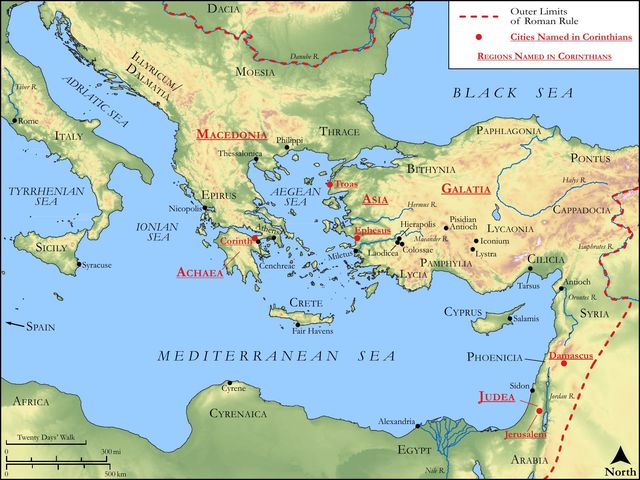
See on the biblical-era maps

Study this verse
Public-domain commentary
Matthew Henry
From his Commentary on the Whole Bible. Henry comments on passages, not single verses — this entry covers 1 Corinthians 10:1–5. His three-level outline is real structure in the source text, so it is rendered as structure.
In order to dissuade the Corinthians from communion with idolaters, and security in any sinful course, he sets before them the example of the Jews, the church under the Old Testament. They enjoyed great privileges, but, having been guilty of heinous provocations, they fell under very grievous punishments. In these verses he reckons up their privileges, which, in the main, were the same with ours.
I.He prefaces this discourse with a note of regard:
"Moreover, brethren, I would not that you should be ignorant. I would not have you without the knowledge of this matter; it is a thing worthy both of your knowledge and attention. It is a history very instructive and monitory." Judaism was Christianity under a veil, wrapt up in types and dark hints. The gospel was preached to them, in their legal rites and sacrifices. And the providence of God towards them, and what happened to them notwithstanding these privileges, may and ought to be warnings to us.
II.He specifies some of their privileges. He begins,
1.With their deliverance from Egypt: "Our fathers, that is, the ancestors of us Jews, were under the cloud, and all passed through the sea. They were all under the divine covering and conduct." The cloud served for both purposes: it sometimes contracted itself into a cloudy pillar, shining on one side to show them their way, dark on the other to hide them from their pursuing enemies; and sometimes spread itself over them as a mighty sheet, to defend them from the burning sun in the sandy desert, Psa 105:39. They were miraculously conducted through the Red Sea, where the pursuing Egyptians were drowned: it was a lane to them, but a grave to these: a proper type of our redemption by Christ, who saves us by conquering and destroying his enemies and ours. They were very dear to God, and much in his favour, when he would work such miracles for their deliverance, and take them so immediately under his guidance and protection.
2.They had sacraments like ours.
(1.)They were all baptized unto Moses in the cloud, and in the sea (Co1 10:2), or into Moses, that is, brought under obligation to Moses's law and covenant, as we are by baptism under the Christian law and covenant. It was to them a typical baptism.
(2.)They did all eat of the same spiritual meat, and drink of the same spiritual drink, that we do. The manna on which they fed was a type of Christ crucified, the bread which came down from heaven, which whoso eateth shall live forever. Their drink was a stream fetched from a rock which followed them in all their journeyings in the wilderness; and this rock was Christ, that is, in type and figure. He is the rock on which the Christian church is built; and of the streams that issue from him do all believers drink, and are refreshed. Now all the Jews did eat of this meat, and drink of this rock, called here a spiritual rock, because it typified spiritual things. These were great privileges. One would think that this should have saved them; that all who ate of that spiritual meat, and drank of that spiritual drink, should have been holy and acceptable to God. Yet was it otherwise: With many of them God was not well pleased; for they were overthrown in the wilderness, Co1 10:5. Note, Men may enjoy many and great spiritual privileges in this world, and yet come short of eternal life. Many of those who were baptized unto Moses in the cloud and sea, that is, had their faith of his divine commission confirmed by these miracles, were yet overthrown in the wilderness, and never saw the promised land. Let none presume upon their great privileges, or profession of the truth; these will not secure heavenly happiness, nor prevent judgments here on earth, except the root of the matter be in us.
Historical interpretation
Five Centuries of Reception
17 surviving comments on this verse. Each one is dated, so this reads as a timeline rather than a list.
Select a marker to jump to its quote. Markers stagger vertically where authors wrote within a few decades of each other.
This is the Way which leads to the Father, the Rock, the Defence, the Key, the Shepherd, the Sacrifice, the Door of knowledge, through which have entered Abraham, and Isaac, and Jacob, Moses and all the company of the prophets, and these pillars of the world, the apostles, and the spouse of Christ, on whose account He poured out His own blood, as her marriage portion, that He might redeem her.
For Isaiah did not send you to a bath, there to wash away murder and other sins, which not even all the water of the sea were sufficient to purge; but, as might have been expected, this was that saving bath of the olden time which followed those who repented, and who no longer were purified by the blood of goats and of sheep, or by the ashes of an heifer, or by the offerings of fine flour, but by faith through the blood of Christ, and through His death, who died for this very reason.
And as He was born of Mary in the last times, so did He also proceed from God as the First-begotten of every creature; and as He hungered, so did He satisfy
But why enlarge on such a subject? When the very apostle whom our heretics adopt, interprets the law which allows an unmuzzled mouth to the oxen that tread out the corn, not of cattle, but of ourselves; and also alleges that the rock which followed (the Israelites) and supplied them with drink was Christ; teaching the Galatians, moreover, that the two narratives of the sons of Abraham had an allegorical meaning in their course; and to the Ephesians giving an intimation that, when it was declared in the beginning that a man should leave his father and mother and become one flesh with his wife, he applied this to Christ and the church.
For behold Marcion, in his blindness, stumbled at the rock whereof our fathers drank in the wilderness. For since "that rock was Christ," it was, of course, the Creator's, to whom also belonged the people.
For, because Jesus Christ was to introduce the second people (which is composed of us nations, lingering deserted in the world aforetime) into the land of promise, "flowing with milk and honey" (that is, into the possession of eternal life, than which nought is sweeter); and this had to come about, not through Moses (that is, not through the Law's discipline), but through Joshua (that is, through the new law's grace), after our circumcision with "a knife of rock" (that is, with Christ's precepts, for Christ is in many ways and figures predicted as a rock ); therefore the man who was being prepared to act as images of this sacrament was inaugurated under the figure of the Lord's name, even so as to be named Jesus.
How, therefore, can such a hydra of delinquencies fail to offend the Lord, the Disapprover of evils? Is it not manifest that it was through impatience that Israel himself also always failed in his duty toward God, from that time when, forgetful of the heavenly arm whereby he had been drawn out of his Egyptian affliction, he demands from Aaron "gods as his guides; "when he pours down for an idol the contributions of his gold: for the so necessary delays of Moses, while he met with God, he had borne with impatience. After the edible rain of the manna, after the watery following of the rock, they despair of the Lord in not enduring a three-days' thirst; for this also is laid to their charge by the Lord as impatience.
But having to be rejected and afterwards to be acknowledged, and taken up and glorified, He borrowed the very word "rejected" from the passage, where, under the figure of a stone, His twofold manifestation was celebrated by David-the first in rejection, the second in honour: "The stone," says He, "which the builders rejected, is become the head-stone of the corner. This is the Lord's doing." Now it would be idle, if we believed that God had predicted the humiliation, or even the glory, of any Christ at all, that He could have signed His prophecy for any but Him whom He had foretold under the figure of a stone, and a rock, and a mountain. If, however, He speaks of His own coming, why does He compare it with the days of Noe and of Lot, which were dark and terrible-a mild and gentle God as He is? Why does He bid us "remember Lot's wife," who despised the Creator's command, and was punished for her contempt, if He does not come with judgment to avenge the infraction of His precepts?
I considered the Word of the Creator and likened it to the rock that marched with the people in Israel in the wilderness; it was not from the reservoir of water contained within it that it poured forth for them glorious streams. There was no water in the rock, yet oceans sprang forth from it. Just so did the Word fashion created things out of nothing.
The manna and the water which flowed from the rock are called spiritual because they were formed not according to the law of nature but by the power of God working independently of the natural elements. They were created for a time as figures of what we now eat and drink in remembrance of Christ the Lord.
We also will be a rock, imitating, as far as possible in our changing nature, the unchanging and permanent nature of the Master.
This surely referred not to his divinity but to his flesh, which flowed over the hearts of the thirsting people with the perpetual stream of his blood.
Meantime they came to Mount Sinai, and thence the law was given to them with voices and sights from heaven, written in ten precepts, of which the first and greatest was that they should worship God Himself alone, and not make to themselves any appearance or form to worship. But when Moses had gone up to the mount, and was staying there forty days, the people, although they had seen Egypt struck with the ten plagues, and the sea parted and passed over by them on foot, manna also given to them from heaven for bread, and drink supplied to them out of the rock that followed [1 Corinthians 10:4] them, which kind of food was turned into whatever taste any one desired; and although, being placed under the torrid region of heaven, they were shaded by a cloud in the day-time, that they might not be scorched by the heat, and by night were enlightened by a pillar of fire, lest the horror of darkness should be added to the wasteness of the wilderness
"That our fathers," saith he, "were all under the cloud, and all passed through the sea; and were all baptized unto Moses in the cloud and in the sea; and did all eat the same spiritual meat; and did all drink the same spiritual drink; for they drank of a spiritual Rock that followed them: and the Rock was Christ. Howbeit with most of them God was not well pleased."
And wherefore saith he these things? To point out that as they were nothing profited by the enjoyment of so great a gift, so neither these by obtaining Baptism and partaking of spiritual Mysteries, except they go on and show forth a life worthy of this grace. Wherefore also he introduces the types both of Baptism and of the Mysteries.
But what is, "They were baptized into Moses?" Like as we, on our belief in Christ and His resurrection, are baptized, as being destined in our own persons to partake in the same mysteries; for, "we are baptized," saith he, "for the dead," i.e., for our own bodies; even so they putting confidence in Moses, i.e., having seen him cross first, ventured also themselves into the waters. But because he wishes to bring the Type near the Truth; he speaks it not thus, but uses the terms of the Truth even concerning the Type.
Further: this was a symbol of the Font, and that which follows, of the Holy Table. For as thou eatest the Lord's Body, so they the manna: and as thou drinkest the Blood, so they water from a rock. For though they were things of sense which were produced, yet were they spiritually exhibited, not according to the order of nature, but according to the gracious intention of the gift, and together with the body nourished also the soul, leading it unto faith. On this account, you see, touching the food he made no remark, for it was entirely different, not in mode only but in nature also; (for it was manna;) but respecting the drink, since the manner only of the supply was extraordinary and required proof, therefore having said that "they drank the same spiritual drink," he added, "for they drank of a spiritual Rock that followed them," and he subjoined, "and the Rock was Christ." For it was not the nature of the rock which sent forth the water, (such is his meaning,) else would it as well have gushed out before this time: but another sort of Rock, a spiritual One, performed the whole, even Christ who was every where with them and wrought all the wonders. For on this account he said, "that followed them."
Perceivest thou the wisdom of Paul, how in both cases he points out Him as the Giver, and thereby brings the Type nigh to the Truth? "For He who set those things before them," saith he, "the same also hath prepared this our Table: and the same Person both brought them through the sea and thee through Baptism; and before them set manna, but before thee His Body and Blood."
As touching His gift then, such is the case: now let us observe also what follows, and consider, whether when they showed themselves unworthy of the gift, He spared them. Nay, this thou canst not say. Wherefore also he added, "Howbeit with most of them God was not well-pleased;" although He had honored them with so great honor. Yea, it profited them nothing, but most of them perished. The truth is, they all perished, but that he might not seem to prophesy total destruction to these also, therefore he said, "most of them." And yet they were innumerable, but their number profited them nothing: and these were all so many tokens of love; but not even did this profit them, inasmuch as they did not themselves show forth the fruits of love.
Thus, since most men disbelieve the things said of hell, as not being present nor in sight; he alleges the things heretofore done as a proof that God doth punish all who sin, even though He have bestowed innumerable benefits upon them: "for if ye disbelieve the things to come," so he speaks, "yet surely the things that are past ye will not disbelieve." Consider, for example, how great benefits He bestowed on them: from Egypt and the slavery there He set them free, the sea He made their path, from heaven he brought down manna, from beneath He sent forth strange and marvellous fountains of waters; He was with them every where, doing wonders and fencing them in on every side: nevertheless since they showed forth nothing worthy of this gift, He spared them not, but destroyed them all.
All symbols seem in some way to personify the realities of which they are symbols. So, St. Paul says, “The rock was Christ,” because the rock in question symbolized Christ.
Surely this refers more to his physical body than to his divinity, for the hearts of the thirsty people were satisfied by the endless stream of his blood.
And again, speaking also of the children of Israel as baptized in the cloud and in the sea, he says: "And they all drank of the same spiritual drink: for they drank of that spiritual Rock that followed them, and that Rock was Christ."
Continue studying 1 Corinthians 10:4 across the web’s major study libraries — every link below opens this exact verse, chapter, or book on the destination site.
Read & Compare
 BibleGatewayThis verse in more than 200 translations and 70 languages.
 Bible.comThe YouVersion reader — hundreds of translations, reading plans, and highlights.
 ESV.orgCrossway's official English Standard Version reader.
 NET BibleThe NET translation with 60,000+ translators' notes on every rendering decision.
 STEP BibleTyndale House's free study tool — original text, vocabulary, and scholarly resources.
 BibliaLogos Bible Software's free web reader.
 USCCBThe New American Bible (Revised Edition) with the U.S. bishops' study notes.
Commentaries
 BibleHub CommentariesDozens of classic commentaries on this verse, gathered on one page.
 StudyLightMore than 100 commentary sets — the largest collection on the web.
 BibleRefPlain-English commentary on what this verse means, verse by verse.
 Enduring WordDavid Guzik's free commentary on this chapter, widely used by Bible teachers.
 Bible Study ToolsVerse commentary alongside Greek and Hebrew study aids.
Original Language & Research
- BibleHub InterlinearThe verse word by word — original language, transliteration, and English.
- BibleHub LexiconEvery word's original-language definition and Strong's entry.
 Blue Letter BibleDeep-study tools — Strong's numbers, concordance, and word studies.
 CNTR CollationThe earliest Greek manuscripts of this verse, collated letter by letter.
Sermons, Hymns & Audio


TrulyRandomVerse is not affiliated with these sites and doesn’t control their content. They’re linked because they’re genuinely useful.
Summary
1 Corinthians 10:4 is a profound theological declaration by the Apostle Paul, asserting that the miraculous water-providing Rock for the Israelites in the wilderness was, in fact, Christ Himself. This verse underscores God's consistent and supernatural provision for His people throughout salvation history, revealing the pre-incarnate Christ's active presence and essential role as the ultimate source of spiritual sustenance and life for both Old Testament Israel and New Testament believers.
Context
ShowHideLiterary Context
This verse is situated within Paul's broader argument in 1 Corinthians 10, where he draws lessons from the history of Israel's wilderness wanderings to warn the Corinthian believers against idolatry, immorality, and presumptuous sin. Paul reminds them that despite experiencing extraordinary divine provisions—such as being "under the cloud" and passing "through the sea" (1 Corinthians 10:1-2) and partaking of "spiritual meat" (manna) and "spiritual drink" (water from the rock)—many of them still fell into sin and were disciplined by God, serving as a solemn warning for the Corinthians (1 Corinthians 10:5-11). The immediate context of verse 4, following the mention of "spiritual meat" in 1 Corinthians 10:3, completes the picture of God's supernatural provision and sets the stage for Paul's startling revelation about the Rock's true identity.
Historical & Cultural Context
The historical backdrop for this verse is the Exodus narrative, specifically the miraculous provision of water from a rock in the wilderness, recorded in Exodus 17:1-7 and Numbers 20:2-13. While the Old Testament accounts describe a stationary rock, a popular Jewish tradition (found in rabbinic writings like the Targum Pseudo-Jonathan on Numbers 21:16) held that the miraculous rock, or a stream flowing from it, literally followed the Israelites throughout their forty years of wandering, providing continuous water. Paul, inspired by the Holy Spirit, utilizes this well-known tradition not to endorse its literal historicity, but to reveal a deeper, spiritual truth: that the continuous, miraculous provision was ultimately sourced in the pre-incarnate Christ, who was present with His people.
Key Themes
ShowHideThis verse significantly contributes to several major themes within 1 Corinthians and the broader biblical narrative. It highlights Divine Provision and Sustenance, emphasizing God's unwavering faithfulness to supply His people's needs, both physical and spiritual, even in the most desolate circumstances. Crucially, it advances the theme of Christ's Pre-existence and Active Presence in the Old Testament, revealing that the second person of the Trinity was not only present but actively involved in the miraculous events of Israel's past, foreshadowing His ultimate role as the "living water" (John 4:10-14). Furthermore, it underscores the Spiritual Reality Behind Physical Symbols, teaching that the physical events and objects in the Old Testament often served as types or shadows pointing to a deeper, spiritual reality found in Christ (Colossians 2:16-17).
Exposition and Analysis
ShowHideKey Word Analysis
ShowHideThis term signifies something divinely given, divinely empowered, and pertaining to the Holy Spirit or the divine realm. It goes beyond merely "non-physical" to denote a supernatural quality, indicating that the drink and the Rock were not merely natural phenomena but were imbued with God's power and presence, pointing to a deeper, salvific reality.
Referring to a mass of rock, this word is used both literally and figuratively in Scripture. Here, it refers to the physical rock from which water miraculously flowed in the wilderness. However, Paul immediately elevates its meaning by calling it "spiritual" and then explicitly identifying it with Christ, transforming it into a profound theological symbol of Christ as the unshakeable foundation and source of life.
This is the imperfect tense of the verb "to be," indicating a continuous state or ongoing reality in the past. It signifies that the Rock's identity as Christ was not a temporary or symbolic association but an inherent, continuous truth. It suggests Christ's enduring presence and identity with this life-giving source throughout Israel's journey.
Verse Breakdown
ShowHide"And did all drink the same spiritual drink"
This clause continues Paul's enumeration of Israel's shared spiritual privileges in the wilderness. "All" (G3956, pâs) emphasizes the universality of this experience among the Israelites, highlighting that every single one of them partook of this miraculous provision. The "spiritual drink" (G4188, póma) refers to the water supernaturally provided from the rock, designated as "spiritual" (G4152, pneumatikós) because its source and sustenance were divine, not merely natural. This shared experience underscores the gravity of their subsequent failures.
"for they drank of that spiritual Rock that followed them"
The particle "for" (G1063, gár) introduces the reason or explanation for their drinking the spiritual drink. It clarifies that the source of this drink was "that spiritual Rock" (G4073, pétra), reiterating its supernatural nature. The phrase "that followed them" (G190, akolouthéō) alludes to the Jewish tradition that the miraculous rock or its accompanying stream moved with Israel. Paul uses this tradition to emphasize the continuous, ever-present nature of God's provision and, by extension, Christ's enduring presence with His people throughout their journey.
"and that Rock was Christ."
This climactic declaration is the theological crux of the verse. The conjunction "and" (G1161, dé) introduces a weighty identification. Paul unequivocally states that the "Rock" (G4073, pétra) was (G2258, ēn, imperfect tense, indicating continuous identity) "Christ" (G5547, Christós). This is not merely a symbolic comparison but a profound theological assertion of Christ's pre-existence and His active, life-giving presence with Israel in the Old Testament. It reveals that the ultimate source of their spiritual sustenance was the pre-incarnate Son of God, establishing a direct continuity between Old Testament types and New Testament fulfillment in Christ.
Literary Devices
ShowHidePaul masterfully employs several literary devices in this concise verse. Most prominently, he uses Typology, where the Old Testament "Rock" serves as a type (a pre-figurement or pattern) of Christ. The physical rock and its miraculous water foreshadow the spiritual reality of Christ as the ultimate source of living water and spiritual sustenance. The phrase "spiritual Rock" itself is an example of Symbolism, where the physical object (rock) is imbued with a deeper, divine meaning, pointing beyond itself to a supernatural reality. Furthermore, Paul uses a striking Identification ("that Rock was Christ") which is a form of Metaphor or Allegory, directly equating the Old Testament type with its New Testament fulfillment. This bold assertion transforms a historical account into a profound Christological statement, revealing the continuity of God's redemptive plan centered on Christ through all ages.
Theological and Thematic Connections
ShowHideThis verse profoundly impacts our understanding of Christ's eternal nature and His consistent work throughout salvation history. It reveals that the God who provided for Israel in the wilderness was none other than the pre-incarnate Christ, actively sustaining His people. This truth establishes a vital continuity between the Old and New Covenants, demonstrating that Christ is the unchanging source of life and spiritual nourishment for all who believe, regardless of the dispensation. It underscores the unity of God's redemptive plan, showing that the "spiritual drink" of the wilderness was a direct manifestation of Christ's life-giving presence, foreshadowing His ultimate sacrifice and the outpouring of the Holy Spirit. This theological insight deepens our appreciation for Christ's sovereignty and His intimate involvement in every aspect of His people's journey, from ancient Israel to the church today.
Reflection and Application
ShowHide1 Corinthians 10:4 calls us to a deeper understanding of Christ's omnipresence and His enduring faithfulness. Just as the spiritual Rock provided constant sustenance for Israel in their arduous wilderness journey, Christ remains our ever-present and all-sufficient source of spiritual life, strength, and guidance. This verse reminds us that true spiritual nourishment does not come from earthly provisions or human efforts, but solely from our connection to Him. We are invited to depend fully on Christ for all our needs, trusting that He is the living water who satisfies our deepest spiritual thirst. Furthermore, recognizing that even those who partook of Christ's direct provision could fall into sin serves as a sober warning. It compels us to cultivate vigilance, humility, and unwavering obedience in our Christian walk, ensuring that our spiritual blessings lead to greater devotion, not complacency. Our past experiences of God's grace are not a guarantee against future temptation, but rather a call to lean more heavily on the unchanging Christ.
Questions for Reflection
ShowHideFAQ
ShowHideDoes Paul's statement "that Rock was Christ" mean the literal rock was Jesus?
ShowHideNo, Paul's statement does not mean the physical rock itself was literally transformed into Jesus. Rather, it is a profound theological declaration about the spiritual reality behind the physical phenomenon. The "spiritual Rock" (G4073, pétra) was Christ in the sense that the pre-incarnate Son of God was the divine power and presence associated with that rock, the true source from which the miraculous water flowed. He was the ultimate provider and sustainer, foreshadowing His role as the "living water" (John 4:10-14) and the foundation of salvation (Isaiah 28:16). Paul is revealing a Christological truth: Christ was actively present and providing for His people in the Old Testament, even before His incarnation.
What is the significance of the "Rock that followed them" tradition?
ShowHideThe tradition of the "Rock that followed them" was a popular Jewish legend or midrash of Paul's time, suggesting that the miraculous rock or its accompanying stream literally moved with the Israelites during their wilderness wanderings. Paul uses this tradition not to endorse its literal accuracy, but to highlight a deeper spiritual truth: the continuous, ever-present nature of God's provision and, specifically, the constant presence of the pre-incarnate Christ with His people. It emphasizes that Christ was always with Israel, providing for them, just as He is always with His church today (Matthew 28:20). The emphasis is on Christ's enduring faithfulness and availability as the source of life.
Christ-Centered Fulfillment
ShowHide1 Corinthians 10:4 stands as a powerful testament to the overarching Christ-centered narrative of Scripture. The "spiritual Rock" in the wilderness, identified by Paul as Christ, serves as a profound type foreshadowing Jesus as the ultimate source of spiritual life and salvation. Just as the physical rock provided essential water for physical survival, Christ, through His sacrificial death and resurrection, provides the "living water" that quenches the deepest spiritual thirst and grants eternal life (John 4:10-14). His pre-existence and active involvement in Israel's wilderness journey demonstrate His eternal nature and His consistent role as the divine provider and sustainer, fulfilling the promises and patterns established in the Old Testament. The water flowing from the smitten rock prefigures the life-giving Spirit poured out from the crucified Christ (John 19:34), establishing Him as the foundation upon which the church is built (Matthew 16:18) and the unshakeable cornerstone of God's redemptive plan (Ephesians 2:20). Thus, the ancient Rock finds its glorious and complete fulfillment in Jesus Christ, the one who truly gives life to the world.