


John 19:34
- ἀλλ᾽all᾽ButG235CONJConjunction
- εἷςheisoneG1520A-NSMAdjective Nominative Singular Masculine
- τῶνtōnof theG3588T-GPMDefinite article Genitive Plural Masculine
- στρατιωτῶνstratiōtōnsoldiersG4757N-GPMNoun Genitive Plural Masculine
- λόγχῃlogchēwith a spearG3057N-DSFNoun Dative Singular Feminine
- αὐτοῦautouof HisG846P-GSMPersonal pronoun Genitive Singular Masculine
- τὴνtēn<the>G3588T-ASFDefinite article Accusative Singular Feminine
- πλευρὰνpleuransideG4125N-ASFNoun Accusative Singular Feminine
- ἔνυξενenuxenpiercedG3572V-AAI-3SVerb Aorist Active Indicative 3rd Singular
- καὶkaiandG2532CONJConjunction
- ἐξῆλθενexēlthencame outG1831V-2AAI-3SVerb 2nd Aorist Active Indicative 3rd Singular
- εὐθὺςeuthusimmediatelyG2112ADVAdverb
- αἷμαhaimabloodG129N-NSNNoun Nominative Singular Neuter
- καὶkaiandG2532CONJConjunction
- ὕδωρhudōrwaterG5204N-NSNNoun Nominative Singular Neuter
English is a literal word-by-word gloss of the Greek, not the KJV's wording. Why?
This is the original text the KJV's translators worked from — each Greek word with its own literal English meaning in this verse, prepared by scholars at Tyndale House, Cambridge. The KJV translates whole sentences, not word by word, so its wording differs: one Greek word can become several English words, and the KJV may choose “charity” where the gloss reads “love”. Both are faithful — they answer different questions. For the KJV's own rendering, switch to the KJV text.
Details
See on the biblical-era map
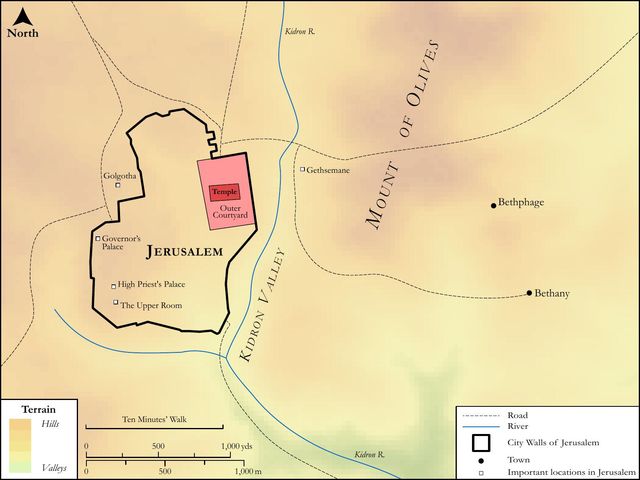
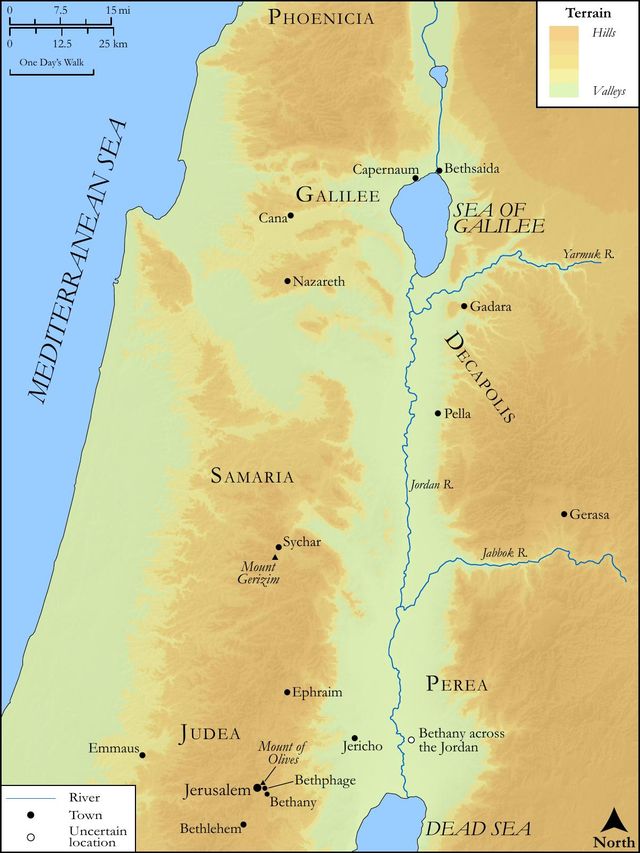
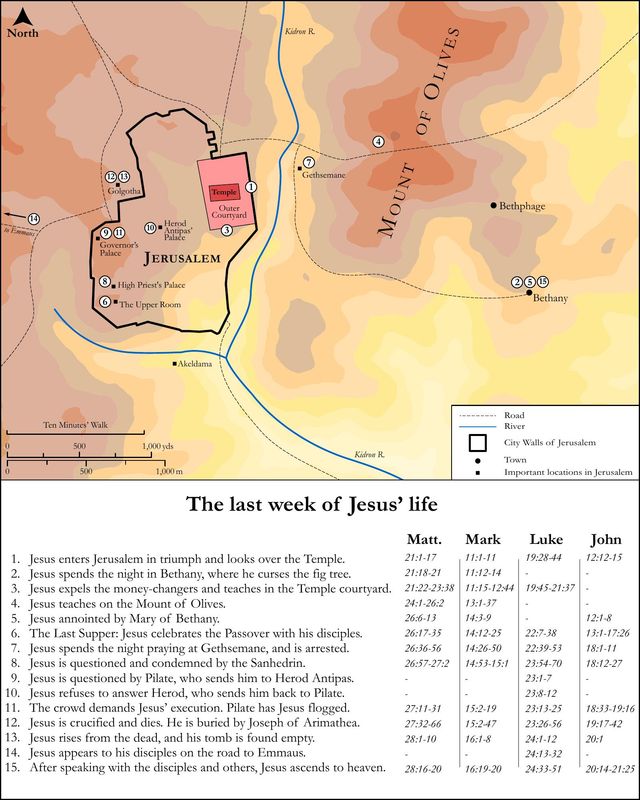
Study this verse
Public-domain commentary
Matthew Henry
From his Commentary on the Whole Bible. Henry comments on passages, not single verses — this entry covers John 19:31–37. His four-level outline is real structure in the source text, so it is rendered as structure.
This passage concerning the piercing of Christ's side after his death is recorded only by this evangelist.
I.Observe the superstition of the Jews, which occasioned it (Joh 19:31):
Because it was the preparation for the sabbath, and that sabbath day, because it fell in the passover-week, was a high day, that they might show a veneration for the sabbath, they would not have the dead bodies to remain on the crosses on the sabbath-day, but besought Pilate that their legs might be broken, which would be a certain, but cruel dispatch, and that then they might be buried out of sight. Note here,
1.The esteem they would be thought to have for the approaching sabbath, because it was one of the days of unleavened bread, and (some reckon) the day of the offering of the first-fruits. Every sabbath day is a holy day, and a good day, but this was a high day, megalē hēmera - a great day. Passover sabbaths are high days; sacrament-days, supper-days, communion-days are high days, and there ought to be more than ordinary preparation for them, that these may be high days indeed to us, as the days of heaven.
2.The reproach which they reckoned it would be to that day if the dead bodies should be left hanging on the crosses. Dead bodies were not to be left at any time (Deu 21:23); yet, in this case, the Jews would have left the Roman custom to take place, had it not been an extraordinary day; and, many strangers from all parts being then at Jerusalem, it would have been an offence to them; nor could they well bear the sight of Christ's crucified body, for, unless their consciences were quite seared, when the heat of their rage was a little over, they would upbraid them.
3.Their petition to Pilate, that their bodies, now as good as dead, might be dispatched; not by strangling or beheading them, which would have been a compassionate hastening of them out of their misery, like the coup de grace (as the French call it) to those that are broken upon the wheel, the stroke of mercy, but by the breaking of their legs, which would carry them off in the most exquisite pain. Note,
(1.)The tender mercies of the wicked are cruel.
(2.)The pretended sanctity of hypocrites is abominable. These Jews would be thought to bear a great regard for the sabbath, and yet had not regard to justice and righteousness; they made no conscience of bringing an innocent and excellent person to the cross, and yet scrupled letting a dead body hang upon the cross.
II.The dispatching of the two thieves that were crucified with him, Joh 19:32.
Pilate was still gratifying the Jews, and gave orders as they desired; and the soldiers came, hardened against all impressions of pity, and broke the legs of the two thieves, which, no doubt, extorted from them hideous outcries, and made them die according to the bloody disposition of Nero, so as to feel themselves die. One of these thieves was a penitent, and had received from Christ an assurance that he should shortly be with him in paradise, and yet died in the same pain and misery that the other thief did; for all things come alike to all. Many go to heaven that have bands in their death, and die in the bitterness of their soul. The extremity of dying agonies is no obstruction to the living comforts that wait for holy souls on the other side death. Christ died, and went to paradise, but appointed a guard to convey him thither. This is the order of going to heaven - Christ, the first-fruits and forerunner, afterwards those that are Christ's.
III.The trial that was made whether Christ was dead or no, and the putting of it out of doubt.
1.They supposed him to be dead, and therefore did not break his legs, Joh 19:33. Observe here,
(1.)That Jesus died in less time than persons crucified ordinarily did. The structure of his body, perhaps, being extraordinarily fine and tender, was the sooner broken by pain; or, rather, it was to show that he laid down his life of himself, and could die when he pleased, though his hands were nailed. Though he yielded to death, yet he was not conquered.
(2.)That his enemies were satisfied he was really dead. The Jews, who stood by to see the execution effectually done, would not have omitted this piece of cruelty, if they had not been sure he was got out of the reach of it.
(3.)Whatever devices are in men's hearts, the counsel of the Lord shall stand. It was fully designed to break his legs, but, God's counsel being otherwise, see how it was prevented.
2.Because they would be sure he was dead they made such an experiment as would put it past dispute. One of the soldiers with a spear pierced his side, aiming at his heart, and forthwith came thereout blood and water, Joh 19:34.
(1.)The soldier hereby designed to decide the question whether he was dead or no, and by this honourable wound in his side to supersede the ignominious method of dispatch they took with the other two. Tradition says that this soldier's name was Longinus, and that, having some distemper in his eyes, he was immediately cured of it, by some drops of blood that flowed out of Christ's side falling on them: significant enough, if we had any good authority for the story.
(2.)But God had a further design herein, which was,
[1.]To give an evidence of the truth of his death, in order to the proof of his resurrection. If he was only in a trance or swoon, his resurrection was a sham; but, by this experiment, he was certainly dead, for this spear broke up the very fountains of life, and, according to all the law and course of nature, it was impossible a human body should survive such a wound as this in the vitals, and such an evacuation thence.
[2.]To give an illustration of the design of his death. There was much of mystery in it, and its being solemnly attested (Joh 19:35) intimates there was something miraculous in it, that the blood and water should come out distinct and separate from the same wound; at least it was very significant; this same apostle refers to it as a very considerable thing, Jo1 5:6, Jo1 5:8.
First, the opening of his side was significant. When we would protest our sincerity, we wish there were a window in our hearts, that the thoughts and intents of them might be visible to all. Through this window, opened in Christ's side, you may look into his heart, and see love flaming there, love strong as death; see our names written there. Some make it an allusion to the opening of Adam's side in innocency. When Christ, the second Adam, was fallen into a deep sleep upon the cross, then was his side opened, and out of it was his church taken, which he espoused to himself. See Eph 5:30, Eph 5:32. Our devout poet, Mr. George Herbert, in his poem called The Bag, very affectingly brings in our Saviour, when his side was pierced, thus speaking to his disciples: -
If ye have any thing to send, or write
(I have no bag, but here is room),
Unto my Father's hands and sight
(Believe me) it shall safely come.
That I shall mind what you impart,
Look, you may put it very near my heart;
Or, if hereafter any of my friends
Will use me in this kind, the door
Shall still be open; what he sends
I will present, and somewhat more,
Not to his hurt. Sighs will convey
Any thing to me. Hark, Despair, away.
Secondly, The blood and water that flowed out of it were significant. 1. They signified the two great benefits which all believers partake of through Christ - justification and sanctification; blood for remission, water for regeneration; blood for atonement, water for purification. Blood and water were used very much under the law. Guilt contracted must be expiated by blood; stains contracted must be done away by the water of purification. These two must always go together. You are sanctified, you are justified, Co1 6:11. Christ has joined them together, and we must not think to put them asunder. They both flowed from the pierced side of our Redeemer. To Christ crucified we owe both merit for our justification, and Spirit and grace for our sanctification; and we have as much need of the latter as of the former, Co1 1:30. 2. They signified the two great ordinances of baptism and the Lord's supper, by which those benefits are represented, sealed, and applied, to believers; they both owe their institution and efficacy to Christ. It is not the water in the font that will be to us the washing of regeneration, but the water out of the side of Christ; not the blood of the grape that will pacify the conscience and refresh the soul, but the blood out of the side of Christ. Now was the rock smitten (Co1 10:4), now was the fountain opened (Zac 13:1), now were the wells of salvation digged, Isa 12:3. Here is the river, the streams whereof make glad the city of our God.
IV.The attestation of the truth of this by an eye-witness (Joh 19:35), the evangelist himself. Observe,
1.What a competent witness he was of the matters of fact.
(1.)What he bore record of he saw; he had it not by hearsay, nor was it only his own conjecture, but he was an eyewitness of it; it is what we have seen and looked upon (Jo1 1:1; Pe2 1:16), and had perfect understanding of, Luk 1:3.
(2.)What he saw he faithfully bore record of; as a faithful witness, he told not only the truth, but the whole truth; and did not only attest it by word of mouth, but left it upon record in writing, in perpetuam rei memoriam - for a perpetual memorial.
(3.)His record is undoubtedly true; for he wrote not only from his own personal knowledge and observation, but from the dictates of the Spirit of truth, that leads into all truth.
(4.)He had himself a full assurance of the truth of what he wrote, and did not persuade others to believe that which he did not believe himself: He knows that he saith true.
(5.)He therefore witnessed these things, that we might believe; he did not record them merely for his own satisfaction or the private use of his friends, but made them public to the world; not to please the curious nor entertain the ingenious, but to draw men to believe the gospel in order to their eternal welfare.
2.What care he showed in this particular instance. That we may be well assured of the truth of Christ's death, he saw his heart's blood, his life's blood, let out; and also of the benefits that flow to us from his death, signified by the blood and water which came out of his side. Let this silence the fears of weak Christians, and encourage their hopes, iniquity shall not be their ruin, for there came both water and blood out of Christ's pierced side, both to justify and sanctify them; and if you ask, How can we be sure of this? You may be sure, for he that saw it bore record.
V.The accomplishment of the scripture in all this (Joh 19:36):
That the scripture might be fulfilled, and so both the honour of the Old Testament preserved and the truth of the New Testament confirmed. Here are two instances of it together: -
1.The scripture was fulfilled in the preserving of his legs from being broken; therein that word was fulfilled, A bone of him shall not be broken.
(1.)There was a promise of this made indeed to all the righteous, but principally pointing at Jesus Christ the righteous (Psa 34:20): He keepeth all his bones, not one of them is broken. And David, in spirit, says, All my bones shall say, Lord, who is like unto thee? Psa 35:10.
(2.)There was a type of this in the paschal lamb, which seems to be specially referred to here (Exo 12:46): Neither shall you break a bone thereof; and it is repeated (Num 9:12), You shall not break any bone of it; for which law the will of the law-maker is the reason, but the antitype must answer the type. Christ our Passover is sacrificed for us, Co1 5:7. He is the Lamb of God (Joh 1:29), and, as the true passover, his bones were kept unbroken. This commandment was given concerning his bones, when dead, as of Joseph's, Heb 11:22.
(3.)There was a significancy in it; the strength of the body is in the bones. The Hebrew word for the bones signifies the strength, and therefore not a bone of Christ must be broken, to show that though he be crucified in weakness his strength to save is not at all broken. Sin breaks our bones, as it broke David's (Psa 51:8); but it did not break Christ's bones; he stood firm under the burden, mighty to save.
2.The scripture was fulfilled in the piercing of his side (Joh 19:37): They shall look on me whom they had pierced; so it is written, Zac 12:10. And there the same that pours out the Spirit of grace, and can be no less than the God of the holy prophets, says, They shall look upon me, which is here applied to Christ, They shall look upon him.
(1.)It is here implied that the Messiah shall be pierced; and here it had a more full accomplishment than in the piercing of his hands and feet; he was pierced by the house of David and the inhabitants of Jerusalem, wounded in the house of his friends, as it follows, Zac 13:6.
(2.)It is promised that when the Spirit is poured out they shall look on him and mourn. This was in part fulfilled when many of those that were his betrayers and murderers were pricked to the heart, and brought to believe in him; it will be further fulfilled, in mercy, when all Israel shall be saved; and, in wrath, when those who persisted in their infidelity shall see him whom they have pierced, and wail because of him, Rev 1:7. But it is applicable to us all. We have all been guilty of piercing the Lord Jesus, and are all concerned with suitable affections to look on him.
Historical interpretation
Nine Centuries of Reception
19 surviving comments on this verse. Each one is dated, so this reads as a timeline rather than a list.
Select a marker to jump to its quote. Markers stagger vertically where authors wrote within a few decades of each other.
And why did He acknowledge Himself to be the Son of man, if He had not gone through that birth which belongs to a human being? How, too, could He forgive us those sins for which we are answerable to our Maker and God? And how, again, supposing that He was not flesh, but was a man merely in appearance, could He have been crucified, and could blood and water have issued from His pierced side?
The sacred vine produced the prophetic cluster. This was a sign to them, after they had been trained from wandering to [find] their rest. The sacred vine represented the great cluster of the Word, bruised for us. For the blood of the grape—that is, the Word—desired to be mixed with water, as his blood is mingled with salvation. And the blood of the Lord is twofold. For there is the blood of his flesh, by which we are redeemed from corruption. And there is the spiritual blood, that by which we are anointed. And to drink the blood of Jesus is to become a partaker of the Lord’s immortality with the Spirit as the enervating principle of the Word, as blood is of flesh. Accordingly, as wine is blended with water, so is the Spirit with humankind. And the one, the mixture of wine and water, nourishes the faith; while the other, the Spirit, brings us to immortality. And the mixture of both, of the water and of the Word, is called Eucharist, renowned and glorious grace. And they who by faith partake of it are sanctified both in body and soul. For the Father’s will has mystically compounded the divine mixture, man, by the Spirit and the Word. For in truth, the spirit is joined to the soul, which is inspired by it. And the flesh, by reason of which the Word became flesh, is joined to the Word.
Onward even to the passion does the witness of baptism last: while He is being surrendered to the cross, water intervenes; witness Pilate's hands: when He is wounded, forth from His side bursts water; witness the soldier's lance!
For He had come "by means of water and blood," just as John has written; that He might be baptized by the water, glorified by the blood; to make us, in like manner, called by water, chosen by blood. These two baptisms He sent out from the wound in His pierced side, in order that they who believed in His blood might be bathed with the water; they who had been bathed in the water might likewise drink the blood.
The body of the Lord presented both these to the world, the sacred blood and the holy water.
And His body, though dead after the manner of man, possesses in it great power of life. For streams which flow not from dead bodies flowed forth from Him, viz., blood and water; in order that we might know what power for life is held by the virtue that dwelt in His body, so as that it appears not to be dead like others, and is able to shed forth for us the springs of life.
And not a bone of the Holy Lamb is broken, this figure showing us that suffering toucheth not His strength. For the bones are the strength of the body
Celsus asks whether the blood in the body of the crucified Jesus was the same as that which flows in the bodies of the immortal gods. He asks in jest, but we shall show that it was no mythic or Homeric blood that flowed from the body of Jesus.… With other dead bodies the blood congeals and pure water does not flow. But in the case of Jesus’ dead body, the miraculous feature was that both blood and water flowed forth from his side.
If there is anyone who, when he reads Moses, murmurs against him, and the Law which has been written according to the letter is displeasing to him because it seems incoherent in many things, Moses shows him the rock which is Christ and leads him to it that he may drink from it and quench his thirst. But this rock will not give water unless it has been struck, but when it has been struck it brings forth streams. For after Christ had been struck and crucified, he brought forth the streams of the New Testament. This is why it was said of him, “I will the strike the shepherd and the sheep will be scattered.” He had to be struck, therefore, for unless he had been struck and unless “water and blood had gone out from his side,” we all would suffer “thirst for the word of God.” This, therefore, is what the Apostle also understood when he said, “They all ate the same spiritual food and drank the same spiritual drink. For they drank of the spiritual rock which followed, but the rock was Christ.”
Pilate sought to gratify the whole people who had said, “Crucify, crucify him.” He also feared a riot among the people and so did not give orders (according to the usual practice of the Romans with those who are crucified) for Jesus to be stabbed under his armpits. This is sometimes done by those who condemn people guilty of greater crimes, because greater suffering is endured by those who are not stabbed after crucifixion who end up living in very great torment sometimes even the whole night and still the whole day after. Jesus therefore, since he had not been stabbed and was expected to hang a long time on the cross and endure greater torments, prayed to the Father and was heard. Immediately on crying to the Father, he was taken. Or, as one who had the power to lay down his life, he laid it down when he wanted to.
“There came forth blood and water,” which is his church, and it is built on him, just as [in the case of] Adam, whose wife was taken from his side. Adam’s rib is his wife, and the blood of our Lord is his church. From Adam’s rib there was death, but from our Lord’s rib, life. The olive tree [symbolizes] the mystery of Christ, from which spring forth milk, water and oil; milk for the children, water for the youths and oil for the sick. The olive tree gave water and blood through its death, [just as] the Messiah gave these through his death.
The beginning of signs under Moses was blood and water. And the last of all Jesus’ signs was the same. First, Moses changed the river into blood. And Jesus at the last gave forth from his side water with blood.… In the Gospels, the power of saving baptism happens in two ways: one is granted through water to the illuminated, a second is granted to holy martyrs in persecutions through their own blood. Since this is so, blood and water came out of that saving Side to confirm the grace of the confession made for Christ, whether in baptism or martyrdom.
But the Jews, on the other hand, who swallowed the camel and strained at the gnat, having wrought so atrocious a deed, are very precise concerning the day. "Because it was the Preparation, that the bodies should not remain upon the cross - they besought Pilate that their legs might be broken." Seest thou how strong a thing is truth? By means of the very things which are the objects of their zeal, prophecy is fulfilled, for by occasion of those things, this plain prediction, unconnected with them, receives its accomplishment. For the soldiers when they came, brake the legs of the others, but not those of Christ. Yet these to gratify the Jews pierced His side with a spear, and now insulted the dead body. O abominable and accursed purpose! Yet, beloved, be not thou confounded, be not thou desponding; for the things which these men did from a wicked will, fought on the side of the truth. Since there was a prophecy, saying, (from this circumstance, "They shall look on Him whom they pierced." (Zech. xii. 10.) And not this only, but the deed then dared was a demonstration of the faith, to those who should afterwards disbelieve; as to Thomas, and those like him. With this too an ineffable mystery was accomplished. For "there came forth water and blood." Not without a purpose, or by chance, did those founts come forth, but because by means of these two together the Church consisteth. And the initiated know it, being by water indeed regenerate, and nourished by the Blood and the Flesh. Hence the Mysteries take their beginning; that when thou approachest to that awful cup, thou mayest so approach, as drinking from the very side.
"And he that saw it bare record, and his record is true." That is, "I heard it not from others, but was myself present and saw it, and the testimony is true." As may be supposed. For he relates an insult done; he relates not anything great and admirable, that thou shouldest suspect his narrative; but securing the mouths of heretics, and loudly proclaiming beforehand the Mysteries that should be, and beholding the treasure laid up in them, he is very exact concerning what took place. And that prophecy also is fulfilled, "A bone of Him shall not be broken." (Ex. xii. 46; Num. ix. 12.) For even if this was said with reference to the lamb of the Jews, still it was for the sake of the reality that the type preceded, and in Him the prophecy was more fully accomplished. On this account the Evangelist brought forward the Prophet. For since by continually producing himself as witness he would have seemed unworthy of credit, he brings Moses to help him, and saith, that neither did this come to pass without a purpose, but was written before of old. And this is the meaning of the words, "A bone of Him shall not be broken." Again he confirms the Prophet's words by his own witness. "These things," saith he, "I have told you, that ye might learn that great is the connection of the type with the reality." Seest thou what pains he takes to make that believed which seemed to be matter of reproach, and bringing shame? For that the soldier should insult even the dead body, was far worse than being crucified. "But still, even these things," he saith, "I have told, and told with much earnestness, 'that ye might believe.' Let none then be unbelieving, nor through shame injure our cause. For the things which appear to be most shameful, are the very venerable records of our good things."
(Hom. lxxxv) The Jews who strained at a gnat and swallowed a camel, after their audacious wickedness, reason scrupulously about the day: The Jews therefore because it was the preparation, that the bodies should not remain upon the cross on the sabbath.
(Hom. lxxxv. 3) How forcible is truth: their own devices it is that accomplish the fulfilment of prophecy: Then came the soldiers and brake the legs of the first, and of the other which was crucified with Him. But when they came to Jesus, and saw that He was dead already, they brake not His legs: but one of the soldiers with a spear pierced His side.
(Hom. lxxxv) This being the source whence the holy mysteries are derived, when thou approachest the awful cup, approach it as if thou wert about to drink out of Christ's side.
(Hom. lxxxv. 3) As if to say, I did not hear it from others, but saw it with mine own eyes. And his record is true, he adds, not as if he had mentioned something so wonderful that his account would be suspected, but to stop the mouths of heretics, and in contemplation of the deep value of those mysteries which he announces.
And he knoweth that he saith true, that ye might believe.
It is written that when the side of Jesus was pierced, “he poured out blood and water.” This has a mystical meaning. For Jesus himself had said, “Out of his belly shall flow rivers of living water.”
(Tr. cxx.) The Evangelist has expressed himself cautiously; not struck, or wounded, but opened His side: (ἔνυξε, aperuit V.) whereby was opened the gate of life, from whence the sacraments of the Church flowed, without which we cannot enter into that life which is the true life: And forthwith came thereout blood and water. That blood was shed for the remission of sins, that water tempers the cup of salvation. This it was which was prefigured when Noah was commanded to make a door in the side of the ark, by which the animals that were not to perish by the deluge entered; which animals prefigured the Church. To shadow forth this, the woman was made out of the side of the sleeping man; for this second Adam bowed His head, and slept on the cross, that out of that which came therefrom, there might be formed a wife for Him. O death, by which the dead are quickened, what can be purer than that blood, what more salutary than that wound!
A suggestive word was made use of by the evangelist, in not saying pierced, or wounded His side, or anything else, but "opened;" that thereby, in a sense, the gate of life might be thrown open, from whence have flowed forth the sacraments of the Church, without which there is no entrance to the life which is the true life. That blood was shed for the remission of sins; that water it is that makes up the health-giving cup, and supplies at once the layer of baptism and water for drinking. This was announced beforehand, when Noah was commanded to make a door in the side of the ark, whereby the animals might enter which were not destined to perish in the flood, and by which the Church was prefigured. Because of this, the first woman was formed from the side of the man when asleep, and was called Life, and the mother of all living. Truly it pointed to a great good, prior to the great evil of the transgression (in the guise of one thus lying asleep). This second Adam bowed His head and fell asleep on the cross, that a spouse might be formed for Him from that which flowed from the sleeper's side. O death, whereby the dead are raised anew to life! What can be purer than such blood? What more health-giving than such a wound?
When the soldiers pierced the Savior’s side with the lance, what flowed out of it according to the Gospel writers? Blood and water. He called the Savior’s blood, therefore, the blood of a grape. For if the Lord was called a vine, and if the fruit of the vine is called wine, and if springs of blood and water poured from the Lord’s side and ran over the rest of his body to the ground, then the patriarch’s prophecy was reasonable and appropriate: “He will wash his robe in wine and his garment in blood of the grape.” For just as we call the sacramental fruit of the vine the Lord’s blood after the consecration, so he called the blood of the true vine blood of the grape.
At the Lamb’s high feast we sing
Praise to our victorious King,
Who has washed us in the tide
Flowing from his pierced side.
Praise we him whose love divine
Gives the guests his blood for wine,
Gives his body for the feast,
Love the victim, love the priest.
Where the Paschal blood is poured,
Death’s dark angel sheathes his sword;
Israel’s hosts triumphant go
Through the wave that drowns the foe.
Christ, the Lamb whose blood was shed,
Paschal victim, Paschal bread;
With sincerity and love
Eat we manna from above.
Mighty victim from the sky,
Powers of hell beneath you lie;
Death is conquered in the fight;
You have brought us life and light.
Alleluia!
Christ came and opened up baptism by his cross, so that it should be a mother of life for the world in place of Eve, water and blood for the fashioning of spiritual infants flowed forth from it, and baptism became the mother of life. No previous baptism [i.e., of Moses or of John] ever gave the Holy Spirit. Only the baptism that was opened by the Son of God on the cross did so. It gives birth to children spiritually with the “water and the blood,” and, instead of a soul, the Holy Spirit is breathed into them.
To please the Jews, they pierce Christ, thus insulting even His lifeless body. But the insult issues in a miracle: for a miracle it is that blood should flow from a dead body.
Shame then upon them who mix not water with the wine in the holy mysteries: they seem as if they believed not that the water flowed from the side. Had blood flowed only, a man might have said that there was some life left in the body, and that that was why the blood flowed. But the water flowing is an irresistible miracle, and therefore the Evangelist adds, And he that saw it bare record.
Continue studying John 19:34 across the web’s major study libraries — every link below opens this exact verse, chapter, or book on the destination site.
Read & Compare
 BibleGatewayThis verse in more than 200 translations and 70 languages.
 Bible.comThe YouVersion reader — hundreds of translations, reading plans, and highlights.
 ESV.orgCrossway's official English Standard Version reader.
 NET BibleThe NET translation with 60,000+ translators' notes on every rendering decision.
 STEP BibleTyndale House's free study tool — original text, vocabulary, and scholarly resources.
 BibliaLogos Bible Software's free web reader.
 USCCBThe New American Bible (Revised Edition) with the U.S. bishops' study notes.
Commentaries
 BibleHub CommentariesDozens of classic commentaries on this verse, gathered on one page.
 StudyLightMore than 100 commentary sets — the largest collection on the web.
 BibleRefPlain-English commentary on what this verse means, verse by verse.
 Enduring WordDavid Guzik's free commentary on this chapter, widely used by Bible teachers.
 Bible Study ToolsVerse commentary alongside Greek and Hebrew study aids.
Original Language & Research
- BibleHub InterlinearThe verse word by word — original language, transliteration, and English.
- BibleHub LexiconEvery word's original-language definition and Strong's entry.
 Blue Letter BibleDeep-study tools — Strong's numbers, concordance, and word studies.
 CNTR CollationThe earliest Greek manuscripts of this verse, collated letter by letter.
Sermons, Hymns & Audio


TrulyRandomVerse is not affiliated with these sites and doesn’t control their content. They’re linked because they’re genuinely useful.
Summary
John 19:34 records a profoundly significant event immediately following the death of Jesus on the cross: a Roman soldier pierced His side with a spear, from which flowed blood and water. This seemingly simple act served multiple crucial purposes, including the undeniable verification of Christ's physical death, the fulfillment of Old Testament prophecy, and the profound theological symbolism of the outpouring of the elements essential to Christian salvation and new life.
Context
ShowHideLiterary Context
This verse is situated within the climactic narrative of Jesus' crucifixion and death, specifically after He has declared "It is finished" and yielded His spirit (John 19:30). The preceding verses describe the Jewish leaders' request to Pilate to hasten the deaths of the crucified, so their bodies would not remain on the cross during the Sabbath, which was a "high day" (John 19:31). The soldiers then proceed to break the legs of the two criminals crucified alongside Jesus, a practice known as crurifragium. However, upon reaching Jesus, they find Him already dead and thus do not break His legs, fulfilling a prophecy that "not one of his bones will be broken" (John 19:36). The piercing of His side, therefore, serves as a final, definitive confirmation of His death, setting the stage for the burial and subsequent resurrection.
Historical & Cultural Context
Roman crucifixion was a brutal method of execution designed to inflict maximum suffering and public humiliation. Death often occurred from asphyxiation as the condemned could no longer push up to breathe. Crurifragium, the breaking of the legs, was a common practice to accelerate death. The Jewish law regarding the Sabbath and the treatment of bodies (Deuteronomy 21:22-23) necessitated the removal of bodies before sunset. The soldiers' actions, including the piercing of Jesus' side, were part of their official duty to ensure death and compliance with local customs and Roman authority. The presence of a spear (Greek: lonche) was standard military equipment, used here to verify the complete demise of the crucified.
Key Themes
ShowHideThe immediate context of John 19:34 contributes significantly to several overarching themes in John's Gospel. Firstly, it underscores the reality of Jesus' death, a foundational truth for the resurrection. John, as an eyewitness, emphasizes this fact to counter any future claims that Jesus merely fainted or survived the crucifixion. Secondly, the event highlights the fulfillment of prophecy, with John explicitly linking the piercing to Zechariah 12:10 in John 19:37. This reinforces Jesus' identity as the promised Messiah. Thirdly, and perhaps most profoundly, the outflow of blood and water carries rich symbolic meaning, pointing to the atoning sacrifice of Christ and the life-giving work of the Holy Spirit and the sacraments, themes woven throughout John's theological narrative, particularly in passages like John 7:37-39.
Exposition and Analysis
ShowHideKey Word Analysis
ShowHideMeaning to prick or "nudge," but in this context, it signifies a forceful and decisive stab or thrust. This action was not merely a light poke but a deliberate, penetrating wound intended to ensure death. The use of this specific verb emphasizes the certainty and finality of the act.
Referring to literal blood, but also carrying profound figurative and special meaning, particularly the "atoning blood of Christ." It implies bloodshed and, by extension, kindred. In this verse, it primarily signifies the sacrificial, atoning work of Jesus, the very essence of the new covenant.
Meaning literal water, often associated with rain. Figuratively, it frequently symbolizes purification, cleansing, new life, and the Holy Spirit in biblical theology. Its outflow alongside blood from Christ's side holds deep spiritual significance, pointing to spiritual cleansing and the impartation of life.
Verse Breakdown
ShowHide"But one of the soldiers with a spear pierced his side,"
This clause introduces a decisive action performed by a Roman soldier. The "but" (G235, allá) highlights a contrast to the previous action of not breaking Jesus' legs, emphasizing a different method of death confirmation. The soldier's use of a "spear" (G3057, lonchē) and the act of "piercing" (G3572, nýssō) Jesus' "side" (G4125, pleurá) are presented as a definitive, final act to ensure His death. This action is not accidental but a deliberate, forceful thrust into the vital area of the chest, likely penetrating the pericardium or pleura.
"and forthwith came there out blood and water."
This clause describes the immediate and remarkable consequence of the piercing. The term "forthwith" (G2117, euthýs) emphasizes the instantaneous nature of the outflow. The appearance of both "blood" (G129, haîma) and "water" (G5204, hýdōr) is medically significant (potentially indicating a separation of blood plasma or pericardial/pleural effusion due to heart failure or trauma) but, more importantly, carries immense theological weight. This dual outflow is unique to John's account and serves as a powerful symbol of the spiritual realities flowing from Christ's sacrifice.
Literary Devices
ShowHideThe passage employs significant Symbolism through the outflow of "blood and water." The blood universally symbolizes the atoning sacrifice of Christ, the shedding of His life for the forgiveness of sins and the establishment of the new covenant. The water, often associated with cleansing, new life, and the Holy Spirit in John's Gospel (e.g., John 3:5, John 4:10-14), symbolizes purification, spiritual regeneration, and the life-giving Spirit that flows from Christ. The combination presents a profound picture of complete salvation: justification through His blood and sanctification through the Spirit. There is also Foreshadowing, as this event anticipates the spiritual realities of baptism (water) and the Eucharist (blood) within the Christian tradition, suggesting the ongoing efficacy of Christ's work in the life of the believer. John's specific inclusion of this detail, which is absent from the Synoptic Gospels, also serves as a form of Eyewitness Testimony, lending credibility and authority to his account, as he explicitly states in John 19:35.
Theological and Thematic Connections
ShowHideThe piercing of Jesus' side and the outflow of blood and water are not merely historical details but profound theological statements. This event unequivocally confirms the reality of Christ's death, which is foundational to the truth of His resurrection and the efficacy of His atoning work. The dual outflow symbolizes the complete provision of salvation: the blood representing the propitiatory sacrifice that cleanses from sin and establishes the new covenant, and the water signifying the purifying and life-giving work of the Holy Spirit and the spiritual cleansing that regenerates believers. It points to the source of all spiritual life and the means by which humanity is reconciled to God and made new. This moment encapsulates the very essence of the Gospel, demonstrating the depth of God's love and the comprehensive nature of Christ's redemptive work.
Reflection and Application
ShowHideJohn 19:34 invites believers to gaze upon the crucified Christ and contemplate the profound implications of His suffering and death. The certainty of His physical death, confirmed by the soldier's spear, undergirds the miraculous truth of His resurrection. The outflow of blood and water serves as a powerful visual metaphor for the dual blessings of salvation: the forgiveness of sins through His atoning sacrifice and the new life, cleansing, and empowering presence of the Holy Spirit. This verse calls us to remember the immense cost of our redemption and to embrace the full scope of God's grace. It reminds us that from Christ's wounded side flows everything necessary for our spiritual life and purification, inviting us to draw near to Him for justification and ongoing sanctification. It is a call to deep gratitude, humble worship, and a commitment to live lives that reflect the new life received through His sacrifice.
Questions for Reflection
ShowHideFAQ
ShowHideWhy did the soldier pierce Jesus' side if He was already dead?
ShowHideThe Jewish leaders requested Pilate to have the legs of the crucified broken to hasten their deaths, ensuring the bodies would be removed before the Sabbath, which was a "high day" (John 19:31). When the soldiers came to Jesus, they found Him already dead and therefore did not break His legs, fulfilling an Old Testament prophecy (John 19:36). However, to definitively confirm His death and ensure there was no doubt or possibility of survival, one soldier performed this final act of piercing His side with a spear. This was a standard procedure to verify death in such circumstances, making any claims of His survival impossible and validating the reality of His subsequent resurrection.
Christ-Centered Fulfillment
ShowHideThe piercing of Jesus' side in John 19:34 stands as a profound Christ-centered fulfillment, not only of Old Testament prophecy but also as a vivid demonstration of the comprehensive nature of His redemptive work. The outflow of "blood and water" from His wounded side is a powerful symbol of the new covenant established through His sacrifice. The blood unequivocally points to His atoning death, the ultimate sacrifice for the forgiveness of sins, echoing the need for blood for remission as seen in Hebrews 9:22. This sacrificial blood cleanses us from all unrighteousness, as proclaimed in 1 John 1:7. Simultaneously, the water symbolizes the life-giving Spirit and the spiritual cleansing that flows from Him, bringing regeneration and sanctification to believers. This aligns with Jesus' own teaching about "living water" in John 7:38-39, referring to the Spirit given to those who believe. Thus, from the very core of our crucified Savior, the twin streams of justification (through His blood) and sanctification (through the Spirit, symbolized by water) pour forth, providing everything necessary for humanity's reconciliation with God and entrance into new life in Christ, truly making Him the source of eternal salvation (Hebrews 5:9).