


Zechariah 13:1
Bible text: King James Version (1769 Blayney text) · Public domain
Bible text: King James Version with Strong's numbers · Public domain
Bible text: Berean Standard Bible · Public domain
Bible text: American Standard Version (1901) · Public domain
Bible text: World English Bible, Messianic edition · Public domain
Bible text: Geneva Bible (1599) · Public domain
Bible text: Young's Literal Translation · Public domain
- בַּיּוֹםbai·Yomon the dayH3117Prep-b ¦ N-msNoun Singular Masculine Absoluteבַּon theיּוֹםday
- הַהוּאha·Hu'<the> thatH1931Art ¦ Pro-3msPronoun Personal 3rd Singular Masculineהַ<the>הוּאthat
- יִהְיֶהyih·Yehit will beH1961V-Qal-Imperf-3msVerb Qal Imperfect 3rd Singular Masculine
- מָקוֹרma·Kora fountainH4726N-msNoun Singular Masculine Absolute
- נִפְתָּחnif·TachopenedH6605V-Niphal-Prtcpl-msVerb Niphal Participle Singular Masculine Absolute
- לְבֵיתle·Veitfor [the] house ofH1004Prep-l ¦ N-mscNoun Singular Masculine Constructלְforבֵית[the] house of
- דָּוִידda·VidDavidH1732N-proper-mNoun Proper Masculine
- וּלְיֹשְׁבֵיu·le·yo·she·Veiand for [the] inhabitants ofH3427Conj-w ¦ Prep-l ¦ V-Qal-Prtcpl-mpVerb Qal Participle Plural Masculine Constructוּandלְforיֹשְׁבֵי[the] inhabitants of
- יְרוּשָׁלִָםye·ru·sha·LimJerusalemH3389N-properNoun Proper Location
- לְחַטַּאתle·cha·Tatfor sinH2403Prep-l ¦ N-fsNoun Singular Feminine Absoluteלְforחַטַּאתsin
- וּלְנִדָּהu·le·ni·Dahand for impurityH5079Conj-w ¦ Prep-l ¦ N-fsNoun Singular Feminine Absoluteוּandלְforנִדָּהimpurity
English is a literal word-by-word gloss of the Hebrew, not the KJV's wording. Why?
This is the original text the KJV's translators worked from — each Hebrew word with its own literal English meaning in this verse, prepared by scholars at Tyndale House, Cambridge. The KJV translates whole sentences, not word by word, so its wording differs: one Hebrew word can become several English words, and the KJV may choose “the LORD” where the gloss reads “Yahweh”. Both are faithful — they answer different questions. For the KJV's own rendering, switch to the KJV text.
Details
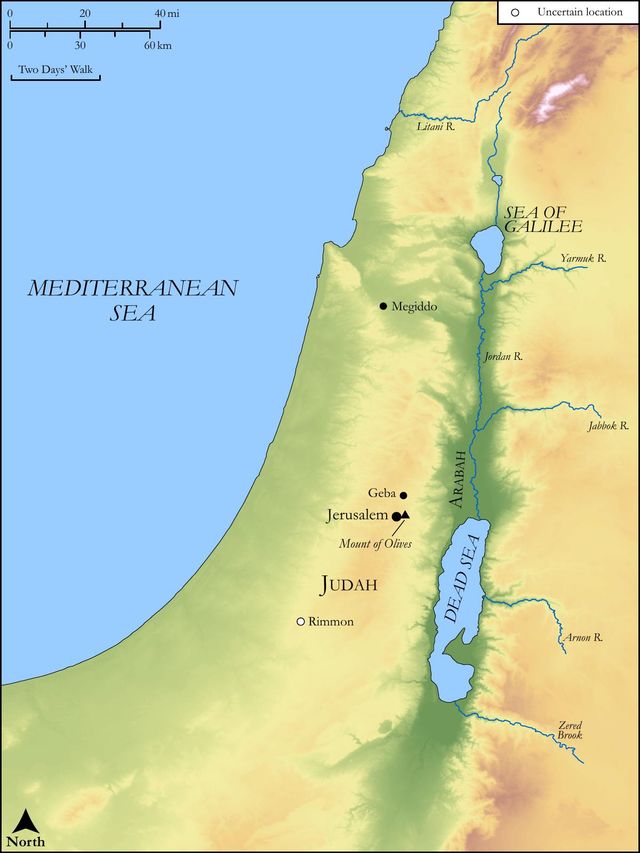
See on the biblical-era map
Study this verse
Public-domain commentary
Matthew Henry
From his Commentary on the Whole Bible. Henry comments on passages, not single verses — this entry covers Zechariah 13:1–6. His four-level outline is real structure in the source text, so it is rendered as structure.
Behold the Lamb of God taking away the sin of the world, the sin of the church; for therefore was the Son of God manifested, to take away our sin, Jo1 3:5.
I.He takes away the guilt of sin by the blood of his cross (Zac 13:1):
In that day, in the gospel-day, there shall be a fountain opened, that is, provision made for the cleansing of all those from the pollutions of sin who truly repent and are sorry for them. In that day, when the Spirit of grace is poured out to set them a mourning for their sins, they shall not mourn as those who have no hope, but they shall have their sins pardoned, and the comfort of their pardon in their bosoms. Their consciences shall be purified and pacified by the blood of Christ, which cleanses from all sin, Jo1 1:7. For Christ is exalted to give both repentance and remission of sins; and where he gives the one no doubt he gives the other. This fountain opened is the pierced side of Jesus Christ, spoken of just before (Zac 12:10), for thence came there out blood and water, and both for cleansing. And those who look upon Christ pierced, and mourn for their sins that pierced him, and are therefore in bitterness for him, may look again upon Christ pierced and rejoice in him, because it pleased the Lord thus to smite this rock, that it might be to us a fountain of living waters. See here,
1.How we are polluted; we are all so; we have sinned, and sin is uncleanness; it defiles the mind and conscience, renders us odious to God and uneasy in ourselves, unfit to be employed in the service of God and admitted into communion with him, as those who were ceremonially unclean were shut out of the sanctuary. The house of David and the inhabitants of Jerusalem are under sin, which is uncleanness. The truth is, we are all as an unclean thing, and deserve to have our portion with the unclean.
2.How we may be purged. Behold, there is fountain opened for us to wash in, and there are streams flowing to us from that fountain, so that, if we be not made clean, it is our own fault. The blood of Christ, and God's pardoning mercy in that blood, revealed in the new covenant, are,
(1.)A fountain; for there is in them an inexhaustible fulness. There is mercy enough in God, and merit enough in Christ, for the forgiving of the greatest sins and sinners, upon gospel-terms. Such were some of you, but you are washed, Co1 6:11. Under the law there were a brazen laver and a brazen sea to wash in; those were but vessels, but we have a fountain to ourselves, overflowing, ever-flowing.
(2.)A fountain opened; for, whoever will, may come and take the benefit of it; it is opened, not only to the house of David, but to the inhabitants of Jerusalem, to the poor and mean as well as to the rich and great; or it is opened for all believers, who, as the spiritual seed of Christ, are of the house of David, and, as living members of the church, are inhabitants of Jerusalem. Through Christ all that believe are justified, are washed from their sins in his blood, that they may be made to our God kings and priests, Rev 1:5, Rev 1:6.
II.He takes away the dominion of sin by the power of his grace, even of beloved sins.
This evermore accompanies the former; those that are washed in the fountain opened, as they are justified, so they are sanctified; the water came with the blood out of the pierced side of Christ. It is here promised that in that day,
1.Idolatry shall be quite abolished and the people of the Jews shall be effectually cured of their inclination to it (Zac 13:2): I will cut off the names of the idols out of the land. The worship of the idols of their fathers shall be so perfectly rooted out that in one generation or two it shall be forgotten that ever there were such idols among them; they shall either not be named at all or not with any respect; they shall no more be remembered, as was promised, Hos 2:17. This was fulfilled in the rooted aversion which the Jews had, after the captivity, to idols and idolatry, and still retain to this day; it was fulfilled also in the ready conversion of many to the faith of Christ, by which they were taken off from making an idol of the ceremonial law, as the unbelieving Jews did; and it is still in the fulfilling when souls are brought off from the world and the flesh, those two great idols, that they may cleave to God only.
2.False prophecy shall also be brought to an end: I will cause the prophets and the unclean spirit, the prophets that are under the influence of the unclean spirit, to pass out of the land. The devil is an unclean spirit; sin and uncleanness are from him; he has his prophets, that serve his interests and receive their instructions from him. Take away the unclean spirit, and the prophets would not deceive as they do; take away the false prophets that produce sham commissions, and the unclean spirit could not do the mischief he does. When God designs the silencing of the false prophets he banishes the unclean spirit out of the land, that wrought in them, and was a rival with him for the throne in the heart. The church of the Jews, when they were addicted to idols, did also dote much upon false prophets, who flattered them in their sins with promises of impunity and peace; but here it is promised, as a blessed effect of the promised reformation, that they should be very much set against false prophets, and zealous to clear the land of them; they were so after the captivity, till, through the blindness of their zeal against false prophets, they had put Christ to death under that character, and, after that, there arose many false Christs and false prophets, and deceived many, Mat 24:11. It is here foretold,
(1.)That false prophets, instead of being indulged and favoured, should be brought to condign punishment even by their nearest relations, which would be as great an instance as any of flagrant zeal against those deceivers (Zac 13:3): When any shall set up for a prophet, and shall speak lies in the name of the Lord, shall preach that which tends to draw people from God and to confirm them in sin, his own parents shall be the first and most forward to prosecute him for it, according to the law. Deu 13:6-11, "If thy son entice thee secretly from God, thou shalt surely kill him. Show thy indignation against him, and prevent any further temptation from him." His father and his mother shall thrust him through when he prophesies. Note, We ought to conceive, and always to retain, a very great detestation and dread of every thing that would draw us out of the way of our duty into by-paths, as those who cannot bear that which is evil, Rev 2:2. And holy zeal for God and godliness will make us hate sin, and dread temptation, most in those whom naturally we love best, and who are nearest to us; there our danger is greatest, as Adam's from Eve, Job's from his wife; and there it will be the most praiseworthy to show our zeal, as Levi, who, in the cause of God, did not acknowledge his brethren, nor know his own children, Deu 33:9. Thus we must hate and forsake our nearest relations when they come in competition with our duty to God, Luk 14:26. Natural affections, even the strongest, must be over-ruled by gracious affections.
(2.)That false prophets should be themselves convinced of their sin and folly, and let fall their pretensions (Zac 13:4): "The prophets shall be ashamed every one of his vision; they shall not repeat it, or insist upon it, but desire that it may be forgotten and no more said of it, being ready themselves to own it was a sham, because God has by his grace awakened their consciences and shown them their error, or because the event disproves their predictions, and gives them the lie, or because their prophecies do not meet with such a favourable reception as they used to meet with, but are generally despised and distasted; they perceive the people ashamed of them, which makes them begin to be ashamed of themselves. And therefore they shall no longer wear a rough garment, or garment of hair, as the true prophets used to do, in imitation of Elijah, and in token of their being mortified to the pleasures and delights of sense." The pretenders had appeared in the habit of true prophets; but, their folly being now made manifest, they shall lay it aside, no more to deceive and impose upon unthinking unwary people by it. A modest dress is a very good thing, if it be the genuine indication of a humble heart, and is to instruct; but it is a bad thing if it be the hypocritical disguise of a proud ambitious heart, and is to deceive. Let men be really as good as they seem to be, but not seem to be better than really they are. This pretender, as a true penitent,
[1.]Shall undeceive those whom he had imposed upon: He shall say, "I am no prophet, as I have pretended to be, was never designed nor set apart to the office, never educated nor brought up for it, never conversant among the sons of the prophets. I am a husbandman, and was bred to that business; I was never taught of God to prophesy, but taught of man to keep cattle" Amos was originally such a one too, and yet was afterwards called to be a prophet, Amo 7:14, Amo 7:15. But this deceiver never had any such call. Note, Those who sorrow after a godly sort for their having deceived others will be forward to confess their sin, and will be so just as to rectify the mistakes which they have been the cause of. Thus those who had used curious arts, when they were converted showed their deeds, and by what fallacies they had cheated the people, Act 19:18.
[2.]He shall return to his own proper employment, which is the fittest for him: I will be a husbandman (so it may be read); "I will apply myself to my calling again, and meddle no more with things that belong not to me; for man taught me to keep cattle from my youth, and cattle I will again keep, and never set up for a preacher any more." Note, When we are convinced that we have gone out of the way of our duty we must evince the truth of our repentance by returning to it again, though it be the severest mortification to us.
[3.]He shall acknowledge those to be his friends who by a severe discipline were instrumental to bring him to a sight of his error, Zac 13:6. When he who with the greatest assurance had asserted himself so lately to be a prophet suddenly drops his claims, and says, I am no prophet, every body will be surprised at it, and some will ask, "What are these wounds, or marks of stripes, in thy hands? how camest thou by them? Hast thou not been examined by scourging? And is not that it that has brought thee to thyself?" (Vexatio dat intellectum - Vexation sharpens the intellect.) "Hast thou not been beaten into this acknowledgment? Was it not the rod and reproof that gave thee this wisdom?" And he shall own, "Yes, it was; these are the wounds with which I was wounded in the house of my friends, who bound me, and used me hardly and severely, as a distracted man, and so brought me to my senses." By this it appears that those parents of the false prophet that thrust him through (Zac 13:3) did not do it till they had first tried to reclaim him by correction, and he would not be reclaimed; for so was the law concerning a disobedient son - his parents must first have chastened him in vain before they were allowed to bring him forth to be stoned, Deu 21:18, Deu 21:19. But here is another who was reduced by stripes, and so prevented the capital punishment; and he had the sense and honesty to own that they were his friends, his real friends, who thus wounded him, that they might reclaim him; for faithful are the wounds of a friend, Pro 27:6. Some good interpreters, observing how soon this comes after the mention of Christ's being pierced, think that these are the words of that great prophet, not of the false prophet spoken of before. Christ was wounded in his hands, when they were nailed to the cross, and, after his resurrection, he had the marks of these wounds; and here he tells how he came by them; he received them as a false prophet, for the chief priests called him a deceiver, and upon that account would have him crucified; but he received them in the house of his friends - the Jews, who should have been his friends; for he came to his own, and, though they were his bitter enemies, yet he was pleased to call them his friends, as he did Judas (Friend, wherefore hast thou come?) because they forwarded his sufferings for him; as he called Peter Satan - an adversary, because he dissuaded him from them.
Historical interpretation
Historical reception
1 surviving comment on this verse from the historical church.
(Chapter 13, Verse 1) On that day there will be a flowing fountain for the house of David and the inhabitants of Jerusalem, for cleansing from sin and impurity. LXX: On that day there will be an open fountain for the house of David and the inhabitants of Jerusalem, for transformation and purification. Concerning this fountain, which is said to flow out from the house of David, it is written in the prophet Ezekiel (Ezekiel 47) that the fountain shall burst forth in the house of the Lord and become a river, which is called the water of forgiveness and indulgence; and it shall flow to the desert and the sea, which is now called the Dead Sea, and it shall give life to all kinds of fish, and trees of various kinds shall grow on both banks, bearing abundant fruit every month. And so that we may know that the house, that is, the temple of God, is itself the house of David, which in Ezekiel is called the house of God, and in Zechariah is called the house of David: this fountain, coming forth from the house of God, is brought back to the Church and to the knowledge of the Scriptures, so that we may all be reborn in Christ, and in the water of baptism our sins may be forgiven to us. Nothing is more unclean than a menstruating woman, who makes whatever she touches unclean: and yet these impurities of Christ are washed away by baptism. For the ablution of sins and menstruation, the LXX translated it as transference and sprinkling: that we may go from the Law to the Gospel, from the letter to the spirit, from the shadow to the truth, that the future and eternal may succeed the brief and present. Moreover, sprinkling signifies the blood of the Lord, about which Peter the Apostle also speaks: Grace to you and peace be multiplied, in obedience and the sprinkling of the blood of Jesus Christ (I Peter 1:2). And again: Knowing that you were not redeemed with corruptible things like silver and gold, but with the precious blood of Christ, as of a lamb without blemish and without spot (1 Peter, 18), with which whoever is sprinkled and redeemed, can say with the prophet: You shall sprinkle me, O Lord, with hyssop, and I shall be cleansed: You shall wash me, and I shall be made whiter than snow (Psalm 50, 9).
Continue studying Zechariah 13:1 across the web’s major study libraries — every link below opens this exact verse, chapter, or book on the destination site.
Read & Compare
 BibleGatewayThis verse in more than 200 translations and 70 languages.
 Bible.comThe YouVersion reader — hundreds of translations, reading plans, and highlights.
 ESV.orgCrossway's official English Standard Version reader.
 NET BibleThe NET translation with 60,000+ translators' notes on every rendering decision.
 STEP BibleTyndale House's free study tool — original text, vocabulary, and scholarly resources.
 BibliaLogos Bible Software's free web reader.
 USCCBThe New American Bible (Revised Edition) with the U.S. bishops' study notes.
Commentaries
 BibleHub CommentariesDozens of classic commentaries on this verse, gathered on one page.
 StudyLightMore than 100 commentary sets — the largest collection on the web.
 BibleRefPlain-English commentary on what this verse means, verse by verse.
 Enduring WordDavid Guzik's free commentary on this chapter, widely used by Bible teachers.
 Bible Study ToolsVerse commentary alongside Greek and Hebrew study aids.
Original Language & Research
- BibleHub InterlinearThe verse word by word — original language, transliteration, and English.
- BibleHub LexiconEvery word's original-language definition and Strong's entry.
 Blue Letter BibleDeep-study tools — Strong's numbers, concordance, and word studies.
 SefariaThe Hebrew text with Rashi and centuries of Jewish commentary.
Sermons, Hymns & Audio


TrulyRandomVerse is not affiliated with these sites and doesn’t control their content. They’re linked because they’re genuinely useful.
Summary
Zechariah 13:1 presents a profound prophetic vision of a future day when God will provide a radical and comprehensive means of purification for His people, the "house of David and the inhabitants of Jerusalem." This "fountain" will be opened to cleanse them from both moral transgression (sin) and ritual or spiritual defilement (uncleanness), signifying a complete divine initiative for restoration and reconciliation.
Context
ShowHideLiterary Context
Zechariah 13:1 is situated within the latter portion of the book, specifically chapters 12-14, which comprise a distinct prophetic oracle concerning the eschatological future of Israel and the coming of the Messiah. Chapter 12 describes God's defense of Jerusalem against its enemies and the nation's repentance and mourning over the "one they have pierced" (Zechariah 12:10). Chapter 13 then immediately follows, providing the divine response to this repentance: a provision for cleansing. This verse sets the stage for the subsequent descriptions of the removal of idolatry and false prophecy (Zechariah 13:2-6) and the striking of the shepherd (Zechariah 13:7), all leading into the climactic events of the Lord's return and the establishment of His kingdom in chapter 14 (Zechariah 14). Thus, Zechariah 13:1 serves as the foundational promise of purification that enables the full restoration and spiritual transformation of God's people in the Messianic age.
Historical & Cultural Context
Zechariah prophesied to the Jewish community that had returned from Babylonian exile, a people struggling to rebuild their temple and their national identity. They were still grappling with the consequences of past sins that led to the exile, and the need for spiritual purity was paramount for their relationship with a holy God. The concepts of "sin" (moral transgression against God's law) and "uncleanness" (ritual impurity that separated one from the community and the temple, often associated with idolatry, bodily discharges, or contact with death) were central to Old Testament theology and daily life. The Mosaic Law provided various sacrifices and rituals for dealing with these issues, but they were largely provisional and temporary. The "house of David" represents the royal lineage and, by extension, the leadership and identity of the nation, while "inhabitants of Jerusalem" signifies the entire covenant community. The promise of a "fountain opened" speaks to a divine, permanent, and accessible solution that transcends the limitations of the existing sacrificial system, addressing the deep-seated spiritual defilement of a people who had repeatedly fallen into idolatry and disobedience.
Key Themes
ShowHideThis verse powerfully contributes to several key themes within Zechariah and broader biblical theology. First, it highlights Divine Provision for Cleansing, emphasizing that God Himself initiates and provides the means for His people's purification, rather than human effort or ritual alone. This underscores God's grace and His commitment to restoring His covenant relationship. Second, it speaks to Comprehensive Forgiveness and Purification, as the "fountain" addresses both "sin" (moral guilt and rebellion) and "uncleanness" (ritual or spiritual defilement), indicating a holistic cleansing from all forms of human brokenness and alienation from God. This comprehensive nature contrasts with the limited scope of Old Covenant rituals. Third, the phrase "In that day" points to Eschatological Hope and Messianic Fulfillment. This prophetic marker consistently signals a future, decisive intervention by God, often tied to the coming of the Messiah and the establishment of His kingdom. The "fountain" imagery, therefore, implicitly points forward to the ultimate, once-for-all sacrifice that would truly cleanse God's people, a theme echoed in passages like Jeremiah 31:31-34 which speaks of a new covenant where sins are remembered no more.
Exposition and Analysis
ShowHideKey Word Analysis
ShowHideThis term, H3117, signifies a period of time, often used figuratively to denote a specific era or significant event. In prophetic literature, "in that day" frequently refers to an eschatological period, a decisive moment of divine intervention, often associated with the coming of the Messiah, the judgment of nations, or the establishment of God's kingdom. Here, it points to a future, divinely appointed time when the promised cleansing will occur.
Literally meaning "something dug" or a "source (of water)," a "spring," or a "well-spring." The imagery of a fountain suggests a continuous, flowing, and abundant supply of water, symbolizing life, refreshment, and purification. Unlike a stagnant pool or a limited cistern, a fountain provides an inexhaustible source, emphasizing the sufficiency and ongoing availability of the cleansing God will provide.
Denoting an "offence," "transgression," or "habitual sinfulness," along with its penalty, occasion, or expiation. This term covers moral guilt, rebellion against God's commands, and the inherent human condition of estrangement from God. It encompasses both specific acts of wrongdoing and the pervasive nature of humanity's fallen state.
Meaning "rejection" or "impurity," especially personal (like menstruation) or moral (like idolatry or incest). This term refers to ritual, ceremonial, or spiritual defilement that renders one unfit for worship or fellowship with God and His people. It highlights the pervasive nature of defilement that separated individuals from God's holy presence, emphasizing the need for comprehensive purification.
Verse Breakdown
ShowHide"In that day"
This phrase introduces a future, divinely appointed time, signaling a significant eschatological event. It points to a decisive moment in God's redemptive plan, distinct from the present reality, when a new and profound work of purification will commence.
"there shall be a fountain opened"
This powerful metaphor signifies a new, accessible, and abundant source of purification. The passive voice "opened" emphasizes that this is God's initiative and provision, not something achieved by human effort. The "fountain" imagery suggests a continuous, life-giving flow of cleansing, available to all who need it.
"to the house of David and to the inhabitants of Jerusalem"
This specifies the recipients of this divine provision. "The house of David" represents the royal line, leadership, and the continuity of God's covenant with Israel, while "the inhabitants of Jerusalem" signifies the entire covenant community, encompassing all of God's people. This indicates a comprehensive, national, and spiritual cleansing for all who belong to God's chosen people.
"for sin and for uncleanness"
This clarifies the purpose and scope of the fountain. "Sin" refers to moral transgressions and guilt, while "uncleanness" denotes ritual, ceremonial, or spiritual defilement. The dual mention underscores the comprehensive nature of the cleansing, addressing both the active rebellion against God's law and the pervasive defilement that separates humanity from a holy God.
Literary Devices
ShowHideZechariah 13:1 employs several powerful literary devices. The most prominent is Metaphor, where the "fountain" serves as a vivid image for a source of purification. This metaphor conveys the ideas of continuous flow, abundance, and accessibility, contrasting with the limited and temporary nature of Old Covenant purification rituals. The phrase "In that day" is a classic example of Prophecy, signaling a future, divinely determined event within an eschatological framework. This device creates anticipation and emphasizes the certainty of God's redemptive plan. The parallel structure of "for sin and for uncleanness" utilizes Merism, where two contrasting or complementary terms are used to express a totality. By mentioning both "sin" (moral transgression) and "uncleanness" (ritual/spiritual defilement), the prophet indicates a complete and all-encompassing purification that addresses every aspect of human defilement before God. The entire verse functions as a Divine Promise, offering hope and assurance of God's future redemptive work.
Theological and Thematic Connections
ShowHideZechariah 13:1 stands as a pivotal Old Testament prophecy, pointing to God's ultimate solution for humanity's profound problem of sin and defilement. It highlights God's unwavering commitment to restore His people to purity and fellowship, a theme that runs throughout the biblical narrative from the Fall in Genesis 3 to the New Creation in Revelation 21-22. The "fountain opened" signifies not merely a ritualistic cleansing but a deep, spiritual transformation, made possible by divine initiative. This promise anticipates a new covenant reality where forgiveness is complete and accessible, far surpassing the temporary efficacy of the Mosaic sacrificial system. It underscores the truth that true cleansing is always a gift of God's grace, flowing from His very nature as holy and merciful.
Reflection and Application
ShowHideZechariah 13:1 offers profound comfort and hope to all who recognize their need for cleansing from sin and uncleanness. It reminds us that our deepest spiritual defilement is not a barrier to God's grace, but rather the very condition for which He has provided a divine solution. This verse invites us to consider the source of our spiritual purity—not our own efforts, rituals, or good deeds, but God's sovereign and gracious initiative. For believers, this "fountain" is eternally open through the atoning work of Jesus Christ, providing continuous access to forgiveness, renewal, and a conscience cleansed from dead works. This truth should lead to humble gratitude, confident access to God, and a life lived in the freedom and purity that His provision enables. It calls us to regularly draw near to this spiritual fountain, acknowledging our ongoing need for His cleansing grace.
Questions for Reflection
ShowHideFAQ
ShowHideWhat does "In that day" refer to in Zechariah 13:1?
ShowHide"In that day" is a common prophetic phrase in the Old Testament, particularly in books like Zechariah, Joel, and Isaiah. It typically refers to a future, decisive period of divine intervention, often associated with the end times, the Messianic era, or the establishment of God's kingdom. In Zechariah 13:1, it specifically points to a future time when God will provide a unique and ultimate means of cleansing for His people, which Christian theology understands to be fulfilled in the redemptive work of Jesus Christ. This phrase signals a pivotal moment in God's unfolding plan of salvation.
What is the significance of the "fountain" imagery in this verse?
ShowHideThe "fountain" (Hebrew: maqôwr) is a powerful metaphor signifying a continuous, abundant, and accessible source of purification. In a land where water was precious and often scarce, a flowing spring represented life, refreshment, and cleansing. Unlike the temporary and limited nature of Old Covenant sacrifices and purification rites, this "fountain" suggests an inexhaustible supply of divine cleansing. It emphasizes that the provision for sin and uncleanness is not a one-time event but an ever-present reality, flowing from God's gracious initiative to restore His people to purity. It contrasts with the need for repeated sacrifices under the Law, pointing to a permanent solution.
Christ-Centered Fulfillment
ShowHideZechariah 13:1 finds its ultimate and profound fulfillment in the person and work of Jesus Christ. The "fountain opened" is revealed to be the atoning sacrifice of Jesus on the cross, where His shed blood provides the complete and eternal cleansing for humanity's sin and uncleanness. Just as the prophet foretold, God Himself provided the means of purification, not through human effort or ritual, but through His Son. The blood of Christ, the Lamb of God who takes away the sin of the world, is the inexhaustible source that cleanses us from all unrighteousness (1 John 1:7). This divine provision is not limited to a specific nation or era but is accessible to "whosoever believes in Him" (John 3:16). Through Christ, we are washed, sanctified, and justified (1 Corinthians 6:11), allowing us to draw near to God with a clean conscience (Hebrews 9:14). He is the living water that quenches spiritual thirst and purifies the soul, establishing a new covenant where sins are remembered no more (Hebrews 8:12). Thus, the prophetic imagery of Zechariah culminates in the glorious reality of Christ's finished work, making a way for all people to be reconciled to a holy God.