


Zechariah 12:10
Bible text: King James Version (1769 Blayney text) · Public domain
Bible text: King James Version with Strong's numbers · Public domain
Bible text: Berean Standard Bible · Public domain
Bible text: American Standard Version (1901) · Public domain
Bible text: World English Bible, Messianic edition · Public domain
Bible text: Geneva Bible (1599) · Public domain
Bible text: Young's Literal Translation · Public domain
- וְשָׁפַכְתִּיve·sha·fakh·Tiand I will pour outH8210Conj-w ¦ V-Qal-ConsecPerf-1csVerb Qal Consecutive Perfect 1st Singular common genderוְandשָׁפַכְתִּיI will pour out
- עַל'alonH5921PrepPreposition
- בֵּיתbeit[the] house ofH1004N-mscNoun Singular Masculine Construct
- דָּוִידda·VidDavidH1732N-proper-mNoun Proper Masculine
- וְעַלve·'Aland onH5921Conj-w ¦ PrepPrepositionוְandעַלon
- יוֹשֵׁבyo·Shev[the] inhabitant[s] ofH3427V-Qal-Prtcpl-msVerb Qal Participle Singular Masculine Construct
- יְרוּשָׁלִַםye·ru·sha·LimJerusalemH3389N-properNoun Proper Location
- רוּחַRu·acha spirit ofH7307N-fscNoun Singular Feminine Construct
- חֵןchenfavorH2580N-msNoun Singular Masculine Absolute
- וְתַחֲנוּנִיםve·Ta·cha·nu·Nimand supplicationsH8469Conj-w ¦ N-mpNoun Plural Masculine Absoluteוְandתַחֲנוּנִיםsupplications
- וְהִבִּיטוּve·hi·Bi·tuand they will lookH5027Conj-w ¦ V-Hiphil-ConsecPerf-3cpVerb Hiphil Consecutive Perfect 3rd Plural common genderוְandהִבִּיטוּthey will look
- אֵלַי'e·Laito meH413Prep ¦ 1csPrepositionאֵלַtoיme
- אֵת'et<obj.>H853DirObjMParticle Object Indicator
- אֲשֶׁר'a·Sher[the one] whomH834RelParticle Relative
- דָּקָרוּda·Ka·ruthey have pierced throughH1856V-Qal-Perf-3cpVerb Qal Perfect 3rd Plural common gender
- וְסָפְדוּve·sa·fe·Duand they will mournH5594Conj-w ¦ V-Qal-ConsecPerf-3cpVerb Qal Consecutive Perfect 3rd Plural common genderוְandסָפְדוּthey will mourn
- עָלָיו'a·Lavon himH5921Prep ¦ 3msPrepositionעָלָיonוhim
- כְּמִסְפֵּדke·mis·Pedlike mourningH4553Prep-k ¦ N-msNoun Singular Masculine Absoluteכְּlikeמִסְפֵּדmourning
- עַל'alonH5921PrepPreposition
- הַיָּחִידhai·ya·Chid<the> only [son]H3173Art ¦ Adj-msAdjective Singular Masculine Absoluteהַ<the>יָּחִידonly [son]
- וְהָמֵרve·ha·Merand they will show bitternessH4843Conj-w ¦ V-Hiphil-InfVerb Hiphil Infinitive Constructוְandהָמֵרthey will show bitterness
- עָלָיו'a·Lavon himH5921Prep ¦ 3msPrepositionעָלָיonוhim
- כְּהָמֵרke·ha·Meras shows bitternessH4843Prep-k ¦ V-Hiphil-InfVerb Hiphil Infinitive Constructכְּasהָמֵרshows bitterness
- עַל'alonH5921PrepPreposition
- הַבְּכוֹרha·be·Khor<the> firstbornH1060Art ¦ N-msNoun Singular Masculine Absoluteהַ<the>בְּכוֹרfirstborn
English is a literal word-by-word gloss of the Hebrew, not the KJV's wording. Why?
This is the original text the KJV's translators worked from — each Hebrew word with its own literal English meaning in this verse, prepared by scholars at Tyndale House, Cambridge. The KJV translates whole sentences, not word by word, so its wording differs: one Hebrew word can become several English words, and the KJV may choose “the LORD” where the gloss reads “Yahweh”. Both are faithful — they answer different questions. For the KJV's own rendering, switch to the KJV text.
Details
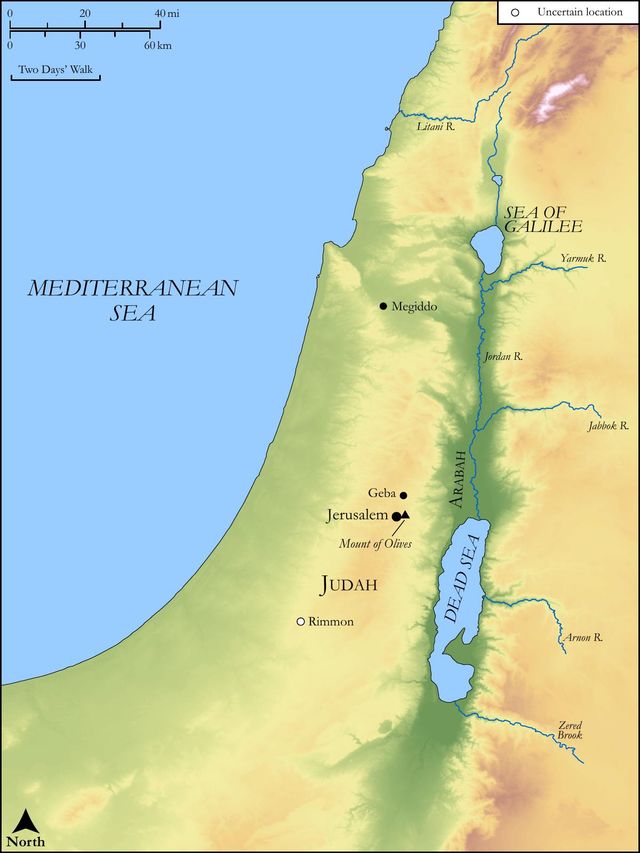
See on the biblical-era map
Study this verse
Public-domain commentary
Matthew Henry
From his Commentary on the Whole Bible. Henry comments on passages, not single verses — this entry covers Zechariah 12:9–14. His four-level outline is real structure in the source text, so it is rendered as structure.
The day here spoken of is the day of Jerusalem's defence and deliverance, that glorious day when God will appear for the salvation of his people, which, if it do refer to the successes which the Jews had against their enemies in the time of the Maccabees, yet certainly looks further, to the gospel-day, to Christ's victories over the powers of darkness and the great salvation he has wrought for his chosen. Now we have here an account of two remarkable works designed in that day.
I.A glorious work of God to be wrought for his people:
"I will seek to destroy all the nations that come against Jerusalem, Zac 12:9. Nations come against Jerusalem, many and mighty nations; but they shall all be destroyed, their power shall be broken, and their attempts baffled; the mischief they intend shall return upon their own head." God will seek to destroy them, not as if he were at a loss for ways and means to bring it about (Infinite Wisdom was never nonplussed), but his seeking to do it intimates that he is very earnest and intent upon it (he is jealous for Zion with great jealousy, and has the day of vengeance in his heart) and that he overrules means and instruments, and all the motions and operations of second causes, in order to it. He is framing evil against them; when he seems to be setting them up he is seeking to destroy them. In Christ's first coming, he sought to destroy him that had the power of death, and did destroy him, bruised the serpent's head, and broke all the powers of darkness that fought against God's kingdom among men and against the faithful friends and subjects of that kingdom; he spoiled them, and made a show of them openly. In his second coming, he will complete their destruction, when he shall put down all opposing rule, principality, and power, and death itself shall be swallowed up in that victory. The last enemy shall be destroyed of all that fought against Jerusalem.
II.A gracious work of God to be wrought in his people, in order to the work that is to be wrought for them.
When he seeks to destroy their enemies he will pour upon them the Spirit of grace and supplication. Note, When God intends great mercy for his people the first thing he does is to set them a praying; thus he seeks to destroy their enemies by stirring them up to seek to him that he would do it for them; because, though he has proposed it and promised it, and it is for his own glory to do it, yet he will for this be enquired of by the house of Israel, Eze 36:37. Ask, and it shall be given. This honour will he have to himself, and this honour will he put upon prayer and upon praying people. And it is a happy presage to the distressed church of deliverance approaching, and is, as it were, the dawning of its day, when his people are stirred up to cry mightily to him for it. But this promise has reference to, and is performed in, the graces of the Spirit given to all believers, as that Isa 44:3, I will pour my Spirit upon thy seed, which was fulfilled when Jesus was glorified, Joh 7:39. It is a promise of the Spirit, and with him of all spiritual blessings in heavenly things by Christ. Now observe here,
1.On whom these blessings are poured out.
(1.)On the house of David, on the great men; for they are no more, and no better, than the grace of God makes them. It was promised (Zac 12:8) that the house of David should be as the angel of the Lord. Now, in order to that, the Spirit of grace is poured upon them; for the more the saints have of the Spirit of grace the more like they are to the holy angels. When God was about to appear for the land, he poured his Spirit of grace upon the house of David, the leading men of the land. It bodes well to a people when princes and great men go before the rest in that which is good, as Ch2 20:5. The house of David is all summed up in Jesus Christ, the Son of David; and upon him, as the head, the Spirit of grace is poured out, from him to be diffused to all his members; from his fulness we receive, and grace for grace.
(2.)On the inhabitants of Jerusalem, the common people; for the operations of the Spirit are the same upon the mean and weak Christians that they are upon the strong and more grown. The inhabitants of Jerusalem cannot influence public affairs by their powers and policies, as the great men of the house of David may, yet they may do good service by their prayers, and therefore upon them the Spirit shall be poured out. The church is Jerusalem, the heavenly Jerusalem; all true believers, that have their conversation in the heaven, are inhabitants of this Jerusalem, and to them this promise belongs. God will pour his Spirit upon them. This is the earnest which all that believe in Christ shall receive; thus they are sanctified; thus they are sealed.
2.What these blessings are: I will pour upon them the Spirit. That includes all good things, as it qualifies us for the favour of God, and all his other gifts. He will pour out the Spirit,
(1.)As a Spirit of grace, to sanctify us and to make us gracious.
(2.)As a Spirit of supplications, inclining us to, instructing and assisting us in, the duty of prayer. Note, Wherever the Spirit is given as a Spirit of grace, he is given as a Spirit of sanctification. Wherever he is a Spirit of adoption, he teaches to cry, Abba, Father. As soon as ever Paul was converted, Behold, he prays, Act 9:11. You may as soon find a living man without breath as a living saint without prayer. There is a more plentiful effusion of the Spirit of prayer now under the gospel than was under the law; and the further the work of sanctification is carried in us the better is the work of supplication carried on by us.
3.What the effect of them will be: I will pour upon them the Spirit of grace. One would think that it should follow, "And they shall look on him whom they have believed, and shall rejoice" (and it is true that that is one of the fruits of the pouring out of the Spirit, whence we read of the joy of the Holy ghost), but it follows, They shall mourn; for there is a holy mourning, that is the effect of the pouring out of the Spirit, a mourning for sin, which is of use to quicken faith in Christ and qualify for joy in God. It is here made the matter of a promise that they shall mourn, for there is a mourning that will end in rejoicing and has a blessing entailed upon it. This mourning is a fruit of the Spirit of grace, an evidence of a work of grace in the soul, and a companion of the Spirit of supplication, as it expresses lively affections working in prayer; hence prayers and tears are often put together, Kg2 20:5. Jacob, that wrestler with God, wept and made supplication. But here it is a mourning for sin that is the effect of the pouring out of the Spirit.
(1.)It is a mourning grounded upon a sight of Christ: They shall look on me whom they have pierced, and shall mourn for him. Here,
[1.]It is foretold that Christ should be pierced, and this scripture is quoted as that which was fulfilled when Christ's side was pierced upon the cross; see Joh 19:37.
[2.]He is spoken of as one whom we have pierced; it is spoken primarily of the Jews, who persecuted him to death (and we find that those who pierced him are distinguished from the other kindreds of the earth that shall wail because of him, Rev 1:7); yet it is true of us all as sinners, we have pierced Christ, inasmuch as our sins were the cause of his death, for he was wounded for our transgressions, and they are the grief of his soul; he is broken with the whorish heart of sinners, who therefore are said to crucify him afresh and put him to open shame.
[3.]Those that truly repent of sin look upon Christ as one whom they have pierced, who was pierced for their sins and is pierced by them; and this engages them to look unto him, as those that are deeply concerned for him.
[4.]This is the effect of their looking to Christ; it makes them mourn. This was particularly fulfilled in those to whom Peter preached Christ crucified; when they heard it those who had had a hand in piercing him were pricked to the heart, and cried out, What shall we do? It is fulfilled in all those who sorrow for sin after a godly sort; they look to Christ, and mourn for him, not so much for his sufferings as for their own sins that procured them. Note, The genuine sorrows of a penitent soul flow from the believing sight of a pierced Saviour. Looking by faith upon the cross of Christ will set us a mourning for sin after a godly sort.
(2.)It is a great mourning. [1.] it is like the mourning of a parent for the death of a beloved child. They shall mourn for sin as one mourns for an only son, in whose grave the hopes of his family are buried, and shall be inwardly in bitterness as one that is in bitterness for his first-born, as the Egyptians were when there was a cry throughout all their land for the death of their first-born. The sorrow of children for the death of their parents is sometimes counterfeited, is often small, and soon wears off and is forgotten; but the sorrow of parents for a child, for a son, for an only son, for a first-born, is natural, sincere, unforced, and unaffected, it is secret and lasting; such are the sorrows of a true penitent, flowing purely from love to Christ above any other. [2.] It is like the mourning of a people for the death of a wise and good prince. It shall be like the mourning of Hadadrimmon in the valley of Megiddon, where good king Josiah was slain, for whom there was a general lamentation (Zac 12:11), and perhaps the greater because they were told that it was their sin that provoked God to deprive them of so great a blessing; therefore they cried out, The crown has fallen from our head. Woe unto us, for we have sinned! Lam 5:16. Christ is our King; our sins were his death, and, for that reason, ought to be our grief.
(3.)It is a general universal mourning (Zac 12:12): The land shall mourn. The land itself put on mourning at the death of Christ, for there was then darkness over all the land, and the earth trembled; but this is a promise that, in consideration of the death of Christ, multitudes shall be effectually brought to sorrow for sin and turn to God; it shall be such a universal gracious mourning as was when all the house of Israel lamented after the Lord, Sa1 7:2. Some think this is yet to have its complete accomplishment in the general conversion of the Jewish nation.
(4.)It is also a private particular mourning. There shall be not only a mourning of the land, by its representatives in a general assembly (as Jdg 2:5, when the place was called Bochim - A place of weepers), but it shall spread itself into all corners of the land: Every family apart shall mourn (Zac 12:12), all the families that remain, Zac 12:14. All have contributed to the guilt, and therefore all shall share in the grief. Note, The exercises of devotion should be performed by private families among themselves, besides their joining in public assemblies for religious worship. National fasts must be observed, not only in our synagogues, but in our houses. In the mourning here foretold the wives mourn apart by themselves, in their own apartment, as Esther and her maids. And some think it intimates their denying themselves the use even of lawful delights in a time of general humiliation Co1 7:5. Four several families are here specified as examples to others in this mourning: - [1.] Two of them are royal families: the house of David, in Solomon, and the house of Nathan, another son of David, brother to Solomon, from whom Zerubbabel descended, as appears by Christ's genealogy, Luk 3:27-31. The house of David, particularly that of Nathan, which is now the chief branch of that house, shall go before in this good work. The greatest princes must not think themselves exempted from the law of repentance, but rather obliged most solemnly to express it, for the exciting of others, as Hezekiah humbled himself (Ch2 32:26), the princes and the king (Ch2 12:6), and the king of Nineveh, Jon 3:6. [2.] Two of them are sacred families (Zac 12:13), the family of the house of Levi, which was God's tribe, and in it particularly the family of Shimei, which was a branch of the tribe of Levi (Ch1 6:17), and probably some of the descendants of that family were now of note for preachers to the people or ministers to the altar. As the princes must mourn for the sins of the magistracy, so must the priests for the iniquity of the holy things. In times of general tribulation and humiliation the Lord's ministers are concerned to weep between the porch and the altar (Joe 2:17), and not only there, but in their houses apart; for in what families should godliness, both in the form and in the power of it, be found, if not in ministers' families?
Historical interpretation
Six Centuries of Reception
9 surviving comments on this verse. Each one is dated, so this reads as a timeline rather than a list.
Select a marker to jump to its quote. Markers stagger vertically where authors wrote within a few decades of each other.
The Jews therefore, because it was the preparation, that the bodies should not remain upon the cross on the sabbath day, (for that sabbath day was an high day,) besought Pilate that their legs might be broken, and that they might be taken away. Then came the soldiers, and brake the legs of the first, and of the other which was crucified with him. But when they came to Jesus, and saw that he was dead already, they brake not his legs: But one of the soldiers with a spear pierced his side, and forthwith came there out blood and water. And he that saw it bare record, and his record is true: and he knoweth that he saith true, that ye might believe. For these things were done, that the scripture should be fulfilled, A bone of him shall not be broken. And again another scripture saith, They shall look on him whom they pierced. [Zechariah 12:10]
And in what kind of sensation and punishment the wicked are to be, hear from what was said in like manner with reference to this; it is as follows: "Their worm shall not rest, and their fire shall not be quenched;" and then shall they repent, when it profits them not. And what the people of the Jews shall say and do, when they see Him coming in glory, has been thus predicted by Zechariah the prophet: "I will command the four winds to gather the scattered children; I will command the north wind to bring them, and the south wind, that it keep not back. And then in Jerusalem there shall be great lamentation, not the lamentation of mouths or of lips, but the lamentation of the heart; and they shall rend not their garments, but their hearts. Tribe by tribe they shall mourn, and then they shall look on Him whom they have pierced; and they shall say, Why, O Lord, hast Thou made us to err from Thy way? The glory which our fathers blessed, has for us been turned into shame."
We must after all this turn our attention to those scriptures also which forbid our belief in such a resurrection as is held by your Animalists (for I will not call them Spiritualists), that it is either to be assumed as taking place now, as soon as men come to the knowledge of the truth, or else that it is accomplished immediately after their departure from this life... Who has yet beheld Jesus descending from heaven in like manner as the apostles saw Him ascend, according to the appointment of the two angels? [Acts 1:11] Up to the present moment they have not, tribe by tribe, smitten their breasts, looking on Him whom they pierced. [John 19:37; Zechariah 12:10] No one has as yet fallen in with Elias; [Malachi 4:5] no one has as yet escaped from Antichrist; [1 John 4:3] no one has as yet had to bewail the downfall of Babylon. [Revelation 18:2] And is there now anybody who has risen again, except the heretic? He, of course, has already quitted the grave of his own corpse — although he is even now liable to fevers and ulcers; he, too, has already trodden down his enemies — although he has even now to struggle with the powers of the world. And as a matter of course, he is already a king — although he even now owes to Cæsar the things which are Cæsar's. [Matthew 22:21]
Then shall the son of perdition be brought forward as the accuser, with his demons and with his servants, by angels stern and inexorable. And they shall be given over to the fire that is never quenched, and to the worm that never sleeps, and to the outer darkness. For the crucifiers shall see him in human form, as he appeared to them “when he came” by the holy virgin in the flesh and as they crucified him. And he will show them the “prints of the” nails in his hands and feet, and his side pierced with the spear, and his head crowned with thorns, and his honorable cross. And once for all shall the people of the Hebrews see all these things, and they shall mourn and weep, as the prophet exclaims, “They shall look on him whom they have pierced.”
(Vers. 10.) And they shall look upon me whom they have pierced; and they shall mourn for him, as one mourns for an only son, and they shall grieve over him, as one grieves over a firstborn. LXX: And they shall look upon me, because they have insulted me; and they shall mourn over him with mourning, as over a dearest one; and they shall grieve with sorrow, as over a firstborn. The Hebrew letters Daleth and Res, that is, D and R, are similar and are distinguished only by a small mark. From which it happens that the same word, when read by different people, is translated differently. Let us give one example for the sake of understanding: And the clothing, he says, was a Linen Ephod (I Sam. II, 18), that is, a linen garment, for linum is called 'linen': hence, Baddim are called 'linen garments'. In the Hebrew and Latin language, some read Ephod Bar wrongly: for Bar can mean either 'son', 'bundle of grain', 'chosen', or 'curly'. What happened there due to an error in interpretation, we have also detected here. For if it is read as Dacaru (), it is understood to mean 'they pierced or nailed', but if the order is reversed, with the letters transposed, it is understood to mean 'they danced', as Racadu (). And the error arose due to the similarity of the letters. However, the beloved disciple John, who drew wisdom from the heart of the Lord and was a Hebrew among the Hebrews (John 19), did not greatly care about what the Greek letters contained; but he translated word for word, as he had read it in Hebrew, and said that it was fulfilled at the time of the Lord's passion. But if someone does not accept it, let him bear witness, from whom John has brought forth these words in the place of the Holy Scriptures: and when he does not find, he will be forced to accept the truth with ingratitude. But the Jews will mourn as over an only begotten and firstborn, signifying the same in the Lord Savior, both only begotten and firstborn. He is called only begotten, because of the nature's property: Firstborn, according to the Apostle, of those who rise from the dead (Colossians 1). For the only-begotten, most beloved, the Septuagint translated, about whom we read in the Gospel: This is my beloved Son, in whom I am well pleased (Matthew 3:17). Then they will grieve for having crucified Him when they see Him reigning in glory. The word κατωρχήσαντο, among the Greeks, is composed not from illusion, but from dance, namely that they danced against the Lord as if in jest, when they said in jest and laughed: Ah! You who destroy the temple, and in three days rebuild it: save yourself, coming down from the cross (Matthew 15:29, 30). They were speaking these and other mocking words, and dancing with a certain madness and mockery.
Now, indeed, that body is worthy of a heavenly dwelling place, not subject to death, not changeable through the ages [of life]. For as he had grown to that age from infancy, so he does not decline to old age from the age which was young adulthood. He remains as he ascended; he is going to come to those to whom, before he comes, he wanted his word to be preached. So therefore he will come in a human form. The ungodly too will see this; those placed to the right will see it too; those separate to the left will see it too, as it was written, “They shall see him whom they have pierced.” If they will see him whom they have pierced, they will see the same body that they thrust through with a spear, [for] the Word is not struck by a spear.
And perhaps it is then that the words “all flesh” will become more perfectly fulfilled. Now I mean to say, flesh has seen him, but not all flesh. Then, however, at the judgment, as he comes with his angels to judge the living and the dead, “when all who are in tombs hear his voice and come forth, some to the resurrection of life, others to the resurrection of judgment,” it is not only the just but also the wicked, those on the right, these on the left, who will see that form which he pleased to take on for us. Even those who killed him “will look on the one whom they have pierced.” So “all flesh shall see the salvation of God.” Body will be seen by body, because he will come to judge him in his real body. But to those placed on the right and sent on into the kingdom of heaven, he is going to show himself in the same way as he could already be seen in the body; and yet he had said, “Whoever loves me shall be loved by my Father; and I will love him, and manifest myself to him.”
“For the Lord shall build up Zion.” This work is going on now. O you living stones, run to the work of the building, not to ruin. Zion is building; beware of the ruined walls. The tower is building, the ark is in building; remember the deluge. This work is in progress now, but when Zion is built, what will happen? “And he will appear in his glory.” That he might build up Zion, that he might be a foundation in Zion, he was seen in Zion, but not in his glory: “We have seen him, and he had no form or comeliness.” But truly when he shall have come with his angels to judge, shall they not then look upon him whom they have pierced? And too late they shall [be] put to confusion, who refused confusion in early and healthful repentance.
He commanded them, among other things, to pray as follows: “And forgive us our debts as we forgive our debtors.” Or [it may be that] he calls his disciples “evil” because in comparison with the divine goodness, every creature is judged to be evil, as the Lord says, “No one is good except God alone.” It is only by participation in the divine goodness that a rational creature is recognized as being capable of becoming good. Hence the Lord also bears witness by a benevolent promise that your heavenly Father will “give the Holy Spirit to those who ask him.” This is to the point that those who of themselves are evil can become good through receiving the gift of the Spirit. He pledged that his good Spirit would be given by the Father to those asking for him, because whether we desire to secure faith, hope and charity, or any other heavenly goods at all, they are not bestowed upon us otherwise than by the gift of the Holy Spirit. So it is that the same spirit, in Isaiah, is named the spirit of wisdom and understanding, the spirit of counsel and fortitude, the spirit of knowledge and piety, the spirit of the fear of the Lord; and in another place, the spirit of love and peace, [and] the spirit of grace and prayer. Undoubtedly whatever good we truly have, whatever we do well, this we receive from the lavishness of the same Spirit. When a prophet who understood this was seeking purity of heart, saying, “Create a pure heart in me, O Lord,” he immediately added, “Renew an upright spirit in my inmost parts.” If the upright spirit of the Lord does not fill our innermost being, we have no pure heart where he may abide. When in his eager longing for and advance in good for his work he had said, “Lord, I have had recourse to you, teach me to do your will,” he at once showed in what way he had to secure this when he went on, “Let your good spirit lead me into the right way.”
Continue studying Zechariah 12:10 across the web’s major study libraries — every link below opens this exact verse, chapter, or book on the destination site.
Read & Compare
 BibleGatewayThis verse in more than 200 translations and 70 languages.
 Bible.comThe YouVersion reader — hundreds of translations, reading plans, and highlights.
 ESV.orgCrossway's official English Standard Version reader.
 NET BibleThe NET translation with 60,000+ translators' notes on every rendering decision.
 STEP BibleTyndale House's free study tool — original text, vocabulary, and scholarly resources.
 BibliaLogos Bible Software's free web reader.
 USCCBThe New American Bible (Revised Edition) with the U.S. bishops' study notes.
Commentaries
 BibleHub CommentariesDozens of classic commentaries on this verse, gathered on one page.
 StudyLightMore than 100 commentary sets — the largest collection on the web.
 BibleRefPlain-English commentary on what this verse means, verse by verse.
 Enduring WordDavid Guzik's free commentary on this chapter, widely used by Bible teachers.
 Bible Study ToolsVerse commentary alongside Greek and Hebrew study aids.
Original Language & Research
- BibleHub InterlinearThe verse word by word — original language, transliteration, and English.
- BibleHub LexiconEvery word's original-language definition and Strong's entry.
 Blue Letter BibleDeep-study tools — Strong's numbers, concordance, and word studies.
 SefariaThe Hebrew text with Rashi and centuries of Jewish commentary.
Sermons, Hymns & Audio


TrulyRandomVerse is not affiliated with these sites and doesn’t control their content. They’re linked because they’re genuinely useful.
Summary
Zechariah 12:10 is a pivotal messianic prophecy foretelling a future divine outpouring of the Holy Spirit upon the people of Israel, specifically the house of David and the inhabitants of Jerusalem. This outpouring will lead to a profound spiritual awakening, enabling them to recognize and mourn over the one whom they have historically rejected and "pierced"—the Messiah. The depth of their collective repentance and sorrow is vividly compared to the inconsolable grief of losing an only son or a firstborn, signifying a national turning to God in deep contrition and faith.
Context
ShowHideLiterary Context
Zechariah 12:10 is situated within the latter half of the book of Zechariah (chapters 9-14), often referred to as the "Burden" or "Oracle" concerning the future of Israel and the coming of the Messiah. This section is highly eschatological, describing climactic events leading up to and including the Day of the Lord. Chapter 12 specifically details a future siege against Jerusalem, where God supernaturally intervenes to protect His people, turning the tide against all nations that gather against them. Amidst this intense physical conflict, the focus abruptly shifts in verse 10 from military victory to a profound spiritual transformation, highlighting that God's ultimate victory includes the redemption and restoration of His people's hearts. This verse serves as the spiritual climax of the chapter, moving from outward conflict to inward conviction, setting the stage for the cleansing and renewal described in Zechariah 13.
Historical & Cultural Context
Zechariah prophesied during the post-exilic period (around 520-518 BC), alongside Haggai, urging the returned exiles to rebuild the Temple in Jerusalem. The people were living under Persian rule, a time of national vulnerability and spiritual apathy, yet also a period of renewed hope in God's covenant promises. Culturally, the concept of mourning for an "only son" or "firstborn" carried immense weight in ancient Israel. An only son represented the continuation of the family line and the fulfillment of promises, while the firstborn held a special, often consecrated, status and the right to a double portion of the inheritance. The loss of such a child was considered the most profound and devastating grief imaginable, as seen in the lamentations of Jeremiah 6:26 or the plague on Egypt in Exodus 12:29-30. This cultural understanding underscores the unparalleled depth of sorrow Zechariah describes.
Key Themes
ShowHideZechariah 12:10 contributes significantly to several major themes throughout the book and broader biblical narrative. Firstly, it emphasizes Divine Sovereignty and Intervention, demonstrating God's ultimate control over history and His direct involvement in the spiritual awakening of His people. Secondly, it is a cornerstone of Messianic Prophecy, providing a clear foretelling of the Messiah's suffering ("pierced") and His future recognition by Israel. This theme is foundational to understanding God's redemptive plan, echoing earlier prophecies like the suffering servant in Isaiah 53. Thirdly, the verse highlights the theme of National Repentance and Restoration, portraying a future moment when Israel will collectively turn back to God in deep contrition, fulfilling promises of a renewed covenant and a transformed heart, as envisioned in Ezekiel 36:26-27. Finally, the "spirit of grace and supplications" underscores the Empowering Work of the Holy Spirit in enabling true repentance and prayer, a theme that culminates in the New Testament outpouring of the Spirit.
Exposition and Analysis
ShowHideKey Word Analysis
ShowHideThis verb signifies a forceful, abundant, and often dramatic outpouring, like shedding blood or gushing water. When applied to the Spirit, as here, it denotes a lavish, unreserved, and sovereign act of God, not a mere trickle but an overwhelming flood of divine influence. It implies a complete and transformative saturation.
This word means to stab, pierce, or thrust through, often implying a fatal wound inflicted by a weapon like a sword or spear. Its use here is highly significant, pointing to a violent and lethal act. In the context of "me whom they have pierced," it prophetically foreshadows the violent death of the Messiah, specifically His crucifixion.
This adjective means "united," "sole," or "unique." When referring to a son, it emphasizes the singular, irreplaceable nature of the child, highlighting the profound and unique bond. The mourning for an "only son" is therefore the most intense and inconsolable grief imaginable, underscoring the unparalleled depth of sorrow and repentance described in the verse.
Verse Breakdown
ShowHide"And I will pour upon the house of David, and upon the inhabitants of Jerusalem, the spirit of grace and of supplications:"
This opening clause reveals God as the sovereign initiator of a profound spiritual work. The "house of David" represents the leadership and royal line, while "inhabitants of Jerusalem" signifies the broader populace. The "spirit of grace and of supplications" refers to the Holy Spirit imparting both divine favor (grace) and a deep, earnest desire for prayer and intercession (supplications). This is a divinely enabled spiritual awakening, empowering genuine repentance and a turning to God.
"and they shall look upon me whom they have pierced,"
This is the pivotal messianic core of the verse. The "me" is Yahweh, the speaker, yet the one "pierced" is clearly the Messiah. This paradoxical statement points to the divine nature of the one who would suffer a violent, piercing death. It foretells a future moment when the Jewish people will collectively recognize Jesus, the one crucified, as their true God and Messiah. Their "looking" implies a revelatory understanding and a profound recognition of truth.
"and they shall mourn for him, as one mourneth for [his] only [son],"
Following their recognition, a deep and agonizing national repentance ensues. The mourning is not for themselves or their circumstances, but "for him"—the one they pierced. The simile to mourning an "only son" emphasizes the unparalleled, heart-wrenching, and irreplaceable loss, signifying a grief of the deepest personal and collective magnitude.
"and shall be in bitterness for him, as one that is in bitterness for [his] firstborn."
This second simile reinforces the intensity and profound nature of their sorrow. To be "in bitterness" signifies a deep, internal anguish and sorrow. The comparison to mourning a "firstborn" child, who held special status and hope within the family, further amplifies the depth of their contrition and the profound sense of loss and regret over their historical rejection of their Messiah.
Literary Devices
ShowHideZechariah 12:10 is rich with literary artistry that amplifies its prophetic message. The verse employs powerful Symbolism, where "the spirit of grace and of supplications" symbolizes a divine empowerment for spiritual transformation, conviction, and prayer. The act of "piercing" is a stark Metaphor for the violent rejection and crucifixion of the Messiah, becoming a literal act of fulfillment in the New Testament. The repeated use of Simile—"as one mourneth for his only son" and "as one that is in bitterness for his firstborn"—is particularly potent, drawing on the deepest human experience of grief to convey the profound, agonizing, and national repentance that will occur. This use of hyperbole underscores the unparalleled nature of their future sorrow. Furthermore, the verse contains profound Prophecy, foretelling future events with remarkable precision. The shift in pronoun from "me" (Yahweh) to "him" (the one pierced) creates a powerful Paradox or Divine Enigma, hinting at the mysterious unity of the speaker (God) and the suffering Messiah, a theological truth fully revealed in Christ.
Theological and Thematic Connections
ShowHideZechariah 12:10 stands as a profound theological statement on God's redemptive plan, revealing His steadfast faithfulness to Israel and His ultimate purpose for their spiritual restoration. It underscores the necessity of divine grace for true repentance, as the "spirit of grace and of supplications" is poured out by God Himself, enabling the people to turn to Him. The verse also highlights the centrality of the Messiah's suffering and His identity as both God and man, whose piercing is the catalyst for national conviction and mourning. This future spiritual awakening of Israel, marked by deep contrition for their historical rejection of Christ, is a testament to God's enduring covenant love and His power to transform hearts, leading to a profound and national recognition of their Savior.
Reflection and Application
ShowHideZechariah 12:10 offers profound insights for believers today, inviting us to reflect on the nature of true repentance and the transformative power of God's Spirit. Just as Israel will one day mourn over their rejection of the Messiah, we are called to a similar, deeply personal contrition for our own sins and for any ways we have rejected or neglected Christ. This verse reminds us that genuine sorrow for sin is not merely regret over consequences, but a heartfelt grief over offending a holy and loving God, a grief that is divinely enabled by the Holy Spirit. It encourages us to cultivate a "spirit of grace and supplications" in our own lives, recognizing that our ability to pray, seek God, and experience His favor is a gift from Him. Furthermore, it instills hope in God's sovereign plan for all people, including the future restoration of Israel, and calls us to pray for revival and spiritual awakening in our communities and around the world.
Questions for Reflection
ShowHideFAQ
ShowHideWho is the "me" whom they have pierced, and why does the pronoun shift to "him"?
ShowHideThe "me" is Yahweh, the Lord God, who is speaking in the first person. The shift to "him" refers to the one who was pierced. This seemingly paradoxical phrasing is a profound messianic prophecy, revealing the divine identity of the suffering Messiah. It indicates that the one pierced is none other than God Himself, in the person of Jesus Christ. The New Testament explicitly confirms this, with John 19:37 quoting Zechariah 12:10 in reference to Jesus' crucifixion, and Revelation 1:7 reiterating the future recognition. This linguistic structure points to the mystery of the Incarnation, where God Himself would take on human flesh and suffer.
When will this prophecy be fulfilled?
ShowHideThis prophecy is primarily understood to have a future fulfillment, specifically at the end of the age, often associated with the Second Coming of Christ. While Jesus was literally "pierced" at His crucifixion (a partial fulfillment), the collective national mourning and recognition by "the house of David and the inhabitants of Jerusalem" has not yet occurred on a widespread scale. Many scholars believe this will take place when Jesus returns to establish His kingdom, as described in Matthew 24:30 and Revelation 1:7, when "every eye will see Him, even those who pierced Him." It signifies a national spiritual awakening and repentance of Israel before or at the time of Christ's glorious return.
What is the "spirit of grace and of supplications"?
ShowHideThe "spirit of grace and of supplications" refers to the Holy Spirit, who is poured out by God to enable two specific spiritual capacities. "Grace" (Hebrew: chên) denotes divine favor, kindness, and the unmerited enablement from God. "Supplications" (Hebrew: tachănûwn) refers to earnest pleas, petitions, and fervent prayer. Together, this phrase describes a divinely imparted spiritual gift that leads to a profound sense of God's favor and a deep, genuine desire and ability to pray with heartfelt humility and earnestness. It is the Holy Spirit's work that convicts hearts, reveals truth, and empowers individuals and a nation to turn to God in repentance and seek His mercy, as seen in the outpouring of the Spirit on Pentecost in Acts 2:1-4.
Christ-Centered Fulfillment
ShowHideZechariah 12:10 finds its ultimate and most profound fulfillment in Jesus Christ, the Messiah. The prophecy's declaration, "they shall look upon me whom they have pierced," is a direct foretelling of the crucifixion of Jesus. While Yahweh is speaking, the one who is "pierced" is Jesus, demonstrating His divine identity and His atoning sacrifice. The Apostle John explicitly links this prophecy to Christ's death on the cross, noting that the soldiers did not break Jesus' legs but one pierced His side with a spear, fulfilling the scripture: "They shall look on Him whom they pierced" (John 19:37). Jesus, the Lamb of God who takes away the sin of the world, was pierced not only physically but also spiritually by the rejection of His own people and the weight of humanity's sin. His suffering and bloodshed were the necessary atonement for sin, for "without the shedding of blood there is no forgiveness" (Hebrews 9:22). The future outpouring of "the spirit of grace and of supplications" upon Israel will enable them to recognize Jesus as their long-awaited Messiah and mourn for their historical rejection of Him, leading to a national spiritual regeneration. This future event, often associated with Christ's glorious return, will be a dramatic display of God's faithfulness to His covenant promises and the ultimate triumph of His Son, when "every eye will see Him, even those who pierced Him" (Revelation 1:7).