


Jonah 3:6
Bible text: King James Version (1769 Blayney text) · Public domain
Bible text: King James Version with Strong's numbers · Public domain
Bible text: Berean Standard Bible · Public domain
Bible text: American Standard Version (1901) · Public domain
Bible text: World English Bible, Messianic edition · Public domain
Bible text: Geneva Bible (1599) · Public domain
Bible text: Young's Literal Translation · Public domain
- וַיִּגַּעvai·yi·Ga'and it reachedH5060Conj-w ¦ V-Qal-ConsecImperf-3msVerb Qal Consecutive Imperfect 3rd Singular Masculineוַandיִּגַּעit reached
- הַדָּבָרha·da·Varthe wordH1697Art ¦ N-msNoun Singular Masculine Absoluteהַtheדָּבָרword
- אֶל'eltoH413PrepPreposition
- מֶלֶךMe·lekh[the] king ofH4428N-mscNoun Singular Masculine Construct
- נִינְוֵהnin·VehNinevehH5210N-properNoun Proper Location
- וַיָּקָםvai·Ya·komand he aroseH6965Conj-w ¦ V-Qal-ConsecImperf-3msVerb Qal Consecutive Imperfect 3rd Singular Masculineוַandיָּקָםhe arose
- מִכִּסְאוֹmi·kis·'Ofrom his throneH3678Prep-m ¦ N-msc ¦ 3msNoun Singular Masculine Constructמִfromכִּסְאthroneוֹhis
- וַיַּעֲבֵרvai·ya·'a·Verand he took offH5674Conj-w ¦ V-Hiphil-ConsecImperf-3msVerb Hiphil Consecutive Imperfect 3rd Singular Masculineוַandיַּעֲבֵרhe took off
- אַדַּרְתּוֹ'a·dar·Tohis cloakH155N-fsc ¦ 3msNoun Singular Feminine Constructאַדַּרְתּcloakוֹhis
- מֵעָלָיוme·'a·Lavfrom on <the> himH5921Prep-m ¦ Prep ¦ 3msPreposition Definiteמֵfromעָלָיon <the>וhim
- וַיְכַסvay·Khasand he coveredH3680Conj-w ¦ V-Piel-ConsecImperf-3msVerb Piel Consecutive Imperfect 3rd Singular Masculineוַandיְכַסhe covered
- שַׂקSaksackclothH8242N-msNoun Singular Masculine Absolute
- וַיֵּשֶׁבvai·Ye·shevand he satH3427Conj-w ¦ V-Qal-ConsecImperf-3msVerb Qal Consecutive Imperfect 3rd Singular Masculineוַandיֵּשֶׁבhe sat
- עַל'alonH5921PrepPreposition
- הָאֵפֶרha·'E·fer<the> ash[es]H665Art ¦ N-msNoun Singular Masculine Absoluteהָ<the>אֵפֶרash[es]
English is a literal word-by-word gloss of the Hebrew, not the KJV's wording. Why?
This is the original text the KJV's translators worked from — each Hebrew word with its own literal English meaning in this verse, prepared by scholars at Tyndale House, Cambridge. The KJV translates whole sentences, not word by word, so its wording differs: one Hebrew word can become several English words, and the KJV may choose “the LORD” where the gloss reads “Yahweh”. Both are faithful — they answer different questions. For the KJV's own rendering, switch to the KJV text.
Details
See on the biblical-era map
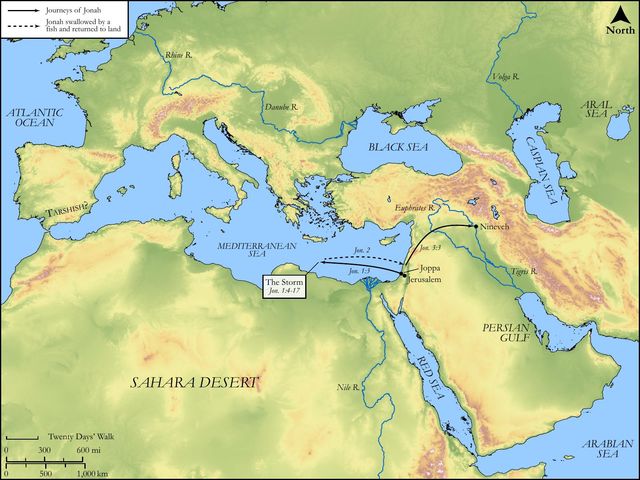
Study this verse
Historical interpretation
Historical reception
3 surviving comments on this verse. Each one is dated, so this reads as a timeline rather than a list.
Select a marker to jump to its quote. Markers stagger vertically where authors wrote within a few decades of each other.
"For word came unto the king of Nineveh, and he arose from his throne, and he laid his robe from him, and covered him with sackcloth, and sat in ashes. And he caused it to be proclaimed and published through Nineveh by the decree of the king and his nobles, saying, Let neither man nor beast, herd nor flock, taste any thing: let them not feed, nor drink water: But let man and beast be covered with sackcloth, and cry mightily unto God: yea, let them turn every one from his evil way, and from the violence that is in their hands. Who can tell if God will turn and repent, and turn away from his fierce anger, that we perish not?" LXX: 'the message reached the king of Nineveh, and he arose from his throne, took off his robe and covered himself with sackcloth, and he sat down upon the earth. And by the order of the king and his nobles it was announced throughout Nineveh, saying, it is forbidden for any man or beast or oxen or sheep to eat anything, to drink any water. Men and beasts were covered in sackcloth and cried out to the Lord mightily. Let each one turn away from his wicked practises and from the unfairness that was in his hands, saying, who knows if God will turn and repent, if he will not abandon the fierceness of his wrath so that we might not die?'. I know certain men for whom the king of Nineveh, (who is the last to hear the proclamation and who descends from his throne, and forgoes the ornaments of his former vices and dressed in sackcloth sits on the ground, he is not content with his own conversion, preaches penitence to others with his leaders, saying, "let the men and beasts, big and small of size, be tortured by hunger, let them put on sackcloth, condemn their former sins and betake themselves without reservation to penitence!) is the symbol of the devil, who at the end of the world, (because no spiritual creature that is made reasoning by God will perish), will descend from his pride and do penitence and will be restored to his former position. To support this opinion they use this example of Daniel in which Nebuchadnezzar after seven years of penitence is returned to his former reign. [Dan. 4:24, 29, 33] But because this idea is not in the Holy Scripture and since it completely destroys the fear of God, (for men will slide easily into vices if they believe that even the devil, the creator of wickedness and the source of all sins, can be saved if he does penitence), we must eradicate this from our spirits. Let us remember though that the sinners in the Gospel are sent to the eternal fire [Mt. 25:41], which is prepared for the devil and his angels, about whom is said, "their worm will not die and their fire will not be extinguished" [Is. 66:24]. All the same we know that God is mild, and we sinners do not enjoy his cruelty, but we read, "the Lord is kindly and righteous, and our God will be merciful" [Ps. 114:5]. The justice of God is surrounded by mercy, and it is by this route that he proceeds to judgement: he spares to judge, he judges to be merciful. "Mercy and Truth are to be found in our path; Justice and Peace are to be embraced" [Ps. 84:11]. Moreover if all spiritual creatures are equal and if they raise themselves up by their virtues to heaven, or by their vices take themselves to the depths, then after a long circuit and infinite centuries, if all are returned to their original state with the same worthiness to all conflicting, what difference will there be between the virgin and the prostitute? What distinction will there be between the mother of the Lord and (it is wicked to say) the victims of public pleasures? Will Gabriel be like the devil? Will the apostles be as demons? Will the prophets be as pseudoprophets? Martyrs as their persecutors? Imagine all that you will, increase by two-fold the years and the time, take infinite time for torture: if the end for all is the same, all the past is then nothing, for what is of importance to us is not what we are at any given moment, but what we will be forever more. I am not forgetting what is often said to argue against this point, preparing hope for oneself and some kind of safety with the devil. But this is not the appropriate time to write at length against the opinion of the wicked and against the synphragma of the devil from those who teach one thing in private only to deny it in public. It is enough for me to have shown what I believe this passage signifies, and as is appropriate in a commentary, to remark briefly who the king of Nineveh is, he who is the last to hear the word of God. Just how much eloquence and secular knowledge are worth to mankind can be seen in Demosthenes, Cicero, Plato, Xenophon, Theophrastus, Aristotle and the other philosophers and orators who are considered kings and their precepts are not taken as the work of mortals but as oracles of the gods. About which Plato says, happy are those states where philosophers rule, or if kings are philosophers. How difficult it is for such men to believe in God! I am neglecting though those examples from daily life, and pass over the stories of pagans and content myself with the text of the apostle who writes in Corinthians, saying, "look, brothers, to your vocation, among you. For there are not many who are wise about their flesh, nor many powerful, or noble. But there is much madness in the world, and this is what God has chosen to confuse wise men. That which is weak in the world, this is what God has chosen to confuse strength, and that which is in the world without good birth this is what God has chosen…" [1 Cor. 1:26-8] and again he says, "I will destroy the wisdom of the wise, and I will reprove the knowledge of those who know." [Is. 29:14; 1 Cor. 1:19] And: "see that no one robs you, through philosophy, this is a vain seduction" [Col. 2:8]. From this the predication of Christ is clear, the kings of the world hear last; then they put down the clamour of eloquence and the beautiful appearance of words, they abandon themselves completely to all simplicity and rusticity, and return to the ways of peasants, sitting in the dirt and destroying what they had formerly said was good before. Let us take as an example the benevolent Cyprian: who is firstly the champion of idolatry, and had such a reputation of good speaking that he taught the art of rhetoric at Carthage. He finishes by listening to the speech of Jonah, is converted to repent and gains such courage as to preach about Christ in public and lays his neck under the sword for him. For sure we know that the King of Nineveh descended from his throne, exchanged his red gown for sackcloth, his perfumes for mud, and cleanness for uncleanness- not uncleanness of meanings but of his words. In the same way in Jeremiah it is said about Babylon that "Babylon is a golden chalice which makes all the earth drunk" [Jer. 51:7]. Which man has not been made drunk by secular eloquence? Whose spirit has not been shot through by the composition of words and by the brightness of his elegant speech? Those powerful, noble and rich have great difficulty in believing in God; then how much more so for the masters of speech! Their spirit is blinded by riches, wealth, abundance, they are prevented by their sins and cannot see their virtues; they judge the simplicity of the Holy Scripture not on the majesty of its meanings, but out of the baseness of its words. But when they who have previously taught wickedness are converted to repent and start to teach what is good then we will see the people of Nineveh converted with a single proclamation, and the speech that we read in Isaiah will come true: "is a people thus born in one go?". [Is. 66:8. LX] Men and animals are covered with sackcloth, crying out to the Lord, this is to be understood by the same meaning as this: that those who have reason and those who do not, the wise and the simple repent according to that phrase said elsewhere: "You will save men and the animals O Lord" [Ps. 35:7]. It is possible however to interpret differently the animals covered in sackcloth, especially according to those passages in which we read, "the sun and moon will be dressed in sackcloth" [Joel 2:10], and in another passage, "I will cover the heavens with sackcloth". [Is. 50:3] This will be the clothing of mourning, the worry and sadness that are designated metaphorically by sackcloth. And this phrase: "who knows if God will turn and pardon?" places us in uncertainty and doubt. Thus men in hypothetical cleanness repent with more intent and arouse even more God's mercy.
A sovereign serves God one way as a man, another way as a king. He serves him as man by living according to faith. He serves him as king by exerting the necessary strength to sanction laws that command goodness and prohibit its opposite. It was thus that Ezekiel served him by destroying the groves and temples of idols and the high places that had been set up contrary to the commandments of God. Thus Josiah served him by performing similar acts. Thus the king of the Ninevites served him by compelling the whole city to appease the Lord.
The king preferred to escape in a hair-shirt, rather than to perish in purple garments. We must understand, dearly beloved, that lowliness avails more than power.
Continue studying Jonah 3:6 across the web’s major study libraries — every link below opens this exact verse, chapter, or book on the destination site.
Read & Compare
 BibleGatewayThis verse in more than 200 translations and 70 languages.
 Bible.comThe YouVersion reader — hundreds of translations, reading plans, and highlights.
 ESV.orgCrossway's official English Standard Version reader.
 NET BibleThe NET translation with 60,000+ translators' notes on every rendering decision.
 STEP BibleTyndale House's free study tool — original text, vocabulary, and scholarly resources.
 BibliaLogos Bible Software's free web reader.
 USCCBThe New American Bible (Revised Edition) with the U.S. bishops' study notes.
Commentaries
 BibleHub CommentariesDozens of classic commentaries on this verse, gathered on one page.
 StudyLightMore than 100 commentary sets — the largest collection on the web.
 BibleRefPlain-English commentary on what this verse means, verse by verse.
 Enduring WordDavid Guzik's free commentary on this chapter, widely used by Bible teachers.
 Bible Study ToolsVerse commentary alongside Greek and Hebrew study aids.
Original Language & Research
- BibleHub InterlinearThe verse word by word — original language, transliteration, and English.
- BibleHub LexiconEvery word's original-language definition and Strong's entry.
 Blue Letter BibleDeep-study tools — Strong's numbers, concordance, and word studies.
 SefariaThe Hebrew text with Rashi and centuries of Jewish commentary.
Sermons, Hymns & Audio


TrulyRandomVerse is not affiliated with these sites and doesn’t control their content. They’re linked because they’re genuinely useful.
Summary
Jonah 3:6 vividly portrays the immediate and profound response of the King of Nineveh to Jonah's prophetic message. Upon hearing the word of impending judgment, this powerful pagan monarch, without hesitation, abandoned his royal symbols of authority and status—his throne and robe—and publicly adopted the humble posture of repentance by covering himself with sackcloth and sitting in ashes. This radical act of contrition by the highest authority in the formidable Assyrian Empire underscores the transformative power of God's word and sets a striking example of genuine humility and national repentance.
Context
ShowHideLiterary Context
This verse is a pivotal moment in the book of Jonah, immediately following the people of Nineveh's belief in God and their proclamation of a fast in Jonah 3:5. Jonah had just delivered a stark, eight-word Hebrew prophecy: "Yet forty days, and Nineveh shall be overthrown" (Jonah 3:4). The king's response in Jonah 3:6 elevates the city's widespread repentance to the highest level of authority, demonstrating that the divine message permeated all strata of society. His subsequent decree in Jonah 3:7-9 mandates and formalizes the city-wide repentance, setting the stage for God's merciful relenting in Jonah 3:10.
Historical & Cultural Context
Nineveh was the magnificent capital of the Assyrian Empire, a dominant and notoriously brutal power among the nations. The Assyrians were known for their military prowess, vast wealth, and often cruel treatment of conquered peoples. For a Hebrew prophet to deliver a message of doom to such a formidable city, and for its king to respond with such immediate and public humility, was extraordinary. The practice of "sackcloth and ashes" was a widely understood and deeply significant custom in Israel and among the nations, signifying profound grief, mourning, and repentance. Kings, even powerful ones, would sometimes adopt these humble signs to express national sorrow, appeal to divine mercy, or acknowledge a superior power, demonstrating a cultural understanding of penitential rites.
Key Themes
ShowHideThe king's actions in Jonah 3:6 powerfully contribute to several overarching themes in the book of Jonah and broader biblical theology. Firstly, it highlights the theme of Radical Repentance, illustrating that genuine turning from sin involves a willingness to abandon pride, status, and self-reliance, symbolized by the king's stripping away of his royal regalia. Secondly, it underscores God's Universal Sovereignty, demonstrating His ability to move the hearts of even the most powerful pagan rulers and to extend His word's reach beyond the covenant people of Israel. This unexpected response from Nineveh, a city known for its wickedness, paves the way for the profound display of God's Expansive Mercy, revealing that His compassion is not limited by national or ethnic boundaries but is available to all who genuinely humble themselves and turn from their wicked ways, as seen later in Jonah 4:11.
Exposition and Analysis
ShowHideKey Word Analysis
ShowHideThis term, often translated as "word," carries a much broader semantic range. It can refer to a matter, thing, affair, report, or even a divine decree. In this context, "word came" signifies not just a spoken utterance but the authoritative, impactful message of God delivered through Jonah, which carried the weight of divine judgment and the potential for a new course of action. It implies the full substance and import of Jonah's prophecy.
This word denotes something ample, a wide dress, a mantle, or a magnificent robe. Here, it specifically refers to the king's royal garment, a symbol of his authority, wealth, and exalted status. The act of "laying his robe from him" is a powerful visual representation of the king voluntarily divesting himself of his earthly power and pride, signifying a profound act of self-abasement before a higher power.
This primitive root means "to sit down," but also "to dwell," "to remain," or "to settle." In the context of "sitting in ashes," it implies a deliberate and sustained posture of humility, grief, and repentance. It's not a fleeting gesture but a settled, intentional act of abasement, signifying a deep internal state of contrition and a willingness to remain in that humble state.
Verse Breakdown
ShowHide"For word came unto the king of Nineveh"
This clause establishes the catalyst for the king's actions. The prophetic message of impending doom, delivered by Jonah, reached the highest authority in the land, indicating that the divine warning was not confined to the common people but penetrated the very seat of power.
"and he arose from his throne"
This signifies an immediate and decisive break from his position of power and comfort. The throne represents the pinnacle of earthly authority and majesty. By rising from it, the king physically abandons his royal prerogative and steps into a posture of vulnerability and readiness to respond to the divine word.
"and he laid his robe from him"
This action further emphasizes the king's radical self-abasement. His royal robe, a visible emblem of his status, dignity, and power, is voluntarily removed. This stripping away of outward symbols mirrors an internal shedding of pride and self-importance, preparing him for a posture of humility.
"and covered [him] with sackcloth"
Having divested himself of his royal attire, the king adopts the traditional garment of mourning and repentance. Sackcloth, a coarse, uncomfortable fabric, was universally recognized as a sign of deep distress, sorrow, and penitence, symbolizing a conscious choice to identify with the lowest and most humbled state.
"and sat in ashes"
This final action completes the visual tableau of profound humility and contrition. Sitting in ashes, often accompanied by sprinkling ashes on one's head, was the ultimate expression of abasement, desolation, and grief in that day. It demonstrated a complete abandonment of comfort and status, signifying a total surrender and plea for mercy.
Literary Devices
ShowHideJonah 3:6 is rich with Symbolism and Juxtaposition. The king's "throne" and "robe" are potent symbols of his immense earthly power, authority, and pride. Their abandonment immediately followed by the adoption of "sackcloth" and "ashes" creates a dramatic Juxtaposition between his former state of regal splendor and his newfound posture of profound humility and repentance. Sackcloth and ashes themselves are powerful symbols of mourning, grief, and penitence, understood in Israel and among the nations. This stark visual contrast underscores the radical nature of the king's response and the transformative power of God's word, which compels even the most powerful to lay aside their earthly glory in recognition of divine sovereignty.
Theological and Thematic Connections
ShowHideThe King of Nineveh's actions in Jonah 3:6 offer a profound theological statement on the nature of true repentance and God's boundless mercy. His immediate and public act of laying aside his royal symbols and embracing sackcloth and ashes demonstrates that genuine contrition involves a radical reorientation of one's life, a stripping away of pride, self-sufficiency, and earthly status before God. This is not merely an internal change but often manifests in outward, tangible expressions of humility and sorrow for sin. The king's response, astonishing for a pagan ruler, underscores God's sovereign ability to work in any heart, regardless of background or power, and highlights His readiness to extend forgiveness and avert judgment when there is sincere turning from wickedness.
Reflection and Application
ShowHideThe King of Nineveh's radical and immediate repentance serves as a powerful and challenging example for believers today. In a world that often values status, comfort, and self-reliance, the king's willingness to abandon his throne and robe for sackcloth and ashes calls us to examine our own hearts. True repentance is not merely an intellectual acknowledgment of sin but a profound, heart-felt turning that may require us to "lay aside" our own "thrones" of pride, self-sufficiency, or worldly attachments. It demands a willingness to humble ourselves, to confess our failings, and to embrace a posture of dependence on God, just as the king did. His actions remind us that God is always ready to extend mercy and forgiveness to those who genuinely humble themselves and turn from their wicked ways, demonstrating His boundless compassion for all humanity.
Questions for Reflection
ShowHideFAQ
ShowHideWas the King of Nineveh truly converted to the worship of Yahweh, the God of Israel?
ShowHideThe text of Jonah primarily focuses on the king's and the city's repentance from their wicked ways and God's subsequent mercy in relenting from the threatened judgment. While the king's actions and decree demonstrate a profound and effective response to God's word—acknowledging His power and the need to appease Him—the book does not explicitly detail a personal conversion to monotheistic Yahwism. The emphasis is on the national turning from evil and God's character as a compassionate God who desires all people to turn to Him, rather than on the king's individual theological shift. His actions were sufficient for God to extend grace to the city, demonstrating that God responds to genuine humility and a turning from evil, even if the theological understanding of the Ninevites was incomplete by Israelite standards.
Christ-Centered Fulfillment
ShowHideThe radical repentance of the King of Nineveh, culminating in his public display of humility, finds its ultimate fulfillment and deepest meaning in the person and work of Jesus Christ. Jesus Himself points to the Ninevites as a stark contrast to His own generation, stating, "The men of Nineveh shall rise in judgment with this generation, and shall condemn it: because they repented at the preaching of Jonas; and, behold, a greater than Jonas is here" (Matthew 12:41). If a pagan king could lay aside his throne and robe in response to a reluctant prophet's limited message, how much more should humanity repent and humble itself before Christ, the King of kings, who laid aside His divine glory not merely as a symbolic act, but by emptying Himself and taking on the form of a servant, even to the point of death on a cross (Philippians 2:6-8)? The mercy extended to Nineveh foreshadows the universal offer of salvation found in Christ, who, through His ultimate sacrifice, enables all who repent and believe to be reconciled to God, regardless of their past wickedness, demonstrating God's boundless love and desire for all to come to repentance (2 Peter 3:9).