


Jonah 3:4
Bible text: King James Version (1769 Blayney text) · Public domain
Bible text: Berean Standard Bible · Public domain
Bible text: American Standard Version (1901) · Public domain
Bible text: World English Bible, Messianic edition · Public domain
Bible text: Geneva Bible (1599) · Public domain
Bible text: Young's Literal Translation · Public domain
- וַיָּחֶלvai·Ya·cheland he beganH2490Conj-w ¦ V-Hiphil-ConsecImperf-3msVerb Hiphil Consecutive Imperfect 3rd Singular Masculineוַandיָּחֶלhe began
- יוֹנָהyo·NahJonahH3124N-proper-mNoun Proper Masculine
- לָבוֹאla·Vo'to goH935Prep-l ¦ V-Qal-InfVerb Qal Infinitive Constructלָtoבוֹאgo
- בָעִירva·'Irin the cityH5892Prep-b ¦ N-fsNoun Singular Feminine Absoluteבָin theעִירcity
- מַהֲלַךְma·ha·Lakha journey ofH4109N-mscNoun Singular Masculine Construct
- יוֹםYoma dayH3117N-msNoun Singular Masculine Absolute
- אֶחָד'e·ChadoneH259N-fsNoun Singular Feminine Absolute
- וַיִּקְרָאvai·yik·Ra'and he proclaimedH7121Conj-w ¦ V-Qal-ConsecImperf-3msVerb Qal Consecutive Imperfect 3rd Singular Masculineוַandיִּקְרָאhe proclaimed
- וַיֹּאמַרvai·yo·Marand he saidH559Conj-w ¦ V-Qal-ConsecImperf-3msVerb Qal Consecutive Imperfect 3rd Singular Masculineוַandיֹּאמַרhe said
- עוֹדodyetH5750Adj-msAdjective Numerical Singular Masculine Absolute
- אַרְבָּעִים'ar·ba·'ImfortyH705N-mpNoun Plural Masculine Absolute
- יוֹםYomday[s]H3117N-msNoun Singular Masculine Absolute
- וְנִינְוֵהve·ni·ne·Vehand NinevehH5210Conj-w ¦ N-properNoun Proper LocationוְandנִינְוֵהNineveh
- נֶהְפָּכֶתneh·Pa·khet[is] about to be overturnedH2015V-Niphal-Prtcpl-fsVerb Niphal Participle Singular Feminine Absolute
English is a literal word-by-word gloss of the Hebrew, not the KJV's wording. Why?
This is the original text the KJV's translators worked from — each Hebrew word with its own literal English meaning in this verse, prepared by scholars at Tyndale House, Cambridge. The KJV translates whole sentences, not word by word, so its wording differs: one Hebrew word can become several English words, and the KJV may choose “the LORD” where the gloss reads “Yahweh”. Both are faithful — they answer different questions. For the KJV's own rendering, switch to the KJV text.
Details
See on the biblical-era map
Study this verse
Historical interpretation
Four Centuries of Reception
7 surviving comments on this verse. Each one is dated, so this reads as a timeline rather than a list.
Select a marker to jump to its quote. Markers stagger vertically where authors wrote within a few decades of each other.
Let us turn to every age that has passed, and learn that, from generation to generation, the Lord has granted a place of repentance to all such as would be converted unto Him... Jonah proclaimed destruction to the Ninevites; but they, repenting of their sins, propitiated God by prayer, and obtained salvation, although they were aliens [to the covenant] of God.
Does God for our salvation deceive and say certain things so that the sinner ceases doing what he might do if he had not heard certain of these words? Was the one who says, “Yet three days and Nineveh shall be destroyed,” speaking as one who speaks truly or not? Or as one who deceives by a deceit that converts? If that kind of conversion did not happen, was what was said no longer a deceit but already truth. There would have been a destruction that followed for Nineveh. It was up to those who hear.
If you want, let us also hear this story: “Now the word of the Lord,” it says, “came to Jonah, saying, ‘Rise and go to Nineveh, the great city.’ ” He wanted to put Jonah to shame by sending him to the great city of Nineveh, because he foresaw the prophet’s escape. However, let us also listen to the preaching: “Yet three days, and Nineveh shall be overthrown.” Why do you, God, foretell the sufferings that you will inflict upon Nineveh? “So that I will not do what I announced.” This is why God threatened with hell—so he would not lead anyone away to hell. He says, “Fear that which is spoken to you, and do not be saddened about what has been done.” Why does he establish the appointed time to be only a period of three days? So that you may learn even the virtue of the barbarians—I call the Ninevites barbarians, who were able to annul in three days such anger caused by sin. I want you to marvel at the philanthropy of God, who was satisfied with three days of repentance for so many transgressions. I do not want you to sink into despair, even though you have innumerable sins.
God threatens to destroy the city of Nineveh for the very reason that He might not destroy it. When God makes a threat concerning our sins, He makes the threat beforehand so that we may be sobered by fear, so that our repentance will bring about God’s mercy so He will not have to follow through with the threat. (Hom. On Paralytic 3)
[Daniel 4:27] "'Wherefore, O king, let my counsel meet with thy favor, and make up for thy sins by deeds of charity, and thine iniquities by showing mercy to the poor. Perhaps God will forgive thy transgressions.'" Since he had previously pronounced the sentence of God, which of course cannot be altered, how could he exhort the king to deeds of charity and acts of mercy towards the poor? This difficulty is easily solved by reference to the example of King Hezekiah, who Isaiah had said was going to die (Isaiah 38:1); and again, to the example of the Ninevites, to whom it was said: "Yet forty days, and Nineveh shall be destroyed" (Jonah 3:4). And yet the sentence of God was changed in response to the prayers of Hezekiah and the city of Nineveh, not by any means because of the ineffectualness of the judgment itself but because of the conversion of those who merited pardon. Morever in Jeremiah God states that He threatens evil for the nation (Jeremiah 18:7-8), but if it does that which is good, He will alter His threats to bestow mercy. Again, He affirms that He directs His promises to the man who does good; and if the same man thereafter works evil, He says that He changes His decision, not with regard to the men themselves, but with regard to their works which have thus changed in character. For after all, God is not angered at men but at their sins; and when no sins inhere in a man, God by no means inflicts a punishment which has been commuted. In other words, let us say that Nebuchadnezzar performed deeds of mercy toward the poor in accordance with Daniel's advice, and for that reason the sentence against him was delayed of execution for twelve months. But because he afterwards while walking about in his palace at Babylon said boastingly: "Is this not the great Babylon which I myself have built up as a home for the king by the might of my power and the glory of my name?" therefore he lost the virtue of his charitableness by reason of the wickedness of his pride.
"It may be that God will forgive thy sins." In view of the fact that the blessed Daniel, foreknowing the future as he did, had doubts concerning God's decision, it is very rash on the part of those who boldly promise pardon to sinners. And yet it should be recognized that indulgence was promised to Nebuchadnezzar in return, as long as he wrought good works. Much more, then, is it promised to other men who have committed less grievous sins than he. We read in Jeremiah also of God's direction to the people of the Jews, that they should pray for the Babylonians, inasmuch as the peace of the captives was bound up with the peace of the captors themselves (Jeremiah 29:7).
"[And Jonah began to enter into the city a day's journey], and he cried, and said, Yet forty days, and Nineveh shall be overthrown." LXX: 'he proclaimed and said, another three days and Nineveh will be destroyed". The umber three written in the Septuagint does not agree with the penitence, and I am quite astonished at this translation, for in Hebrew neither the letters or syllables or accents or the word show any common element. For three is said, salos and forty arbaim. Moreover the prophet who was sent from Judea to the Assyrians was to claim after such a journey penitence worthy of his prediction to cure with a long-present dressing his old and putrid wounds. Moreover the number forty is appropriate to sinners, to hunger, to prayer, to sackcloth, to tears and to perseverance in prayer. In this way Moses fasted for forty days on mount Sinai [Ex. 34:28; Deut. 9:18] and Elijah fleeing Jezebel [3 Kings. 19:8] is presented to us as having fasted for forty days after having told Israel about the famine [3 Kings. 17:1], when the anger of God was upon them. And the Lord Himself, the true Jonah who is sent to preach to the world fasts for forty days [Mt. 4:2]. And he leaves us as hereditary fasting to prepare our spirits, by this number of forty, as the food of his body. "he cried out": the Gospel shows this expression more fully: "standing, he cried out in the temple: if anyone is thirsty, let him come to me and he shall drink" [John 7:37], for all speech of the Saviour is called a cry because he speaks about weighty subjects.
We should not despair of those who are still unwilling to correct their vices and do not even blush to defend them. In a similar way hope was not abandoned for that city of which it is written, “Three days more, and Nineveh shall be destroyed”; yet in those three days it was able to be converted, pray, bewail and merit mercy from the threatened punishment. Therefore let all who are such listen to God while it is possible to hear him in his silence; that is, not punishing at present. For he will come and will not be silent, and he will then reprove when there is no chance of amendment.
Continue studying Jonah 3:4 across the web’s major study libraries — every link below opens this exact verse, chapter, or book on the destination site.
Read & Compare
 BibleGatewayThis verse in more than 200 translations and 70 languages.
 Bible.comThe YouVersion reader — hundreds of translations, reading plans, and highlights.
 ESV.orgCrossway's official English Standard Version reader.
 NET BibleThe NET translation with 60,000+ translators' notes on every rendering decision.
 STEP BibleTyndale House's free study tool — original text, vocabulary, and scholarly resources.
 BibliaLogos Bible Software's free web reader.
 USCCBThe New American Bible (Revised Edition) with the U.S. bishops' study notes.
Commentaries
 BibleHub CommentariesDozens of classic commentaries on this verse, gathered on one page.
 StudyLightMore than 100 commentary sets — the largest collection on the web.
 BibleRefPlain-English commentary on what this verse means, verse by verse.
 Enduring WordDavid Guzik's free commentary on this chapter, widely used by Bible teachers.
 Bible Study ToolsVerse commentary alongside Greek and Hebrew study aids.
Original Language & Research
- BibleHub InterlinearThe verse word by word — original language, transliteration, and English.
- BibleHub LexiconEvery word's original-language definition and Strong's entry.
 Blue Letter BibleDeep-study tools — Strong's numbers, concordance, and word studies.
 SefariaThe Hebrew text with Rashi and centuries of Jewish commentary.
Sermons, Hymns & Audio


TrulyRandomVerse is not affiliated with these sites and doesn’t control their content. They’re linked because they’re genuinely useful.
Summary
Jonah 3:4 marks the pivotal moment of Jonah's reluctant obedience, as he finally enters the vast Assyrian capital of Nineveh and delivers God's stark, concise message of impending judgment. After his miraculous deliverance, Jonah begins to penetrate the city, proclaiming a direct divine ultimatum: "Yet forty days, and Nineveh shall be overthrown," setting the stage for the city's unexpected and profound response.
Context
ShowHideLiterary Context
This verse immediately follows Jonah's second divine commission in Jonah 3:1-3, which mirrors the first command given in Jonah 1:2. Unlike his initial flight from God's presence in Jonah 1:3, Jonah now obeys the Lord's word and sets out for Nineveh. The preceding chapter, Jonah 2, details Jonah's desperate prayer from the belly of the great fish and his miraculous deliverance, a profound experience that evidently broke his rebellious spirit and prepared him for this moment of compliance. The verse also serves as the direct catalyst for the Ninevites' repentance, which is vividly described in Jonah 3:5-9.
Historical & Cultural Context
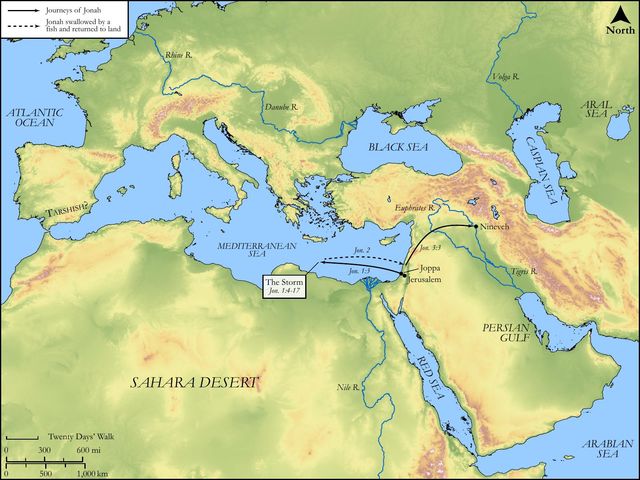
Nineveh was the sprawling capital of the Neo-Assyrian Empire, a formidable and notoriously cruel power that was a constant threat to Israel. Its immense size, indicated by "a day's journey," suggests a city so vast that merely entering it and beginning to proclaim a message would take considerable time and effort. Ancient Nineveh was indeed one of the largest cities of its time, with an outer wall circuit estimated to be over 60 miles, encompassing not only urban areas but also agricultural lands and villages. The Assyrians were known for their brutal military tactics and harsh treatment of conquered peoples, making God's extension of mercy to them all the more remarkable and challenging for an Israelite prophet like Jonah. The message of "forty days" would have been understood as a period of divine probation, a common biblical motif for testing or judgment, giving the Ninevites a clear timeframe for their impending doom.
Key Themes
ShowHideJonah 3:4 powerfully contributes to several overarching themes in the book. Firstly, it underscores Divine Sovereignty and Mercy, demonstrating God's persistent desire for all people, even the most wicked, to repent and turn to Him, rather than face judgment. This aligns with God's self-revelation in Exodus 34:6-7. Secondly, it highlights the Power of the Prophetic Word; a simple, direct message from God, delivered in obedience, carries immense authority and can provoke a profound societal response. Thirdly, the verse subtly introduces the theme of Reluctant Obedience, as Jonah, despite his personal animosity towards Nineveh (which becomes evident in Jonah 4), nonetheless carries out his divine commission. Finally, it sets the stage for the theme of Universal Scope of God's Grace, showing that God's concern for humanity extends beyond Israel to the Gentile nations.
Exposition and Analysis
ShowHideKey Word Analysis
ShowHideThis word, often meaning "to profane" or "to wound," here takes on the sense of "to begin" or "to open." It suggests Jonah's initial, perhaps hesitant, penetration into the city, marking the commencement of his prophetic mission after his earlier disobedience. The nuance implies an "opening wedge" or the initiation of a significant action.
This verb signifies a loud, public proclamation, not a quiet utterance. It implies a formal, authoritative declaration, fitting for a prophet delivering a divine oracle. Jonah's "crying out" indicates the urgency and public nature of his message to Nineveh, ensuring it was heard widely.
Meaning "to turn about or over," this term denotes a complete reversal, destruction, or overturning. It carries the weight of divine judgment, reminiscent of the catastrophic destruction of cities like Sodom and Gomorrah (Genesis 19:25), implying a total and irreversible devastation if repentance does not occur.
Verse Breakdown
ShowHide"And Jonah began to enter into the city a day's journey"
This clause describes Jonah's initial action upon arriving at Nineveh. The phrase "a day's journey" highlights the immense size of the city, indicating that Jonah did not merely stand at the gates but began to penetrate its vast urban sprawl, suggesting a public and visible proclamation rather than a discreet one. It marks the commencement of his mission within the heart of the city.
"and he cried, and said"
This signifies the manner of Jonah's proclamation. The verb "cried" (Hebrew qârâʼ) implies a loud, public, and authoritative declaration, consistent with the role of a prophet delivering God's word. It was not a whisper or a private conversation, but an open announcement meant to be heard by many.
"Yet forty days, and Nineveh shall be overthrown"
This is the core message delivered by Jonah. "Forty days" serves as a specific, limited period of probation, a common biblical motif for testing or judgment. The word "overthrown" (Hebrew hâphak) conveys a sense of total destruction and reversal, akin to the fate of Sodom and Gomorrah, emphasizing the severity of the impending divine judgment if the city does not respond.
Literary Devices
ShowHideThe verse employs several potent Literary Devices. The phrase "a day's journey" functions as Hyperbole or Exaggeration, emphasizing the immense scale of Nineveh and the daunting task before Jonah, even if it wasn't a literal full day to traverse the entire city. The "forty days" serves as Symbolism, representing a period of divine testing, probation, or judgment, a recurring motif throughout biblical narrative (e.g., the flood in Genesis 7:4, Israel's wilderness wandering in Numbers 14:34, Jesus' temptation in Matthew 4:2). The entire declaration, "Yet forty days, and Nineveh shall be overthrown," is a stark Ultimatum, a concise and direct warning designed to elicit an immediate and decisive response. It also functions as Foreshadowing, setting the stage for the dramatic and unexpected repentance of the Ninevites in the subsequent verses, thereby highlighting God's surprising mercy.
Theological and Thematic Connections
ShowHideJonah 3:4 vividly illustrates God's unwavering commitment to justice alongside His boundless mercy. Despite Nineveh's notorious wickedness, God extends a clear warning, providing an opportunity for repentance before judgment. This demonstrates that God's character is not merely punitive but fundamentally redemptive, desiring that all should turn from their evil ways. The brevity and directness of Jonah's message underscore the power of God's word, which, even when delivered by a reluctant messenger, possesses the inherent authority to bring about transformative change. This verse challenges the narrow, nationalistic view of God often held by Jonah and some Israelites, revealing a God whose compassion extends to all humanity, regardless of their past sins or ethnic identity.
Reflection and Application
ShowHideJonah 3:4 offers profound lessons for contemporary believers. It reminds us that God's patience and mercy are far-reaching, extending even to those we might deem most undeserving or hostile. Just as God gave Nineveh a clear warning and an opportunity to repent, He continues to call people to Himself today, often through the simple, direct proclamation of His truth. This verse challenges us to consider our own willingness to be messengers of God's word, even when the message is uncomfortable or the recipients are difficult. It underscores the importance of obedience, even when our personal biases or understanding might conflict with God's command. Ultimately, it invites us to trust in the power of God's word to transform hearts and societies, and to embrace His expansive heart for all humanity, recognizing that repentance and salvation are always possible when His warning is heeded.
Questions for Reflection
ShowHideFAQ
ShowHideWhy did Jonah only preach "Yet forty days, and Nineveh shall be overthrown," and not explicitly "Repent"?
ShowHideWhile Jonah's message in Jonah 3:4 is a direct declaration of impending judgment, the call to "repent" is implicitly embedded within such a warning in the biblical context. A prophetic warning of "overthrow" (Hebrew hâphak) for wickedness inherently implies that a change of heart and action is the only way to avert the prophesied doom. The Ninevites, as seen in Jonah 3:5-9, understood this implicit call, responding with immediate and widespread repentance, fasting, and a turning from their evil ways. God's character, as revealed throughout Scripture (e.g., Jeremiah 18:7-8), is such that He relents from disaster when a people repent. Therefore, the warning itself serves as an opportunity for repentance.
What is the significance of "forty days" in this verse?
ShowHideThe "forty days" in Jonah 3:4 is a significant biblical motif, often representing a period of testing, probation, or divine judgment. It is a time-bound opportunity for a critical decision or transformation. Examples include the forty days of rain during Noah's flood (Genesis 7:4), Israel's forty years of wandering in the wilderness (Numbers 14:34), Moses' forty days on Mount Sinai (Exodus 34:28), and Jesus' forty days of fasting and temptation in the wilderness (Matthew 4:2). In Jonah's context, it signifies a fixed period during which Nineveh had the opportunity to respond to God's warning before the decreed judgment would fall.
Christ-Centered Fulfillment
ShowHideJonah 3:4, with its stark proclamation of judgment and the subsequent repentance of Nineveh, finds profound Christ-centered fulfillment in the person and work of Jesus. Jesus Himself directly references Jonah, declaring that "an evil and adulterous generation seeks for a sign, but no sign will be given to it except the sign of the prophet Jonah" (Matthew 12:39). This "sign" primarily refers to His death, burial, and resurrection, mirroring Jonah's three days and nights in the fish's belly (Matthew 12:40). However, Jesus also connects the Ninevites' repentance to His own ministry, stating that "The men of Nineveh will rise up at the judgment with this generation and condemn it, for they repented at the preaching of Jonah, and behold, something greater than Jonah is here" (Matthew 12:41). This highlights that while Jonah preached a message of judgment that led to repentance, Jesus, the Son of God, preached the ultimate message of repentance and the good news of the Kingdom of God (Mark 1:15). The Ninevites' immediate and comprehensive turning to God in response to Jonah's brief warning foreshadows the universal scope of God's grace, made fully manifest in Christ, who calls all people from every nation to repentance and faith in Him for salvation (Acts 17:30-31). Thus, Jonah's reluctant mission to a Gentile city, culminating in their repentance, prefigures Christ's redemptive work that extends salvation to the ends of the earth.