


Jonah 3:3
Bible text: King James Version (1769 Blayney text) · Public domain
Bible text: King James Version with Strong's numbers · Public domain
Bible text: Berean Standard Bible · Public domain
Bible text: American Standard Version (1901) · Public domain
Bible text: World English Bible, Messianic edition · Public domain
Bible text: Geneva Bible (1599) · Public domain
Bible text: Young's Literal Translation · Public domain
- וַיָּקָםvai·Ya·komand he aroseH6965Conj-w ¦ V-Qal-ConsecImperf-3msVerb Qal Consecutive Imperfect 3rd Singular Masculineוַandיָּקָםhe arose
- יוֹנָהyo·NahJonahH3124N-proper-mNoun Proper Masculine
- וַיֵּלֶךְvai·Ye·lekhand he wentH1980Conj-w ¦ V-Qal-ConsecImperf-3msVerb Qal Consecutive Imperfect 3rd Singular Masculineוַandיֵּלֶךְhe went
- אֶל'eltoH413PrepPreposition
- נִינְוֶהnin·VehNinevehH5210N-properNoun Proper Location
- כִּדְבַרkid·Varaccording to [the] word ofH1697Prep-k ¦ N-mscNoun Singular Masculine Constructכִּaccording toדְבַר[the] word of
- יְהוָהYah·wehYahwehH3068N-properNoun Proper Title
- וְנִינְוֵהve·ni·ne·Vehand NinevehH5210Conj-w ¦ N-properNoun Proper LocationוְandנִינְוֵהNineveh
- הָיְתָהha·ye·Tahit wasH1961V-Qal-Perf-3fsVerb Qal Perfect 3rd Singular Feminine
- עִיר'ira cityH5892N-fsNoun Singular Feminine Absolute
- גְּדוֹלָהge·do·LahgreatH1419Adj-fsAdjective Singular Feminine Absolute
- לֵאלֹהִיםle·lo·Himto GodH430Prep-l ¦ N-mpNoun Plural Masculine AbsoluteלֵtoאלֹהִיםGod
- מַהֲלַךְma·ha·Lakha journey ofH4109N-mscNoun Singular Masculine Construct
- שְׁלֹשֶׁתshe·Lo·shetthreeH7969N-cscNoun Singular common gender Construct
- יָמִיםya·MimdaysH3117N-mpNoun Plural Masculine Absolute
English is a literal word-by-word gloss of the Hebrew, not the KJV's wording. Why?
This is the original text the KJV's translators worked from — each Hebrew word with its own literal English meaning in this verse, prepared by scholars at Tyndale House, Cambridge. The KJV translates whole sentences, not word by word, so its wording differs: one Hebrew word can become several English words, and the KJV may choose “the LORD” where the gloss reads “Yahweh”. Both are faithful — they answer different questions. For the KJV's own rendering, switch to the KJV text.
Details
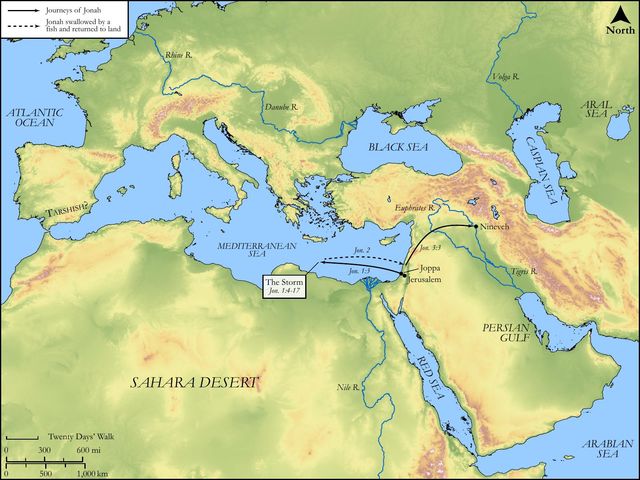
See on the biblical-era map
Study this verse
Historical interpretation
Historical reception
2 surviving comments on this verse. Each one is dated, so this reads as a timeline rather than a list.
Select a marker to jump to its quote. Markers stagger vertically where authors wrote within a few decades of each other.
"So Jonah arose, and went unto Nineveh, according to the word of the LORD. Now Nineveh was an exceeding great city of three days' journey. [And Jonah began to enter into the city a day's journey]" LXX: 'so Jonah arose and went to Nineveh, according to the word of the Lord. Now Nineveh was a city of godly size, around three days in journey. Jonah began to enter the city, about one day's travel.' Jonah immediately carries out the command that he has been given. Nineveh to which the prophet was journeying, was a great city, which it took around three days' journey to circle. But he remembers the command he has been given and the recent shipwreck and makes the normal journey of three days in one day. However, there are some people who believe that he simply proclaimed his message in a third of the city, and that his speech quickly was made known to the other inhabitants. And our Lord is said to arise and speak of his own accord after being in hell, and announces the word of the Lord when he sends the apostles to baptise those who were in Nineveh in the name of the Father the Son and the Holy Spirit [Mt. 28:19]. So there are the three days of journey! And this sacrament of mankind's safety is "a journey of one day", that is it is finished by the proclamation of one sole God. Jonah preaches not so much to the apostles but more by the method of the apostles. He himself says, "and I will be with you always until the end of the world" [Mt. 28:20]. There is no doubt that Nineveh was a city of godly magnitude because the world and all things have existed through God and because without Him nothing would ever have existed. [John 1:3] Note too that he has not said, "of three days and three nights" or "of one day and of one night", but simply "and of three days", and "of one day", to show that in the sacrament of the Trinity and of the confession of one sole God there is no darkness.
Why, then, are we asked what was prefigured by the prophet being swallowed by that monster and restored alive on the third day? Christ explained it when he said an evil and adulterous generation seeks a sign, and a sign shall not be given to it, but the sign of Jonah the prophet. For as Jonah was in the whale’s belly three days and three nights, so shall the Son of man be in the heart of the earth three days and three nights. … So then, as Jonah went from the ship into the belly of the whale, so Christ went from the tree into the tomb, or into the abyss of death. And as Jonah was sacrificed for those endangered by the storm, so Christ was offered for those who are drowning in the storm of this world. And as Jonah was first commanded to preach to the Ninevites but his prophecy did not come to them until after the whale had vomited him out, so the prophecy made to the Gentiles did not come to them until after the resurrection of Christ.
Continue studying Jonah 3:3 across the web’s major study libraries — every link below opens this exact verse, chapter, or book on the destination site.
Read & Compare
 BibleGatewayThis verse in more than 200 translations and 70 languages.
 Bible.comThe YouVersion reader — hundreds of translations, reading plans, and highlights.
 ESV.orgCrossway's official English Standard Version reader.
 NET BibleThe NET translation with 60,000+ translators' notes on every rendering decision.
 STEP BibleTyndale House's free study tool — original text, vocabulary, and scholarly resources.
 BibliaLogos Bible Software's free web reader.
 USCCBThe New American Bible (Revised Edition) with the U.S. bishops' study notes.
Commentaries
 BibleHub CommentariesDozens of classic commentaries on this verse, gathered on one page.
 StudyLightMore than 100 commentary sets — the largest collection on the web.
 BibleRefPlain-English commentary on what this verse means, verse by verse.
 Enduring WordDavid Guzik's free commentary on this chapter, widely used by Bible teachers.
 Bible Study ToolsVerse commentary alongside Greek and Hebrew study aids.
Original Language & Research
- BibleHub InterlinearThe verse word by word — original language, transliteration, and English.
- BibleHub LexiconEvery word's original-language definition and Strong's entry.
 Blue Letter BibleDeep-study tools — Strong's numbers, concordance, and word studies.
 SefariaThe Hebrew text with Rashi and centuries of Jewish commentary.
Sermons, Hymns & Audio


TrulyRandomVerse is not affiliated with these sites and doesn’t control their content. They’re linked because they’re genuinely useful.
Summary
Jonah 3:3 marks a pivotal moment in the prophet's narrative, detailing his immediate and obedient response to God's renewed command to go to Nineveh, a stark contrast to his earlier rebellion. The verse also vividly portrays the immense scale of Nineveh, describing it as an "exceeding great city of three days' journey," thereby underscoring the formidable nature of Jonah's mission and the vast reach of God's redemptive purpose.
Context
ShowHideLiterary Context
This verse immediately follows God's second direct command to Jonah in Jonah 3:1-2. Having been miraculously delivered from the belly of the great fish in Jonah 2:10, Jonah's "arose, and went" stands in stark contrast to his initial flight from God's presence in Jonah 1:3. This shift highlights a profound change in Jonah's disposition, demonstrating his newfound submission to the divine will after a period of intense discipline and repentance. The description of Nineveh's size sets the stage for the dramatic and widespread repentance that will unfold in the subsequent verses of Jonah 3.
Historical & Cultural Context
Nineveh was the formidable capital of the Neo-Assyrian Empire, a dominant power among the nations known for its military might and often brutal conquests. Located on the eastern bank of the Tigris River, it was renowned for its massive walls, extensive fortifications, and vast population, making it one of the largest cities of its time. The phrase "three days' journey" likely refers to the time it would take to traverse the entire city, either by walking its perimeter or moving through its major districts to proclaim a message effectively. This detail emphasizes the city's immense physical size and the logistical challenge of evangelizing such a sprawling metropolis. The Assyrians were a constant threat to Israel, which makes God's command to Jonah to preach repentance to them particularly challenging and counter-intuitive from a human perspective.
Key Themes
ShowHideThis verse powerfully contributes to several overarching themes in the book of Jonah. Firstly, it underscores the theme of obedience after failure, presenting Jonah's immediate compliance as a testament to God's grace in offering second chances and the transformative power of divine discipline. Secondly, it highlights God's persistent and unwavering call, demonstrating that He does not abandon His purposes or His chosen instruments, even when they falter, as seen in Jonah 3:1. Lastly, the description of Nineveh's immense size reinforces the theme of the expansive scope of God's compassion and mission, revealing His concern for all peoples, even those considered enemies, and His desire for universal repentance, a message echoed in Jonah 4:11.
Exposition and Analysis
ShowHideKey Word Analysis
ShowHideThis verb signifies not merely standing up but a decisive action, a readiness for undertaking a task. In this context, it marks a significant turning point from Jonah's previous flight and rebellion. It implies a firm resolve and immediate compliance, indicating a renewed commitment to God's will after his profound experience in the fish.
This term is far more comprehensive than just a spoken utterance; it encompasses a matter, a thing, a decree, or a divine message. Here, it emphasizes the authoritative and intentional nature of God's command. Jonah's obedience is not to a suggestion but to the very dâbâr of the LORD, highlighting the divine origin and binding nature of his mission.
While literally meaning "great" in size or extent, when applied to Nineveh, especially in the phrase "exceeding great city" (literally "great to God" or "divinely great"), it conveys an immense, almost overwhelming magnitude. This suggests not only its physical vastness but also its significance in God's divine plan, perhaps due to its wickedness or its large population, making it a focal point for God's redemptive intervention.
Verse Breakdown
ShowHide"So Jonah arose, and went unto Nineveh, according to the word of the LORD."
This clause presents a concise yet powerful statement of Jonah's newfound obedience. The "So" indicates a direct consequence of the preceding events—God's second command and Jonah's deliverance. His immediate action of arising and going directly to Nineveh, in precise alignment with "the word of the LORD," contrasts sharply with his initial disobedience in Jonah 1:3. This demonstrates a profound shift in his spiritual posture, marked by submission to divine authority.
"Now Nineveh was an exceeding great city of three days' journey."
This descriptive clause provides crucial context for the magnitude of Jonah's task. The phrase "exceeding great city" (often interpreted as "great to God" or "divinely great") emphasizes Nineveh's immense size, importance, and perhaps its moral standing in God's eyes. The "three days' journey" likely refers to the time required to traverse the city's main areas or circuit its vast perimeter, underscoring the extensive effort needed to deliver a message throughout its entirety. This detail not only highlights the physical challenge but also subtly magnifies the power of God, who sends one man to such a formidable metropolis.
Literary Devices
ShowHideThe verse employs several literary devices to enhance its impact. Contrast is immediately evident between Jonah's past rebellion (fleeing from God's command in Jonah 1:3) and his present, immediate obedience ("So Jonah arose, and went unto Nineveh"). This highlights the transformative power of God's discipline and grace. The description of Nineveh as an "exceeding great city of three days' journey" functions as Hyperbole or Exaggeration, emphasizing its immense scale and the overwhelming nature of the task. While it may have been literally large, the phrasing aims to impress upon the reader the sheer magnitude of the city and, by extension, the scope of God's compassion. Furthermore, the very act of Jonah's journey to such a city, after his miraculous rescue, serves as Symbolism for the universal reach of God's salvation and His willingness to extend mercy even to those considered enemies, foreshadowing the immense repentance that is about to occur.
Theological and Thematic Connections
ShowHideJonah 3:3 is rich with theological implications, primarily showcasing God's unwavering patience and commitment to His redemptive purposes, even when His chosen instruments falter. It underscores the profound truth that God is a God of second chances, always ready to restore and re-commission those who repent and turn back to Him. Jonah's obedience, though born out of divine discipline, serves as a powerful testament to the necessity of submitting to God's sovereign will, regardless of personal discomfort or prejudice. The description of Nineveh's vastness simultaneously emphasizes the magnitude of human sin and the even greater magnitude of God's compassion, demonstrating His desire for all people, even the most wicked and formidable, to come to repentance. This verse sets the stage for one of the most remarkable displays of corporate repentance in the Old Testament, highlighting the transformative power of God's word when faithfully proclaimed.
Reflection and Application
ShowHideJonah 3:3 offers profound lessons for contemporary believers. Jonah's journey from rebellion to immediate obedience serves as a powerful reminder that God is a God of second chances, always extending grace to those who genuinely repent. We, too, may falter in our walk, but God's call on our lives remains, and His mercy is sufficient to restore us to His path. This verse challenges us to examine areas where we might be resisting God's will, perhaps due to fear, prejudice, or a lack of understanding. Just as Jonah was called to a difficult mission in a formidable city, we are called to engage with a world that often seems overwhelming and hostile to the Gospel. The "three days' journey" of Nineveh reminds us that God's mission is vast, requiring sustained effort and unwavering commitment. It urges us to overcome our preconceived notions about who is "worthy" of God's grace and to embrace His expansive love for all humanity, participating actively in His global redemptive work.
Questions for Reflection
ShowHideFAQ
ShowHideWhat is the significance of Nineveh being an "exceeding great city of three days' journey"?
ShowHideThe description of Nineveh as an "exceeding great city of three days' journey" (literally, "great to God" or "divinely great") emphasizes its immense physical size and importance in that day. It was one of the largest cities of its time, the capital of the powerful Assyrian Empire. The "three days' journey" likely refers to the time it would take to traverse the city's main areas or circuit its vast perimeter, indicating the extensive effort required for Jonah to deliver his message throughout the entire city. This detail highlights the formidable nature of Jonah's mission and, by extension, the vast scope of God's concern for humanity, even a city known for its wickedness, as seen in Jonah 1:2. It also sets the stage for the dramatic and widespread repentance that is about to unfold.
Christ-Centered Fulfillment
ShowHideJonah 3:3, though seemingly a simple narrative of obedience, finds profound Christ-centered fulfillment in several ways. Jonah's journey from rebellion to obedience, spurred by divine discipline and a second chance, foreshadows the perfect and unwavering obedience of Jesus Christ. Unlike Jonah, who initially fled, Jesus perfectly fulfilled the will of His Father, even to the point of death on a cross (Philippians 2:8). Furthermore, the "sign of Jonah" that Jesus Himself references in Matthew 12:39-41 directly connects Jonah's three days and nights in the fish to Christ's three days and nights in the tomb, culminating in His resurrection. Just as Jonah's preaching led to the repentance of a great Gentile city, Christ's death and resurrection, and the subsequent preaching of His Gospel, initiated a worldwide call to repentance and salvation for all nations, Jew and Gentile alike (Luke 24:47). The vastness of Nineveh, requiring a "three days' journey" to traverse, subtly points to the expansive reach of the Gospel message, which through Christ, extends to the uttermost parts of the earth, demonstrating God's boundless compassion for all humanity (Acts 1:8). Thus, Jonah's reluctant mission to Nineveh ultimately prefigures Christ's willing and universal mission to redeem a lost world.