


2 Timothy 4:11
Bible text: King James Version (1769 Blayney text) · Public domain
Bible text: Berean Standard Bible · Public domain
Bible text: American Standard Version (1901) · Public domain
Bible text: World English Bible, Messianic edition · Public domain
Bible text: Geneva Bible (1599) · Public domain
Bible text: Young's Literal Translation · Public domain
- ΛουκᾶςLoukasLukeG3065N-NSM-PNoun Nominative Singular Masculine Individual
- ἐστινestinisG1510V-PAI-3SVerb Present Active Indicative 3rd Singular
- μόνοςmonosaloneG3441A-NSMAdjective Nominative Singular Masculine
- μετ᾽met᾽withG3326PREPPreposition
- ἐμοῦemoumeG1473S-1SGSNPossessive pronoun Genitive 1st Person Singular Neuter
- ΜᾶρκονMarkonMarkG3138N-ASM-PNoun Accusative Singular Masculine Individual
- ἀναλαβὼνanalabōnhaving takenG353V-2AAP-NSMVerb 2nd Aorist Active Participle Nominative Singular Masculine
- ἄγεagedo bring [him]G71V-PAM-2SVerb Present Active Imperative 2nd Singular
- μετὰmetawithG3326PREPPreposition
- σεαυτοῦ·seautouyourselfG4771F-2GSMReflexive pronoun Genitive 2nd Singular Masculine
- ἔστινestinhe isG1510V-PAI-3SVerb Present Active Indicative 3rd Singular
- γάρgarforG1063CONJConjunction
- μοιmoito meG3165P-1DSPersonal pronoun Dative 1st Singular
- εὔχρηστοςeuchrēstosusefulG2173A-NSMAdjective Nominative Singular Masculine
- εἰςeisforG1519PREPPreposition
- διακονίανdiakonian[the] ministryG1248N-ASFNoun Accusative Singular Feminine
English is a literal word-by-word gloss of the Greek, not the KJV's wording. Why?
This is the original text the KJV's translators worked from — each Greek word with its own literal English meaning in this verse, prepared by scholars at Tyndale House, Cambridge. The KJV translates whole sentences, not word by word, so its wording differs: one Greek word can become several English words, and the KJV may choose “charity” where the gloss reads “love”. Both are faithful — they answer different questions. For the KJV's own rendering, switch to the KJV text.
Details
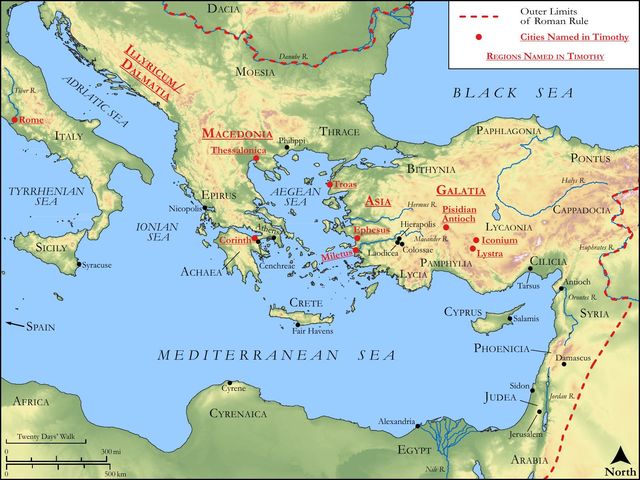
See on the biblical-era maps

Study this verse
Public-domain commentary
Matthew Henry
From his Commentary on the Whole Bible. Henry comments on passages, not single verses — this entry covers 2 Timothy 4:9–15.
Here are divers particular matters which Paul mentions to Timothy, now at the closing of the epistle. 1. He bids him hasten to him, if possible (Ti2 4:9): So thy diligence to come shortly to me. For Timothy was an evangelist, one who was not a fixed pastor of any one place, but attended the motions of the apostles, to build upon their foundation. Paul wanted Timothy's company and help; and the reason he gives is because several had left him (Ti2 4:10); one from an ill principle, namely, Demas, who abides under an ill name for it: Demas hath forsaken me, having loved this present world. He quitted Paul and his interest, either for fear of suffering (because Paul was now a prisoner, and he was afraid o coming into trouble upon his account) or being called off from his ministry by secular affairs, in which he entangled himself; his first love to Christ and his gospel was forsaken and forgotten, and he fell in love with the world. Note, Love to this present world is often the cause of apostasy from the truths and ways of Jesus Christ. He has gone off, has departed to Thessalonica, called thither perhaps by trade, or by some other worldly business. Crescens had gone one way and Titus another way. Luke however remained with Paul (Ti2 4:11, Ti2 4:12), and was not this enough? Paul did not think it so; he loved the company of his friends. 2. He speaks respectfully concerning Mark: He is profitable to me for the ministry. It is supposed that this Mark was he about whom Paul and Barnabas had contended, Act 15:39. Paul would not take him with him to the work, because he had once flinched and drawn back: but now, says he, Take Mark, and bring him with thee. By this it appears that Paul was now reconciled to Mark, and had a better opinion of him than he had had formerly. This teaches us to be of a forgiving spirit; we must not therefore disclaim for ever making use of those that are profitable and useful, though they may have done amiss. 3. Paul orders Timothy to come to him, bids him as he came through Troas to bring with him thence those things which he had left behind him there (Ti2 4:13), the cloak he had left there, which, it may be, Paul had the more occasion for in a cold prison. It is probable that it was the habit Paul usually wore, a plain dress. Some read it, the roll of parchment I left at Troas; others, the desk that I left. Paul was guided by divine inspiration, and yet he would have his books with him. Whereas he had exhorted Timothy to give attendance to reading, so he did himself, though he was now ready to be offered. As long as we live, we must be still learning. But especially the parchments, which some think were the originals of his epistles; others think they were the skins of which he made his tents, whereby he obtained a livelihood, working with his own hands. 4. He mentions Alexander, and the mischief that he had done him, Ti2 4:14, Ti2 4:15. This is he who is spoken of Act 19:33. It should seem, he had been a professor of the Christian religion, a forward professor, for he was there particularly maligned by the worshippers of Diana, and yet he did Paul much evil. Paul was in as much danger from false brethren (Co2 11:26) as from open enemies. Paul foretels that God would reckon with him. It is a prophetical denunciation of the just judgment of God that would befall him: The Lord will reward him according to his works. He cautions Timothy to take heed of him: "Of whom be thou aware also, that he do not, under pretence of friendship, betray thee to mischief." It is dangerous having any thing to do with those who would be enemies to such a man as Paul. Observe, (1.) Some who were once Paul's hearers and admirers did not give him reason to remember them with much pleasure; for one forsook him, and another did him much evil, and greatly withstood his words. Yet, (2.) At the same time he mentions some with pleasure; the badness of some did not make him forget the goodness of others; such as Timothy, Titus, Mark, and Luke. (3.) The apostle has left a brand on the names and memory of two persons; the one is Demas, who forsook him, having loved the present world, and the other is Alexander, who greatly withstood his words. (4.) God will reward evil-doers, particularly apostates, according to their works. (5.) Of such as are of Alexander's spirit and temper we should beware; for they will do us no good, but all the mischief that is in their power.
Historical interpretation
Six Centuries of Reception
2 surviving comments on this verse. Each one is dated, so this reads as a timeline rather than a list.
Select a marker to jump to its quote. Markers stagger vertically where authors wrote within a few decades of each other.
It is worth while to enquire why he calls Timothy to him, inasmuch as he was intrusted with a Church, and a whole nation. It was not from arrogance. For Paul was ready to come to him; for we find him saying, "But if I tarry long, that thou mayest know how thou oughtest to behave thyself in the house of God." (1 Tim. iii. 15.) But he was withholden by a strong necessity. He was no longer matter of his own movements. He was in prison, and had been confined by Nero, and was all but on the point of death. That this might not happen before he saw his disciple, he therefore sends for him, desiring to see him before he dies, and perhaps to deliver much in charge to him. Wherefore he says, "Hasten to come to me before the winter." "For Demas hath forsaken me, having loved this present world." He does not say, "That I may see thee before I depart this life," which would have grieved him, but "because I am alone," he says, "and have no one to help or support me." "For Demas hath forsaken me, having loved this present world, and is departed to Thessalonica"; that is, having loved his own ease and security from danger, he has chosen rather to live luxuriously at home, than to suffer hardships with me, and share my present danger. He has blamed him alone, not for the sake of blaming him, but to confirm us, that we may not be effeminate in declining toils and dangers, for this is, "having loved this present world." "Only Luke is with me." For he adhered to him inseparably. It was he who wrote the Gospel, and the General Acts; he was devoted to labors, and to learning, and a man of fortitude. "Take Mark, and bring him with thee, for he is profitable to me for the ministry." It is not for his own relief, but for the ministry of the Gospel that he wanted him. For though imprisoned, he did not cease to preach. "The cloak that I left at Troas with Carpus, when thou comest bring with thee, and the books, but especially the parchments." The word here translated "cloak" may mean a garment, or, as some say, a bag, in which the books were contained. But what had he to do with books, who was about to depart and go to God? He needed them much, that he might deposit them in the hands of the faithful, who would retain them in place of his own teaching.
For Demas has forsaken me, having loved this present age, and has gone to Thessalonica; Crescens to Galatia; Titus to Dalmatia. Only Luke is with me. Take Mark and bring him with you, for he is useful to me for ministry.
having loved this present age. Having become safe and secure, as he thought. For Demas preferred to indulge in luxury at home rather than suffer hardships with me. But Paul does not want to slander this man, rather to support us so that we do not become weak.
Crescens to Galatia. They had left of their own accord, therefore he does not say, "The rest." Moreover, Titus was among the distinguished to whom the bishopric of Crete had been entrusted.
Only Luke is with me. This Luke is the one who wrote the Gospel and the Acts of the Apostles. And since he was eager to learn, holy and committed, he was never separated from Paul.
Take Mark and bring him with you, for he is useful to me. Paul said, "Not for my comfort, but for the ministry of the Gospel." Indeed, Paul also called Timothy for this reason, so that after his death the brothers might be comforted.
for ministry. Of the Gospel, Paul says.
Continue studying 2 Timothy 4:11 across the web’s major study libraries — every link below opens this exact verse, chapter, or book on the destination site.
Read & Compare
 BibleGatewayThis verse in more than 200 translations and 70 languages.
 Bible.comThe YouVersion reader — hundreds of translations, reading plans, and highlights.
 ESV.orgCrossway's official English Standard Version reader.
 NET BibleThe NET translation with 60,000+ translators' notes on every rendering decision.
 STEP BibleTyndale House's free study tool — original text, vocabulary, and scholarly resources.
 BibliaLogos Bible Software's free web reader.
 USCCBThe New American Bible (Revised Edition) with the U.S. bishops' study notes.
Commentaries
 BibleHub CommentariesDozens of classic commentaries on this verse, gathered on one page.
 StudyLightMore than 100 commentary sets — the largest collection on the web.
 BibleRefPlain-English commentary on what this verse means, verse by verse.
 Enduring WordDavid Guzik's free commentary on this chapter, widely used by Bible teachers.
 Bible Study ToolsVerse commentary alongside Greek and Hebrew study aids.
Original Language & Research
- BibleHub InterlinearThe verse word by word — original language, transliteration, and English.
- BibleHub LexiconEvery word's original-language definition and Strong's entry.
 Blue Letter BibleDeep-study tools — Strong's numbers, concordance, and word studies.
 CNTR CollationThe earliest Greek manuscripts of this verse, collated letter by letter.
Sermons, Hymns & Audio


TrulyRandomVerse is not affiliated with these sites and doesn’t control their content. They’re linked because they’re genuinely useful.
Summary
In this poignant and urgent final letter, the Apostle Paul, facing imminent martyrdom, expresses his deep isolation while acknowledging Luke's faithful presence. He issues a specific and significant request to Timothy: to bring Mark to him, affirming Mark's renewed usefulness and profitability for the ongoing work of ministry. This verse beautifully encapsulates themes of loyalty, reconciliation, and the practical necessity of collaborative service in the spread of the Gospel, even in the face of profound personal hardship.
Context
ShowHideLiterary Context
This verse is situated within Paul's Second Epistle to Timothy, widely regarded as his final inspired writing before his execution in Rome under Emperor Nero. The letter is deeply personal, serving as Paul's last will and testament to his spiritual son, Timothy. Immediately preceding this verse, Paul laments the desertion of some companions (Demas, Crescens, Titus) who have gone to other regions, leaving him with only Luke (2 Timothy 4:10). This stark reality underscores Paul's sense of isolation and highlights the profound loyalty of Luke. The subsequent verses contain further practical instructions and greetings, emphasizing the urgency of Timothy's arrival and the continuation of the Gospel mission despite Paul's impending death. The request for Mark, therefore, is not merely a personal desire but a strategic move for the ongoing work.
Historical & Cultural Context
Paul is imprisoned in Rome, likely in harsh conditions, awaiting trial or execution. This period was characterized by intense Roman persecution of Christians, especially after the Great Fire of Rome in 64 AD, for which Christians were scapegoated. Travel in the ancient world was challenging and dangerous, often requiring significant planning and resources. The early Christian movement relied heavily on personal networks, itinerant evangelists, and the collaborative efforts of apostles and their co-workers. Paul's request for Mark, despite their past conflict (Acts 15:38), reflects the high value placed on capable and trustworthy individuals in a time when the spread of the Gospel depended on dedicated, resilient teams. The "ministry" (diakonia) Paul refers to would have encompassed a wide range of activities, from preaching and teaching to practical support and administrative tasks essential for the nascent church.
Key Themes
ShowHideA central theme is Loyalty and Companionship in suffering. Luke's steadfast presence is a testament to faithful friendship in Paul's darkest hour, contrasting sharply with those who departed. Another profound theme is Reconciliation and Second Chances. The request for Mark is deeply significant given his earlier departure from Paul and Barnabas during their first missionary journey, which caused a "sharp disagreement" (Acts 15:38). Paul's later commendation of Mark, also seen in Colossians 4:10, demonstrates his capacity for forgiveness, his recognition of Mark's growth, and the Christian principle of offering opportunities for restoration. Finally, the verse highlights the Practical Value in Ministry. Paul's specific reason for wanting Mark—"for he is profitable to me for the ministry"—underscores the ongoing, practical need for capable and willing helpers in the work of the Gospel, even for an apostle facing death. It illustrates that ministry is a collaborative effort requiring diverse gifts and faithful cooperation.
Exposition and Analysis
ShowHideKey Word Analysis
ShowHideThis word, meaning "sole" or "single," emphasizes the profound isolation Paul felt. It highlights Luke's unique and faithful presence, contrasting him with others who had departed or been sent away. It underscores the personal and emotional weight of Paul's situation, making Luke's companionship all the more precious.
Derived from "well" (eu) and "useful" (chrēstos), this term signifies "easily used," "useful," or "serviceable." Paul's assessment of Mark as "profitable" indicates a significant transformation and maturity in Mark's character and abilities since his earlier departure. It implies that Mark had become a valuable and effective asset for the apostolic work, capable of contributing meaningfully to Paul's needs and the broader ministry.
This word refers to "attendance," "service," or "administration," particularly in a Christian context. It encompasses a broad range of activities, from practical assistance and personal care to active participation in evangelism, teaching, and supporting the spread of the Gospel. Paul's statement that Mark is profitable "for the ministry" specifies the purpose of Mark's usefulness, indicating that his skills and renewed commitment would directly aid Paul in his final apostolic endeavors.
Verse Breakdown
ShowHide"Only Luke is with me."
This clause starkly reveals Paul's immediate circumstances. In his final imprisonment, many of his companions have left or been dispatched, leaving him with only Luke. This highlights Luke's unwavering loyalty and serves as a poignant testament to the value of faithful companionship in times of extreme hardship and isolation.
"Take Mark, and bring him with thee:"
This is a direct command and an urgent request from Paul to Timothy. The imperative "take" (analambanō) and "bring" (agō) convey Paul's earnest desire for Mark's presence. The request for Mark is particularly significant given their past strained relationship, underscoring Paul's forgiveness and recognition of Mark's growth and renewed potential.
"for he is profitable to me for the ministry."
This clause provides the reason for Paul's request. Mark is no longer the one who "departed from them from Pamphylia" (Acts 15:38), but has matured into a valuable and useful co-worker. His profitability is specifically tied to "the ministry," indicating that Mark's presence would provide practical assistance and support for Paul's ongoing apostolic work, even from prison, and contribute to the broader mission of the Gospel.
Literary Devices
ShowHideThe verse employs Juxtaposition by contrasting Luke's steadfast presence ("Only Luke is with me") with the implied absence and requested return of Mark. This highlights the different trajectories of Paul's companions and emphasizes Luke's unique faithfulness. There is also a strong sense of Implicit Narrative, as the simple request for Mark carries the weight of their complicated history, suggesting a powerful story of redemption and reconciliation without explicitly detailing it. Finally, the verse is a Personal Plea, direct and urgent, revealing Paul's human need for companionship and practical assistance in his final days, making the abstract concept of "ministry" tangible and relational.
Theological and Thematic Connections
ShowHideThis verse powerfully illustrates God's redemptive work not only in individual lives but also in the relationships within the Christian community. It underscores the profound importance of reconciliation and second chances, demonstrating that past failures do not disqualify individuals from future usefulness in God's kingdom. Paul's willingness to re-embrace Mark, who had previously caused a significant rift, exemplifies the transformative power of grace and forgiveness that should characterize believers. Furthermore, the verse highlights the collaborative nature of Christian ministry, emphasizing that even the most prominent apostles relied on the support and diverse gifts of others. It teaches us that every believer, through growth and dedication, can become "profitable" for the Lord's work, contributing uniquely to the advancement of His purposes.
Reflection and Application
ShowHidePaul's request for Mark, set against the backdrop of his impending martyrdom and the desertion of others, offers profound lessons for contemporary believers. It challenges us to value and cultivate faithful relationships, recognizing those "Lukes" who stand by us in difficult times. More significantly, it calls us to embody the spirit of reconciliation and offer genuine second chances to those who have stumbled or disappointed us. Just as Paul saw Mark's potential for renewed usefulness, we are encouraged to look beyond past failures and recognize the transformative power of grace in others' lives. This verse also prompts us to consider our own role in ministry: Are we striving to be "profitable" for the Lord's work, diligently developing our gifts and making ourselves available for service? It reminds us that every believer has a valuable contribution to make to the body of Christ, and that our growth and maturity can turn past weaknesses into future strengths for the Gospel.
Questions for Reflection
ShowHideFAQ
ShowHideWhy was Mark "profitable" to Paul after their earlier disagreement?
ShowHideMark's profitability stemmed from his spiritual maturity and proven reliability over time. While he had indeed "departed" from Paul and Barnabas during their first missionary journey (Acts 15:38), causing a "sharp disagreement," he evidently grew in faith and commitment. By the time of Paul's imprisonment, Mark had become a trusted and valuable co-worker, as evidenced by Paul's earlier commendation of him in Colossians 4:10. This demonstrates Paul's capacity for forgiveness and reconciliation, and his recognition that God can redeem past failures for future usefulness in His service. Mark's journey is a powerful testament to the transformative power of grace and the possibility of second chances in Christian ministry.
What specific kind of "ministry" did Paul need Mark for?
ShowHideThe Greek word diakonía (ministry) is broad, encompassing various forms of service. In Paul's context as an imprisoned apostle, Mark's "profitability" likely included practical assistance, such as running errands, delivering messages, providing personal care, or assisting with writing and administrative tasks. Given Paul's focus on the Gospel, Mark might also have been useful in evangelism, teaching, or offering support to the local Christian community in Rome. The term signifies any form of helpful service that would advance Paul's apostolic mission and alleviate his burdens during his final imprisonment. It highlights the collaborative nature of ministry, where even an apostle like Paul relied on the diverse gifts and practical support of his co-workers.
Christ-Centered Fulfillment
ShowHideThe narrative of Paul's request for Mark, a once-faltering disciple now deemed "profitable for the ministry," beautifully foreshadows and reflects the redemptive work of Jesus Christ. Just as Paul extended grace and a second chance to Mark, so too does Christ relentlessly pursue and restore those who have stumbled or fallen short. Peter's denial of Christ, followed by his tender restoration by the resurrected Lord on the seashore (John 21:15-19), serves as a profound example of this divine reconciliation. Furthermore, Mark's transformation into a "profitable" servant points to the empowering work of the Holy Spirit, who gifts and equips all believers for service within the body of Christ (1 Corinthians 12:4-7). Christ Himself came not to be served, but to serve, and to give His life as a ransom for many (Mark 10:45). His ultimate act of service on the cross makes it possible for us, once unprofitable due to sin, to be reconciled to God and made "vessels for noble use, useful to the Master, prepared for every good work" (2 Timothy 2:21). Thus, Mark's story is a microcosm of the Gospel: God's grace transforms us from our past failures into useful instruments for His eternal purposes, all through the finished work of Christ.