


Jonah 3:2
Bible text: King James Version (1769 Blayney text) · Public domain
Bible text: Berean Standard Bible · Public domain
Bible text: American Standard Version (1901) · Public domain
Bible text: World English Bible, Messianic edition · Public domain
Bible text: Geneva Bible (1599) · Public domain
Bible text: Young's Literal Translation · Public domain
- קוּםkumariseH6965V-Qal-Imp-2msVerb Qal Imperative 2nd Singular Masculine
- לֵךְlekhgoH1980V-Qal-Imp-2msVerb Qal Imperative 2nd Singular Masculine
- אֶל'eltoH413PrepPreposition
- נִינְוֵהnin·VehNinevehH5210N-properNoun Proper Location
- הָעִירha·'Irthe cityH5892Art ¦ N-fsNoun Singular Feminine Absoluteהָtheעִירcity
- הַגְּדוֹלָהha·ge·do·Lah<the> greatH1419Art ¦ Adj-fsAdjective Singular Feminine Absoluteהַ<the>גְּדוֹלָהgreat
- וִּקְרָאvik·Ra'and call outH7121Conj-w ¦ V-Qal-Imp-2msVerb Qal Imperative 2nd Singular Masculineוִּandקְרָאcall out
- אֵלֶיהָ'e·Lei·haagainst itH413Prep ¦ 3fsPreposition Definiteאֵלֶיagainstהָit
- אֶת'et<obj.>H853DirObjMParticle Object Indicator
- הַקְּרִיאָהha·ke·ri·'Ahthe proclamationH7150Art ¦ N-fsNoun Singular Feminine Absoluteהַtheקְּרִיאָהproclamation
- אֲשֶׁר'a·SherwhichH834RelParticle Relative
- אָנֹכִי'a·no·KhiIH595Pro-1csPronoun Personal 1st Singular common gender
- דֹּבֵרdo·Ver[am] speakingH1696V-Qal-Prtcpl-msVerb Qal Participle Singular Masculine Absolute
- אֵלֶיךָ'e·Lei·khato youH413Prep ¦ 2msPreposition Definiteאֵלֶיtoךָyou
English is a literal word-by-word gloss of the Hebrew, not the KJV's wording. Why?
This is the original text the KJV's translators worked from — each Hebrew word with its own literal English meaning in this verse, prepared by scholars at Tyndale House, Cambridge. The KJV translates whole sentences, not word by word, so its wording differs: one Hebrew word can become several English words, and the KJV may choose “the LORD” where the gloss reads “Yahweh”. Both are faithful — they answer different questions. For the KJV's own rendering, switch to the KJV text.
Details
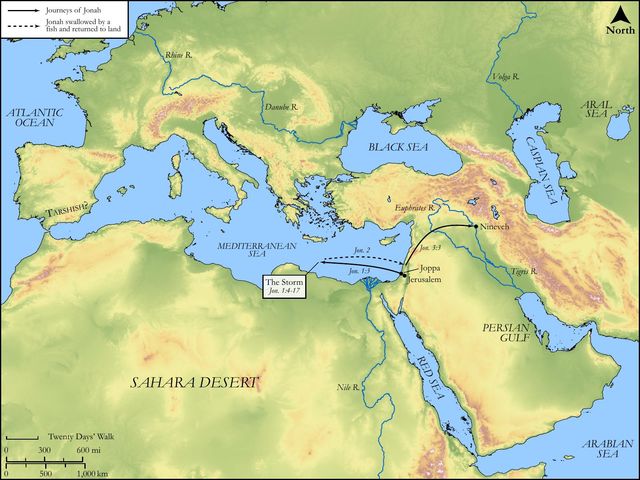
See on the biblical-era map
Study this verse
Historical interpretation
Four Centuries of Reception
2 surviving comments on this verse. Each one is dated, so this reads as a timeline rather than a list.
Select a marker to jump to its quote. Markers stagger vertically where authors wrote within a few decades of each other.
"And the word of the LORD came unto Jonah the second time, saying, arise, go unto Nineveh, that great city, and preach unto it the preaching that I bid you." LXX: 'and the message of God came to Jonah a second time, saying, arise, go to Nineveh, the great city, and preach there this message that I have told you'. He did not say to the prophet, "why have you not done what you were ordered to do?." But the punishment of the shipwreck and his drowning are enough for him to understand the Lord, the liberator, whom he hadn't known to be ordering. Moreover it is superfluous to see his wounds as those of a false servant of God, once he has been smitten, for such a punishment is less of a correction than a reproof. And our Lord is sent to Nineveh a second time after his resurrection: he who had fled by whatever means beforehand when he said, "My Father, if it is possible let this cup pass me by" [Mt. 26:39], and who had not wanted to give bread of children to dogs, now the children have cried out, "crucify him, crucify him! we have no king except Caesar" [Lk. 23:21; John 19:15], he makes his way towards Nineveh of his own accord to preach after his resurrection that he underwent as he was ordered to do before his suffering. The command is given, he hears it, he refuses, then he is forced to want, and the second time he carries out the will of the Father: all of this is connected to man and to the "form of a slave" [Phil. 2:7], to whom such expressions are appropriate.
Jonah arose, it says; he did not delay, but immediately made himself ready for obeying.
Continue studying Jonah 3:2 across the web’s major study libraries — every link below opens this exact verse, chapter, or book on the destination site.
Read & Compare
 BibleGatewayThis verse in more than 200 translations and 70 languages.
 Bible.comThe YouVersion reader — hundreds of translations, reading plans, and highlights.
 ESV.orgCrossway's official English Standard Version reader.
 NET BibleThe NET translation with 60,000+ translators' notes on every rendering decision.
 STEP BibleTyndale House's free study tool — original text, vocabulary, and scholarly resources.
 BibliaLogos Bible Software's free web reader.
 USCCBThe New American Bible (Revised Edition) with the U.S. bishops' study notes.
Commentaries
 BibleHub CommentariesDozens of classic commentaries on this verse, gathered on one page.
 StudyLightMore than 100 commentary sets — the largest collection on the web.
 BibleRefPlain-English commentary on what this verse means, verse by verse.
 Enduring WordDavid Guzik's free commentary on this chapter, widely used by Bible teachers.
 Bible Study ToolsVerse commentary alongside Greek and Hebrew study aids.
Original Language & Research
- BibleHub InterlinearThe verse word by word — original language, transliteration, and English.
- BibleHub LexiconEvery word's original-language definition and Strong's entry.
 Blue Letter BibleDeep-study tools — Strong's numbers, concordance, and word studies.
 SefariaThe Hebrew text with Rashi and centuries of Jewish commentary.
Sermons, Hymns & Audio


TrulyRandomVerse is not affiliated with these sites and doesn’t control their content. They’re linked because they’re genuinely useful.
Summary
Jonah 3:2 records the Lord's renewed command to the prophet Jonah, instructing him to "Arise, go unto Nineveh, that great city, and preach unto it the preaching that I bid thee." This verse marks a pivotal turning point in the book, signifying God's persistent grace and Jonah's second opportunity to fulfill his divine mission after his initial disobedience and miraculous deliverance from the great fish. It underscores God's unwavering purpose for Nineveh's repentance and His sovereign authority over His chosen messengers.
Context
ShowHideLiterary Context
This verse is a precise repetition of God's initial command to Jonah found in Jonah 1:2. The immediate context leading up to Jonah 3:2 is Jonah's dramatic experience in the belly of the great fish, detailed in Jonah 1:17 and Jonah 2:1-10. This harrowing ordeal, culminating in his prayer of repentance and subsequent deliverance, serves as a divine discipline and a powerful demonstration of God's sovereignty over creation and His prophet. The repetition of the command, without any rebuke or further instruction, highlights God's unwavering purpose and His readiness to grant a second chance, affirming that His plans are not thwarted by human failure. Jonah's response in Jonah 3:3 immediately follows, showing his newfound obedience.
Historical & Cultural Context
Nineveh was the capital of the Assyrian Empire, a formidable power among the nations, known for its military might and extreme cruelty. Located on the eastern bank of the Tigris River, it was a sprawling metropolis, as indicated by the description "that great city," likely encompassing a vast urban area and its surrounding settlements. The Assyrians were a constant threat to Israel and Judah, and their reputation for brutality (e.g., impalement, flaying, mass deportations) was well-known. For a prophet like Jonah, an Israelite, being commanded to preach repentance to such a hostile and pagan people would have been deeply unsettling, challenging his nationalistic prejudices and his understanding of God's justice. The city's immense size and population, as alluded to in Jonah 4:11, underscore the magnitude of the task and the universal scope of God's compassion, extending even to Israel's sworn enemies.
Key Themes
ShowHideJonah 3:2 contributes significantly to several key themes within the Book of Jonah. Firstly, it powerfully illustrates God's Persistent Grace and Second Chances. Despite Jonah's blatant disobedience in Jonah 1:3, God does not abandon His purpose or His prophet, offering an identical command, signifying His unwavering patience and desire for His servants to fulfill their calling. Secondly, it reinforces Divine Sovereignty and Unwavering Purpose. God's plan for Nineveh's repentance remains unchanged, demonstrating that His will ultimately prevails, even in the face of human resistance. Thirdly, the phrase "preach unto it the preaching that I bid thee" emphasizes the theme of Obedience and Faithful Proclamation. Jonah's role is not to invent his own message but to deliver God's precise words, highlighting the importance of fidelity in prophetic ministry. Finally, the command to go to "that great city" underscores God's Universal Concern and Compassion, extending His salvific desire beyond the boundaries of Israel to all nations, a theme further developed in Jonah 4.
Exposition and Analysis
ShowHideKey Word Analysis
ShowHideThis primitive root signifies "to rise" in various applications, including literal and figurative. Here, it is an urgent imperative, a call to immediate action and readiness. It implies not just a physical standing up but a mental and spiritual readiness to embark on the task, contrasting sharply with Jonah's previous flight.
This primitive root means "to walk" or "to go," literally or figuratively. Paired with "Arise," it forms a common Hebrew idiom for initiating a journey or undertaking a task. It emphasizes the physical act of setting out and progressing towards the destination, Nineveh, a journey Jonah had previously refused.
This primitive root means "to call out to," "to proclaim," or "to read." In this context, it denotes a public, authoritative declaration of a message. It is not merely speaking but making a formal, public announcement, often with a sense of urgency and divine authority, demanding a response from the hearers.
Verse Breakdown
ShowHide"Arise, go unto Nineveh, that great city"
This opening clause reiterates the divine imperative, emphasizing urgency and direction. "Arise, go" (ק֥וּם לֵ֛ךְ, qûm lēḵ) is a forceful command, demanding immediate obedience, a stark contrast to Jonah's initial flight in Jonah 1:3. Nineveh is described as "that great city" (הָעִיר הַגְּדוֹלָה, hāʿîr haggedōlāh), highlighting its immense size, population, and perhaps its notoriety as a powerful, wicked empire. This description serves to underscore both the challenge of the mission and the magnitude of God's concern for its inhabitants.
"and preach unto it the preaching that I bid thee."
This second clause specifies the nature and content of Jonah's mission. He is not merely to go to Nineveh but to "preach unto it" (וּקְרָא אֵלֶיהָ, ūqərāʾ ʾēlêhā), implying a public proclamation. The repetition of the root for "preach" (קְרִיאָה, qerîʾāh) in "the preaching" (literally, "the proclamation") emphasizes the authoritative and specific nature of the divine message. Crucially, Jonah is to deliver "the preaching that I bid thee" (אֲשֶׁר אָנֹכִי דֹּבֵר אֵלֶיךָ, ʾăšer ʾānōḵî dōḇēr ʾēlêḵā), meaning he is to be a faithful messenger, delivering God's exact words, not his own interpretation or a diluted version. This underscores the divine origin and unalterable content of the prophetic word.
Literary Devices
ShowHideThe most prominent literary device in Jonah 3:2 is Repetition. The verse is an almost verbatim restatement of God's initial command to Jonah in Jonah 1:2. This repetition serves several crucial purposes: it highlights God's unwavering purpose and sovereignty, demonstrating that His plans are not thwarted by human disobedience; it emphasizes God's grace, offering Jonah a second, identical chance without further rebuke; and it underscores the urgency and unchanging nature of the divine commission. The phrase "that great city" functions as an element of Emphasis or Hyperbole, drawing attention to Nineveh's immense scale and significance, which likely contributed to Jonah's initial reluctance but also magnifies the scope of God's compassion. The entire verse is a direct Divine Command, conveying God's authoritative will and the expectation of immediate obedience from His prophet.
Theological and Thematic Connections
ShowHideJonah 3:2 powerfully articulates God's unwavering commitment to His purposes and His boundless grace. The repetition of the command, identical to the one Jonah previously defied, underscores that God's plans are not contingent on human perfection but on His own sovereign will and persistent love. It reveals a God who offers second chances, not out of weakness, but out of a steadfast desire for both His prophet's obedience and the repentance of even the most hardened sinners. This divine patience extends to all humanity, demonstrating that God's compassion is not limited by nationalistic boundaries or past wickedness. The emphasis on delivering "the preaching that I bid thee" highlights the non-negotiable nature of God's word and the prophet's sacred duty to proclaim it faithfully, without alteration or compromise, a principle foundational to all divine communication.
Reflection and Application
ShowHideJonah 3:2 offers profound lessons for every believer. Firstly, it serves as a powerful reminder of God's incredible grace and His willingness to grant us second chances when we stumble in our walk of faith or actively disobey His call. Our past failures do not disqualify us from God's future purposes; rather, they can become catalysts for deeper understanding of His patience and mercy. Just as Jonah was given another opportunity, we too can find redemption and renewed purpose when we turn back to the Lord in repentance. Secondly, the verse underscores the paramount importance of obedience to God's specific instructions. Jonah was commanded to deliver a precise message, not one of his own making. This challenges us to consider whether we are truly listening to and faithfully proclaiming God's truth, or if we are diluting, altering, or avoiding uncomfortable aspects of His word. Our mission is to be faithful conduits of His truth, regardless of our personal preferences or fears. Finally, Jonah's renewed mission to Nineveh broadens our understanding of God's compassion. He cares deeply for all people, even those we might deem unworthy or hostile. This calls us to examine our own prejudices and extend God's love and the message of repentance to all, recognizing that His desire for salvation knows no bounds.
Questions for Reflection
ShowHideFAQ
ShowHideWhy did God repeat the exact same command to Jonah?
ShowHideGod repeated the exact same command to Jonah, almost verbatim from Jonah 1:2, to emphasize several crucial points. Firstly, it underscores God's unwavering purpose and sovereignty; His plans are not thwarted by human disobedience. The mission to Nineveh was paramount and would be accomplished. Secondly, it highlights God's immense grace and patience. Despite Jonah's blatant rebellion and the severe divine discipline he endured, God did not abandon him or His call upon his life. Instead, He offered a clear, identical second chance, demonstrating His restorative love. Finally, the repetition signifies the unchanging nature of the divine word and the urgency of the commission. Jonah's task remained precisely as it was initially given, demanding faithful and immediate obedience.
What is the significance of Nineveh being called "that great city"?
ShowHideThe description of Nineveh as "that great city" (הָעִיר הַגְּדוֹלָה, hāʿîr haggedōlāh) carries significant meaning beyond its literal size. It emphasizes Nineveh's prominence as the capital of the formidable Assyrian Empire, known for its power, wealth, and profound wickedness. This "greatness" likely contributed to Jonah's initial reluctance to go, fearing its power or perhaps believing it was beyond God's mercy. However, for God, its "greatness" also implies the magnitude of its sin and, consequently, the immense scope of His compassion. It highlights that God's concern extends even to the largest, most powerful, and most wicked Gentile cities, challenging the narrow, nationalistic views often held by Israelites. The phrase sets the stage for the dramatic and widespread repentance of the Ninevites in Jonah 3:5-9, magnifying the power of God's word and His desire for all people to turn to Him.
Christ-Centered Fulfillment
ShowHideJonah 3:2, with its emphasis on God's persistent call and the prophet's renewed obedience, finds profound Christ-centered fulfillment in the New Testament. Just as God sent Jonah to a wicked Gentile city, Jesus Christ, the ultimate Prophet, was sent by the Father to redeem all humanity, including the Gentiles (John 3:16). Jonah's second chance and his eventual obedience foreshadow Christ's perfect obedience to the Father's will, even unto death (Philippians 2:8). Furthermore, the "preaching that I bid thee" finds its ultimate expression in the Great Commission, where Jesus commands His disciples to "go and make disciples of all nations, baptizing them in the name of the Father and of the Son and of the Holy Spirit, teaching them to observe all that I have commanded you" (Matthew 28:19-20). This universal call to proclaim the Gospel, echoing God's concern for Nineveh, reveals the heart of God for the salvation of all peoples, fulfilled through the atoning work of Christ on the cross (1 Timothy 2:4). Jonah's mission, though limited in scope and flawed in execution, points to the infinitely greater mission of Christ and His church to bring repentance and forgiveness to the ends of the earth (Luke 24:47).