


Jonah 1:2
Bible text: King James Version (1769 Blayney text) · Public domain
Bible text: Berean Standard Bible · Public domain
Bible text: American Standard Version (1901) · Public domain
Bible text: World English Bible, Messianic edition · Public domain
Bible text: Geneva Bible (1599) · Public domain
Bible text: Young's Literal Translation · Public domain
- קוּםkumariseH6965V-Qal-Imp-2msVerb Qal Imperative 2nd Singular Masculine
- לֵךְlekhgoH1980V-Qal-Imp-2msVerb Qal Imperative 2nd Singular Masculine
- אֶל'eltoH413PrepPreposition
- נִינְוֵהnin·VehNinevehH5210N-properNoun Proper Location
- הָעִירha·'Irthe cityH5892Art ¦ N-fsNoun Singular Feminine Absoluteהָtheעִירcity
- הַגְּדוֹלָהha·ge·do·Lah<the> greatH1419Art ¦ Adj-fsAdjective Singular Feminine Absoluteהַ<the>גְּדוֹלָהgreat
- וּקְרָאu·ke·Ra'and call outH7121Conj-w ¦ V-Qal-Imp-2msVerb Qal Imperative 2nd Singular Masculineוּandקְרָאcall out
- עָלֶיהָ'a·Lei·haon itH5921Prep ¦ 3fsPreposition Definiteעָלֶיonהָit
- כִּיkiforH3588PrtParticle Conditional
- עָלְתָה'al·Tahit has come upH5927V-Qal-Perf-3fsVerb Qal Perfect 3rd Singular Feminine
- רָעָתָםra·'a·Tamtheir wickednessH7451N-fsc ¦ 3mpNoun Singular Feminine Constructרָעָתָwickednessםtheir
- לְפָנָיle·fa·Nai<to> before meH6440Prep-l ¦ N-mpc ¦ 1csNoun Plural Masculine Constructלְ<to>פָנָbeforeיme
English is a literal word-by-word gloss of the Hebrew, not the KJV's wording. Why?
This is the original text the KJV's translators worked from — each Hebrew word with its own literal English meaning in this verse, prepared by scholars at Tyndale House, Cambridge. The KJV translates whole sentences, not word by word, so its wording differs: one Hebrew word can become several English words, and the KJV may choose “the LORD” where the gloss reads “Yahweh”. Both are faithful — they answer different questions. For the KJV's own rendering, switch to the KJV text.
Details
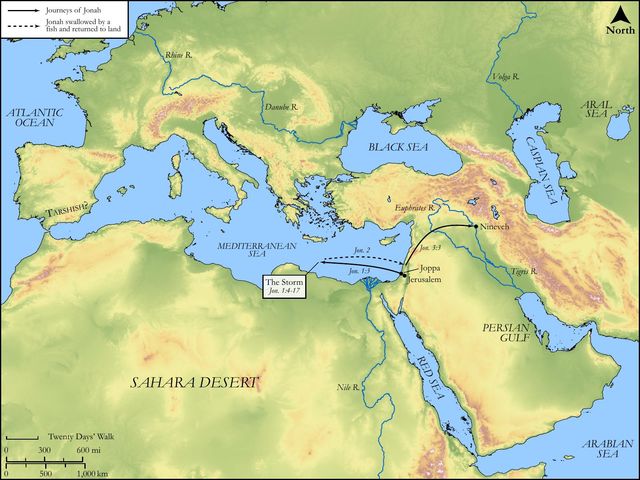
See on the biblical-era map
Study this verse
Public-domain commentary
Matthew Henry
From his Commentary on the Whole Bible. Henry comments on passages, not single verses — this entry covers Jonah 1:1–3.
Observe, 1. The honour God put upon Jonah, in giving him a commission to go and prophesy against Nineveh. Jonah signifies a dove, a proper name for all God's prophets, all his people, who ought to be harmless as doves, and to mourn as doves for the sins and calamities of the land. His father's name was Amittai - My truth; for God's prophets should be sons of truth. To him the word of the Lord came - to him it was (so the word signifies), for God's word is a real thing; men's words are but wind, but God's words are substance. He has been before acquainted with the word of the Lord, and knew his voice from that of a stranger; the orders now given him were, Arise, go to Nineveh, that great city, Jon 1:2. Nineveh was at this time the metropolis of the Assyrian monarchy, an eminent city (Gen 10:11), a great city, that great city, forty-eight miles in compass (some make it much more), great in the number of the inhabitants, as appears by the multitude of infants in it (Jon 4:11), great in wealth (there was no end of its store, Nah 2:9), great in power and dominion; it was the city that for some time ruled over the kings of the earth. But great cities, as well as great men, are under God's government and judgment. Nineveh was a great city, and yet a heathen city, without the knowledge and worship of the true God. How many great cities and great nations are there that sit in darkness and in the valley of the shadow of death! This great city was a wicked city: Their wickedness has come up before me (their malice, so some read it); their wickedness was presumptuous, and they sinned with a high hand. It is sad to think what a great deal of sin is committed in great cities, where there are many sinners, who are not only all sinners, but making one another sin. Their wickedness has come up, that is, it has come to a high degree, to the highest pitch; the measure of it is full to the brim; their wickedness has come up, as that of Sodom, Gen 18:20, Gen 18:21. It has come up before me - to my face (so the word is); it is a bold and open affront to God; it is sinning against him, in his sight; therefore Jonah must cry against it; he must witness against their great wickedness, and must warn them of the destruction that was coming upon them for it. God is coming forth against it, and he sends Jonah before, to proclaim war, and to sound an alarm. Cry aloud, spare not. He must not whisper his message in a corner, but publish it in the streets of Nineveh; he that hath ears let him hear what God has to say by his prophet against that wicked city. When the cry of sin comes up to God the cry of vengeance comes out against the sinner. He must go to Nineveh, and cry there upon the spot against the wickedness of it. Other prophets were ordered to send messages to the neighbouring nations, and the prophecy of Nahum is particularly the burden of Nineveh; but Jonah must go and carry the message himself: "Arise quickly; apply thyself to the business with speed and courage, and the resolution that becomes a prophet; arise, and go to Nineveh." Those that go on God's errands must rise and go, must stir themselves to the work cut out for them. The prophets were sent first to the lost sheep of the house of Israel, yet not to them only; they had the children's bread, but Nineveh eats of the crumbs. 2. The dishonour Jonah did to God in refusing to obey his orders, and to go on the errand on which he was sent (Jon 1:3): But Jonah, instead of rising to go to Nineveh, rose up to flee to Tarshish, to the sea, not bound for any port, but desirous to get away from the presence of the Lord; and, if he might but do that, he card not whither he went, not as if he thought he could go any where from under the eye of God's inspection, but from his special presence, from the spirit of prophecy, which, when it put him upon this work, he thought himself haunted with, and coveted to get out of the hearing of. Some think Jonah went upon the opinion of some of the Jews that the spirit of prophecy was confined to the land of Israel (which in Ezekiel and Daniel was effectually proved to be a mistake), and therefore he hoped he should get clear of it if he could but get out of the borders of that land. (1.) Jonah would not go to Nineveh to cry against it either because it was a long and dangerous journey thither, and in a road he knew not, or because he was afraid it would be as much as his life was worth to deliver such an ungrateful message to that great and potent city. He consulted with flesh and blood, and declined the embassy because he could not go with safety, or because he was jealous for the prerogatives of his country, and not willing that any other nation should share in the honour of divine revelation; he feared it would be the beginning of the removal of the kingdom of God from the Jews to another nation, that would bring forth more of the fruits of it. He owns himself (Jon 4:2) that the reason of his aversion to this journey was because he foresaw that the Ninevites would repent, and God would forgive them and take them into favour, which would be a slur upon the people of Israel, who had been so long a peculiar people to God. (2.) He therefore went to Tarshish, to Tarsus in Cilicia (so some), probably because he had friends and relations there, with whom he hoped for some time to sojourn. He went to Joppa, a famous seaport in the land of Israel, in quest of a ship bound for Tarshish, and there he found one. Providence seemed to favour his design, and give him an opportunity to escape. We may be out of the way of duty and yet may meet with a favourable gale. The ready way is not always the right way. He found the ship just ready to weigh anchor perhaps, and to set sail for Tarshish, and so he lost no time. Or, perhaps, he went to Tarshish because he found the ship going thither; otherwise all places were alike to him. He did not think himself out of his way, the way he would go, provided he was not in his way, the way he should go. So he paid the fare thereof; for he did not regard the charge, so he could but gain his point, and get to a distance from the presence of the Lord. He went with them, with the mariners, with the passengers, with the merchants, whoever they were that were going to Tarshish. Jonah, forgetting his dignity as well as his duty, herded with them, and went down into the ship to go with them to Tarshish. See what the best of men are when God leaves them to themselves, and what need we have, when the word of the Lord comes to us, to have the Spirit of the Lord come along with the word, to bring every thought within us into obedience to it. The prophet Isaiah owns that therefore he was not rebellious, neither turned away back, because God not only spoke to him, but opened his ear, Isa 50:5. Let us learn hence to cease from man, and not to be too confident either of ourselves or others in a time of trial; but let him that thinks he stands take heed lest he fall.
Historical interpretation
Two Centuries of Reception
5 surviving comments on this verse. Each one is dated, so this reads as a timeline rather than a list.
Select a marker to jump to its quote. Markers stagger vertically where authors wrote within a few decades of each other.
In trying to run away from the Lord, you show up the fickleness of all who plan flight. A certain headstrong prophet also had run away from the Lord, crossing the sea from Joppa to Tarsus, as if he could escape from God. But God found him not on land or on sea but in the belly of a beast, where for three days he could not die or even in that way escape from the eyes of God. Is that man not better off who, though he fears the enemy of God, does not flee from but despises him? Who trusts in the protection of God or, if you will, has an even greater fear of God, having stood the longer in his eyes? He says, “He is the Lord, he is mighty, all things are his, and wherever I shall be I am in his hands. Let him do what he will, I shall not run away. If he wishes me to die, let him destroy me, as long as I faithfully serve him. Much would I rather bring odium on him, by dying according to his will, than to live by my own cowardice.”
Jonah knew better than anyone the purpose of his message to the Ninevites and that, in planning his flight, although he changed his location, he did not escape from God. Nor is this possible for anyone else, either by concealing himself in the bosom of the earth, or in the depths of the sea, or by soaring on wings, if there be any means of doing so, and rising into the air, or by abiding in the lowest depths of hell, or by any other of the many devices for ensuring escape. For God alone of all things cannot be escaped from or contended with. If he wills to seize and bring them under his hand, he outstrips the swift. He outwits the wise. He overthrows the strong. He cuts down the lofty. He subdues rashness. He resists power.
But there Jonah calls upon God, and marvelous as it is, on the third day, he, like Christ, is delivered.… In my own case, what could be said? What defense could be made if I remained unsettled and rejected the yoke of ministry, which, though I know not whether to call it light or heavy, had at any rate been laid upon me.… On this account I had much toilsome consideration to discover my duty, being set in the middle between two fears, of which the one held me back and the other urged me on. For a long while I was at a loss between them. After wavering from side to side, and, like a current driven by inconstant winds, inclining first in this direction then in that, I at last yielded to the stronger. The fear of disobedience overcame me.
That is to be understood as nothing else than excess of their wickedness.
"Now the word of the LORD came unto Jonah the son of Amittai, saying, Arise, go to Nineveh, that great city, and cry against it; for their wickedness is come up before me." Apart from that which the Septuagint translates as, "the noise of their wickedness has risen up even to me", it has translated the rest similarly. Jonah is sent to the gentiles to condemn Israel, because Nineveh had to repent, but the Israelites still persisted in their sin. And when God says, "their wickedness has come up to me", or "the noise of their wickedness…" it is exactly the text of Genesis: "the noise of Sodom and of Gomorrah is very loud" [Gen. 18:20], and to Cain: "the blood of your brother cries to me from the earth" [Gen. 4:10]. According to tropology the Lord, our Jonah, that is to say 'dove' or 'suffering', (he is given both meaning, either because the Holy Spirit descends in the form of a dove and stays with him [Mark. 1:10; Luke 3:22; John 1:32-33], or because he has suffered for our wounds, wept for Jerusalem [Luke 19:41], and because we have been cured by his malice [Is. 53:5]) is truly the son of Truth, for God is Truth [John 14:6]. He is sent to Nineveh the beautiful, that is to the world, where there is nothing more beautiful to our eyes than flesh. In Greek the idea of adornment is in the word cosmos. And when everything had been completed, each one by one, it was said, "and God saw that it was good" [Gen. 1:10]. It is to Nineveh that he goes, the great city, so that although Israel has not wanted to listen, the whole world of peoples will hear God's word. And this is because their wickedness has gone up to God. For although God had made the most beautiful house for man who was devoted to serving his creator, man deprived himself of this by his own will; from childhood his heart fixed upon wickedness [Gen. 8:21; 6:5]. He turned his face to the heaven [Ps. 72:9] and constructed a tower of pride [Gen 11]. He deserves then God to come down to him so that he may be able to rise to heaven by the destruction of repentance, he that did not succeed by the swell of pride.
Continue studying Jonah 1:2 across the web’s major study libraries — every link below opens this exact verse, chapter, or book on the destination site.
Read & Compare
 BibleGatewayThis verse in more than 200 translations and 70 languages.
 Bible.comThe YouVersion reader — hundreds of translations, reading plans, and highlights.
 ESV.orgCrossway's official English Standard Version reader.
 NET BibleThe NET translation with 60,000+ translators' notes on every rendering decision.
 STEP BibleTyndale House's free study tool — original text, vocabulary, and scholarly resources.
 BibliaLogos Bible Software's free web reader.
 USCCBThe New American Bible (Revised Edition) with the U.S. bishops' study notes.
Commentaries
 BibleHub CommentariesDozens of classic commentaries on this verse, gathered on one page.
 StudyLightMore than 100 commentary sets — the largest collection on the web.
 BibleRefPlain-English commentary on what this verse means, verse by verse.
 Enduring WordDavid Guzik's free commentary on this chapter, widely used by Bible teachers.
 Bible Study ToolsVerse commentary alongside Greek and Hebrew study aids.
Original Language & Research
- BibleHub InterlinearThe verse word by word — original language, transliteration, and English.
- BibleHub LexiconEvery word's original-language definition and Strong's entry.
 Blue Letter BibleDeep-study tools — Strong's numbers, concordance, and word studies.
 SefariaThe Hebrew text with Rashi and centuries of Jewish commentary.
Sermons, Hymns & Audio


TrulyRandomVerse is not affiliated with these sites and doesn’t control their content. They’re linked because they’re genuinely useful.
Summary
Jonah 1:2 carries forward the opening of the prophetic book by recording God's direct command to Jonah: "Arise, go to Nineveh, that great city, and cry against it; for their wickedness is come up before me." This verse establishes the divine imperative for Jonah's mission, identifying the formidable target city and articulating the profound reason for God's impending judgment – the pervasive and accumulated wickedness of its inhabitants, which has reached a point requiring divine intervention.
Context
ShowHideLiterary Context
This verse immediately follows the opening statement in Jonah 1:1, which introduces Jonah as the son of Amittai and establishes the divine origin of the message. Jonah 1:2 is the pivotal divine commission that sets the entire narrative in motion. It presents a clear, non-negotiable command from God, directly preceding Jonah's infamous act of disobedience in Jonah 1:3, where he attempts to flee from the Lord's presence. The abruptness of the command and the specific, challenging nature of the task immediately establish the central conflict of the book: God's sovereign will versus human reluctance and prejudice.
Historical & Cultural Context
The command to go to Nineveh places the narrative firmly in the 8th century BC, during the reign of Jeroboam II in the Northern Kingdom of Israel, a period when Jonah was an active prophet (2 Kings 14:25). Nineveh was the sprawling capital of the Assyrian Empire, a formidable and notoriously cruel superpower that posed a significant threat to Israel. Assyria was known for its brutal military campaigns, forced deportations, and oppressive rule, making them a deeply feared and hated enemy of the Israelites. For an Israelite prophet like Jonah to be commanded to preach repentance to such a nation would have been not only dangerous but also deeply unpalatable, challenging his nationalistic sentiments and expectations of divine justice against Israel's oppressors.
Key Themes
ShowHideJonah 1:2 introduces several foundational themes that resonate throughout the book of Jonah and beyond. Firstly, it highlights Divine Sovereignty and Initiative, as God actively intervenes in human affairs and issues a direct command, demonstrating His control over nations, even those hostile to His chosen people, as seen in the broader prophetic tradition where God raises up and casts down empires (e.g., Isaiah 10:5-19). Secondly, the verse underscores God's Universal Concern and Justice, revealing that His moral authority and redemptive purposes extend beyond the covenant nation of Israel to encompass all humanity, including a pagan city like Nineveh, a theme echoed in the New Testament's emphasis on the gospel for all nations (e.g., Matthew 28:19). Thirdly, the phrase "their wickedness is come up before me" introduces the theme of Sin and Impending Judgment, indicating that Nineveh's accumulated moral corruption has reached a point demanding divine reckoning, a concept consistent with God's response to rampant sin in other narratives like the account of Sodom and Gomorrah in Genesis 18:20-21).
Exposition and Analysis
ShowHideKey Word Analysis
ShowHideA primitive root meaning to rise, stand up, or establish. In this imperative command, "Arise" conveys urgency and a call to immediate, decisive action. It is not merely a suggestion but a divine summons for Jonah to move from his current state of inactivity or preparation to active obedience and engagement with the mission.
This adjective, derived from a root meaning "to be great," describes Nineveh's immense size, importance, and perhaps even its notoriety or formidable nature. It highlights the significant scale of the city, making the task of prophesying against it particularly daunting and emphasizing the magnitude of the wickedness that has emanated from such a prominent center.
This term encompasses evil, badness, calamity, or mischief, referring to profound moral depravity. In the context of Nineveh, it signifies the pervasive corruption, violence, and unrighteousness that characterized the city and its empire, which has now reached a critical mass, demanding God's direct attention and intervention.
Verse Breakdown
ShowHide"Arise, go to Nineveh, that great city"
This clause presents a direct, three-fold divine imperative. "Arise" (qûwm) signifies an immediate call to action, demanding a change of posture and readiness. "Go" (yâlak) specifies the movement and direction, indicating a journey. The destination, "Nineveh," is explicitly named, emphasizing the specificity of God's target. The description "that great city" highlights its prominence, size, and perhaps its formidable nature, underscoring the challenge and significance of the prophetic mission.
"and cry against it"
This is the core command regarding the nature of Jonah's mission. "Cry" (qârâʼ) implies a public, forceful, and authoritative proclamation, not a quiet or private message. It is a prophetic utterance of judgment, a confrontational declaration against the city, indicating that the message will be one of warning and condemnation.
"for their wickedness is come up before me"
This final clause provides the divine justification and motivation for the entire command. "Their wickedness" refers to the accumulated moral evil and depravity of Nineveh. The anthropomorphic phrase "is come up before me" signifies that their sin has ascended to God's presence, becoming fully known and acknowledged by Him, reaching a point where it demands a divine response and intervention. It implies that the measure of their iniquity is full.
Literary Devices
ShowHideThe verse employs several potent literary devices to convey its message. The predominant use of the Imperative Mood ("Arise," "go," "cry") underscores the absolute authority of God and the non-negotiable nature of His command to Jonah, immediately establishing the divine will as the driving force of the narrative. Anthropomorphism is evident in the phrase "their wickedness is come up before me," attributing human-like perception and presence to God, as if sin physically ascends to His sight. This device vividly communicates God's full awareness and the gravity of Nineveh's transgressions, making the abstract concept of sin tangible and its impact on the divine realm clear. Furthermore, the description of Nineveh as "that great city" functions as a form of Emphasis or perhaps even a subtle Hyperbole, highlighting not only its immense physical size and political power but also the magnitude of its wickedness, thereby magnifying the challenge posed to Jonah and the significance of God's universal concern.
Theological and Thematic Connections
ShowHideJonah 1:2 profoundly reveals God's active engagement with the moral state of humanity beyond the boundaries of Israel. It asserts His universal sovereignty, demonstrating that His justice and concern are not confined to His covenant people but extend to all nations, even those considered enemies. The "wickedness" of Nineveh is not overlooked; it is precisely because of this pervasive evil that God initiates a prophetic intervention, underscoring His character as a righteous judge who holds all peoples accountable. Yet, this judgment is prefaced by a call to repentance, hinting at God's ultimate desire for all to turn from their destructive paths, a testament to His boundless mercy that will be fully unveiled later in the book. This divine initiative also sets the stage for the profound theological tension between God's universal compassion and Jonah's narrow, nationalistic prejudice.
Reflection and Application
ShowHideJonah 1:2 serves as a timeless reminder that God sees and is fully aware of all sin, whether in the grand scale of nations or the quiet corners of individual lives. It challenges us to confront our own comfort zones and prejudices, as God often calls His people to uncomfortable or challenging tasks – to go to difficult places or speak hard truths, even to those we might consider adversaries or "unworthy." Our obedience to God's call, regardless of our personal feelings toward the recipients or the perceived difficulty of the mission, is paramount. This verse implicitly raises the critical question of our willingness to step outside our immediate communities and personal preferences for God's purposes, recognizing that His concern for repentance and salvation extends far beyond our familiar circles. It compels us to consider where God might be calling us to "cry against" injustice or proclaim His truth, even when it feels daunting or unwelcome.
Questions for Reflection
ShowHideFAQ
ShowHideWhy was Nineveh considered "that great city"?
ShowHideNineveh was the capital of the Assyrian Empire, a dominant and feared power among the nations during the 8th century BC. Its "greatness" referred not only to its immense physical size (archaeological evidence suggests it was indeed a sprawling metropolis) but also to its political, military, and economic importance. It was a center of imperial power, known for its formidable defenses, vast wealth, and, unfortunately, its reputation for extreme cruelty and violence in warfare and governance. This made the task of prophesying against it particularly significant and dangerous for Jonah.
What does "their wickedness is come up before me" mean?
ShowHideThis phrase is an anthropomorphic expression, attributing human-like perception and presence to God. It does not imply that God was previously unaware of Nineveh's sins, but rather that their accumulated moral corruption, violence, and injustice had reached a critical point, a "full measure," in God's sight. It signifies that their actions had become so egregious and pervasive that they demanded divine attention and a consequential response, making intervention necessary. It's a vivid way of saying that their sin was ripe for judgment.
Why would God send an Israelite prophet to an enemy nation like Nineveh?
ShowHideGod's decision to send Jonah to Nineveh highlights His universal sovereignty and His concern for all humanity, not just the nation of Israel. It demonstrates that God's moral authority and redemptive purposes extend beyond His chosen people. While Israel was His covenant nation, God's justice and mercy are not limited by national or ethnic boundaries. This act foreshadows the broader scope of God's redemptive plan, which ultimately includes the Gentiles, and underscores His desire for all people to repent and turn to Him, even those who were enemies of Israel.
Christ-Centered Fulfillment
ShowHideJonah's reluctant mission to Nineveh, prompted by God's awareness of their "wickedness," finds profound Christ-centered fulfillment in the person and work of Jesus. While Jonah was sent to a single city with a message of impending judgment that could be averted by repentance, Jesus, the greater Prophet, came to the entire world with a message of salvation through His atoning work. Jesus Himself draws a direct parallel, stating that "the men of Nineveh will rise up at the judgment with this generation and condemn it, for they repented at the preaching of Jonah, and behold, something greater than Jonah is here" (Matthew 12:41). This highlights Jesus' unparalleled authority and the superior nature of His message. Unlike Jonah, who initially fled from his mission, Jesus willingly embraced His divine commission, even to the point of death on the cross, to address the ultimate "wickedness" of humanity – sin itself. The repentance of Nineveh foreshadows the inclusion of Gentiles into God's family, a reality fully realized through Christ's universal call to repentance and faith, preached "to all nations, beginning from Jerusalem" (Luke 24:47). Thus, Jonah 1:2, with its divine imperative to confront global sin, ultimately points to the Lamb of God who takes away the sin of the world, inviting all to come to Him for salvation (John 1:29).