


Romans 1:18
- ἈποκαλύπτεταιApokaluptetaiIs revealedG601V-PPI-3SVerb Present Passive Indicative 3rd Singular
- γὰρgarforG1063CONJConjunction
- ὀργὴorgē[the] wrathG3709N-NSFNoun Nominative Singular Feminine
- θεοῦtheouof GodG2316N-GSM-TNoun Genitive Singular Masculine Title
- ἀπ᾽ap᾽fromG575PREPPreposition
- οὐρανοῦouranouheavenG3772N-GSMNoun Genitive Singular Masculine
- ἐπὶepiuponG1909PREPPreposition
- πᾶσανpasanallG3956A-ASFAdjective Accusative Singular Feminine
- ἀσέβειανasebeianungodlinessG763N-ASFNoun Accusative Singular Feminine
- καὶkaiandG2532CONJConjunction
- ἀδικίανadikianunrighteousnessG93N-ASFNoun Accusative Singular Feminine
- ἀνθρώπωνanthrōpōnof menG444N-GPMNoun Genitive Plural Masculine
- τῶνtōn<the>G3588T-GPMDefinite article Genitive Plural Masculine
- τὴνtēntheG3588T-ASFDefinite article Accusative Singular Feminine
- ἀλήθειανalētheiantruthG225N-ASFNoun Accusative Singular Feminine
- ἐνenbyG1722PREPPreposition
- ἀδικίᾳadikiaunrighteousnessG93N-DSFNoun Dative Singular Feminine
- κατεχόντωνkatechontōnsuppressingG2722V-PAP-GPMVerb Present Active Participle Genitive Plural Masculine
English is a literal word-by-word gloss of the Greek, not the KJV's wording. Why?
This is the original text the KJV's translators worked from — each Greek word with its own literal English meaning in this verse, prepared by scholars at Tyndale House, Cambridge. The KJV translates whole sentences, not word by word, so its wording differs: one Greek word can become several English words, and the KJV may choose “charity” where the gloss reads “love”. Both are faithful — they answer different questions. For the KJV's own rendering, switch to the KJV text.
Details
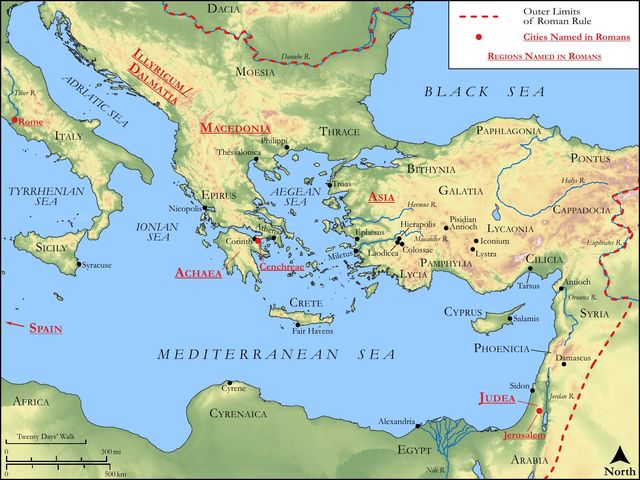
See on the biblical-era map

Study this verse
Public-domain commentary
Matthew Henry
From his Commentary on the Whole Bible. Henry comments on passages, not single verses — this entry covers Romans 1:16–18. His three-level outline is real structure in the source text, so it is rendered as structure.
Paul here enters upon a large discourse of justification, in the latter part of this chapter laying down his thesis, and, in order to the proof of it, describing the deplorable condition of the Gentile world. His transition is very handsome, and like an orator: he was ready to preach the gospel at Rome, though a place where the gospel was run down by those that called themselves the wits; for, saith he, I am not ashamed of it, Rom 1:16. There is a great deal in the gospel which such a man as Paul might be tempted to be ashamed of, especially that he whose gospel it is was a man hanged upon a tree, that the doctrine of it was plain, had little in it to set it off among scholars, the professors of it were mean and despised, and every where spoken against; yet Paul was not ashamed to own it. I reckon him a Christian indeed that is neither ashamed of the gospel nor a shame to it. The reason of this bold profession, taken from the nature and excellency of the gospel, introduces his dissertation.
I.The proposition, Rom 1:16, Rom 1:17. The excellency of the gospel lies in this, that it reveals to us,
1.The salvation of believers as the end: It is the power of God unto salvation. Paul is not ashamed of the gospel, how mean and contemptible soever it may appear to a carnal eye; for the power of God works by it the salvation of all that believe; it shows us the way of salvation (Act 16:17), and is the great charter by which salvation is conveyed and made over to us. But,
(1.)It is through the power of God; without that power the gospel is but a dead letter; the revelation of the gospel is the revelation of the arm of the Lord (Isa 53:1), as power went along with the word of Christ to heal diseases.
(2.)It is to those, and those only, that believe. Believing interests us in the gospel salvation; to others it is hidden. The medicine prepared will not cure the patient if it be not taken. - To the Jew first. The lost sheep of the house of Israel had the first offer made them, both by Christ and his apostles. You first (Act 3:26), but upon their refusal the apostles turned to the Gentiles, Act 13:46. Jews and Gentiles now stand upon the same level, both equally miserable without a Saviour, and both equally welcome to the Saviour, Col 3:11. Such doctrine as this was surprising to the Jews, who had hitherto been the peculiar people, and had looked with scorn upon the Gentile world; but the long-expected Messiah proves a light to enlighten the Gentiles, as well as the glory of his people Israel.
2.The justification of believers as the way (Rom 1:17): For therein, that is, in this gospel, which Paul so much triumphs in, is the righteousness of God revealed. Our misery and ruin being the product and consequent of our iniquity, that which will show us the way of salvation must needs show us the way of justification, and this the gospel does. The gospel makes known a righteousness. While God is a just and holy God, and we are guilty sinners, it is necessary we should have a righteousness wherein to appear before him; and, blessed be God, there is such a righteousness brought in by Messiah the prince (Dan 9:24) and revealed in the gospel; a righteousness, that is, a gracious method of reconciliation and acceptance, notwithstanding the guilt of our sins. This evangelical righteousness,
(1.)Is called the righteousness of God; it is of God's appointing, of God's approving and accepting. It is so called to cut off all pretensions to a righteousness resulting from the merit of our own works. It is the righteousness of Christ, who is God, resulting from a satisfaction of infinite value.
(2.)It is said to be from faith to faith, from the faithfulness of God revealing to the faith of man receiving (so some); from the faith of dependence upon God, and dealing with him immediately, as Adam before the fall, to the faith of dependence upon a Mediator, and so dealing with God (so others); from the first faith, by which we are put into a justified state, to after faith, by which we live, and are continued in that state: and the faith that justifies us is no less than our taking Christ for our Saviour, and becoming true Christians, according to the tenour of the baptismal covenant; from faith engrafting us into Christ, to faith deriving virtue from him as our root: both implied in the next words, The just shall live by faith. Just by faith, there is faith justifying us; live by faith, there is faith maintaining us; and so there is a righteousness from faith to faith. Faith is all in all, both in the beginning and progress of a Christian life. It is not from faith to works, as if faith put us into a justified state, and then works preserved and maintained us in it, but it is all along from faith to faith, as Co2 3:18, from glory to glory; it is increasing, continuing, persevering faith, faith pressing forward, and getting ground of unbelief. To show that this is no novel upstart doctrine, he quotes for it that famous scripture in the Old Testament, so often mentioned in the New (Hab 2:4): The just shall live by faith. Being justified by faith he shall live by it both the life of grace and of glory. The prophet there had placed himself upon the watch-tower, expecting some extraordinary discoveries (Rom 1:1), and the discovery was of the certainty of the appearance of the promised Messiah in the fulness of time, not withstanding seeming delays. This is there called the vision, by way of eminence, as elsewhere the promise; and while that time is coming, as well as when it has come, the just shall live by faith. Thus is the evangelical righteousness from faith to faith - from Old Testament faith in a Christ to come to New Testament faith in a Christ already come.
II.The proof of this proposition, that both Jews and Gentiles stand in need of a righteousness wherein to appear before God, and that neither the one nor the other have nay of their own to plead. Justification must be either by faith or works. It cannot be by works, which he proves at large by describing the works both of Jews and Gentiles; and therefore he concludes it must be by faith, Rom 3:20, Rom 3:28. The apostle, like a skilful surgeon, before he applies the plaster, searches the wound - endeavours first to convince of guilt and wrath, and then to show the way of salvation. This makes the gospel the more welcome. We must first see the righteousness of God condemning, and then the righteousness of God justifying will appear worthy of all acceptation. In general (Rom 1:18), the wrath of God is revealed. The light of nature and the light of the law reveal the wrath of God from sin to sin. It is well for us that the gospel reveals the justifying righteousness of God from faith to faith. The antithesis is observable. Here is,
1.The sinfulness of man described; he reduceth it to two heads, ungodliness and unrighteousness; ungodliness against the laws of the first table, unrighteousness against those of the second.
2.The cause of that sinfulness, and that is, holding the truth in unrighteousness. Some communes notitae, some ideas they had of the being of God, and of the difference of good and evil; but they held them in unrighteousness, that is, they knew and professed them in a consistency with their wicked courses. They held the truth as a captive or prisoner, that it should not influence them, as otherwise it would. An unrighteous wicked heart is the dungeon in which many a good truth is detained and buried. Holding fast the form of sound words in faith and love is the root of all religion (Ti2 1:13), but holding it fast in unrighteousness is the root of all sin.
3.The displeasure of God against it: The wrath of God is revealed from heaven; not only in the written word, which is given by inspiration of God (the Gentiles had not that), but in the providences of God, his judgments executed upon sinners, which do not spring out of the dust, or fall out by chance, nor are they to be ascribed to second causes, but they are a revelation from heaven. Or wrath from heaven is revealed; it is not the wrath of a man like ourselves, but wrath from heaven, therefore the more terrible and the more unavoidable.
Historical interpretation
Three Centuries of Reception
12 surviving comments on this verse. Each one is dated, so this reads as a timeline rather than a list.
Select a marker to jump to its quote. Markers stagger vertically where authors wrote within a few decades of each other.
And as the wrath of God did then descend upon the unrighteous, here also does the apostle likewise say: "For the wrath of God shall be revealed from heaven against all ungodliness and unrighteousness of those men who hold back the truth in unrighteousness."
Whose wrath? The Creator’s, of course! The truth therefore belongs to the Creator, as does the wrath, which has to be revealed in order to vindicate the truth.
The wrath, therefore, which is to vindicate truth, can only be revealed from heaven by the God of wrath; so that this sentence, which is quite in accordance with that previous one wherein the judgment is declared to be the Creator's, cannot possibly be ascribed to another god who is not a judge, and is incapable of wrath.
When, again, he declares that "the wrath (of God) is revealed from heaven against all ungodliness and unrighteousness of men, who hold the truth in unrighteousness," (I ask) the wrath of what God? Of the Creator certainly.
Here the wrath of God is said to be revealed not in part but against all ungodliness and wickedness; yet not against all men but only against those who suppress the truth by their wickedness.… Ungodliness refers to sin against God; wickedness, to sin against human beings. Those who suppress the truth by their wickedness sin against both God and humanity. Humans know this truth by the natural and God-given powers of the mind. Enough wisdom is given to them so that they might know what is known of God, i.e., what may be known of God, apprehending the invisible things from those things which can be seen, using the powers of human thought. For this reason God’s judgment is just on those who, before the coming of Christ, could have known God but instead turned away from him and fell into worshiping images of men and animals. To sum up: to worship anything at all apart from the Father, Son and Holy Spirit is the offense of ungodliness.
This means that although the visible creation was sufficient to reveal the invisible God, they nevertheless abandoned God and deified creatures instead, “suppressing the truth of God in unrighteousness.”
Just as the righteousness of God is revealed in the one who believes, as I recalled earlier, so ungodliness and unrighteousness are revealed in the one who does not believe. From the very structure of heaven it appears that God is angry with them. For this reason he made the stars so beautiful that from them he might be known as their great and wonderful Creator, and alone be adored. It is written in the eighteenth psalm: “The heavens declare the glory of God, and the firmament shows his handiwork,” and so the human race is made guilty by the natural law. For men could learn this by the law of nature, with the structure of the world bearing witness that God its author ought alone to be loved, which Moses put down in writing. But they became ungodly, not worshiping the Creator, and so unrighteousness appeared in them, in that seeing they suppressed the truth, not confessing the one God.
Observe the discretion of Paul, how after encouraging by the gentler things, he turns his discourse to the more fearful. For after saying that the Gospel is the cause of salvation and of life, that it is the power of God, that it gendereth salvation and righteousness, he mentions what might well make them fear that were heedless of it. For since in general most men are not drawn so much by the promise of what is good as by the fear of what is painful, he draws them on both sides. For this cause too did God not only promise a kingdom, but also threaten hell. And the Prophets spake thus with the Jews, ever intermingling the evil with the good. For this cause too Paul thus varies his discourse, yet not any how, but he sets first the good things, and after the evil, to show that the former came of the guiding purpose of God, but the latter of the wickedness of the backsliding. And in this way the prophet puts the good first, saying, "If ye be willing and will obey me, ye shall eat the good of the land: but if ye be not willing and will not obey me, the sword shall devour you." (Is. i. 19, 20.) So here too does Paul conduct his discourse. But observe him; Christ, he means, came to bring forgiveness, righteousness, life, yet not in any way, but by the Cross, which is greatest too and wonderful, that He not only gave such things, but that He also suffered such things. If then ye insolently scorn the gifts, then will the penalties await you, And see how he raises his language, "For the wrath of God," he says, "is revealed from heaven." Whence does this appear? If it be a believer who says this, we will tell him of the declarations of Christ, but if the unbeliever and the Grecian, him Paul silences, by what he says presently of the judgment of God, bringing an uncontrovertible demonstration from the things which were done by them. And this too is by far the most striking point in him, how he exhibits those who speak against the truth, as themselves bearing witness by the things which they do daily, and say, to the doctrines of the truth. But of this in the sequel: but for the present, let us keep to what is set before us. "For the wrath of God is revealed from heaven." And indeed even here this often takes place in famines and pestilences and wars: for each individually and all in common are punished. What will be the new thing then? That the chastisement will be greater, and common to all, and not by the same rules. For now what takes place is for correction; but then for vengeance. And this also St. Paul showed, when he said, "We are chastened now, that we should not be condemned with the world." (1 Cor. xi. 32.) And now indeed to many such things usually seem to come not of the wrath from above, but of the malice of man. But then the punishment from God shall be manifest, when the Judge, sitting upon the fearful tribunal, shall command some to be dragged to the furnaces, and some to the outer darkness, and some to other inexorable and intolerable punishments. And why is it that he does not speak as plainly as this, the Son of God is coming with ten thousand angels, and will call each man to account, but says, that "the wrath of God is revealed?" His hearers were as yet novices, and therefore he draws them first by things quite allowed by them. And besides what is here mentioned, he also seems to me to be aiming against the Greeks. And this is why he makes his beginning from this, but afterwards he introduces the subject of Christ's judgment.
"Against all ungodliness and unrighteousness of men who hold the truth in unrighteousness." Here he showeth that the ways of ungodliness are many, and that of truth, one. For error is a thing various and multiform and compound, but the truth is one. And after speaking of doctrines he speaks of life, mentioning the unrighteousness of men. For there be various kinds of unrighteousness also. One is in money affairs, as when any one deals unrighteously by his neighbor in these; and another in regard to women, when a man leaves his own wife, and breaks in upon the marriage of another. For St. Paul calls this also defrauding, saying thus, "That no man go beyond or defraud his brother in the matter." (1 Thess. iv. 6.) Others again injure not the wife or property, but the reputation of their neighbor, and this too is unrighteousness. For "a good name is better than great riches." (Prov. xxii. 1.) But some say that this also is said of Paul about doctrines. Still there is nothing to prevent its having been said of both. But what it is "to hold the truth in unrighteousness," learn from the sequel.
Since the forthcoming punishment of the ungodly and unrighteous has already been decreed, it is essential to walk in the righteousness of faith, in order to avoid the evils to come. Paul rightly said that the wrath of God is being revealed … in this present age, when God restrains himself and does not render the full punishment, so as not to remove the opportunity to repent, with the result that either they will turn around and be saved or else they will turn away and have no excuse.
Those whom the apostle reproved knew but did not give thanks and, claiming to be wise, actually became fools and fell into idolatry. For when the apostle spoke to the Athenians, he showed plainly that the wise among the Gentiles had discovered the Creator.… He condemned the unbelief of the Gentiles first, in order to show that they could obtain grace if they converted. For it would be unjust for them to suffer a penalty for unbelief but not obtain the reward of faith.
For nature taught them both that God is the Creator of all things and also that they should flee unrighteousness and embrace righteousness. But even when teachers were given to them, they did not live up to this. So God threatened them with future punishment.… This punishment is called the wrath of God, not because God punishes people for any emotional reason but in order to stun those who rebel against him.
Generally speaking there are two main types of sin—discord with God and discord with one’s neighbor. Paul mentions them both, putting discord with God first because it is the greater sin, and calling it “ungodliness.” He then mentions the second kind of discord, the one with one’s neighbor, calling it “wickedness.” He even states that our entire race has rightly come under judgment, saying that they have suppressed the truth in wickedness. Nor can they claim to be ignorant, for knowing the truth, they perverted it.… And outlining their sins, Paul lists the one against God first, saying that they had clear and plain knowledge about God because God had revealed himself to them.
Continue studying Romans 1:18 across the web’s major study libraries — every link below opens this exact verse, chapter, or book on the destination site.
Read & Compare
 BibleGatewayThis verse in more than 200 translations and 70 languages.
 Bible.comThe YouVersion reader — hundreds of translations, reading plans, and highlights.
 ESV.orgCrossway's official English Standard Version reader.
 NET BibleThe NET translation with 60,000+ translators' notes on every rendering decision.
 STEP BibleTyndale House's free study tool — original text, vocabulary, and scholarly resources.
 BibliaLogos Bible Software's free web reader.
 USCCBThe New American Bible (Revised Edition) with the U.S. bishops' study notes.
Commentaries
 BibleHub CommentariesDozens of classic commentaries on this verse, gathered on one page.
 StudyLightMore than 100 commentary sets — the largest collection on the web.
 BibleRefPlain-English commentary on what this verse means, verse by verse.
 Enduring WordDavid Guzik's free commentary on this chapter, widely used by Bible teachers.
 Bible Study ToolsVerse commentary alongside Greek and Hebrew study aids.
Original Language & Research
- BibleHub InterlinearThe verse word by word — original language, transliteration, and English.
- BibleHub LexiconEvery word's original-language definition and Strong's entry.
 Blue Letter BibleDeep-study tools — Strong's numbers, concordance, and word studies.
 CNTR CollationThe earliest Greek manuscripts of this verse, collated letter by letter.
Sermons, Hymns & Audio


TrulyRandomVerse is not affiliated with these sites and doesn’t control their content. They’re linked because they’re genuinely useful.
Summary
Romans 1:18 marks a crucial pivot in Paul's argument, shifting from the revelation of God's saving righteousness to the equally certain revelation of His righteous wrath. This verse establishes the universal human predicament of sin, declaring that divine judgment is actively being unveiled from heaven against all forms of human impiety and moral wrongdoing, particularly targeting those who, despite possessing a measure of truth, actively suppress or hinder it through their unrighteous lives. It sets the indispensable backdrop for understanding humanity's dire need for the gospel's salvation.
Context
ShowHideLiterary Context
Romans 1:18 immediately follows Paul's profound declaration of the gospel's power for salvation to everyone who believes, where "the righteousness of God is revealed from faith to faith" (Romans 1:16-17). Having presented the solution—God's righteousness—Paul now introduces the problem: humanity's universal sinfulness that necessitates such a divine intervention. This verse inaugurates a lengthy and detailed indictment of both Gentile and Jewish sinfulness, spanning through Romans 3:20, demonstrating that "all have sinned and fall short of the glory of God" (Romans 3:23). The "for" (Greek: gar) at the beginning of the verse signifies that it provides the reason or explanation for the gospel's necessity, establishing the dire situation from which the gospel offers deliverance.
Historical & Cultural Context
Paul is writing to the church in Rome, the heart of the Roman Empire, a melting pot of cultures, philosophies, and religions. While the Roman world boasted of its legal systems, philosophical advancements, and moral codes, it was also characterized by widespread idolatry, sexual immorality, oppression, and a general disregard for the one true God. Paul's audience would have been familiar with various forms of pagan worship and ethical systems. His assertion that God's wrath is "revealed from heaven" would have resonated with both Jewish and Gentile understandings of divine judgment, though Paul redefines its scope and nature. The concept of "truth" was debated among philosophers, but Paul presents it as an inherent knowledge of God, accessible even to those without the Mosaic Law, which is then suppressed.
Key Themes
ShowHideThis verse introduces and contributes to several foundational themes in Romans. Firstly, the Wrath of God is presented not as capricious anger but as God's settled, righteous, and active opposition to sin, a necessary aspect of His holy character. Secondly, the themes of Ungodliness (asébeia) and Unrighteousness (adikía) are central, demonstrating humanity's dual failure: a failure to honor God (ungodliness) and a failure to live justly in relation to God's standards and fellow humans (unrighteousness). Thirdly, the concept of Suppression of Truth is pivotal, highlighting humanity's culpability. Paul argues that humanity has an innate, undeniable knowledge of God (as elaborated in Romans 1:19-20), but actively chooses to "hold" or "suppress" this truth, leading to further moral decay and justly incurring divine wrath. This suppression is not ignorance but willful rejection.
Exposition and Analysis
ShowHideKey Word Analysis
ShowHideThis term signifies more than a fleeting emotion; it denotes a settled, righteous indignation and determined opposition. In the context of God, orgḗ is His holy, just, and unwavering antagonism toward sin and rebellion. It implies a judicial response to human wickedness, leading to consequences and ultimately, divine judgment. It is not an uncontrolled outburst but a consistent attribute of God's character in response to unrighteousness.
Derived from apó (from) and kalýptō (to cover), this verb literally means "to uncover" or "to disclose." The use of the present tense indicates an ongoing, active process. Just as God's righteousness is being "revealed" (v. 17), so too is His wrath. This revelation is not hidden but is evident through the natural consequences of sin, the moral decay of society, and ultimately, through divine judgment. It implies that humanity is without excuse, as God's opposition to sin is made manifest.
This verb has a range of meanings, including "to hold fast," "to possess," "to retain," but also "to restrain," "to hinder," or "to suppress." In the context of "holding the truth in unrighteousness," the latter meaning is strongly implied and supported by the subsequent verses (Romans 1:19-23). It suggests an active, willful act of suppressing or hindering the truth about God that is already known, preventing it from having its proper effect on one's life. This suppression is not passive ignorance but an active rebellion against divine revelation.
Verse Breakdown
ShowHide"For the wrath of God is revealed from heaven"
This clause introduces the foundational premise for the universal need for the gospel. "For" (G1063, gár) links this statement as the reason for the gospel's necessity. "The wrath of God" (G3709, orgḗ G2316, theós) is God's righteous, active opposition to sin. The phrase "is revealed" (G601, apokalýptō) signifies an ongoing, evident disclosure, paralleling the revelation of God's righteousness in the preceding verse. "From heaven" (G575, apó G3772, ouranós) emphasizes the divine origin and authority of this revelation, indicating that it is not a human construct but a direct manifestation of God's character and judgment.
"against all ungodliness and unrighteousness of men"
This specifies the target of God's wrath. "Against all" (G1909, epí G3956, pâs) indicates a comprehensive and universal scope, encompassing every instance and form of human sin. "Ungodliness" (G763, asébeia) refers to impiety, irreverence, or a failure to honor God, encompassing a lack of proper worship, respect, or devotion. "Unrighteousness" (G93, adikía) refers to injustice, moral wrong-doing, and a failure to meet God's ethical standards in relation to others and oneself. The conjunction "and" (G2532, kaí) highlights that God's wrath is directed at both aspects of human rebellion: the vertical (against God) and the horizontal (against His moral law and fellow humans).
"who hold the truth in unrighteousness;"
This final clause identifies the particular culpability of humanity. "Who hold" (G2722, katéchō) implies an active suppression or hindering. "The truth" (G225, alḗtheia) refers to the inherent knowledge of God and His moral demands, which Paul further explains in Romans 1:19-20. Humanity possesses this truth, not through special revelation, but through creation and conscience. "In unrighteousness" (G1722, en G93, adikía) describes the manner or sphere in which this suppression occurs: it is through their sinful actions, choices, and lifestyles that people actively hinder or reject the truth they know about God. This makes their ungodliness and unrighteousness inexcusable.
Literary Devices
ShowHidePaul employs several potent literary devices in Romans 1:18 to underscore his message. The use of Parallelism is evident in the contrast and connection between "the righteousness of God is revealed" in verse 17 and "the wrath of God is revealed" in verse 18. This highlights that both aspects of God's character are actively disclosed, one offering salvation, the other demonstrating the dire need for it. The phrase "from heaven" serves as a powerful Metonymy, where "heaven" stands for God Himself, emphasizing the divine origin and authority of this revealed wrath. Furthermore, the description of "ungodliness and unrighteousness" uses Merism, combining two distinct but related terms to encompass the totality of human sin—both vertical offenses against God and horizontal offenses against His moral order and fellow humans. Finally, the concluding phrase, "who hold the truth in unrighteousness," is a striking Paradox and a form of Irony, as it describes individuals who possess knowledge of divine truth yet actively use their sinful lives to suppress or hinder that very truth, making their condemnation all the more just.
Theological and Thematic Connections
ShowHideRomans 1:18 is a foundational theological statement that underscores the justice and holiness of God. It asserts that God's wrath is not arbitrary but a righteous response to human rebellion, specifically against those who suppress the innate knowledge of God. This revelation of wrath is not merely a future event but an active, ongoing process, manifested in the consequences of sin and the moral degradation described in the subsequent verses. It establishes the universal guilt of humanity, demonstrating that all people, regardless of their access to specific divine law, are accountable before God due to their willful rejection of the truth evident in creation and conscience. This profound declaration of human culpability and divine judgment sets the stage for the glorious revelation of God's saving righteousness through faith in Christ, highlighting the indispensable need for the gospel as the sole remedy for humanity's desperate condition.
Reflection and Application
ShowHideRomans 1:18 serves as a sobering reminder of the gravity of sin and the unwavering holiness of God. It challenges us to confront the reality that God's wrath is not a distant, abstract concept, but a present and active opposition to all forms of ungodliness and unrighteousness. For those who acknowledge Christ, this verse deepens our appreciation for the immense grace found in the gospel, which delivers us from this very wrath. It compels us to live in a manner that honors God and reflects His righteousness, rather than suppressing the truth we have received. For those yet to embrace the gospel, it serves as a stark warning, urging a turning from rebellion to repentance and faith. We are called to examine our own lives: are we truly living in alignment with the truth of God we profess to know, or are there areas where our actions and attitudes subtly, or overtly, suppress that truth? This verse powerfully underscores the urgency of sharing the good news of Christ, for it is the only way for humanity to escape the just condemnation of God's wrath and enter into His saving righteousness.
Questions for Reflection
ShowHideFAQ
ShowHideWhat does "the wrath of God is revealed from heaven" mean?
ShowHideThis phrase signifies that God's righteous indignation and active opposition to sin are not hidden but are being openly and continuously disclosed. "From heaven" emphasizes the divine origin and authority of this revelation, meaning it is God's own judgment and holy response emanating from His throne. This revelation is evident both in the natural consequences of sin (as described in Romans 1:24-32) and in the ultimate judgment to come. It underscores that humanity is without excuse, as God's character and His opposition to unrighteousness are clearly manifested.
What is the difference between "ungodliness" and "unrighteousness"?
ShowHideWhile closely related, "ungodliness" (Greek: asébeia) primarily refers to a lack of reverence, piety, or proper worship toward God. It is a failure in one's vertical relationship with the Creator, encompassing a disregard for His authority, glory, and rightful place. "Unrighteousness" (Greek: adikía), on the other hand, refers to injustice, moral wrongdoing, or a failure to meet God's ethical standards in one's horizontal relationships with others and in one's own character. It signifies a deviation from what is right or just. Paul uses both terms to comprehensively describe humanity's rebellion, encompassing both a failure to honor God and a failure to live according to His moral law.
Christ-Centered Fulfillment
ShowHideRomans 1:18, in its stark declaration of God's revealed wrath against sin, serves as the essential dark canvas upon which the brilliance of Christ's saving work is painted. The very wrath described here, which humanity justly incurs, is precisely what Jesus Christ bore on the cross. He became the propitiation for our sins, diverting God's righteous anger from us by enduring it Himself (Romans 3:25). The "truth" that humanity suppresses in unrighteousness is ultimately embodied in Christ, who is "the way, the truth, and the life" (John 14:6). Through His perfect obedience and sacrificial death, Christ fulfilled the demands of God's righteousness, offering a path for humanity to be declared righteous and escape the wrath that is revealed from heaven (Romans 5:9). Thus, this verse, while describing humanity's dire predicament, ultimately magnifies the unparalleled grace and redemptive power of the Lord Jesus, who delivers us from the coming wrath (1 Thessalonians 1:10).