


1 Corinthians 1:25
Bible text: King James Version (1769 Blayney text) · Public domain
Bible text: Berean Standard Bible · Public domain
Bible text: American Standard Version (1901) · Public domain
Bible text: World English Bible, Messianic edition · Public domain
Bible text: Geneva Bible (1599) · Public domain
Bible text: Young's Literal Translation · Public domain
- ὅτιhotiForG3754CONJConjunction
- τὸtotheG3588T-NSNDefinite article Nominative Singular Neuter
- μωρὸνmōronfoolishnessG3474A-NSNAdjective Nominative Singular Neuter
- τοῦtou<the>G3588T-GSMDefinite article Genitive Singular Masculine
- θεοῦtheouof GodG2316N-GSM-TNoun Genitive Singular Masculine Title
- σοφώτερονsophōteronwiserG4680A-NSN-CAdjective Nominative Singular Neuter Comparative
- τῶνtōn<the>G3588T-GPMDefinite article Genitive Plural Masculine
- ἀνθρώπωνanthrōpōnthan menG444N-GPMNoun Genitive Plural Masculine
- ἐστὶνestinisG1510V-PAI-3SVerb Present Active Indicative 3rd Singular
- καὶkaiandG2532CONJConjunction
- τὸtotheG3588T-NSNDefinite article Nominative Singular Neuter
- ἀσθενὲςasthenesweaknessG772A-NSNAdjective Nominative Singular Neuter
- τοῦtou<the>G3588T-GSMDefinite article Genitive Singular Masculine
- θεοῦtheouof GodG2316N-GSM-TNoun Genitive Singular Masculine Title
- ἰσχυρότερονischuroteronstrongerG2478A-NSN-CAdjective Nominative Singular Neuter Comparative
- τῶνtōn<the>G3588T-GPMDefinite article Genitive Plural Masculine
- ἀνθρώπωνanthrōpōnthan menG444N-GPMNoun Genitive Plural Masculine
- ἐστίνestinisG1510V-PAI-3SVerb Present Active Indicative 3rd Singular
English is a literal word-by-word gloss of the Greek, not the KJV's wording. Why?
This is the original text the KJV's translators worked from — each Greek word with its own literal English meaning in this verse, prepared by scholars at Tyndale House, Cambridge. The KJV translates whole sentences, not word by word, so its wording differs: one Greek word can become several English words, and the KJV may choose “charity” where the gloss reads “love”. Both are faithful — they answer different questions. For the KJV's own rendering, switch to the KJV text.
Details
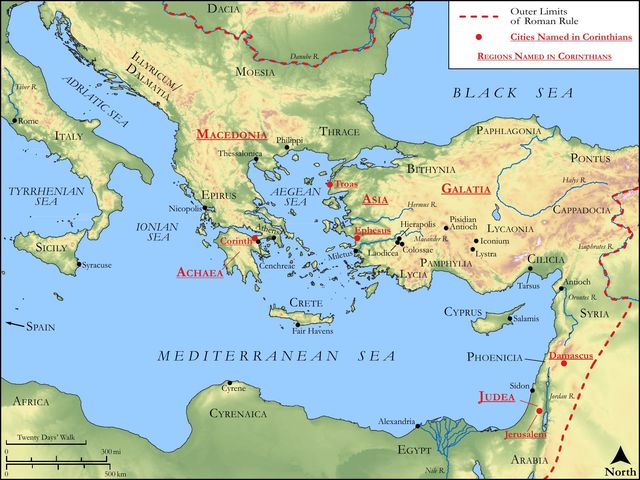
See on the biblical-era maps

Study this verse
Public-domain commentary
Matthew Henry
From his Commentary on the Whole Bible. Henry comments on passages, not single verses — this entry covers 1 Corinthians 1:17–31. His three-level outline is real structure in the source text, so it is rendered as structure.
We have here,
I.The manner in which Paul preached the gospel, and the cross of Christ:
Not with the wisdom of words (Co1 1:17), the enticing words of man's wisdom (Co1 2:4), the flourish of oratory, or the accuracies of philosophical language, upon which the Greeks so much prided themselves, and which seem to have been the peculiar recommendations of some of the heads of the faction in this church that most opposed this apostle. He did not preach the gospel in this manner, lest the cross of Christ should be of no effect, lest the success should be ascribed to the force of art, and not of truth; not to the plain doctrine of a crucified Jesus, but to the powerful oratory of those who spread it, and hereby the honour of the cross be diminished or eclipsed. Paul had been bred up himself in Jewish learning at the feet of Gamaliel, but in preaching the cross of Christ he laid his learning aside. He preached a crucified Jesus in plain language, and told the people that that Jesus who was crucified at Jerusalem was the Son of God and Saviour of men, and that all who would be saved must repent of their sins, and believe in him, and submit to his government and laws. This truth needed no artificial dress; it shone out with the greatest majesty in its own light, and prevailed in the world by its divine authority, and the demonstration of the Spirit, without any human helps. The plain preaching of a crucified Jesus was more powerful than all the oratory and philosophy of the heathen world.
II.We have the different effects of this preaching:
To those who perish it is foolishness, but to those who are saved it is the power of God, Co1 1:18. It is to the Jews a stumbling-block, and to the Greeks foolishness; but unto those who are called, both Jews and Greeks, Christ the power of God and the wisdom of God, Co1 1:23, Co1 1:24.
1.Christ crucified is a stumbling-block to the Jews. They could not get over it. They had a conceit that their expected Messiah was to be a great temporal prince, and therefore would never own one who made so mean an appearance in life, and died so accursed a death, for their deliverer and king. They despised him, and looked upon him as execrable, because he was hanged on a tree, and because he did not gratify them with a sign to their mind, though his divine power shone out in innumerable miracles. The Jews require a sign, Co1 1:22. See Mat 12:38.
2.He was to the Greeks foolishness. They laughed at the story of a crucified Saviour, and despised the apostles' way of telling it. They sought for wisdom. They were men of wit and reading, men that had cultivated arts and sciences, and had, for some ages, been in a manner the very mint of knowledge and learning. There was nothing in the plain doctrine of the cross to suit their taste, nor humour their vanity, nor gratify a curious and wrangling temper: they entertained it therefore with scorn and contempt. What, hope to be saved by one that could not save himself! And trust in one who was condemned and crucified as a malefactor, a man of mean birth and poor condition in life, and cut off by so vile and opprobrious a death! This was what the pride of human reason and learning could not relish. The Greeks thought it little better than stupidity to receive such a doctrine, and pay this high regard to such a person: and thus were they justly left to perish in their pride and obstinacy. Note, It is just with God to leave those to themselves who pour such proud contempt on divine wisdom and grace.
3.To those who are called and saved he is the wisdom of God, and the power of God. Those who are called and sanctified, who receive the gospel, and are enlightened by the Spirit of God, discern more glorious discoveries of God's wisdom and power in the doctrine of Christ crucified than in all his other works. Note, Those who are saved are reconciled to the doctrine of the cross, and led into an experimental acquaintance with the mysteries of Christ crucified.
III.We have here the triumphs of the cross over human wisdom, according to the ancient prophecy (Isa 29:14):
I will destroy the wisdom of the wise, and bring to nothing the understanding of the prudent. Where is the wise? Where is the scribe? Where is the disputer of this world? Hath not God made foolish the wisdom of this world? Co1 1:19, Co1 1:20, All the valued learning of this world was confounded, baffled, and eclipsed, by the Christian revelation and the glorious triumphs of the cross. The heathen politicians and philosophers, the Jewish rabbis and doctors, the curious searchers into the secrets of nature, were all posed and put to a nonplus. This scheme lay out of the reach of the deepest statesmen and philosophers, and the greatest pretenders to learning both among the Jews and Greeks. When God would save the world, he took a way by himself; and good reason, for the world by wisdom knew not God, Co1 1:21. All the boasted science of the heathen world did not, could not, effectually bring home the world to God. In spite of all their wisdom, ignorance still prevailed, iniquity still abounded. Men were puffed up by their imaginary knowledge, and rather further alienated from God; and therefore it pleased him, by the foolishness of preaching, to save those that believe. By the foolishness of preaching - not such in truth, but in vulgar reckoning.
1.The thing preached was foolishness in the eyes of worldly-wise men. Our living through one who died, our being blessed by one who was made a curse, our being justified by one who was himself condemned, was all folly and inconsistency to men blinded with self-conceit and wedded to their own prejudices and the boasted discoveries of their reason and philosophy.
2.The manner of preaching the gospel was foolishness to them too. None of the famous men for wisdom or eloquence were employed to plant the church or propagate the gospel. A few fishermen were called out, and sent upon this errand. These were commissioned to disciple the nations: these vessels chosen to convey the treasure of saving knowledge to the world. There was nothing in them that at first view looked grand or august enough to come from God; and the proud pretenders to learning and wisdom despised the doctrine for the sake of those who dispensed it. And yet the foolishness of God is wiser than men, Co1 1:25. Those methods of divine conduct that vain men are apt to censure as unwise and weak have more true, solid, and successful wisdom in them, than all the learning and wisdom that are among men: "You see your calling, brethren, how that not many wise men after the flesh, not many mighty, not many noble, are called, Co1 1:26, etc. You see the state of Christianity; not many men of learning, or authority, or honourable extraction, are called." There is a great deal of meanness and weakness in the outward appearance of our religion. For,
(1.)Few of distinguished character in any of these respects were chosen for the work of the ministry. God did not choose philosophers, nor orators, nor statesmen, nor men of wealth and power and interest in the world, to publish the gospel of grace and peace. Not the wise men after the flesh, though men would apt to think that a reputation for wisdom and learning might have contributed much to the success of the gospel. Not the mighty and noble, however men might be apt to imagine that secular pomp and power would make way for its reception in the world. But God seeth not as man seeth. He hath chosen the foolish things of the world, the weak things of the world, the base and despicable things of the world, men of mean birth, of low rank, of no liberal education, to be the preachers of the gospel and planters of the church. His thoughts are not as our thoughts, nor his ways as our ways. He is a better judge than we what instruments and measures will best serve the purposes of his glory.
(2.)Few of distinguished rank and character were called to be Christians. As the teachers were poor and mean, so generally were the converts. Few of the wise, and mighty, and noble, embraced the doctrine of the cross. The first Christians, both among Jews and Greeks, were weak, and foolish, and base; men of mean furniture as to their mental improvements, and very mean rank and condition as to their outward estate; and yet what glorious discoveries are there of divine wisdom in the whole scheme of the gospel, and in this particular circumstance of its success!
IV.We have an account how admirably all is fitted, 1.
To beat down the pride and vanity of men. God hath chosen the foolish things of the world to confound the wise - men of no learning to confound the most learned; the weak things of the world to confound the might - men of mean rank and circumstances to confound and prevail against all the power and authority of earthly kings; and base things, and things which are despised - things which men have in the lowest esteem, or in the utmost contempt, to pour contempt and disgrace on all they value and have in veneration; and things which are not, to bring to nought (to abolish) things that are - the conversion of the Gentiles (of whom the Jews had the most contemptuous and vilifying thoughts) was to open a way to the abolishing of that constitution of which they were so fond, and upon which they valued themselves so much as for the sake of it to despise the rest of the world. It is common for the Jews to speak of the Gentiles under this character, as things that are not. Thus, in the apocryphal book of Esther, she is brought in praying that God would not give his sceptre to those who are not, Esth. 14:11. Esdras, in one of the apocryphal books under his name, speaks to God of the heathen as those who are reputed as nothing, 2 Esdras 6:56, 57. And the apostle Paul seems to have this common language of the Jews in his view when he calls Abraham the father of us all before him whom he believed, God, who calleth those things that are not as though they were, Rom 4:17. The gospel is fitted to bring down the pride of both Jews and Greeks, to shame the boasted science and learning of the Greeks, and to take down that constitution on which the Jews valued themselves and despised all the world besides, that no flesh should glory in his presence (Co1 1:29), that there might be no pretence for boasting. Divine wisdom alone had the contrivance of the method of redemption; divine grace alone revealed it, and made it known. It lay, in both respects, out of human reach. And the doctrine and discovery prevailed, in spite of all the opposition it met with from human art or authority: so effectually did God veil the glory and disgrace the pride of man in all. The gospel dispensation is a contrivance to humble man. But, 2. It is as admirably fitted to glorify God. There is a great deal of power and glory in the substance and life of Christianity. Though the ministers were poor and unlearned, and the converts generally of the meanest rank, yet the hand of the Lord went along with the preachers, and was mighty in the hearts of the hearers; and Jesus Christ was made both to ministers and Christians what was truly great and honourable. All we have we have from God as the fountain, and in and through Christ as the channel of conveyance. He is made of God to us wisdom, righteousness, sanctification, and redemption (Co1 1:30): all we need, or can desire. We are foolishness, ignorant and blind in the things of God, with all our boasted knowledge; and he is made wisdom to us. We are guilty, obnoxious to justice; and he is made righteousness, our great atonement and sacrifice. We are depraved and corrupt; and he is made sanctification, the spring of our spiritual life; from him, the head, it is communicated to all the members of his mystical body by his Holy Spirit. We are in bonds, and he is made redemption to us, our Saviour and deliverer. Observe, Where Christ is made righteousness to any soul, he is also made sanctification. He never discharges from the guilt of sin, without delivering from the power of it; and he is made righteousness and sanctification, that he may in the end be made complete redemption, may free the soul from the very being of sin, and loose the body from the bonds of the grave: and what is designed in all is that all flesh may glory in the Lord, Co1 1:31. Observe, It is the will of God that all our glorifying should be in the Lord: and, our salvation being only through Christ, it is thereby effectually provided that it should be so. Man is humbled, and God glorified and exalted, by the whole scheme.
Historical interpretation
Two Centuries of Reception
7 surviving comments on this verse. Each one is dated, so this reads as a timeline rather than a list.
Select a marker to jump to its quote. Markers stagger vertically where authors wrote within a few decades of each other.
Moreover, having the spirit of the world, and "in the wisdom of God by wisdom knowing not God," they seem to themselves to be wiser than God; because, as the wisdom of the world is foolishness with God, so also the wisdom of God is folly in the world's esteem. We, however, know that "the foolishness of God is wiser than men, and the weakness of God is stronger than men." Accordingly, God is then especially great, when He is small to man; then especially good, when not good in man's judgment; then especially unique, when He seems to man to be two or more.
The very "stumbling-block" which he declares Christ to be "to the Jews," points unmistakeably to the Creator's prophecy respecting Him, when by Isaiah He says: "Behold I lay in Sion a stone of stumbling and a rock of offence." This rock or stone is Christ. This stumbling-stone Marcion retains still. Now, what is that "foolishness of God which is wiser than men," but the cross and death of Christ? What is that "weakness of God which is stronger than men," but the nativity and incarnation of God? If, however, Christ was not born of the Virgin, was not constituted of human flesh, and thereby really suffered neither death nor the cross there was nothing in Him either of foolishness or weakness; nor is it any longer true, that "God hath chosen the foolish things of the world to confound the wise; "nor, again, hath "God chosen the weak things of the world to confound the mighty; "nor "the base things" and the least things "in the world, and things which are despised, which are even as nothing" (that is, things which really are not), "to bring to nothing things which are" (that is, which really are).
When Paul speaks of the “foolishness of God,” he is not implying that God is foolish. Rather he is saying that since God’s way of reasoning is in accord with things of the spirit, it confounds the reasoning of this world. It is wiser than human reasoning, because spiritual things are wiser than carnal ones. Spiritual things do not exist through carnal ones, but the other way around. Therefore carnal things are understandable in relation to spiritual ones. Similarly, what belongs to heaven is stronger than what belongs to earth. So what seems like the weakness of God is not really weak at all. Christ appeared to be defeated when he was killed, but he emerged as the victor and turned the reproof back on his persecutors.
All these things, therefore, Paul bearing in mind, and being struck with astonishment, said that "the foolishness of God is wiser than men, and the weakness of God is stronger than men;" in relation to the Cross, speaking of a folly and weakness, not real but apparent. For he is answering with respect unto the other party's opinion. For that which philosophers were not able by means of reasoning to accomplish, this, what seemed to be foolishness did excellently well. Which then is the wiser, he that persuadeth the many, or he that persuadeth few, or rather no one? He who persuadeth concerning the greatest points, or about matters which are nothing? What great labors did Plato endure, and his followers, discoursing to us about a line, and an angle, and a point, and about numbers even and odd, and equal unto one another and unequal, and such-like spiderwebs; (for indeed those webs are not more useless to man's life than were these subjects;) and without doing good to any one great or small by their means, so he made an end of his life. How greatly did he labor, endeavoring to show that the soul was immortal! and even as he came he went away, having spoken nothing with certainty, nor persuaded any hearer. But the Cross wrought persuasion by means of unlearned men; yea it persuaded even the whole world: and not about common things, but in discourse of God, and the godliness which is according to truth, and the evangelical way of life, and the judgment of the things to come. And of all men it made philosophers: the very rustics, the utterly unlearned. Behold how "the foolishness of God is wiser than men," and "the weakness stronger?" How "stronger?" Because it overran the whole world, and took all by main force, and while men were endeavoring by ten thousands to extinguish the name of the Crucified, the contrary came to pass: that flourished and increased more and more, but they perished and wasted away; and the living at war with the dead, had no power. So that when the Greek calls me foolish, he shows himself above measure foolish: since I who am esteemed by him a fool, evidently appear wiser than the wise. When he calls me weak, then he shows himself to be weaker. For the noble things which publicans and fishermen were able to effect by the grace of God, these, philosophers, and rhetoricians, and tyrants, and in short the whole world, running ten thousand ways here and there, could not even form a notion of. For what did not the Cross introduce? The doctrine concerning the Immortality of the Soul; that concerning the Resurrection of the Body; that concerning the contempt of things present; that concerning the desire of things future. Yea, angels it hath made of men, and all, every where, practice self-denial, and show forth all kinds of fortitude.
But among them also, it will be said, many have been found contemners of death. Tell me who? was it he who drank the hemlock? But if thou wilt, I can bring forward ten thousand such from within the Church. For had it been lawful when persecution befell them to drink hemlock and depart, all had become more famous than he. And besides, he drank when he was not at liberty to drink or not to drink; but willing or against his will he must have done it. What great thing was it then, to do that from necessity, which robbers and man-slayers, having fallen under the condemnation of their judges, have suffered? But with us it is all quite the contrary. For not against their will did the martyrs endure, but of their will, and being at liberty not to suffer; shewing forth fortitude harder than all adamant. This then you see is no great wonder, that he whom I was mentioning drank hemlock; it being no longer in his power not to drink, and also when he had arrived at a very great age. For when he despised life he stated himself to be seventy years old; if this can be called despising. For I for my part could not affirm it: nor, what is more, can anyone else. But show me some one enduring firm in torments for godliness' sake, as I shew thee ten thousand every where in the world. Who, while his nails were tearing out, nobly endured? Who, while his body joints were wrenching asunder? Who, while his body was cut in pieces, member by member? Who, while his bones were forced out by levers? Who, while placed without intermission upon frying-pans? Who, when thrown into a caldron? Show me these instances. For to die by hemlock is all as one with a man's continuing in a state of sleep. Nay even sweeter than sleep is this sort of death, if report say true. Wherefore of the deeds of those nothing is said; but these flourish and daily increase. Which Paul having in mind said, "The weakness of God is stronger than all men."
For that the Gospel is divine, even from hence is evident; namely, whence could it have occurred to twelve ignorant men to attempt such great things? who sojourned in marshes, in rivers, in deserts; who never at any time perhaps had entered into a city nor into a forum;-whence did it occur, to set themselves in array against the whole world? For that they were timid and unmanly, he shews who wrote of them, not apologizing, nor enduring to throw their failings into the shade: which indeed of itself is a very great token of the truth. What then doth he say about them? That when Christ was apprehended, after ten thousand wonders, they fled; and he who remained, being the leader of the rest, denied. Whence was it then that they who when Christ was alive endured not the attack of the Jews; now that He was dead and buried, and as ye say, had not risen again, nor had any talk with them, nor infused courage into them-whence did they set themselves in array against so great a world? Would they not have said among themselves, "what meaneth this? Himself He was not able to save, and will He protect us? Himself He defended not when alive, and will He stretch out the hand unto us now that he is dead? Himself, when alive, subdued not even one nation; and are we to convince the whole world by uttering His Name?" How, I ask, could all this be reasonable, I will not say, as something to be done, but even as something to be imagined? From whence it is plain that had they not seen Him after He was risen, and received most ample proof of his power, they would not have ventured so great a cast.
There is no way that this gospel truth could have been made acceptable to some philosophers and debaters. They follow a way of life that does not stand in the truth but is only an imitation of it. They deceived themselves and others.
Continue studying 1 Corinthians 1:25 across the web’s major study libraries — every link below opens this exact verse, chapter, or book on the destination site.
Read & Compare
 BibleGatewayThis verse in more than 200 translations and 70 languages.
 Bible.comThe YouVersion reader — hundreds of translations, reading plans, and highlights.
 ESV.orgCrossway's official English Standard Version reader.
 NET BibleThe NET translation with 60,000+ translators' notes on every rendering decision.
 STEP BibleTyndale House's free study tool — original text, vocabulary, and scholarly resources.
 BibliaLogos Bible Software's free web reader.
 USCCBThe New American Bible (Revised Edition) with the U.S. bishops' study notes.
Commentaries
 BibleHub CommentariesDozens of classic commentaries on this verse, gathered on one page.
 StudyLightMore than 100 commentary sets — the largest collection on the web.
 BibleRefPlain-English commentary on what this verse means, verse by verse.
 Enduring WordDavid Guzik's free commentary on this chapter, widely used by Bible teachers.
 Bible Study ToolsVerse commentary alongside Greek and Hebrew study aids.
Original Language & Research
- BibleHub InterlinearThe verse word by word — original language, transliteration, and English.
- BibleHub LexiconEvery word's original-language definition and Strong's entry.
 Blue Letter BibleDeep-study tools — Strong's numbers, concordance, and word studies.
 CNTR CollationThe earliest Greek manuscripts of this verse, collated letter by letter.
Sermons, Hymns & Audio


TrulyRandomVerse is not affiliated with these sites and doesn’t control their content. They’re linked because they’re genuinely useful.
Summary
First Corinthians 1:25 articulates a profound paradox at the heart of God's redemptive plan, asserting that what appears as "foolishness" and "weakness" from a human perspective is, in fact, the ultimate expression of divine wisdom and strength. This verse serves as a foundational declaration against human pride and self-sufficiency, revealing that God's ways transcend and often contradict worldly understanding, yet they are perfectly designed to accomplish His sovereign purposes and bring Him glory.
Context
ShowHideLiterary Context
This verse is a pivotal statement within Paul's opening argument in 1 Corinthians 1. Paul is addressing the Corinthian church, which was plagued by divisions, pride, and an over-reliance on human wisdom, rhetoric, and social status. Many in Corinth, influenced by Greek philosophy and oratorical skill, found the message of a crucified Messiah to be scandalous or absurd. Paul systematically dismantles this worldly perspective, contrasting it with God's counter-intuitive strategy. He establishes in 1 Corinthians 1:18 that "the preaching of the cross is to them that perish foolishness; but unto us which are saved, it is the power of God." Verse 25 then serves as a concise summary and powerful affirmation of this divine inversion of values, setting the stage for Paul's subsequent explanation of why God chose the "foolish" and "weak" things of the world to shame the "wise" and "strong" in 1 Corinthians 1:26-29.
Historical & Cultural Context
The city of Corinth was a bustling, cosmopolitan hub, renowned for its intellectual pursuits, philosophical schools, and rhetorical competitions. In this environment, eloquence, logical argumentation, and worldly success were highly prized. The concept of a crucified Messiah—a condemned criminal executed by the Roman state—was deeply offensive to Jews, who sought a conquering king, and utterly nonsensical to Greeks, who valued wisdom and power as understood through their philosophical lenses. To the sophisticated Corinthians, the simple, unadorned message of the cross, preached by seemingly unsophisticated apostles, appeared utterly foolish and weak. Paul's letter directly confronts this cultural bias, asserting that God's wisdom operates on a vastly different plane than human intellect, deliberately choosing means that defy human expectations to demonstrate His unique power and ensure that no human can boast before Him.
Key Themes
ShowHideThe primary themes interwoven throughout 1 Corinthians 1 and powerfully encapsulated in verse 25 include the Paradox of the Cross, where God's greatest power is revealed through apparent weakness and suffering. This directly challenges the Corinthian church's overemphasis on Human Wisdom vs. Divine Wisdom, highlighting that God's ways are superior and often counter-intuitive to human reasoning. The verse also underscores God's Sovereignty and Glory, emphasizing that God deliberately chooses means that humble human pride, ensuring that all glory redounds to Him alone, as elaborated in 1 Corinthians 1:29-31. Furthermore, it introduces the theme of God's Choice of the Weak and Foolish, as seen in 1 Corinthians 1:27-28, where God uses the seemingly insignificant to confound the powerful, thereby demonstrating His power and wisdom through unexpected vessels.
Exposition and Analysis
ShowHideKey Word Analysis
ShowHideThis term, from which we derive "moron," signifies what is considered dull, stupid, absurd, or idiotic from a human perspective. In this context, Paul is not suggesting that God is literally foolish, but that His chosen method of salvation—the cross—appears utterly senseless and contemptible to those who rely solely on worldly wisdom. It is a deliberate divine strategy that defies human logic.
This word denotes a state of feebleness, infirmity, or lack of power. Like "foolishness," it describes how God's chosen instrument, the crucified Christ, appeared to be the epitome of powerlessness and defeat in the eyes of the world. Yet, it is precisely through this perceived weakness that God's ultimate strength and redemptive power were perfectly manifested.
Referring to the supreme Divinity, this word emphasizes that the "foolishness" and "weakness" are not inherent qualities of God but are attributed to Him by human perception, specifically concerning His methods. The contrast is not between God's actual nature and human nature, but between God's perceived methods and human understanding. The implication is that even God's most "absurd" or "impotent" actions (from a human viewpoint) far surpass the greatest achievements of human intellect or strength.
Verse Breakdown
ShowHide"Because the foolishness of God is wiser than men"
This clause directly contrasts God's seemingly illogical or absurd methods with the pinnacle of human wisdom. Paul asserts that what the world dismisses as divine foolishness—preeminently the message of a crucified Savior—possesses a depth of insight, a strategic brilliance, and an ultimate effectiveness that far surpasses any human philosophical system, intellectual achievement, or strategic planning. God's "foolishness" leads to salvation and eternal life, while human wisdom, left to itself, leads to spiritual blindness and ultimately to destruction.
"and the weakness of God is stronger than men"
This parallel clause reinforces the paradox, pitting God's perceived feebleness against human strength. The cross, which appeared to be the ultimate display of weakness and defeat—a public execution of an innocent man—is proclaimed as the very means by which God utterly triumphed over sin, death, and the powers of darkness. This "weakness" of God achieved what no human power, military might, or political strength could ever accomplish: the redemption of humanity and the establishment of His eternal kingdom. It demonstrates that God's power is not limited by human capabilities or expectations but is made perfect in apparent vulnerability.
Literary Devices
ShowHideThe verse is a masterful example of Paradox, presenting two seemingly contradictory statements that reveal a deeper truth. It highlights the counter-intuitive nature of God's wisdom and power. The structure also employs Parallelism, specifically Antithetical Parallelism, where the two clauses mirror each other in structure ("foolishness of God is wiser than men" and "weakness of God is stronger than men") but present contrasting ideas (foolishness vs. wisdom, weakness vs. strength) to emphasize the profound inversion of values. This rhetorical device effectively underscores Paul's central argument: God's ways are fundamentally different from and superior to human ways. The use of Hyperbole is also evident, as Paul uses extreme language (foolishness, weakness) to highlight the vast chasm between divine and human understanding, thereby magnifying the incomprehensible greatness of God's wisdom and power.
Theological and Thematic Connections
ShowHideThe profound truth of 1 Corinthians 1:25 resonates throughout biblical theology, affirming God's transcendent nature and His sovereign choice to work through means that humble human pride. It underscores that true wisdom and power originate solely from God, not from human intellect, strength, or achievements. This divine inversion of values ensures that all glory belongs to God, as His seemingly "foolish" and "weak" methods ultimately achieve His perfect, redemptive purposes, culminating in the cross of Christ. This principle challenges believers to re-evaluate worldly standards of success and strength, embracing humility and trusting in God's counter-intuitive wisdom.
Reflection and Application
ShowHide1 Corinthians 1:25 offers a liberating truth for believers, challenging us to re-evaluate our reliance on worldly standards of wisdom, strength, and success. In a world that often values intellect, capability, and outward appearance, this verse reminds us that God frequently chooses to work through what appears insignificant, flawed, or even foolish in human eyes, precisely so that His power and glory are undeniably evident. It calls us to embrace humility, recognizing that our greatest strengths and most profound insights come not from our own efforts but from yielding to God's often counter-intuitive ways. This should encourage us when we feel inadequate or when our circumstances seem weak, reminding us that it is in our weakness that God's strength is made perfect. It also empowers us to boldly proclaim the Gospel, knowing that its "foolishness" to the world is its very power for salvation, resting not on human eloquence but on divine truth.
Questions for Reflection
ShowHideFAQ
ShowHideDoes this verse imply that God is actually foolish or weak?
ShowHideNo, absolutely not. The verse uses anthropomorphic language to describe how God's methods and attributes are perceived by human beings who operate solely on worldly wisdom and strength. Paul is not suggesting that God is inherently foolish or weak in His nature. Rather, he is highlighting that God deliberately chooses means that appear foolish or weak to the unregenerate human mind (such as the crucifixion of Christ) precisely because these methods confound human pride and demonstrate His superior, transcendent wisdom and power. God's "foolishness" is wiser than all human wisdom combined, and His "weakness" is stronger than all human strength. The point is the paradox and the contrast between divine and human understanding.
How does this verse relate to the message of the cross?
ShowHideThis verse is inextricably linked to the message of the cross. For the Jews, a crucified Messiah was a "stumbling block" because it contradicted their expectation of a conquering king (1 Corinthians 1:23). For the Greeks, the idea of salvation through a crucified man was "foolishness" because it defied their philosophical emphasis on reason and power (1 Corinthians 1:23). Yet, Paul proclaims that this very cross, which appears as the ultimate foolishness and weakness, is in reality "the power of God, and the wisdom of God" (1 Corinthians 1:24). 1 Corinthians 1:25 encapsulates this central paradox, asserting that God's greatest triumph over sin and death was achieved through what the world considered His greatest defeat.
Christ-Centered Fulfillment
ShowHide1 Corinthians 1:25 finds its ultimate and most profound fulfillment in the person and work of Jesus Christ, particularly in His crucifixion. The cross, to the world, was the epitome of foolishness and weakness: a public execution of a man condemned by both Jewish and Roman authorities. Yet, it was precisely through this apparent defeat that God's ultimate wisdom and power were unleashed for the salvation of humanity. Christ, "who, being in the form of God, thought it not robbery to be equal with God: But made himself of no reputation, and took upon him the form of a servant, and was made in the likeness of men: And being found in fashion as a man, he humbled himself, and became obedient unto death, even the death of the cross" (Philippians 2:6-8). His voluntary submission to the cross, a demonstration of profound weakness in human eyes, was God's perfect plan to disarm "principalities and powers" (Colossians 2:15) and reconcile humanity to Himself. The "foolishness" of a God-man dying for sinners is the deepest wisdom, revealing divine love and justice simultaneously (Romans 5:8). The "weakness" of Christ on the cross is the very strength that conquered sin, death, and hell, proving that "my strength is made perfect in weakness" (2 Corinthians 12:9). Thus, Christ crucified is not merely an example of this paradox, but its living embodiment and the very means by which God's superior wisdom and power are eternally revealed.