


Colossians 2:3
Bible text: King James Version (1769 Blayney text) · Public domain
Bible text: Berean Standard Bible · Public domain
Bible text: American Standard Version (1901) · Public domain
Bible text: World English Bible, Messianic edition · Public domain
Bible text: Geneva Bible (1599) · Public domain
Bible text: Young's Literal Translation · Public domain
- ἐνeninG1722PREPPreposition
- ᾧhōwhomG3739R-DSMRelative pronoun Dative Singular Masculine
- εἰσινeisinareG1510V-PAI-3PVerb Present Active Indicative 3rd Plural
- πάντεςpantesallG3956A-NPMAdjective Nominative Plural Masculine
- οἱhoitheG3588T-NPMDefinite article Nominative Plural Masculine
- θησαυροὶthēsauroitreasuresG2344N-NPMNoun Nominative Plural Masculine
- τῆςtēs<the>G3588T-GSFDefinite article Genitive Singular Feminine
- σοφίαςsophiasof wisdomG4678N-GSFNoun Genitive Singular Feminine
- καὶkaiandG2532CONJConjunction
- τῆςtēs<the>G3588T-GSFDefinite article Genitive Singular Feminine
- γνώσεωςgnōseōsof knowledgeG1108N-GSFNoun Genitive Singular Feminine
- ἀπόκρυφοι·apokruphoihiddenG614A-NPMAdjective Nominative Plural Masculine
English is a literal word-by-word gloss of the Greek, not the KJV's wording. Why?
This is the original text the KJV's translators worked from — each Greek word with its own literal English meaning in this verse, prepared by scholars at Tyndale House, Cambridge. The KJV translates whole sentences, not word by word, so its wording differs: one Greek word can become several English words, and the KJV may choose “charity” where the gloss reads “love”. Both are faithful — they answer different questions. For the KJV's own rendering, switch to the KJV text.
Details
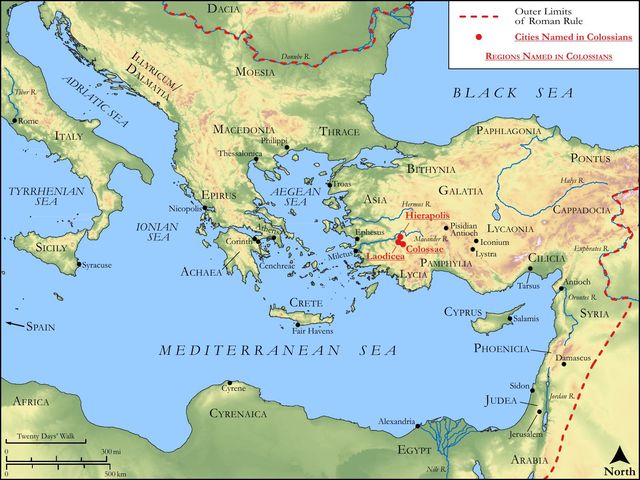
See on the biblical-era maps

Study this verse
Public-domain commentary
Matthew Henry
From his Commentary on the Whole Bible. Henry comments on passages, not single verses — this entry covers Colossians 2:1–3. His three-level outline is real structure in the source text, so it is rendered as structure.
We may observe here the great concern which Paul had for these Colossians and the other churches which he had not any personal knowledge of. The apostle had never been at Colosse, and the church planted there was not of his planting; and yet he had as tender a care of it as if it had been the only people of his charge (Col 2:1): For I would that you knew what great conflict I have for you, and for those at Laodicea, and for as many as have not seen my face in the flesh. Observe, 1. Paul's care of the church was such as amounted to a conflict. He was in a sort of agony, and had a constant fear respecting what would become of them. Herein he was a follower of his Master, who was in an agony for us, and was heard in that he feared. (2.) We may keep up a communion by faith, hope, and holy love, even with those churches and fellow-christians of whom we have no personal knowledge, and with whom we have no conversation. We can think, and pray, and be concerned for one another, at the greatest distance; and those we never saw in the flesh we may hope to meet in heaven. But,
I.What was it that the apostle desired for them? That their hearts may be comforted, being knit together in love, etc., Col 2:2.
It was their spiritual welfare about which he was solicitous. He does not say that they may be healthy, and merry, and rich, and great, and prosperous; but that their hearts may be comforted. Note, The prosperity of the soul is the best prosperity, and what we should be most solicitous about for ourselves and others. We have here a description of soul-prosperity.
1.When our knowledge grows to an understanding of the mystery of God, and of the Father, and of Christ, - when we come to have a more clear, distinct, methodical knowledge of the truth as it is in Jesus, then the soul prospers: To understand the mystery, either what was before concealed, but is now made known concerning the Father and Christ, or the mystery before mentioned, of calling the Gentiles into the Christian church, as the Father and Christ have revealed it in the gospel; and not barely to speak of it by rote, or as we have been taught it by our catechisms, but to be led into it, and enter into the meaning and design of it. This is what we should labour after, and then the soul prospers.
2.When our faith grows to a full assurance and bold acknowledgment of this mystery.
(1.)To a full assurance, or a well-settled judgment, upon their proper evidence, of the great truths of the gospel, without doubting, or calling them in question, but embracing them with the highest satisfaction, as faithful sayings and worthy of all acceptation.
(2.)When it comes to a free acknowledgment, and we not only believe with the heart, but are ready, when called to it, to make confession with our mouth, and are not ashamed of our Master and our holy religion, under the frowns and violence of their enemies. This is called the riches of the full assurance of understanding. Great knowledge and strong faith make a soul rich. This is being rich towards God, and rich in faith, and having the true riches, Luk 12:21; Luk 16:11; Jam 2:5.
3.It consists in the abundance of comfort in our souls: That their hearts might be comforted. The soul prospers when it is filled with joy and peace (Rom 15:13), and has a satisfaction within which all the troubles without cannot disturb, and is able to joy in the Lord when all other comforts fail, Hab 3:17, Hab 3:18.
4.The more intimate communion we have with our fellow-christians the more the soul prospers: Being knit together in love. Holy love knits the hearts of Christians one to another; and faith and love both contribute to our comfort. The stronger our faith is, and the warmer our love, the greater will our comfort be. Having occasion to mention Christ (Col 2:2), according to his usual way, he makes this remark to his honour (Col 2:3): In whom are hidden all the treasures of wisdom and knowledge. He had said (Col 1:19) that all fulness dwells in him: here he mentions particularly the treasures of wisdom and knowledge. There is a fulness of wisdom in him, as he has perfectly revealed the will of God to mankind. Observe, The treasures of wisdom are hidden not from us, but for us, in Christ. Those who would be wise and knowing must make application to Christ. We must spend upon the stock which is laid up for us in him, and draw from the treasures which are hidden in him. He is the wisdom of God, and is of God made unto us wisdom, etc., Co1 1:24, Co1 1:30.
II.His concern for them is repeated (Col 2:5):
Though I am absent in the flesh, yet am I with you in the spirit, joying, and beholding your order, and the stedfastness of your faith in Christ. Observe,
1.We may be present in spirit with those churches and Christians from whom we are absent in body; for the communion of saints is a spiritual thing. Paul had heard concerning the Colossians that they were orderly and regular; and though he had never seen them, nor was present with them, he tells them he could easily think himself among them, and look with pleasure upon their good behaviour.
2.The order and stedfastness of Christians are matter of joy to ministers; they joy when they behold their order, their regular behaviour and stedfast adherence to the Christian doctrine.
3.The more stedfast our faith in Christ is, the better order there will be in our whole conversation; for we live and walk by faith, Co2 5:7; Heb 10:38.
Historical interpretation
Four Centuries of Reception
6 surviving comments on this verse. Each one is dated, so this reads as a timeline rather than a list.
Select a marker to jump to its quote. Markers stagger vertically where authors wrote within a few decades of each other.
On consideration, your Majesty, of the reason wherefore men have so far gone astray, or that many-alas!-should follow diverse ways of belief concerning the Son of God, the marvel seems to be, not at all that human knowledge has been baffled in dealing with superhuman things, but that it has not submitted to the authority of the Scriptures. What reason, indeed, is there to wonder, if by their worldly wisdom men failed to comprehend the mystery of God the Father and the Lord Jesus Christ, in Whom all the treasures of wisdom and knowledge are hidden, that mystery of which not even angels have been able to take knowledge, save by revelation?
Now henceforward he is hastening and in pangs to enter upon the doctrine, neither accusing them, nor clearing them of accusation. "I strive," he saith. To what end? That they may be knit together. What he means is something like this; that they may stand firm in the faith. He doth not however so express himself; but extenuates the matter of accusation. That is, that they may be united with love, not with necessity nor with force. For as I have said, he always avoids offending, by leaving it to themselves; and therefore "striving," because I wish it to be with love, and willingly. For I do not wish it to be with the lips merely, nor merely that they shall be brought together, but "that their hearts may be comforted."
"Being knit together in love unto all riches of the full assurance of understanding." That is, that they may doubt about nothing, that they may be fully assured in all things. But I meant full assurance which is by faith, for there is a full assurance which cometh by arguments, but that is worthy of no consideration. I know, he saith, that ye believe, but I would have you fully assured: not "unto riches" only, but "unto all riches"; that your full assurance may be intense, as well as in all things. And observe the wisdom of this blessed one. He said not, "Ye do ill that ye are not fully assured," nor accused them; but, ye know not how desirous I am that ye may be fully assured, and not merely so, but with understanding. For seeing he spoke of faith; suppose not, he saith, that I meant barely and unprofitably, but with understanding and love. "That they may know the mystery of God the Father and of Christ." So that this is the mystery of God, the being brought unto Him by the Son. "And of Christ, in whom are hid all the treasures of wisdom and knowledge." But if they are in Him, then wisely also no doubt He came at this time. Wherefore then do some foolish persons object to Him, "See how He discourseth with the simpler sort." "In whom are all the treasures." He himself knows all things. "Hid," for think not in truth that ye already have all; they are hidden also even from Angels, not, from you only; so that you ought to ask all things from Him. He himself giveth wisdom and knowledge. Now by saying, "treasures," he shows their largeness, by "All," that He is ignorant of nothing, by "hid," that He alone knoweth.
Can the workman be ignorant of his work? We read of Christ in St. Paul: “In whom are hidden all treasures of wisdom and knowledge.” Note: “all treasures of wisdom and knowledge.” Not that some are and some are not in him but that they are hidden. That which is in him, therefore, is not lacking to him, even though it be hidden to us. If, moreover, the treasures of wisdom and knowledge are hidden in Christ, we must find out why they are hidden. If we men were to know the day of judgment, that, for example, it would not be for two thousand years, and if we knew it so long ahead of time, we would be more careless on that account. We would say, for instance, What is it to me if the day of judgment will not be here for two thousand years? Scripture says, therefore, for our benefit, that “the Son does not know the day of judgment,” because we do not know when the day of judgment will be upon us; and further: “Take heed, watch and pray, for you do not know when the time is.” Not “we do not know” but “you do not know.” Homilies on Mark (x).
Pay attention, dearly beloved, and see how sound the apostle’s advice is, when he says, “As therefore you received Christ Jesus our Lord, so walk in him, rooted and built up in him and confirmed in the faith.” What we have to do, after all, is to abide firmly in him through the simplicity and assurance of this faith, so that he may open up to us, as faithful believers, the treasure that is hidden in him. The same apostle says, “In him are all the treasures of wisdom and knowledge hidden.” He didn’t hide them in order to deny them to us but to rouse our desire for what is hidden. That is the value of secrets.
Herein is all the worth of grace, by which he saves those who believe, containing in itself deep treasures of wisdom and knowledge and steeping in faith the minds which it draws to the eternal contemplation of unchangeable truth. Suppose the omnipotent had created his humanity by forming it otherwise than in a mother’s womb and had presented himself suddenly to our sight. Suppose he had not passed through the stages from childhood to youth, had taken no food, no sleep: would he not have given ground for the erroneous opinion which believed that he had not really become a human being? And by doing everything miraculously, would he not have obscured the effect of his mercy? But now he has appeared as Mediator between God and men, in such a way as to join both natures in the unity of one Person. He has both raised the commonplace to the heights of the uncommon and brought down the uncommon to the commonplace. .
For, although he was impassible, he became subject to the experience of human passions and was made minister of our salvation. Now, they who say that he is a servant divide the one Christ into two, just as Nestorius did. But we say that he is Lord and Master of all creation, the one Christ, the same being at once God and man, and that he knows all things, “for in him are hid all the treasures of wisdom and knowledge.”
Continue studying Colossians 2:3 across the web’s major study libraries — every link below opens this exact verse, chapter, or book on the destination site.
Read & Compare
 BibleGatewayThis verse in more than 200 translations and 70 languages.
 Bible.comThe YouVersion reader — hundreds of translations, reading plans, and highlights.
 ESV.orgCrossway's official English Standard Version reader.
 NET BibleThe NET translation with 60,000+ translators' notes on every rendering decision.
 STEP BibleTyndale House's free study tool — original text, vocabulary, and scholarly resources.
 BibliaLogos Bible Software's free web reader.
 USCCBThe New American Bible (Revised Edition) with the U.S. bishops' study notes.
Commentaries
 BibleHub CommentariesDozens of classic commentaries on this verse, gathered on one page.
 StudyLightMore than 100 commentary sets — the largest collection on the web.
 BibleRefPlain-English commentary on what this verse means, verse by verse.
 Enduring WordDavid Guzik's free commentary on this chapter, widely used by Bible teachers.
 Bible Study ToolsVerse commentary alongside Greek and Hebrew study aids.
Original Language & Research
- BibleHub InterlinearThe verse word by word — original language, transliteration, and English.
- BibleHub LexiconEvery word's original-language definition and Strong's entry.
 Blue Letter BibleDeep-study tools — Strong's numbers, concordance, and word studies.
 CNTR CollationThe earliest Greek manuscripts of this verse, collated letter by letter.
Sermons, Hymns & Audio


TrulyRandomVerse is not affiliated with these sites and doesn’t control their content. They’re linked because they’re genuinely useful.
Summary
Colossians 2:3 stands as a profound declaration of the absolute supremacy and all-sufficiency of Jesus Christ, asserting that in Him alone are hidden all the inexhaustible treasures of divine wisdom and knowledge. This verse serves as a foundational truth for believers, directly countering any notion that true spiritual insight or understanding can be found apart from Christ, or through human philosophies, esoteric teachings, or ritualistic practices. It underscores Christ's unique position as the ultimate revelation of God and the complete source of all spiritual and intellectual truth.
Context
ShowHideLiterary Context
Colossians 2:3 is strategically placed within Paul's letter to the church at Colossae, immediately following his fervent prayer and desire for the believers to grasp the "full assurance of understanding, to the acknowledgement of the mystery of God, and of the Father, and of Christ" in Colossians 2:2. The "whom" in verse 3 unequivocally refers to Christ, making Him the singular focus of this profound statement. This verse functions as a powerful theological anchor, reinforcing Christ's preeminence already established in Colossians 1:15-20 and setting the stage for Paul's subsequent warnings against deceptive philosophies and empty traditions that detract from Christ's sufficiency, as seen in Colossians 2:8.
Historical & Cultural Context
The Colossian church was grappling with a complex blend of false teachings that threatened to undermine the simplicity and sufficiency of the gospel. These heresies, often referred to as the "Colossian heresy," combined elements of Jewish legalism (e.g., dietary laws, circumcision, observance of festivals as in Colossians 2:16-17), ascetic practices (self-abasement, harsh treatment of the body as in Colossians 2:21-23), angel worship, and a nascent form of Gnosticism. This early Gnostic tendency emphasized secret knowledge (Greek: gnosis) as the path to a higher spiritual plane or salvation, often positing a series of intermediaries between God and humanity, thereby diminishing Christ's unique role. Paul's declaration in Colossians 2:3 directly confronts these syncretistic ideas by asserting that all true wisdom and knowledge are found exclusively and exhaustively in Christ, leaving no room for additional revelations or intermediaries.
Key Themes
ShowHideColossians 2:3 significantly contributes to several overarching themes in the letter. Firstly, it underscores the absolute supremacy and preeminence of Christ in all things, particularly in the realm of truth and understanding, a theme central to Colossians 1:18. Secondly, it highlights the sufficiency of Christ for salvation, spiritual growth, and the acquisition of genuine wisdom, countering any teaching that suggests Christ is insufficient or that additional practices are required for spiritual maturity, as further elaborated in Colossians 2:10. Thirdly, the verse addresses the theme of divine revelation, asserting that the "mystery of God" (Christ Himself) is not an esoteric secret for a select few, but rather the revealed truth accessible through faith in Him. Finally, it emphasizes the fullness of spiritual treasure available in Christ, contrasting with the empty promises of human philosophies and traditions that lack the divine substance found only in Him.
Exposition and Analysis
ShowHideKey Word Analysis
ShowHideFrom apokryptō, meaning "to hide away." This word suggests something kept secret or concealed. In this context, it does not imply that these treasures are inaccessible or withheld from believers, but rather that they are not obvious to the unspiritual mind or to those who seek wisdom apart from Christ. They are revealed through faith and the Holy Spirit, contrasting sharply with the Gnostic claim of secret, exclusive knowledge. The true "secret" is Christ Himself.
From tithēmi, meaning "to place" or "to deposit." This term denotes a deposit, wealth, or a storehouse of valuable things. Its use here signifies an immense, inexhaustible, and precious abundance. It implies that in Christ, there is a limitless supply of divine understanding, far exceeding any earthly or human-derived wisdom, suggesting a richness that is beyond measure and fully satisfying.
From sophós, meaning "wise." This refers to wisdom in a broad sense, encompassing practical insight, moral discernment, and understanding of God's overarching purposes and moral order. It is the ability to apply knowledge rightly and to discern truth from error, particularly in spiritual matters. In Christ, this is perfect wisdom, aligning with God's divine plan.
From ginōskō, meaning "to know." This refers to factual understanding, acquaintance with truth, and cognitive apprehension. While sophia is about applying truth, gnōsis is about possessing truth. Paul uses this term to reclaim it from the Gnostics who boasted in their supposed superior "knowledge," asserting that genuine, salvific knowledge is found only in Christ, not in human speculation or esoteric practices.
Verse Breakdown
ShowHide"In whom"
This phrase, referring directly to Jesus Christ, is pivotal. It establishes Christ as the exclusive locus, the very sphere and person, within whom these spiritual realities reside. It means "in union with Him," "through Him," or "by means of Him." Christ is not merely a conduit or a teacher of wisdom and knowledge, but He is the embodiment and source of them.
"are hid"
This verb (from apókryphos) emphasizes that the treasures are not superficially apparent or accessible through human effort or worldly means alone. They are not secret in the sense of being withheld, but rather they are concealed from those who do not seek them in Christ. This "hiddenness" implies a depth and mystery that can only be unveiled through faith and divine revelation, contrasting with the superficiality of human philosophies.
"all the treasures"
The word "all" (pâs) underscores the totality and completeness of these treasures. There is no wisdom or knowledge outside of Christ that is truly valuable or necessary for spiritual life. "Treasures" (thēsaurós) conveys the idea of immense, inexhaustible wealth, signifying the immeasurable value and abundance of what is found in Christ. It suggests a divine storehouse of infinite spiritual riches.
"of wisdom and knowledge"
These two terms collectively encompass the full spectrum of intellectual and spiritual understanding. "Wisdom" (sophía) speaks to the practical application of truth, discerning God's will and purposes. "Knowledge" (gnōsis) refers to the apprehension of facts and truths about God and His creation. By stating that both are found in Christ, Paul declares Him to be the ultimate and complete repository of all that is true, profound, and spiritually enlightening.
Literary Devices
ShowHidePaul employs several significant literary devices in Colossians 2:3 to convey his powerful theological message. The most prominent is Metaphor, where Christ is implicitly presented as a vast, inexhaustible treasure chest or storehouse containing all spiritual riches. This metaphor vividly communicates the idea of abundance and value. Related to this is Symbolism, where "treasures" symbolize the immeasurable spiritual wealth and divine truth found in Christ. The concept of "hid" also carries symbolic weight, suggesting that these truths are not for casual discovery but require a deeper, faith-filled engagement with Christ to be revealed. Furthermore, there is an implied Antithesis throughout the letter, and specifically here, between the true wisdom and knowledge found in Christ and the empty, deceptive philosophies and human traditions promoted by the false teachers. This stark contrast highlights the incomparable superiority and sufficiency of Christ.
Theological and Thematic Connections
ShowHideColossians 2:3 profoundly asserts Christ's unique role as the embodiment and source of all truth, directly challenging any system that seeks wisdom or spiritual maturity apart from Him. This verse elevates Christ to the ultimate position of divine revelation, where the very mind and purposes of God are fully disclosed. It underscores the Trinitarian truth that the Father's wisdom is fully manifest in the Son, making Christ the complete answer to humanity's quest for understanding and meaning. The "hidden" aspect suggests that this wisdom is not discovered through human intellectual prowess or esoteric rituals, but through a spiritual revelation granted by God to those who are "in Christ." This theological truth forms the bedrock for Christian discipleship, encouraging believers to continually plumb the depths of Christ for all their spiritual and intellectual needs, recognizing that true enlightenment flows solely from Him.
Reflection and Application
ShowHideColossians 2:3 offers a profound anchor for our faith and a clear directive for our spiritual journey. In a world saturated with competing philosophies, spiritualities, and claims to truth, this verse calls us back to the singular, all-sufficient source of genuine wisdom and knowledge: Jesus Christ. It encourages us to cultivate a Christ-centered approach to learning, discernment, and living, recognizing that every true insight into God, humanity, and the universe ultimately finds its coherence and deepest meaning in Him. This means that our pursuit of understanding should always lead us back to Christ, whether we are studying Scripture, engaging with creation, or navigating complex ethical dilemmas. We are invited to continually "dig" into Christ through prayer, Scripture study, and fellowship, confident that in Him, we will find inexhaustible treasures that satisfy our deepest longings for truth and purpose, guarding us against the deceptive allure of worldly wisdom.
Questions for Reflection
ShowHideFAQ
ShowHideWhat does it mean that these treasures are "hid" in Christ?
ShowHideThe term "hid" (Greek: apókryphos) does not mean that these treasures are inaccessible or withheld from believers. Instead, it signifies that they are not obvious to the unspiritual mind or to those who seek wisdom through human intellectualism, worldly philosophies, or esoteric practices. They are "hid" in the sense that they are revealed only through a personal relationship with Christ and by the illumination of the Holy Spirit. This contrasts sharply with the Gnostic idea of secret, exclusive knowledge. For believers, these "hidden" treasures are waiting to be discovered and continually explored as we grow in our understanding and union with Christ, as He is the very embodiment of God's wisdom and truth.
Christ-Centered Fulfillment
ShowHideColossians 2:3 finds its ultimate Christ-centered fulfillment in presenting Jesus as the very incarnation of divine wisdom and knowledge. He is not merely a wise teacher or a prophet who imparts truth, but He is the truth itself, the Logos of God made flesh (John 1:1-14). In Christ, the previously veiled mysteries of God are fully revealed, making Him the complete and final revelation of the Father (Hebrews 1:1-3). His life, teachings, atoning death, and resurrection are the ultimate expression of God's perfect wisdom for humanity's salvation and reconciliation (1 Corinthians 1:24). Therefore, to seek wisdom and knowledge is to seek Christ Himself, for in Him "dwells all the fullness of the Godhead bodily" (Colossians 2:9). He is the true light that illuminates every person (John 1:9), and through Him, believers are granted access to the very mind of God, receiving spiritual understanding that surpasses all human comprehension (Ephesians 1:17-19). Colossians 2:3 thus proclaims that Christ is the inexhaustible wellspring of all that is truly valuable and eternally significant, making Him the singular focus of our intellectual and spiritual pursuit.