


Romans 11:33
Bible text: King James Version (1769 Blayney text) · Public domain
Bible text: King James Version with Strong's numbers · Public domain
Bible text: Berean Standard Bible · Public domain
Bible text: American Standard Version (1901) · Public domain
Bible text: World English Bible, Messianic edition · Public domain
Bible text: Geneva Bible (1599) · Public domain
Bible text: Young's Literal Translation · Public domain
- ὮŌOG5599INJInterjection
- βάθοςbathos[the] depthG899N-NSNNoun Nominative Singular Neuter
- πλούτουploutouof richesG4149N-GSMNoun Genitive Singular Masculine
- καὶkaibothG2532CONJConjunction
- σοφίαςsophiasof wisdomG4678N-GSFNoun Genitive Singular Feminine
- καὶkaiandG2532CONJConjunction
- γνώσεωςgnōseōsknowledgeG1108N-GSFNoun Genitive Singular Feminine
- θεοῦtheouof God!G2316N-GSM-TNoun Genitive Singular Masculine Title
- ὡςhōsHowG5613PRTParticle or Disjunctive
- ἀνεξεραύνηταanexeraunētaunsearchableG419A-NPNAdjective Nominative Plural Neuter
- τὰtatheG3588T-NPNDefinite article Nominative Plural Neuter
- κρίματαkrimatajudgmentsG2917N-NPNNoun Nominative Plural Neuter
- αὐτοῦautouof HimG846P-GSMPersonal pronoun Genitive Singular Masculine
- καὶkaiandG2532CONJConjunction
- ἀνεξιχνίαστοιanexichniastoiuntraceableG421A-NPFAdjective Nominative Plural Feminine
- αἱhaitheG3588T-NPFDefinite article Nominative Plural Feminine
- ὁδοὶhodoiwaysG3598N-NPFNoun Nominative Plural Feminine
- αὐτοῦautouof Him!G846P-GSMPersonal pronoun Genitive Singular Masculine
English is a literal word-by-word gloss of the Greek, not the KJV's wording. Why?
This is the original text the KJV's translators worked from — each Greek word with its own literal English meaning in this verse, prepared by scholars at Tyndale House, Cambridge. The KJV translates whole sentences, not word by word, so its wording differs: one Greek word can become several English words, and the KJV may choose “charity” where the gloss reads “love”. Both are faithful — they answer different questions. For the KJV's own rendering, switch to the KJV text.
Details
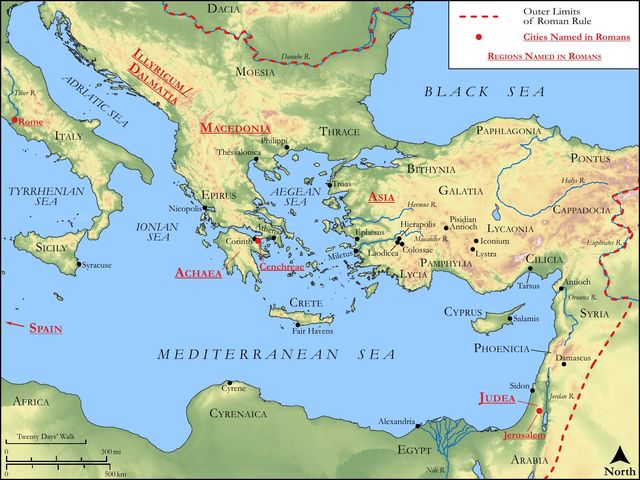
See on the biblical-era maps

Study this verse
Public-domain commentary
Matthew Henry
From his Commentary on the Whole Bible. Henry comments on passages, not single verses — this entry covers Romans 11:33–36. His three-level outline is real structure in the source text, so it is rendered as structure.
The apostle having insisted so largely, through the greatest part of this chapter, upon reconciling the rejection of the Jews with the divine goodness, he concludes here with the acknowledgment and admiration of the divine wisdom and sovereignty in all this. Here the apostle does with great affection and awe adore,
I.The secrecy of the divine counsels:
O the depth! in these proceedings towards the Jews and Gentiles; or, in general, the whole mystery of the gospel, which we cannot fully comprehend. - The riches of the wisdom and knowledge of God, the abundant instances of his wisdom and knowledge in contriving and carrying on the work of our redemption by Christ, a depth which the angels pry into, Pe1 1:12. Much more may it puzzle any human understanding to give an account of the methods, and reasons, and designs, and compass of it. Paul was as well acquainted with the mysteries of the kingdom of God as ever any mere man was; and yet he confesses himself at a loss in the contemplation, and, despairing to find the bottom, he humbly sits down at the brink, and adores the depth. Those that know most in this state of imperfection cannot but be most sensible of their own weakness and short-sightedness, and that after all their researches, and all their attainments in those researches, while they are here they cannot order their speech by reason of darkness. Praise is silent to thee, Psa 65:1. - The depth of the riches. Men's riches of all kinds are shallow, you may soon see the bottom; but God's riches are deep (Psa 36:6): Thy judgments are a great deep. There is not only depth in the divine counsels, but riches too, which denotes an abundance of that which is precious and valuable, so complete are the dimensions of the divine counsels; they have not only depth and height, but breadth and length (Eph 3:18), and that passing knowledge, v. 19. - Riches of the wisdom and knowledge of God. His seeing all things by one clear, and certain, and infallible view - all things that are, or ever were, or ever shall be, - that all is naked and open before him: there is his knowledge. His ruling and ordering all things, directing and disposing them to his own glory, and bringing about his own purposes and counsels in all; this is his wisdom. And the vast extent of both these is such a depth as is past our fathoming, and we may soon lose ourselves in the contemplation of them. Such knowledge is too wonderful for me, Psa 139:6. Compare Psa 139:17, Psa 139:18. - How unsearchable are his judgments! that is, his counsels and purposes: and his ways, that is, the execution of these counsels and purposes. We know not what he designs. When the wheels are set in motion, and Providence has begun to work, yet we know not what he has in view; it is past finding out. This does not only overturn all our positive conclusions about the divine counsels, but it also checks all our curious enquiries. Secret things belong not to us, Deu 29:29. God's way is in the sea, Psa 77:19. Compare Job 23:8, Job 23:9; Psa 97:2. What he does we know not now, Joh 13:7. We cannot give a reason of God's proceedings, nor by searching find out God. See Job 5:9; Job 9:10. The judgments of his mouth, and the way of our duty, blessed be God, are plain and easy, it is a high-way; but the judgments of his hands, and the ways of his providence, are dark and mysterious, which therefore we must not pry into, but silently adore and acquiesce in. The apostle speaks this especially with reference to that strange turn, the casting off of the Jews and the entertainment of the Gentiles, with a purpose to take in the Jews again in due time; these were strange proceedings, the choosing of some, the refusing of others, and neither according to the probabilities of human conjecture. Even so, Father, because it seemed good in thing eyes. These are methods unaccountable, concerning which we must say, O the depth! - Past finding out, anexichniastoi - cannot be traced. God leaves no prints nor footsteps behind him, does not make a path to shine after him; but his paths of providence are new every morning. He does not go the same way so often as to make a track of it. How little a portion is heard of him! Job 26:14. It follows (Rom 11:34), For who hath known the mind of the Lord? Is there any creature made of his cabinet-council, or laid, as Christ was, in the bosom of the Father? Is there any to whom he has imparted his counsels, or that is able, upon the view of his providences, to know the way that he takes? There is so vast a distance and disproportion between God and man, between the Creator and the creature, as for ever excludes the thought of such an intimacy and familiarity. The apostle makes the same challenge (Co1 2:16): For who hath known the mind of the Lord? And yet there he adds, But we have the mind of Christ, which intimates that through Christ true believers, who have his Spirit, know so much of the mind of God as is necessary to their happiness. He that knew the mind of the Lord has declared him, Joh 1:18. And so, though we know not the mind of the Lord, yet, if we have the mind of Christ, we have enough. The secret of the Lord is with those that fear him, Psa 25:14. Shall I hide from Abraham the thing which I do? See Joh 15:15. - Or who has been his counsellor? He needs no counsellor, for he is infinitely wise; nor is any creature capable of being his counsellor; this would be like lighting a candle to the sun. This seems to refer to that scripture (Isa 40:13, Isa 40:14), Who hath directed the Spirit of the Lord, or, being his counsellor, hath taught him? With whom took he counsel? etc. It is the substance of God's challenge to Job concerning the work of creation (Job 38), and is applicable to all the methods of his providence. It is nonsense for any man to prescribe to God, or to teach him how to govern the world.
II.The sovereignty of the divine counsels.
In all these things God acts as a free agent, does what he will, because he will, and gives not account of any of his matters (Job 23:13; Job 33:13), and yet there is no unrighteousness with him. To clear which,
1.He challenges any to prove God a debtor to him (Rom 11:35): Who hath first given to him? Who is there of all the creatures that can prove God is beholden to him? Whatever we do for him, or devote to him, it must be with that acknowledgment, which is for ever a bar to such demands (Ch1 29:14): Of thine own we have given thee. All the duties we can perform are not requitals, but rather restitutions. If any can prove that God is his debtor, the apostle here stands bound for the payment, and proclaims, in God's name, that payment is ready: It shall be recompensed to him again. It is certain God will let nobody lose by him; but never any one yet durst make a demand of this kind, or attempt to prove it. This is here suggested,
(1.)To silence the clamours of the Jews. When God took away their visible church-privileges from them, he did but take his own: and may he not do what he will with his own - give or withhold his grace where and when he pleases?
(2.)To silence the insultings of the Gentiles. When God sent the gospel among them, and gave so many of them grace and wisdom to accept of it, it was not because he owed them so much favour, or that they could challenge it as a debt, but of his own good pleasure.
2.He resolves all into the sovereignty of God (Rom 11:36): For of him, and through him, and to him, are all things, that is, God is all in all. All things in heaven and earth (especially those things which relate to our salvation, the things which belong to our peace) are of him by way of creation, through him by way of providential influence, that they may be to him in their final tendency and result. Of God as the spring and fountain of all, through Christ, God - man, as the conveyance, to God as the ultimate end. These three include, in general, all God's causal relations to his creatures: of him as the first efficient cause, through him as the supreme directing cause, to him as the ultimate final cause; for the Lord hath made all for himself, Rev 4:11. If all be of him and through him, there is all the reason in the world that all should be to him and for him. It is a necessary circulation; if the rivers received their waters from the sea, they return them to the sea again, Ecc 1:7. To do all to the glory of God is to make a virtue of necessity; for all shall in the end be to him, whether we will or no. And so he concludes with a short doxology: To whom be glory for ever, Amen. God's universal agency as the first cause, the sovereign ruler, and the last end, ought to be the matter of our adoration. Thus all his works do praise him objectively; but his saints do bless him actively; they hand that praise to him which all the creatures do minister matter for, Psa 145:10. Paul had been discoursing at large of the counsels of God concerning man, sifting the point with a great deal of accuracy; but, after all, he concludes with the acknowledgment of the divine sovereignty, as that into which all these things must be ultimately resolved, and in which alone the mind can safely and sweetly rest. This is, if not the scholastic way, yet the Christian way, of disputation. Whatever are the premises, let god's glory be the conclusion; especially when we come to talk of the divine counsels and actings, it is best for us to turn our arguments into awful and serious adorations. The glorified saints, that see furthest into these mysteries, never dispute, but praise to eternity.
Historical interpretation
Eleven Centuries of Reception
15 surviving comments on this verse. Each one is dated, so this reads as a timeline rather than a list.
Select a marker to jump to its quote. Markers stagger vertically where authors wrote within a few decades of each other.
For in reference to these points, and others of a like nature, the apostle exclaims: "Oh! the depth of the riches both of the wisdom and knowledge of God; how unsearchable are His judgments, and His ways past finding out!"
And the treasures of wisdom are unfailing, in admiration of which the apostle says, "O the depth of the riches and the wisdom!".
"Consequently, therefore, the noble apostle exclaims, "Oh the depth of the riches both of the wisdom and the knowledge of God!"
If Marcion had an object in his erasures, why does his apostle utter such an exclamation, because his god has no riches for him to contemplate? So poor and indigent was he, that he created nothing, predicted nothing-in short, possessed nothing; for it was into the world of another God that he descended.
or who taught Him knowledge, and showed to Him the way of understanding? " With whom the apostle agreeing exclaims, "Oh the depth of the riches both of the wisdom and knowledge of God! how unsearchable are His judgments, and His ways past finding out!" "His judgments unsearchable," as being those of God the Judge; and "His ways past finding out," as comprising an understanding and knowledge which no man has ever shown to Him, except it may be those critics of the Divine Being, who say, God ought not to have been this, and He ought rather to have been that; as if any one knew what is in God, except the Spirit of God.
For where had been their sin, if they only maintained the righteousness of their own God against one of whom they were ignorant? But he exclaims: "O the depth of the riches and the wisdom of God; how unsearchable also are His ways!" Whence this outburst of feeling? Surely from the recollection of the Scriptures, which he had been previously turning over, as well as from his contemplation of the mysteries which he had been setting forth above, in relation to the faith of Christ coming from the law.
Paul did not say that God’s judgments were hard to search out but that they could not be searched out at all. He did not say that God’s ways were hard to find out but that they were impossible to find out. For however far one may advance in the search and make progress through an increasingly earnest study, even when aided and enlightened in the mind by God’s grace, he will never be able to reach the final goal of his inquiries.
That he secrets of God cannot be seen through, and therefore that our faith ought to be simple. In the first Epistle of Paul to the Corinthians: "We see now through the glass in an enigma, but then with face to face. Now I know partly; but then I shall know even as also I am known." Also in Solomon, in Wisdom: "And in simplicity of heart seek Him." Also in the same: "He who walketh with simplicity, walketh trustfully." Also in the same: "Seek not things higher than thyself, and look not into things stronger than thyself." Also in Solomon: "Be not excessively righteous, and do not reason more than is required." Also in Isaiah: "Woe unto them who are convicted in themselves." Also in the Maccabees: "Daniel in his simplicity was delivered from the mouth of tile lions." Also in the Epistle of Paul to the Romans: "Oh the depth of the riches of the wisdom and knowledge of God! How incomprehensible are His judgments, and how unsearchable are His ways! For who has known the mind of the Lord? or who has been His counsellor? or who has first given to Him, and it shall be recompensed to him again? Because from Him, and through Him, and in Him, are all things: to Him be glory for ever and ever." Also to Timothy: "But foolish and unlearned questions avoid, knowing that they generate strifes. But the servant of God ought not to strive, but to be gentle towards all men."
The world, this chariot of God and all that is therein, is guided by the angels and the stars. Although their movements are varied—bound nevertheless by fixed laws—we see them guided to their goals according to the time measured out to them. So may we deservedly cry out with the apostle as we admire the Maker and his works: “O the depth of the riches and wisdom and knowledge of God! How unsearchable are his judgments and how inscrutable his ways!”
O wondrous circumstance! "O the depth of the riches both of the wisdom and knowledge of God!"
God knew from the beginning what man’s behavior and works would be like, in that the human race could not be saved only by the severity of his justice nor could it reach perfection only by his mercy. So at a particular time he decreed what should be preached, whereas before that time he allowed each person to decide for himself, because righteousness was recognized under the guidance of nature. And because the authority of natural righteousness was weakened by the habit of sin, the law was given so that the human race would be held back by the fear engendered by the revealed law. But because they did not restrain themselves and were counted guilty under the law, mercy was proclaimed, which would save those who took refuge in it but would blind those who rejected it for a time. During that time this mercy would invite the Gentiles, who earlier on had not wanted to follow the law given to Moses, to share in the promise, so that the Jews might become jealous of their salvation and because of that jealousy turn again to the source of the root, which is the Savior. This is “the depth of the riches and wisdom and knowledge of God,” who by his many-sided providence has won both Jews and Gentiles to eternal life.
Paul examined … the unclear and hidden aspects of the divine mysteries and through suggestive phrases revealed the illuminations which came to him from God concerning the understanding of what is incomprehensible and unsearchable.
"Oh, the depth of the riches, both of the wisdom and knowledge of God! How unsearchable are His judgments!"
Here after going back to former times, and looking back to God's original dispensation of things whereby the world hath existed up to the present time, and having considered what special provision He had made for all occurrences, he is stricken with awe, and cries aloud, so making his hearers feel confident that certainly that will come to pass which he saith. For he would not have cried aloud and been awe-struck, unless this was quite sure to come to pass. That it is a depth then, he knows: but how great, he knows not. For the language is that of a person wondering, not of one that knew the whole. But admiring and being awe-struck at the goodliness, so far forth as in him lay, he heralds it forth by two intensitive words, riches and depth, and then is awestruck at His having had both the will and the power to do all this, and by opposites effecting opposites. "How unsearchable are His judgments." For they are not only impossible to be comprehended, but even to be searched. "And His ways past finding out;" that is, His dispensations for these also are not only impossible to be known, but even to be sought into. For even I, he means, have not found out the whole, but a little part, not all. For He alone knoweth His own clearly.
Paul praises the wisdom of God, who according to his foreknowledge waited until all were in need of mercy in order to take from everyone the glory that derives from unfounded boasting in works. The judgments of God are a great deep, for they cannot be clearly grasped.
Antony was confused as he meditated upon the depths of God’s judgements, and he asked God, ‘Lord, how is it that some die young and others grow old and sick? Why are there some poor and some rich? Why are there those who are bad and rich and oppress the good poor?’ He heard a voice saying to him, ‘Antony, worry about yourself; these other matters are up to God, and it will not do you any good to know them.’
Above the Apostle endeavored to assign a reason for the divine judgments, by which Gentiles and Jews obtain mercy after unbelief; now he recognizes his inadequacy for such an investigation and exclaims his admiration of the divine excellence. First, he extols the divine excellence; 462 secondly, he proves what he says [v. 34; n. 938]. In regard to the first he does two things: first, he extols the divine wisdom in itself; secondly, in relation to us [v. 33b; n. 937]. 934. He extols the excellence of divine knowledge: first, as to its depth, saying: O the depth: "It is a great depth. Who shall find it out?" (Ec 7:25); "A glorious throne set on high from the beginning" (Jer 17:12). This depth is considered in regard to three things: first, in regard to the thing known, inasmuch as God knows himself perfectly: "I dwell in the highest places" (Sir 24:7); secondly, in regard to the manner of knowing, inasmuch as he knows all things through himself: "The Lord looked down from his holy height, from heaven the Lord looked at the earth" (PS 102:19); thirdly, in regard to the certainty of His knowledge: "The eyes of the Lord are far brighter than the sun" (Sir 23:28). 935. Secondly, he extols the excellence of divine knowledge in regard to its fullness when he says: of the riches "Abundance of salvation, wisdom and knowledge" (Is 33:6). This fullness is regarded in three ways: in one way as to the number of things known, because he knows all things: "Lord, you know all things" (Jn 21:17); "In him are hid all the treasures of wisdom ad knowledge" (Col 2:3); in another way in regard to ease of knowing, because He intuits all things without search and difficulty: "All things are open and laid bare to his eyes" (Heb 4:13). Thirdly, in regard to the abundance of His knowledge, because He gives it generously to everyone: "If anyone lacks wisdom, let him ask God who gives to all men generously" (Jas 1:5). 463 936. Thirdly, he extols the divine excellence in regard to its perfection when he says, of the wisdom and knowledge of God. For He has wisdom about divine things and knowledge about created things. "Who knows all things knows her" (Bar 3:32). 937. Then when he says, How incomprehensible, he shows the excellence of divine wisdom as compared to our understanding. And first in regard to wisdom, whose function is to judge and put things in order, he says: How incomprehensible are his judgments, because man cannot comprehend the reason of God's judgments, since they are hidden in his wisdom: "Thy judgments are like the great deep" (Ps 36:6). Secondly, in regard to knowledge, through which he is at work in things; hence he adds: and unsearchable i.e., his procedures, by which he works in creatures. Even though the creatures are known by man, the ways in which God works in them cannot be comprehended by man: "Thy way was through the sea, they path through the great waters; yet their footprints were unseen (Ps 77:19); "Where is the way to the dwelling of light" (Jb 38:19). 938. The when he says, For who, he proves what he had said by appealing to two authorities, one of which is Is 40(:13): For who has helped the spirit of the Lord, or who has been his counselor? The other is from Job (35:7; 41:11): Or who has given a gift to him that he might be repaid? In these words and those that follow them the Apostle does three things. 939. First, he shows the excellence of divine wisdom as compared to our understanding, saying: For who has known the mind of the Lord, namely, through which He judges and acts. As if to say: No one, unless God reveals it: "Who shall know they 464 though, except thou give wisdom, and send they Holy Spirit from above:" (Wis 9:17) and "The things of God no one knows but the Spirit of God. But to us God has revealed them through his Spirit" (1 Cor 2:12 & 10). Secondly, he shows the excellence of divine wisdom according as it has height in itself, and indeed is that height which is the supreme principle. Two points pertain to this: first, that it does not proceed from something else; secondly, that other things proceed from it [v. 36; n. 942]. 941. That God's wisdom does not depend on a higher source is shown in two ways. First, by the fact that it is not instructed by someone else's teaching. Hence, he says: Or who has been his counselor? As if to say: No one. For counsel is needed by one who does not fully know how something is to be done, and this does not apply to God: "To whom has thou given counsel? Perhaps to him that has no wisdom" (Jb 26:3). Secondly, by the fact that it is not helped by another's gift. Hence he adds: Or who has given a gift to him that he might be repaid, as one giving first? As if to say: No one. For man can give God only what he has received form God: "All this abundance comes from thy hand and is all thy own" (1 Chr 29:16); "If thou do justly, what shalt thou give him, or what shall he receive of thy hand" (Jb 35:7). 942. Then when he says, For from him, he shows God's depth, inasmuch as in Him are all things. First, he shows its causality; secondly, its dignity [v. 36b; n. 950]; 465 thirdly, its perpetuity [v.36c; n. 951]. 943. First, therefore, he says: It is right to say that no one first gave to him, because from him and through him and in him are all things. Thus nothing can be unless received from God. To designate God's causality he uses three prepositions, namely, "from", "through" and "in". But the preposition "from" [ex] denotes a principle of change; and this is in three ways. In one way the acting or movent principle; in another way the matter, in a third way the opposite contrary, which is the point of departure of the change. For we say that the knife came to be "from" the knife maker, "from" the steel, and "from" the unshaped [matter]. But the universe of creatures was not made from pre-existing matter, because even their matter is an effect of God. Accordingly, created things are not said to be from something but from its opposite, which is nothing; because they were nothing, before they were created to exist: "We are born of nothing" (Wis 2:2). But all things are from God as from their first maker: "All things are from God" (1 Cor 11:12). 944. It should be noted that another Latin word for "from" is de, which seems to suggest the same relationships; however, de always designates a consubstantial cause. For we say that the knife is from [de] the iron, but not from [de] the maker. Therefore, because the Son proceeds from the Father as consubstantial with Him, we say that the Son is from [de] the Father. But creatures do not proceed from God as consubstantial with Him; hence, they are not said to be from [de] Him but from [ex] Him. 466 945. The preposition, "through" designates the cause of an action; but because an action lies between the maker and the things he makes, there are two ways in which the preposition, "through," can designate the cause of an action. In one way accordingly as the action comes from its performer, as something which is its own cause of acting is said to act through itself. In one way this is the form, as we say that fire acts through heat. In another way it is a higher agent, as we say that man begets man through the power of the sun or rather of God. So, therefore, all things are said to be through him in two ways: In one way as through the first agent, by whose power all things act: "Through me kings reign" (Pr 8:15). In another way, inasmuch as His wisdom, which is His essence, is the form through which God makes all things: "The Lord through wisdom founded the earth" (Pr 3:19). 946. In another way the preposition, "through," designates the cause of an action, not as it comes from the performer but as terminated in its products, as we say that the artisan makes a knife through a hammer: not that the hammer works with the artisan in the way described above, but because the knife comes to be from the activity of the artisan by means of the hammer. Therefore, it is said that this preposition, "through," designates authority directly, as when we say that the king acts through his bailiff—which pertains to what is now being said. But sometimes in a causal sense, as when we say that the bailiff acts through the king—which pertains to the preceding mode. In this mode about which we are now speaking, all things are said to have been made by the Father through the Son, as in Jb (1:3): "All things were made through him," not that the Father has from the Son the power to make thing, but rather that the Son 467 accepts the power of making things from the Father, a power not instrumental but principal, not of a lower order but equal, not diverse but the same: "Whatever the Father does, that the Son does likewise" (Jn 5:19). Hence, although all things were made by the Father through the Son, The Son is not an instrument or minister of the Father. 947. The preposition, "in," also designates a causal relationship in three ways: in one way it designates matter, as we say that the soul is in the body or a form in matter. This is not the way in which things are said to be in God, because He is not the material cause of things. In another way it designates a relationship of efficient cause, in whose power it lies to dispose of its effects. In this sense all things are said to be in Him, inasmuch as all things lie under His power and arrangement: "In his hand are all the ends of the earth" (Ps 95:4); "In him we live and move and have our being" (Ac 17:28). In a third way it designates a relationship of final cause, in that the entire good of a thing and its preservation consists in its own optimum. In this sense all things are said to be in God as in the goodness preserving them. "All things hold together in him" (Col 1:17). 948. When he says, All, it is not be taken absolutely for all things which have true being. Sins do not have true being, but insofar as they are sins they lack some being, due to the fact that evil is nothing else than a deprivation of good. Therefore, when he says: From him and through him and to him are all things, this does not include sin, because, according to Augustine, since is nothing and man accomplishes nothing when he sins. yet, whatever entity is present in sin, it is from God. 468 949. Therefore, according to the foregoing, all things are from Him, i.e., God as from the first operating power. All things are through Him, inasmuch as He makes all things through His wisdom. All things are in Him as in their preserving Goodness. Now these three things, namely, power, wisdom and goodness are common to the three persons. Hence, the statement that from him and through him and in him can be applied to each of the three persons. Nevertheless, the power, which involved the notion of principle, is appropriated to the Father, Which is the principle of the entire godhead; wisdom to the Son, Who proceeds as Word, which is nothing else than wisdom begotten; goodness is appropriated to the Holy Spirit, Who proceeds as love, whose object is goodness. Therefore, by appropriation we can say: from him, namely, from the Father, through him, namely, through the Son, in him, namely, in the Holy Spirit, are all things. 950. Then when he says, To him be honor and glory forever, he allows God's dignity, which consists in the two things previously mentioned. For from the fact that all things are from Him and through Him and in Him, honor and reverence and subjection are owed Him by every creature: "If I am a father, where is my honor" (Ma. 1:6). But from the fact that He has not received either counsel or gifts from anyone, glory is owed Him; just as on the contrary it is said of man: "If then you received it, why do you boast as though it were not a gift?" (1 Cor 4:7). And because this is proper to God, it says in Is (42:8): "I am the Lord; my glory I give to no other." 951. Finally, he mentions His eternity when he says: unto the ages of ages, because His glory does not pass as does man's glory, of which it is said: "All its glory is 469 like the flower of the filed" (Is 40:6). But God's glory lasts for all ages, i.e., through all the ages succeeding all ages, inasmuch as the duration of any given thing is called an age. Or unto the ages of ages refers to the durations of incorruptible things, which contain the ages of corruptible things. This applies especially to God’s eternity, which can be spoken of as a plurality because of the multitude and diversity of things contained in it, even though it is one and simple in itself. The meaning would then be "unto the ages that contain the ages": "Your reign is a reign of all ages" (Ps 144:13). 952. He adds: Amen, as confirmation. As if to say: Truly it is so. This is the meaning in the gospels when it says: "Amen, I say to you." Sometimes, however, it means: May it come to pass.
Continue studying Romans 11:33 across the web’s major study libraries — every link below opens this exact verse, chapter, or book on the destination site.
Read & Compare
 BibleGatewayThis verse in more than 200 translations and 70 languages.
 Bible.comThe YouVersion reader — hundreds of translations, reading plans, and highlights.
 ESV.orgCrossway's official English Standard Version reader.
 NET BibleThe NET translation with 60,000+ translators' notes on every rendering decision.
 STEP BibleTyndale House's free study tool — original text, vocabulary, and scholarly resources.
 BibliaLogos Bible Software's free web reader.
 USCCBThe New American Bible (Revised Edition) with the U.S. bishops' study notes.
Commentaries
 BibleHub CommentariesDozens of classic commentaries on this verse, gathered on one page.
 StudyLightMore than 100 commentary sets — the largest collection on the web.
 BibleRefPlain-English commentary on what this verse means, verse by verse.
 Enduring WordDavid Guzik's free commentary on this chapter, widely used by Bible teachers.
 Bible Study ToolsVerse commentary alongside Greek and Hebrew study aids.
Original Language & Research
- BibleHub InterlinearThe verse word by word — original language, transliteration, and English.
- BibleHub LexiconEvery word's original-language definition and Strong's entry.
 Blue Letter BibleDeep-study tools — Strong's numbers, concordance, and word studies.
 CNTR CollationThe earliest Greek manuscripts of this verse, collated letter by letter.
Sermons, Hymns & Audio


TrulyRandomVerse is not affiliated with these sites and doesn’t control their content. They’re linked because they’re genuinely useful.
Summary
Romans 11:33 serves as a profound doxological outburst, a climactic expression of praise and adoration that concludes Paul's intricate theological exposition in Romans chapters 9-11. After meticulously navigating the complex interplay of God's sovereign plan for Israel and the surprising inclusion of Gentiles into salvation, Paul arrives at a moment of humble awe before the incomprehensible and boundless wisdom, knowledge, judgments, and ways of God, acknowledging their unfathomable depth and unsearchable nature.
Context
ShowHideLiterary Context
This verse acts as the grand finale and interpretive summary of Paul's preceding argument in Romans 9-11. In these chapters, Paul grapples with the apparent paradox of Israel's rejection of Christ and God's continued faithfulness to His covenant people, alongside His unexpected, yet glorious, plan to extend salvation to the Gentiles. He explains that God, in His sovereign wisdom, allowed a partial hardening to come upon Israel so that salvation might reach the Gentiles (Romans 11:11), with the ultimate promise of Israel's future restoration and full inclusion (Romans 11:25-26). This intricate divine strategy, which transcends human logic and capacity for comprehension, culminates in Paul's humble worship, acknowledging that God's ways are far grander and more mysterious than any human could devise or fully grasp.
Historical & Cultural Context
Paul writes to a diverse church in Rome, comprising both Jewish and Gentile believers. Tensions likely existed between these groups, particularly concerning the status of Israel in God's plan. Jewish believers might have struggled with the apparent "failure" of Israel to embrace the Messiah, while Gentile believers might have been tempted to boast against Israel (Romans 11:18). Paul's discourse in Romans 9-11 directly addresses these concerns, demonstrating God's faithfulness to His promises and His wise, overarching plan for all humanity. The concept of "wisdom" (σοφία, sophia) was highly valued in both Jewish and Hellenistic thought, often associated with divine insight and practical skill. Paul's declaration elevates God's wisdom far beyond any human or philosophical understanding.
Key Themes
ShowHideRomans 11:33 powerfully encapsulates several major theological themes woven throughout the book of Romans. Firstly, it highlights God's Incomprehensible Wisdom and Knowledge, emphasizing the infinite depth of His understanding and insight, which are boundless and beyond human measurement. This relates directly to Paul's earlier assertion that God's ways are not like human ways (Romans 9:14-24). Secondly, the verse underscores Divine Sovereignty and Unsearchable Ways. Paul declares that God's "judgments" (His decisions and decrees) are "unsearchable" and His "ways" (His methods and paths of action) are "past finding out," affirming God's absolute control and the fact that His dealings with humanity are not fully discoverable or explainable by human reason. This echoes the Old Testament declaration in Isaiah 55:8-9. Finally, the exclamation itself ("O the depth...") conveys a profound sense of Humility Before God. It is an admission that finite human minds cannot fully comprehend the infinite God, leading to worship rather than frustration, and acknowledging that God's perfection means His ways are always right, even when mysterious.
Exposition and Analysis
ShowHideKey Word Analysis
ShowHideFrom the same root as "deep," this word signifies profundity, an immeasurable extent, or figuratively, a profound mystery. In this context, it speaks to the unfathomable vastness of God's riches, wisdom, and knowledge, suggesting a reality so immense that it cannot be fully plumbed or understood by human intellect.
Derived from a negative particle and a verb meaning "to search out thoroughly," this adjective describes something that cannot be investigated, explored, or fully comprehended. Applied to God's judgments, it means His decrees and decisions are inscrutable, beyond the scope of human inquiry or logical deduction.
Formed from a negative particle and a verb related to "tracking" or "tracing," this word means "not to be tracked out" or "untraceable." When applied to God's ways, it conveys the idea that His paths and methods of operation are like those leaving no discernible trail, making them impossible for humans to follow, map, or fully understand.
Verse Breakdown
ShowHide"O the depth of the riches both of the wisdom and knowledge of God!"
This opening exclamation is a doxological cry, expressing overwhelming awe and wonder. "O" (G5599, ō) is an interjection of profound emotion. Paul marvels at the "depth" (G899, báthos) – the immeasurable profundity – of God's attributes. The "riches" (G4149, ploûtos) here refer not to material wealth but to the abundant, overflowing fullness of God's divine perfections. Specifically, Paul highlights God's "wisdom" (G4678, sophía), His perfect plan and insight into all things, and His "knowledge" (G1108, gnōsis), His comprehensive awareness and understanding of every detail. These attributes are presented as boundless and inexhaustible.
"how unsearchable are his judgments,"
Following the initial exclamation, Paul elaborates on the practical outworking of God's profound wisdom and knowledge. The adverb "how" (G5613, hōs) intensifies the declaration. God's "judgments" (G2917, kríma) refer to His decisions, decrees, and the principles by which He governs the world and interacts with humanity. These are declared to be "unsearchable" (G419, anexereúnētos), meaning they cannot be fully investigated, scrutinized, or understood by human reason. They are beyond human capacity to plumb or explain.
"and his ways past finding out!"
This final clause parallels the previous one, further emphasizing God's incomprehensibility. God's "ways" (G3598, hodós) denote His methods, paths, and courses of action in history and in the lives of individuals. These "ways" are described as "past finding out" (G421, anexichníastos), meaning they are untraceable, leaving no discernible track for human beings to follow or fully comprehend. This highlights the mystery and transcendence of God's sovereign dealings, particularly as demonstrated in His intricate plan for Israel and the Gentiles.
Literary Devices
ShowHideRomans 11:33 is rich in literary devices that amplify its powerful message. The most prominent is Doxology, an outburst of praise directed towards God, signaling a shift from theological argumentation to worshipful adoration. This doxology is expressed through Exclamation, indicated by the initial "O" and the emphatic "how," conveying Paul's overwhelming emotion and awe. The use of "depth," "unsearchable," and "past finding out" employs Hyperbole, exaggerating the immeasurability of God's attributes to emphasize their infinite nature and human inability to fully grasp them. There is also a clear instance of Parallelism in the structure "how unsearchable are his judgments, and his ways past finding out," where the second clause echoes and reinforces the meaning of the first, creating a sense of balance and emphasis on the inscrutability of God's actions. Finally, the verse attributes human-like qualities of wisdom and knowledge to God, a form of Anthropomorphism that helps human minds conceive of divine attributes, even while declaring their transcendence.
Theological and Thematic Connections
ShowHideThis profound doxology in Romans 11:33 establishes a cornerstone for understanding the nature of God and humanity's posture before Him. It underscores the absolute transcendence and incomprehensibility of God's being, His plans, and His actions. While God has revealed Himself truly and sufficiently for salvation, this verse reminds us that His ultimate wisdom and knowledge far exceed our finite capacity to grasp. It calls believers to a posture of humble reverence, acknowledging that God's ways are not our ways, and His thoughts are infinitely higher than ours. This mystery is not a cause for frustration but for worship, as it affirms God's perfect sovereignty and the unfathomable depth of His character, which is always just, wise, and good, even when His specific methods remain hidden from our full comprehension.
Reflection and Application
ShowHideRomans 11:33 invites believers into a deeper, more humble relationship with God, one that embraces the mystery of His divine wisdom rather than demanding full comprehension. In a world that often seeks to rationalize and control, this verse calls us to surrender our limited understanding to the infinite wisdom of God. It encourages us to cultivate a spirit of profound humility, recognizing that our human intellect, though a gift from God, can never fully grasp the depths of His being or the intricacies of His sovereign plan. This humility, in turn, fosters a robust trust in God's goodness and perfect timing, even when circumstances seem perplexing or contrary to our expectations. When we are confronted with unanswered questions or seemingly inexplicable events, Romans 11:33 reminds us that God's judgments are unsearchable and His ways past finding out, yet they are always righteous and ultimately for His glory and our good. Therefore, our proper response is not anxiety or doubt, but joyful worship and adoration for a God whose wisdom is so immense that it inspires awe rather than apprehension. This verse empowers us to rest in the assurance that the God who orchestrates the salvation of both Jew and Gentile, in ways we cannot fully trace, is utterly trustworthy.
Questions for Reflection
ShowHideFAQ
ShowHideWhy does Paul burst into this doxology at the end of Romans 9-11?
ShowHidePaul's doxology in Romans 11:33 is a natural and fitting response to the profound theological truths he has just unpacked in Romans chapters 9-11. After wrestling with the complex interplay of God's faithfulness to Israel, their partial hardening, and the inclusion of the Gentiles into salvation, Paul reaches a point where human logic and reasoning are exhausted. The intricate, seemingly paradoxical nature of God's plan—allowing Israel to stumble so that Gentiles might be saved, with the ultimate promise of Israel's future restoration—reveals a wisdom so deep and a knowledge so vast that it transcends all human comprehension. His outburst of praise is an acknowledgment that God's ways are infinitely superior and beyond human capacity to fully understand or critique, leading him to humble adoration rather than intellectual resolution.
What does it mean that God's ways are "unsearchable" and "past finding out"?
ShowHideWhen Paul declares that God's "judgments" are "unsearchable" (Greek, anexereúnētos') and His "ways" are "past finding out" (Greek, anexichníastos'), he is emphasizing the infinite transcendence and incomprehensibility of God. "Unsearchable" means that God's decisions and decrees cannot be fully investigated, scrutinized, or understood through human intellect or reasoning. They are beyond our capacity to plumb their depths. "Past finding out" means God's methods and paths of action are untraceable; they leave no discernible trail for human beings to follow or map out. This does not imply that God is arbitrary or chaotic, but rather that His wisdom and knowledge are so vast and perfect that His operations often transcend our limited human logic and perspective. It is a call to humility and trust, recognizing that while we may not always understand the "how" or "why" of God's actions, we can trust in the character of the One who acts. This echoes Isaiah 55:8-9, where God declares His thoughts and ways are higher than ours.
Christ-Centered Fulfillment
ShowHideRomans 11:33, while a doxology directed to the Father's incomprehensible wisdom, finds its ultimate fulfillment and most profound revelation in the person and work of Jesus Christ. It is in Christ that the "depth of the riches both of the wisdom and knowledge of God" is most perfectly displayed and made accessible to humanity. The seemingly "unsearchable judgments" and "ways past finding out" of God's redemptive plan, particularly the inclusion of Gentiles and the future restoration of Israel, are all centered on Christ. He is the very "wisdom of God" (1 Corinthians 1:24) and in Him "are hidden all the treasures of wisdom and knowledge" (Colossians 2:2-3). The mystery of God's will, which was hidden for ages, has now been "made known to us in all wisdom and insight" through Christ (Ephesians 1:9-10). Even the profound mystery of the Gentiles being fellow heirs with Israel, which Paul labors to explain in Ephesians 3, is ultimately revealed through the gospel of Christ. Thus, while God's ways remain ultimately unfathomable, in Christ, God has revealed the core of His wisdom and the path to salvation, inviting us not to full comprehension, but to saving faith and worship of the One who perfectly embodies the depth of God's wisdom.