


John 1:18
Bible text: King James Version (1769 Blayney text) · Public domain
Bible text: Berean Standard Bible · Public domain
Bible text: American Standard Version (1901) · Public domain
Bible text: World English Bible, Messianic edition · Public domain
Bible text: Geneva Bible (1599) · Public domain
Bible text: Young's Literal Translation · Public domain
- ΘεὸνTheonGodG2316N-ASM-TNoun Accusative Singular Masculine Title
- οὐδεὶςoudeisno [one]G3762A-NSMAdjective Nominative Singular Masculine
- ἑώρακενhe'ōrakenhas seenG3708V-RAI-3SVerb Perfect Active Indicative 3rd Singular
- πώποτε·pōpoteever yetG4455ADVAdverb
- ὁhotheG3588T-NSMDefinite article Nominative Singular Masculine
- μονογενὴςmonogenēsonly begottenG3439A-NSMAdjective Nominative Singular Masculine
- θεὸςtheosGodG2316N-NSM-TNoun Nominative Singular Masculine Title
- ὁhowhoG3588T-NSMDefinite article Nominative Singular Masculine
- ὢνōnis beingG1510V-PAP-NSMVerb Present Active Participle Nominative Singular Masculine
- εἰςeisinG1519PREPPreposition
- τὸνtontheG3588T-ASMDefinite article Accusative Singular Masculine
- κόλπονkolponbosomG2859N-ASMNoun Accusative Singular Masculine
- τοῦtouof theG3588T-GSMDefinite article Genitive Singular Masculine
- πατρόςpatrosFatherG3962N-GSM-TNoun Genitive Singular Masculine Title
- ἐκεῖνοςekeinosHeG1565D-NSMDemonstrative pronoun Nominative Singular Masculine
- ἐξηγήσατοexēgēsatohas made [Him] knownG1834V-ADI-3SVerb Aorist Middle Deponent Indicative 3rd Singular
English is a literal word-by-word gloss of the Greek, not the KJV's wording. Why?
This is the original text the KJV's translators worked from — each Greek word with its own literal English meaning in this verse, prepared by scholars at Tyndale House, Cambridge. The KJV translates whole sentences, not word by word, so its wording differs: one Greek word can become several English words, and the KJV may choose “charity” where the gloss reads “love”. Both are faithful — they answer different questions. For the KJV's own rendering, switch to the KJV text.
Details
See on the biblical-era maps
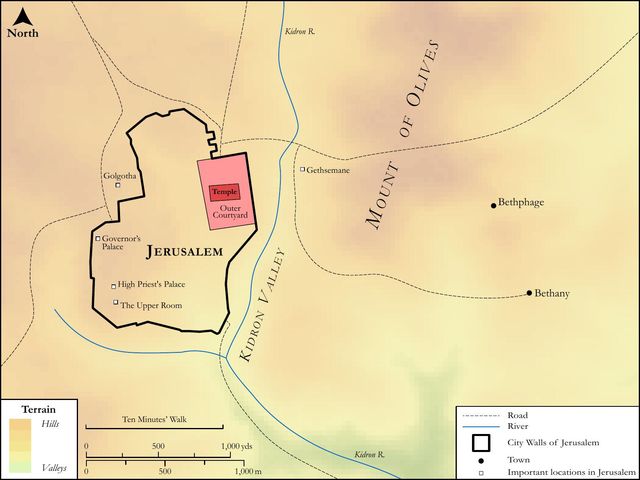
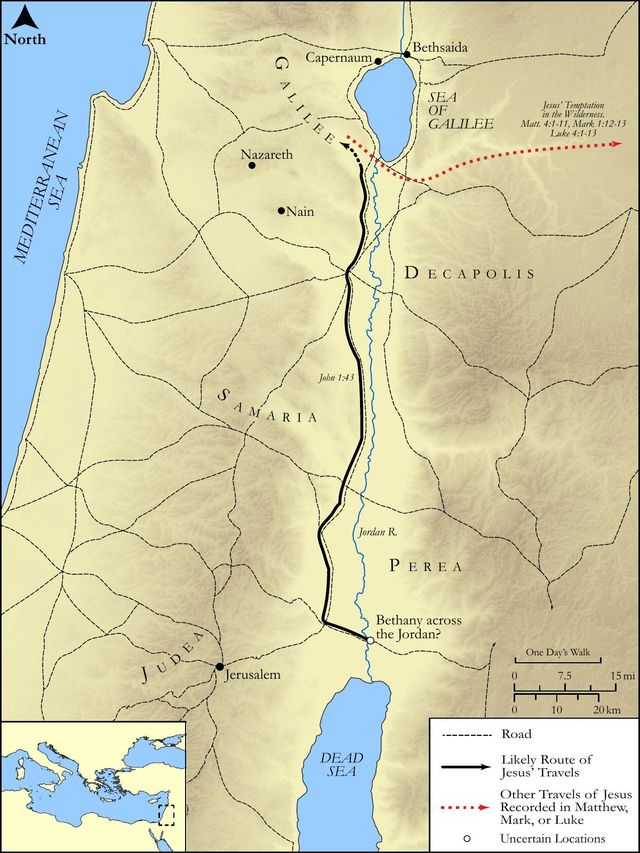
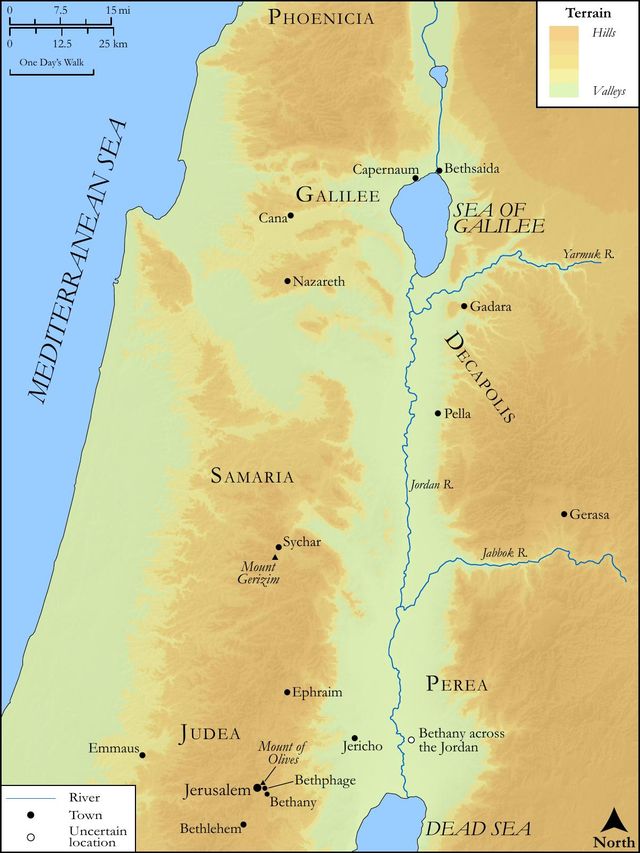
Study this verse
Public-domain commentary
Matthew Henry
From his Commentary on the Whole Bible. Henry comments on passages, not single verses — this entry covers John 1:15–18. His four-level outline is real structure in the source text, so it is rendered as structure.
In these verses,
I.The evangelist begins again to give us John Baptist's testimony concerning Christ, Joh 1:15.
He had said (Joh 1:8) that he came for a witness; now here he tells us that he did accordingly bear witness. Here, Observe,
1.How he expressed his testimony: He cried, according to the prediction that he should be the voice of one crying. The Old Testament prophets cried aloud, to show people their sins; this New Testament prophet cried aloud, to show people their Saviour. This intimates,
(1.)That it was an open public testimony, proclaimed, that all manner of persons might take notice of it, for all are concerned in it. False teachers entice secretly, but wisdom publishes her dictates in the chief places of concourse.
(2.)That he was free and hearty in bearing this testimony. He cried as one that was both well assured of the truth to which he witnessed and well affected to it. He that had leaped in his mother's womb for joy of Christ's approach, when newly conceived, does now with a like exultation of spirit welcome his public appearance.
2.What his testimony was. He appeals to what he had said at the beginning of his ministry, when he had directed them to expect one that should come after him, whose forerunner he was, and never intended any other than to lead them to him, and to prepare his way. This he had given them notice of from the first. Note, It is very comfortable to a minister to have the testimony of his conscience for him that he set out in his ministry with honest principles and sincere intentions, with a single eye to the glory and honour of Christ. Now what he had then said he applies to this Jesus whom he had lately baptized, and who was so remarkably owned from heaven: This was he of whom I spoke. John did not tell them that there would shortly appear such a one among them, and then leave them to find him out; but in this he went beyond all the Old Testament prophets that he particularly specified the person: "This was he, the very man I told you of, and to him all I said is to be accommodated." Now what was it he said?
(1.)He had given the preference to this Jesus: He that comes after me, in the time of his birth and public appearance, is preferred before me; he that succeeds me in preaching and making disciples is a more excellent person, upon all accounts; as the prince or peer that comes after is preferred before the harbinger or gentleman-usher that makes way for him. Note, Jesus Christ, who was to be called the Son of the Highest (Luk 1:32), was preferred before John Baptist, who was to be called only the prophet of the Highest, Luk 1:76. John was a minister of the New Testament, but Christ was the Mediator of the New Testament. And observe, though John was a great man, and had a great name and interest, yet he was forward to give the preference to him to whom it belonged. Note, All the ministers of Christ must prefer him and his interest before themselves and their own interests; they will make an ill account that seek their own things, not the things of Christ, Phi 2:21. He comes after me, and yet is preferred before me. Note, God dispenses his gifts according to his good pleasure, and many times crosses hands, as Jacob did, preferring the younger before the elder. Paul far outstripped those that were in Christ before him.
(2.)He here gives a good reason for it: For he was before me, prōtos mou ēn - He was my first, or first to me; he was my first Cause, my original. The First is one of God's names, Isa 44:6. He is before me, is my first,
[1.]In respect of seniority: he was before me, for he was before Abraham, Joh 8:58. Nay, he was before all things, Col 1:17. I am but of yesterday, he from eternity. It was but in those days that John Baptist came (Mat 3:1), but the goings forth of our Lord Jesus were of old, from everlasting, Mic 5:2. This proves two natures in Christ. Christ, as man, came after John as to his public appearance; Christ, as God, was before him; and how could he otherwise be before him but by an eternal existence?
[2.]In respect of supremacy; for he was my prince; so some princes are called the first; prōton, "It is he for whose sake and service I am sent: he is my Master, I am his minister and messenger."
II.He presently returns again to speak of Jesus Christ, and cannot go on with John Baptist's testimony till Joh 1:19.
The Joh 1:16 has a manifest connection with Joh 1:14, where the incarnate Word was said to be full of grace and truth. Now here he makes this the matter, not only of our adoration, but of our thankfulness, because from that fulness of his we all have received. He received gifts for men (Psa 68:18), that he might give gifts to men, Eph 4:8. He was filled, that he might fill all in all (Eph 1:23), might fill our treasures, Pro 8:21. He has a fountain of fulness overflowing: We all have received. All we apostles; so some. We have received the favour of this apostleship, that is grace; and a fitness for it, that is truth. Or, rather, All we believers; as many as received him (Joh 1:16), received from him. Note, All true believers receive from Christ's fulness; the best and greatest saints cannot live without him, the meanest and weakest may live by him. This excludes proud boasting, that we have nothing but we have received it; and silences perplexing fears, that we want nothing but we may receive it. Let us see what it is that we have received.
1.We have received grace for grace. Our receivings by Christ are all summed up in this one word, grace; we have received kai charin - even grace, so great a gift, so rich, so invaluable; we have received no less than grace; this is a gift to be spoken of with an emphasis. It is repeated, grace for grace; for to every stone in this building, as well as to the top-stone, we must cry, Grace, grace. Observe,
(1.)The blessing received. It is grace; the good will of God towards us, and the good work of God in us. God's good will works the good work, and then the good work qualifies us for further tokens of his good will. As the cistern receives water from the fulness of the fountain, the branches sap from the fulness of the root, and the air light from the fulness of the sun, so we receive grace from the fulness of Christ.
(2.)The manner of its reception: Grace for grace - charin anti charitos. The phrase is singular, and interpreters put different senses upon it, each of which will be of use to illustrate the unsearchable riches of the grace of Christ. Grace for grace bespeaks,
[1.]The freeness of this grace. It is grace for grace' sake; so Grotius. We receive grace, not for our sakes (be it known to us), but even so, Father, because it seemed good in thy sight. It is a gift according to grace, Rom 12:6. It is grace to us for the sake of grace to Jesus Christ. God was well pleased in him, and is therefore well pleased with us in him, Eph 1:6.
[2.]The fulness of this grace. Grace for grace is abundance of grace, grace upon grace (so Camero), one grace heaped upon another; as skin for skin is skin after skin, even all that a man has, Job 2:4. It is a blessing poured out, that there shall not be room to receive it, plenteous redemption: one grace a pledge of more grace. Joseph - he will add. It is such a fulness as is called the fulness of God which we are filled with. We are not straitened in the grace of Christ, if we be not straitened in our own bosoms.
[3.]The serviceableness of this grace. Grace for grace is grace for the promoting and advancing of grace. Grace to be exercised by ourselves; gracious habits for gracious acts. Grace to be ministered to others; gracious vouchsafements for gracious performances: grace is a talent to be traded with. The apostles received grace (Rom 1:5; Eph 3:8), that they might communicate it, Pe1 4:10.
[4.]The substitution of New Testament grace in the room and stead of Old Testament grace: so Beza. And this sense is confirmed by what follows (Joh 1:17); for the Old Testament had grace in type, the New Testament has grace in truth. There was a grace under the Old Testament, the gospel was preached then (Gal 3:8); but that grace is superseded, and we have gospel grace instead of it, a glory which excelleth, Co2 3:10. Discoveries of grace are now more clear, distributions of grace far more plentiful; this is grace instead of grace.
[5.]It bespeaks the augmentation and continuance of grace. Grace for grace is one grace to improve, confirm, and perfect another grace. We are changed into the divine image, from glory to glory, from one degree of glorious grace to another, Co2 3:18. Those that have true grace have that for more grace, Jam 4:6. When God gives grace he saith, Take this in part; for he who hath promised will perform.
[6.]It bespeaks the agreeableness and conformity of grace in the saints to the grace that is in Jesus Christ; so Mr. Clark. Grace for grace is grace in us answering to grace in him, as the impression upon the wax answers the seal line for line. The grace we receive from Christ changes us into the same image (Co2 3:18), the image of the Son (Rom 8:29), the image of the heavenly, Co1 15:49.
2.We have received grace and truth, Joh 1:17. He had said (Joh 1:14) that Christ was full of grace and truth; now here he says that by him grace and truth came to us. From Christ we receive grace; this is a string he delights to harp upon, he cannot go off from it. Two things he further observes in this verse concerning this grace: - (1.) Its preference above the law of Moses: The law was given by Moses, and it was a glorious discovery, both of God's will concerning man and his good will to man; but the gospel of Christ is a much clearer discovery both of duty and happiness. That which was given by Moses was purely terrifying and threatening, and bound with penalties, a law which could not give life, which was given with abundance of terror (Heb 12:18); but that which is given by Jesus Christ is of another nature; it has all the beneficial uses of the law, but not the terror, for it is grace: grace teaching (Tit 2:11), grace reigning, Rom 5:21. It is a law, but a remedial law. The endearments of love are the genius of the gospel, not the affrightments of law and the curse. (2.) Its connection with truth: grace and truth. In the gospel we have the discovery of the greatest truths to be embraced by the understanding, as well as of the richest grace to be embraced by the will and affections. It is a faithful saying, and worthy of all acceptation; that is, it is grace and truth. The offers of grace are sincere, and what we may venture our souls upon; they are made in earnest, for it is grace and truth. It is grace and truth with reference to the law that was given by Moses. For it is, [1.] The performance of all the Old Testament promises. In the Old Testament we often find mercy and truth put together, that is, mercy according to promise; so here grace and truth denote grace according to promise. See Luk 1:72; Kg1 8:56. [2.] It is the substance of all the Old Testament types and shadows. Something of grace there was both in the ordinances that were instituted for Israel and the providences that occurred concerning Israel; but they were only shadows of good things to come, even of the grace that is to be brought to us by the revelation of Jesus Christ. He is the true paschal lamb, the true scape-goat, the true manna. They had grace in the picture; we have grace in the person, that is, grace and truth. Grace and truth came, egeneto - was made; the same word that was used (Joh 1:3) concerning Christ's making all things. The law was only made known by Moses, but the being of this grace and truth, as well as the discovery of them, is owing to Jesus Christ; this was made by him, as the world at first was; and by him this grace and truth do consist.
3.Another thing we receive from Christ is a clear revelation of God to us (Joh 1:18): He hath declared God to us, whom no man hath seen at any time. This was the grace and truth which came by Christ, the knowledge of God and an acquaintance with him. Observe,
(1.)The insufficiency of all other discoveries: No man hath seen God at any time. This intimates,
[1.]That the nature of God being spiritual, he is invisible to bodily eyes, he is a being whom no man hath seen, nor can see, Ti1 6:16. We have therefore need to live by faith, by which we see him that is invisible, Heb 11:27.
[2.]That the revelation which God made of himself in the Old Testament was very short and imperfect, in comparison with that which he has made by Christ: No man hath seen God at any time; that is, what was seen and known of God before the incarnation of Christ was nothing to that which is now seen and known; life and immortality are now brought to a much clearer light than they were then.
[3.]That none of the Old Testament prophets were so well qualified to make known the mind and will of God to the children of men as our Lord Jesus was, for none of them had seen God at any time. Moses beheld the similitude of the Lord (Num 12:8), but was told that he could not see his face, Exo 33:20. But this recommends Christ's holy religion to us that it was founded by one that had seen God, and knew more of his mind than any one else ever did.
(2.)The all-sufficiency of the gospel discovery proved from its author: The only-begotten Son, who is in the bosom of the Father, he has declared him. Observe here,
[1.]How fit he was to make this discovery, and every way qualified for it. He and he alone was worthy to take the book, and to open the seals, Rev 5:9. For, First, He is the only-begotten Son; and who so likely to know the Father as the Son? or in whom is the Father better known than in the Son? Mat 11:27. He is of the same nature with the Father, so that he who hath seen him hath seen the Father, Joh 14:9. The servant is not supposed to know so well what his Lord does as the Son, Joh 15:15. Moses was faithful as a servant, but Christ as a Son. Secondly, He is in the bosom of the Father. He had lain in his bosom from eternity. When he was here upon earth, yet still, as God, he was in the bosom of the Father, and thither he returned when he ascended. In the bosom of the Father; that is, 1. In the bosom of his special love, dear to him, in whom he was well pleased, always his delight. All God's saints are in his hand, but his Son was in his bosom, one in nature and essence, and therefore in the highest degree one in love. 2. In the bosom of his secret counsels. As there was a mutual complacency, so there was a mutual consciousness, between the Father and Son (Mat 11:27); none so fit as he to make known God, for none knew his mind as he did. Our most secret counsels we are said to hide in our bosom (in pectore); Christ was privy to the bosom-counsels of the Father. The prophets sat down at his feet as scholars; Christ lay in his bosom as a friend. See Eph 3:11.
[2.]How free he was in making this discovery: He hath declared. Him is not in the original. He has declared that of God which no man had at any time seen or known; not only that which was hid of God, but that which was hid in God (Eph 3:9), exēgēsato - it signifies a plain, clear, and full discovery, not by general and doubtful hints, but by particular explications. He that runs may now read the will of God and the way of salvation. This is the grace, this the truth, that came by Jesus Christ.
Historical interpretation
Six Centuries of Reception
43 surviving comments on this verse. Each one is dated, so this reads as a timeline rather than a list.
Select a marker to jump to its quote. Markers stagger vertically where authors wrote within a few decades of each other.
There is then one God and Father, and not two or three; One who is; and there is no other besides Him, the only true [God]. For "the Lord thy God," saith [the Scripture], "is one Lord." And again, "Hath not one God created us? Have we not all one Father? And there is also one Son, God the Word. For "the only-begotten Son," saith [the Scripture], "who is in the bosom of the Father." And again, "One Lord Jesus Christ." And in another place, "What is His name, or what His Son's name, that we may know? " And there is also one Paraclete. For "there is also," saith [the Scripture], "one Spirit," since "we have been called in one hope of our calling." And again, "We have drunk of one Spirit," with what follows. And it is manifest that all these gifts [possessed by believers] "worketh one and the self-same Spirit." There are not then either three Fathers, or three Sons, or three Paracletes, but one Father, and one Son, and one Paraclete. Wherefore also the Lord, when He sent forth the apostles to make disciples of all nations, commanded them to "baptize in the name of the Father, and of the Son, and of the Holy Ghost," not unto one [person] having three names, nor into three [persons] who became incarnate, but into three possessed of equal honour.
Clearly the Father is indeed invisible, of whom also the Lord said, “No one has seen God at any time.” But his Word, as he himself willed it and for the benefit of those who beheld it, did show the Father’s brightness and explained his purposes—as also the Lord said, “The only begotten God, which is in the bosom of the Father, he has declared [him].” And, he himself also interprets the Word of the Father as being rich and great. He appeared not only in one figure or in one character to those who saw him, but according to whatever purpose or effect he was aiming for in his plan of salvation.
For "no man "he says, "hath seen God at any time "unless "the only-begotten Son of God, which is in the bosom of the Father, He hath declared .
He who worketh all things in all is God, .
If, then, neither Moses, nor Elias, nor Ezekiel, who had all many celestial visions, did see God; but if what they did see were similitudes of the splendour of the Lord, And prophecies of things to come; it is manifest that the Father is indeed invisible, of whom also the Lord said, "No man hath seen God at any time."
And John the apostle says: "No man hath seen God at any time. The only-begotten God, who is in the bosom of the Father, He hath declared Him,"-calling invisibility and ineffableness the bosom of God. Hence some have called it the Depth, as containing and embosoming all things, inaccessible and boundless.
For God the Father none ever saw, and lived. And accordingly it is agreed that the Son of God Himself spake to Moses, and said to the people, "Behold, I send mine angel before thy"-that is, the people's-"face, to guard thee on the march, and to introduce thee into the land which I have prepared thee: attend to him, and be not disobedient to him; for he hath not escaped thy notice, since my name is upon him.
With us, however, the Son alone knows the Father, and has Himself unfolded "the Father's bosom." He has also heard and seen all things with the Father; and what He has been commanded by the Father, that also does He speak.
"His glory was beheld-the glory as of the only-begotten of the Father;" not, (observe, ) as of the Father. He "declared" (what was in) "the bosom of the Father alone; " the Father did not divulge the secrets of His own bosom.
Behold, then, I find both in the Gospels and in the (writings of the) apostles a visible and an invisible God (revealed to us), under a manifest and personal distinction in the condition of both. There is a certain emphatic saying by John: "No man hath seen God at any time; " meaning, of course, at any previous time But he has indeed taken away all question of time, by saying that God had never been seen.
Well, (I must again ask, ) what God does he mean? It is of course the Father, with whom was the Word, the only begotten Son, who is in the bosom of the Father, and has Himself declared Him. He was both heard and seen and, that He might not be supposed to be a phantom, was actually handled.
And therefore, inasmuch as he had said that the Word of God was God, in order that he might give no help to the presumption of the adversary, (which pretended) that he had seen the Father Himself and in order to draw a distinction between the invisible Father and the visible Son, he makes the additional assertion, ex abundanti as it were: "No man hath seen God at any time." What God does he mean? The Word? But he has already said: "Him we have seen and heard, and our hands have handled the Word of life.
He "declared" (what was in) "the bosom of the Father alone; " the Father did not divulge the secrets of His own bosom. For this is preceded by another statement: "No man hath seen God at any time." Then, again, when He is designated by John (the Baptist) as "the Lamb of God," He is not described as Himself the same with Him of whom He is the beloved Son.
If, again, he allege His own word when He said, "I and the Father are one," let him attend to the fact, and understand that He did not say, "I and the Father am one, but are one." For the word are is not said of one person, but it refers to two persons, and one power. He has Himself made this clear, when He spake to His Father concerning the disciples, "The glory which Thou gavest me I have given them; that they may be one, even as we are one: I in them, and Thou in me, that they may be made perfect in one; that the world may know that Thou hast sent me." What have the Noetians to say to these things? Are alI one body in respect of substance, or is it that we become one in the power and disposition of unity of mind? In the same manner the Son, who was sent and was not known of those who are in the world, confessed that He was in the Father in power and disposition. For the Son is the one mind of the Father. We who have the Father's mind believe so (in Him); but they who have it not have denied the Son. And if, again, they choose to allege the fact that Philip inquired about the Father, saying, "Show us the Father, and it sufficeth us," to whom the Lord made answer in these terms: "Have I been so long time with you, and yet hast thou not known me, Philip? He that hath seen me hath seen the Father. Believest thou not that I am in the Father, and the Father in me? " and if they choose to maintain that their dogma is ratified by this passage, as if He owned Himself to be the Father, let them know that it is decidedly against them, and that they are confuted by this very word. For though Christ had spoken of Himself, and showed Himself among all as the Son, they had not yet recognised Him to be such, neither had they been able to apprehend or contemplate His real power. And Philip, not having been able to receive this, as far as it was possible to see it, requested to behold the Father. To whom then the Lord said, "Philip, have I been so long time with you, and yet hast thou not known me? He that hath seen me hath seen the Father." By which He means, If thou hast seen me, thou mayest know the Father through me. For through the image, which is like (the original), the Father is made readily known. But if thou hast not known the image, which is the Son, how dost thou seek to see the Father? And that this is the case is made clear by the rest of the chapter, which signifies that the Son who "has been set forth was sent from the Father, and goeth to the Father."
(in Joan. t. vi. §. 2) Heraclcon asserts, that this is a declaration of the disciple, not of the Baptist: an unreasonable supposition; for if the words, Of His fulness have we all received, are the Baptist's, does not the connection run naturally, that he receiving of the grace of Christ, the second in the place of the first grace, and confessing that the law was given by Moses, but grace and truth came by Jesus Christ; understood here that no man had seen God at any time, and that the Only Begotten, who was in the bosom of the Father, had committed this declaration of Himself to John, and all who with him had received of His fulness? For John was not the first who declared Him; for He Himself who was before Abraham, tells us, that Abraham rejoiced to see His glory.
For “[he who is] in the bosom of the Father” did not now for the first time make the declarations that he made to the apostles, as though there had been no one fit to receive them previously, since, indeed, in his existence before Abraham was, he teaches us that Abraham rejoiced that he might see his day and was glad. … The prophets too have received their gift from the fullness of Christ, and they have received the second grace for the former, for they too, being led by the Spirit, arrived at the vision of truth after they were initiated in types.
Let us then also sing the like song, and raise the hymn to the Holy Father, glorifying in the Spirit Jesus, who is in His bosom.
Therefore God alone is celebrated, as the unbegotten, independent, and unwearied nature; being incorporeal, and therefore invisible; for "no man hath seen God."
But that the Son of God was not made "from things which are not," and that there was no "time when He was not," the evangelist John sufficiently shows, when he thus writes concerning Him: "The only-begotten Son, who is in the bosom of the Father." For since that divine teacher intended to show that the Father and the Son are two things inseparable the one from the other, he spoke of Him as being in the bosom of the Father.
Who that hears these words of the Gospel, "the only-begotten Son;" and, "by Him were all things made," will not hate those who declare He is one of the things made? For how can He be one of the things made by Him? or how shall He be the only-begotten who, as they say, is reckoned with all the rest, if indeed He is a thing made and created?
From the text “No one has seen God at any time,” perhaps it might be thought that the above quotation contradicts the Savior’s words, as implying that the invisible is visible. But if they are understood, like our former quotations, of the Word of God, who was seen by the fathers “in many and various ways,” no contradiction is involved.
It seemed to [John] that the name of Son did not set forth with sufficient distinctness his true divinity, unless he gave an external support to the peculiar majesty of Christ by indicating the difference between him and all others. And so he not only calls him the Son but adds the further designation of the Only Begotten. In this way he cuts away the last prop from under this imaginary adoption. For the fact that he is Only Begotten is proof positive of his right to the name of Son.
In the nature of God, God is one, yet in such a way that the Son also is God, because in him there is not a different nature. And since he is God of God, both must be God, and since there is no difference of kind between them, there is no distinction in their essence. The idea of having a number of titular gods is rejected because there is no diversity in the quality of the divine nature. Therefore he is anathema who says there are many gods, and he is anathema who denies that the Son is God. It is fully shown that the fact that each has one and the same name arises from the real character of the similar substance in each.… In confessing the unborn God the Father, and the only begotten God the Son, with no dissimilarity of essence between them, each is called God. And yet, God must be believed and be declared to be one. So by the diligent and watchful care of the bishops the creed guards the similarity of the nature begotten and the nature begetting, confirming it by the application of one name.
(de Trin. vi. 39) The Truth of His Nature did not seem sufficiently explained by the name of Son, unless, in addition, its peculiar force as proper to Him were expressed, so signifying its distinctness from all beside. For in that, besides Son, he calleth Him also the Only-Begotten, he cut off altogether all suspicion of adoption, the Nature of the Only-Begotten guaranteeing the truth of the name.
After this he comes to the water, and blesses and glorifies the Lord God Almighty, the Father of the only begotten God;
The Word of God is in the bosom of his Father, that is, in the hidden and secret places of God. The fountain of wisdom is there, and from it one may drink the everlasting drink of eternal life in place of death.
“The bosom of the Father,” then, is to be understood in a spiritual sense, as a kind of innermost dwelling of the Father’s love and of his nature in which the Son always dwells. Even so, the Father’s womb is the spiritual womb of an inner sanctuary from which the Son has proceeded just as from a generative womb. To be sure, we read in different versions, now that it was the Father’s womb, again that it was his heart with which he uttered the Word, and again that it was his mouth from which justice proceeded and from which wisdom came forth, as Wisdom says, “From the mouth of the Most High I came forth.” Thus, since the One is not limited and all things declare the One, the blessing refers rather to the spiritual mystery of generation from the Father than to some part of the body. But just as we interpret it to mean that generation from the Father, likewise let us interpret it to mean the generation from Mary unto the completion of faith, when the mother’s womb is blessed, that virginal womb of Mary that brought forth for us the Lord Jesus.… Here was a twofold nature in Christ, the divine and the fleshly, the former from the Father, the latter from a virgin.
For Christ is the interpreter of the Godhead, because “no one has at any time seen God, except the only begotten Son, who is in the bosom of the Father, he has revealed him.”
"In addition to this, it is the peculiarity of the Father not to have been begotten, but of the Son to have been begotten; but what is begotten cannot be compared with that which is unbegotten or self-begotten." And Simon said: "Is it not the same on account of its origin?" And Peter said: "He who is not the same in all respects as some one, cannot have all the same appellations applied to him as that person." And Simon said: "This is to assert, not to prove." And Peter said: "Why, do you not see that if the one happens to be self-begotten or unbegotten, they cannot be called the same; nor can it be asserted of him who has been begotten that he is of the same substance as he is who has begotten him? Learn this also: The bodies of men have immortal souls, which have been clothed with the breath of God; and having come forth from God, they are of the same substance, but they are not gods. But if they are gods, then in this way the souls of all men, both those who have died, and those who are alive, and those who shall come into being, are gods. But if in a spirit of controversy you maintain that these also are gods, what great matter is it, then, for Christ to be called God? For He has only what all have."
"No man hath seen God at any time." By what connection of thought does the Apostle come to say this? After showing the exceeding greatness of the gifts of Christ, and the infinite difference between them and those ministered by Moses, he would add the reasonable cause of the difference. Moses, as being a servant, was minister of lower things, but Christ being Lord and King, and the King's Son, brought to us things far greater, being ever with the Father, and beholding Him continually; wherefore He saith, "No man hath seen God at any time."
What then shall we answer to the most mighty of voice, Esaias, when he says, "I saw the Lord sitting upon a throne high and lifted up"; and to John himself testifying of Him, that "he said these things when he had seen His glory"? What also to Ezekiel? for he too beheld Him sitting above the Cherubim. What to Daniel? for he too saith, "The Ancient of days did sit." What to Moses himself, saying, "Show me Thy Glory, that I may see Thee so as to know Thee." And Jacob took his name from this very thing, being called "Israel"; for Israel is "one that sees God." And others have seen him. How then saith John, "No man hath seen God at any time"? It is to declare, that all these were instances of (His) condescension, not the vision of the Essence itself unveiled. For had they seen the very Nature, they would not have beheld It under different forms, since that is simple, without form, or parts, or bounding lines. It sits not, nor stands, nor walks: these things belong all to bodies. But how He Is, He only knoweth. And this He hath declared by a certain prophet, saying, "I have multiplied visions, and used similitudes by the hands of the prophets," that is, "I have condescended, I have not appeared as I really was." For since His Son was about to appear in very flesh, He prepared them from old time to behold the substance of God, as far as it was possible for them to see It; but what God really is, not only have not the prophets seen, but not even angels nor archangels.
"He hath declared Him," saith John. What hath he declared? That "no man hath seen God at any time"? That "God is one"? But this all the other prophets testify, and Moses continually exclaims, "The Lord thy God is one Lord"; and Esaias, "Before Me there was no God formed, neither shall there be after me." What more then have we learned from "the Son which is in the bosom of the Father"? What from "the Only-Begotten"? In the first place, these very words were uttered by His working; in the next place, we have received a teaching that is far clearer, and learned that "God is a spirit, and they that worship Him must worship Him in spirit and in truth"; and again, that it is impossible to see God; "that no man knoweth" Him, "save the Son"; that He is the Father of the true and Only-Begotten; and all other things that are told us of Him.
Observe, therefore, with what fullness the Evangelist speaks; for having said that "no man hath seen God at any time," he does not go on to say, "that the Son who hath seen, hath declared Him," but adds something beyond "seeing" by the words, "Who is in the bosom of the Father"; because, "to dwell in the bosom" is far more than "to see." For he that merely "seeth" hath not an in every way exact knowledge of the object, but he that "dwelleth in the bosom" can be ignorant of nothing. Now lest when thou hearest that "none knoweth the Father, save the Son," thou shouldest assert that although He knoweth the Father more than all, yet He knoweth not how great He is, the Evangelist says that He dwells in the bosom of the Father; and Christ Himself declares, that He knoweth Him as much as the Father knoweth the Son.
But the Son only Beholds Him, and the Holy Ghost. How can any created nature even see the Uncreated? If we are absolutely unable clearly to discern any incorporeal power whatsoever, even though created, as has been often proved in the case of angels, much less can we discern the Essence which is incorporeal and uncreated. Wherefore Paul saith, "Whom no man hath seen, nor can see." Does then this special attribute belong to the Father only, not to the Son? Away with the thought. It belongs also to the Son; and to show that it does so, hear Paul declaring this point, and saying, that He "is the Image of the invisible God." Now if He be the Image of the Invisible, He must be invisible Himself, for otherwise He would not be an "image."
But the word "hath declared" shows the plainer and clearer teaching which He gave not to the Jews only but to all the world, and established. To the prophets not even all the Jews gave heed, but to the Only-Begotten Son of God all the world yielded and obeyed. So the "declaration" in this place shows the greater clearness of His teaching, and therefore also He is called "Word," and "Angel of great Counsel."
Wherefore, as I said, the Evangelist mentions "the bosom," to show all this to us by that one word; that great is the affinity and nearness of the Essence, that the knowledge is nowise different, that the power is equal. For the Father would not have in His bosom one of another essence, nor would He have dared, had He been one amongst many servants, to live in the bosom of his Lord, for this belongs only to a true Son, to one who has much confidence towards His Father, and who is in nothing inferior to Him.
(in Joan. Hom. xiv. [xiii.] 1) Or thus; the Evangelist after showing the great superiority of Christ's gifts, compared with those dispensed by Moses, wishes in the next place to supply an adequate reason for the difference. The one being a servant was made a minister of a lesser dispensation: but the other Who was Lord, and Son of the King, brought us far higher things, being ever coexistent with the Father, and beholding Him. Then follows, No man hath seen God at any time, &c.
(Hom. xv. [xiv.]) If the old fathers had seen That very Nature, they would not have contemplated It so variously, for It is in Itself simple and without shape; It sits not, It walks not; these are the qualities of bodies. Whence he saith through the Prophet, I have multiplied visions, and used similitudes, by the ministry of the Prophets: (Hosea 12:10) i. e. I have condescended to them, I appeared that which I was not. For inasmuch as the Son of God was about to manifest Himself to us in actual flesh, men were at first raised to the sight of God, in such ways as allowed of their seeing Him.
(Hom. xv. [xiv.] 1) That very existence which is God, neither Prophets, nor even Angels, nor yet Archangels, have seen. For enquire of the Angels; they say nothing concerning His Substance; but sing, Glory to God in the highest, and Peace on earth to men of good will. (Luke 2:1) Nay, ask even Cherubim and Seraphim; thou wilt hear only in reply the mystic melody of devotion, and that heaven and earth are full of His glory. (Is. 6:3)
(Hom. xv. [xiv.] 1.) In this complete sense only the Son and the Holy Ghost see the Father. For how can created nature see that which is uncreated? So then no man knoweth the Father as the Son knoweth Him: and hence what follows, The Only-Begotten Son, Who is in the bosom of the Father, He hath declared Him. That we might not be led by the identity of the name, to confound Him with the sons made so by grace, the article is annexed in the first place; and then, to put an end to all doubt, the name Only-Begotten is introduced.
(Hom. xv. [xiv.] 2.) He adds, Which is in the bosom of the Father. To dwell in the bosom is much more than simply to see. For he who sees simply, hath not the knowledge thoroughly of that which he sees; but he who dwells in the bosom, knoweth every thing. When you hear then that no one knoweth the Father save the Son, do not by any means suppose that he only knows the Father more than any other, and does not know Him fully. For the Evangelist sets forth His residing in the bosom of the Father on this very account: viz. to show us the intimate converse of the Only-Begotten, and His coeternity with the Father.
(Hom. xv. [xiv.] 3) But what hath He declared? That God is one. But this the rest of the Prophets and Moses proclaim: what else have we learnt from the Son Who was in the bosom of the Father? In the first place, that those very truths, which the others declared, were declared through the operation of the Only Begotten: in the next place, we have received a far greater doctrine from the Only Begotten; viz. that God is a Spirit, and those who worship Him must worship Him in spirit and in truth; and that God is the Father of the Only Begotten.
(Hom. xvi. [xv.] 1.) The text then, No man hath seen God at any time, applies not to the Father only, but also to the Son: for He, as Paul saith, is the Image of the invisible God; but He who is the Image of the Invisible, must Himself also be invisible.
Wouldest thou learn also His eternity? Hear what Moses saith concerning the Father. When he asked what he was commanded to answer should the Jews enquire of him, "Who it was that had sent him," he heard these words: "Say, I AM hath sent me." Now the expression "I AM," is significative of Being ever, and Being without beginning, of Being really and absolutely. And this also the expression, "Was in the beginning," declares, being indicative of Being ever; so that John uses this word to show that the Son Is from everlasting to everlasting in the bosom of the Father. For that you may not from the sameness of name, suppose that He is some one of those who are made sons by grace, first, the article is added, distinguishing Him from those by grace. But if this does not content you, if you still look earthwards, hear a name more absolute than this, "Only-Begotten."
We believe in him that he was born of the Holy Spirit and the Virgin Mary. Each birth of his, you see, must be considered wonderful, both that of his divinity and that of his humanity. The first is from the Father without mother, the second from mother without father; the first apart from all time, the second at "the acceptable time"; the first eternal, the second at the right moment; the first without a body "in the bosom of the Father," the second with a body, which did not violate the virginity of his mother; the first without either sex, the second without a man's embrace.
He is Son by nature, we by grace; he is the “only Son,” we are many, because he is born, we are adopted. So while God had a one and only Son, “he did not spare,” as the apostle says, “his very own one and only Son, but gave him up for us all.” What greater medicine could the human race demand or hope for, than that the only Son should be sent, not to live with us, but to die?
And lest, perhaps, any one should say, "And did not grace and truth come through Moses, who saw God," immediately he adds, "No one hath seen God at any time." And how did God become known to Moses? Because the Lord revealed Himself to His servant. What Lord? The same Christ, who sent the law beforehand by His servant, that He might Himself come with grace and truth. "For no one hath seen God at any time." And whence did He appear to that servant as far as he was able to receive Him? But "the Only-begotten," he says, "who is in the bosom of the Father, He has declared Him." What signifieth "in the bosom of the Father"? In the secret of the Father. For God has not a bosom, as we have, in our garments, nor is He to be thought of sitting, as we do, nor is He girt with a girdle so as to have a bosom; but because our bosom is within, the secret of the Father is called the bosom of the Father. And He who knew the Father, being in the secret of the Father, He declared Him. "For no man hath seen God at any time." He then came and narrated whatever He saw. What did Moses see? Moses saw a cloud, he saw an angel, he saw a fire. All that is the creature: it bore the type of its Lord, but did not manifest the presence of the Lord Himself. For thou hast it plainly stated in the law: "And Moses spake with the Lord face to face, as a friend with his friend." Following the same scripture, thou findest Moses saying: "If I have found grace in Thy sight, show me Thyself plainly, that I may see Thee." And it is little that he said this: he received the reply, "Thou canst not see my face." An angel then spake with Moses, my brethren, bearing the type of the Lord; and all those things which were done by the angel promised that future grace and truth. Those who examine the law well know this; and when we have opportunity to speak somewhat of this matter also, we shall not fail to speak to you, beloved brethren, as far as the Lord may reveal to us.
But know this, that all those things which were seen in bodily form were not that substance of God. For we saw those things with the eyes of the flesh: how is the substance of God seen? Interrogate the Gospel: "Blessed are the pure in heart; for they shall see God." There have been men who, deceived by the vanity of their hearts, have said, The Father is invisible, but the Son is visible. How visible? If on account of His flesh, because He took flesh, the matter is manifest. For of those who saw the flesh of Christ, some believed, some crucified; and those who believed doubted when He was crucified; and unless they had touched the flesh after the resurrection, their faith would not have been recalled. If, then, on account of His flesh the Son was visible, that we also grant, and it is the Catholic faith; but if before He took flesh, as they say, that is, before He became incarnate, they are greatly deluded, and grievously err. For those visible and bodily appearances took place through the creature, in which a type might be exhibited: not in any fashion was the substance itself shown and made manifest. Give heed, beloved brethren, to this easy proof. The wisdom of God cannot be beheld by the eyes. Brethren, if Christ is the Wisdom of God and the Power of God; if Christ is the Word of God, and if the word of man is not seen with the eyes, can the Word of God be so seen?
(de Trin. xiii. c. 24. [xix.]) Or, we may refer grace to knowledge, truth to wisdom. Amongst the events of time the highest grace is the uniting of man to God in One Person; in the eternal world the highest truth pertains to God the Word.
(Ep. to Paulina [Ep. 147. al. 112. c. 5]) What is that then which Jacob said, I have seen God face to face; (Gen. 32.) and that which is written of Moses, he talked with God face to face; (Ex. 33) and that which the prophet Isaiah saith of himself, I saw the Lord sitting upon a throne? (Isa. 6.)
(Ep. to Paulina sparsim.) Now it is said, Blessed are the pure in heart, for they shall see God; (Matt. 5:8) and again, When He shall appear, we shall be like unto Him, for we shall see Him as He is. (1 John 3:2) What is the meaning then of the words here: No man hath seen God at any time? The reply is easy: those passages speak of God, as to be seen, not as already seen. They shall see God, it is said, not, they have seen Him: nor is it, we have seen Him, but, we shall see Him as He is. For, No man hath seen God at any time, neither in this life, nor yet in the Angelic, as He is; in the same way in which sensible things are perceived by the bodily vision.
(xii. on Gen. ad litteram c. 27) For unless any in some sense die to this life, either by leaving the body altogether, or by being so withdrawn and alienated from carnal perceptions, that he may well not know, as the Apostle says, whether he be in the body or out of the body, (2 Cor. 12:2) he cannot be carried away, and borne aloft to that vision.
(to Paul. c. iv.) If we say, that the text, No oned hath seen God at any time, (1 Tim. 6:16) applies only to men; so that, as the Apostle more plainly interprets it, Whom no man hath seen nor can see, no one is to be understood here to mean, no one of men: the question may be solved in a way not to contradict what our Lord says, Their Angels do always behold the face of My Father; (Mat. 18:10) so that we must believe that Angels see, what no one, i. e. of men, hath ever seen.
(to Paulina c. 7) Which indeed is true so far, that no bodily or even mental vision of man hath ever embraced the fulness of God; for it is one thing to see, another to embrace the whole of what thou seest. A thing is seen, if only the sight of it be caught; but we only see a thing fully, when we have no part of it unseen, when we see round its extreme limits.
(in Joan. Tr. iii. c. 17) In the bosom of the Father, i. e. in the secret Presence of the Father: for God hath not the folde on the bosom, as we have; nor must be imagined to sit, as we do; nor is He bound with a girdle, so as to have a fold: but from the fact of our bosom being placed innermost, the secret Presence of the Father is called the bosom of the Father. He then who, in the secret Presence of the Father, knew the Father, the same hath declared what He saw.
(Tr. iii. c. 18) Yet have there been men, who, deceived by the vanity of their hearts, maintained that the Father is invisible, the Son visible. Now if they call the Son visible, with respect to His connection with the flesh, we object not; it is the Catholic doctrine. But it is madness in them to say He was so before His incarnation; i. e. if it be true that Christ is the Wisdom of God, and the Power of God. The Wisdom of God cannot be seen by the eye. If the human word cannot be seen by the eye, how can the Word of God?
CHAPTER X. That the Only-Begotten is Alone by Nature the Son from the Father, as being of Him and in Him.
See again herein the vigilance of the Spirit-clad. He was not ignorant that some would surely say, bitterly searching into the things which are spoken of the Only-Begotten: You said, good sir, that you had beheld His Glory, the glory as of the Only-Begotten of the Father: then when you ought to unfold to us the explanation of this and to tell us some thing God-befitting and due, you made your demonstration from His superiority to Moses and to the measure of John, as though one could not in any other way see His Glory, although the blessed Prophet Isaiah says, I saw the Lord sitting upon a throne high and lifted up and His train filled the temple. Above it stood the Seraphim, each one had six wings, with twain he covered his face and with twain he covered his feet and with twain he did fly; and one cried unto another and said, Holy, holy, holy, is the Lord of hosts; the whole earth is full of His glory: Bzekiel again cried openly to us that he both saw the Cherubim, having a firmament like a sapphire resting upon their heads, and upon a throne likewise the Lord of Hosts: his words are these, And there was a voice, says he, from the firmament that was over their heads, and above the firmament that was over their heads was the likeness of a throne, as the appearance of a sapphire stone: and upon the likeness of the throne was the likeness as the appearance of a man above upon it: and I saw as the colour of amber, from the appearance of his loins even upwards and from the appearance of his loins even downwards, I saw as it were the appearance of fire and it had brightness round about, as the appearance of the bow that is in the cloud in the day of rain, so was the appearance of the brightness round about. This was the appearance of the likeness of the glory of the Lord.
Since therefore it was not unlikely that not a few of the more unlearned would say some such things to us, needs does the blessed Evangelist hasten to cut short their attempts, saying, No man hath seen God at any time; for the Only-Begotten Himself being God, Which is in the bosom of God the Father, made this declaration to us, saying most clearly to the hierophant Moses, There shall no man see My Face and live: and sometime to His own disciples, Not that any man hath seen the Father, save He Which is of God, He hath seen the Father. For to the Son Alone That is by Nature is the Father visible and that in such wise as one may think that the Divine Nature Divinely sees and is seen, and to none other of things which are. Yet will the speech of the holy Prophets in no way be false when they cry aloud that they saw the Lord of Hosts: for they do not affirm that they saw that very essential Thing that the Nature of God is, but they themselves too openly cry out, This is the appearance of the likeness of the Glory of the LORD. Therefore the fashion of the Divine Glory was darkly formed out of things such as are ours, and was rather a likeness giving things Divine as it were in a picture, while the truth of them mounts up to excellence above mind and speech. Most excellently then does the most wise Evangelist saying, And we beheld His glory, the glory as of the Only-Begotten of the Father, full of grace and truth, bring in the demonstration thereof from His superiority to all. For like as from the beauty of the creatures proportionably is the Power of the Creator of all beheld, and the heavens without voice declare the glory of God, and the firmament showeth His handywork: so again will the Only-Begotten be proved superior in Glory and more resplendent, surpassing apprehension, as regards the power of the eye, as God; and wherein He surpasses the creature, therein deemed of and glorified as being above it. Such thought then and no other I deem that the words now before us are replete with. But we must note again that he both calls the Son Only-Begotten God, and says that He is in the Bosom of the Father, that He may be shown again to be outside of any connaturality with the creature and to have His own proper Being of the Father and in the Father. For if He is verily Only-Begotten God, how is He not Other in nature than they who are by adoption gods and sons? For the Only-Begotten will be conceived of not among many brethren, but as the Only one from the Father. But since, while there are as Paul saith many who are are called gods in heaven and earth, the Son is Only-Begotten God, He will clearly be outside of the rest and will not be reckoned among those who are gods by grace, but will rather be Very God with the Father. For so does Paul conjoin Him, saying to us, But to us One God the Father of Whom are all things, and One Lord Jesus Christ by Whom are all things. For the Father being by Nature One God, the Word That is of Him and in Him will not remain external from being God, eminent in the ownness of Him Who begat Him, and ascending essentially to equal Dignity, because He is by Nature God.
Therefore does he say that He is in the Bosom of the Father, that you may again conceive His being in Him and of Him according to what is said in the Psalms: From the womb before the day-star begat I Thee. For as here he puts From the womb, because of His being of Him and that really, from likeness of things belonging to us (for things born of men proceed from the womb); so too when he says in the bosom, he would plainly show the Son all but in the womb of the Father which begat Him forth, (as it were in some Divine gleaming forth and unspeakable forth-come unto His own Person), but which yet possesses Him, since not by cutting away or division after the flesh, did the Divine Offspring come forth of the Father. And indeed the Son somewhere says that He is in the Father and has again the Father in Him. For the very own of the Father's Essence passing essentially into, the Son, shows the Father in Him, and the Father again has the Son rooted in Himself in exact sameness of Essence and begotten of Him, yet not by division or interval of place, but inherent and ever co-existing; thus rather shall we piously understand that the Son is in the Bosom of the Father, not as some of those who are wont to fight against God have taken it, whose damnation is just: for they pervert all equity, as the Prophet says, undoing the ears of the simpler ones and sinning without heed against the brethren, for whom Christ died.
What it is then that these both think and say and try to teach others, we must needs say. When the holy Evangelist says that the Son is in the Bosom of God the Father, and the children of the Church think rightly, and affirm that He is therefore of the Father and in the Father, and contend and that aright, that the true mode of Generation must be preserved; straightway they that are drunk with all unlearning laugh outright and even dare to say: Your opinion, sirs, is all nonsense: for not well-instructedly do ye think of God, deeming that because the Son is said to be in the Bosom of the Father, He is therefore wholly of His Essence, and foolishly imagining that He is the Fruit of the Inoriginate Nature. For have ye not heard, say they, in the Gospel parables, when Christ Himself was discoursing of the Rich man and Lazarus, that it came to pass that Lazarus died and was carried by the angels into Abraham's bosom? will ye then grant, because Lazarus was in the bosom of Abraham, that therefore he is of him and in him by nature, or will ye not rightly refuse to say this, and yourselves too with us allow that love is meant by the "bosom"? we say therefore that the Son is in the Bosom of God the Father, instead of in His love, as Himself also says, The Father loveth the Son.
But when the fault-finders hit us with these words, though they be zealous to nought but railing, then we too will answer them, arraying against them the right word of the truth: The bosom, good sirs, according to you means love: for this we just now heard you say. Shall we then, since God loved the world, as the Saviour saith, and The Lord loveth the gates of Sion, according to the holy Psalmist, fearlessly say that both the world itself and the gates of Sion are in the bosom of God the Father? And when He says too to the hierophant Moses, Put thine hand into thy bosom, does He bid him, tell me, love his hand and not rather keep it hidden? Then how shall we not incur great laughter hereby, yea rather how shall we not behave with impiety towards the Father Himself, if we say that all things are in His Bosom, and make that common to the rest which is the special prerogative of the Only-Begotten, in order that the Son may have nought above the creature?
Hence bidding good bye to their ill-counsel, we will go on the straight road of thoughts of the Truth, when the Son is said to be in the Bosom of the Father, conceiving of Him as of Him and in Him: and accurately taking in the force of the thought, we shall find it thus and not otherwise. The Only-Begotten God, he says, Which is in the Bosom of the Father, He hath declared. For when he said Only-Begotten and God, he straightway says, Which is in the Bosom of the Father, that He may be conceived of as Son of Him and in Him Naturally, saying Bosom of the Father instead of Essence, as by corporeal simile. For things manifest are types of things spiritual, and things among us lead us by the hand to the apprehension of the things which are above us: and the corporal things are often taken in the way of image and introduce to us the apprehension of subtler thoughts, even though they be in their proper time understood as they were uttered, as I mean that to Moses, Put thine hand into thy bosom. And it will no way hurt our argument to say that Lazarus was laid in Abraham's bosom, but will aid it rather and will go along with our thoughts. For the Divine Scripture says so to speak thus: Lazarus having died and deceased from his life in the body, was carried into Abraham's bosom, instead of "was numbered among Abraham's children." For "I have made thee a father of many nations," said God to him, for so is it somewhere written of him, For a father of many nations have I made thee.
So when we use religious arguments and rely on divine denials that explicitly state that “no one has ever seen God,” we are saying that they have seen, not the divine nature but certain visions adapted to their capability. …Let us think about the angels in the same way, then, when we hear, “They see the face of your Father daily.” For they do not see the divine substance, which is infinite, unlimited, incomprehensible and embraces all things, but rather a certain glory that is adapted to their own nature.…
After becoming human, however, he is also seen by angels, according to the divine apostle, not in a likeness of glory, but using the true and living cloak of flesh as though it were a veil. For he says, “Who was made manifest in flesh, was vindicated in spirit, was seen by angels.”
(xviii. Moral. c. 54. [88] rec. 28) It is plainly given us to understand here, that while we are in this mortal state, we can see God only through the medium of certain images, not in the reality of His own nature. A soul influenced by the grace of the Spirit may see God through certain figures, but cannot penetrate into his absolute essence. And hence it is that Jacob, who testifies that he saw God, saw nothing but an Angel: and that Moses, who talked with God face to face, says, show me Thy way, that I may know Thee: (Exod. 33:13) meaning that he ardently desired to see in the brightness of His own infinite Nature, Him Whom he had only as yet seen reflected in images.
(xviii. Moral.) If however any, while inhabiting this corruptible flesh, can advance to such an immeasurable height of virtue, as to be able to discern by the contemplative vision, the eternal brightness of God, their case affects not what we say. For whoever seeth wisdom, that is, God, is dead wholly to this life, being no longer occupied by the love of it.
(xviii. Moral. c. 54. 90. vet. xxxviii.) Some hold that in the place of bliss, God is visible in His brightness, but not in His nature. This is to indulge in over much subtlety. For in that simple and unchangeable essence, no division can be made between the nature and the brightness.
(xviii. Moral. c. 54. [91] vet. xxxviii.) Some however there are who conceive that not even the Angels see God.
(in loc.) Farther, if the word declared have reference to the past, it must be considered that He, being made man, declared the doctrine of the Trinity in unity, and how, and by what acts we should prepare ourselves for the contemplation of it. If it have reference to the future, then it means that He will declare Him, when He shall introduce His elect to the vision of His brightness.
Continue studying John 1:18 across the web’s major study libraries — every link below opens this exact verse, chapter, or book on the destination site.
Read & Compare
 BibleGatewayThis verse in more than 200 translations and 70 languages.
 Bible.comThe YouVersion reader — hundreds of translations, reading plans, and highlights.
 ESV.orgCrossway's official English Standard Version reader.
 NET BibleThe NET translation with 60,000+ translators' notes on every rendering decision.
 STEP BibleTyndale House's free study tool — original text, vocabulary, and scholarly resources.
 BibliaLogos Bible Software's free web reader.
 USCCBThe New American Bible (Revised Edition) with the U.S. bishops' study notes.
Commentaries
 BibleHub CommentariesDozens of classic commentaries on this verse, gathered on one page.
 StudyLightMore than 100 commentary sets — the largest collection on the web.
 BibleRefPlain-English commentary on what this verse means, verse by verse.
 Enduring WordDavid Guzik's free commentary on this chapter, widely used by Bible teachers.
 Bible Study ToolsVerse commentary alongside Greek and Hebrew study aids.
Original Language & Research
- BibleHub InterlinearThe verse word by word — original language, transliteration, and English.
- BibleHub LexiconEvery word's original-language definition and Strong's entry.
 Blue Letter BibleDeep-study tools — Strong's numbers, concordance, and word studies.
 CNTR CollationThe earliest Greek manuscripts of this verse, collated letter by letter.
Sermons, Hymns & Audio


TrulyRandomVerse is not affiliated with these sites and doesn’t control their content. They’re linked because they’re genuinely useful.
Summary
John 1:18 serves as the climactic theological statement of the Gospel's prologue, asserting that while no human being has ever directly perceived God in His transcendent essence, the unique Son, Jesus Christ, who shares an unparalleled, intimate relationship with the Father, has perfectly revealed and interpreted Him to humanity. This verse encapsulates the profound truth that the invisible God is made knowable through the incarnate Word, establishing Jesus as the sole and ultimate revealer of divine truth and character.
Context
ShowHideLiterary Context
John 1:18 functions as the grand theological conclusion to John's magnificent prologue (John 1:1-18). This prologue introduces Jesus as the eternal Word (Logos), co-existent with God, active in creation, and the source of life and light. It traces the Word's journey from pre-existence to incarnation, highlighting humanity's initial failure to receive Him and the grace offered to those who believe. After contrasting the Law's revelation through Moses with the superior grace and truth brought by Jesus Christ in John 1:17, verse 18 delivers the ultimate and exclusive means by which God is truly known. It transitions from the general statement of the Word's coming to the specific, unique identity of the Son as the perfect interpreter of the Father, setting the stage for the entire Gospel narrative that follows.
Historical & Cultural Context
The declaration "No man hath seen God at any time" resonates deeply with Old Testament theology, where God's transcendent holiness often rendered Him unapproachable and invisible to human sight (e.g., Exodus 33:20, Isaiah 6:1-5). This concept underscored God's absolute otherness and purity. In the Hellenistic world, there was also a philosophical understanding of the ultimate divine being as unknowable and unapproachable. Against this backdrop, John presents a radical claim: while God remains unseen in His essence, He has become perfectly known through a specific, historical figure – Jesus, the "only begotten Son." This challenges both Jewish and Hellenistic notions of divine revelation by positing an ultimate, personal disclosure.
Key Themes
ShowHideThis verse powerfully contributes to several foundational themes within the Gospel of John. Firstly, it reinforces the theme of Divine Revelation, asserting that God, though transcendent, is not unknowable, but rather perfectly revealed through His Son. Secondly, it highlights the Unique Sonship of Jesus, emphasizing His unparalleled relationship with the Father as "the only begotten Son," distinct from all creation. Thirdly, it underscores the theme of Intimacy with God, depicted by Jesus being "in the bosom of the Father," signifying a relationship of profound love, shared knowledge, and privileged access. This intimacy is the basis for Jesus' unique ability to "declare" God, making Him the ultimate Interpreter of God's Nature and will, a theme that permeates Jesus' teachings and actions throughout the Gospel, particularly in His "I AM" statements and discourses (e.g., John 14:9).
Exposition and Analysis
ShowHideKey Word Analysis
ShowHideThis verb, G3708, signifies not merely a fleeting glance but a discerning, clear perception, whether physical or mental. In the context of "No man hath seen God," it emphasizes that God's transcendent, spiritual nature is beyond direct human physical apprehension or comprehensive intellectual grasp. It speaks to the impossibility of humanity, in its fallen state, to fully comprehend or physically behold the unapproachable glory of God.
Derived from monos (only) and ginomai (to become, to be born), means "only-born" or "sole." This term does not imply that Jesus was created, but rather denotes His unique, one-of-a-kind relationship and origin from the Father. It speaks to His singular status as the unique Son, sharing the Father's essence and nature, distinct from all other beings. It emphasizes His unparalleled and exclusive relationship with God.
From which we derive the English word "exegete," means "to lead out," "to explain," or "to interpret." This is a crucial term, indicating that Jesus did not merely speak about God, but He fully explained, interpreted, and revealed God's character, will, and nature through His very being, words, and actions. He is the perfect "exegete" of the invisible God, making Him comprehensible to humanity.
Verse Breakdown
ShowHide"No man hath seen God at any time;"
This opening clause affirms the absolute transcendence and invisibility of God in His essential being. It echoes Old Testament declarations that God's glory is too immense for human sight, emphasizing His spiritual nature and the limitations of human perception. It sets the stage for the profound revelation that follows, highlighting the chasm between humanity and the divine that only a unique mediator can bridge.
"the only begotten Son,"
This phrase introduces Jesus Christ with a title that underscores His unparalleled identity and relationship with God. "Only begotten" (monogenēs) points to His unique origin and singular status as the Son, distinct from creation and sharing the very nature of the Father. He is not merely a prophet or a messenger, but the unique Son, inherently qualified to reveal God.
"which is in the bosom of the Father,"
This vivid, anthropomorphic imagery conveys the profound intimacy, close fellowship, and privileged position Jesus holds with God the Father. "Bosom" (kolpos) suggests a place of deepest affection, shared counsel, and mutual indwelling, much like a beloved child resting closest to a parent's heart. It speaks to a relationship of perfect knowledge, love, and unity, providing the foundation for Jesus' authoritative revelation.
"he hath declared [him]."
This is the climactic assertion of the verse. The pronoun "he" (ekeînos) emphatically points to the Son. The verb "declared" (exēgeomai) signifies that Jesus has fully explained, interpreted, and unfolded the nature of the unseen God. Through His incarnation, life, teachings, miracles, death, and resurrection, Jesus has perfectly manifested God's character, will, and redemptive plan, making the unknowable God knowable to humanity.
Literary Devices
ShowHideJohn 1:18 employs several powerful literary devices. Contrast is central, juxtaposing the absolute invisibility of God to humanity ("No man hath seen God at any time") with the perfect revelation provided by the Son. This highlights the unique necessity and efficacy of Jesus' role. The phrase "in the bosom of the Father" is a rich metaphor or anthropomorphism, conveying profound intimacy, affection, and shared knowledge. It paints a picture of familial closeness that transcends mere proximity, suggesting a deep, essential unity. The entire verse functions as a powerful theological statement or summary declaration, acting as the capstone of the prologue's argument regarding Jesus' identity and mission. It is also a form of exclusivity, stating that only this unique Son possesses the capacity and authority to reveal God.
Theological and Thematic Connections
ShowHideJohn 1:18 is a foundational text for understanding the nature of God's revelation. It asserts that while God in His absolute essence remains unseen and transcendent, He is not unknowable. Instead, His character, will, and redemptive purposes are perfectly disclosed through the person of Jesus Christ. This verse underscores the Trinitarian truth of the Son's unique relationship with the Father and His indispensable role in mediating divine knowledge to humanity. It establishes Jesus as the definitive and ultimate Word of God, making Him the sole lens through which humanity can truly perceive and comprehend the divine.
Reflection and Application
ShowHideJohn 1:18 offers profound comfort and direction for those seeking to know God. In a world grappling with uncertainty and diverse spiritual paths, this verse provides a clear, unwavering truth: the path to knowing the invisible God is exclusively through His Son, Jesus Christ. It reminds us that our understanding of God is not based on human speculation or fleeting experiences, but on the authoritative and perfect revelation provided by the One who knows the Father intimately. To truly know God's love, justice, mercy, and truth, we must turn our gaze to Jesus – His life, His words, His actions, and His sacrifice. This calls us to a deeper, more intentional relationship with Christ, recognizing that in Him, the fullness of God dwells and is made manifest. Our spiritual journey is therefore one of continually beholding Jesus, allowing Him to declare the Father to our hearts and minds, transforming us into His likeness.
Questions for Reflection
ShowHideFAQ
ShowHideWhy does the verse say "No man hath seen God at any time" if people like Moses and Isaiah saw visions of God?
ShowHideThe phrase "No man hath seen God at any time" (G3708, horáō, to discern clearly) refers to seeing God in His absolute, essential, and unveiled glory and essence, which is impossible for finite, fallen humanity (as seen in Exodus 33:20). The Old Testament accounts of individuals like Moses or Isaiah "seeing" God typically refer to theophanies—temporary, veiled manifestations of God, often through an angelic figure or a symbolic form, or visions of His glory, rather than a direct, comprehensive apprehension of His infinite being. John 1:18 emphasizes that only the Son, who is eternally united with the Father, possesses the capacity for such direct knowledge and therefore is the only one who can truly "declare" or reveal God's full nature.
Christ-Centered Fulfillment
ShowHideJohn 1:18 powerfully culminates the prologue's Christology, presenting Jesus as the ultimate and exclusive fulfillment of God's self-revelation. The Old Testament longed for a clearer understanding of God, often encountering Him in veiled forms or through prophetic words. This verse declares that in Jesus, the invisible God has become perfectly visible and comprehensible. The "only begotten Son," who eternally dwells "in the bosom of the Father," is the very embodiment of God's character and will. His incarnation (as described in John 1:14) means that God Himself entered human history, not merely to speak about Himself, but to be the living explanation. Jesus' entire life, from His miraculous birth to His teachings, His miracles, His sacrificial death on the cross (a profound revelation of God's love, as seen in Romans 5:8), and His glorious resurrection, serves as the divine "exegesis." As Jesus Himself declared, "He that hath seen me hath seen the Father" (John 14:9). Thus, Jesus is not just a messenger, but the message itself, the perfect image of the invisible God (Colossians 1:15), through whom all of God's truth, grace, and glory are fully and finally declared.