


John 1:19
Bible text: King James Version (1769 Blayney text) · Public domain
Bible text: King James Version with Strong's numbers · Public domain
Bible text: Berean Standard Bible · Public domain
Bible text: American Standard Version (1901) · Public domain
Bible text: World English Bible, Messianic edition · Public domain
Bible text: Geneva Bible (1599) · Public domain
Bible text: Young's Literal Translation · Public domain
- καὶkaiAndG2532CONJConjunction
- αὕτηhautēthisG3778D-NSFDemonstrative pronoun Nominative Singular Feminine
- ἐστὶνestinisG1510V-PAI-3SVerb Present Active Indicative 3rd Singular
- ἡhētheG3588T-NSFDefinite article Nominative Singular Feminine
- μαρτυρίαmarturiatestimonyG3141N-NSFNoun Nominative Singular Feminine
- τοῦtou<the>G3588T-GSMDefinite article Genitive Singular Masculine
- ἸωάννουIōannouof JohnG2491N-GSM-PNoun Genitive Singular Masculine Individual
- ὅτεhotewhenG3753CONJConjunction
- ἀπέστειλανapesteilansentG649V-AAI-3PVerb Aorist Active Indicative 3rd Plural
- οἱhoitheG3588T-NPMDefinite article Nominative Plural Masculine
- ἸουδαῖοιIoudaioiJewsG2453N-NPM-PGNoun Nominative Plural Masculine Person Gentilic
- ἐξexfromG1537PREPPreposition
- ἹεροσολύμωνHi'erosolumōnJerusalemG2414N-GPN-LNoun Genitive Plural Neuter Location
- ἱερεῖςhi'ereispriestsG2409N-APMNoun Accusative Plural Masculine
- καὶkaiandG2532CONJConjunction
- ΛευίταςLeuitasLevitesG3019N-APM-PGNoun Accusative Plural Masculine Person Gentilic
- ἵναinathatG2443CONJConjunction
- ἐρωτήσωσινerōtēsōsinthey may askG2065V-AAS-3PVerb Aorist Active Subjunctive 3rd Plural
- αὐτόν·autonhimG846P-ASMPersonal pronoun Accusative Singular Masculine
- σὺsuYou yourselfG4771P-2NSPersonal pronoun Nominative 2nd Singular
- τίςtiswhoG5101I-NSMInterrogative pronoun Nominative Singular Masculine
- εἶ;eiare?G1510V-PAI-2SVerb Present Active Indicative 2nd Singular
English is a literal word-by-word gloss of the Greek, not the KJV's wording. Why?
This is the original text the KJV's translators worked from — each Greek word with its own literal English meaning in this verse, prepared by scholars at Tyndale House, Cambridge. The KJV translates whole sentences, not word by word, so its wording differs: one Greek word can become several English words, and the KJV may choose “charity” where the gloss reads “love”. Both are faithful — they answer different questions. For the KJV's own rendering, switch to the KJV text.
Details
See on the biblical-era maps
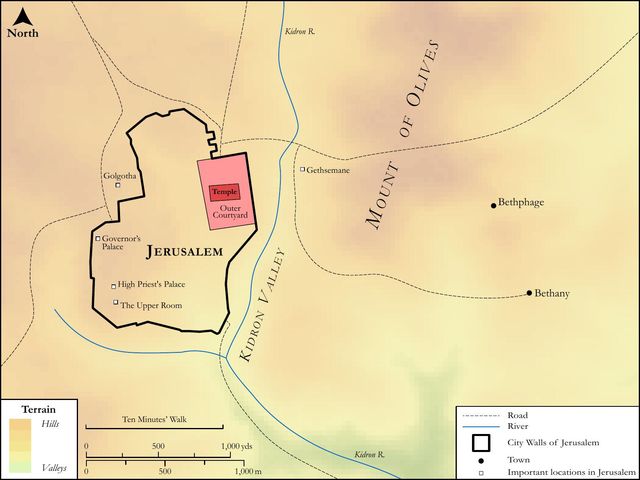
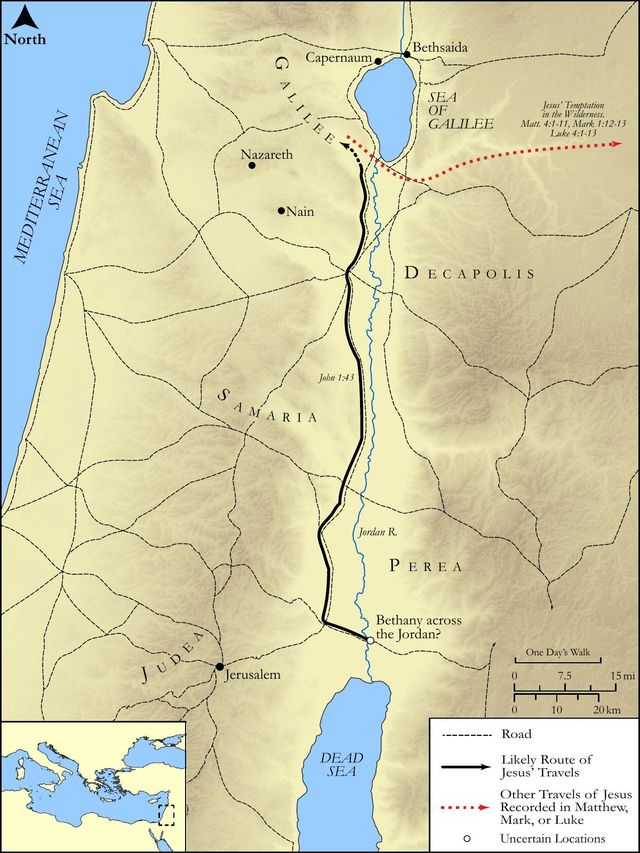
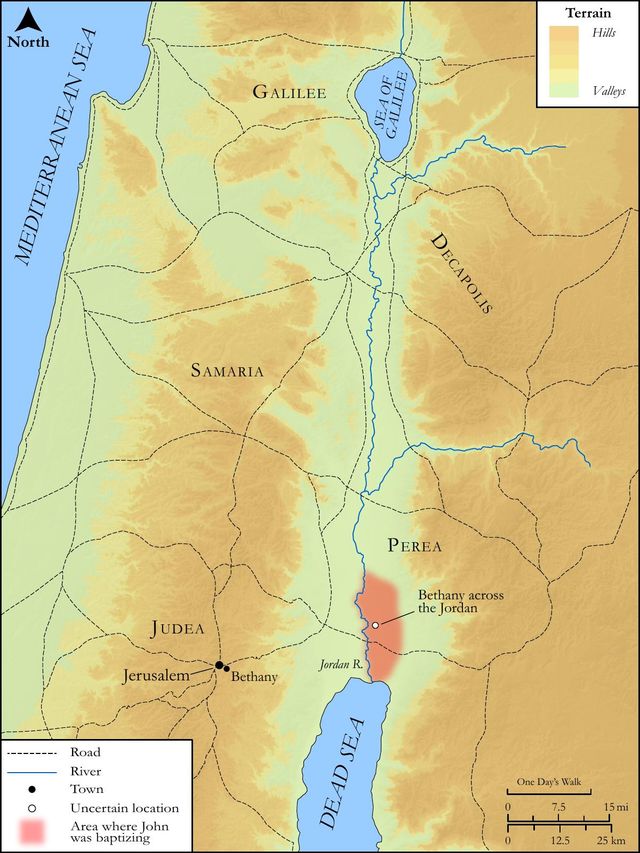
Study this verse
Public-domain commentary
Matthew Henry
From his Commentary on the Whole Bible. Henry comments on passages, not single verses — this entry covers John 1:19–28. His four-level outline is real structure in the source text, so it is rendered as structure.
We have here the testimony of John, which he delivered to the messengers who were sent from Jerusalem to examine him. Observe here,
I.Who they were that sent to him, and who they were that were sent.
1.They that sent to him were the Jews at Jerusalem, the great sanhedrim or high-commission court, which sat at Jerusalem, and was the representative of the Jewish church, who took cognizance of all matters relating to religion. One would think that they who were the fountains of learning, and the guides of the church, should have, by books, understood the times so well as to know that the Messiah was at hand, and therefore should presently have known him that was his forerunner, and readily embraced him; but, instead of this, they sent messengers to cross questions with him. Secular learning, honour, and power, seldom dispose men's minds to the reception of divine light.
2.They that were sent were,
(1.)Priests and Levites, probably members of the council, men of learning, gravity, and authority. John Baptist was himself a priest of the seed of Aaron, and therefore it was not fit that he should be examined by any but priests. It was prophesied concerning John's ministry that it should purify the Sons of Levi (Mal 3:3), and therefore they were jealous of him and his reformation.
(2.)They were of the Pharisees, proud, self-justiciaries, that thought they needed no repentance, and therefore could not bear one that made it his business to preach repentance.
II.On what errand they were sent; it was to enquire concerning John and his baptism.
They did not send for John to them, probably because they feared the people, lest the people where John was should be provoked to rise, or lest the people where they were should be brought acquainted with him; they thought it was good to keep him at a distance. They enquire concerning him,
1.To satisfy their curiosity; as the Athenians enquired concerning Paul's doctrine, for the novelty of it, Act 17:19, Act 17:20. Such a proud conceit they had of themselves that the doctrine of repentance was to them strange doctrine.
2.It was to show their authority. They thought they looked great when they called him to account whom all men counted as a prophet, and arraigned him at their bar.
3.It was with a design to suppress him and silence him if they could find any colour for it; for they were jealous of his growing interest, and his ministry agreed neither with the Mosaic dispensation which they had been long under, nor with the notions they had formed of the Messiah's kingdom.
III.What was the answer he gave them, and his account, both concerning himself and concerning his baptism, in both which he witnessed to Christ.
1.Concerning himself, and what he professed himself to be. They asked him, Su tis ei - Thou, who art thou? John's appearing in the world was surprising. He was in the wilderness till the day of his showing unto Israel. His spirit, his converse, he doctrine, had something in them which commanded and gained respect; but he did not, as seducers do, give out himself to be some great one. He was more industrious to do good than to appear great; and therefore waived saying any thing of himself till he was legally interrogated. Those speak best for Christ that say least of themselves, whose own works praise them, not their own lips. He answers their interrogatory,
(1.)Negatively. He was not that great one whom some took him to be. God's faithful witnesses stand more upon their guard against undue respect than against unjust contempt. Paul writes as warmly against those that overvalued him, and said, I am of Paul, as against those that undervalued him, and said that his bodily presence was weak; and he rent his clothes when he was called a god.
[1.]John disowns himself to be the Christ (Joh 1:20): He said, I am not the Christ, who was now expected and waited for. Note, The ministers of Christ must remember that they are not Christ, and therefore must not usurp his powers and prerogatives, nor assume the praises due to him only. They are not Christ, and therefore must not lord it over God's heritage, nor pretend to a dominion over the faith of Christians. They cannot created grace and peace; they cannot enlighten, convert, quicken, comfort; for they are not Christ. Observe how emphatically this is here expressed concerning John: He confessed, and denied not, but confessed; it denotes his vehemence and constancy in making this protestation. Note, Temptations to pride, and assuming that honour to ourselves which does not belong to us, ought to be resisted with a great deal of vigour and earnestness. When John was taken to be the Messiah, he did not connive at it with a Si populus vult decipi, decipiatur - If the people will be deceived, let them; but openly and solemnly, without any ambiguities, confessed, I am not the Christ; hoti ouk eimi egō ho Christos - I am not the Christ, not I; another is at hand, who is he, but I am not. His disowning himself to be the Christ is called his confessing and not denying Christ. Note, Those that humble and abase themselves thereby confess Christ, and give honour to him; but those that will not deny themselves do in effect deny Christ,
[2.]He disowns himself to be Elias, Joh 1:21. The Jews expected the person of Elias to return from heaven, and to live among them, and promised themselves great things from it. Hearing of John's character, doctrine, and baptism, and observing that he appeared as one dropped from heaven, in the same part of the country from which Elijah was carried to heaven, it is no wonder that they were ready to take him for this Elijah; but he disowned this honour too. He was indeed prophesied of under the name of Elijah (Mal 4:5), and he came in the spirit and power of Elias (Luk 1:17), and was the Elias that was to come (Mat 11:14); but he was not the person of Elias, not that Elias that went to heaven in the fiery chariot, as he was that met Christ in his transfiguration. He was the Elias that God had promised, not the Elias that they foolishly dreamed of. Elias did come, and they knew him not (Mat 17:12); nor did he make himself known to them as the Elias, because they had promised themselves such an Elias as God never promised them.
[3.]He disowns himself to be that prophet, or the prophet. First, He was not that prophet which Moses said the Lord would raise up to them of their brethren, like unto him. If they meant this, they needed not ask that question, for that prophet was no other than the Messiah, and he had said already, I am not the Christ. Secondly, He was not such a prophet as they expected and wished for, who, like Samuel and Elijah, and some other of the prophets, would interpose in public affairs, and rescue them from under the Roman yoke. Thirdly, He was not one of the old prophets raised from the dead, as they expected one to come before Elias, as Elias before the Messiah. Fourthly, Though John was a prophet, yea, more than a prophet, yet he had his revelation, not by dreams and visions, as the Old Testament prophets had theirs; his commission and work were of another nature, and belonged to another dispensation. If John had said that he was Elias, and was a prophet, he might have made his words good; but ministers must, upon all occasions, express themselves with the utmost caution, both that they may not confirm people in any mistakes, and particularly that they may not give occasion to any to think of them above what is meet.
(2.)Affirmatively. The committee that was sent to examine him pressed for a positive answer (Joh 1:22), urging the authority of those that sent them, which they expected he should pay a deference to: "Tell us, What art thou? not that we may believe thee, and be baptized by three, but that we may give an answer to those that sent us, and that it may not be said we were sent on a fool's errand." John was looked upon as a man of sincerity, and therefore they believed he would not give an evasive ambiguous answer; but would be fair and above-board, and give a plain answer to a plain question: What sayest thou of thyself? And he did so, I am the voice of one crying in the wilderness. Observe,
[1.]He gives his answer in the words of scripture, to show that the scripture was fulfilled in him, and that his office was supported by a divine authority. What the scripture saith of the office of the ministry should be often thought of by those of that high calling, who must look upon themselves as that, and that only, which the word of God makes them.
[2.]He gives in his answer in very humble, modest, self-denying expressions. He chooses to apply that scripture to himself which denotes not his dignity, but his duty and dependence, which bespeaks him little: I am the voice, as if he were vox et praeterea nihil - mere voice.
[3.]He gives such an account of himself as might be profitable to them, and might excite and awaken them to hearken to him; for he was the voice (see Isa 40:3), a voice to alarm, an articulate voice to instruct. Ministers are but the voice, the vehicle, by which God is pleased to communicate his mind. What are Paul and Apollos but messengers? Observe, First, He was a human voice. The people were prepared to receive the law by the voice of thunders, and a trumpet exceedingly loud, such as made them tremble; but they were prepared for the gospel by the voice of a man like ourselves, a still small voice, such as that in which God came to Elijah, Kg1 19:12. Secondly, He was the voice of one crying, which denotes, 1. His earnestness and importunity in calling people to repentance; he cried aloud, and did not spare. Ministers must preach as those that are in earnest, and are themselves affected with those things with which they desire to affect others. Those words are not likely to thaw the hearers' hearts that freeze between the speaker's lips. 2. His open publication of the doctrine he preached; he was the voice of one crying, that all manner of persons might hear and take notice. Doth not wisdom cry? Pro 8:1. Thirdly, It was in the wilderness that this voice was crying; in a place of silence and solitude, out of the noise of the world and the hurry of its business; the more retired we are from the tumult of secular affairs the better prepared we are to hear from God. Fourthly, That which he cried was, Make straight the way of the Lord; that is, 1. He came to rectify the mistakes of people concerning the ways of God; it is certain that they are right ways, but the scribes and Pharisees, with their corrupt glosses upon the law, had made them crooked. Now John Baptist calls people to return to the original rule. 2. He came to prepare and dispose people for the reception and entertainment of Christ and his gospel. It is an allusion to the harbingers of a prince or great man, that cry, Make room. Note, When God is coming towards us, we must prepare to meet him, and let the word of the Lord have free course. See Psa 24:7.
2.Here is his testimony concerning his baptism.
(1.)The enquiry which the committee made about it: Why baptizest thou, if thou be not the Christ, nor Elias, nor that prophet? Joh 1:25.
[1.]They readily apprehended baptism to be fitly and properly used as a sacred rite or ceremony, for the Jewish church had used it with circumcision in the admission of proselytes, to signify the cleansing of them from the pollutions of their former state. That sign was made use of in the Christian church, that it might be the more passable. Christ did not affect novelty, nor should his ministers.
[2.]They expected it would be used in the days of the Messiah, because it was promised that then there should be a fountain opened (Zac 13:1), and clean water sprinkled, Eze 36:25. It is taken for granted that Christ, and Elias, and that prophet, would baptize, when they came to purify a polluted world. Divine justice drowned the old world in its filth, but divine grace has provided for the cleansing of this new world from its filth.
[3.]They would therefore know by what authority John baptized. His denying himself to be Elias, or that prophet, subjected him to this further question, Why baptizest thou? Note, It is no new thing for a man's modesty to be turned against him, and improved to his prejudice; but it is better that men should take advantage of our low thoughts of ourselves, to trample upon us, than the devil take advantage of our high thoughts of ourselves, to tempt us to pride and draw us into his condemnation.
(2.)The account he gave of it, Joh 1:26, Joh 1:27.
[1.]He owned himself to be only the minister of the outward sign: "I baptize with water, and that is all; I am no more, and do no more, than what you see; I have no other title than John the Baptist; I cannot confer the spiritual grace signified by it." Paul was in care that none should think of him above what they saw him to be (Co2 12:6); so was John Baptist. Ministers must not set up for masters.
[2.]He directed them to one who was greater than himself, and would do that for them, if they pleased, which he could not do: "I baptize with water, and that is the utmost of my commission; I have nothing to do but by this to lead you to one that comes after me, and consign you to him." Note, The great business of Christ's ministers is to direct all people to him; we preach not ourselves, but Christ Jesus the Lord. John gave the same account to this committee that he had given to the people (Joh 1:15): This as he of whom I spoke. John was constant and uniform in his testimony, not as a reed shaken with the wind. The sanhedrim were jealous of his interest in the people, but he is not afraid to tell them that there is one at the door that will go beyond him. First, He tells them of Christ's presence among them now at this time: There stands one among you, at this time, whom you know not. Christ stood among the common people, and was as one of them. Note, 1. Much true worth lies hid in this world; obscurity is often the lot of real excellency. Saints are God's hidden ones, therefore the world knows them not. 2. God himself is often nearer to us than we are aware of. The Lord is in this place, and I knew it not. They were gazing, in expectation of the messiah: Lo he is here, or he is there, when the kingdom of God was abroad and already among them, Luk 17:21. Secondly, He tells them of Christ's preference above himself: He comes after me, and yet is preferred before me. This he had said before; he adds here, "Whose shoe-latchet I am not worthy to loose; I am not fit to be named the same day with him; it is an honour too great for me to pretend to be in the meanest office about him," Sa1 25:41. Those to whom Christ is precious reckon his service, even the most despised instances of it, an honour to them. See Psa 84:10. If so great a man as John accounted himself unworthy of the honour of being near Christ, how unworthy then should we account ourselves! Now, one would think, these chief priests and Pharisees, upon this intimation given concerning the approach of the Messiah, should presently have asked who, and where, this excellent person was; and who more likely to tell them than he who had given them this general notice? No, they did not think this any part of their business or concern; they came to molest John, not to receive any instructions from him: so that their ignorance was wilful; they might have known Christ, and would not.
Lastly, Notice is taken of the place where all this was done: In Bethabara beyond Jordan, Joh 1:28. Bethabara signifies the house of passage; some think it was the very place where Israel passed over Jordan into the land of promise under the conduct of Joshua; there was opened the way into the gospel state by Jesus Christ. It was at a great distance from Jerusalem, beyond Jordan; probably because what he did there would be least offensive to the government. Amos must go prophesy in the country, not near the court; but it was sad that Jerusalem should put so far from her the things that belonged to her peace. He made this confession in the same place where he was baptizing, that all those who attended his baptism might be witnesses of it, and none might say that they knew not what to make of him.
Historical interpretation
Nine Centuries of Reception
13 surviving comments on this verse. Each one is dated, so this reads as a timeline rather than a list.
Select a marker to jump to its quote. Markers stagger vertically where authors wrote within a few decades of each other.
(in Joan. tom. ii. c. 29) This is the second testimony of John the Baptist to Christ, the first began with, This is He of Whom I spake; and ended with, He hath declared Him.
(t. vi. c. 4) The Jews of Jerusalem, as being of kin to the Baptist, who was of the priestly stock, send Priests and Levites to ask him who he is; (c. 6). that is, men considered to hold a superior rank to the rest of their order, by God's election, and coming from that favoured above all cities, Jerusalem. Such is the reverential way in which they interrogate John. We read of no such proceeding towards Christ: but what the Jews did to John, John in turn does to Christ, when he asks Him, through His disciples, Art thou He that should come, (Luke 7:20) or look we for another?
Now, therefore, let us consider John’s second testimony. Jews from Jerusalem send priests and Levites to inquire who John might be, since they are kinsmen of the Baptist who happens to be from the priestly race. … Note that two embassies come to the Baptist. One consists of “priests and Levites” sent from Jerusalem by the Jews “to ask him, ‘Who are you?’ ” The other comes from the Pharisees, who send also because they are in doubt about the answer that had been given to the priests and Levites. Observe carefully, therefore, how in accordance with the character of priests and Levites, things are said with gentleness and curiosity.… There is nothing self-willed or rash in the inquiry of these men; everything is appropriate to scrupulous servants of God.…These elect ambassadors were sent from Jerusalem, the place chosen above all the earth … and they interrogate John with the greatest respect. Nothing like this, however, has been recorded to have been done by the Jews concerning Christ. It is John who does to Christ what the Jews do to him, when he [respectfully] inquires through his own disciples, “Are you he that is to come, or should we expect another?”
When then John continually sent them from himself to Jesus, who seemed to them a meaner person, being ashamed and vexed at this, and wishing rather to have him for their teacher, they did not dare to say so plainly, but send to him, thinking by their flattery to induce him to confess that he was the Christ. They do not therefore send to him mean men, as in the case of Christ, for when they wished to lay hold on Him, they sent servants, and then Herodians, and the like, but in this instance, "priests and Levites," and not merely "priests," but those "from Jerusalem," that is, the more honorable; for the Evangelist did not notice this without a cause.
(Hom. xvi. [xv.] 1.) The text then, No man hath seen God at any time, applies not to the Father only, but also to the Son: for He, as Paul saith, is the Image of the invisible God; but He who is the Image of the Invisible, must Himself also be invisible.
(in Joan. Hom. xvi. [xv.]) Such confidence had they in John, that they were ready to believe him on his own words: witness how it is said, To ask him, Who art thou?
(Hom. xvi. [xv.] 1, 2) Or take this explanation: The Jews were influenced by a kind of human sympathy for John, whom they were reluctant to see made subordinate to Christ, on account of the many marks of greatness about him; his illustrious descent in the first place, he being the son of a chief priest; in the next, his hard training, and his contempt of the world. Whereas in Christ the contrary were apparent; a humble birth, for which they, reproach Him; Is not this the carpenter's son? (Mat. 13:55) an ordinary way of living; a dress such as every one else wore. As John then was constantly sending to Christ, they send to him, with the view of having him for their master, and thinking to induce him, by blandishments, to confess himself Christ. They do not therefore send inferior persons to him, ministers and Herodians, as they did to Christ, but Priests and Levites; and not of these an indiscriminate party, but those of Jerusalem, i. e. the more honourable ones; but they send them with this question, to ask, Who art thou? not from a wish to be informed, but in order to induce him to do what I have said. John replies then to their intention, not to their interrogation: And he confessed, and denied not; but confessed, I am not the Christ. And observe the wisdom of the Evangelist: he repeats the same thing three times, to show John's virtue, and the malice and madness of the Jews. For it is the character of a devoted servant, not only to forbear taking to himself his lord's glory, but even, when numbers offer it to him, to reject it. The multitude indeed believed from ignorance that John was the Christ, but in these it was malice; and in this spirit they put the question to him, thinking, by their blandishments to bring him over to their wishes. For unless this had been their design, when he replied, I am not the Christ, they would have said, We did not suspect this; we did not come to ask this. When caught, however, and discovered in their purpose, they proceed to another question: And they asked him, What then? Art thou Elias?
(Hom. xvi. [xv.] 2) You see them here pressing him still more strongly with their questions, while he on the other hand quietly puts down their suspicions, where they are untrue, and establishes the truth in their place: saying, I am the voice of one crying in the wilderness.
It is worth while to learn why he did thus. It was, that their wickedness might be manifest and plain to all men. Often did John testify of Christ to the Jews, and when he baptized them he continually made mention of Him to his company, and said, "I indeed baptize you with water, but there cometh One after me who is mightier than I; He shall baptize you with the Holy Ghost and with fire." With regard to him they were affected by a human feeling; for, tremblingly attentive to the opinion of the world, and looking to "the outward appearance," they deemed it an unworthy thing that he should be subject to Christ.
Since there were many things that pointed out John for an illustrious person. In the first place, his distinguished and noble descent; for he was the son of a chief priest. Then his conversation, his austere mode of life, his contempt of all human things; for despising dress and table, and house and food itself, he had passed his former time in the desert. In the case of Christ all was the contrary of this. His family was mean, (as they often objected to Him, saying, "Is not this the carpenter's son? Is not his mother called Mary? and his brethren James and Joses?"); and that which was supposed to be His country was held in such evil repute, that even Nathanael said, "Can there any good thing come out of Nazareth?"
This is the part of an honest servant, not only not to take to himself his master's honor, but also to reject it when given to him by the many. But the multitudes arrived at this supposition from simplicity and ignorance; these questioned him from an ill intention, which I have mentioned, expecting, as I said, to draw him over to their purpose by their flattery. Had they not expected this, they would not have proceeded immediately to another question, but would have been angry with him for having given them an answer foreign to their enquiry, and would have said, "Why, did we suppose that? did we come to ask thee that?" But now as taken and detected in the fact, they proceed to another question.
"And this is the record of John, when the Jews sent priests and Levites from Jerusalem to ask him, Who art thou?" A Dreadful thing is envy, beloved, a dreadful thing and a pernicious, to the enviers, not to the envied. All this I have said, by reason of the envy of the Jews. Because those who had flocked from the cities to John, and had condemned their own sins, and caused themselves to be baptized, repenting as it were after Baptism, send to ask him, "Who art thou?" Of a truth they were the offspring of vipers, serpents, and even worse if possible than this. O evil and adulterous and perverse generation, after having been baptized, do ye then become vainly curious, and question about the Baptist?
Hear then how this blessed person answered to the intention with which they asked the question, not to the question itself. When they said, "Who art thou?" he did not at once give them what would have been the direct answer, "I am the voice of one crying in the wilderness." But what did he? He removed the suspicion they had formed; for, saith the Evangelist, being asked, "Who art thou?" "He confessed, and denied not; but confessed, I am not the Christ." Observe the wisdom of the Evangelist. He mentions this for the third time, to set forth the excellency of the Baptist, and their wickedness and folly.
And they send to ask, "Who art thou?" Yet the manner of his birth was well known to all, so that all said, "What manner of child shall this be?"; and the report had gone forth into all the hill country. And afterwards when he came to Jordan, all the cities were set on the wing, and came to him from Jerusalem, and from all Judaea, to be baptized. Why then do they now ask? Not because they did not know him, (how could that be, when he had been made manifest in so many ways?) but because they wished to bring him to do that which I have mentioned.
You have very often heard, holy brethren, and you know well, that John the Baptist, in proportion as he was greater than those born of women, and was more humble in his acknowledgment of the Lord, obtained the grace of being the friend of the Bridegroom; zealous for the Bridegroom, not for himself; not seeking his own honor, but that of his Judge, whom as a herald he preceded. Therefore, to the prophets who went before, it was granted to predict concerning Christ; but to this man, to point Him out with the finger. For as Christ was unknown by those who did not believe the prophets before He came, He remained unknown to them even when present. For He had come humbly and concealed from the first; the more concealed in proportion as He was more humble: but the people, despising in their pride the humility of God, crucified their Saviour, and made Him their condemner.
Yet because He appeared as it were in the night, in a mortal body, He lighted for Himself a lamp by which He might be seen. That lamp was John, concerning whom you lately heard many things: and the present passage of the evangelist contains the words of John; in the first place, and it is the chief point, his confession that he was not the Christ. But so great was the excellence of John, that men might have believed him to be the Christ: and in this he gave a proof of his humility, that he said he was not when he might have been believed to have been the Christ; therefore, "This is the testimony of John, when the Jews sent priests and Levites to him from Jerusalem to ask him, Who art thou?" But they would not have sent unless they had been moved by the excellence of his authority who ventured to baptize. "And he confessed, and denied not." What did he confess? "And he confessed, I am not the Christ."
(Tr. 4. c. 3) They would not have sent, unless they had been impressed by his lofty exercise of authority, in daring to baptize.
(in loc.) Or, after the introduction above of John's testimony to Christ, is preferred before me, the Evangelist now adds when the above testimony was given, And this is the record of John, when the Jews sent priests and Levites from Jerusalem.
(in loc.) Or because he declared the truth plainly, while all who were under the law spoke obscurely.
Continue studying John 1:19 across the web’s major study libraries — every link below opens this exact verse, chapter, or book on the destination site.
Read & Compare
 BibleGatewayThis verse in more than 200 translations and 70 languages.
 Bible.comThe YouVersion reader — hundreds of translations, reading plans, and highlights.
 ESV.orgCrossway's official English Standard Version reader.
 NET BibleThe NET translation with 60,000+ translators' notes on every rendering decision.
 STEP BibleTyndale House's free study tool — original text, vocabulary, and scholarly resources.
 BibliaLogos Bible Software's free web reader.
 USCCBThe New American Bible (Revised Edition) with the U.S. bishops' study notes.
Commentaries
 BibleHub CommentariesDozens of classic commentaries on this verse, gathered on one page.
 StudyLightMore than 100 commentary sets — the largest collection on the web.
 BibleRefPlain-English commentary on what this verse means, verse by verse.
 Enduring WordDavid Guzik's free commentary on this chapter, widely used by Bible teachers.
 Bible Study ToolsVerse commentary alongside Greek and Hebrew study aids.
Original Language & Research
- BibleHub InterlinearThe verse word by word — original language, transliteration, and English.
- BibleHub LexiconEvery word's original-language definition and Strong's entry.
 Blue Letter BibleDeep-study tools — Strong's numbers, concordance, and word studies.
 CNTR CollationThe earliest Greek manuscripts of this verse, collated letter by letter.
Sermons, Hymns & Audio


TrulyRandomVerse is not affiliated with these sites and doesn’t control their content. They’re linked because they’re genuinely useful.
Summary
John 1:19 initiates the formal investigation into the identity and authority of John the Baptist by a delegation of Jewish religious leaders from Jerusalem. This pivotal moment serves as the public platform for John to clarify his role, deny any messianic or prophetic claims for himself, and ultimately prepare the way for his profound testimony concerning Jesus Christ, the true Light of the world.
Context
ShowHideLiterary Context
This verse immediately follows the prologue of John's Gospel (John 1:1-18), which introduces Jesus as the pre-existent Word, the Light, and the Son of God, and briefly mentions John the Baptist's role as a witness to this Light (John 1:6-8). John 1:19 marks the transition from the theological exposition of the prologue to the narrative account of John the Baptist's public ministry and his direct encounters with the Jewish authorities. It sets the stage for John's clear denials of being the Christ, Elijah, or "the Prophet" in John 1:20-21, and his subsequent declaration of his true identity as "the voice of one crying in the wilderness" (John 1:23). The inquiry in this verse is not merely a historical detail but a narrative device to prompt John's essential testimony about Jesus.
Historical & Cultural Context
The first century Judea was a land simmering with messianic expectation and prophetic anticipation. Various groups, including the Pharisees and Essenes, held diverse views on the coming deliverer. The sending of "priests and Levites from Jerusalem" indicates an official delegation from the Sanhedrin, the supreme Jewish religious and judicial council. These officials were guardians of Jewish law and tradition, responsible for maintaining religious order and identifying any potential false prophets or messianic claimants who could incite unrest or challenge Roman authority. Jerusalem was the religious and political center, and any significant religious movement originating outside its direct control, especially one involving a prophet like John baptizing in the wilderness (a place associated with prophetic activity and new beginnings, as seen in the Exodus narrative), would naturally draw the attention and scrutiny of the established religious hierarchy. Their question, "Who art thou?", reflects their urgent need to categorize John within their existing theological frameworks.
Key Themes
ShowHideThis verse contributes significantly to several key themes in John's Gospel. Firstly, it highlights the theme of Witness and Testimony, as John's entire purpose is to bear witness to Jesus, and this inquiry provides the perfect public forum for that testimony. Secondly, it underscores the theme of Identity and Authority, as the central question revolves around John's identity and the source of his authority to baptize. This theme will recur throughout the Gospel as Jesus' own identity and authority are repeatedly challenged. Thirdly, it subtly introduces the theme of Light versus Darkness, as John, the "witness to the Light" (John 1:7), is confronted by representatives of a religious establishment that largely failed to recognize or receive the true Light (John 1:10-11). Finally, the verse sets up the Messianic Expectation prevalent in Israel, which John will redirect away from himself and towards Jesus Christ.
Exposition and Analysis
ShowHideKey Word Analysis
ShowHideThis word signifies "evidence given (judicially or genitive case):--record, report, testimony, witness." In the context of John's Gospel, it is far more than a mere historical account; it is a divinely appointed testimony. John the Baptist's entire ministry is understood as a witness, bearing evidence to the truth of Jesus Christ. This term emphasizes the authoritative and truthful nature of John's declaration about himself and, more importantly, about the Christ.
Meaning "set apart, i.e. (by implication) to send out (properly, on a mission) literally or figuratively:--put in, send (away, forth, out), set (at liberty)." The use of this verb highlights the official and deliberate nature of the delegation. The priests and Levites were not merely curious individuals; they were formally dispatched on a mission by the Jewish authorities in Jerusalem, underscoring the gravity and institutional concern surrounding John's ministry.
Meaning "to interrogate; by implication, to request:--ask, beseech, desire, intreat, pray." This verb indicates a formal inquiry, a questioning intended to elicit specific information, particularly regarding John's claims and the source of his authority. It's not a casual question but an interrogation by those in power, seeking to understand and categorize John's movement.
Verse Breakdown
ShowHide"And this is the record of John,"
This phrase introduces John's public testimony, emphasizing that what follows is his authoritative declaration concerning his identity and mission. The term "record" (martyría) signals that this is not just a story, but a crucial witness.
"when the Jews sent priests and Levites from Jerusalem"
This part establishes the official and high-level nature of the inquiry. "The Jews" here refers to the religious authorities, likely the Sanhedrin, who dispatched a formal delegation of priests (descendants of Aaron, responsible for temple worship) and Levites (assistants to the priests, responsible for various temple duties) from the religious capital, Jerusalem. This signifies a serious investigation into John's activities and claims.
"to ask him, Who art thou?"
This is the central question, revealing the core concern of the Jewish leaders. They sought to understand John's identity and the basis of his authority, likely suspecting he might be the Messiah, Elijah, or "the Prophet" foretold in Scripture. This direct question provides the immediate context for John's subsequent denials and his declaration of his true role.
Literary Devices
ShowHideThe passage employs several significant literary devices. Foreshadowing is evident as this official inquiry into John's identity and authority sets a precedent for the numerous interrogations and challenges Jesus himself will face from these same religious authorities throughout John's Gospel. There is also an element of Dramatic Irony: the Jewish leaders, representing the established religious order, are diligently seeking to understand John's role and authority, yet they are unknowingly preparing the way for the very Messiah they fail to recognize, who is already "among you, whom you do not know" (John 1:26). The precise question, "Who art thou?", is a form of Interrogation, designed to elicit a definitive statement from John, which he provides with humble clarity, thereby fulfilling his role as the witness who points away from himself to the true Light.
Theological and Thematic Connections
ShowHideJohn 1:19 is foundational for understanding the unique role of John the Baptist as the divinely appointed forerunner of Christ. His identity as "the voice crying in the wilderness" (John 1:23) is not self-proclaimed but a fulfillment of Old Testament prophecy, particularly from Isaiah. This passage underscores the importance of a clear and humble understanding of one's God-given purpose, especially when confronted by human authority or scrutiny. John's unwavering focus on the One who was to come, rather than on his own popularity or perceived status, serves as a powerful model of selfless ministry. The inquiry also highlights the tension between established religious institutions and new movements, a dynamic that will intensify with Jesus' ministry.
Reflection and Application
ShowHideJohn the Baptist's response to the official inquiry in John 1:19 provides a profound lesson in humility, clarity of purpose, and faithful witness. In a world that often demands self-promotion and personal branding, John's immediate denial of being the Christ, Elijah, or "the Prophet" is counter-cultural. It challenges believers to consider their own identity in Christ and the true source of their authority and purpose. Are we quick to draw attention to ourselves, or do we, like John, humbly point others to Jesus? This passage also encourages us to be prepared to articulate our faith and the hope that is within us, even when questioned by those who may be skeptical or hostile. Our ultimate identity is found not in what we do or what titles we hold, but in whose we are—children of God, called to bear witness to His Son.
Questions for Reflection
ShowHideFAQ
ShowHideWhy did the Jewish leaders send priests and Levites specifically?
ShowHideThe sending of "priests and Levites" from "Jerusalem" signifies the highest level of official inquiry. Priests were descendants of Aaron, responsible for temple worship and interpreting the Law. Levites assisted the priests and maintained the temple. As representatives of the Sanhedrin, the supreme Jewish religious council based in Jerusalem, their mission was to investigate any significant religious movement that could challenge the established order, identify potential false prophets, or assess if John was a legitimate prophetic figure. Their authority was rooted in the temple and the Mosaic Law, making them the appropriate delegation to question someone like John, whose wilderness ministry and baptizing practices were drawing large crowds and raising questions about his authority and identity, as seen in John 1:24-25.
What was the significance of the question "Who art thou?"
ShowHideThis seemingly simple question carried immense theological and political weight in first-century Judea. Given the fervent messianic expectations, the Jewish leaders were looking to categorize John. They were likely considering if he was the Messiah (the Christ), Elijah returned (as prophesied in Malachi 4:5-6), or "the Prophet" like Moses (foretold in Deuteronomy 18:15-18). John's answer would determine how they would view his ministry and whether he posed a threat to their authority or the fragile peace with Rome. His clear denial of all these prominent identities in John 1:20-21 was crucial for redirecting attention to the true Christ.
Christ-Centered Fulfillment
ShowHideJohn 1:19, though focused on John the Baptist, serves as a crucial Christ-centered passage by setting the stage for Jesus' public ministry and the revelation of His divine identity. John's "record" or testimony is not about himself, but about the One who is to come. His humble denial of being the Christ, Elijah, or "the Prophet" (John 1:20-21) immediately redirects the focus from himself to Jesus, the true Messiah. John's mission, as illuminated by this inquiry, was to prepare the way for the Lord (Isaiah 40:3), to bear witness to the Light (John 1:7), and to decrease so that Christ might increase (John 3:30). This passage emphasizes that John's entire existence and ministry found its ultimate meaning and fulfillment in pointing to Jesus, the Lamb of God who takes away the sin of the world (John 1:29), thereby establishing the indispensable link between the forerunner and the Redeemer.