


John 1:26
Bible text: King James Version (1769 Blayney text) · Public domain
Bible text: Berean Standard Bible · Public domain
Bible text: American Standard Version (1901) · Public domain
Bible text: World English Bible, Messianic edition · Public domain
Bible text: Geneva Bible (1599) · Public domain
Bible text: Young's Literal Translation · Public domain
- ἀπεκρίθηapekrithēAnsweredG611V-ADI-3SVerb Aorist Middle Deponent Indicative 3rd Singular
- αὐτοῖςautoisthemG846P-DPMPersonal pronoun Dative Plural Masculine
- ὁho<the>G3588T-NSMDefinite article Nominative Singular Masculine
- ἸωάννηςIōannēsJohnG2491N-NSM-PNoun Nominative Singular Masculine Individual
- λέγων·legōnsayingG3004V-PAP-NSMVerb Present Active Participle Nominative Singular Masculine
- ἐγὼegōI myselfG1473P-1NSPersonal pronoun Nominative 1st Singular
- βαπτίζωbaptizōbaptizeG907V-PAI-1SVerb Present Active Indicative 1st Singular
- ἐνenwithG1722PREPPreposition
- ὕδατι·hudatiwaterG5204N-DSNNoun Dative Singular Neuter
- μέσοςmesos[in the] midstG3319A-NSMAdjective Nominative Singular Masculine
- δὲdenowG1161CONJConjunction
- ὑμῶνhumōnof youG4771P-2GPPersonal pronoun Genitive 2nd Plural
- ἕστηκενhestēkenhe has stoodG2476V-RAI-3SVerb Perfect Active Indicative 3rd Singular
- ὃνhonwhomG3739R-ASMRelative pronoun Accusative Singular Masculine
- ὑμεῖςhumeisyou yourselvesG4771P-2NPPersonal pronoun Nominative 2nd Plural
- οὐκouknotG3756PRT-NNegative Particle Negative
- οἴδατεoidateknowG1492V-RAI-2PVerb Perfect Active Indicative 2nd Plural
English is a literal word-by-word gloss of the Greek, not the KJV's wording. Why?
This is the original text the KJV's translators worked from — each Greek word with its own literal English meaning in this verse, prepared by scholars at Tyndale House, Cambridge. The KJV translates whole sentences, not word by word, so its wording differs: one Greek word can become several English words, and the KJV may choose “charity” where the gloss reads “love”. Both are faithful — they answer different questions. For the KJV's own rendering, switch to the KJV text.
Details
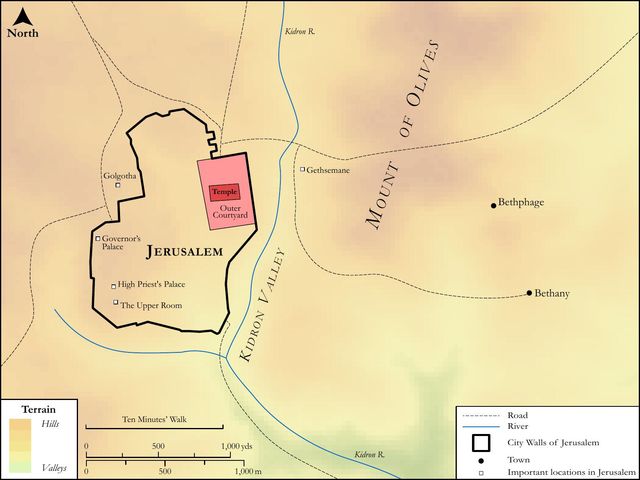
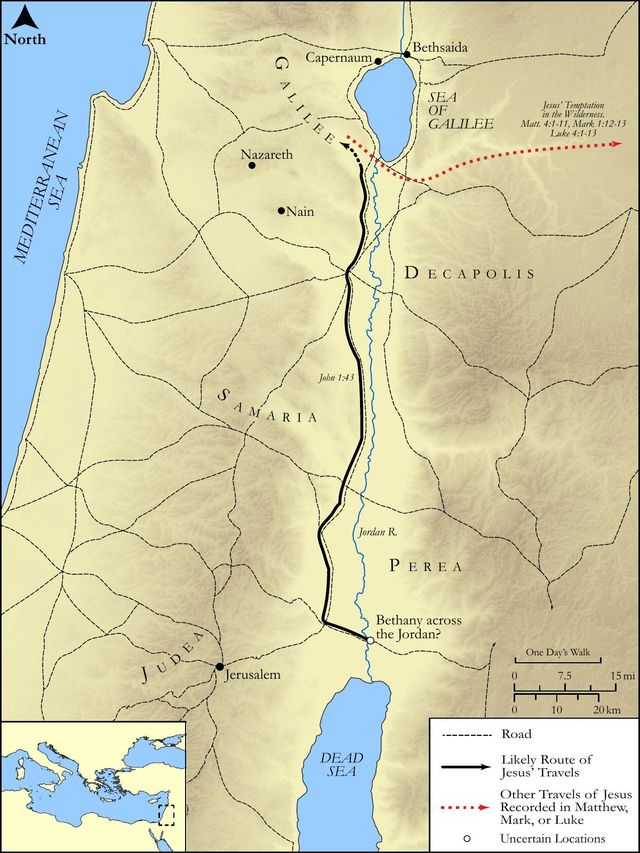
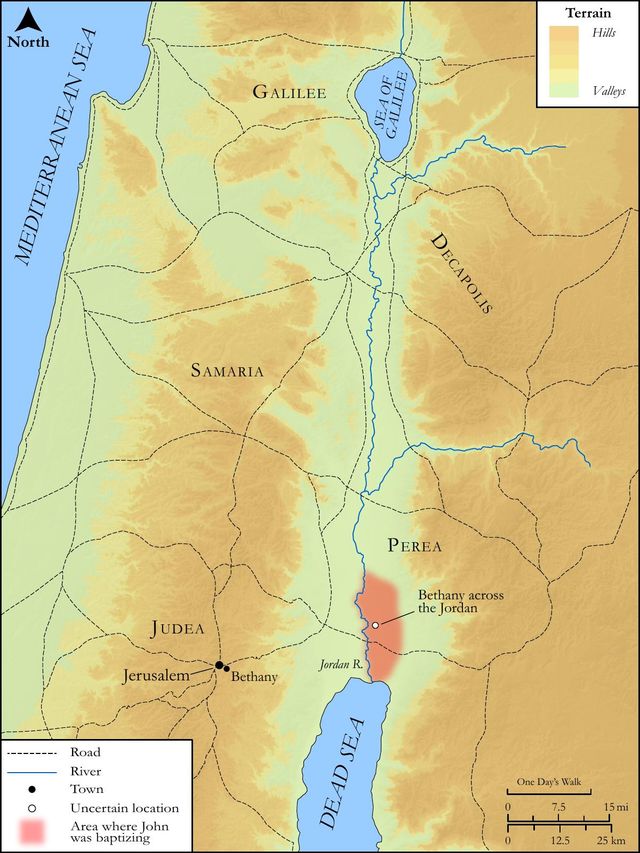
See on the biblical-era maps
Study this verse
Public-domain commentary
Matthew Henry
From his Commentary on the Whole Bible. Henry comments on passages, not single verses — this entry covers John 1:19–28. His four-level outline is real structure in the source text, so it is rendered as structure.
We have here the testimony of John, which he delivered to the messengers who were sent from Jerusalem to examine him. Observe here,
I.Who they were that sent to him, and who they were that were sent.
1.They that sent to him were the Jews at Jerusalem, the great sanhedrim or high-commission court, which sat at Jerusalem, and was the representative of the Jewish church, who took cognizance of all matters relating to religion. One would think that they who were the fountains of learning, and the guides of the church, should have, by books, understood the times so well as to know that the Messiah was at hand, and therefore should presently have known him that was his forerunner, and readily embraced him; but, instead of this, they sent messengers to cross questions with him. Secular learning, honour, and power, seldom dispose men's minds to the reception of divine light.
2.They that were sent were,
(1.)Priests and Levites, probably members of the council, men of learning, gravity, and authority. John Baptist was himself a priest of the seed of Aaron, and therefore it was not fit that he should be examined by any but priests. It was prophesied concerning John's ministry that it should purify the Sons of Levi (Mal 3:3), and therefore they were jealous of him and his reformation.
(2.)They were of the Pharisees, proud, self-justiciaries, that thought they needed no repentance, and therefore could not bear one that made it his business to preach repentance.
II.On what errand they were sent; it was to enquire concerning John and his baptism.
They did not send for John to them, probably because they feared the people, lest the people where John was should be provoked to rise, or lest the people where they were should be brought acquainted with him; they thought it was good to keep him at a distance. They enquire concerning him,
1.To satisfy their curiosity; as the Athenians enquired concerning Paul's doctrine, for the novelty of it, Act 17:19, Act 17:20. Such a proud conceit they had of themselves that the doctrine of repentance was to them strange doctrine.
2.It was to show their authority. They thought they looked great when they called him to account whom all men counted as a prophet, and arraigned him at their bar.
3.It was with a design to suppress him and silence him if they could find any colour for it; for they were jealous of his growing interest, and his ministry agreed neither with the Mosaic dispensation which they had been long under, nor with the notions they had formed of the Messiah's kingdom.
III.What was the answer he gave them, and his account, both concerning himself and concerning his baptism, in both which he witnessed to Christ.
1.Concerning himself, and what he professed himself to be. They asked him, Su tis ei - Thou, who art thou? John's appearing in the world was surprising. He was in the wilderness till the day of his showing unto Israel. His spirit, his converse, he doctrine, had something in them which commanded and gained respect; but he did not, as seducers do, give out himself to be some great one. He was more industrious to do good than to appear great; and therefore waived saying any thing of himself till he was legally interrogated. Those speak best for Christ that say least of themselves, whose own works praise them, not their own lips. He answers their interrogatory,
(1.)Negatively. He was not that great one whom some took him to be. God's faithful witnesses stand more upon their guard against undue respect than against unjust contempt. Paul writes as warmly against those that overvalued him, and said, I am of Paul, as against those that undervalued him, and said that his bodily presence was weak; and he rent his clothes when he was called a god.
[1.]John disowns himself to be the Christ (Joh 1:20): He said, I am not the Christ, who was now expected and waited for. Note, The ministers of Christ must remember that they are not Christ, and therefore must not usurp his powers and prerogatives, nor assume the praises due to him only. They are not Christ, and therefore must not lord it over God's heritage, nor pretend to a dominion over the faith of Christians. They cannot created grace and peace; they cannot enlighten, convert, quicken, comfort; for they are not Christ. Observe how emphatically this is here expressed concerning John: He confessed, and denied not, but confessed; it denotes his vehemence and constancy in making this protestation. Note, Temptations to pride, and assuming that honour to ourselves which does not belong to us, ought to be resisted with a great deal of vigour and earnestness. When John was taken to be the Messiah, he did not connive at it with a Si populus vult decipi, decipiatur - If the people will be deceived, let them; but openly and solemnly, without any ambiguities, confessed, I am not the Christ; hoti ouk eimi egō ho Christos - I am not the Christ, not I; another is at hand, who is he, but I am not. His disowning himself to be the Christ is called his confessing and not denying Christ. Note, Those that humble and abase themselves thereby confess Christ, and give honour to him; but those that will not deny themselves do in effect deny Christ,
[2.]He disowns himself to be Elias, Joh 1:21. The Jews expected the person of Elias to return from heaven, and to live among them, and promised themselves great things from it. Hearing of John's character, doctrine, and baptism, and observing that he appeared as one dropped from heaven, in the same part of the country from which Elijah was carried to heaven, it is no wonder that they were ready to take him for this Elijah; but he disowned this honour too. He was indeed prophesied of under the name of Elijah (Mal 4:5), and he came in the spirit and power of Elias (Luk 1:17), and was the Elias that was to come (Mat 11:14); but he was not the person of Elias, not that Elias that went to heaven in the fiery chariot, as he was that met Christ in his transfiguration. He was the Elias that God had promised, not the Elias that they foolishly dreamed of. Elias did come, and they knew him not (Mat 17:12); nor did he make himself known to them as the Elias, because they had promised themselves such an Elias as God never promised them.
[3.]He disowns himself to be that prophet, or the prophet. First, He was not that prophet which Moses said the Lord would raise up to them of their brethren, like unto him. If they meant this, they needed not ask that question, for that prophet was no other than the Messiah, and he had said already, I am not the Christ. Secondly, He was not such a prophet as they expected and wished for, who, like Samuel and Elijah, and some other of the prophets, would interpose in public affairs, and rescue them from under the Roman yoke. Thirdly, He was not one of the old prophets raised from the dead, as they expected one to come before Elias, as Elias before the Messiah. Fourthly, Though John was a prophet, yea, more than a prophet, yet he had his revelation, not by dreams and visions, as the Old Testament prophets had theirs; his commission and work were of another nature, and belonged to another dispensation. If John had said that he was Elias, and was a prophet, he might have made his words good; but ministers must, upon all occasions, express themselves with the utmost caution, both that they may not confirm people in any mistakes, and particularly that they may not give occasion to any to think of them above what is meet.
(2.)Affirmatively. The committee that was sent to examine him pressed for a positive answer (Joh 1:22), urging the authority of those that sent them, which they expected he should pay a deference to: "Tell us, What art thou? not that we may believe thee, and be baptized by three, but that we may give an answer to those that sent us, and that it may not be said we were sent on a fool's errand." John was looked upon as a man of sincerity, and therefore they believed he would not give an evasive ambiguous answer; but would be fair and above-board, and give a plain answer to a plain question: What sayest thou of thyself? And he did so, I am the voice of one crying in the wilderness. Observe,
[1.]He gives his answer in the words of scripture, to show that the scripture was fulfilled in him, and that his office was supported by a divine authority. What the scripture saith of the office of the ministry should be often thought of by those of that high calling, who must look upon themselves as that, and that only, which the word of God makes them.
[2.]He gives in his answer in very humble, modest, self-denying expressions. He chooses to apply that scripture to himself which denotes not his dignity, but his duty and dependence, which bespeaks him little: I am the voice, as if he were vox et praeterea nihil - mere voice.
[3.]He gives such an account of himself as might be profitable to them, and might excite and awaken them to hearken to him; for he was the voice (see Isa 40:3), a voice to alarm, an articulate voice to instruct. Ministers are but the voice, the vehicle, by which God is pleased to communicate his mind. What are Paul and Apollos but messengers? Observe, First, He was a human voice. The people were prepared to receive the law by the voice of thunders, and a trumpet exceedingly loud, such as made them tremble; but they were prepared for the gospel by the voice of a man like ourselves, a still small voice, such as that in which God came to Elijah, Kg1 19:12. Secondly, He was the voice of one crying, which denotes, 1. His earnestness and importunity in calling people to repentance; he cried aloud, and did not spare. Ministers must preach as those that are in earnest, and are themselves affected with those things with which they desire to affect others. Those words are not likely to thaw the hearers' hearts that freeze between the speaker's lips. 2. His open publication of the doctrine he preached; he was the voice of one crying, that all manner of persons might hear and take notice. Doth not wisdom cry? Pro 8:1. Thirdly, It was in the wilderness that this voice was crying; in a place of silence and solitude, out of the noise of the world and the hurry of its business; the more retired we are from the tumult of secular affairs the better prepared we are to hear from God. Fourthly, That which he cried was, Make straight the way of the Lord; that is, 1. He came to rectify the mistakes of people concerning the ways of God; it is certain that they are right ways, but the scribes and Pharisees, with their corrupt glosses upon the law, had made them crooked. Now John Baptist calls people to return to the original rule. 2. He came to prepare and dispose people for the reception and entertainment of Christ and his gospel. It is an allusion to the harbingers of a prince or great man, that cry, Make room. Note, When God is coming towards us, we must prepare to meet him, and let the word of the Lord have free course. See Psa 24:7.
2.Here is his testimony concerning his baptism.
(1.)The enquiry which the committee made about it: Why baptizest thou, if thou be not the Christ, nor Elias, nor that prophet? Joh 1:25.
[1.]They readily apprehended baptism to be fitly and properly used as a sacred rite or ceremony, for the Jewish church had used it with circumcision in the admission of proselytes, to signify the cleansing of them from the pollutions of their former state. That sign was made use of in the Christian church, that it might be the more passable. Christ did not affect novelty, nor should his ministers.
[2.]They expected it would be used in the days of the Messiah, because it was promised that then there should be a fountain opened (Zac 13:1), and clean water sprinkled, Eze 36:25. It is taken for granted that Christ, and Elias, and that prophet, would baptize, when they came to purify a polluted world. Divine justice drowned the old world in its filth, but divine grace has provided for the cleansing of this new world from its filth.
[3.]They would therefore know by what authority John baptized. His denying himself to be Elias, or that prophet, subjected him to this further question, Why baptizest thou? Note, It is no new thing for a man's modesty to be turned against him, and improved to his prejudice; but it is better that men should take advantage of our low thoughts of ourselves, to trample upon us, than the devil take advantage of our high thoughts of ourselves, to tempt us to pride and draw us into his condemnation.
(2.)The account he gave of it, Joh 1:26, Joh 1:27.
[1.]He owned himself to be only the minister of the outward sign: "I baptize with water, and that is all; I am no more, and do no more, than what you see; I have no other title than John the Baptist; I cannot confer the spiritual grace signified by it." Paul was in care that none should think of him above what they saw him to be (Co2 12:6); so was John Baptist. Ministers must not set up for masters.
[2.]He directed them to one who was greater than himself, and would do that for them, if they pleased, which he could not do: "I baptize with water, and that is the utmost of my commission; I have nothing to do but by this to lead you to one that comes after me, and consign you to him." Note, The great business of Christ's ministers is to direct all people to him; we preach not ourselves, but Christ Jesus the Lord. John gave the same account to this committee that he had given to the people (Joh 1:15): This as he of whom I spoke. John was constant and uniform in his testimony, not as a reed shaken with the wind. The sanhedrim were jealous of his interest in the people, but he is not afraid to tell them that there is one at the door that will go beyond him. First, He tells them of Christ's presence among them now at this time: There stands one among you, at this time, whom you know not. Christ stood among the common people, and was as one of them. Note, 1. Much true worth lies hid in this world; obscurity is often the lot of real excellency. Saints are God's hidden ones, therefore the world knows them not. 2. God himself is often nearer to us than we are aware of. The Lord is in this place, and I knew it not. They were gazing, in expectation of the messiah: Lo he is here, or he is there, when the kingdom of God was abroad and already among them, Luk 17:21. Secondly, He tells them of Christ's preference above himself: He comes after me, and yet is preferred before me. This he had said before; he adds here, "Whose shoe-latchet I am not worthy to loose; I am not fit to be named the same day with him; it is an honour too great for me to pretend to be in the meanest office about him," Sa1 25:41. Those to whom Christ is precious reckon his service, even the most despised instances of it, an honour to them. See Psa 84:10. If so great a man as John accounted himself unworthy of the honour of being near Christ, how unworthy then should we account ourselves! Now, one would think, these chief priests and Pharisees, upon this intimation given concerning the approach of the Messiah, should presently have asked who, and where, this excellent person was; and who more likely to tell them than he who had given them this general notice? No, they did not think this any part of their business or concern; they came to molest John, not to receive any instructions from him: so that their ignorance was wilful; they might have known Christ, and would not.
Lastly, Notice is taken of the place where all this was done: In Bethabara beyond Jordan, Joh 1:28. Bethabara signifies the house of passage; some think it was the very place where Israel passed over Jordan into the land of promise under the conduct of Joshua; there was opened the way into the gospel state by Jesus Christ. It was at a great distance from Jerusalem, beyond Jordan; probably because what he did there would be least offensive to the government. Amos must go prophesy in the country, not near the court; but it was sad that Jerusalem should put so far from her the things that belonged to her peace. He made this confession in the same place where he was baptizing, that all those who attended his baptism might be witnesses of it, and none might say that they knew not what to make of him.
Historical interpretation
Nine Centuries of Reception
13 surviving comments on this verse. Each one is dated, so this reads as a timeline rather than a list.
Select a marker to jump to its quote. Markers stagger vertically where authors wrote within a few decades of each other.
But we, who know the economy, adore His mercy, because He hath come to save and not to judge the world. Wherefore John, the forerunner of the Lord, who before knew not this mystery, on learning that He is Lord in truth, cried out, and spake to those who came to be baptized of him, "O generation of vipers," why look ye so earnestly at me? "I am not the Christ; " I am the servant, and not the lord; I am the subject, and not the king; I am the sheep, and not the shepherd; I am a man, and not God. By my birth I loosed the barrenness of my mother; I did not make virginity barren. I was brought up from beneath; I did not come down from above. I bound the tongue of my father; I did not unfold divine grace. I was known by my mother, and I was not announced by a star. I am worthless, and the least; but "after me there comes One who is before me" -after me, indeed, in time, but before me by reason of the inaccessible and unutterable light of divinity. "There comes One mightier than I, whose shoes I am not worthy to bear: He shall baptize you with the Holy Ghost, and with fire." I am subject to authority, but He has authority in Himself. I am bound by sins, but He is the Remover of sins. apply the law, but He bringeth grace to light. teach as a slave, but He judgeth as the Master. I have the earth as my couch, but He possesses heaven. I baptize with the baptism of repentance, but He confers the gift of adoption: "He shall baptize you with the Holy Ghost, and with fire." Why give ye attention to me? I am not the Christ.
(in Joan. tom. vi. c. 15) For how would the question, Why then baptizest thou, be replied to in any other way, than by setting forth the carnal nature of his own baptism?
(in Joan. tom. vi. c. 15) Or thus; Having said, I indeed baptize with water, in answer to the question, Why baptizest thou then?—to the next, If thou be not Christ? he replies by declaring the preexistent substance of Christ; that it was of such virtue, that though His Godhead was invisible, He was present to every one, and pervaded the whole world; as is conveyed in the words; There standeth one among you. For He it is, Who hath diffused Himself through the whole system of nature, insomuch that every thing which is created, is created by Him; All things were made by Him. Whence it is evident that even those who enquired of John, Why baptizest thou then? had Him among them. Or, the words, There standeth one among you, are to be understood of mankind generally. For, from our character as rational beings, it follows that the words exists in the centre of us, because the heart, which is the spring of motion within us, is situated in the centre of the body. Those then who carry the word within them, but are ignorant of its nature, and the source and beginning and the way in which it resides in them; these, hearing the word within them, know it not. But John recognised Him, and reproached the Pharisees, saying, Whom ye know not. For, though expecting Christ's coming, the Pharisees had formed no lofty conception of Him, but supposed that He would only be a holy man: wherefore he briefly refutes their ignorance, and the false ideas that they had of His excellence. He saith, standeth; for as the Father standeth, i. e. exists without variation or change, so standeth the Word ever in the work of salvation, though It assume flesh, though It be in the midst of men, though It stand invisible. Lest any one however should think that the invisible One Who cometh to all men, and to the universal world, is different from Him Who was made man, and appeared on the earth, he adds, He that cometh after me; i. e. Who will appear after me. The after however here has not the same meaning that it has, when Christ calls us after Him; for there we are told to follow after Him, that by treading in His steps, we may attain to the Father; but here the word is used to intimate what should follow upon John's teaching; for he came that all may believe, having by his ministry been fitted gradually by lesser things, for the reception of the perfect Word. Therefore he saith, He it is Who cometh after me.
(tom. vi. in Joan.) The place has been understood not amiss thus by a certain person1; I am not of such importance, as that for my sake He should descend from this high abode, and take flesh upon Him, as it were a shoe.
We must note that John’s baptism was inferior to Jesus’ baptism, which was given through his disciples. Those, therefore, in Acts who have been baptized into John’s baptism, who have not even heard that there was a Holy Spirit, are baptized a second time by the apostle. For the washing of regeneration did not come about at the hands of John but at the hands of Jesus through his disciples. And the so-called bath of rebirth takes place with the renewal of the Spirit, which even now is borne above the water, since it is from God. But it does not appear in everyone after the water.
That Christ is the Bridegroom, having the Church as His bride, from which spiritual children were to be born. In Joel: "Blow with the trumpet in Sion; sanctify a fast, and call a healing; assemble the people, sanctify the Church, gather the elders, collect the little ones that suck the breast; let the Bridegroom go forth of His chamber, and the bride out of her closet." Also in Jeremiah: "And I will take away from the cities of Judah, and from the streets of Jerusalem, the voice of the joyous, and the voice of the glad; the voice of the bridegroom, and the voice of the bride." Also in the eighteenth Psalm: "And he is as a bridegroom going forth from his chamber; he exulted as a giant to run his course. From the height of heaven is his going forth, and his circuit even to the end of it; and there is nothing which is hid from his heat." Also in the Apocalypse: "Come, I will show thee the new bride, the Lamb's wife. And he took me in the Spirit to a great mountain, and he showed me the holy city Jerusalem descending out of heaven from God, having the glory of God." Also in the Gospel according to John: "Ye are my witnesses, that I said to them who were sent from Jerusalem to me, that I am not the Christ, but that I am sent before Him. For he who has the bride is the bridegroom; but the friend of the bridegroom is he who standeth and heareth him with joy, and rejoiceth because of the voice of the bridegroom." The mystery of this matter was shown in Jesus the son of Nave, when he was bidden to put his shoes from off him, doubt less because he himself was not the bridegroom. For it was in the law, that whoever should refuse marriage should put off his shoe, but that he should be shod who was to be the bridegroom: "And it happened, when Jesus was in Jericho, he looked around with his eyes, and saw a man standing before his face, and holding a javelin in his hand, and said, Art thou for us or for our enemies? And he said, I am the leader of the host of the Lord; now draw near. And Jesus fell on his rice to the earth, and said to him, Lord, what dost Thou command unto Thy servant. And the leader of the Lord's host said, Loose thy shoe from thy feet, for the place whereon thou standest is holy ground." Also, in Exodus, Moses is bidden to put off his shoe, because he, too, was not the bridegroom: "And there appeared unto him the angel of the Lord in a flame of fire out of a bush; and he saw that the bush burned with fire, but the bush was not consumed. And Moses said, I will pass over and see this great sight, why the bush is not consumed. But when He saw that he drew near to see, the Lord God called him from the bush, saying, Moses, Moses. And he said, What is it? And He said, Draw not nigh hither, unless thou hast loosed thy shoe from off thy feet; for the place on which thou standest is holy ground. And He said unto him, I am the God of thy father, the God of Abraham, and the God of Isaac, and the God of Jacob." This was also made plain in the Gospel according to John: "And John answered them, I indeed baptize with water, but there standeth One in the midst of you whom ye know not: He it is of whom I said, The man that cometh after me is made before me, the latchet of whose shoe I am not worthy to unloose." Also according to Luke: "Let your loins be girt, and your lamps burning, and ye like to men that wait for their master when he shall come from the wedding, that when he cometh and knocketh, they may open unto him. Blessed are those servants whom their Lord, when He cometh, shall find watching." Also in the Apocalypse: "The Lord God omnipotent reigneth: let us be glad and rejoice, and let us give to Him the honour of glory; for the marriage of the Lamb is come, and His wife hath made herself ready."
They object to John, “Why then do you baptize, if you are none of these things?” They do not know that not even the Christ—who himself was the prophet—baptized, but rather his disciples. Elijah did not baptize the wood of the altar that needed dousing in the matter of Ahab, but he ordered the priests to do this. Now then, to address the words “Why then do you baptize?” John sets forth his own bodily baptism. But to address the words “if you are not the Christ,” he praises the preexisting nature of Christ, saying that he is unseen in his divinity but is present to all the world. He upbraids them for their low opinion about the Christ, and he unites the Word “in the beginning” by his incarnation, as he joins the phrase “whom you do not know” with the words “the one coming after me.” He shows the superiority of Christ to himself through the sentence “I am not worthy.” And if he is “in the midst” either of the whole world so as to reach every rational creature, or in the midst only of us who have dominion over the world, then in any case the Word is in each person. But if his earlier presence among us remained unperceived, his coming after John would not. As John speaks about the nature of the Word, he also adds some words about his sojourn after him, mentioning that Christ will come after him.
"I," saith he, "baptize with water: but there standeth one among you, whom ye know not; He it is, who coming after me is preferred before me, whose shoe's latchet I am not worthy to unloose." What could the Jews have left to say to this? for even from this the accusation against them cannot be evaded, the decision against them admits not of pardon, they have given sentence against themselves. How? In what way? They deemed John worthy of credit, and so truthful, that they might believe him not only when he testified of others, but also when he spoke concerning himself. For had they not been so disposed, they would not have sent to learn from him what related to himself.
"But there standeth One among you, whom ye know not." Reasonable it was that Christ should mingle among the people as one of the many, because everywhere He taught men not to be puffed up and boastful. And in this place by "knowledge" the Baptist means a perfect acquaintance with Him, who and whence He was. And immediately next to this he puts, "Who cometh after me"; all but saying, "Think not that all is contained in my baptism, for had that been perfect, Another would not have arisen after me to offer you a different One, but this of mine is a preparation and a clearing the way for that other. Mine is but a shadow and image, but One must come who shall add to this the reality. So that His very coming 'after me' especially declares His dignity: for had the first been perfect, no place would have been required for a second."
(xvi. 3) One among you. It was fitting that Christ should mix with the people, and be one of the many, showing every where His humility. Whom ye know not; i. e. not, in the most absolute and certain sense; not, who He is, and whence Ho is.
(Hom. xvi. [al. xv.] 3) As if he said, Do not think that every thing is contained in my baptism; for if my baptism were perfect, another would not come after me with another baptism. This baptism of mine is but an introduction to the other, and will soon pass away, like a shadow, or an image. There is One coming after me to establish the truth: and therefore this is not a perfect baptism; for, if it were, there would be no room for a second: and therefore he adds, Who is made before me: i. e. is more honourable, more lofty.
(Hom. xvi. [al. xv.] 3) But lest thou shouldest think this to be the result of comparison, he immediately shows it to be a superiority beyond all comparison; Whose shoe's latchet I am not worthy to unloose: as if He said, He is so much before me, that I am unworthy to be numbered among the lowest of His attendants: the unloosing of the sandal being the very lowest kind of service.
"Why baptizest thou then, if thou be not the Christ, nor Elias, nor a prophet? John answered them, saying, I baptize with water; but there standeth One among you whom ye know not." For, very truly, He was not seen, being humble, and therefore was the lamp lighted.
Much enduringly does the blessed Baptist bear with the fault finders: and very seasonably does he make the declaration regarding himself a basis of saving preaching: and teaches those who were sent from the Pharisees now even against their will that Christ was within the doors. For I, he says, am bringing in an introductory Baptism, washing those defiled by sin with water for a beginning of penitence and teaching them to go up from the lower unto the more perfect. For this were to accomplish in act, what I was sent to preach, Prepare ye, I mean, the way of the Lord. For the Giver of the greater and most notable gifts and Supplier of all perfection of good things, standeth among you, unknown as yet by reason of the veil of flesh, but so much surpassing me the Baptist, that I must deem myself not to have the measure even of a servant's place in His Presence. For this I deem is the meaning of, I am not worthy to unloose His shoe-latchet.
And in saying what is true, he works something else that is useful, for he persuades the haughty Pharisee to think lowlily, and brings himself in as an example of this.
But he says that these things were done in Bethabara beyond Jordan, putting this too as a sign of accurate and careful narration. For we are all accustomed, so to speak, in our accounts of things that require it to mention also the places where they happened.
A saint, even when perversely questioned, is never diverted from the pursuit of goodness. Thus John to the words of envy opposes the words of life: John answered them, saying, I indeed baptize with water.
John baptizeth not with the Spirit, but with water; not being able to remit sins, he washes the bodies of the baptized with water, but not their souls with pardon. Why then doth he baptize, when he doth not remit sins by baptism? To maintain his character of forerunner. As his birth preceded our Lord's, so doth his baptism precede our Lord's baptism. And he who was the forerunner of Christ in His preaching, is forerunner also in His baptism, which was the imitation of that Sacrament. And withal he announces the mystery of our redemption, saying that He, the Redeemer, is standing in the midst of men, and they know it not: There standeth one among you, whom ye know not: for our Lord, when He appeared in the flesh, was visible in body, but in majesty invisible.
For immediately he adds: "I baptize in water; but there has stood in your midst one whom you do not know." John baptizes not with the Spirit, but with water, because, not being able to forgive sins, he washes the bodies of the baptized through water, but nevertheless does not wash the mind through pardon. Why then does he baptize who does not remit sins through baptism, unless, preserving the order of his role as precursor, he who had preceded by being born the one who was to be born, might also precede by baptizing the Lord who was to baptize; and he who by preaching became the precursor of Christ, might also become his precursor in baptizing through imitation of the sacrament? Who, announcing the mystery amid these things, asserts that he both stood in the midst of men and was unknown, because the Lord appearing through flesh both existed visible in body and invisible in majesty.
(in loc.) Or it was, that our Lord was in the midst of the Pharisees; and they not knowing Him. For they thought that they knew the Scriptures, and therefore, inasmuch as our Lord was pointed out there, He was in the midst of them, i. e. in their hearts. But they knew Him not, inasmuch as they understood not the Scriptures. Or take another interpretation. He was in the midst of them, as mediator between God and man, wishing to bring them, the Pharisees, to God. But they knew Him not.
Continue studying John 1:26 across the web’s major study libraries — every link below opens this exact verse, chapter, or book on the destination site.
Read & Compare
 BibleGatewayThis verse in more than 200 translations and 70 languages.
 Bible.comThe YouVersion reader — hundreds of translations, reading plans, and highlights.
 ESV.orgCrossway's official English Standard Version reader.
 NET BibleThe NET translation with 60,000+ translators' notes on every rendering decision.
 STEP BibleTyndale House's free study tool — original text, vocabulary, and scholarly resources.
 BibliaLogos Bible Software's free web reader.
 USCCBThe New American Bible (Revised Edition) with the U.S. bishops' study notes.
Commentaries
 BibleHub CommentariesDozens of classic commentaries on this verse, gathered on one page.
 StudyLightMore than 100 commentary sets — the largest collection on the web.
 BibleRefPlain-English commentary on what this verse means, verse by verse.
 Enduring WordDavid Guzik's free commentary on this chapter, widely used by Bible teachers.
 Bible Study ToolsVerse commentary alongside Greek and Hebrew study aids.
Original Language & Research
- BibleHub InterlinearThe verse word by word — original language, transliteration, and English.
- BibleHub LexiconEvery word's original-language definition and Strong's entry.
 Blue Letter BibleDeep-study tools — Strong's numbers, concordance, and word studies.
 CNTR CollationThe earliest Greek manuscripts of this verse, collated letter by letter.
Sermons, Hymns & Audio


TrulyRandomVerse is not affiliated with these sites and doesn’t control their content. They’re linked because they’re genuinely useful.
Summary
John 1:26 captures a pivotal moment in John the Baptist's ministry, as he responds to the probing questions of a delegation from Jerusalem. He clarifies the nature and limitation of his own water baptism, asserting his role as a mere forerunner, while simultaneously declaring the immediate, yet unrecognized, presence of the Messiah among the religious leaders, highlighting their profound spiritual unawareness.
Context
ShowHideLiterary Context
This verse is John the Baptist's direct and humble response to a formal inquiry from Jerusalem's religious authorities, specifically priests and Levites, who were sent to ascertain his identity and the source of his authority to baptize. Following John's explicit denials of being the Christ, Elijah, or "the Prophet" in John 1:19-21, and his self-identification as the "voice of one crying in the wilderness" from Isaiah 40:3, the delegation's final question in John 1:25 directly prompts the statement in John 1:26. John's answer here sets the stage for his even more explicit identification of Jesus as the "Lamb of God" in John 1:29.
Historical & Cultural Context
In first-century Judaism, ritual washings were common for purification, and proselyte baptism was practiced for Gentiles converting to Judaism. However, John's baptism was unique: it was a baptism of repentance for Jews, signifying a turning away from sin in preparation for God's coming kingdom. This public, authoritative act by someone not from the priestly or prophetic establishment would naturally draw scrutiny from the Sanhedrin, represented by the delegation. The expectation of the Messiah, Elijah, or "the Prophet" (Deuteronomy 18:15-18) was high, and John's ministry was significant enough to warrant an official investigation into whether he fulfilled any of these roles. The phrase "among you" also subtly hints at the Jewish leaders' spiritual blindness, a recurring theme in the Gospel of John, where the light has come into the world, but the darkness has not understood it (John 1:5) and the world did not know Him (John 1:10).
Key Themes
ShowHideJohn 1:26 powerfully contributes to several key themes within the Gospel of John. Firstly, it underscores John's profound humility and subordination to Christ, as he consistently deflects attention from himself and points to the greater One. Secondly, it highlights the superiority of Christ's ministry over John's, implicitly contrasting John's water baptism with the more profound spiritual baptism the Messiah would administer. Lastly, the striking declaration "whom ye know not" emphasizes the spiritual blindness and unawareness of the religious establishment, who, despite their theological knowledge and proximity, failed to recognize the very Messiah standing in their midst, a poignant echo of the world's failure to recognize Christ as seen in John 1:10.
Exposition and Analysis
ShowHideKey Word Analysis
ShowHideThis verb means "to immerse, submerge, or make fully wet." In the New Testament, it refers specifically to ceremonial ablution, particularly the ordinance of Christian baptism. Here, John's use of the word emphasizes his act of immersion in water as a symbol of repentance and purification, distinct from the spiritual baptism to be administered by the coming One.
This word means "to stand (transitively or intransitively), to be present, to be appointed, or to be established." In this context, it conveys the immediate and active presence of Jesus. The Messiah is not merely coming in the future; He is already "standing among" them, indicating His physical proximity and imminent public revelation, even if unrecognized.
This verb primarily means "to see" (literally or figuratively), and by implication, "to know." In its perfect tense, as used here (οἴδατε, oidate), it signifies a state of knowing, often implying experiential or true recognition rather than mere intellectual acquaintance. John's statement "whom ye know not" therefore implies a deep spiritual ignorance and failure to truly perceive or understand Jesus' identity, despite His physical presence.
Verse Breakdown
ShowHide"John answered them, saying, I baptize with water"
This clause establishes John's direct and unhesitating response to the delegation's question about his authority to baptize. He clearly states the medium of his baptism is "water," emphasizing its symbolic, preparatory nature. It is an external rite, signifying repentance and cleansing, but not possessing the power to impart new life or the Holy Spirit. This sets up a crucial distinction between his ministry and that of the Messiah.
"but there standeth one among you"
The conjunction "but" (G1161, dé) introduces a sharp contrast. John shifts the focus from himself and his ministry to another, greater figure who is already present. The phrase "there standeth one among you" is highly significant, indicating the Messiah's physical presence within the very community of those questioning John, even among the religious leaders themselves. This highlights the immediacy of Christ's advent, not as a future expectation, but as a present reality.
"whom ye know not"
This is the most poignant part of the verse. Despite the Messiah's physical proximity ("among you"), the religious leaders, who were supposed to be the spiritual guides and discerners of God's will, utterly failed to recognize Him. This "not knowing" is not merely a lack of information but a profound spiritual blindness—a failure to perceive, understand, or experientially acknowledge the true identity and significance of the One standing before them. It underscores a central theme of John's Gospel: the light has come into the world, but the darkness has not comprehended it.
Literary Devices
ShowHideJohn 1:26 masterfully employs several literary devices to convey its profound theological message. Contrast is central, as John juxtaposes his limited water baptism with the implied, superior baptism of the coming One. This contrast highlights the preparatory nature of John's ministry versus the ultimate, transformative power of Christ's. There is also a stark irony present: the religious leaders, who are supposedly experts in the Law and prophets and are tasked with recognizing God's work, are spiritually blind to the Messiah standing literally in their midst, while a wilderness prophet discerns and declares His presence. Furthermore, the verse functions as foreshadowing, hinting at the imminent public revelation of Jesus and the profound impact His arrival will have, even upon those who initially fail to recognize Him. John's testimony here also serves as a proleptic declaration, announcing a truth that will soon be fully revealed, emphasizing the "already but not yet" aspect of the kingdom of God.
Theological and Thematic Connections
ShowHideJohn 1:26 serves as a critical theological bridge, connecting the preparatory ministry of John the Baptist to the saving work of Jesus Christ. Theologically, it underscores the concept of divine presence often going unrecognized by those who are spiritually unprepared or bound by preconceived notions. John's humility in declaring his own limitations and immediately pointing to the "One among you" sets a paradigm for all true ministry: it is always Christ-centered, deflecting glory from self to the Savior. The distinction between John's water baptism and the implied baptism of the Messiah (with the Holy Spirit and fire) highlights the shift from external ritual to internal transformation, a core tenet of the New Covenant. This verse also implicitly affirms the incarnation, as the "One" is physically present, embodying God's presence among humanity, yet paradoxically, "whom ye know not."
Reflection and Application
ShowHideJohn 1:26 offers profound lessons for contemporary believers, challenging us to examine our own spiritual posture. John's unwavering humility, consistently pointing away from himself and towards Christ, serves as a powerful model for all who seek to serve God. Our ministries, our gifts, and our efforts should always be directed towards exalting Jesus, rather than drawing attention to ourselves. Furthermore, the spiritual blindness of the religious leaders is a sobering reminder that intellectual knowledge or religious position do not guarantee spiritual discernment. We must cultivate a deep, experiential relationship with Christ, allowing the Holy Spirit to open our eyes to His presence and work in our lives and in the world around us, lest we, too, fail to recognize Him. This verse also prompts us to consider the nature of our faith: are we content with external religious practices, or do we earnestly seek the deeper, transformative work of Christ and the Holy Spirit within us?
Questions for Reflection
ShowHideFAQ
ShowHideWhat was the significance of John's baptism, and how was it different from Christian baptism?
ShowHideJohn's baptism was a "baptism of repentance for the forgiveness of sins" (Mark 1:4). It was a public declaration of turning from sin and preparing for the imminent arrival of the Messiah and His kingdom. It symbolized an internal commitment to a new way of life in anticipation of God's redemptive work. Christian baptism, instituted by Jesus after His resurrection (Matthew 28:19), signifies a believer's identification with Christ's death, burial, and resurrection (Romans 6:3-4). It is a symbol of new life in Christ, the washing away of sins, and the indwelling of the Holy Spirit. While John's baptism prepared the way, Christian baptism marks entrance into the new covenant through Christ.
Christ-Centered Fulfillment
ShowHideJohn 1:26, though spoken by John the Baptist, finds its profound fulfillment in Jesus Christ. John's declaration, "I baptize with water: but there standeth one among you, whom ye know not," serves as a direct pointer to the incarnate Son of God. The "one among you" is the very Word who became flesh and dwelt among us (John 1:14), the One who came to reveal God and offer true life. John's water baptism, a symbol of repentance, foreshadowed Christ's far superior baptism with the Holy Spirit and fire, which brings about spiritual regeneration and empowers believers for new life (Acts 1:5). The tragic spiritual blindness of the religious leaders, who did not "know" Him, underscores the necessity of Christ's redemptive work to open the eyes of the spiritually blind (John 9:39). Ultimately, John's entire ministry, including this pivotal statement, was to decrease so that Christ might increase (John 3:30), revealing Jesus as the true light who enlightens every person (John 1:9).