


Isaiah 40:3
- קוֹלKola voiceH6963N-msNoun Singular Masculine Absolute
- קוֹרֵאko·Re'[is] callingH7121V-Qal-Prtcpl-msVerb Qal Participle Singular Masculine Absolute
- בַּמִּדְבָּרba·mid·Barin the wildernessH4057Prep-b ¦ N-msNoun Singular Masculine Absoluteבַּin theמִּדְבָּרwilderness
- פַּנּוּpa·Numake clearH6437V-Piel-Imp-2mpVerb Piel Imperative 2nd Plural Masculine
- דֶּרֶךְDe·rekh[the] way ofH1870N-cscNoun Singular common gender Construct
- יְהוָהYah·wehYahwehH3068N-properNoun Proper Title
- יַשְּׁרוּya·she·Rumake straightH3474V-Piel-Imp-2mpVerb Piel Imperative 2nd Plural Masculine
- בָּעֲרָבָהba·'a·ra·Vahin the desert plainH6160Prep-b ¦ N-fsNoun Singular Feminine Absoluteבָּin theעֲרָבָהdesert plain
- מְסִלָּהme·si·Laha highwayH4546N-fsNoun Singular Feminine Absolute
- לֵאלֹהֵינוּle·lo·Hei·nufor our GodH430Prep-l ¦ N-mpc ¦ 1cpNoun Plural Masculine ConstructלֵforאלֹהֵיGodנוּour
English is a literal word-by-word gloss of the Hebrew, not the KJV's wording. Why?
This is the original text the KJV's translators worked from — each Hebrew word with its own literal English meaning in this verse, prepared by scholars at Tyndale House, Cambridge. The KJV translates whole sentences, not word by word, so its wording differs: one Hebrew word can become several English words, and the KJV may choose “the LORD” where the gloss reads “Yahweh”. Both are faithful — they answer different questions. For the KJV's own rendering, switch to the KJV text.
Details
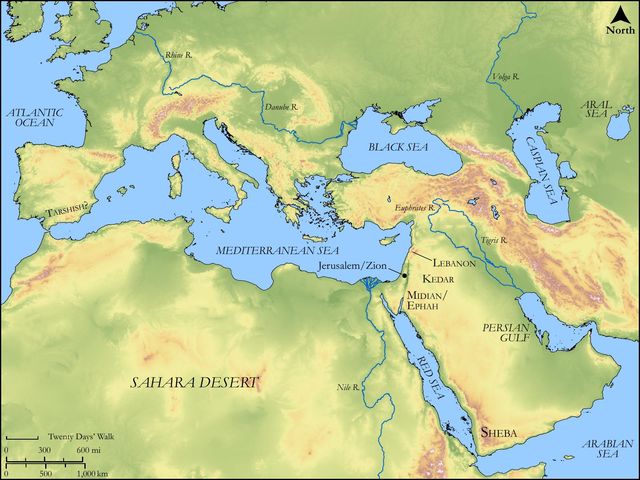
See on the biblical-era map
Study this verse
Public-domain commentary
Matthew Henry
From his Commentary on the Whole Bible. Henry comments on passages, not single verses — this entry covers Isaiah 40:3–8. His three-level outline is real structure in the source text, so it is rendered as structure.
The time to favour Zion, yea, the set time, having come, the people of God must be prepared, by repentance and faith, for the favours designed them; and, in order to call them to both these, we have here the voice of one crying in the wilderness, which may be applied to those prophets who were with the captives in their wilderness-state, and who, when they saw the day of their deliverance dawn, called earnestly upon them to prepare for it, and assured them that all the difficulties which stood in the way of their deliverance should be got over. It is a good sign that mercy is preparing for us if we find God's grace preparing us for it, Psa 10:17. But it must be applied to John the Baptist; for, though God was the speaker, he was the voice of one crying in the wilderness, and his business was to prepare the way of the Lord, to dispose men's minds for the reception and entertainment of the gospel of Christ. The way of the Lord is prepared,
I.By repentance for sin; that was it which John Baptist preached to all Judah and Jerusalem (Mat 3:2, Mat 3:5), and thereby made ready a people prepared for the Lord, Luk 1:17.
1.The alarm is given; let all take notice of it at their peril; God is coming in a way of mercy, and we must prepare for him, Isa 40:3-5. If we apply it to their captivity, it may be taken as a promise that, whatever difficulties lie in their way, when they return they shall be removed. This voice in the wilderness (divine power going along with it) sets pioneers on work to level the roads. But it may be taken as a call to duty, and it is the same duty that we are called to, in preparation for Christ's entrance into our souls.
(1.)We must get into such a frame of spirit as will dispose us to receive Christ and his gospel: "Prepare you the way of the Lord; prepare yourselves for him, and let all that be suppressed which would be an obstruction to his entrance. Make room for Christ: Make straight a highway for him." If he prepare the end for us, we ought surely to prepare the way for him. Prepare for the Saviour; lift up your heads, O you gates! Psa 24:7, Psa 24:9. Prepare for the salvation, the great salvation, and other minor deliverances. Let us get to be fit for them, and then God will work them out. Let us not stand in our own light, nor put a bar in our own door, but find, or make, a highway for him, even in that which was desert ground. This is that for which he waits to be gracious.
(2.)We must get our hearts levelled by divine grace. Those that are hindered from comfort in Christ by their dejections and despondencies are the valleys that must be exalted. Those that are hindered from comfort in Christ by a proud conceit of their own merit and worth are the mountains and hills that must be made low. Those that have entertained prejudices against the word and ways of God, that are untractable, and disposed to thwart and contradict even that which is plain and easy because it agrees not with their corrupt inclinations and secular interests, are the crooked that must be made straight and the rough places that must be made plain. Let but the gospel of Christ have a fair hearing, and it cannot fail of acceptance. This prepares the way of the Lord; and thus God will by his grace prepare his own way in all the vessels of mercy, whose hearts he opens as he did Lydia's.
2.When this is done the glory of the Lord shall be revealed, Isa 40:5.
(1.)When the captives are prepared for deliverance Cyrus shall proclaim it, and those shall have the benefit of it, and those only, whose hearts the Lord shall stir up with courage and resolution to break through the discouragements that lay in their way, and to make nothing of the hills, and valleys, and all the rough places.
(2.)When John Baptist has for some time preached repentance, mortification, and reformation, and so made ready a people prepared for the Lord (Luk 1:17), then the Messiah himself shall be revealed in his glory, working miracles, which John did not, and by his grace, which is his glory, binding up and healing with consolations those whom John had wounded with convictions. And this revelation of divine glory shall be a light to lighten the Gentiles. All flesh shall see it together, and not the Jews only; they shall see and admire it, see it and bid it welcome; as the return out of captivity was taken notice of by the neighbouring nations, Psa 126:2. And it shall be the accomplishment of the word of God, not one iota or tittle of which shall fall to the ground: The mouth of the Lord has spoken it, and therefore the hand of the Lord will effect it.
II.By confidence in the word of the Lord, and not in any creature.
The mouth of the Lord having spoken it, the voice has this further to cry (he that has ears to hear let him hear it), The word of our God shall stand for ever, Isa 40:8.
1.By this accomplishment of the prophecies and promises of salvation, and the performance of them to the utmost in due time, it appears that the word of the Lord is sure and what may be safely relied on. Then we are prepared for deliverance when we depend entirely upon the word of God, build our hopes on that, with an assurance that it will not make us ashamed: in a dependence upon this word we must be brought to own that all flesh is grass, withering and fading.
(1.)The power of man, when it does appear against the deliverance, is not to be feared; for it shall be as grass before the word of the Lord: it shall wither and be trodden down. The insulting Babylonians, who promise themselves that the desolations of Jerusalem shall be perpetual, are but as grass which the spirit of the Lord blows upon, makes nothing of, but blasts all its glory; for the word of the Lord, which promises their deliverance, shall stand for ever, and it is not in the power of their enemies to hinder the execution of it.
(2.)The power of man, when it would appear for the deliverance, is not to be trusted to; for it is but as grass in comparison with the word of the Lord, which is the only firm foundation for us to build our hope upon. When God is about to work salvation for his people he will take them off from depending upon creatures, and looking for it from hills and mountains. They shall fail them, and their expectations from them shall be frustrated: The Spirit of the Lord shall blow upon them; for God will have no creature to be a rival with him for the hope and confidence of his people; and, as it is his word only that shall stand for ever, so in that word only our faith must stand. When we are brought to this, then, and not till then, we are fit for mercy.
2.The word of our God, that glory of the Lord which is now to be revealed, the gospel, and that grace which is brought with it to us and wrought by it in us, shall stand for ever; and this is the satisfaction of all believers, when they find all their creature-comforts withering and fading like grass. Thus the apostle applies it to the word which by the gospel is preached unto us, and which lives and abides for ever as the incorruptible seed by which we are born again, Pe1 1:23-25. To prepare the way of the Lord we must be convinced,
(1.)Of the vanity of the creature, that all flesh is grass, weak and withering. We ourselves are so, and therefore cannot save ourselves; all our friends are so, and therefore are unable to save us. All the beauty of the creature, which might render it amiable, is but as the flower of grass, soon blasted, and therefore cannot recommend us to God and to his acceptance. We are dying creatures; all our comforts in this word are dying comforts, and therefore cannot be the felicity of our immortal souls. We must look further for a salvation, look further for a portion.
(2.)Of the validity of the promise of God. We must be convinced that the word of the Lord can do that for us which all flesh cannot - that, forasmuch as it stands for ever, it will furnish us with a happiness that will run parallel with the duration of our souls, which must live for ever; for the things that are not seen, but must be believed, are eternal.
Historical interpretation
Five Centuries of Reception
19 surviving comments on this verse. Each one is dated, so this reads as a timeline rather than a list.
Select a marker to jump to its quote. Markers stagger vertically where authors wrote within a few decades of each other.
As it is written in the prophets, Behold, I send my messenger before thy face, which shall prepare thy way before thee. The voice of one crying in the wilderness, Prepare ye the way of the Lord, make his paths straight. [Isaiah 40:3-5] John did baptize in the wilderness, and preach the baptism of repentance for the remission of sins. And there went out unto him all the land of Judaea, and they of Jerusalem, and were all baptized of him in the river of Jordan, confessing their sins. And John was clothed with camel's hair, and with a girdle of a skin about his loins; and he did eat locusts and wild honey
In those days came John the Baptist, preaching in the wilderness of Judaea, And saying, Repent ye: for the kingdom of heaven is at hand. For this is he that was spoken of by the prophet Esaias, saying, The voice of one crying in the wilderness, Prepare ye the way of the Lord, make his paths straight. [Isaiah 40:3-5] And the same John had his raiment of camel's hair, and a leathern girdle about his loins; and his meat was locusts and wild honey. Then went out to him Jerusalem, and all Judaea, and all the region round about Jordan, And were baptized of him in Jordan, confessing their sins.
Now in the fifteenth year of the reign of Tiberius Caesar, Pontius Pilate being governor of Judaea, and Herod being tetrarch of Galilee, and his brother Philip tetrarch of Ituraea and of the region of Trachonitis, and Lysanias the tetrarch of Abilene, Annas and Caiaphas being the high priests, the word of God came unto John the son of Zacharias in the wilderness. And he came into all the country about Jordan, preaching the baptism of repentance for the remission of sins; As it is written in the book of the words of Esaias the prophet, saying, The voice of one crying in the wilderness, Prepare ye the way of the Lord, make his paths straight. Every valley shall be filled, and every mountain and hill shall be brought low; and the crooked shall be made straight, and the rough ways shall be made smooth; And all flesh shall see the salvation of God. [Isaiah 40:3-5]
And this is the record of John, when the Jews sent priests and Levites from Jerusalem to ask him, Who art thou? And he confessed, and denied not; but confessed, I am not the Christ. And they asked him, What then? Art thou Elias? And he saith, I am not. Art thou that prophet? And he answered, No. Then said they unto him, Who art thou? that we may give an answer to them that sent us. What sayest thou of thyself? He said, I am the voice of one crying in the wilderness, Make straight the way of the Lord, as said the prophet Esaias. [Isaiah 40:3-5]
Since even then by Isaiah it was Christ, the Word and the Spirit of the Creator who prophetically described John as “the voice of one crying in the wilderness to prepare the way of the Lord.” And [he] was about to come forth for the purpose of terminating from that point onwards the course of the law and the prophets: by their fulfillment and not their extinction.
Now the way of the Lord is made straight in two ways: by contemplation, which is clarified by truth unmixed with falsehood, and by activity, which follows sound contemplation of the appropriate action to be taken, which is conformed to the correct sense of these things to be done.
The Lord wants to find in you a path by which he can enter into your souls and make his journey. Prepare for him the path of which it is said, “Make straight his path.” “The voice of one crying in the desert”—the voice cries, “prepare the way.”
While the heavenly powers rejoice, let the souls that are to be united to the spiritual bridegroom make themselves ready. For the voice is heard of one crying in the wilderness, “Prepare the way of the Lord.” For this is no light matter, no ordinary and indiscriminate union according to the flesh but the all-searching Spirit’s election according to faith.
God, indeed, never descends from any place, for he says, “I fill heaven and earth.” But he seems to descend when the Word of God enters our hearts, as the prophet has said, “Prepare the way of the Lord, make his paths straight.” We are to do this, so that, as he himself promised, he may come together with the Father and make his abode with us.
Do you see that both by the words of the prophet and by his own preaching, this one and only thing is manifested, that he came, making a way and preparing beforehand, not bestowing the gift, which was the remission, but ordering in good time the souls of such as should receive the God of all?
(Verse 3 onwards) The voice of one crying in the wilderness: Prepare the way of the Lord, make straight in the desert a highway for our God. Every valley shall be lifted up, and every mountain and hill shall be made low: and the crooked shall be made straight, and the rough places plain. And the glory of the Lord shall be revealed, and all flesh shall see it together: for the mouth of the Lord has spoken it. LXX: The voice of one crying in the wilderness: Prepare the way of the Lord, make straight the paths of our God. Every valley shall be filled, and every mountain and hill shall be brought low; and the crooked shall be made straight, and the rough ways shall be made smooth. And the glory of the Lord shall be revealed; and all flesh shall see the salvation of God, for the Lord has spoken. When the scribes and Pharisees and Jewish leaders heard John preaching in the wilderness and baptizing with a baptism of repentance, they sent messengers to ask him if he was the Christ, or Elijah, or a prophet. And when he answered that he was none of these, they asked him again, 'Then who are you?' So that we may give an answer to those who sent us. What do you say about yourself? And he answered: I am the voice of one crying out in the wilderness: 'Prepare the way of the Lord, as Isaiah the Prophet said (John 1:22-23)'. In which it should be noted that the straight paths of the Lord and the ways of our God: the filling of valleys and mountains, the humbling of hills and the correction of the wicked, and the rough places made level: and the glory of the Lord and the salvation of our God, will not be proclaimed in Jerusalem, but in the solitude of the Church, and in the deserted multitude of the nations, of which we read above (Isaiah 35:1): 'Rejoice, O desert, and let the wilderness exult, and let it blossom like the lily.' For this knowledge of God was unknown and humbled by idols, lowly in confession, exalted in pride, rough and unyielding in wrath. But after the glory of the Lord appeared, and all flesh saw the salvation of God, everything suddenly changed, and the way of the Lord was prepared, so that the glory of God would appear in the wilderness. When the Lord was baptized in the Jordan and the heavens were opened, and the Holy Spirit descended in the form of a dove and remained in him, and the voice of the Father from above was heard, saying: This is my beloved Son, in whom I am well pleased; listen to him. (Matthew 3:17). And all flesh saw the salvation of God. Which is why it was called flesh, because it did not have the Holy Spirit before. Concerning this, the Lord says: My spirit will not remain in these people, because they are flesh (Gen. VI, 3). But that flesh will see the salvation of God, of which the same Joel spoke: I will pour out my spirit upon all flesh, and they shall prophesy (Joel. II, 28). This is not only what John proclaimed at that time, who was the precursor and forerunner of the word of God, rightly called the voice (Matth. III); but even to this day in the wilderness of the Gentiles, the teachers of the Churches cry out: that we may make straight paths and ways for God in our hearts, that we may be filled with virtues, and may be inclined with humility; that we may change what is evil into what is right, and what is rough into what is gentle: and thus we may deserve to see the glory of the Lord and the salvation of God.
In that the Word has now become flesh and dwelled among us, now there will not be in any way the voice of a prophet in the desert but the voice of the archangel, preparing the way for the one coming not in the humility of the flesh but for him who is with the Father. And in those days they were going out into the desert, so as to hear the forerunner of the assumed man and to see the sand perturbed by the wind.
They were not reborn, those who were baptized by John’s baptism, by which Christ himself was baptized. Rather, they were “prepared” by the ministry of a forerunner, who said, “Prepare a way for the Lord”—for him in whom alone they could be reborn.
There it is written, “a voice of one crying in the wilderness,” the Word is conceived in the virgin’s womb. If the voice is not the Word, it is then a loud clanging of metal. For one then would not be able to say that every word is a sound but not every sound is a word. For it is not unfitting to take “the way” as that which came up to the very heart and filled us inwardly. Indeed, the heart became his place to which he comes and remains.
John [the Baptist] was filled with the Holy Spirit; and he had a baptism from heaven, not from human beings. But how long did he have it? He said, “Prepare the way for the Lord.” But when the Lord was known, he himself became the way; there was no longer need for the baptism of John, by which the way was to be prepared for the Lord.
The true consolation, the genuine comfort and the real deliverance from the iniquities of humankind is the incarnation of our God and Savior. Now the first who acted as herald of this event was the inspired John the Baptist. Accordingly, the prophetic text proclaims the realities that relate to him in advance, for that is what the three blessed Evangelists have taught us and that the most divine Mark has even made the prologue of his work. As for the inspired John, whom the Pharisees asked whether he himself was the Christ, he declared on his part: “I am ‘the voice of one crying in the wilderness, Make straight the way of the Lord’ ” as the prophet Isaiah said; I am not God the Word but a voice, for it is as a herald that I am announcing God the Word, who is incarnate. Moreover, he refers to the Gentiles as the “untrodden [land]” because they have not yet received the prophetic stamp.
“I am the voice of one that cries out in the desert.” This means, I am not the Word that was with God from the beginning and that was God, but I am rather a voice; in other words, I am a minister of the Word, in order that through me he may reach the hearing and senses of [people]. For this reason the blessed Baptist exclaimed with equal humility, “He must increase, while I must decrease.”
"I am the voice of one crying in the wilderness: Make straight the way of the Lord, as Isaiah the prophet said." You know, dearest brothers, that the only-begotten Son is called the Word of the Father, as John testifies when he says: "In the beginning was the Word, and the Word was with God, and the Word was God." And from your own manner of speaking you recognize that the voice sounds first, so that the word may afterward be heard. Therefore John asserts that he is the voice, because he precedes the Word. And so, going before the coming of the Lord, he is called a voice, because through his ministry the Word of the Father is heard by men. He also cries out in the wilderness, because he announces the comfort of the Redeemer to abandoned and forsaken Judea. But what he cries out he indicates when he adds: "Make straight the way of the Lord." The way of the Lord is made straight to the heart when the word of truth is humbly heard. The way of the Lord is made straight to the heart when one's life is prepared according to his commandment.
It is well said that he sent them before his face into every city and place where he himself was about to come. For the Lord follows his preachers, because preaching comes first, and then the Lord comes to the dwelling place of our mind, when words of exhortation run ahead, and through these truth is received in the mind. For thus Isaiah says to these same preachers: Prepare the way of the Lord, make straight the paths of our God.
Continue studying Isaiah 40:3 across the web’s major study libraries — every link below opens this exact verse, chapter, or book on the destination site.
Read & Compare
 BibleGatewayThis verse in more than 200 translations and 70 languages.
 Bible.comThe YouVersion reader — hundreds of translations, reading plans, and highlights.
 ESV.orgCrossway's official English Standard Version reader.
 NET BibleThe NET translation with 60,000+ translators' notes on every rendering decision.
 STEP BibleTyndale House's free study tool — original text, vocabulary, and scholarly resources.
 BibliaLogos Bible Software's free web reader.
 USCCBThe New American Bible (Revised Edition) with the U.S. bishops' study notes.
Commentaries
 BibleHub CommentariesDozens of classic commentaries on this verse, gathered on one page.
 StudyLightMore than 100 commentary sets — the largest collection on the web.
 BibleRefPlain-English commentary on what this verse means, verse by verse.
 Enduring WordDavid Guzik's free commentary on this chapter, widely used by Bible teachers.
 Bible Study ToolsVerse commentary alongside Greek and Hebrew study aids.
Original Language & Research
- BibleHub InterlinearThe verse word by word — original language, transliteration, and English.
- BibleHub LexiconEvery word's original-language definition and Strong's entry.
 Blue Letter BibleDeep-study tools — Strong's numbers, concordance, and word studies.
 SefariaThe Hebrew text with Rashi and centuries of Jewish commentary.
Sermons, Hymns & Audio


TrulyRandomVerse is not affiliated with these sites and doesn’t control their content. They’re linked because they’re genuinely useful.
Summary
Isaiah 40:3 stands as a foundational prophetic declaration, initiating the "Book of Comfort" (Isaiah 40-66) and heralding the imminent and glorious advent of the Lord. It portrays a divine herald proclaiming a call to prepare a majestic highway through the desolate wilderness, symbolizing the removal of all impediments for God's triumphant return to His people, bringing forth restoration, salvation, and divine presence after a period of judgment and exile.
Context
ShowHideLiterary Context
Isaiah 40:3 marks a profound thematic and tonal shift within the book of Isaiah. The preceding chapters (1-39) are largely characterized by pronouncements of judgment against Judah and surrounding nations, warning of impending exile due to their idolatry and unfaithfulness. However, chapter 40 opens with a startling message of divine comfort and hope, encapsulated in the command, "Comfort, comfort my people, says your God" (Isaiah 40:1). This verse, therefore, serves as a programmatic statement for the latter half of the book, signaling a transition from condemnation to promises of redemption, restoration, and the ultimate vindication of God's covenant people. It sets the stage for the unfolding themes of God's incomparable sovereignty, His unwavering faithfulness, and the certainty of His promised return to Zion, establishing a new era of grace and renewal.
Historical & Cultural Context
The prophecy of Isaiah 40:3 is set against the looming backdrop of the Babylonian exile, a period that would bring immense suffering, displacement, and spiritual despair to the Jewish people. Although Isaiah prophesied centuries before the actual exile, his divine foresight extends to this future calamity, offering a beacon of hope beyond the impending judgment. In the ancient Near East, it was a common practice for kings, emperors, or high-ranking dignitaries to have roads prepared, leveled, and cleared of all obstacles when they were expected to travel through a region. This often involved significant public works, demonstrating the power, authority, and importance of the approaching ruler. Applying this grand imagery to the Lord God underscores His supreme majesty, His absolute authority, and the absolute certainty of His coming, ensuring His path is straight and unobstructed through even the most desolate and challenging landscapes.
Key Themes
ShowHideThis verse introduces several pivotal themes that resonate throughout the remainder of Isaiah and beyond. Firstly, it powerfully conveys Divine Sovereignty and Imminent Arrival, emphasizing that God is not a passive observer but an active participant in history, intervening decisively to fulfill His promises, even in seemingly impossible circumstances like a barren desert. Secondly, it highlights the Call to Preparation, which is not merely a physical act but a profound spiritual readiness for the Lord's advent. This involves repentance, the removal of spiritual barriers, and a realignment of hearts with God's will, echoing the broader prophetic call for Israel to return to the Lord. Thirdly, the imagery of a "voice crying in the wilderness" foreshadows the Role of a Forerunner, an individual divinely appointed to precede the Lord, announce His arrival, and prepare the hearts of the people, a theme explicitly developed in later prophetic books like Malachi 3:1. Finally, the vivid imagery of a "highway in the desert" powerfully speaks to God's Power to Transform Desolation into a Path of Glory, promising that even the most barren, hopeless, and challenging situations can become magnificent avenues for His majestic presence and redemptive work.
Exposition and Analysis
ShowHideKey Word Analysis
ShowHideMeaning "a voice or sound; [phrase] aloud, bleating, crackling, cry ([phrase] out)." In this context, "voice" signifies a distinct, authoritative, and public utterance. It is the sound of a herald, a divinely appointed messenger, whose purpose is to announce a momentous event. The emphasis is on the audible, public declaration, demanding immediate attention and a responsive action from the hearers.
Meaning "a pasture (i.e. open field, whither cattle are driven); by implication, a desert; also speech (including its organs); desert, south, speech, wilderness." The "wilderness" here is more than a mere geographical location; it carries profound symbolic weight. It represents a place of desolation, hardship, isolation, and spiritual barrenness. Historically, it was a place of testing for Israel (e.g., the forty years of wandering), but also a place where God intimately revealed Himself (e.g., the giving of the Law at Sinai). The voice crying in the wilderness emphasizes that the message of comfort and hope emerges from a context of profound barrenness and despair, making the divine intervention even more striking and miraculous.
Meaning "to be straight or even; figuratively, to be (causatively, to make) right, pleasant, prosperous; direct, fit, seem good (meet), [phrase] please (will), be (esteem, go) right (on), bring (look, make, take the) straight (way), be upright(-ly)." This imperative verb signifies the act of leveling, smoothing, or making direct. It implies the removal of obstacles, the filling of valleys, and the lowering of hills to create an unobstructed path. While it has a literal application to road construction, its spiritual implication is paramount: to rectify moral crookedness, to align lives with God's righteousness, and to remove spiritual impediments that hinder God's presence.
Verse Breakdown
ShowHide"The voice of him that crieth in the wilderness,"
This opening clause introduces the prophetic herald, an unnamed but divinely commissioned messenger whose powerful proclamation originates from a place of isolation, hardship, and spiritual desolation. The "voice" itself signifies a public, authoritative announcement, demanding attention and action, emerging from a context of profound spiritual and perhaps physical barrenness. It sets the stage for a message of profound significance and divine intervention.
"Prepare ye the way of the LORD,"
This is the central, urgent command issued by the herald. "Prepare" (Hebrew: pânâh, H6437) implies clearing, leveling, and making ready. "The way of the LORD" (Hebrew: derek Yᵉhôvâh, H1870, H3068) refers to the path for God Himself, signifying His imminent and majestic arrival. This preparation is not merely a physical act of road construction but a spiritual imperative: a call for the removal of moral and spiritual obstacles, such as sin, rebellion, and unbelief, that hinder God's presence and work among His people. It is an urgent summons to repentance and alignment with God's divine will.
"make straight in the desert a highway for our God."
This phrase powerfully reinforces and expands upon the preceding command. "Make straight" (Hebrew: yâshar, H3474) means to level, smooth, or make direct, implying the removal of all impediments. The "desert" (Hebrew: ʻărâbâh, H6160) again emphasizes a desolate, difficult, and seemingly impassable terrain. A "highway" (Hebrew: mᵉçillâh, H4546) refers to a raised, well-constructed, and prominent road, suitable for a grand, royal procession. This imagery underscores the grandeur, certainty, and transformative power of God's coming, overcoming all natural and spiritual barriers and making His presence unmistakable and accessible. The concluding phrase "for our God" (Hebrew: ʼĕlôhîym, H430) highlights the intimate, covenantal relationship between the coming God and His people, emphasizing His redemptive purpose.
Literary Devices
ShowHideIsaiah 40:3 is exceptionally rich in Imagery, painting a vivid and majestic picture of a grand divine procession through an otherwise desolate landscape. The "wilderness" and "desert" serve as potent Symbols of Israel's spiritual barrenness and physical desolation during exile, creating a stark contrast with the grandeur of the coming "highway" for God. The "voice" itself is a form of Personification, as it is the active, vocal agent of the divine proclamation. The entire verse functions as a profound Prophecy, foretelling a future event of monumental divine intervention and restoration. The use of the Imperative Mood in "Prepare ye" and "make straight" conveys the urgency and divine command for action, demanding a decisive response from the audience. The powerful contrast between the barrenness of the desert and the magnificent construction of a highway creates a striking Antithesis, highlighting God's miraculous ability to transform the impossible into a glorious path for His presence and redemptive work. The repetition of the idea of "preparing a way" through different but synonymous phrases also demonstrates a form of Parallelism, reinforcing the central message.
Theological and Thematic Connections
ShowHideIsaiah 40:3 profoundly articulates God's unwavering faithfulness and His steadfast commitment to restore His covenant people, even after periods of severe judgment and apparent abandonment. It establishes the theological truth that God is not a distant or aloof deity but one who actively intervenes in human history, orchestrating events to bring about His sovereign redemptive purposes. The call to prepare the way signifies that human readiness, characterized by repentance, moral straightening, and spiritual alignment, is a necessary and expected response to God's gracious initiative. This preparation is not a means to earn God's favor but rather a removal of the spiritual and moral obstacles that hinder a deeper experience of His transformative presence and the full reception of His promised salvation. The coming of the Lord is presented as a transformative event, capable of making the crooked straight and the rough places plain, symbolizing the rectification of injustice, the leveling of societal and spiritual disparities, and the establishment of righteousness in His glorious presence.
Reflection and Application
ShowHideIsaiah 40:3 remains a timeless and urgent call to spiritual readiness, challenging believers across generations to actively prepare for the Lord's presence in their individual lives and in the world around them. Just as an ancient highway was meticulously cleared of debris, leveled, and smoothed for a king's grand procession, so too must our hearts, minds, and lives be continually cleared of sin, worldly distractions, pride, and anything that obstructs our intimate communion with God. This involves a continuous, intentional process of repentance, spiritual discipline, humble obedience, and the diligent pursuit of righteousness. Furthermore, recognizing the profound prophetic fulfillment of this verse in the ministry of John the Baptist, we are powerfully reminded of our own missional imperative to prepare the way for others to encounter Jesus Christ. This means faithfully sharing the transformative Gospel, embodying the radical love of God in our actions, and actively working to remove spiritual, social, and pervasive barriers that prevent people from truly knowing Him. Ultimately, this verse instills a vibrant, hopeful anticipation for Christ's glorious return, encouraging us to live in a state of constant readiness, holiness, and active witness, ensuring that our "way" is indeed straight for His majestic second coming.
Questions for Reflection
ShowHideFAQ
ShowHideWho is "the voice" crying in the wilderness in Isaiah 40:3?
ShowHideWhile Isaiah's original audience would have understood this as a prophetic figure announcing God's return from the Babylonian exile, the New Testament explicitly identifies "the voice" as John the Baptist. John the Baptist's ministry was precisely to prepare the way for the first coming of Jesus Christ, calling people to repentance and baptizing them in the Jordan River. All four Gospels directly quote or allude to this verse in relation to John's ministry, making it one of the clearest and most significant examples of Old Testament prophecy fulfilled in the New Testament (e.g., Matthew 3:3, Mark 1:3, Luke 3:4, John 1:23).
What is the significance of the "wilderness" and "desert" in this prophecy?
ShowHideThe "wilderness" (Hebrew: midbâr) and "desert" (Hebrew: ʻărâbâh) are significant on multiple profound levels. Geographically, they represent barren, uninhabitable, and challenging regions, emphasizing the miraculous and supernatural nature of God's intervention to create a grand "highway" where none could naturally exist. Spiritually, they powerfully symbolize the desolate state of Israel during their impending exile in Babylon and their spiritual barrenness due to generations of sin and rebellion against God. However, the wilderness also holds a redemptive significance in Israel's history; it was the place where God revealed Himself to Israel after the Exodus, providing for them miraculously (e.g., Exodus 16) and establishing His covenant at Mount Sinai (Exodus 19). Thus, the prophecy suggests that God's glorious return and restoration will emerge from a place of despair and desolation, transforming it into a path of divine presence, blessing, and new life. It powerfully signifies that God can work mightily and bring forth His purposes even in the most unlikely, challenging, and seemingly hopeless circumstances.
Christ-Centered Fulfillment
ShowHideIsaiah 40:3 finds its ultimate and most profound fulfillment in the person and redemptive work of Jesus Christ. The "voice crying in the wilderness" was literally embodied by John the Baptist, the divinely appointed forerunner who came "preaching a baptism of repentance for the forgiveness of sins" (Luke 3:3), thereby preparing the hearts of the people for the arrival of the Messiah. Jesus himself is the "LORD" and "our God" for whom the way was prepared. His advent into human history was the long-awaited divine visitation, bringing not only comfort and salvation but also the establishment of God's eternal kingdom. Furthermore, Jesus is not merely the one for whom the way is prepared, but He is the Way itself, declaring, "I am the way, and the truth, and the life; no one comes to the Father except through me" (John 14:6). Through His perfect life, atoning death on the cross, and glorious resurrection, Jesus made straight the crooked paths of humanity's sin and rebellion, leveling the spiritual mountains of pride and filling the valleys of despair, thus creating a direct, accessible "highway" for humanity to access God and experience reconciliation. This prophecy, therefore, points powerfully to Christ as the divine solution to humanity's separation from God, providing the ultimate means for forgiveness, reconciliation, and eternal life. It also foreshadows His glorious second coming, reminding believers to continually prepare their hearts for His return, when indeed every "mountain and hill shall be made low" and "the glory of the LORD shall be revealed, and all flesh shall see it together" (Isaiah 40:4-5).