


Isaiah 40:4
Bible text: King James Version (1769 Blayney text) · Public domain
Bible text: Berean Standard Bible · Public domain
Bible text: American Standard Version (1901) · Public domain
Bible text: World English Bible, Messianic edition · Public domain
Bible text: Geneva Bible (1599) · Public domain
Bible text: Young's Literal Translation · Public domain
- כָּלkoleveryH3605N-mscNoun Singular Masculine Construct
- גֶּיאgei'valleyH1516N-csNoun Singular common gender Absolute
- יִנָּשֵׂאyi·na·Se'it will be lifted upH5375V-Niphal-Imperf-3msVerb Niphal Imperfect 3rd Singular Masculine
- וְכָלve·kholand everyH3605Conj-w ¦ N-mscNoun Singular Masculine Constructוְandכָלevery
- הַרharmountainH2022N-msNoun Singular Masculine Absolute
- וְגִבְעָהve·giv·'Ahand hillH1389Conj-w ¦ N-fsNoun Singular Feminine Absoluteוְandגִבְעָהhill
- יִשְׁפָּלוּyish·Pa·luthey will become lowH8213V-Qal-Imperf-3mpVerb Qal Imperfect 3rd Plural Masculine
- וְהָיָהve·ha·Yahand it will becomeH1961Conj-w ¦ V-Qal-ConsecPerf-3msVerb Qal Consecutive Perfect 3rd Singular Masculineוְandהָיָהit will become
- הֶעָקֹבhe·'a·Kothe steep [place]H6121Art ¦ N-msNoun Singular Masculine Absoluteהֶtheעָקֹבsteep [place]
- לְמִישׁוֹרle·mi·Shor<into> level groundH4334Prep-l ¦ N-msNoun Singular Masculine Absoluteלְ<into>מִישׁוֹרlevel ground
- וְהָרְכָסִיםve·ha·re·kha·Simand the rough placesH7406Conj-w ¦ Art ¦ N-mpNoun Plural Masculine Absoluteוְandהָtheרְכָסִיםrough places
- לְבִקְעָהle·vik·'Ah<into> a plainH1237Prep-l ¦ N-fsNoun Singular Feminine Absoluteלְ<into>בִקְעָהa plain
English is a literal word-by-word gloss of the Hebrew, not the KJV's wording. Why?
This is the original text the KJV's translators worked from — each Hebrew word with its own literal English meaning in this verse, prepared by scholars at Tyndale House, Cambridge. The KJV translates whole sentences, not word by word, so its wording differs: one Hebrew word can become several English words, and the KJV may choose “the LORD” where the gloss reads “Yahweh”. Both are faithful — they answer different questions. For the KJV's own rendering, switch to the KJV text.
Details
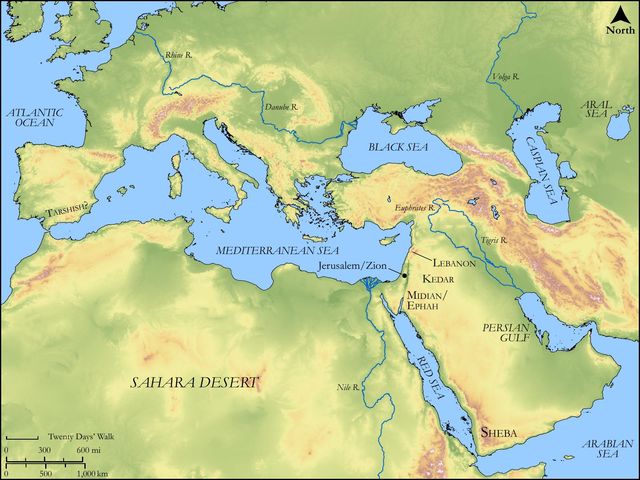
See on the biblical-era map
Study this verse
Public-domain commentary
Matthew Henry
From his Commentary on the Whole Bible. Henry comments on passages, not single verses — this entry covers Isaiah 40:3–8. His three-level outline is real structure in the source text, so it is rendered as structure.
The time to favour Zion, yea, the set time, having come, the people of God must be prepared, by repentance and faith, for the favours designed them; and, in order to call them to both these, we have here the voice of one crying in the wilderness, which may be applied to those prophets who were with the captives in their wilderness-state, and who, when they saw the day of their deliverance dawn, called earnestly upon them to prepare for it, and assured them that all the difficulties which stood in the way of their deliverance should be got over. It is a good sign that mercy is preparing for us if we find God's grace preparing us for it, Psa 10:17. But it must be applied to John the Baptist; for, though God was the speaker, he was the voice of one crying in the wilderness, and his business was to prepare the way of the Lord, to dispose men's minds for the reception and entertainment of the gospel of Christ. The way of the Lord is prepared,
I.By repentance for sin; that was it which John Baptist preached to all Judah and Jerusalem (Mat 3:2, Mat 3:5), and thereby made ready a people prepared for the Lord, Luk 1:17.
1.The alarm is given; let all take notice of it at their peril; God is coming in a way of mercy, and we must prepare for him, Isa 40:3-5. If we apply it to their captivity, it may be taken as a promise that, whatever difficulties lie in their way, when they return they shall be removed. This voice in the wilderness (divine power going along with it) sets pioneers on work to level the roads. But it may be taken as a call to duty, and it is the same duty that we are called to, in preparation for Christ's entrance into our souls.
(1.)We must get into such a frame of spirit as will dispose us to receive Christ and his gospel: "Prepare you the way of the Lord; prepare yourselves for him, and let all that be suppressed which would be an obstruction to his entrance. Make room for Christ: Make straight a highway for him." If he prepare the end for us, we ought surely to prepare the way for him. Prepare for the Saviour; lift up your heads, O you gates! Psa 24:7, Psa 24:9. Prepare for the salvation, the great salvation, and other minor deliverances. Let us get to be fit for them, and then God will work them out. Let us not stand in our own light, nor put a bar in our own door, but find, or make, a highway for him, even in that which was desert ground. This is that for which he waits to be gracious.
(2.)We must get our hearts levelled by divine grace. Those that are hindered from comfort in Christ by their dejections and despondencies are the valleys that must be exalted. Those that are hindered from comfort in Christ by a proud conceit of their own merit and worth are the mountains and hills that must be made low. Those that have entertained prejudices against the word and ways of God, that are untractable, and disposed to thwart and contradict even that which is plain and easy because it agrees not with their corrupt inclinations and secular interests, are the crooked that must be made straight and the rough places that must be made plain. Let but the gospel of Christ have a fair hearing, and it cannot fail of acceptance. This prepares the way of the Lord; and thus God will by his grace prepare his own way in all the vessels of mercy, whose hearts he opens as he did Lydia's.
2.When this is done the glory of the Lord shall be revealed, Isa 40:5.
(1.)When the captives are prepared for deliverance Cyrus shall proclaim it, and those shall have the benefit of it, and those only, whose hearts the Lord shall stir up with courage and resolution to break through the discouragements that lay in their way, and to make nothing of the hills, and valleys, and all the rough places.
(2.)When John Baptist has for some time preached repentance, mortification, and reformation, and so made ready a people prepared for the Lord (Luk 1:17), then the Messiah himself shall be revealed in his glory, working miracles, which John did not, and by his grace, which is his glory, binding up and healing with consolations those whom John had wounded with convictions. And this revelation of divine glory shall be a light to lighten the Gentiles. All flesh shall see it together, and not the Jews only; they shall see and admire it, see it and bid it welcome; as the return out of captivity was taken notice of by the neighbouring nations, Psa 126:2. And it shall be the accomplishment of the word of God, not one iota or tittle of which shall fall to the ground: The mouth of the Lord has spoken it, and therefore the hand of the Lord will effect it.
II.By confidence in the word of the Lord, and not in any creature.
The mouth of the Lord having spoken it, the voice has this further to cry (he that has ears to hear let him hear it), The word of our God shall stand for ever, Isa 40:8.
1.By this accomplishment of the prophecies and promises of salvation, and the performance of them to the utmost in due time, it appears that the word of the Lord is sure and what may be safely relied on. Then we are prepared for deliverance when we depend entirely upon the word of God, build our hopes on that, with an assurance that it will not make us ashamed: in a dependence upon this word we must be brought to own that all flesh is grass, withering and fading.
(1.)The power of man, when it does appear against the deliverance, is not to be feared; for it shall be as grass before the word of the Lord: it shall wither and be trodden down. The insulting Babylonians, who promise themselves that the desolations of Jerusalem shall be perpetual, are but as grass which the spirit of the Lord blows upon, makes nothing of, but blasts all its glory; for the word of the Lord, which promises their deliverance, shall stand for ever, and it is not in the power of their enemies to hinder the execution of it.
(2.)The power of man, when it would appear for the deliverance, is not to be trusted to; for it is but as grass in comparison with the word of the Lord, which is the only firm foundation for us to build our hope upon. When God is about to work salvation for his people he will take them off from depending upon creatures, and looking for it from hills and mountains. They shall fail them, and their expectations from them shall be frustrated: The Spirit of the Lord shall blow upon them; for God will have no creature to be a rival with him for the hope and confidence of his people; and, as it is his word only that shall stand for ever, so in that word only our faith must stand. When we are brought to this, then, and not till then, we are fit for mercy.
2.The word of our God, that glory of the Lord which is now to be revealed, the gospel, and that grace which is brought with it to us and wrought by it in us, shall stand for ever; and this is the satisfaction of all believers, when they find all their creature-comforts withering and fading like grass. Thus the apostle applies it to the word which by the gospel is preached unto us, and which lives and abides for ever as the incorruptible seed by which we are born again, Pe1 1:23-25. To prepare the way of the Lord we must be convinced,
(1.)Of the vanity of the creature, that all flesh is grass, weak and withering. We ourselves are so, and therefore cannot save ourselves; all our friends are so, and therefore are unable to save us. All the beauty of the creature, which might render it amiable, is but as the flower of grass, soon blasted, and therefore cannot recommend us to God and to his acceptance. We are dying creatures; all our comforts in this word are dying comforts, and therefore cannot be the felicity of our immortal souls. We must look further for a salvation, look further for a portion.
(2.)Of the validity of the promise of God. We must be convinced that the word of the Lord can do that for us which all flesh cannot - that, forasmuch as it stands for ever, it will furnish us with a happiness that will run parallel with the duration of our souls, which must live for ever; for the things that are not seen, but must be believed, are eternal.
Historical interpretation
Four Centuries of Reception
8 surviving comments on this verse. Each one is dated, so this reads as a timeline rather than a list.
Select a marker to jump to its quote. Markers stagger vertically where authors wrote within a few decades of each other.
As it is written in the prophets, Behold, I send my messenger before thy face, which shall prepare thy way before thee. The voice of one crying in the wilderness, Prepare ye the way of the Lord, make his paths straight. [Isaiah 40:3-5] John did baptize in the wilderness, and preach the baptism of repentance for the remission of sins. And there went out unto him all the land of Judaea, and they of Jerusalem, and were all baptized of him in the river of Jordan, confessing their sins. And John was clothed with camel's hair, and with a girdle of a skin about his loins; and he did eat locusts and wild honey
In those days came John the Baptist, preaching in the wilderness of Judaea, And saying, Repent ye: for the kingdom of heaven is at hand. For this is he that was spoken of by the prophet Esaias, saying, The voice of one crying in the wilderness, Prepare ye the way of the Lord, make his paths straight. [Isaiah 40:3-5] And the same John had his raiment of camel's hair, and a leathern girdle about his loins; and his meat was locusts and wild honey. Then went out to him Jerusalem, and all Judaea, and all the region round about Jordan, And were baptized of him in Jordan, confessing their sins.
Now in the fifteenth year of the reign of Tiberius Caesar, Pontius Pilate being governor of Judaea, and Herod being tetrarch of Galilee, and his brother Philip tetrarch of Ituraea and of the region of Trachonitis, and Lysanias the tetrarch of Abilene, Annas and Caiaphas being the high priests, the word of God came unto John the son of Zacharias in the wilderness. And he came into all the country about Jordan, preaching the baptism of repentance for the remission of sins; As it is written in the book of the words of Esaias the prophet, saying, The voice of one crying in the wilderness, Prepare ye the way of the Lord, make his paths straight. Every valley shall be filled, and every mountain and hill shall be brought low; and the crooked shall be made straight, and the rough ways shall be made smooth; And all flesh shall see the salvation of God. [Isaiah 40:3-5]
And this is the record of John, when the Jews sent priests and Levites from Jerusalem to ask him, Who art thou? And he confessed, and denied not; but confessed, I am not the Christ. And they asked him, What then? Art thou Elias? And he saith, I am not. Art thou that prophet? And he answered, No. Then said they unto him, Who art thou? that we may give an answer to them that sent us. What sayest thou of thyself? He said, I am the voice of one crying in the wilderness, Make straight the way of the Lord, as said the prophet Esaias. [Isaiah 40:3-5]
It is said that the valleys are filled, because the Lord has entered the world, and has redeemed all the peoples from the bondage of the devil, and brought them back to the faith and adoration of their Creator and has taught them to hope in eternal salvation. This is also said, because he has filled the deep valleys and the horrible and inhospitable caves with ascetics, who, after abandoning the cares of this world, exclusively devote themselves to honor and praise God.
(Verse 3 onwards) The voice of one crying in the wilderness: Prepare the way of the Lord, make straight in the desert a highway for our God. Every valley shall be lifted up, and every mountain and hill shall be made low: and the crooked shall be made straight, and the rough places plain. And the glory of the Lord shall be revealed, and all flesh shall see it together: for the mouth of the Lord has spoken it. LXX: The voice of one crying in the wilderness: Prepare the way of the Lord, make straight the paths of our God. Every valley shall be filled, and every mountain and hill shall be brought low; and the crooked shall be made straight, and the rough ways shall be made smooth. And the glory of the Lord shall be revealed; and all flesh shall see the salvation of God, for the Lord has spoken. When the scribes and Pharisees and Jewish leaders heard John preaching in the wilderness and baptizing with a baptism of repentance, they sent messengers to ask him if he was the Christ, or Elijah, or a prophet. And when he answered that he was none of these, they asked him again, 'Then who are you?' So that we may give an answer to those who sent us. What do you say about yourself? And he answered: I am the voice of one crying out in the wilderness: 'Prepare the way of the Lord, as Isaiah the Prophet said (John 1:22-23)'. In which it should be noted that the straight paths of the Lord and the ways of our God: the filling of valleys and mountains, the humbling of hills and the correction of the wicked, and the rough places made level: and the glory of the Lord and the salvation of our God, will not be proclaimed in Jerusalem, but in the solitude of the Church, and in the deserted multitude of the nations, of which we read above (Isaiah 35:1): 'Rejoice, O desert, and let the wilderness exult, and let it blossom like the lily.' For this knowledge of God was unknown and humbled by idols, lowly in confession, exalted in pride, rough and unyielding in wrath. But after the glory of the Lord appeared, and all flesh saw the salvation of God, everything suddenly changed, and the way of the Lord was prepared, so that the glory of God would appear in the wilderness. When the Lord was baptized in the Jordan and the heavens were opened, and the Holy Spirit descended in the form of a dove and remained in him, and the voice of the Father from above was heard, saying: This is my beloved Son, in whom I am well pleased; listen to him. (Matthew 3:17). And all flesh saw the salvation of God. Which is why it was called flesh, because it did not have the Holy Spirit before. Concerning this, the Lord says: My spirit will not remain in these people, because they are flesh (Gen. VI, 3). But that flesh will see the salvation of God, of which the same Joel spoke: I will pour out my spirit upon all flesh, and they shall prophesy (Joel. II, 28). This is not only what John proclaimed at that time, who was the precursor and forerunner of the word of God, rightly called the voice (Matth. III); but even to this day in the wilderness of the Gentiles, the teachers of the Churches cry out: that we may make straight paths and ways for God in our hearts, that we may be filled with virtues, and may be inclined with humility; that we may change what is evil into what is right, and what is rough into what is gentle: and thus we may deserve to see the glory of the Lord and the salvation of God.
According to the plain teaching of the Lord, the king’s highway is easy and smooth, though it may be felt as hard and rough. For those who piously and faithfully serve him, when they have taken on them the yoke of the Lord and have learned of him, that he is meek and lowly of heart, at once [they] somehow or other lay aside the burden of earthly passions and find no labor but rest for their souls, by the gift of the Lord. [To this] he himself testifies by Jeremiah the prophet, saying, “Stand on the ways and see, and ask for the old paths, which is the good way, and walk in it: and you shall find refreshment for your souls.” For to them at once “the crooked shall become straight and the rough ways plain”; and they shall “taste and see that the Lord is gracious.” And when they hear Christ proclaiming in the Gospel, “Come unto me, all you that labor and are heavy laden, and I will refresh you,” they will lay aside the burden of their sins and realize what follows: “For my yoke is easy, and my burden is light.” The way of the Lord then has refreshment if it is kept according to his law.
He has clearly shown by these terms the facility of the evangelical proclamation: thanks to this facility, in a short time it filled the whole world. One should understand by “filled valleys” and “mountains and hills brought low” that literally it relates to a way that is level and cleared of all obstacles, but in a figurative sense, the souls of the unbelievers are the valleys, those who are lying in some way at the bottom of a pit and who do not have the intelligence to turn toward the heavens, while the mountains and the hills are the demons who are worshiped on the mountains and on the hills, whose deceit has been ended by the incarnation of our Savior.
Continue studying Isaiah 40:4 across the web’s major study libraries — every link below opens this exact verse, chapter, or book on the destination site.
Read & Compare
 BibleGatewayThis verse in more than 200 translations and 70 languages.
 Bible.comThe YouVersion reader — hundreds of translations, reading plans, and highlights.
 ESV.orgCrossway's official English Standard Version reader.
 NET BibleThe NET translation with 60,000+ translators' notes on every rendering decision.
 STEP BibleTyndale House's free study tool — original text, vocabulary, and scholarly resources.
 BibliaLogos Bible Software's free web reader.
 USCCBThe New American Bible (Revised Edition) with the U.S. bishops' study notes.
Commentaries
 BibleHub CommentariesDozens of classic commentaries on this verse, gathered on one page.
 StudyLightMore than 100 commentary sets — the largest collection on the web.
 BibleRefPlain-English commentary on what this verse means, verse by verse.
 Enduring WordDavid Guzik's free commentary on this chapter, widely used by Bible teachers.
 Bible Study ToolsVerse commentary alongside Greek and Hebrew study aids.
Original Language & Research
- BibleHub InterlinearThe verse word by word — original language, transliteration, and English.
- BibleHub LexiconEvery word's original-language definition and Strong's entry.
 Blue Letter BibleDeep-study tools — Strong's numbers, concordance, and word studies.
 SefariaThe Hebrew text with Rashi and centuries of Jewish commentary.
Sermons, Hymns & Audio


TrulyRandomVerse is not affiliated with these sites and doesn’t control their content. They’re linked because they’re genuinely useful.
Summary
Isaiah 40:4 is a powerful prophetic declaration within the "Book of Comfort," vividly portraying a metaphorical landscape undergoing radical transformation. This verse symbolizes the divine removal of all impediments—spiritual, social, and physical—in anticipation of the Lord's glorious advent. It carries profound significance, pointing both to the historical return of the Jewish exiles from Babylonian captivity and, more profoundly, to the preparatory work for the coming of the Messiah, Jesus Christ, and the establishment of His righteous kingdom.
Context
ShowHideLiterary Context
Isaiah 40 marks a dramatic and pivotal shift in the book of Isaiah, transitioning from prophecies of judgment and condemnation (chapters 1-39) to messages of profound hope, comfort, and restoration for God's people (chapters 40-66). The chapter opens with the tender divine command, "Comfort ye, comfort ye my people, saith your God". This immediate preceding context establishes a tone of grace and deliverance following a period of divine discipline. Verses 2-5 specifically describe a voice crying in the wilderness, preparing a highway for the Lord, culminating in the declaration that "the glory of the Lord shall be revealed, and all flesh shall see it together". Isaiah 40:4, therefore, is an integral part of this preparatory imagery, detailing the specific leveling and straightening required for the divine procession, ensuring an unobstructed path for God's manifest presence.
Historical & Cultural Context
The prophecies in Isaiah 40-66 are primarily addressed to a people either experiencing or anticipating the Babylonian exile, a period of immense suffering, despair, and national humiliation for Judah. The imagery of preparing a "highway" for the Lord, as introduced in Isaiah 40:3, would have resonated deeply with the practices of that day. It was customary for kings and conquering deities to have roads prepared for their grand processions, especially after military victories or during royal visits. This often involved significant engineering efforts: leveling terrain, removing obstacles, and making paths straight. For the exiled Israelites, this imagery would evoke the miraculous return from Babylon, a journey made possible by divine intervention, as if God Himself were leading them on a newly prepared, unobstructed path. It speaks to a divine act of clearing the way for their liberation and restoration to their homeland, a powerful promise in a time of deep uncertainty.
Key Themes
ShowHideIsaiah 40:4 contributes powerfully to several overarching themes within the book of Isaiah and the broader biblical narrative. The primary theme is Divine Preparation and Intervention, where God Himself actively clears all impediments, both literal and metaphorical, for His purposes to be realized. This verse underscores God's Sovereignty and Power, demonstrating His absolute ability to transform circumstances, humble the proud, and exalt the lowly, as seen in the dramatic reshaping of the landscape. It also highlights Restoration and Justice, promising a reversal of fortunes where the downtrodden are lifted ("every valley shall be exalted") and oppressive practices are brought low ("every mountain and hill shall be made low"). Furthermore, the making "straight" of the "crooked" and "plain" of the "rough places" speaks to God's work of Rectification and Moral Renewal, smoothing out injustices and moral perversions, bringing order and clarity where chaos and difficulty once reigned. This comprehensive transformation anticipates a new era of divine presence and blessing, foundational to the "Book of Comfort" that begins in Isaiah 40.
Exposition and Analysis
ShowHideKey Word Analysis
ShowHideMeaning "a gorge (from its lofty sides; hence, narrow, but not a gully or winter-torrent); valley." This term denotes a low, often confined place, symbolically representing humility, despair, or the downtrodden. The promise that such a place "shall be exalted" signifies a dramatic reversal of fortune and a lifting up of the lowly, indicating divine elevation and restoration.
Meaning "to lift, in a great variety of applications, literal and figurative... exalt (self), extol, fetch, forgive, furnish, further, give, go on, help, high, hold up, honorable ([phrase] man), lade, lay, lift (self) up, lofty, marry, magnify, [idiom] needs, obtain, pardon, raise (up), receive, regard, respect, set (up), spare, stir up, [phrase] swear, take (away, up), [idiom] utterly, wear, yield." In this context, it specifically means to be lifted up, raised high, or elevated, indicating a divine act of promotion and restoration, bringing dignity and prominence to what was formerly low.
Meaning "in the original sense, a knoll (as swelling up); in the denominative sense; (transitive) fraudulent or (intransitive) tracked; crooked, deceitful, polluted." This word carries both a literal sense of uneven, winding terrain and a strong metaphorical connotation of moral perversion, deceit, or injustice. The promise that the "crooked shall be made straight" implies not only the removal of physical obstacles but also the rectification of moral wrongs and the establishment of righteousness and integrity.
Verse Breakdown
ShowHide"Every valley shall be exalted"
This clause speaks to the lifting up of the lowly, the humble, and those in despair. Valleys, being low places, metaphorically represent conditions of oppression, suffering, or insignificance. The divine promise is that these will be elevated, signifying a dramatic reversal of fortune and a restoration of dignity, hope, and prominence.
"and every mountain and hill shall be made low"
In contrast to the valleys, mountains and hills represent formidable obstacles, pride, entrenched power, or anything that stands in the way of God's purposes or human flourishing. This clause signifies the humbling of the proud, the removal of barriers, and the leveling of injustices, clearing the path for divine justice and accessibility.
"and the crooked shall be made straight"
"Crooked" refers to twisted, winding paths, but also carries the strong connotation of moral perversion, injustice, deceit, or spiritual deviation. To be "made straight" implies a divine act of rectifying wrongs, bringing clarity where there was confusion, establishing righteousness and integrity, and aligning paths with God's perfect will.
"and the rough places plain"
"Rough places" denote rugged, difficult, or impassable terrain, symbolizing life's hardships, complexities, and obstacles—both external circumstances and internal struggles. To be made "plain" (level, smooth) signifies the smoothing out of difficulties, the removal of impediments, and the creation of an unobstructed, clear path for progress, peace, and divine movement.
Literary Devices
ShowHideIsaiah 40:4 is rich in Imagery, painting a vivid picture of a transformed landscape that immediately conveys its profound message. The verse primarily employs Parallelism, specifically Antithetical Parallelism, by contrasting opposing elements like "valley" and "mountain," "exalted" and "made low," emphasizing the comprehensive reversal of conditions. It also utilizes Synthetic Parallelism in the pairing of "crooked" with "straight" and "rough places" with "plain," where the second part develops and completes the thought of the first, highlighting the thoroughness of the divine work. Furthermore, the entire verse functions as a powerful Metaphor and Symbolism, where the physical leveling of the earth represents spiritual, social, and moral rectification. The landscape is a symbolic representation of human circumstances, societal structures, and the spiritual condition, all being prepared by God for His glorious manifestation. The use of Hyperbole ("Every valley," "every mountain") underscores the absolute and universal scope of this divine work, implying that no obstacle or injustice will remain untouched by God's transformative power.
Theological and Thematic Connections
ShowHideIsaiah 40:4 is a profound declaration of God's sovereign power to bring about restoration and prepare the way for His presence. Theologically, it affirms that God is not only the Creator but also the active Sustainer and Redeemer, capable of reshaping reality—both physical and spiritual—to fulfill His promises. It speaks to the divine justice that exalts the humble and brings low the proud, a recurring theme throughout Scripture. This verse anticipates a time when all impediments to God's glory and the flourishing of His people will be removed, paving the way for a new era of covenant faithfulness and divine revelation. It encapsulates the core message of comfort and hope that marks the latter half of Isaiah, promising that God will indeed intervene decisively for His people, clearing every obstacle for their deliverance and His glorious appearance.
Reflection and Application
ShowHideIsaiah 40:4 offers timeless spiritual principles for believers today, urging us to recognize God's transformative power in our lives and the world. Just as a physical path is cleared for a king, we are called to prepare our hearts and lives for the continuous work of God's Spirit and the anticipation of Christ's return. This involves a profound act of spiritual introspection, identifying and removing the "mountains" of pride, self-sufficiency, stubbornness, or unforgiveness, allowing God to humble what exalts itself against Him. Simultaneously, it challenges us to allow God to lift us from the "valleys" of despair, insecurity, perceived insignificance, or the weight of past failures, restoring our dignity and purpose in Him. It also calls us to confront the "crooked" paths of injustice, deceit, and moral compromise in our own lives and in society, striving for righteousness and integrity that aligns with God's character. Ultimately, this verse instills immense hope, reminding us that no obstacle is too great for God to overcome, and He is actively working to smooth out the "rough places" of our lives, bringing order, clarity, and purpose even amidst chaos and difficulty. This divine assurance empowers us to live with expectant faith, knowing that God is always preparing the way for His glory to be revealed, both within us and through us.
Questions for Reflection
ShowHideFAQ
ShowHideWhat is the primary message of Isaiah 40:4?
ShowHideThe primary message of Isaiah 40:4 is a prophetic declaration of God's sovereign power to remove all obstacles—both physical and metaphorical—and to level all injustices in preparation for His glorious advent and the fulfillment of His promises. It signifies a complete transformation of circumstances, exalting the humble and bringing low the proud, making clear and straight paths for divine intervention and restoration.
How does this verse relate to John the Baptist?
ShowHideIsaiah 40:4, along with the preceding verses, particularly Isaiah 40:3, is famously quoted in the New Testament Gospels to describe the ministry of John the Baptist. John is presented as the "voice crying in the wilderness" who came to "prepare the way of the Lord" Matthew 3:3. His call to repentance and baptism was the spiritual leveling of "valleys" and "mountains" in people's hearts, making them ready to receive Jesus Christ, the Messiah. Specifically, Luke 3:5 directly quotes this verse in describing John's preparatory work, emphasizing the moral and spiritual transformation necessary for the Messiah's arrival.
Does this verse have a literal or symbolic meaning?
ShowHideWhile the language of Isaiah 40:4 uses vivid literal imagery of landscape transformation, its meaning is primarily symbolic and metaphorical. It speaks to a spiritual and moral transformation, as well as a historical one (the return from exile). The "valleys," "mountains," "crooked," and "rough places" represent human conditions, societal injustices, spiritual obstacles, and moral failings that God will rectify. The New Testament's application of this verse to John the Baptist's ministry confirms its deeper, spiritual significance in preparing hearts for the Messiah, demonstrating that the leveling is primarily of the human heart and societal structures.
Christ-Centered Fulfillment
ShowHideIsaiah 40:4 finds its ultimate and profound Christ-centered fulfillment in the person and redemptive work of Jesus Christ. The "voice crying in the wilderness" that prepares the way for the Lord, as foretold in Isaiah 40:3, is unequivocally identified in the Gospels as John the Baptist, whose divine mission was to announce the imminent arrival of the Messiah Matthew 3:1-3. Jesus Himself is the Lord for whom the way was prepared, and through His ministry, sacrificial death, and glorious resurrection, the spiritual "valleys" of human despair, sin, and separation were exalted, and the "mountains" of pride, self-righteousness, and legalism were brought low. He is the one who makes the "crooked" paths of human sin and injustice "straight" through His atoning sacrifice, offering forgiveness and establishing His righteous kingdom Romans 3:21-26. The "rough places" of a fallen world, fraught with suffering and brokenness, are made "plain" by His grace, offering a clear and accessible path to God for all who believe John 14:6. Thus, Isaiah 40:4 is a powerful prophecy pointing to the salvific work of Christ, who removes all spiritual impediments, reconciles humanity to God, and establishes a new, level ground of grace and righteousness for all who walk with Him. While His first coming initiated this leveling, His glorious second coming will bring about its complete and final fulfillment, ushering in the new heavens and new earth where all things are made new and perfectly aligned with God's will Revelation 21:1-4.