


Isaiah 40:5
- וְנִגְלָהve·nig·Lahand it will be revealedH1540Conj-w ¦ V-Niphal-ConsecPerf-3msVerb Niphal Consecutive Perfect 3rd Singular Masculineוְandנִגְלָהit will be revealed
- כְּבוֹדke·Vod[the] glory ofH3519N-mscNoun Singular Masculine Construct
- יְהוָהYah·wehYahwehH3068N-properNoun Proper Title
- וְרָאוּve·ra·'Uand they will see [it]H7200Conj-w ¦ V-Qal-ConsecPerf-3cpVerb Qal Consecutive Perfect 3rd Plural common genderוְandרָאוּthey will see [it]
- כָלkholallH3605N-mscNoun Singular Masculine Construct
- בָּשָׂרba·SarfleshH1320N-msNoun Singular Masculine Absolute
- יַחְדָּוyach·DavtogetherH3162AdvAdverb
- כִּיkiforH3588PrtParticle Conditional
- פִּיpi[the] mouth ofH6310N-mscNoun Singular Masculine Construct
- יְהוָהYah·wehYahwehH3068N-properNoun Proper Title
- דִּבֵּרdi·Berit has spokenH1696V-Piel-Perf-3msVerb Piel Perfect 3rd Singular Masculine
English is a literal word-by-word gloss of the Hebrew, not the KJV's wording. Why?
This is the original text the KJV's translators worked from — each Hebrew word with its own literal English meaning in this verse, prepared by scholars at Tyndale House, Cambridge. The KJV translates whole sentences, not word by word, so its wording differs: one Hebrew word can become several English words, and the KJV may choose “the LORD” where the gloss reads “Yahweh”. Both are faithful — they answer different questions. For the KJV's own rendering, switch to the KJV text.
Details
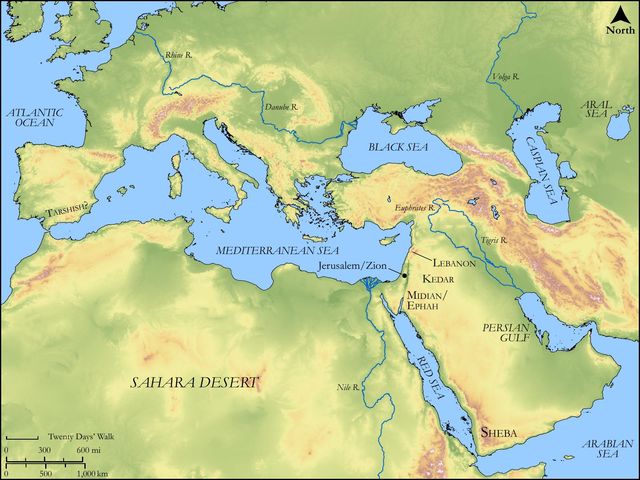
See on the biblical-era map
Study this verse
Public-domain commentary
Matthew Henry
From his Commentary on the Whole Bible. Henry comments on passages, not single verses — this entry covers Isaiah 40:3–8. His three-level outline is real structure in the source text, so it is rendered as structure.
The time to favour Zion, yea, the set time, having come, the people of God must be prepared, by repentance and faith, for the favours designed them; and, in order to call them to both these, we have here the voice of one crying in the wilderness, which may be applied to those prophets who were with the captives in their wilderness-state, and who, when they saw the day of their deliverance dawn, called earnestly upon them to prepare for it, and assured them that all the difficulties which stood in the way of their deliverance should be got over. It is a good sign that mercy is preparing for us if we find God's grace preparing us for it, Psa 10:17. But it must be applied to John the Baptist; for, though God was the speaker, he was the voice of one crying in the wilderness, and his business was to prepare the way of the Lord, to dispose men's minds for the reception and entertainment of the gospel of Christ. The way of the Lord is prepared,
I.By repentance for sin; that was it which John Baptist preached to all Judah and Jerusalem (Mat 3:2, Mat 3:5), and thereby made ready a people prepared for the Lord, Luk 1:17.
1.The alarm is given; let all take notice of it at their peril; God is coming in a way of mercy, and we must prepare for him, Isa 40:3-5. If we apply it to their captivity, it may be taken as a promise that, whatever difficulties lie in their way, when they return they shall be removed. This voice in the wilderness (divine power going along with it) sets pioneers on work to level the roads. But it may be taken as a call to duty, and it is the same duty that we are called to, in preparation for Christ's entrance into our souls.
(1.)We must get into such a frame of spirit as will dispose us to receive Christ and his gospel: "Prepare you the way of the Lord; prepare yourselves for him, and let all that be suppressed which would be an obstruction to his entrance. Make room for Christ: Make straight a highway for him." If he prepare the end for us, we ought surely to prepare the way for him. Prepare for the Saviour; lift up your heads, O you gates! Psa 24:7, Psa 24:9. Prepare for the salvation, the great salvation, and other minor deliverances. Let us get to be fit for them, and then God will work them out. Let us not stand in our own light, nor put a bar in our own door, but find, or make, a highway for him, even in that which was desert ground. This is that for which he waits to be gracious.
(2.)We must get our hearts levelled by divine grace. Those that are hindered from comfort in Christ by their dejections and despondencies are the valleys that must be exalted. Those that are hindered from comfort in Christ by a proud conceit of their own merit and worth are the mountains and hills that must be made low. Those that have entertained prejudices against the word and ways of God, that are untractable, and disposed to thwart and contradict even that which is plain and easy because it agrees not with their corrupt inclinations and secular interests, are the crooked that must be made straight and the rough places that must be made plain. Let but the gospel of Christ have a fair hearing, and it cannot fail of acceptance. This prepares the way of the Lord; and thus God will by his grace prepare his own way in all the vessels of mercy, whose hearts he opens as he did Lydia's.
2.When this is done the glory of the Lord shall be revealed, Isa 40:5.
(1.)When the captives are prepared for deliverance Cyrus shall proclaim it, and those shall have the benefit of it, and those only, whose hearts the Lord shall stir up with courage and resolution to break through the discouragements that lay in their way, and to make nothing of the hills, and valleys, and all the rough places.
(2.)When John Baptist has for some time preached repentance, mortification, and reformation, and so made ready a people prepared for the Lord (Luk 1:17), then the Messiah himself shall be revealed in his glory, working miracles, which John did not, and by his grace, which is his glory, binding up and healing with consolations those whom John had wounded with convictions. And this revelation of divine glory shall be a light to lighten the Gentiles. All flesh shall see it together, and not the Jews only; they shall see and admire it, see it and bid it welcome; as the return out of captivity was taken notice of by the neighbouring nations, Psa 126:2. And it shall be the accomplishment of the word of God, not one iota or tittle of which shall fall to the ground: The mouth of the Lord has spoken it, and therefore the hand of the Lord will effect it.
II.By confidence in the word of the Lord, and not in any creature.
The mouth of the Lord having spoken it, the voice has this further to cry (he that has ears to hear let him hear it), The word of our God shall stand for ever, Isa 40:8.
1.By this accomplishment of the prophecies and promises of salvation, and the performance of them to the utmost in due time, it appears that the word of the Lord is sure and what may be safely relied on. Then we are prepared for deliverance when we depend entirely upon the word of God, build our hopes on that, with an assurance that it will not make us ashamed: in a dependence upon this word we must be brought to own that all flesh is grass, withering and fading.
(1.)The power of man, when it does appear against the deliverance, is not to be feared; for it shall be as grass before the word of the Lord: it shall wither and be trodden down. The insulting Babylonians, who promise themselves that the desolations of Jerusalem shall be perpetual, are but as grass which the spirit of the Lord blows upon, makes nothing of, but blasts all its glory; for the word of the Lord, which promises their deliverance, shall stand for ever, and it is not in the power of their enemies to hinder the execution of it.
(2.)The power of man, when it would appear for the deliverance, is not to be trusted to; for it is but as grass in comparison with the word of the Lord, which is the only firm foundation for us to build our hope upon. When God is about to work salvation for his people he will take them off from depending upon creatures, and looking for it from hills and mountains. They shall fail them, and their expectations from them shall be frustrated: The Spirit of the Lord shall blow upon them; for God will have no creature to be a rival with him for the hope and confidence of his people; and, as it is his word only that shall stand for ever, so in that word only our faith must stand. When we are brought to this, then, and not till then, we are fit for mercy.
2.The word of our God, that glory of the Lord which is now to be revealed, the gospel, and that grace which is brought with it to us and wrought by it in us, shall stand for ever; and this is the satisfaction of all believers, when they find all their creature-comforts withering and fading like grass. Thus the apostle applies it to the word which by the gospel is preached unto us, and which lives and abides for ever as the incorruptible seed by which we are born again, Pe1 1:23-25. To prepare the way of the Lord we must be convinced,
(1.)Of the vanity of the creature, that all flesh is grass, weak and withering. We ourselves are so, and therefore cannot save ourselves; all our friends are so, and therefore are unable to save us. All the beauty of the creature, which might render it amiable, is but as the flower of grass, soon blasted, and therefore cannot recommend us to God and to his acceptance. We are dying creatures; all our comforts in this word are dying comforts, and therefore cannot be the felicity of our immortal souls. We must look further for a salvation, look further for a portion.
(2.)Of the validity of the promise of God. We must be convinced that the word of the Lord can do that for us which all flesh cannot - that, forasmuch as it stands for ever, it will furnish us with a happiness that will run parallel with the duration of our souls, which must live for ever; for the things that are not seen, but must be believed, are eternal.
Historical interpretation
Five Centuries of Reception
10 surviving comments on this verse. Each one is dated, so this reads as a timeline rather than a list.
Select a marker to jump to its quote. Markers stagger vertically where authors wrote within a few decades of each other.
As it is written in the prophets, Behold, I send my messenger before thy face, which shall prepare thy way before thee. The voice of one crying in the wilderness, Prepare ye the way of the Lord, make his paths straight. [Isaiah 40:3-5] John did baptize in the wilderness, and preach the baptism of repentance for the remission of sins. And there went out unto him all the land of Judaea, and they of Jerusalem, and were all baptized of him in the river of Jordan, confessing their sins. And John was clothed with camel's hair, and with a girdle of a skin about his loins; and he did eat locusts and wild honey
In those days came John the Baptist, preaching in the wilderness of Judaea, And saying, Repent ye: for the kingdom of heaven is at hand. For this is he that was spoken of by the prophet Esaias, saying, The voice of one crying in the wilderness, Prepare ye the way of the Lord, make his paths straight. [Isaiah 40:3-5] And the same John had his raiment of camel's hair, and a leathern girdle about his loins; and his meat was locusts and wild honey. Then went out to him Jerusalem, and all Judaea, and all the region round about Jordan, And were baptized of him in Jordan, confessing their sins.
Now in the fifteenth year of the reign of Tiberius Caesar, Pontius Pilate being governor of Judaea, and Herod being tetrarch of Galilee, and his brother Philip tetrarch of Ituraea and of the region of Trachonitis, and Lysanias the tetrarch of Abilene, Annas and Caiaphas being the high priests, the word of God came unto John the son of Zacharias in the wilderness. And he came into all the country about Jordan, preaching the baptism of repentance for the remission of sins; As it is written in the book of the words of Esaias the prophet, saying, The voice of one crying in the wilderness, Prepare ye the way of the Lord, make his paths straight. Every valley shall be filled, and every mountain and hill shall be brought low; and the crooked shall be made straight, and the rough ways shall be made smooth; And all flesh shall see the salvation of God. [Isaiah 40:3-5]
And this is the record of John, when the Jews sent priests and Levites from Jerusalem to ask him, Who art thou? And he confessed, and denied not; but confessed, I am not the Christ. And they asked him, What then? Art thou Elias? And he saith, I am not. Art thou that prophet? And he answered, No. Then said they unto him, Who art thou? that we may give an answer to them that sent us. What sayest thou of thyself? He said, I am the voice of one crying in the wilderness, Make straight the way of the Lord, as said the prophet Esaias. [Isaiah 40:3-5]
But when he took on flesh, he took on the universal logos of flesh. For he triumphed over the powers of all flesh in the flesh, and thus he came to the aid of all flesh, as is said in Isaiah, “all flesh will see the salvation of God,” and in the psalms, “All flesh will come to you.”
He [Christ] was a reproach but at the same time also the majesty of the Lord, as it is written, “And the glory of the Lord shall be revealed, and all flesh together shall see the salvation of God.” What had he lost if he had nothing less? He had neither comeliness nor beauty, but he had not ceased to be the power of God. He appeared a man, but the divine majesty and glory of the Father shone on earth.
(Verse 3 onwards) The voice of one crying in the wilderness: Prepare the way of the Lord, make straight in the desert a highway for our God. Every valley shall be lifted up, and every mountain and hill shall be made low: and the crooked shall be made straight, and the rough places plain. And the glory of the Lord shall be revealed, and all flesh shall see it together: for the mouth of the Lord has spoken it. LXX: The voice of one crying in the wilderness: Prepare the way of the Lord, make straight the paths of our God. Every valley shall be filled, and every mountain and hill shall be brought low; and the crooked shall be made straight, and the rough ways shall be made smooth. And the glory of the Lord shall be revealed; and all flesh shall see the salvation of God, for the Lord has spoken. When the scribes and Pharisees and Jewish leaders heard John preaching in the wilderness and baptizing with a baptism of repentance, they sent messengers to ask him if he was the Christ, or Elijah, or a prophet. And when he answered that he was none of these, they asked him again, 'Then who are you?' So that we may give an answer to those who sent us. What do you say about yourself? And he answered: I am the voice of one crying out in the wilderness: 'Prepare the way of the Lord, as Isaiah the Prophet said (John 1:22-23)'. In which it should be noted that the straight paths of the Lord and the ways of our God: the filling of valleys and mountains, the humbling of hills and the correction of the wicked, and the rough places made level: and the glory of the Lord and the salvation of our God, will not be proclaimed in Jerusalem, but in the solitude of the Church, and in the deserted multitude of the nations, of which we read above (Isaiah 35:1): 'Rejoice, O desert, and let the wilderness exult, and let it blossom like the lily.' For this knowledge of God was unknown and humbled by idols, lowly in confession, exalted in pride, rough and unyielding in wrath. But after the glory of the Lord appeared, and all flesh saw the salvation of God, everything suddenly changed, and the way of the Lord was prepared, so that the glory of God would appear in the wilderness. When the Lord was baptized in the Jordan and the heavens were opened, and the Holy Spirit descended in the form of a dove and remained in him, and the voice of the Father from above was heard, saying: This is my beloved Son, in whom I am well pleased; listen to him. (Matthew 3:17). And all flesh saw the salvation of God. Which is why it was called flesh, because it did not have the Holy Spirit before. Concerning this, the Lord says: My spirit will not remain in these people, because they are flesh (Gen. VI, 3). But that flesh will see the salvation of God, of which the same Joel spoke: I will pour out my spirit upon all flesh, and they shall prophesy (Joel. II, 28). This is not only what John proclaimed at that time, who was the precursor and forerunner of the word of God, rightly called the voice (Matth. III); but even to this day in the wilderness of the Gentiles, the teachers of the Churches cry out: that we may make straight paths and ways for God in our hearts, that we may be filled with virtues, and may be inclined with humility; that we may change what is evil into what is right, and what is rough into what is gentle: and thus we may deserve to see the glory of the Lord and the salvation of God.
And this is the Lord of glory, and we too have come to know his glory. However, those of old did not see it when he showed himself during the dispensation in which he was made man, equal to God the Father in strength, operation and glory, bearing all things by the word of his power and with great tranquillity performing godly works, enhancing creation, raising the dead and performing other deeds of wonder effortlessly. For the glory of the Lord appeared, and all flesh saw the salvation of God, that is, of the Father. For he has sent us his Son from heaven to salvation and redemption. For the law brings no one to perfection, for the sacrifices in prefigurative form were unable to deal with sin. But we have been perfected in Christ and reconciled from every fault as we have been honored with the spirit of sonship.
The one who has made these declarations, he says, is incapable of deceit. As for me, I am greatly astonished at those who think that the prophet has made these prophecies on the subject of the return from Babylon; for they should have considered that the prophetic text has clearly proclaimed in advance that the salvation of God would be evident for all people, whereas this return [from exile] was not evident for all, while the cross of the Savior and the sufferings of the Master have reached even to the ends of the earth.
All flesh, that is, every man can not see the salvation of God in Christ in this life. The Prophet therefore stretches his eye beyond to the last day of judgment, when all men both the elect and the reprobate shall equally see Him.
Continue studying Isaiah 40:5 across the web’s major study libraries — every link below opens this exact verse, chapter, or book on the destination site.
Read & Compare
 BibleGatewayThis verse in more than 200 translations and 70 languages.
 Bible.comThe YouVersion reader — hundreds of translations, reading plans, and highlights.
 ESV.orgCrossway's official English Standard Version reader.
 NET BibleThe NET translation with 60,000+ translators' notes on every rendering decision.
 STEP BibleTyndale House's free study tool — original text, vocabulary, and scholarly resources.
 BibliaLogos Bible Software's free web reader.
 USCCBThe New American Bible (Revised Edition) with the U.S. bishops' study notes.
Commentaries
 BibleHub CommentariesDozens of classic commentaries on this verse, gathered on one page.
 StudyLightMore than 100 commentary sets — the largest collection on the web.
 BibleRefPlain-English commentary on what this verse means, verse by verse.
 Enduring WordDavid Guzik's free commentary on this chapter, widely used by Bible teachers.
 Bible Study ToolsVerse commentary alongside Greek and Hebrew study aids.
Original Language & Research
- BibleHub InterlinearThe verse word by word — original language, transliteration, and English.
- BibleHub LexiconEvery word's original-language definition and Strong's entry.
 Blue Letter BibleDeep-study tools — Strong's numbers, concordance, and word studies.
 SefariaThe Hebrew text with Rashi and centuries of Jewish commentary.
Sermons, Hymns & Audio


TrulyRandomVerse is not affiliated with these sites and doesn’t control their content. They’re linked because they’re genuinely useful.
Summary
Isaiah 40:5 serves as a profound declaration within the "Book of Comfort," offering unwavering assurance to a people grappling with the aftermath of judgment and exile. This pivotal verse majestically proclaims that the inherent splendor, majesty, and power of the LORD will be openly and undeniably displayed, becoming universally visible to all humanity. The absolute certainty of this global revelation is firmly rooted in the unassailable authority and immutable promise of God's own spoken word, providing an unshakeable foundation of hope and divine assurance for every generation.
Context
ShowHideLiterary Context
Isaiah 40:5 stands as a climactic declaration within the opening oracle of comfort that inaugurates the second major division of the book of Isaiah (chapters 40-66), often termed "The Book of Comfort." This section dramatically shifts from prophecies of judgment and impending exile to a message of restoration, hope, and divine intervention. The chapter begins with a tender divine command to comfort God's people, signaling the end of their period of punishment. The immediate preceding verses, Isaiah 40:3-4, vividly depict the preparation of a metaphorical highway in the wilderness, symbolizing a new exodus and the glorious return of the LORD to His people. Verse 5 culminates this preparatory imagery by explicitly stating that this divine return will be accompanied by a universal, undeniable manifestation of God's glory, visible to "all flesh." It serves as the ultimate guarantee that the promises of restoration and divine presence are not merely spiritual aspirations but will be demonstrably and universally realized.
Historical & Cultural Context
The historical setting for Isaiah 40 is the Babylonian exile, a period of profound national trauma, spiritual despair, and theological questioning for the people of Judah. Stripped of their land, the Temple (the physical manifestation of God's presence among them), and their monarchy, they desperately needed a message of hope that transcended their immediate, bleak circumstances. The concept of God's glory being "revealed" would have resonated deeply with a people whose understanding of God's presence had been historically tied to the Shekinah glory in the tabernacle and Temple. The promise of a universal revelation of this glory was revolutionary, suggesting a display of God's power and sovereignty that would not only restore Israel but also compel recognition from the surrounding nations who had witnessed their humiliation. This vision speaks to a future beyond the immediate return from exile, pointing to God's ultimate plan for all creation, a common theme in prophetic literature when addressing the future of Israel and the nations.
Key Themes
ShowHideSeveral profound themes converge and are powerfully articulated in Isaiah 40:5. Firstly, the Revelation of God's Glory is central. This is not a mere intellectual understanding but a manifest, undeniable, and visible display of God's inherent greatness, power, and holiness. It signifies a profound moment in salvation history when God's character and sovereign authority will be fully unveiled, moving beyond the confines of a specific people or place. This theme is foundational to understanding God's self-disclosure throughout Scripture, from the wilderness tabernacle to the ultimate revelation in Christ. Secondly, the theme of Universal Witness is powerfully asserted by the phrase "all flesh shall see it together." This emphasizes the comprehensive and undeniable nature of this revelation, indicating that every human being, regardless of their background or belief, will ultimately bear witness to this divine display. This theme anticipates a time when God's sovereignty will be universally acknowledged, echoing sentiments found in passages like Philippians 2:10-11 and Revelation 1:7. Lastly, the verse underscores the Divine Assurance and Faithfulness through the concluding declaration, "for the mouth of the LORD hath spoken it." This serves as the bedrock of the prophecy's certainty, highlighting the absolute reliability and immutability of God's word. What God declares, He will unfailingly bring to pass, providing ultimate assurance that His promises are dependent solely on His divine will and power, not on human circumstances or efforts.
Exposition and Analysis
ShowHideKey Word Analysis
ShowHideThis term, translated as "glory," fundamentally derives from a root meaning "weight" or "heaviness." When applied to God, it signifies His inherent greatness, His manifest presence, His splendor, honor, and majesty. It is not merely an abstract concept but the tangible, weighty reality of God's being and power made evident. The revelation of God's kâbôwd implies a powerful, undeniable demonstration of His divine attributes that carries immense significance and impact.
Meaning "to denude," "to uncover," "to disclose," or "to reveal," this primitive root implies an active unveiling or making something visible that was previously hidden. In the passive voice ("shall be revealed"), it indicates that God Himself is the agent of this unveiling, ensuring its certainty, comprehensiveness, and the removal of any obscurity. It speaks to a deliberate act of divine self-disclosure.
Translated as "flesh," this term comprehensively refers to humanity in its entirety – "all flesh" signifying all living beings, specifically all humankind. It emphasizes the universal scope of the revelation, indicating that no one will be exempt from witnessing this divine display. The term also carries connotations of human frailty and mortality, highlighting the stark contrast between finite humanity and the infinite, glorious God.
Verse Breakdown
ShowHide"And the glory of the LORD shall be revealed"
This initial clause declares a future, certain, and profound event: the manifestation of God's inherent majesty, splendor, and sovereign power. The "glory of the LORD" (Hebrew: kâbôwd of Yᵉhôvâh) refers to His weighty presence, His divine attributes, and His supreme authority. The use of the passive voice, "shall be revealed" (Hebrew: gâlâh), indicates that God Himself is the active agent in this unveiling, ensuring its certainty and undeniable nature. It speaks to a moment of divine self-disclosure that will transcend previous, more localized manifestations of His presence.
"and all flesh shall see it together"
This phrase powerfully emphasizes the universal and unified nature of this revelation. "All flesh" (Hebrew: kol-bâsâr) encompasses every human being, signifying that this divine display will be witnessed by everyone, without exception. The word "together" (Hebrew: yachad) reinforces the idea of a collective, simultaneous, and undeniable observation, leaving no one untouched or unaware of God's glorious presence. It points to a global acknowledgment of divine sovereignty and an inescapable encounter with His manifest glory.
"for the mouth of the LORD hath spoken it."
This concluding clause provides the ultimate, unassailable ground for the prophecy's certainty. It underscores the absolute authority, reliability, and immutability of God's word (Hebrew: peh of Yᵉhôvâh hath dâbar). What God declares, He will unfailingly bring to pass, for His word is inherently powerful and effective. This serves as the bedrock of assurance, affirming that the promise of universal revelation is not contingent on human circumstances, efforts, or belief, but solely on the divine will and omnipotence of the Sovereign God.
Literary Devices
ShowHideIsaiah 40:5 masterfully employs several powerful literary devices to convey its message of certainty, hope, and divine authority. The verse itself is a clear Prophecy, a forward-looking declaration of a future, divinely ordained event. The concluding phrase, "for the mouth of the LORD hath spoken it," functions as a potent Divine Guarantee or Affirmation, emphasizing the absolute reliability and immutability of God's word. This serves as a powerful rhetorical device designed to instill unwavering confidence and certainty in the listener regarding the fulfillment of the prophecy. The use of "all flesh" is a form of Synecdoche, where a part (flesh, representing human mortality and physicality) stands for the whole (all humanity), underscoring the comprehensive and universal scope of the revelation. This phrase also carries an element of Hyperbole to emphasize the undeniable and inescapable nature of this divine manifestation, implying that no one will be able to deny or escape witnessing God's glory. Furthermore, the entire verse anticipates a grand Theophany, a visible and powerful manifestation of God's presence and glory, which is a recurring and awe-inspiring motif throughout biblical literature.
Theological and Thematic Connections
ShowHideIsaiah 40:5 is a profound theological statement on God's inherent nature, His active engagement with humanity, and the absolute reliability of His divine plan. It asserts God's inherent sovereignty and His unwavering commitment to self-disclosure, promising a future where His glory will not be confined to a specific people or place but will burst forth for all to witness. This universal revelation is not merely for Israel's comfort and restoration but for the global recognition of His Lordship, demonstrating that God's redemptive purposes extend to all creation. The verse underscores the absolute power and faithfulness of God's spoken word, establishing it as the ultimate foundation for all hope and certainty. It reminds us that God's promises are not mere suggestions or possibilities but divine decrees that will inevitably come to pass, shaping history according to His perfect and sovereign will.
Reflection and Application
ShowHideIsaiah 40:5 offers enduring solace and a powerful call to faith for believers across all generations. In a world often marked by uncertainty, hiddenness, and apparent divine silence, this verse serves as a profound anchor, reminding us that God's ultimate plan for revelation and restoration is absolutely certain. It invites us to cultivate a deep and abiding trust in the unfailing nature of God's word, understanding that His promises are not dependent on our fluctuating circumstances or limited human efforts, but solely on His divine will and omnipotent power. This certainty should fuel our hope, enabling us to live with eager anticipation for the day when God's glory will be undeniably evident to all. Furthermore, the universal scope of this prophecy impresses upon us the urgency and privilege of participating in God's ongoing mission. As we await the full revelation of His glory, we are called to share the good news of His coming, His comfort, and His salvation through His Son, Jesus Christ, with a world that desperately needs to see and acknowledge Him.
Questions for Reflection
ShowHideFAQ
ShowHideWhat does "the glory of the LORD" mean in this context?
ShowHideIn Isaiah 40:5, "the glory of the LORD" (Hebrew: kâbôwd Yᵉhôvâh) refers to the manifest presence, inherent greatness, splendor, and majestic power of God. It is not merely an abstract concept but the tangible, weighty reality of God's being made evident. In this context, it signifies a future, undeniable, and visible display of God's divine attributes and sovereign power that will be apparent to all humanity. It speaks to God's active self-revelation, where His character and authority will be fully unveiled for all to behold, moving beyond the localized manifestations of glory seen in the Old Testament.
How can "all flesh" see God's glory? Is this literal?
ShowHideThe phrase "all flesh" (Hebrew: kol-bâsâr) comprehensively refers to all humanity. While there may have been immediate, partial fulfillments related to the return from Babylonian exile, the prophetic scope of Isaiah 40:5 points to an ultimate, eschatological fulfillment. This "seeing" can be understood both literally and spiritually. Literally, it anticipates a future, global event where God's glory will be undeniably displayed, perhaps in a manner akin to a grand theophany, as hinted at in passages like Revelation 1:7, where "every eye will see him." Spiritually, it implies a universal recognition of God's sovereignty and truth, where no one will be able to deny His existence or authority. The emphasis is on the undeniable and comprehensive nature of this revelation, ensuring that every human being will be confronted with God's manifest presence.
Why is it important that "the mouth of the LORD hath spoken it"?
ShowHideThis concluding phrase is crucial because it provides the ultimate, unassailable guarantee for the prophecy's fulfillment. It underscores the absolute authority, reliability, and immutability of God's word. Unlike human promises, which can be broken, hindered, or forgotten, God's word is inherently powerful and effective; what He declares, He will unfailingly bring to pass. This divine assurance means the prophecy of universal revelation is not contingent on human effort, circumstances, or belief, but solely on the sovereign will and omnipotence of God. It serves as the unshakeable foundation for the hope and certainty offered throughout the "Book of Comfort" and indeed, all of Scripture, providing an anchor for faith in God's unwavering faithfulness.
Christ-Centered Fulfillment
ShowHideIsaiah 40:5 finds its most profound and ultimate fulfillment in the person and work of Jesus Christ. While the immediate context points to God's glorious return to His people after exile, the New Testament reveals that the ultimate "glory of the LORD" was uniquely "revealed" in the incarnation of Jesus. As John 1:14 declares, "And the Word was made flesh, and dwelt among us, (and we beheld his glory, the glory as of the only begotten of the Father,) full of grace and truth." In Christ, the invisible God became visible, and His glory was seen by those who believed, though not universally recognized in its full divine majesty at His first coming. However, the promise that "all flesh shall see it together" points unequivocally to Christ's glorious second coming. Matthew 24:30 foretells, "then shall appear the sign of the Son of man in heaven: and then shall all the tribes of the earth mourn, and they shall see the Son of man coming in the clouds of heaven with power and great glory." This future event will be the undeniable, universal manifestation of God's glory in Christ, fulfilling Isaiah's prophecy to its fullest extent. The certainty that "the mouth of the LORD hath spoken it" finds its ultimate validation in God's eternal plan, fully revealed and accomplished through His Son, who is "the radiance of God's glory and the exact representation of his being" as described in Hebrews 1:3. Thus, Isaiah 40:5 is a prophetic beacon pointing to the Christ, in whom God's glory is both revealed and ultimately seen by all.