


Mark 1:5
- καὶkaiAndG2532CONJConjunction
- ἐξεπορεύετοexeporeuetowere going outG1607V-INI-3SVerb Imperfect Middle Or Passive Deponent Indicative 3rd Singular
- πρὸςprostoG4314PREPPreposition
- αὐτὸνautonhimG846P-ASMPersonal pronoun Accusative Singular Masculine
- πᾶσαpasaallG3956A-NSFAdjective Nominative Singular Feminine
- ἡhētheG3588T-NSFDefinite article Nominative Singular Feminine
- ἸουδαίαIoudaiaof JudeaG2449N-NSF-LNoun Nominative Singular Feminine Location
- χώραchōraregionG5561N-NSFNoun Nominative Singular Feminine
- καὶkaiandG2532CONJConjunction
- οἱhoi<the>G3588T-NPMDefinite article Nominative Plural Masculine
- ἹεροσολυμῖταιHi'erosolumitaiof JerusalemG2415N-NPM-LNoun Nominative Plural Masculine Location
- πάντεςpantesallG3956A-NPMAdjective Nominative Plural Masculine
- καὶkaiandG2532CONJConjunction
- ἐβαπτίζοντοebaptizontowere being baptizedG907V-IPI-3PVerb Imperfect Passive Indicative 3rd Plural
- ὑπ᾽hup᾽byG5259PREPPreposition
- αὐτοῦautouhimG846P-GSMPersonal pronoun Genitive Singular Masculine
- ἐνeninG1722PREPPreposition
- τῷtōtheG3588T-DSMDefinite article Dative Singular Masculine
- ἸορδάνῃIordanēJordanG2446N-DSM-LNoun Dative Singular Masculine Location
- ποταμῷpotamōriverG4215N-DSMNoun Dative Singular Masculine
- ἐξομολογούμενοιexomologoumenoiconfessingG1843V-PMP-NPMVerb Present Middle Participle Nominative Plural Masculine
- τὰςtastheG3588T-APFDefinite article Accusative Plural Feminine
- ἁμαρτίαςhamartiassinsG266N-APFNoun Accusative Plural Feminine
- αὐτῶνautōnof themG846P-GPMPersonal pronoun Genitive Plural Masculine
English is a literal word-by-word gloss of the Greek, not the KJV's wording. Why?
This is the original text the KJV's translators worked from — each Greek word with its own literal English meaning in this verse, prepared by scholars at Tyndale House, Cambridge. The KJV translates whole sentences, not word by word, so its wording differs: one Greek word can become several English words, and the KJV may choose “charity” where the gloss reads “love”. Both are faithful — they answer different questions. For the KJV's own rendering, switch to the KJV text.
Details
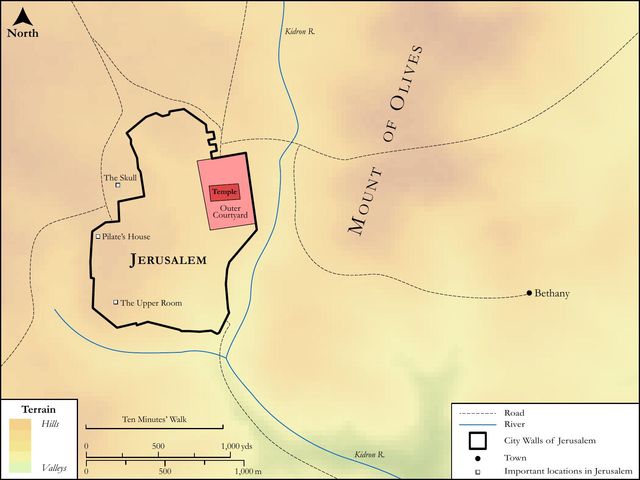
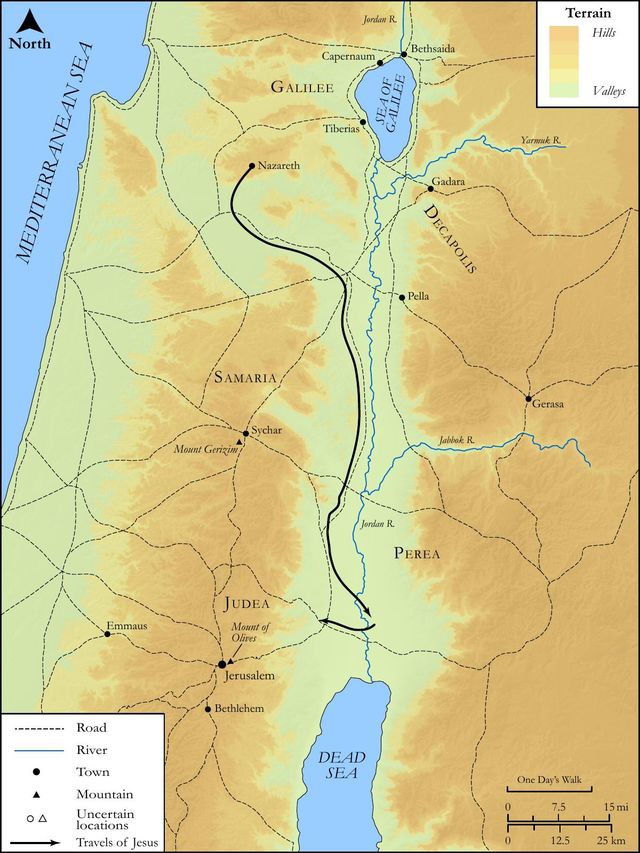
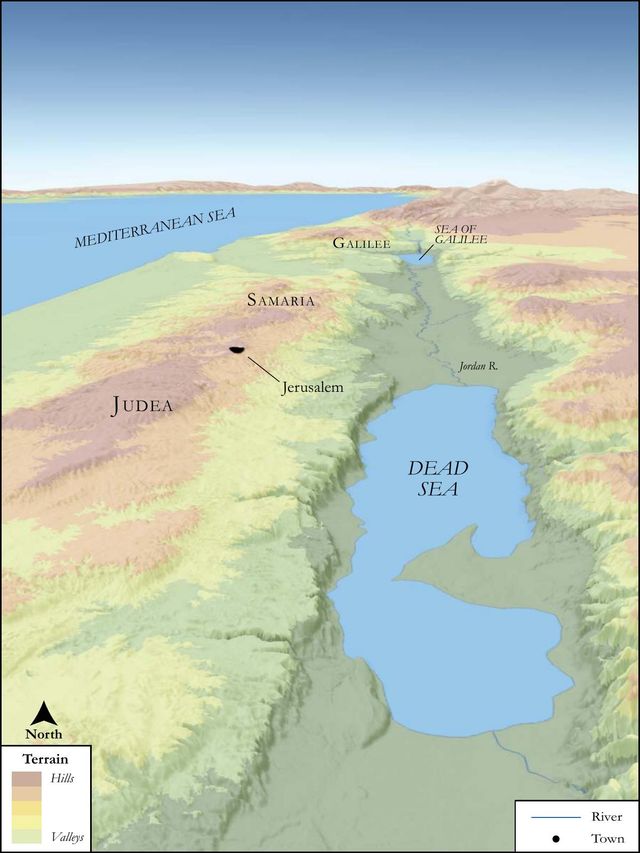
See on the biblical-era map
Study this verse
Public-domain commentary
Matthew Henry
From his Commentary on the Whole Bible. Henry comments on passages, not single verses — this entry covers Mark 1:1–8. His four-level outline is real structure in the source text, so it is rendered as structure.
We may observe here,
I.What the New Testament is - the divine testament, to which we adhere above all that is human; the new testament, which we advance above that which was old. It is the gospel of Jesus Christ the Son of God, Mar 1:1.
1.It is gospel; it is God's word, and is faithful and true; see Rev 19:9; Rev 21:5; Rev 22:6. It is a good word, and well worthy of all acceptation; it brings us glad tidings.
2.It is the gospel of Jesus Christ, the anointed Saviour, the Messiah promised and expected. The foregoing gospel began with the generation of Jesus Christ - that was but preliminary, this comes immediately to the business - the gospel of Christ. It is called his, not only because he is the Author of it, and it comes from him, but because he is the Subject of it, and it treats wholly concerning him.
3.This Jesus is the Son of God. That truth is the foundation on which the gospel is built, and which it is written to demonstrate; for is Jesus be not the Son of God, our faith is vain.
II.What the reference of the New Testament is to the Old, and its coherence with it.
The gospel of Jesus Christ begins, and so we shall find it goes on, just as it is written in the prophets (Mar 1:2); for it saith no other things than those which the prophets and Moses said should come (Act 26:22), which was most proper and powerful for the conviction of the Jews, who believed the Old Testament prophets to be sent of God and ought to have evidenced that they did so by welcoming the accomplishment of their prophecies in its season; but it is of use to us all, for the confirmation of our faith both in the Old Testament and in the New, for the exact harmony that there is between both shows that they both have the same divine original.
Quotations are here borrowed from two prophecies - that of Isaiah, which was the longest, and that of Malachi, which was the latest (and there were above three hundred years between them), both of whom spoke to the same purport concerning the beginning of the gospel of Jesus Christ, in the ministry of John.
1.Malachi, in whom we had the Old Testament farewell, spoke very plainly (Mal 3:1) concerning John Baptist, who was to give the New Testament welcome. Behold, I send my messenger before thy face, Mar 1:2. Christ himself had taken notice of this, and applied it to John (Mat 11:10), who was God's messenger, sent to prepare Christ's way.
2.Isaiah, the most evangelical of all the prophets, begins the evangelical part of his prophecy with this, which points to the beginning of the gospel of Christ (Isa 40:3); The voice of him that crieth in the wilderness, Mar 1:3. Matthew had taken notice of this, and applied it to John, Mat 3:3. But from these two put together here, we may observe,
(1.)That Christ, in his gospel, comes among us, bringing with him a treasure of grace, and a sceptre of government.
(2.)Such is the corruption of the world, that there is something to do to make room for him, and to remove that which gives not only obstruction, but opposition to his progress.
(3.)When God sent his Son into the world, he took care, and when he sends him into the heart, he takes care, effectual care, to prepare his way before him; for the designs of his grace shall not be frustrated; nor may any expect the comforts of that grace, but such as, by conviction of sin and humiliation for it, are prepared for those comforts, and disposed to receive them.
(4.)When the paths that were crooked, are made straight (the mistakes of the judgment rectified, and the crooked ways of the affections), then way is made for Christ's comforts.
(5.)It is in a wilderness, for such this world is, that Christ's way is prepared, and theirs that follow him, like that which Israel passed through to Canaan.
(6.)The messengers of conviction and terror, that come to prepare Christ's way, are God's messengers, whom he sends and will own, and must be received as such.
(7.)They that are sent to prepare the way of the Lord, in such a vast howling wilderness as this is, have need to cry aloud, and not spare, and to lift up their voice like a trumpet.
III.What the beginning of the New Testament was.
The gospel began in John Baptist; for the law and the prophets were, until John, the only divine revelation, but then the kingdom of God began to be preached, Luk 16:16. Peter begins from the baptism of John, Act 1:22. The gospel did not begin so soon as the birth of Christ, for he took time to increase in wisdom and stature, not so late as his entering upon his public ministry, but half a year before, when John began to preach the same doctrine that Christ afterward preached. His baptism was the dawning of the gospel day; for,
1.In John's way of living there was the beginning of a gospel spirit; for it bespoke great self-denial, mortification of the flesh, a holy contempt of the world, and nonconformity to it, which may truly be called the beginning of the gospel of Christ in any soul, Mar 1:6. He was clothed with camels' hair, not with soft raiment; was girt, not with a golden, but with a leathern girdle; and, in contempt of dainties and delicate things, his meat was locusts and wild honey. Note, The more we sit loose to the body, and live above the world, the better we are prepared for Jesus Christ.
2.In John's preaching and baptizing there was the beginning of the gospel doctrines and ordinances, and the first fruits of them.
(1.)He preached the remission of sins, which is the great gospel privilege; showed people their need of it, that they were undone without it, and that it might be obtained.
(2.)He preached repentance, in order to it; he told people that there must be a renovation of their hearts and a reformation of their lives, that they must forsake their sins and turn to God, and upon those terms and no other, their sins should be forgiven. Repentance for the remission of sins, was what the apostles were commissioned to preach to all nations, Luk 24:27.
(3.)He preached Christ, and directed his hearers to expect him speedily to appear, and to expect great things from him. The preaching of Christ is pure gospel, and that was John Baptist's preaching, Mar 1:7, Mar 1:8. Like a true gospel minister, he preaches,
[1.]The great pre-eminence Christ is advanced to; so high, so great, is Christ, that John, though one of the greatest that was born of women, thinks himself unworthy to be employed in the meanest office about him, even to stoop down, and untie his shoes. Thus industrious is he to give honour to him, and to bring others to do so too.
[2.]The great power Christ is invested with; He comes after me in time, but he is mightier than I, mightier than the mighty ones of the earth, for he is able to baptize with the Holy Ghost; he can give the Spirit of God, and by him govern the spirits of men.
[3.]The great promise Christ makes in his gospel to those who have repented, and have had their sins forgiven them; They shall be baptized with the Holy Ghost, shall be purified by his graces, and refreshed by his comforts. And, lastly, All those who received his doctrine, and submitted to his institution, he baptized with water, as the manner of the Jews was to admit proselytes, in token of their cleansing themselves by repentance and reformation (which were the duties required), and of God's cleansing them both by remission and by sanctification, which were the blessings promised. Now this was afterward to be advanced into a gospel ordinance, which John's using it was a preface to.
3.In the success of John's preaching, and the disciples he admitted by baptism, there was the beginning of a gospel church. He baptized in the wilderness, and declined going into the cities; but there went out unto him all the land of Judea, and they of Jerusalem, inhabitants both of city and country, families of them, and were all baptized of him. They entered themselves his disciples, and bound themselves to his discipline; in token of which, they confessed their sins; he admitted them his disciples, in token of which, he baptized them. Here were the stamina of the gospel church, the dew of its youth from the womb of the morning, Psa 110:3. Many of these afterward became followers of Christ, and preachers of his gospel, and this grain of mustard-seed became a tree.
Historical interpretation
Nine Centuries of Reception
9 surviving comments on this verse. Each one is dated, so this reads as a timeline rather than a list.
Select a marker to jump to its quote. Markers stagger vertically where authors wrote within a few decades of each other.
According to the above-mentioned prophecy of Isaiah, the way of the Lord is prepared by John, through faith, baptism, and penitence; the paths are made straight by the rough marks of the hair-cloth garment, the girdle of skin, the feeding on locusts and wild honey, and the most lowly voice; whence it is said, John was in the wilderness. For John and Jesus seek what is lost in the wilderness; where the devil conquered, there he is conquered; where man fell, there he rises up. But the name John means the grace of God, and the narrative begins with grace. For it goes on to say, baptizing. For by baptism grace is given, seeing that by baptism sins are freely remitted. But what is brought to perfection by the bridegroom, is introduced by the friend of the bridegroom. Thus catechumens, (which word means persons instructed,) begin by the ministry of the priest, receive the chrismb from the bishop. And to show this, it is subjoined, And preaching the baptism of repentance, &c.
Now by John as by the bride-groom's friend, the bride is brought to Christ, as by a servant Rebecca was brought to Isaac; wherefore there follows, And there went out to him all, (Gen. 24:61) &c. For confession and beauty are in his presence, (Ps. 95:6. Vulg.) that is, the presence of the bridegroom. And the bride leaping down from her camel signifies the Church, who humbles herself on seeing her husband Isaac, that is, Christ. But the interpretation of Jordan, where sins are washed away, is 'an alien descent.' For we heretofore aliens to God by pride, are by the sign (symbolum) of Baptism made lowly, and thus exalted on highd.
The dress of John, his food, and employment, signifies the austere life of preachers, and that future nations are to be joined to the grace of God, which is John, both in their minds and in externals. For by camel's hair, is meant the rich among the nations; and by the girdle of skin, the poor, dead to the world; and by the wandering locusts, the wise men of this world; who, leaving the dry stalks to the Jews, draw off with their legs the mystic grain, and in the warmth of their faith leap up towards heaven; and the faithful, being inspired by the wild honey, are full-fed from the untilled wood.
Who again is mightier than the grace, by which sins are washed away, which John signifies? He who seven times and seventy times seven remits sin. Grace indeed comes first, but remits sins once only by baptism, but mercy reaches to the wretched from Adam up to Christ through seventy-seven generations, and up to one hundred and forty-four thousand. (Mat. 18:22)
The shoe is in the extremity of the body; for in the end the Incarnate Saviour is coming for justice, whence it is said by the prophet, Over Edom will I cast out my shoe. (Ps. 60:9)
Let us here treat briefly of the different kinds of baptism. Moses baptized, but in water, in the cloud and in the sea; but this he did figuratively. John also baptized, not indeed in the rite of the Jews, not solely in water, but also for the remission of sins; yet not in an entirely spiritual manner, for he had not added: “in the spirit.” Jesus baptized, but in the Spirit; and this is perfection. There is also a fourth baptism, which is wrought by martyrdom and blood, in which Christ himself was also baptized, which is far more venerable than the others, in as much as it is not soiled by repeated contagion. There is yet a fifth, but more laborious, by tears; with which David each night bedewed his bed, washing his couch with tears.
The baptism of John did not so much consist in the forgiveness of sins as in being a baptism of repentance for the remission of sins, that is, for a future remission, which was to follow through the sanctification of Christ.
For what is the difference between water and the Holy Ghost, who was borne over the face of the waters? Water is the ministry of man; but the Spirit is ministered by God.
(Vict. Ant. e Cat. in Marc.) But lest he should be thought to say this by way of comparing himself to Christ, he subjoins, Of whom I am not worthy, &c. It is not however the same thing to loose the shoe-latchet, which Mark here says, and to carry his shoes, which Matthew says. And indeed the Evangelists following the order of the narrative, and not able to err in any thing, say that John spoke each of these sayings in a different sense. But commentators on this passage have expounded each in a different way. For he means by the latchet, the tie of the shoe. (non occ.). He says this therefore to extol the excellence of the power of Christ, and the greatness of His divinity; as if he said, Not even in the station of his servant am I worthy to be reckoned. For it is a great thing to contemplate, as it were stooping down, those things which belong to the body of Christ, and to see from below the image of things above, and to untie each of those mysteries, about the Incarnation of Christ, which cannot be unravelled.
(Moral. xxxi. 25) Or, by the kind itself of his food he pointed out the Lord, of whom he was the forerunner; for in that our Lord took to Himself the sweetness of the barren Gentiles, he ate wild honey. In that He in His own person partly converted the Jews, He received locusts for His food, which suddenly leaping up, at once fall to the ground. For the Jews leaped up when they promised to fulfil the precepts of the Lord; but they fell to the ground, when by their evil works they affirmed that they had not heard them. They made therefore a leap upwards in words, and fell down by their actions.
(Hom. in Evan. vii.) Shoes also are made from the skins of dead animals. The Lord, therefore, coming incarnate, appeared us it were with shoes on His feet, for He assumed in His divinity the dead skins of our corruption. Or else; it was a custom among the ancients, that if a man refused to take as his wife the woman whom he ought to take, he who offered himself as her husband by right of kindred took off that man's shoe. Rightly then does he proclaim himself unworthy to loose his shoe-latchet, as if he said openly, I cannot make bare the feet of the Redeemer, for I usurp not the name of the Bridegroom, a thing which is above my deserts.
(in Marc. i. 2) It is evident that John not only preached, but also gave to some the baptism of repentance; but he could not give baptism for the remission of sinsc. For remission of sins is only given to us by the baptism of Christ. It is therefore only said, Preaching the baptism of repentance for the remission of sins; for he preached a baptism which could remit sins, since he could not give it. Wherefore as he was the forerunner of the Incarnate Word of the Father, by the word of his preaching, so by his baptism, which could not remit sins, he preceded that baptism, of penitence, by which sins are remitted.
(ubi sup.) An example of confessing their sins and of promising to lead a new life, is held out to those who desire to be baptized, by those words which follow, confessing their sins.
It says, clothed in a garment of hair, not in woollen clothes; the former is the mark of an austere garb, the latter of effeminate luxury. But the girdle of skins, with which he was girt, like Elias, is a mark of mortification. And this meat, locusts and wild honey, is suited to a dweller in the wilderness, so that his object in eating was not the deliciousness of meats, but the satisfying of the necessity of human flesh.
(ubi sup.) The dress and food of John may also express of what kind was his inward walk. For he used a dress more austere than was usual, because he did not encourage the life of sinners by flattery, but chid them by the vigour of his rough rebuke; he had a girdle of skin round his loins, for he was one, who crucified his flesh with the affections and lusts. (Gal. 5:24) He used to cat locusts and wild honey, because his preaching had some sweetness for the multitude, whilst the people debated whether he was the Christ himself or not; but this soon came to an end, when his hearers understood that he was not the Christ, but the forerunner and prophet of Christ. For in honey there is sweetness, in locusts swiftness of flight; whence there follows, And he preached, saying, there cometh one mightier than I after me.
(ubi sup.) Thus then John proclaims the Lord not yet as God, or the Son of God, but only as a man mightier than himself. For his ignorant hearers were not yet capable of receiving the hidden things of so great a Sacrament, that the eternal Son of God, having taken upon Him the nature of man, had been lately born into the world of a virgin; but gradually by the acknowledgment of His glorified lowliness, they were to be introduced to the belief of His Divine Eternity. To these words, however, he subjoins, as if covertly declaring that he was the true God, I baptize you with water, but he shall baptize you with the Holy Ghost. For who can doubt, that none other but God can give the grace of the Holy Ghost.
(ubi sup.) Now we are baptized by the Lord in the Holy Ghost, not only when in the day of our baptism, we are washed in the fount of life, to the remission of our sins, but also daily by the grace of the same Spirit we are inflamed, to do those things which please God.
The baptism of John had not remission of sins, but only brought men to penitence. He preached therefore the baptism of repentance, that is, he preached that to which the baptism of penitence led, namely, remission of sins, that they who in penitence received Christ, might receive Him to the remission of their sins.
Or else; The garment of camel's hair was significative of grief, for John pointed out, that he who repented should mourn. For sackcloth signifies grief; but the girdle of skins shows the dead state of the Jewish people. The food also of John not only denotes abstinence, but also shows forth the intellectual food, which the people then were eating, without understanding any thing lofty, but continually raising themselves on high, and again sinking to the earth. For such is the nature of locusts, leaping on high and again falling. In the same way the people ate honey, which had come from bees, that is, from the prophets; it was not however domestic, but wild, for the Jews had the Scriptures, which are as honey, but did not rightly understand them.
Some persons also understand it thus; all who came to John, and were baptized, through penitence were loosed from the bands of their sins by believing in Christ. John then in this way loosed the shoe-latchet of all the others, that is, the bands of sin. But Christ's shoe-latchet he was not able to unloose, because he found no sin in Him.
(non occ.) He said this to do away with the opinion of the crowd, who thought that he was the Christ; but he announces that Christ is mightier than he, who was to remit sins, which he himself could not do.
Continue studying Mark 1:5 across the web’s major study libraries — every link below opens this exact verse, chapter, or book on the destination site.
Read & Compare
 BibleGatewayThis verse in more than 200 translations and 70 languages.
 Bible.comThe YouVersion reader — hundreds of translations, reading plans, and highlights.
 ESV.orgCrossway's official English Standard Version reader.
 NET BibleThe NET translation with 60,000+ translators' notes on every rendering decision.
 STEP BibleTyndale House's free study tool — original text, vocabulary, and scholarly resources.
 BibliaLogos Bible Software's free web reader.
 USCCBThe New American Bible (Revised Edition) with the U.S. bishops' study notes.
Commentaries
 BibleHub CommentariesDozens of classic commentaries on this verse, gathered on one page.
 StudyLightMore than 100 commentary sets — the largest collection on the web.
 BibleRefPlain-English commentary on what this verse means, verse by verse.
 Enduring WordDavid Guzik's free commentary on this chapter, widely used by Bible teachers.
 Bible Study ToolsVerse commentary alongside Greek and Hebrew study aids.
Original Language & Research
- BibleHub InterlinearThe verse word by word — original language, transliteration, and English.
- BibleHub LexiconEvery word's original-language definition and Strong's entry.
 Blue Letter BibleDeep-study tools — Strong's numbers, concordance, and word studies.
 CNTR CollationThe earliest Greek manuscripts of this verse, collated letter by letter.
Sermons, Hymns & Audio


TrulyRandomVerse is not affiliated with these sites and doesn’t control their content. They’re linked because they’re genuinely useful.
Summary
Mark 1:5 powerfully illustrates the profound impact of John the Baptist's ministry, depicting an extraordinary outpouring of people from across Judaea and Jerusalem who flocked to him in the wilderness. This verse captures their collective response to his prophetic call, as they underwent baptism in the Jordan River, publicly confessing their sins as a demonstration of repentance and a desire for spiritual cleansing.
Context
ShowHideLiterary Context
This verse immediately follows the introduction of John the Baptist and his prophetic mission to prepare the way for the Lord, echoing the words of Isaiah 40:3. Mark's Gospel begins with urgency, directly launching into John's ministry as the fulfillment of prophecy, setting the stage for the arrival of Jesus. The widespread response described in Mark 1:5 underscores the significant spiritual awakening John's message ignited, demonstrating the fertile ground for the subsequent ministry of Jesus. It establishes John as a pivotal figure, a bridge between the Old Testament prophetic tradition and the dawning of the New Covenant in Christ.
Historical & Cultural Context
The "land of Judaea" and "Jerusalem" represent the heartland of Jewish religious and political life, making the mass exodus to John in the wilderness a truly remarkable phenomenon. This movement indicates a deep spiritual hunger and widespread anticipation of messianic times, or at least a desire for national and individual purification. The Jordan River held immense symbolic significance for the Israelites, having been the boundary they crossed to enter the Promised Land under Joshua (Joshua 3). It was also the site of Elijah's ascension (2 Kings 2:7-8), making it a natural location for a ritual of new beginnings and spiritual cleansing. John's baptism was distinct from Jewish ritual washings (mikvah) or proselyte baptisms, as it was a unique, one-time act of repentance for Jews, signifying a radical turning towards God in preparation for His imminent kingdom.
Key Themes
ShowHideMark 1:5 contributes significantly to several key themes in Mark's Gospel. Firstly, it highlights the theme of prophetic fulfillment as John's ministry aligns with ancient prophecies concerning the forerunner of the Messiah. Secondly, the widespread response ("all the land of Judaea, and they of Jerusalem") emphasizes the unprecedented nature of John's impact and the pervasive spiritual yearning among the people, setting the stage for Jesus' equally impactful ministry. Thirdly, the acts of baptism and confession of sins underscore the foundational importance of repentance as a prerequisite for entering God's kingdom and receiving His salvation. This public acknowledgment of sin was a radical act, demonstrating a genuine desire for spiritual transformation and readiness for the coming of the Messiah, as John himself would later proclaim in Mark 1:7-8.
Exposition and Analysis
ShowHideKey Word Analysis
ShowHideThis verb, translated "went out," signifies a departure or going forth. Its use here emphasizes the active, deliberate movement of the people out of their settled lives in Judaea and Jerusalem to John in the wilderness. It suggests a purposeful pilgrimage, indicating the compelling nature of John's message and the earnestness of the people's desire for spiritual engagement.
The word "all," appearing twice in this verse, means "whole," "every," or "any." When applied to "the land of Judaea" and "they of Jerusalem," it functions as a rhetorical hyperbole, signifying an overwhelming and comprehensive representation of the population, not necessarily every single individual. This emphasizes the immense scope and widespread nature of John's influence, portraying a movement that gripped the entire region.
Translated "confessing," this verb means "to acknowledge openly," "to agree fully," or "to confess publicly." It implies more than a private admission; it suggests a public declaration of one's sins, often accompanied by a sense of gratitude or praise. In this context, it highlights the sincerity and transparency of the people's repentance, making their spiritual transformation a communal and visible act.
Verse Breakdown
ShowHide"And there went out unto him all the land of Judaea, and they of Jerusalem"
This clause vividly portrays the immense drawing power of John the Baptist. "All the land of Judaea" and "they of Jerusalem" serve as a synecdoche or hyperbole, representing the vast majority of the population from the religious and political centers. It underscores the widespread spiritual hunger and the compelling nature of John's message that drew people from their homes into the wilderness.
"and were all baptized of him in the river of Jordan"
This describes the central ritual of John's ministry. The act of baptism, an immersion in the Jordan River, symbolized a public declaration of repentance and a cleansing from sin. It was a visible commitment to turn away from past transgressions and prepare for the coming kingdom of God. The phrase "all baptized of him" reiterates the collective and pervasive nature of this spiritual movement.
"confessing their sins"
This crucial phrase reveals the internal disposition that accompanied the external act of baptism. The public confession of sins (from exomologéō) was not merely an acknowledgment but an open, often heartfelt, admission of wrongdoing. It signified genuine contrition and a desire for reconciliation with God, making the baptism a meaningful expression of a transformed heart rather than a mere ritual.
Literary Devices
ShowHideMark 1:5 employs several significant literary devices to convey its powerful message. Hyperbole is evident in the phrase "all the land of Judaea, and they of Jerusalem," which, while not literally every single person, effectively communicates the overwhelming and unprecedented scale of the crowds flocking to John. This exaggeration emphasizes the profound impact of his ministry. Symbolism is deeply embedded in the act of baptism in the Jordan River; the river itself, historically a boundary and a place of new beginnings for Israel, becomes a powerful symbol of spiritual cleansing, purification, and a fresh start. The act of immersion symbolizes death to the old self and resurrection to a new life of repentance. Furthermore, the entire scene serves as Foreshadowing, preparing the reader for the greater ministry of Jesus, who will soon appear and offer a more profound baptism of the Holy Spirit. The people's readiness for John's message hints at their potential readiness for the Messiah.
Theological and Thematic Connections
ShowHideMark 1:5 establishes the foundational theological principle that genuine spiritual transformation begins with repentance and confession. The widespread response to John signifies a divine stirring among the people, a preparatory work of God to ready hearts for the advent of His Son. This mass movement underscores humanity's inherent need for cleansing and forgiveness, a need that cannot be met by human effort alone but requires a turning to God. John's ministry, though powerful, was ultimately provisional, pointing beyond itself to the one who would bring a more complete salvation. The public nature of their confession highlights the communal aspect of sin and repentance, yet also the individual responsibility to acknowledge one's brokenness before God and others. This sets the stage for understanding the radical grace and forgiveness offered through Christ.
Reflection and Application
ShowHideMark 1:5 serves as a powerful reminder of the enduring call to repentance and the transformative power of openly acknowledging our sins before God. The eagerness of the crowds, abandoning their daily lives to seek John's ministry, challenges us to consider our own spiritual priorities and the depth of our desire for genuine cleansing. Their public confession of sins underscores that true repentance is not a private, intellectual exercise but often involves a humble, outward declaration of our need for God's grace. For believers today, this verse invites us to continually examine our hearts, confess our failings, and embrace the ongoing work of sanctification. It also highlights the importance of a clear, uncompromised proclamation of truth that can stir hearts and lead people to a place of spiritual readiness, preparing us to receive and walk more deeply with Christ.
Questions for Reflection
ShowHideFAQ
ShowHideWas John's baptism the same as Christian baptism today?
ShowHideNo, John's baptism was not the same as Christian baptism. John's baptism was a "baptism of repentance for the forgiveness of sins" (Mark 1:4) that prepared people for the coming of the Messiah. It was a symbolic act of cleansing and a public declaration of one's turning away from sin in anticipation of God's kingdom. Christian baptism, however, is performed in the name of the Father, Son, and Holy Spirit (Matthew 28:19), and it symbolizes a believer's identification with Christ's death, burial, and resurrection (Romans 6:3-4). It signifies new life in Christ, the indwelling of the Holy Spirit, and incorporation into the body of Christ.
Why did people from "all the land of Judaea, and they of Jerusalem" go out to John?
ShowHidePeople flocked to John from across Judaea and Jerusalem primarily because of his powerful prophetic message and the widespread spiritual yearning of the time. John preached a message of repentance, proclaiming that the Kingdom of God was at hand and that people needed to prepare for the coming Messiah. His austere lifestyle and bold preaching resonated with many who were discontent with the religious establishment and longed for a genuine encounter with God. The sheer number of people indicates a deep spiritual hunger and a recognition of John as a true prophet, fulfilling the ancient prophecies about one who would prepare the way for the Lord.
Christ-Centered Fulfillment
ShowHideMark 1:5, with its vivid portrayal of widespread repentance and confession, finds its ultimate Christ-centered fulfillment in the person and work of Jesus. John's ministry, while powerful, was merely a preparatory act, a voice crying in the wilderness to make straight the way of the Lord. The crowds confessing their sins to John were being readied for the one who would not merely symbolize cleansing but would be the ultimate cleanser, the Lamb of God who takes away the sin of the world. Jesus Himself would later submit to John's baptism, not because He had sins to confess, but to fulfill all righteousness, identifying with humanity's need for redemption. The confession of sins to John foreshadows the greater confession of faith in Jesus Christ, through whom true and lasting forgiveness is found (Acts 10:43). Ultimately, the cleansing offered by John's water baptism points to the spiritual cleansing and new birth made possible through Christ's atoning sacrifice on the cross and the baptism of the Holy Spirit, which truly regenerates and empowers believers for a new life in Him (Titus 3:5).