


Luke 3:3
Bible text: King James Version (1769 Blayney text) · Public domain
Bible text: Berean Standard Bible · Public domain
Bible text: American Standard Version (1901) · Public domain
Bible text: World English Bible, Messianic edition · Public domain
Bible text: Geneva Bible (1599) · Public domain
Bible text: Young's Literal Translation · Public domain
- καὶkaiAndG2532CONJConjunction
- ἦλθενēlthenhe wentG2064V-2AAI-3SVerb 2nd Aorist Active Indicative 3rd Singular
- εἰςeisintoG1519PREPPreposition
- πᾶσανpasanallG3956A-ASFAdjective Accusative Singular Feminine
- τὴνtēntheG3588T-ASFDefinite article Accusative Singular Feminine
- περίχωρονperichōronsurrounding regionG4066N-ASFNoun Accusative Singular Feminine
- τοῦtouof theG3588T-GSMDefinite article Genitive Singular Masculine
- ἸορδάνουIordanouJordanG2446N-GSM-LNoun Genitive Singular Masculine Location
- κηρύσσωνkērussōnproclaimingG2784V-PAP-NSMVerb Present Active Participle Nominative Singular Masculine
- βάπτισμαbaptismaa baptismG908N-ASNNoun Accusative Singular Neuter
- μετανοίαςmetanoiasof repentanceG3341N-GSFNoun Genitive Singular Feminine
- εἰςeisforG1519PREPPreposition
- ἄφεσινaphesinforgivenessG859N-ASFNoun Accusative Singular Feminine
- ἁμαρτιῶνhamartiōnof sinsG266N-GPFNoun Genitive Plural Feminine
English is a literal word-by-word gloss of the Greek, not the KJV's wording. Why?
This is the original text the KJV's translators worked from — each Greek word with its own literal English meaning in this verse, prepared by scholars at Tyndale House, Cambridge. The KJV translates whole sentences, not word by word, so its wording differs: one Greek word can become several English words, and the KJV may choose “charity” where the gloss reads “love”. Both are faithful — they answer different questions. For the KJV's own rendering, switch to the KJV text.
Details
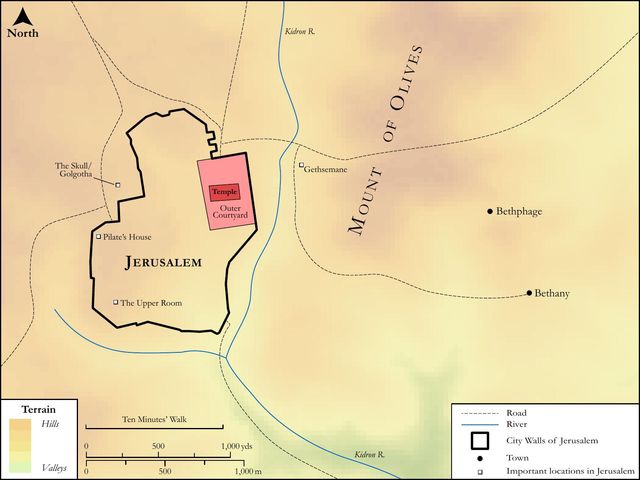
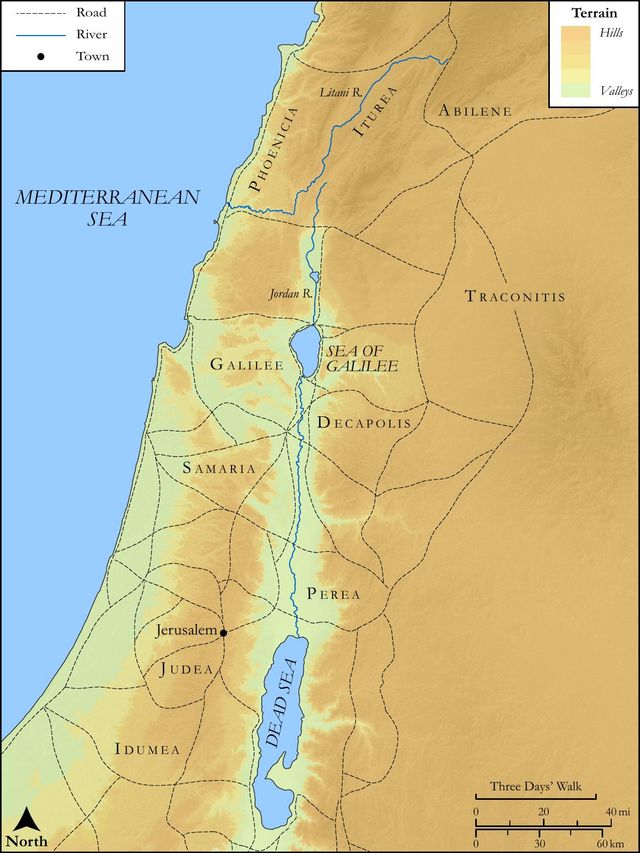
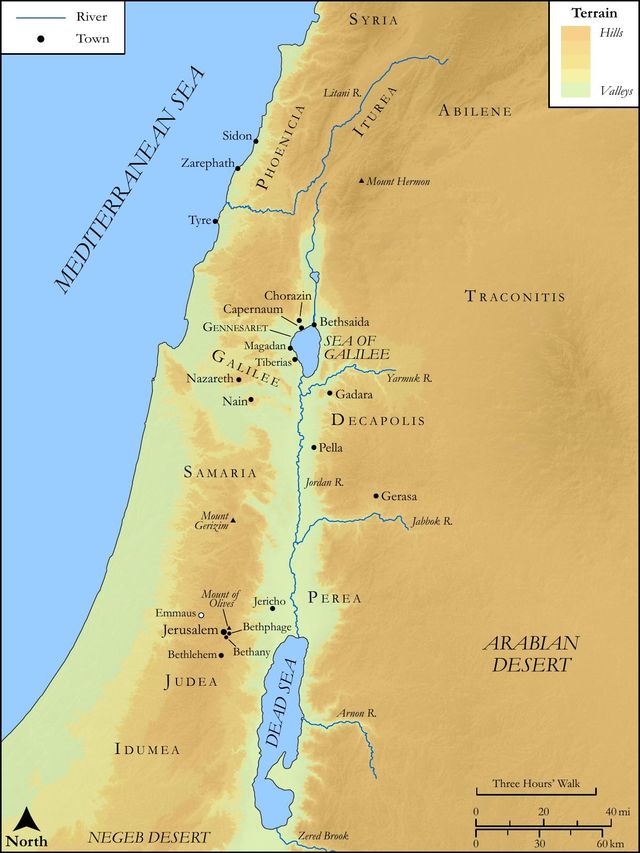
See on the biblical-era maps
Study this verse
Public-domain commentary
Matthew Henry
From his Commentary on the Whole Bible. Henry comments on passages, not single verses — this entry covers Luke 3:1–14. His four-level outline is real structure in the source text, so it is rendered as structure.
John's baptism introducing a new dispensation, it was requisite that we should have a particular account of it. Glorious things were said of John, what a distinguished favourite of Heaven he should be, and what a great blessing to this earth (Luk 1:15, Luk 1:17); but we lost him in the deserts, and there he remains until the day of his showing unto Israel, Luk 1:80. And now at last that day dawns, and a welcome day it was to them that waited for it more than they that waited for the morning. Observe here,
I.The date of the beginning of John's baptism, when it was that he appeared; this is here taken notice of, which was not by the other evangelists, that the truth of the thing might be confirmed by the exact fixing of the time. And it is dated,
1.By the government of the heathen, which the Jews were under, to show that they were a conquered people, and therefore it was time for the Messiah to come to set up a spiritual kingdom, and an eternal one, upon the ruins of all the temporal dignity and dominion of David and Judah.
(1.)It is dated by the reign of the Roman emperor; it was in the fifteenth year of Tiberius Caesar, the third of the twelve Caesars, a very bad man, given to covetousness, drunkenness, and cruelty; such a man is mentioned first (saith Dr. Lightfoot), as it were, to teach us what to look for from that cruel and abominable city wherein Satan reigned in all ages and successions. The people of the Jews, after a long struggle, were of late made a province of the empire, and were under the dominion of this Tiberius; and that country which once had made so great a figure, and had many nations tributaries to it, in the reigns of David and Solomon, is now itself an inconsiderable despicable part of the Roman empire, and rather trampled upon than triumphed in.
- En quo discordia cives, Perduxit miseros
- What dire effects from civil discord flow!
The lawgiver was now departed from between Judah's feet; and, as an evidence of that, their public acts are dated by the reign of the Roman emperor, and therefore now Shiloh must come.
(2.)It is dated by the governments of the viceroys that ruled in the several parts of the Holy Land under the Roman emperor, which was another badge of their servitude, for they were all foreigners, which bespeaks a sad change with that people whose governors used to be of themselves (Jer 30:21), and it was their glory. How is the gold become dim!
[1.]Pilate is here said to be the governor, president, or procurator, of Judea. This character is given of him by some other writers, that he was a wicked man, and one that made no conscience of a lie. He reigned ill, and at last was displaced by Vitellius, president of Syria, and sent to Rome, to answer for his mal-administrations.
[2.]The other three are called tetrarchs, some think from the countries which they had the command of, each of them being over a fourth part of that which had been entirely under the government of Herod the Great. Others think that they are so called from the post of honour they held in the government; they had the fourth place, or were fourth-rate governors: the emperor was the first, the pro-consul, who governed a province, the second, a king the third, and a tetrarch the fourth. So Dr. Lightfoot.
2.By the government of the Jews among themselves, to show that they were a corrupt people, and that therefore it was time that the Messiah should come, to reform them, Luk 3:2. Annas and Caiaphas were the high priests. God had appointed that there should be but one high priest at a time, but here were two, to serve some ill turn or other: one served one year and the other the other year; so some. One was the high priest, and the other the sagan, as the Jews called him, to officiate for him when he was disabled; or, as others say, one was high priest, and represented Aaron, and that was Caiaphas; Annas, the other, was nasi, or head of the sanhedrim, and represented Moses. But to us there is but one high priest, one Lord of all, to whom all judgment is committed.
II.The origin and tendency of John's baptism.
1.The origin of it was from heaven: The word of God came unto John, Luk 3:2. He received full commission and full instructions from God to do what he did. It is the same expression that is used concerning the Old Testament prophets (Jer 1:2); for John was a prophet, yea, more than a prophet, and in him prophecy revived, which had been long suspended. We are not told how the word of the Lord came to John, whether by an angel, as to his father, or by dream, or vision, or voice, but it was to his satisfaction, and ought to be to ours. John is here called the son of Zacharias, to refer us to what the angel said to his father, when he assured him that he should have this son. The word of the Lord came to him in the wilderness; for those whom God fits he will find out, wherever they are. As the word of the Lord is not bound in a prison, so it is not lost in a wilderness. The word of the Lord made its way to Ezekiel among the captives by the river of Chebar, and to John in the isle of Patmos. John was the son of a priest, now entering upon the thirtieth year of his age; and therefore, according to the custom of the temple, he was now to be admitted into the temple-service, where he should have attended as a candidate five years before. But God had called him to a more honourable ministry, and therefore the Holy Ghost enrols him here, since he was not enrolled in the archives of the temple: John the son of Zacharias began his ministration such a time.
2.The scope and design of it were to bring all the people of his country off from their sins and home to their God, Luk 3:3. He came first into all the country about Jordan, the neighbourhood wherein he resided, that part of the country which Israel took possession of first, when they entered the land of promise under Joshua's conduct; there was the banner of the gospel first displayed. John resided in the most solitary part of the country: but, when the word of the Lord came to him, he quitted his deserts, and came into the inhabited country. Those that are best pleased in their retirements must cheerfully exchange them, when God calls them into places of concourse. He came out of the wilderness into all the country, with some marks of distinction, preaching a new baptism; not a sect, or party, but a profession, or distinguishing badge. The sign, or ceremony, was such as was ordinarily used among the Jews, washing with water, by which proselytes were sometimes admitted, or disciples to some great master; but the meaning of it was, repentance for the remission of sins: that is, all that submitted to his baptism,
(1.)Were thereby obliged to repent of their sins, to be sorry for what they had done amiss, and to do so no more. The former they professed, and were concerned to be sincere in their professions; the latter they promised, and were concerned to make good what they promised. He bound them, not to such ceremonious observances as were imposed by the tradition of the elders, but to change their mind, and change their way, to cast away from them all their transgressions, and to make them new hearts and to live new lives. The design of the gospel, which now began, was to make men devout and pious, holy and heavenly, humble and meek, sober and chaste, just and honest, charitable and kind, and good in every relation, who had been much otherwise; and this is to repent.
(2.)They were thereby assured of the pardon of their sins, upon their repentance. As the baptism he administered bound them not to submit to the power of sin, so it sealed to them a gracious and pleadable discharge from the guilt of sin. Turn yourselves from all your transgressions, so iniquity shall not be your ruin; agreeing with the word of the Lord, by the Old Testament prophets, Eze 18:30.
III.The fulfilling of the scriptures in the ministry of John.
The other evangelists had referred us to the same text that is here referred to, that of Esaias, Isa 40:3. It is written in the book of the words of Esaias the prophet, which he heard from God, which he spoke for God, those words of his which were written for the generations to come. Among them it is found that there should be the voice of one crying in the wilderness; and John is that voice, a clear distinct voice, a loud voice, an articulate one; he cries, Prepare ye the way of the Lord, and make his paths straight. John's business is to make way for the entertainment of the gospel in the hearts of the people, to bring them into such a frame and temper as that Christ might be welcome to them, and they welcome to Christ. Luke goes further on with the quotation than Matthew and Mark had done, and applies the following words likewise to John's ministry (Luk 3:5, Luk 3:6), Every valley shall be filled. Dr. Hammond understands this as a prediction of the desolation coming upon the people of the Jews for their infidelity: the land should be made plain by the pioneers for the Roman army, and should be laid waste by it, and there should then be a visible distinction made between the impenitent on the one side and the receivers of the gospel on the other side. But it seems rather to be meant of the gospel of Christ, of which that was the introduction.
1.The humble shall by it be enriched with grace: Every valley that lies low and moist shall be filled and be exalted.
2.The proud shall by it be humbled; the self-confident that stand upon their own bottom, and the self-conceited that lift up their own top, shall have contempt put upon them: Every mountain and hill shall be brought low. If they repent, they are brought to the dust; if not, to the lowest hell.
3.Sinners shall be converted to God: The crooked ways and the crooked spirits shall be made straight; for, though none can make that straight which God hath made crooked (Ecc 7:13), yet God by his grace can make that straight which sin hath made crooked.
4.Difficulties that were hindering and discouraging in the way to heaven shall be removed: The rough ways shall be made smooth; and they that love God's law shall have great peace, and nothing shall offend them. The gospel has made the way to heaven plain and easy to be found, smooth and easy to be walked in.
5.The great salvation shall be more fully discovered than ever, and the discovery of it shall spread further (Luk 3:6): All flesh shall see the salvation of God; not the Jews only, but the Gentiles. All shall see it; they shall have it set before them and offered to them, and some of all sorts shall see it, enjoy it, and have the benefit of it. When way is made for the gospel into the heart, by the captivation of high thoughts and bringing them into obedience to Christ, by the leveling of the soul and the removing of all obstructions that stand in the way of Christ and his grace, then prepare to bid the salvation of God welcome.
IV.The general warnings and exhortations which he gave to those who submitted to his baptism, Luk 3:7-9.
In Matthew he is said to have preached these same things to many of the Pharisees and Sadducees, that came to his baptism (Mat 3:7-10); but here he is said to have spoken them to the multitude, that came forth to be baptized of him, Luk 3:7. This was the purport of his preaching to all that came to him, and he did not alter it in compliment to the Pharisees and Sadducees, when they came, but dealt as plainly with them as with any other of his hearers. And as he did not flatter the great, so neither did he compliment the many, or make his court to them, but gave the same reproofs of sin and warnings of wrath to the multitude that he did to the Sadducees and Pharisees; for, if they had not the same faults, they had others as bad. Now observe here,
1.That the guilty corrupted race of mankind is become a generation of vipers; not only poisoned, but poisonous; hateful to God, hating one another. This magnifies the patience of God, in continuing the race of mankind upon the earth, and not destroying that nest of vipers. He did it once by water, and will again by fire.
2.This generation of vipers is fairly warned to flee from the wrath to come, which is certainly before them if they continue such; and their being a multitude will not be at all their security, for it will be neither reproach nor loss to God to cut them off. We are not only warned of this wrath, but are put into a way to escape it, if we look about us in time.
3.There is no way of fleeing from the wrath to come, but by repentance. They that submitted to the baptism of repentance thereby evidenced that they were warned to flee from the wrath to come and took the warning; and we by our baptism profess to have fled out of Sodom, for fear of what is coming upon it.
4.Those that profess repentance are highly concerned to live like penitents (Luk 3:8): "Bring forth therefore fruits meet for repentance, else, notwithstanding your professions of repentance, you cannot escape the wrath to come." By the fruits of repentance it will be known whether it be sincere or no. By the change of our way must be evidenced the change of our mind.
5.If we be not really holy, both in heart and life, our profession of religion and relation to God and his church will stand us in no stead at all: Begin not now to frame excuses from this great duty of repentance, by saying within yourselves, We have Abraham to our father. What will it avail us to be the children of godly parents if we be not godly, to be within the pale of the Church if we be not brought into the bond of the covenant?
6.We have therefore no reason to depend upon our external privileges and professions of religion, because God has no need of us or of our services, but can effectually secure by his own honour and interest without us. If we were cut off and ruined, he could raise up to himself a church out of the most unlikely, - children to Abraham even out of stones.
7.The greater professions we make of repentance, and the greater assistances and encouragements are given us to repentance, the nearer and the sorer will our destruction be if we do not bring forth fruits meet for repentance. Now that the gospel begins to be preached, now that the kingdom of heaven is at hand, now that the axe is laid to the root of the tree, threatenings to the wicked and impenitent are now more terrible than before, as encouragements to the penitent are now more comfortable. "Now that you are upon your behaviour, look to yourselves."
8.Barren trees will be cast into the fire at length; it is the fittest place for them: Every tree that doth not bring forth fruit, good fruit, is hewn down, and cast into the fire. If it serve not for fruit, to the honour of God's grace, let it serve for fuel, to the honour of his justice.
V.The particular instructions he gave to several sorts of persons, that enquired of him concerning their duty:
the people, the publicans, and the soldiers. Some of the Pharisees and Sadducees came to his baptism; but we do not find them asking, What shall we do? They thought they knew what they had to do as well as he could tell them, or were determined to do what they pleased, whatever he told them. But the people, the publicans, and the soldiers, who knew that they had done amiss, and that they ought to do better, and were conscious to themselves of great ignorance and unacquaintedness with the divine law, were particularly inquisitive: What shall we do? Note,
1.Those that are baptized must be taught, and those that have baptized them are concerned, as they have opportunity, to teach them, Mat 28:19, Mat 28:20.
2.Those that profess and promise repentance in general must evidence it by particular instances of reformation, according as their place and condition are.
3.They that would do their duty must desire to know their duty, and enquire concerning it. The first good word Paul said, when he was converted, was, Lord, what wilt thou have me to do? These here enquire, not, What shall this man do? but, What shall we do? What fruits meet for repentance shall we bring forth? Now John gives answer to each, according to their place and station.
(1.)He tells the people their duty, and that is to be charitable (Luk 3:11): He that has two coats, and, consequently, one to spare, let him give, or lend at least, to him that has none, to keep him warm. Perhaps he saw among his hearers some that were overloaded with clothes, while others were ready to perish in rags, and he puts those who had superfluities upon contributing to the relief of those that had not necessaries. The gospel requires mercy, and not sacrifice; and the design of it is to engage us to do all the good we can. Food and raiment are the two supports of life; he that hath meat to spare, let him give to him that is destitute of daily food, as well as he that hath clothes to spare: what we have we are but stewards of, and must use it, accordingly, as our Master directs.
(2.)He tells the publicans their duty, the collectors of the emperor's revenue (Luk 3:13): Exact no more than that which is appointed you. They must do justice between the government and the merchant, and not oppress the people in levying the taxes, nor any way make them heavier or more burdensome than the law had made them. They must not think that because it was their office to take care that the people did not defraud the prince they might therefore, by the power they had, bear hard upon the people; as those that have ever so little a branch of power are apt to abuse it: "No, keep to your book of rates, and reckon it enough that you collect for Caesar the things that are Caesar's, and do not enrich yourselves by taking more." The public revenues must be applied to the public service, and not to gratify the avarice of private persons. Observe, He does not direct the publicans to quit their places, and to go no more to the receipt of custom; the employment is in itself lawful and necessary, but let them be just and honest in it.
(3.)He tells the soldiers their duty, Luk 3:14. Some think that these soldiers were of the Jewish nation and religion: others think that they were Romans; for it was not likely either that the Jews would serve the Romans or that the Romans would trust the Jews in their garrisons in their own nation; and then it is an early instance of Gentiles embracing the gospel and submitting to it. Military men seldom seem inclined to religion; yet these submitted even to the Baptist's strict profession, and desired to receive the word of command from him: What must we do? Those who more than other men have their lives in their hands, and are in deaths often, are concerned to enquire what they shall do that they may be found in peace. In answer to this enquiry, John does not bid them lay down their arms, and desert the service, but cautions them against the sins that soldiers were commonly guilty of; for this is fruit meet for repentance, to keep ourselves from our iniquity.
[1.]They must not be injurious to the people among whom they were quartered, and over whom indeed they were set: "Do violence to no man. Your business is to keep the peace, and prevent men's doing violence to one another; but do not you do violence to any. Shake no man" ( so the word signifies); "do not put people into fear; for the sword of war, as well as that of justice, is to be a terror only to evil doers, but a protection to those that do well. Be not rude in your quarters; force not money from people by frightening them. Shed not the blood of war in peace; offer no incivility either to man or woman, nor have any hand in the barbarous devastations that armies sometimes make." Nor must they accuse any falsely to the government, thereby to make themselves formidable, and get bribes.
[2.]They must not be injurious to their fellow-soldiers; for some think that caution, not to accuse falsely, has special reference to them: "Be not forward to complain one of another to your superior officers, that you may be revenged on those whom you have a pique against, or undermine those above you, and get into their places." Do not oppress any; so some think the word here signifies as used by the Septuagint in several passages of the Old Testament.
[3.]They must not be given to mutiny, or contend with their generals about their pay: "Be content with your wages. While you have what you agreed for, do not murmur that it is not more." It is discontent with what they have that makes men oppressive and injurious; they that never think they have enough themselves will not scruple at any the most irregular practices to make it more, by defrauding others. It is a rule to all servants that they be content with their wages; for they that indulge themselves in discontents expose themselves to many temptations, and it is wisdom to make the best of that which is.
Historical interpretation
Five Centuries of Reception
16 surviving comments on this verse. Each one is dated, so this reads as a timeline rather than a list.
Select a marker to jump to its quote. Markers stagger vertically where authors wrote within a few decades of each other.
Jordan is the same as descending, for there descends from God a river of healing water. But what parts would John be traversing but the country lying about Jordan, that the penitent sinner might soon arrive at the flowing stream, humbling himself to receive the baptism of repentance. For it is added, preaching the baptism of repentance for the remission of sins.
"Jordan" means "descending." It is the "descending" river of God, one running with a vigorous force. It is the Lord our Savior. Into him we are baptized with true, saving water. Baptism is also preached "for the remission of sins."
The precursor of Christ—the voice of one crying in the wilderness—preaches in the desert of the soul that has known no peace. Not only then, but even now, a bright and burning lamp first comes and preaches the baptism of repentance for the forgiveness of sins. Then the true Light follows, as John himself said: "He must increase, but I must decrease." The word came in the desert and spread in all the countryside around the Jordan.
(non occ.) And because a path is a way trodden down by those that have gone before, and which former men have worn away, the word bids those who depart from the zeal of their predecessors repeatedly pursue it.
(non occ.) But as the hills differ from mountains in respect of height, in other things are the same, so also the adverse powers agree indeed in purpose, but are distinguished from one another in the enormity of their offences.
(Orat. 39.) To speak now of the difference of baptisms. Moses indeed baptized, but in the water, the cloud, and the sea, but this was done figuratively. John also baptized, not indeed according to the Jewish rite, (for he baptized not only with water,) but also for the remission of sins, yet not altogether spiritually, (for he adds not, in the Spirit.) Jesus baptizes but with the Spirit, and this is perfect baptism. There is also a fourth baptism, namely by martyrdom and blood, by which also Christ Himself was baptized, and which is so far more glorious than the others, as it is not sullied by repeated acts of defilement. There is also a fifth, the most weary, according to which David every night washed his bed and his couch with tears. It follows, As it is written in the book of Esaias the Prophet, The voice of one crying in the wilderness. (Is. 40:3.)
(ubi sup.) Or by the valleys he means a quiet habitual practice of virtue, as in the Psalms, The valleys shall be filled with corn. (Ps. 65:13.)
(ubi sup.) Or, He orders the valleys to be filled, the mountains and hills to be cast down, to show that the rule of virtue neither fails from want of good, nor transgresses from excess.
Again, the wilderness is the Church itself, for the barren has more children than she who has an husband. The word of the Lord came, that the earth which was before barren might bring forth fruit unto us.
The Word came, and the voice followed. For the Word first works inward, then follows the office of the voice, as it is said, And he went into all the country about Jordan.
And therefore many say that St. John is a type of the Law, because the Law could denounce sin, but could not pardon it.
John the forerunner of the Word is rightly called the voice, because the voice being inferior precedes, the Word, which is more excellent, follows.
(ubi sup.) For as the sacrifice had not yet been offered up, nor had the holy Spirit descended, how could remission of sins be given? What is it then that St. Luke means by the words, for the remission of sins? Seeing the Jews were ignorant, and knew not the weight of their sins, and because this was the cause of their evils, in order that they might be convinced of their sins and seek a Redeemer, John came exhorting them to repentance, that being thereby made better and sorrowful for their sins, they might be ready to receive pardon. Rightly then after saying, that he came preaching the baptism of repentance, he adds, for the remission of sins. As if he should say, The reason by which he persuaded them to repent was, that thereby they would the more easily obtain subsequent pardon, believing on Christ. For if they were not led by repentance, in vain could they ask for grace, other than as a preparation for faith in Christ.
(ubi sup.) But to cry, Prepare ye the way of the Lord, was not the office of the king, but of the forerunner. And so they called John the voice, because he was the forerunner of the Word.
(ubi sup.) He denounces the haughty and arrogant by the name of mountains, whom Christ has brought low. But by the hills He implies the wreckless, not only because of the pride of their hearts, but because of the barrenness of despair. For the hill produces no fruit.
(in Matt. Hom. 10.) Or by these words he declares the difficulties of the law to be turned into the easiness of faith; as if he said, No more toils and labours await us, but grace and remission of sins make an easy way to salvation.
(ubi sup.) He then adds the cause of these things, saying, And all flesh shall see, &c. showing that the virtue and knowledge of the Gospel shall be extended even to the end of the world, turning mankind from savage manners and perverse wills to meekness and gentleness. Not only Jewish converts but all mankind shall see the salvation of God.
Do you perceive how the prophet anticipated all by his words—the concourse of the people? Thus, when he says, “Every valley shall be filled, and every mountain and hill shall be brought low, and the rough ways shall be made smooth,” he is signifying the exaltation of the lowly, the humiliation of the self-willed, the hardness of the law changed into easiness of faith. For it is no longer toils and labors, says he, but grace and forgiveness of sins, affording the way to salvation. Next he states the cause of these things, saying, “All flesh shall see the salvation of God.” No longer Jews and proselytes only, but also all earth and sea and the whole race of people may be saved. By “the crooked things” he signified our whole corrupt life, publicans, harlots, robbers and magicians, as many as having been perverted before, afterward walk in the right way. As Jesus himself likewise said, “Tax collectors and harlots go into the kingdom of God before you,” because they believed.
Thus the prophet wrote that he shall come saying, “Prepare the way of the Lord, make his paths straight.” And John himself said when he came, “Bring forth fruits consistent with repentance,” which corresponds with “prepare the way of the Lord.” See that both by the words of the prophet and by his own preaching, this one thing is manifested alone. John was to come, making a way and preparing beforehand, not bestowing the gift, which was the remission, but ordering in good time the souls of such as should receive the God of all.
As messenger of God, who was about to come,
He faithfully observed this law, constructing well,
That every hill might low become and tough ways plain,
Lest when the truth should glide from heaven down to earth
It then would find a barrier to its swift approach.
And all flesh did see the salvation of God, even of the Father: for He sent the Son to be our Saviour. And in these words by "flesh," man generally is to be understood, that is, the whole human race. For thus all flesh shall see the salvation of God: no longer Israel only, but all flesh. For the gentleness of the Saviour and Lord of all is not limited, nor did He save one nation merely, but rather embraced within His net the whole world, and has illuminated all who were in darkness.
Moreover, the fruit of repentance is, in the highest degree, faith in Christ. Next to it is the evangelic mode of life, and in general terms the works of righteousness as opposed to sin, which the penitent must bring forth as fruits worthy of repentance.
And he came into all the region of Jordan, preaching the baptism of repentance for the remission of sins. It is clear to all readers that John not only preached the baptism of repentance, but also gave it to some, yet nevertheless he was not able to give his baptism for the remission of sins. For the remission of sins is granted to us only in the baptism of Christ. Therefore it must be noted what is said: Preaching the baptism of repentance for the remission of sins, because the baptism that would loose sins, since he was not able to give it, he preached: so that just as he preceded the incarnate Word of the Father with the word of preaching, so he might precede the baptism of repentance, by which sins are loosed, with his own baptism, by which sins cannot be loosed; so that because his speech preceded the presence of the Redeemer, his baptism also by preceding might become a shadow of the truth.
(ubi sup.) It is plain to every reader that John not only preached the baptism of repentance, but to some also he gave it, yet his own baptism he could not give for the remission of sins.
(ubi sup.) Or John is said to preach the baptism of repentance for the remission of sins, because the baptism which was to take away sin, as he could not give, he preached; just as the Incarnate Word of the Father preceded the word of preaching, so the baptism of repentance, which was able to take away sin, was preceded by John's baptism, which could not take away sin.
(7, 20. in Ev.) John cries in the desert because he brings the glad tidings of redemption to deserted and forsaken Judæa, but what he cries is explained in the words, Prepare ye the way of the Lord. For they who preach true faith and good works, what else do they than prepare the way for the Lord's coming into the hearts of the hearers, that they might make the paths of God straight, forming pure thoughts in the mind by the word of good preaching.
(20. in Ev.) Or, the valley when filled increases, but the mountains and hills when brought low decrease, because the Gentiles by faith in Christ receive fulness of grace, but the Jews by their sin of treachery have lost that wherein they boasted. For the humble receive a gift because the hearts of the proud they keep afar off.
(ubi sup.) But the crooked places are become straight, when the hearts of the wicked, perverted by a course of injustice, are directed to the rule of justice. But the rough ways are changed to smooth, when fierce and savage dispositions by the influence of Divine grace return to gentleness and meckness.
(ubi sup.) Or else, All flesh, i. e. Every man can not see the salvation of God in Christ in this life. The Prophet therefore stretches his eye beyond to the last day of judgment, when all men both the elect and the reprobate shall equally see Him.
And he went into all the region around Jordan, preaching a baptism of repentance for the remission of sins. To all readers it is clear that John not only preached the baptism of repentance, but also gave it to certain people, yet he could not grant his baptism for the remission of sins. For indeed, the remission of sins is granted to us by the baptism of Christ alone. It should be noted, therefore, what is said, preaching a baptism of repentance for the remission of sins, since he could not give a baptism that would absolve sins, he preached it. Just as he preceded the incarnate Word of the Father with the word of preaching: so the baptism of repentance, by which sins are absolved, would precede his baptism, by which sins cannot be absolved.
Continue studying Luke 3:3 across the web’s major study libraries — every link below opens this exact verse, chapter, or book on the destination site.
Read & Compare
 BibleGatewayThis verse in more than 200 translations and 70 languages.
 Bible.comThe YouVersion reader — hundreds of translations, reading plans, and highlights.
 ESV.orgCrossway's official English Standard Version reader.
 NET BibleThe NET translation with 60,000+ translators' notes on every rendering decision.
 STEP BibleTyndale House's free study tool — original text, vocabulary, and scholarly resources.
 BibliaLogos Bible Software's free web reader.
 USCCBThe New American Bible (Revised Edition) with the U.S. bishops' study notes.
Commentaries
 BibleHub CommentariesDozens of classic commentaries on this verse, gathered on one page.
 StudyLightMore than 100 commentary sets — the largest collection on the web.
 BibleRefPlain-English commentary on what this verse means, verse by verse.
 Enduring WordDavid Guzik's free commentary on this chapter, widely used by Bible teachers.
 Bible Study ToolsVerse commentary alongside Greek and Hebrew study aids.
Original Language & Research
- BibleHub InterlinearThe verse word by word — original language, transliteration, and English.
- BibleHub LexiconEvery word's original-language definition and Strong's entry.
 Blue Letter BibleDeep-study tools — Strong's numbers, concordance, and word studies.
 CNTR CollationThe earliest Greek manuscripts of this verse, collated letter by letter.
Sermons, Hymns & Audio


TrulyRandomVerse is not affiliated with these sites and doesn’t control their content. They’re linked because they’re genuinely useful.
Summary
Luke 3:3 succinctly captures the essence and scope of John the Baptist's preparatory ministry, portraying him as a prophetic figure operating in the wilderness regions surrounding the Jordan River. His urgent message centered on a call for "the baptism of repentance for the remission of sins," establishing a critical spiritual prerequisite for the coming of the Messiah and the inauguration of God's Kingdom. This verse serves as a foundational statement, highlighting John's divinely appointed role in preparing hearts and minds for Jesus Christ.
Context
ShowHideLiterary Context
This verse immediately follows the precise chronological and political setting of John the Baptist's appearance, detailing the specific Roman and Jewish authorities in power (Luke 3:1-2). Luke, known for his meticulous historical detail, establishes the exact time and place of John's ministry, lending credibility to the narrative. Verse 3 then directly introduces the content and geographical reach of John's preaching, setting the stage for his encounter with Jesus and the beginning of Jesus's public ministry (Luke 3:21-22). It acts as a bridge, transitioning from the prophetic anticipation of John's birth and early life (Luke 1) to the active fulfillment of his role as the forerunner.
Historical & Cultural Context
John the Baptist's ministry took place in first-century Judea, a region under Roman occupation but with significant Jewish self-governance in religious matters. The "country about Jordan" refers to the wilderness areas along the Jordan River, a place often associated with prophetic activity and spiritual renewal, reminiscent of Israel's wilderness wanderings and the ministry of Elijah. In this period, various Jewish sects and movements existed, all grappling with the nature of God's covenant and the expectation of the Messiah. John's call for a "baptism of repentance" was unique. While ritual washings (mikvahs) were common in Jewish practice for purification, John's baptism was a singular, public act of confession and commitment to a changed life, signifying a turning away from sin and a readiness for divine intervention, distinct from proselyte baptism or later Christian baptism.
Key Themes
ShowHideLuke 3:3 contributes significantly to several overarching themes in Luke's Gospel and the broader biblical narrative. It underscores the theme of Divine Preparation, as John is the divinely appointed messenger prophesied to "prepare the way of the Lord" (Luke 3:4, echoing Isaiah 40:3). The verse also highlights the theme of Repentance as a Prerequisite for Salvation, emphasizing that a genuine turning from sin is essential for experiencing God's forgiveness and entering His Kingdom. This theme is central to both John's and Jesus's initial messages (Matthew 4:17). Furthermore, it introduces the concept of Remission of Sins, pointing towards the ultimate goal of God's redemptive plan, which finds its full realization in the atoning work of Jesus Christ (Luke 24:47).
Exposition and Analysis
ShowHideKey Word Analysis
ShowHideThis word signifies to "herald" or "proclaim as a public crier." It implies an authoritative, public declaration of a message, often one of divine origin. John was not merely teaching or discussing; he was announcing a truth with urgency and authority, much like a royal herald announcing the arrival of a king. This highlights the public and authoritative nature of his ministry, preparing the populace for the imminent arrival of the Messiah.
Derived from metanoeō, meaning "to change one's mind," this term denotes a fundamental, comprehensive change of thinking, attitude, and direction. It is not merely sorrow for sin but a decisive turning away from a sinful lifestyle and a turning towards God. This "change of mind" leads to a corresponding change in behavior, signifying a reorientation of one's entire life. John's call for repentance was a call to a radical moral and spiritual transformation.
This word means "freedom," "release," "pardon," or "forgiveness." It conveys the idea of sending away or letting go, specifically in the context of sins. The purpose of John's baptism of repentance was to lead to this state of being freed from the guilt and penalty of sin. While John's baptism was symbolic, it pointed to the ultimate forgiveness that would be offered through the Messiah, emphasizing that divine pardon is the desired outcome of genuine repentance.
Verse Breakdown
ShowHide"And he came into all the country about Jordan,"
This clause establishes the geographical scope and public nature of John's ministry. "All the country about Jordan" indicates a widespread movement, drawing people from various regions to the wilderness, a place historically associated with spiritual renewal and prophetic encounters. John did not operate in the synagogues or temples but in the wild, rugged terrain, signifying a fresh, unconventional movement that transcended traditional religious structures. His "coming" implies a deliberate, divinely orchestrated initiation of his public role.
"preaching the baptism of repentance"
This phrase details the core content and method of John's ministry. He was "preaching," publicly proclaiming an urgent message. The message itself was "the baptism of repentance." This was not just a call to individual sorrow for sin, but an invitation to a public, symbolic act of immersion in water that signified an inward commitment to a radical change of heart and life. It was a visible sign of an invisible transformation, a turning away from unrighteousness and towards God's will.
"for the remission of sins;"
This final clause states the ultimate purpose and desired outcome of John's preaching and the baptism of repentance. The Greek preposition eis (G1519), translated "for," indicates purpose or result. The aim of repentance and baptism was to prepare individuals to receive "remission of sins," which is divine forgiveness and liberation from the power and guilt of sin. While John's baptism did not inherently grant forgiveness (which comes through Christ), it prepared people to receive it by cultivating a heart ready to acknowledge sin and embrace God's grace.
Literary Devices
ShowHideLuke 3:3 employs several literary devices to convey its profound message. The phrase "all the country about Jordan" uses Hyperbole to emphasize the extensive reach and impact of John's ministry, suggesting a widespread movement rather than a literal coverage of every inch of land. The "baptism of repentance" functions as Symbolism, where the physical act of water immersion symbolizes an internal spiritual transformation—a turning away from sin and a commitment to God. Furthermore, the entire verse serves as a concise Summary of John's mission, encapsulating his geographical scope, core message, and ultimate purpose in a single, impactful statement. The directness of the language also contributes to a sense of Urgency, reflecting the immediate call to prepare for the Messiah's arrival.
Theological and Thematic Connections
ShowHideJohn the Baptist's ministry, as encapsulated in Luke 3:3, serves as a crucial theological bridge between the Old and New Covenants. His call for repentance underscores the unchanging divine requirement for humanity to turn from sin and towards God, a theme consistently woven throughout biblical history. This repentance, symbolized by baptism, was not an end in itself but a preparation for the greater work of Christ, highlighting the necessity of human response to divine initiative. The "remission of sins" points directly to the ultimate purpose of God's redemptive plan, which finds its full and final accomplishment in the atoning sacrifice of Jesus Christ, providing true and complete forgiveness that John's baptism could only foreshadow.
Reflection and Application
ShowHideLuke 3:3 presents a timeless call to spiritual readiness that resonates deeply with believers today. John the Baptist's message of repentance is not a one-time event but an ongoing posture of the heart for those who follow Christ. It challenges us to continually examine our lives, identify areas where we have strayed from God's will, and actively turn back to Him. This turning involves a change of mind that leads to a change in behavior, aligning our desires and actions with the righteousness of God. While our salvation and the full remission of sins are secured by Christ's finished work on the cross, a life of ongoing repentance keeps us sensitive to the Holy Spirit's leading, fosters deeper communion with God, and enables us to walk in the freedom and power of His forgiveness. It reminds us that spiritual growth is a continuous process of surrender and transformation, marked by a humble acknowledgment of our need for God's grace.
Questions for Reflection
ShowHideFAQ
ShowHideWas John's baptism the same as Christian baptism?
ShowHideNo, John's baptism was distinct from Christian baptism, though it served as an important precursor. John's baptism was a "baptism of repentance for the remission of sins," a public act symbolizing an individual's turning away from sin and toward God, preparing them for the coming Messiah (Luke 3:3). It was a sign of readiness for the Kingdom of God. Christian baptism, instituted by Jesus after His resurrection, is performed in the name of the Father, Son, and Holy Spirit (Matthew 28:19), and it signifies a believer's identification with Christ's death, burial, and resurrection, their new life in Him, and their inclusion in the body of Christ (Romans 6:3-4). While both involve water and relate to forgiveness, Christian baptism is rooted in the accomplished work of Christ and the indwelling of the Holy Spirit, which John's baptism anticipated but did not confer (Acts 19:1-6).
Christ-Centered Fulfillment
ShowHideLuke 3:3, though describing John the Baptist's ministry, finds its ultimate fulfillment and deepest meaning in Jesus Christ. John's "baptism of repentance for the remission of sins" was a preparatory work, a clarion call to humanity to acknowledge their sinfulness and prepare their hearts for the one who truly brings salvation. John himself declared that he baptized with water, but one was coming who would baptize with the Holy Spirit and fire (Luke 3:16). This "one" is Jesus, who not only embodies perfect repentance through His sinless life but also, through His sacrificial death on the cross, fully and finally secures the "remission of sins" for all who believe (Ephesians 1:7). John's ministry pointed to the Lamb of God who would take away the sin of the world (John 1:29), and it is through Christ's atoning work that true forgiveness and liberation from sin's bondage are achieved, transforming the symbolic act of repentance into a living reality of new creation in Him (2 Corinthians 5:17). Thus, John's preaching was the necessary prelude, preparing the stage for the glorious advent of the Savior who would accomplish what John's ministry could only foreshadow.