


Acts 19:4
- ΕἶπενEipenSaidG2036V-2AAI-3SVerb 2nd Aorist Active Indicative 3rd Singular
- δὲdethenG1161CONJConjunction
- Παῦλος·PaulosPaulG3972N-NSM-PNoun Nominative Singular Masculine Individual
- ἸωάννηςIōannēsJohnG2491N-NSM-PNoun Nominative Singular Masculine Individual
- μὲνmenindeedG3303PRTParticle or Disjunctive
- ἐβάπτισενebaptisenbaptizedG907V-AAI-3SVerb Aorist Active Indicative 3rd Singular
- βάπτισμαbaptismaa baptismG908N-ASNNoun Accusative Singular Neuter
- μετανοίαςmetanoiasof repentanceG3341N-GSFNoun Genitive Singular Feminine
- τῷtōto theG3588T-DSMDefinite article Dative Singular Masculine
- λαῷlaōpeopleG2992N-DSMNoun Dative Singular Masculine
- λέγωνlegōntellingG3004V-PAP-NSMVerb Present Active Participle Nominative Singular Masculine
- εἰςeisaboutG1519PREPPreposition
- τὸνtonthe [One]G3588T-ASMDefinite article Accusative Singular Masculine
- ἐρχόμενονerchomenoncomingG2064V-PNP-ASMVerb Present Middle Or Passive Deponent Participle Accusative Singular Masculine
- μετ᾽met᾽afterG3326PREPPreposition
- αὐτὸνautonhimG846P-ASMPersonal pronoun Accusative Singular Masculine
- ἵναinathatG2443CONJConjunction
- πιστεύσωσινpisteusōsinthey may believeG4100V-AAS-3PVerb Aorist Active Subjunctive 3rd Plural
- τοῦτ᾽tout᾽ThatG3778D-NSNDemonstrative pronoun Nominative Singular Neuter
- ἔστινestinisG1510V-PAI-3SVerb Present Active Indicative 3rd Singular
- εἰςeisinG1519PREPPreposition
- τὸνton<the>G3588T-ASMDefinite article Accusative Singular Masculine
- ΧριστὸνChristonChristG5547N-ASM-TNoun Accusative Singular Masculine Title
- ἸησοῦνIēsounJesusG2424N-ASM-PNoun Accusative Singular Masculine Individual
English is a literal word-by-word gloss of the Greek, not the KJV's wording. Why?
This is the original text the KJV's translators worked from — each Greek word with its own literal English meaning in this verse, prepared by scholars at Tyndale House, Cambridge. The KJV translates whole sentences, not word by word, so its wording differs: one Greek word can become several English words, and the KJV may choose “charity” where the gloss reads “love”. Both are faithful — they answer different questions. For the KJV's own rendering, switch to the KJV text.
Details
See on the biblical-era map
Study this verse
Public-domain commentary
Matthew Henry
From his Commentary on the Whole Bible. Henry comments on passages, not single verses — this entry covers Acts 19:1–7. His three-level outline is real structure in the source text, so it is rendered as structure.
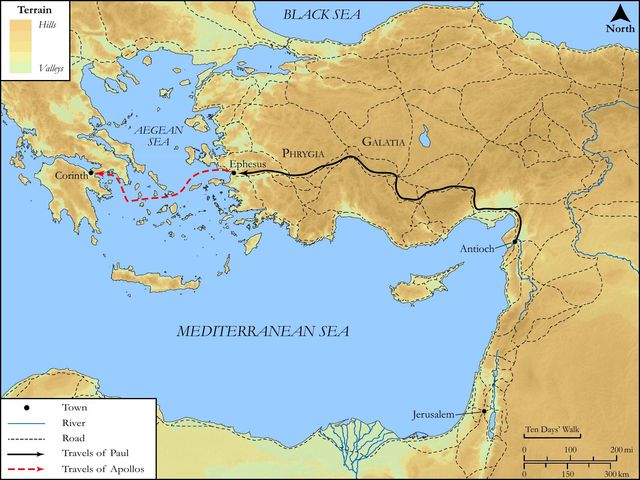
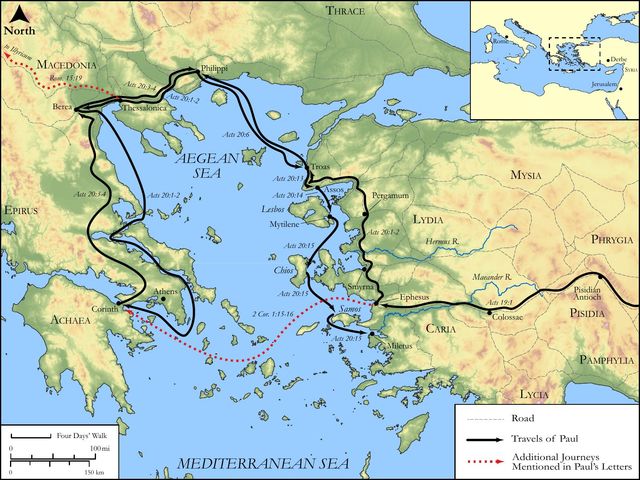
Ephesus was a city of great note in Asia, famous for a temple built there to Diana, which was one of the wonders of the world: thither Paul came to preach the gospel while Apollos was at Corinth (Act 19:1); while he was watering there, Paul was planting here, and grudged not that Apollos entered into his labours and was building upon his foundation, but rejoiced in it, and went on in the new work that was cut out for him at Ephesus with the more cheerfulness and satisfaction, because he knew that such an able minister of the New Testament as Apollos was now at Corinth, carrying on the good work there. Though there were those that made him the head of a party against Paul (Co1 1:12), yet Paul had no jealousy of him, nor any way disliked the affection the people had for him. Paul having gone through the country of Galatia and Phrygia, having passed through the upper coasts, Pontus and Bithynia, that lay north, at length came to Ephesus, where he had left Aquila and Priscilla, and there found them. At his first coming, he met with some disciples there, who professed faith in Christ as the true Messiah, but were as yet in the first and lowest form in the school of Christ, under his usher John the Baptist. They were in number about twelve (Act 19:7); they were much of the standing that Apollos was of when he came to Ephesus (for he knew only the baptism of John, Act 18:25), but they had not opportunity of being acquainted with Aquila and Priscilla, or had not been so long in Ephesus or were not so willing to receive instruction as Apollos was, otherwise they might have had the way of God expounded to them more perfectly, as Apollos had. Observe here,
I.How Paul catechised them.
He was told, probably by Aquila and Priscilla, that they were believers, that they did own Christ, and had given up their names to him; now Paul hereupon takes them under examination.
1.They did believe in the Son of God; but Paul enquires whether they had received the Holy Ghost, - whether they believed in the spirit, whose operations on the minds of men, for conviction, conversion, and comfort, were revealed some time after the doctrine of Jesus being the Christ, - whether they had been acquainted with, and had admitted, this revelation? This was not all; extraordinary gifts of the Holy Ghost were conferred upon the apostles and other disciples presently after Christ's ascension, which was frequently repeated upon occasion; had they participated in these gifts? "Have you received the Holy Ghost since you believed? Have you had that seal of the truth of Christ's doctrine in yourselves?" We are not now to expect any such extraordinary gifts as they had then. The canon of the New Testament being long since completed and ratified, we depend upon that as the most sure word of prophecy. But there are graces of the Spirit given to all believers, which are as earnests to them, Co2 1:22; Co2 5:5; Eph 1:13, Eph 1:14. Now it concerns us all who profess the Christian faith seriously to enquire whether we have received the Holy Ghost or not. The Holy Ghost is promised to all believers, to all petitioners (Luk 11:13); but many are deceived in this matter, thinking they have received the Holy Ghost when really they have not. As there are pretenders to the gifts of the Holy Ghost, so there are to his graces and comforts; we should therefore strictly examine ourselves, Have we received the Holy Ghost since we believed? The tree will be known by its fruits. Do we bring forth the fruits of the Spirit? Are we led by the Spirit? Do we walk in the Spirit? Are we under the government of the Spirit?
2.They owned their ignorance in this matter: "Whether there be a Holy Ghost is more than we know. That there is a promise of the Holy Ghost we know from the scriptures of the Old Testament, and that this promise will be fulfilled in its season we doubt not; but so much have we been out of the way of intelligence in this matter that we have not so much as heard whether the Holy Ghost be indeed yet given as a spirit of prophecy." They knew (as Dr. Lightfoot observes) that, according to the tradition of their nation, after the death of Ezra, Haggai, Zechariah, and Malachi, the Holy Ghost departed from Israel, and went up; and they professed that they had never heard of his return. They spoke as if they expected it, and wondered they did not hear of it, and were ready to welcome the notice of it. The gospel light, like that of the morning, shone more and more, gradually; not only clearer and clearer, in the discovery of truths not before heard of, but further and further, in the discovery of them to persons that had not before heard of them.
3.Paul enquired how they came to be baptized, if they knew nothing of the Holy Ghost; for, if they were baptized by any of Christ's ministers, they were instructed concerning the Holy Ghost, and were baptized in his name. "Know you not that Jesus being glorified, consequently the Holy Ghost is given? unto what then were you baptized? This is strange and unaccountable. What! baptized, and yet know nothing of the Holy Ghost? Surely your baptism was a nullity, if you know nothing of the Holy Ghost; for it is the receiving of the Holy Ghost that is signified and sealed by that washing of regeneration. Ignorance of the Holy Ghost is as inconsistent with a sincere profession of Christianity as ignorance of Christ is." Applying it to ourselves, it intimates that those are baptized to no purpose, and have received the grace of God therein in vain, that do not receive and submit to the Holy Ghost. It is also an enquiry we should often make, not only to whose honour we were born, but into whose service we were baptized, that we may study to answer the ends both of our birth and of our baptism. Let us often consider unto what we were baptized, that we may live up to our baptism.
4.They own that they were baptized unto John's baptism - eis to Iōannou baptisma that is, as I take it, they were baptized in the name of John, not by John himself (he was far enough from any such thought), but by some weak, well-meaning disciple of his, that ignorantly kept up his name as the head of a party, retaining the spirit and notion of those disciples of his that were jealous of the growth of Christ's interest, and complained to him of it, Joh 3:26. Some one or more of these, that found themselves much edified by John's baptism of repentance for the remission of sins, not thinking that the kingdom of heaven, which he spoke of as at hand, was so very near as it proved, ran away with that notion, rested in what they had, and thought they could not do better than to persuade others to do so too; and so, ignorantly, in a blind zeal for John's doctrine, they baptized here and there one in John's name, or, as it is here expressed, unto John's baptism, looking no further themselves, nor directing those that they baptized any further.
5.Paul explains to them the true intent and meaning of John's baptism, as principally referring to Jesus Christ, and so rectifies the mistake of those who had baptized them into the baptism of John, and had not directed them to look any further, but to rest in that. Those that have been left in ignorance, or led into error, by any infelicities of their education, should not therefore be despised nor rejected by those who are more knowing and orthodox, but should be compassionately instructed, and better taught, as these disciples were by Paul.
(1.)He owns that John's baptism was a very good thing, as far as it went: John verily baptized with the baptism of repentance. By this baptism he required people to be sorry for their sins, and to confess them and turn from them; and to bring any to this is a great point gained. But,
(2.)He shows them that John's baptism had a further reference, and he never designed that those he baptized should rest there, but told them that they should believe on him who should come after him, that is, on Christ Jesus, - that his baptism of repentance was designed only to prepare the way of the Lord, and to dispose them to receive and entertain Christ, whom he left them big with expectations of; nay, whom he directed them to: Behold the Lamb of God. "John was a great and good man; but he was only the harbinger, - Christ is the Prince. His baptism was the porch which you were to pass through, not the house you were to rest in; and therefore it was all wrong for you to be baptized into the baptism of John."
6.When they were thus shown the error they were led into, they thankfully accepted the discovery, and were baptized in the name of the Lord Jesus, Act 19:5. As for Apollos, of whom it was said (Act 18:25) that he knew the baptism of John - that he rightly understood the meaning of it when he was baptized with it, though he knew that only - yet, when he understood the way of God more perfectly, he was no again baptized, any more than Christ's first disciples that had been baptized with John's baptism and knew it referred to the Messiah at the door (and, with an eye to this, submitted to it), were baptized again. But to these disciples, who received it only with an eye to John and looked no further, as if he were their saviour, it was such a fundamental error as was as fatal to it as it would have been for any to be baptized in the name of Paul (Co1 1:13); and therefore, when they came to understand things better, they desired to be baptized in the name of the Lord Jesus, and were so: not by Paul himself, as we have reason to think, but by some of those who attended him. It does not therefore follow hence that there was not an agreement between John's baptism and Christ's, or that they were not for substance the same; much less does it follow that those who have been once baptized in the name of the Father, Son, and Holy Ghost (which is the appointed form of Christ's baptism), may be again baptized in the same name; for those that were baptized in the name of the Lord Jesus had never been so baptized before.
II.How Paul conferred the extraordinary gifts of the Holy Ghost upon them, Act 19:6.
1.Paul solemnly prayed to God to give them those gifts, signified by his laying his hands on them, which was a gesture used in blessing by the patriarchs, especially in conveying the great trust of the promise, as Gen 48:14. The Spirit being the great promise of the New Testament, the apostles conveyed it by the imposition of hands: "The Lord bless thee with that blessing, that blessing of blessings," Isa 44:3.
2.God granted the thing he prayed for: The Holy Ghost came upon them in a surprising overpowering manner, and they spoke with tongues and prophesied, as the apostles did and the first Gentile converts, Act 10:44. This was intended to introduce the gospel at Ephesus, and to awaken in the minds of men an expectation of some great things from it; and some think that it was further designed to qualify these twelve men for the work of the ministry, and that these twelve were the elders of Ephesus, to whom Paul committed the care and government of that church. They had the Spirit of prophesy, that they might understand the mysteries of the kingdom of God themselves, and the gift of tongues, that they might preach them to every nation and language. Oh, what a wonderful change was here made on a sudden in these men! those that but just now had not so much as heard that there was any Holy Ghost are now themselves filled with the Holy Ghost; for the Spirit, like the wind, blows where and when he listeth.
Historical interpretation
Five Centuries of Reception
4 surviving comments on this verse. Each one is dated, so this reads as a timeline rather than a list.
Select a marker to jump to its quote. Markers stagger vertically where authors wrote within a few decades of each other.
" And so "the baptism of repentance" was dealt with as if it were a candidate for the remission and sanctification shortly about to follow in Christ: for in that John used to preach "baptism for the remission of sins," the declaration was made with reference to future remission; if it be true, (as it is, ) that repentance is antecedent, remission subsequent; and this is "preparing the way.
John’s baptism had already raised the question, which our Lord himself posed for the Pharisees, whether it was something heavenly or just from earth. They, clearly not understanding because of their unbelief, could not come to a definite answer. We, however, having only a slight understanding that accords with our slight faith, can still judge that John’s baptism was, on the one hand, divine in that God commanded it, but on the other, it was not divine in its power. We read that John had been sent by the Lord for this purpose, which was still human in nature, for he, established as a preacher of repentance, which is a question of a person’s will, was offering nothing heavenly but was making way for the heavenly. Therefore, the scribes and the Pharisees who were unwilling to believe were also unwilling to undergo repentance. But if repentance is something human, then it must be that the baptism was of the very same nature, for had it been heavenly it would have given both the Holy Spirit and remission from sins. But no one forgives sins or grants the Holy Spirit but God alone. Besides, the Lord himself said that the Spirit would otherwise not descend unless he first should ascend to the Father. And so what the master would not yet give, the slave would surely not be able to offer. And again, later, in the Acts of the Apostles we find that those who had received John’s baptism had not received the Holy Spirit of whom they had never even been told. Therefoe, it was not of heaven because it offered nothing heavenly.
"And he said unto them, Unto what then were ye baptized? And they said, Unto John's baptism. Then said Paul, John verily baptized with the baptism of repentance, saying unto the people, that they should believe on Him who should come after him, that is, on Christ Jesus." And he did not say, The baptism of John is nothing, but, It is incomplete. Nor does he add this in so many words, but he taught them, and many received the Holy Ghost. From the baptism itself John prophesies: and Paul leads them to see that this is the meaning of John's baptism. "That they should believe on Him that was to come:" on what kind of Person? "I indeed baptize you with water, but He that cometh after me, shall baptize you with the Holy Ghost."
John baptized with the baptism of repentance. This baptism, he says, could not grant the remission of sins but could teach only repentance. For just as the sign of circumcision was a seal of the faith which they carried in the patriarchs, so this washing was accepted by the repentant people as a singular sign of their devotion: Yet this same thing was figuratively showing also the baptism of Christ, by which remission would be granted.
Continue studying Acts 19:4 across the web’s major study libraries — every link below opens this exact verse, chapter, or book on the destination site.
Read & Compare
 BibleGatewayThis verse in more than 200 translations and 70 languages.
 Bible.comThe YouVersion reader — hundreds of translations, reading plans, and highlights.
 ESV.orgCrossway's official English Standard Version reader.
 NET BibleThe NET translation with 60,000+ translators' notes on every rendering decision.
 STEP BibleTyndale House's free study tool — original text, vocabulary, and scholarly resources.
 BibliaLogos Bible Software's free web reader.
 USCCBThe New American Bible (Revised Edition) with the U.S. bishops' study notes.
Commentaries
 BibleHub CommentariesDozens of classic commentaries on this verse, gathered on one page.
 StudyLightMore than 100 commentary sets — the largest collection on the web.
 BibleRefPlain-English commentary on what this verse means, verse by verse.
 Enduring WordDavid Guzik's free commentary on this chapter, widely used by Bible teachers.
 Bible Study ToolsVerse commentary alongside Greek and Hebrew study aids.
Original Language & Research
- BibleHub InterlinearThe verse word by word — original language, transliteration, and English.
- BibleHub LexiconEvery word's original-language definition and Strong's entry.
 Blue Letter BibleDeep-study tools — Strong's numbers, concordance, and word studies.
 CNTR CollationThe earliest Greek manuscripts of this verse, collated letter by letter.
Sermons, Hymns & Audio


TrulyRandomVerse is not affiliated with these sites and doesn’t control their content. They’re linked because they’re genuinely useful.
Summary
Acts 19:4 records Paul's clarification to certain Ephesian disciples regarding the nature and purpose of John the Baptist's ministry. Paul explains that John's baptism was a call to repentance, preparing people to believe in the one who was to come after him, explicitly identified as Christ Jesus. This verse highlights the essential transition from a preparatory message to the full revelation of salvation found exclusively in faith in Jesus Christ.
Context
ShowHideLiterary Context
This verse is situated within Paul's third missionary journey, specifically during his extended stay in Ephesus, a significant center of pagan worship and intellectual discourse. Acts 19 opens with Paul encountering twelve disciples who, despite having received John's baptism, were unaware of the Holy Spirit. Paul's explanation in this verse serves as the immediate precursor to their subsequent baptism in the name of the Lord Jesus and their reception of the Holy Spirit, as detailed in Acts 19:5-6. The dialogue underscores the critical distinction between John's preparatory ministry and the full Christian experience.
Historical & Cultural Context
John the Baptist's ministry, though divinely appointed, operated within a specific historical and theological framework. His "baptism of repentance" was a public act symbolizing a turning away from sin and a readiness for the Messiah, echoing prophetic calls for spiritual renewal in Israel (e.g., Malachi 3:1). Ephesus itself was a bustling Roman provincial capital, home to the Temple of Artemis, one of the Seven Wonders of the Ancient World. In such a syncretistic environment, it was crucial for Paul to clarify the unique and ultimate authority of Christ, distinguishing Christian faith from other spiritual movements, including incomplete understandings of John's message.
Key Themes
ShowHideActs 19:4 contributes to several overarching themes in the book of Acts and the broader New Testament. It emphasizes the preparatory nature of John the Baptist's ministry, showing it as a divinely ordained but temporary stage that pointed directly to Christ, as seen in John 1:29-31. It also highlights the centrality of faith in Jesus Christ for salvation and the reception of the Holy Spirit, a foundational truth reiterated throughout Paul's epistles (e.g., Ephesians 2:8-9). Furthermore, the passage reinforces the progression of God's redemptive plan, moving from Old Covenant anticipations and preparatory ministries to the New Covenant fulfillment in Christ, which is fully realized through the Spirit's indwelling.
Exposition and Analysis
ShowHideKey Word Analysis
ShowHideThis verb signifies "to immerse, submerge" or "to make whelmed (i.e., fully wet)." In the New Testament, it is primarily used for ceremonial ablution, especially the ordinance of Christian baptism. Here, it refers to John's specific form of water immersion, which symbolized repentance and cleansing in preparation for the Messiah's coming.
Derived from a verb meaning "to change one's mind," metánoia denotes "compunction for guilt, including reformation" or "reversal of decision." John's baptism was specifically "of repentance," indicating a call to a fundamental change of heart and direction away from sin and towards God, as a prerequisite for engaging with the coming kingdom.
This verb means "to have faith (in, upon, or with respect to, a person or thing), i.e., credit." By implication, it means "to entrust (especially one's spiritual well-being to Christ)." Paul emphasizes that the ultimate goal of John's preaching was to lead people to this active, trusting faith in the Messiah who was to follow him.
Verse Breakdown
ShowHide"Then said Paul, John verily baptized with the baptism of repentance,"
Paul begins by affirming the validity and specific nature of John's baptism. He acknowledges that John's ministry was indeed from God, but its unique characteristic was its focus on "repentance." This highlights that John's baptism was not for salvation in itself, but a public declaration of a change of heart and a turning away from sin, preparing individuals for a deeper spiritual reality.
"saying unto the people, that they should believe on him which should come after him,"
This clause reveals the core message and forward-looking purpose of John's ministry. John consistently pointed beyond himself to a greater one who was to follow. His preaching was a direct command for the people to place their faith and trust in this coming figure, indicating that John's role was preparatory and incomplete without the arrival and acceptance of the Messiah.
"that is, on Christ Jesus."
Paul explicitly identifies the "him which should come after him" as "Christ Jesus." This clarification is crucial, as it leaves no ambiguity about the object of faith. John's entire ministry, including his baptism, served as a prophetic signpost directing people to the person and work of Jesus, the Anointed One, the Messiah. This statement bridges the gap between the Old Covenant anticipation and the New Covenant reality.
Literary Devices
ShowHideThe primary literary device at play in Acts 19:4 is Exposition or Didacticism. Paul is engaged in a clear, instructional explanation to correct a theological misunderstanding and provide a more complete understanding of God's redemptive plan. There is also an implicit Contrast being drawn between the preparatory nature of John's baptism and the ultimate, salvific nature of faith in Christ Jesus, which leads to the reception of the Holy Spirit. This contrast underscores the Fulfillment theme, where John's ministry is presented as a necessary but incomplete precursor that finds its ultimate purpose and completion in the person and work of Jesus Christ.
Theological and Thematic Connections
ShowHideActs 19:4 beautifully illustrates the continuity and progression of God's redemptive plan, emphasizing that all preparatory ministries, including John the Baptist's, ultimately converge on Christ. John's baptism of repentance was a divine call to prepare hearts, but it was always designed to lead people to a deeper, saving faith in Jesus. This verse underscores that true spiritual understanding and salvation are not found in rituals or partial truths, but in the full revelation of God's grace through His Son. It highlights the indispensable nature of faith in Christ as the culmination of God's promises and the sole means of receiving the Holy Spirit and eternal life.
Reflection and Application
ShowHideActs 19:4 serves as a powerful reminder that spiritual growth is often a journey of progressive understanding. Just as the Ephesian disciples needed further instruction to move from a partial understanding of John's baptism to the fullness of faith in Christ and the Holy Spirit, so too must believers today continually seek deeper knowledge and application of God's truth. This verse challenges us to examine the foundation of our faith: Is our trust placed solely in Christ Jesus, or are we relying on incomplete understandings, past experiences, or mere rituals? It calls us to ensure that our repentance is not an end in itself, but a turning to Christ, leading to a vibrant, Spirit-filled life. Our spiritual journey should always culminate in a deeper commitment to the One whom John heralded, recognizing that all true spiritual life flows from Him.
Questions for Reflection
ShowHideFAQ
ShowHideWhat was the difference between John's baptism and Christian baptism?
ShowHideJohn's baptism was a "baptism of repentance" (metanoia), signifying a turning away from sin and a preparation for the coming Messiah. It was a symbolic act of cleansing and readiness, but it did not confer the Holy Spirit or complete salvation. Christian baptism, initiated after Christ's death and resurrection, is performed "in the name of the Lord Jesus" and is associated with repentance, faith in Christ, forgiveness of sins, and the reception of the Holy Spirit, as seen in Acts 2:38 and Acts 19:5-6. While John's baptism prepared the way, Christian baptism signifies identification with Christ's death, burial, and resurrection, and the new life in the Spirit.
Christ-Centered Fulfillment
ShowHideActs 19:4 powerfully articulates the Christ-centered nature of all divine revelation and preparatory ministries. John the Baptist, though a pivotal figure, explicitly understood his role as subordinate to and preparatory for the Messiah. His baptism of repentance was not an end in itself, but a necessary step to awaken hearts and direct them to "him which should come after him, that is, on Christ Jesus." This highlights Jesus as the ultimate fulfillment of all Old Testament prophecies and the central figure of God's redemptive plan. John's ministry, as described in this verse, perfectly aligns with the New Testament's consistent portrayal of Jesus as the Lamb of God who takes away the sin of the world (John 1:29), the one who baptizes with the Holy Spirit and fire (Matthew 3:11), and the very embodiment of grace and truth (John 1:17). Thus, Acts 19:4 serves as a crucial reminder that every aspect of God's dealings with humanity ultimately points to and finds its complete meaning and efficacy in the person and finished work of Jesus Christ.