


Acts 1:5
Bible text: King James Version (1769 Blayney text) · Public domain
Bible text: Berean Standard Bible · Public domain
Bible text: American Standard Version (1901) · Public domain
Bible text: World English Bible, Messianic edition · Public domain
Bible text: Geneva Bible (1599) · Public domain
Bible text: Young's Literal Translation · Public domain
- ὅτιhotiforG3754CONJConjunction
- ἸωάννηςIōannēsJohnG2491N-NSM-PNoun Nominative Singular Masculine Individual
- μὲνmenindeedG3303PRTParticle or Disjunctive
- ἐβάπτισενebaptisenbaptizedG907V-AAI-3SVerb Aorist Active Indicative 3rd Singular
- ὕδατιhudatiwith waterG5204N-DSNNoun Dative Singular Neuter
- ὑμεῖςhumeisyou yourselvesG4771P-2NPPersonal pronoun Nominative 2nd Plural
- δὲdehoweverG1161CONJConjunction
- ἐνenwithG1722PREPPreposition
- πνεύματιpneumati[the] SpiritG4151N-DSNNoun Dative Singular Neuter
- βαπτισθήσεσθεbaptisthēsesthewill be baptizedG907V-FPI-2PVerb Future Passive Indicative 2nd Plural
- ἁγίῳhagiōHolyG40A-DSNAdjective Dative Singular Neuter
- οὐounotG3756PRT-NNegative Particle Negative
- μετὰmetaafterG3326PREPPreposition
- πολλὰςpollasmanyG4183A-APFAdjective Accusative Plural Feminine
- ταύταςtautastheseG3778D-APFDemonstrative pronoun Accusative Plural Feminine
- ἡμέραςhēmerasdaysG2250N-APFNoun Accusative Plural Feminine
English is a literal word-by-word gloss of the Greek, not the KJV's wording. Why?
This is the original text the KJV's translators worked from — each Greek word with its own literal English meaning in this verse, prepared by scholars at Tyndale House, Cambridge. The KJV translates whole sentences, not word by word, so its wording differs: one Greek word can become several English words, and the KJV may choose “charity” where the gloss reads “love”. Both are faithful — they answer different questions. For the KJV's own rendering, switch to the KJV text.
Details
See on the biblical-era maps
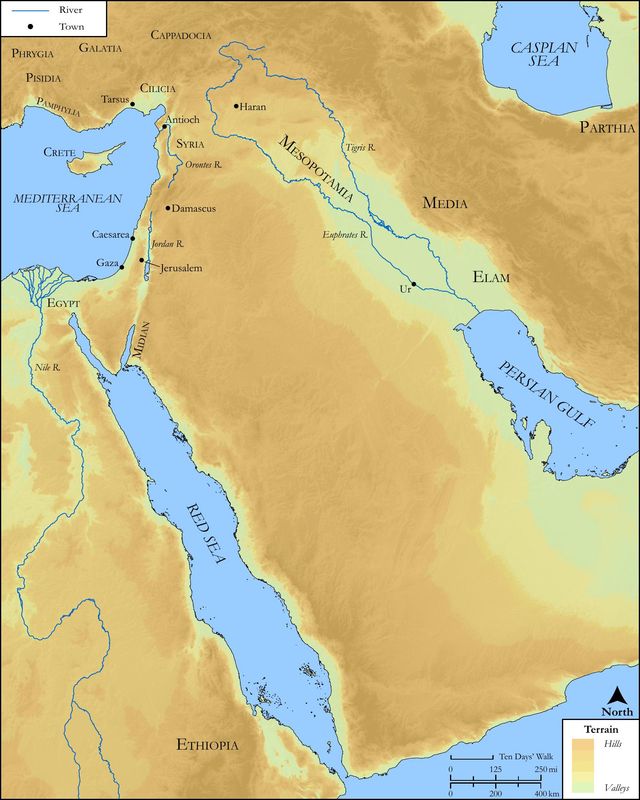
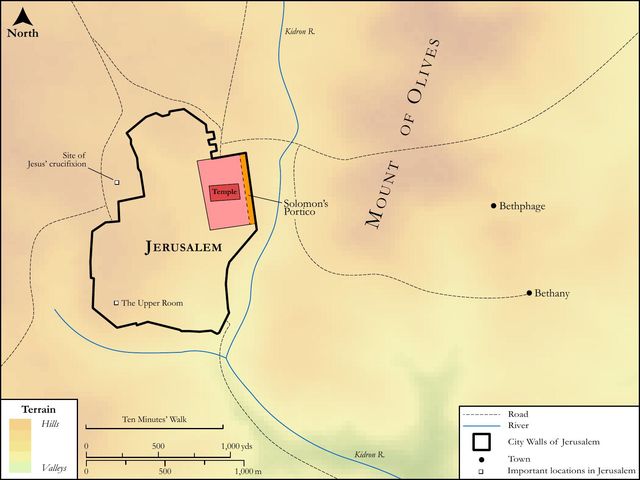
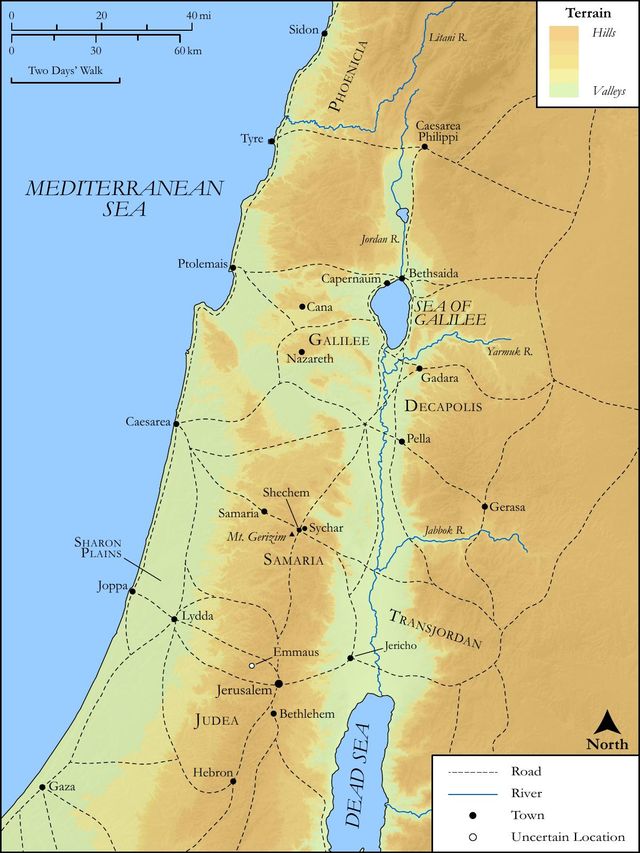
Study this verse
Public-domain commentary
Matthew Henry
From his Commentary on the Whole Bible. Henry comments on passages, not single verses — this entry covers Acts 1:1–5. His four-level outline is real structure in the source text, so it is rendered as structure.
In these verses, I. Theophilus is put in mind, and we in him, of St. Luke's gospel, which it will be of use for us to cast an eye upon before we enter upon the study of this book, that we may not only see how this begins where that breaks off, but that, as in water face answers to face, so do the acts of the apostles to the acts of their Master, the acts of his grace.
1.His patron, to whom he dedicates this book (I should rather say his pupil, for he designs, in dedicating it to him, to instruct and direct him, and not to crave his countenance or protection), is Theophilus, Act 1:1. In the epistle dedicatory before his gospel, he had called him most excellent Theophilus; here he calls him no more than O Theophilus; not that he had lost his excellency, nor that it was diminished and become less illustrious; but perhaps he had now quitted his place, whatever it was, for the sake of which that title was given him, - or he was now grown into years, and despised such titles of respect more than he had done, - or Luke was grown more intimate with him, and therefore could address him with the more freedom. It was usual with the ancients, both Christian and heathen writers, thus to inscribe their writings to some particular persons. But the directing some of the books of the scripture so is an intimation to each of us to receive them as if directed to us in particular, to us by name; for whatsoever things were written aforetime were written for our learning.
2.His gospel is here called the former treatise which he had made, which he had an eye to in writing this, intending this for a continuation and confirmation of that, ton prōton logon - the former word. What is written of the gospel is the word as truly as what was spoken; nay, we now know no unwritten word that we are to give credit to, but as it agrees with that which is written. He made the former treatise, and now is divinely inspired to make this, for Christ's scholars must go on towards perfection, Heb 6:1. And therefore their guides must help them on, must still teach the people knowledge (Ecc 12:9), and not think that their former labours, though ever so good, will excuse them from further labours; but they should rather be quickened and encouraged by them, as St. Luke here, who, because he had laid the foundation in a former treatise, will build upon it in this. Let not this therefore drive out that; let not new sermons and new books make us forget old ones, but put us in mind of them, and help us to improve them.
3.The contents of his gospel were that, all that, which Jesus began both to do and teach; and the same is the subject of the writings of the other three evangelists. Observe,
(1.)Christ both did and taught. The doctrine he taught was confirmed by the miraculous works he did, which proved him a teacher come from God (Joh 3:2); and the duties he taught were copied out in the holy gracious works he did, for he hath left us an example, and that such as proves him a teacher come from God too, for by their fruits you shall know them. Those are the best ministers that both do and teach, whose lives are a constant sermon.
(2.)He began both to do and teach; he laid the foundation of all that was to be taught and done in the Christian church. His apostles were to carry on and continue what he began, and to do and teach the same things. Christ set them in, and then left them to go on, but sent his Spirit to empower them both to do and teach. It is a comfort to those who are endeavouring to carry on the work of the gospel that Christ himself began it. The great salvation at the first began to be spoken by the Lord, Heb 2:3.
(3.)The four evangelists, and Luke particularly, have handed down to us all that Jesus began both to do and to teach; not all the particulars - the world could not have contained them; but all the heads, samples of all, so many, and in such variety, that by them we may judge of the rest. We have the beginnings of his doctrine (Mat 4:17), and the beginnings of his miracles, Joh 2:11. Luke had spoken, had treated, of all Christ's sayings and doings, had given us a general idea of them, though he had not recorded each in particular.
4.The period of the evangelical story is fixed to the day in which he was taken up, Act 1:2. Then it was that he left this world, and his bodily presence was no more in it. St. Mark's gospel concludes with the Lord's being received up into heaven (Mar 16:19), and so does St. Luke's, Luk 24:51. Christ continued doing and teaching to the last, till he was taken up to the other work he had to do within the veil.
II.The truth of Christ's resurrection is maintained and evidenced, Act 1:3.
That part of what was related in the former treatise was so material that it was necessary to be upon all occasions repeated. The great evidence of his resurrection was that he showed himself alive to his apostles; being alive, he showed himself so, and he was seen of them. They were honest men, and one may depend upon their testimony; but the question is whether they were not imposed upon, as many a well-meaning man is. No, they were not; for,
1.The proofs were infallible, tekmēria - plain indications, both that he was alive (he walked and talked with them, he ate and drank with them) and that it was he himself, and not another; for he showed them again and again the marks of the wounds in his hands, and feet, and side, which was the utmost proof the thing was capable of or required.
2.They were many, and often repeated: He was seen by them forty days, not constantly residing with them, but frequently appearing to them, and bringing them by degrees to be fully satisfied concerning it, so that all their sorrow for his departure was done away by it. Christ's staying upon earth so long after he had entered upon his state of exaltation and glory, to confirm the faith of his disciples and comfort their hearts, was such an instance of condescension and compassion to believers as may fully assure us that we have a high priest that is touched with the feeling of our infirmities.
III.A general hint given of the instructions he furnished his disciples with, now that he was about to leave them, and they, since he breathed on them and opened their understandings, were better able to receive them.
1.He instructed them concerning the work they were to do: He gave commandments to the apostles whom he had chosen. Note, Christ's choice is always attended with his charge. Those whom he elected into the apostleship expected he should give them preferments, instead of which he gave them commandments. When he took his journey, and gave authority to his servants, and to every one his work (Mar 13:34), he gave them commandments through the Holy Ghost, which he was himself filled with as Mediator, and which he had breathed into them. In giving them the Holy Ghost, he gave them his commandments; for the Comforter will be a commander; and his office was to bring to their remembrance what Christ had said. He charged those that were apostles by the Holy Ghost; so the words are placed. It was their receiving the Holy Ghost that sealed their commission, Joh 20:22. He was not taken up till after he had given them their charge, and so finished his work.
2.He instructed them concerning the doctrine they were to preach: He spoke to them of the things pertaining to the kingdom of God. He had given them a general idea of that kingdom, and the certain time it should be set up in the world (in his parable, Mk. 13), but here he instructed them more in the nature of it, as a kingdom of grace in this world and of glory in the other, and opened to them that covenant which is the great charter by which it is incorporated. Now this was intended,
(1.)To prepare them to receive the Holy Ghost, and to go through that which they were designed for. He tells them in secret what they must tell the world; and they shall find that the Spirit of truth, when he comes, will say the same.
(2.)To be one of the proofs of Christ's resurrection; so it comes in here; the disciples, to whom he showed himself alive, knew that it was he, not only by what he showed them, but by what he said to them. None but he could speak thus clearly, thus fully, of the things pertaining to the kingdom of God. He did not entertain them with discourses of politics or the kingdoms of men, of philosophy or the kingdom of nature, but pure divinity and the kingdom of grace, the things which most nearly concerned them, and those to whom they were sent.
IV.A particular assurance given them that they should now shortly receive the Holy Ghost, with orders given them to expect it (Act 1:4, Act 1:5), he being assembled together with them, probably in the interview at the mountain in Galilee which he had appointed before his death; for there is mention of their coming together again (Act 1:6), to attend his ascension. Though he had now ordered them to Galilee, yet they must not think to continue there; no, they must return to Jerusalem, and not depart thence. Observe,
1.The command he gives them to wait. This was to raise their expectations of something great; and something very great they had reason to expect from their exalted Redeemer.
(1.)They must wait till the time appointed, which is now not many days hence. Those that by faith hope promised mercies will come must with patience wait till they do come, according to the time, the set time. And when the time draws nigh, as now it did, we must, as Daniel, look earnestly for it, Dan 9:3.
(2.)They must wait in the place appointed, in Jerusalem, for there the Spirit must be first poured out, because Christ was to be as king upon the holy hill of Zion; and because the word of the Lord must go forth from Jerusalem; this must be the mother-church. There Christ was put to shame, and therefore there he will have this honour done him, and this favour is done to Jerusalem to teach us to forgive our enemies and persecutors. The apostles were more exposed to danger at Jerusalem than they would have been in Galilee; but we may cheerfully trust God with our safety, when we keep in the way of our duty. The apostles were now to put on a public character, and therefore must venture in a public station. Jerusalem was the fittest candlestick for those lights to be set up in.
2.The assurance he gives them that they shall not wait in vain.
(1.)The blessing designed them shall come, and they shall find it was worth waiting for; You shall be baptized with the Holy Ghost; that is, [1.] "The Holy Ghost shall be poured out upon you more plentifully than ever." They had already been breathed upon with the Holy Ghost (Joh 20:22), and they had found the benefit of it; but now they shall have larger measures of his gifts, graces, and comforts, and be baptized with them, in which there seems to be an allusion to those Old Testament promises of the pouring out of the Spirit, Joe 2:28; Isa 44:3; Isa 32:15. [2.] "You shall be cleansed and purified by the Holy Ghost," as the priests were baptized and washed with water, when they were consecrated to the sacred function: "They had the sign; you shall have the thing signified. You shall be sanctified by the truth, as the Spirit shall lead you more and more into it, and have your consciences purged by the witness of the Spirit, that you may serve the living God in the apostleship." [3.] "You shall hereby be more effectually than ever engaged to your Master, and to his guidance, as Israel was baptized unto Moses in the cloud, and in the sea; you shall be tied so fast to Christ that you shall never, for fear of any sufferings, forsake him again, as once you did."
(2.)Now this gift of the Holy Ghost he speaks of,
[1.]As the promise of the Father, which they had heard of him, and might therefore depend upon. First, The Spirit was given by promise, and it was at this time the great promise, as that of the Messiah was before (Luk 1:72), and that of eternal life is now, Jo1 2:25. Temporal good things are given by Providence, but the Spirit and spiritual blessings are given by promise, Gal 3:18. The Spirit of God is not given as the spirit of men is given us, and formed within us, by a course of nature (Zac 12:1), but by the word of God. 1. That the gift may be the more valuable, Christ thought the promise of the Spirit a legacy worth leaving to his church. 2. That it may be the more sure, and that the heirs of promise may be confident of the immutability of God's counsel herein. 3. That it may be of grace, peculiar grace, and may be received by faith, laying hold on the promise, and depending upon it. As Christ, so the Spirit, is received by faith. Secondly, It was the promise of the Father, 1. Of Christ's Father. Christ, as Mediator, had an eye to God as his Father, fathering his design, and owning it all along. 2. Of our Father, who, if he give us the adoption of sons, will certainly give us the Spirit of adoption, Gal 4:5, Gal 4:6. He will give the Spirit, as the Father of lights, as the Father of spirits, and as the Father of mercies; it is the promise of the Father. Thirdly, This promise of the Father they had heard from Christ many a time, especially in the farewell sermon he preached to them a little before he died, wherein he assured them, again and again, that the Comforter should come. This confirms the promise of God, and encourages us to depend upon it, that we have heard it from Jesus Christ; for in him all the promises of God are yea, and amen. "You have heard it from me; and I will make it good."
[2.]As the prediction of John Baptist; for so far back Christ here directs them to look (Act 1:5): "You have not only heard it from me, but you had it from John; when he turned you over to me, he said (Mat 3:11), I indeed baptize you with water, but he that comes after me shall baptize you with the Holy Ghost." It is a great honour that Christ now does to John, not only to quote his words, but to make this great gift of the Spirit, now at hand, to be the accomplishment of them. Thus he confirmeth the word of his servants, his messengers, Isa 44:26. But Christ can do more than any of his ministers. It is an honour to them to be employed in dispensing the means of grace, but it his prerogative to give the Spirit of grace. He shall baptize you with the Holy Ghost, shall teach you by his Spirit, and give his Spirit to make intercession in you, which is more than the best ministers preaching with us.
(3.)Now this gift of the Holy Ghost thus promised, thus prophesied of, thus waited for, is that which we find the apostles received in the next chapter, for in that this promise had its full accomplishment; this was it that should come, and we look for no other; for it is here promised to be given not many days hence. He does not tell them how many, because they must keep every day in a frame fit to receive it. Other scriptures speak of the gift of the Holy Ghost to ordinary believers; this speaks of that particular power which, by the Holy Ghost, the first preachers of the gospel, and planters of the church, were endued with, enabling them infallibly to relate to that age, and record to posterity, the doctrine of Christ, and the proofs of it; so that by virtue of this promise, and the performance of it, we receive the New Testament as of divine inspiration, and venture our souls upon it.
Historical interpretation
Nine Centuries of Reception
7 surviving comments on this verse. Each one is dated, so this reads as a timeline rather than a list.
Select a marker to jump to its quote. Markers stagger vertically where authors wrote within a few decades of each other.
The Passover affords a more than usually solemn day for baptism; when, withal, the Lord's passion, in which we are baptized, was completed. Nor will it be incongruous to interpret figuratively the fact that, when the Lord was about to celebrate the last Passover, He said to the disciples who were sent to make preparation, "You will meet a man bearing water." He points out the place for celebrating the Passover by the sign of water. After that, Pentecost is a most joyous space for conferring baptisms; wherein, too, the resurrection of the Lord was repeatedly proved among the disciples [Acts 1:3], and the hope of the advent of the Lord indirectly pointed to, in that, at that time, when He had been received back into the heavens [Acts 1:9], the angels told the apostles that "He would so come, as He had withal ascended into the heavens;" [Acts 1:11] at Pentecost, of course. But, moreover, when Jeremiah says, "And I will gather them together from the extremities of the land in the feast-day," he signifies the day of the Passover and of Pentecost, which is properly a "feast-day." However, every day is the Lord's; every hour, every time, is apt for baptism: if there is a difference in the solemnity, distinction there is none in the grace.
This grace was not in part, but his power was in full perfection; for as he who plunges into the waters and is baptized is encompassed on all sides by the waters, so were they also baptized completely by the Holy Spirit. The water, however, flows round the outside only, but the Spirit baptizes also the soul within, and that completely. And why do you wonder at this? Take an example from matter, a simple and common example, but one that helps the ordinary person. If the fire passing in through the mass of the iron makes the whole of it fire, so that what was cold becomes burning and what was black is made bright, if fire which is a body thus penetrates and works without hindrance in iron which is also a body, why wonder that the Holy Spirit enters into the very inmost recesses of the soul?
Consider also how necessary He made it for them to abide in Jerusalem, by promising that the Spirit should be granted them. For lest they should again flee away after His Ascension, by this expectation, as by a bond, He keeps them to that spot. But having said, "Wait for the promise of the Father, which ye have heard of Me," He then adds, "For John truly baptized with water, but ye shall be baptized with the Holy Ghost not many days hence." For now indeed He gives them to see the difference there was betwixt Him and John, plainly, and not as heretofore in obscure hints; for in fact He had spoken very obscurely, when He said, "Notwithstanding, he that is least in the kingdom of heaven is greater than he:" but now He says plainly, "John baptized with water, but ye shall be baptized with the Holy Ghost." And he no longer uses the testimony, but merely adverts to the person of John, reminding the disciples of what he had said, and shows them that they are now become greater than John; seeing they too are to baptize with the Spirit. Again, He did not say, I baptize you with the Holy Ghost, but, "Ye shall be baptized:" teaching us humility. For this was plain enough from the testimony of John, that it was Christ Himself Who should baptize: "He it is that shall baptize you with the Holy Ghost and with fire;" wherefore also He made mention of John.
The Gospels, then, are a history of what Christ did and said; but the Acts, of what that "other Comforter" said and did. Not but that the Spirit did many things in the Gospels also; even as Christ here in the Acts still works in men as He did in the Gospels; only then the Spirit wrought through the Temple, now through the Apostles: then, He came into the Virgin's womb, and fashioned the Temple; now, into Apostolic souls: then in the likeness of a dove; now, in the likeness of fire. And wherefore? Showing there the gentleness of the Lord, but here His taking vengeance also, He now puts them in mind of the judgment likewise. For, when need was to forgive, need was there of much gentleness; but now we have obtained the gift, it is henceforth a time for judgment and examination.
But why does Christ say, "Ye shall be baptized," when in fact there was no water in the upper room? Because the more essential part of Baptism is the Spirit, through Whom indeed the water has its operation; in the same manner our Lord also is said to be anointed, not that He had ever been anointed with oil, but because He had received the Spirit. Besides, we do in fact find them receiving a baptism with water and a baptism with the Spirit, and these at different moments. In our case both take place under one act, but then they were divided. For in the beginning they were baptized by John; since, if harlots and publicans went to that baptism, much rather would they who thereafter were to be baptized by the Holy Ghost.
Then, that the Apostles might not say, that they were always having it held out to them in promises (for indeed Christ had already discoursed much to them concerning the Spirit, that they should not imagine It to be an impersonal Energy or Operation), that they might not say this, then, He adds, "not many days hence." And He did not explain when, that they might always watch: but, that it would soon take place, He told them, that they might not faint; yet the exact time He refrained from adding, that they might always be vigilant. Nor does He assure them by this alone; I mean, by the shortness of the time, but withal by saying, "The promise which ye have heard of Me." For this is not, saith He, the only time I have told you, but already I have promised what I shall certainly perform. What wonder then that He does not signify the day of the final consummation, when this day which was so near He did not choose to reveal? And with good reason; to the end they may be ever wakeful, and in a state of expectation and earnest heed.
For John indeed baptized with water, but you will be baptized with the Holy Spirit. Baptisma in Greek is called tinctio in Latin. Wherefore, in some manuscripts we find it interpreted thus: For John indeed dipped with water, but you will be dipped in the Holy Spirit. Here the marvelous harmony of the words of the Lord and his precursor is evident. For he said to those whom he baptized, about the Lord: I baptized you with water, but he will baptize you with the Holy Spirit (Mark 1:8). And the Lord himself: John indeed baptized with water, but you will be baptized with the Holy Spirit. It should be noted as well that the baptism of the Lord in the Holy Spirit, which John had foretold, does not refer only to that time when the Apostles and other faithful of that time were baptized with water for the remission of sins, through the grace of the Holy Spirit given to them by the Lord; but also to this, when, with the Lord sending them, they received more fully the gifts of the same Spirit from heaven. But also now, whoever receives baptism for the remission of sins, is certainly baptized in the Holy Spirit, through whose gift they are both cleansed from all sins, and are aided so that they can progress in good deeds.
But you shall be baptized with the Holy Spirit not many days from now. The apostles had not yet been baptized, not with water, but with the Holy Spirit, whom we understand they had already been baptized, either with John's baptism (as some suppose), or (what is more credible) with Christ's baptism. For the ministry of baptizing had not been such that it had baptized servants through whom others would be baptized, for the ministry of that memorable humility was not lacking, when He washed their feet. Therefore, when the Lord said: For John indeed baptized with water, He did not add: But you shall baptize, but: But you shall be baptized with the Holy Spirit. For neither the apostles nor their followers, who baptize even to this day in the Church, can baptize otherwise than John, that is, with water, but only by invoking the name of Christ, the interior power of the Holy Spirit is present, which, with a man providing the water, purifies both the souls and bodies of the baptized, which was not done in John's baptism. For the Spirit had not yet been given, because Jesus had not yet been glorified (John VII).
For John's baptism provided neither spiritual grace nor forgiveness of sins, but the Lord's will forgive you and give you the Spirit in abundance.
Continue studying Acts 1:5 across the web’s major study libraries — every link below opens this exact verse, chapter, or book on the destination site.
Read & Compare
 BibleGatewayThis verse in more than 200 translations and 70 languages.
 Bible.comThe YouVersion reader — hundreds of translations, reading plans, and highlights.
 ESV.orgCrossway's official English Standard Version reader.
 NET BibleThe NET translation with 60,000+ translators' notes on every rendering decision.
 STEP BibleTyndale House's free study tool — original text, vocabulary, and scholarly resources.
 BibliaLogos Bible Software's free web reader.
 USCCBThe New American Bible (Revised Edition) with the U.S. bishops' study notes.
Commentaries
 BibleHub CommentariesDozens of classic commentaries on this verse, gathered on one page.
 StudyLightMore than 100 commentary sets — the largest collection on the web.
 BibleRefPlain-English commentary on what this verse means, verse by verse.
 Enduring WordDavid Guzik's free commentary on this chapter, widely used by Bible teachers.
 Bible Study ToolsVerse commentary alongside Greek and Hebrew study aids.
Original Language & Research
- BibleHub InterlinearThe verse word by word — original language, transliteration, and English.
- BibleHub LexiconEvery word's original-language definition and Strong's entry.
 Blue Letter BibleDeep-study tools — Strong's numbers, concordance, and word studies.
 CNTR CollationThe earliest Greek manuscripts of this verse, collated letter by letter.
Sermons, Hymns & Audio


TrulyRandomVerse is not affiliated with these sites and doesn’t control their content. They’re linked because they’re genuinely useful.
Summary
Acts 1:5 records Jesus' final pre-ascension promise to His disciples, drawing a sharp distinction between John the Baptist's preparatory water baptism and the imminent, empowering baptism with the Holy Spirit. This declaration shifts the disciples' focus from temporal, political expectations of a restored kingdom to the spiritual empowerment necessary for their global mission, signaling a new era defined by the indwelling and active presence of God's Spirit.
Context
ShowHideLiterary Context
This verse is situated within the opening chapter of the Book of Acts, which serves as a divinely inspired sequel to the Gospel of Luke, both penned by the physician Luke. Immediately preceding Acts 1:5, Jesus has spent forty days post-resurrection appearing to His disciples and speaking about the kingdom of God (Acts 1:3). The disciples, still clinging to nationalistic hopes, then ask if He will at this time restore the kingdom to Israel (Acts 1:6). Jesus' response in Acts 1:5, followed by the commission in Acts 1:8, directly addresses and corrects their temporal understanding, reorienting their mission from political restoration to spiritual witness. The promise of the Spirit is the hinge upon which the narrative of the early church's expansion turns, setting the stage for the dramatic events of Pentecost in Acts 2).
Historical & Cultural Context
The Jewish people, having endured centuries of foreign domination, harbored strong messianic expectations centered on a political deliverer who would liberate Israel from Roman rule and restore the Davidic kingdom. This hope is evident in the disciples' question in Acts 1:6). John the Baptist's ministry, though divinely appointed, was transitional, preparing the way for the Messiah by calling people to repentance and symbolizing that repentance through water baptism. This practice was familiar within Jewish purification rituals, but John's baptism was unique in its eschatological significance. Jesus' promise of a "baptism with the Holy Ghost" would have been understood by the disciples in light of Old Testament prophecies (e.g., Joel 2:28-29) that spoke of a future outpouring of God's Spirit, signaling a new covenant era and divine empowerment.
Key Themes
ShowHideActs 1:5 contributes significantly to several overarching themes in the book. Firstly, it highlights the continuity and discontinuity of God's redemptive plan. While John's ministry was essential for preparing hearts, Jesus introduces a new, more profound spiritual reality. Secondly, the verse underscores the centrality of the Holy Spirit in the life and mission of the church. The Spirit is presented not merely as an abstract concept but as a dynamic, empowering presence essential for witness and ministry, directly linking to the promise of power in Acts 1:8). Thirdly, it emphasizes the fulfillment of prophecy, as Jesus' words echo Old Testament promises of the Spirit's outpouring, a theme that finds its dramatic realization on the Day of Pentecost (Acts 2:1-4). This promise also recalls Jesus' own teachings about the coming Helper or Advocate found in John 14-16).
Exposition and Analysis
ShowHideKey Word Analysis
ShowHideMeaning "to immerse, submerge; to make whelmed (i.e. fully wet); used only (in the New Testament) of ceremonial ablution, especially (technically) of the ordinance of Christian baptism." In this context, it signifies a complete immersion or overwhelming experience. When applied to the Holy Spirit, it denotes a profound, transformative envelopment by the Spirit's presence and power, distinct from the physical act of water baptism.
A primary particle (adversative or continuative), often translated as "but," "and," or "moreover." Here, it functions adversatively, signaling a sharp contrast between John's water baptism and the Spirit baptism. It emphasizes the qualitative difference and the newness of what Jesus is to inaugurate.
Meaning "sacred (physically, pure, morally blameless or religious, ceremonially, consecrated)." It describes the divine nature of the Spirit, emphasizing His purity, distinctness, and consecrated character.
Meaning "a current of air, i.e. breath (blast) or a breeze; by analogy or figuratively, a spirit, i.e. (human) the rational soul, (by implication) vital principle, mental disposition, etc., or (superhuman) an angel, demon, or (divine) God, Christ's spirit, the Holy Spirit." In the KJV, "Ghost" is synonymous with "Spirit." It conveys the unseen, powerful, and life-giving nature of the third person of the Trinity.
Verse Breakdown
ShowHide"For John truly baptized with water;"
This clause serves as a factual premise, acknowledging the widely recognized and accepted ministry of John the Baptist. John's baptism was a public act of repentance, a symbolic washing that prepared people for the coming Messiah. It was an external sign, signifying a change of heart and a readiness for God's new work. The word "truly" (G3303 mén) emphasizes the undeniable reality and validity of John's ministry.
"but ye shall be baptized with the Holy Ghost"
This is the pivotal contrast. The particle "but" (G1161 dé) introduces a profound shift from the external and preparatory to the internal and empowering. The disciples are promised an immersion, not in water, but "with" (G1722 en) the Holy Spirit. This signifies a complete envelopment and saturation by the divine presence and power of God Himself, a spiritual reality far surpassing any symbolic ritual. This baptism would empower them for a new kind of life and ministry.
"not many days hence."
This final phrase provides a specific, albeit short, timeframe for the fulfillment of the promise. "Not many days hence" (G3756 ou G3326 metá G4183 polýs G2250 hēméra G5025 taútais) indicates the imminence of the event, building anticipation for the outpouring of the Spirit. This precise timing underscores the divine orchestration of events, leading directly to the Day of Pentecost, which occurred approximately ten days after Jesus' ascension.
Literary Devices
ShowHideActs 1:5 employs several significant literary devices. Contrast is the most prominent, highlighted by the conjunction "but," which sharply distinguishes John's water baptism from the Holy Spirit baptism. This contrast emphasizes the qualitative difference between a symbolic, preparatory act and a profound, empowering spiritual experience. The verse also utilizes Foreshadowing, as Jesus' promise directly anticipates the dramatic outpouring of the Holy Spirit at Pentecost, which marks the birth of the church and the beginning of its global mission. Furthermore, there is an Allusion to earlier prophetic promises (e.g., Joel 2:28-29) and Jesus' own teachings about the coming of the Comforter (John 14-16), placing this pivotal moment within the broader sweep of God's redemptive history.
Theological and Thematic Connections
ShowHideActs 1:5 is a foundational theological statement, distinguishing between the preparatory nature of John's water baptism and the transformative, empowering reality of the Spirit's baptism. It underscores that while water baptism is a significant outward sign of repentance and identification with Christ, the baptism with the Holy Spirit is an internal, divine work that equips believers for witness and service. This Spirit-baptism is not merely an experience but an endowment of power, fulfilling Old Testament prophecies and Jesus' own promises, enabling the church to carry out its mission effectively. It signifies the inauguration of the new covenant age, where God's Spirit indwells and empowers His people in an unprecedented way.
Reflection and Application
ShowHideActs 1:5 profoundly shapes our understanding of Christian life and mission. It reminds us that our effectiveness in serving God and witnessing to the world is not dependent on our own strength or wisdom, but on the empowering presence of the Holy Spirit. Just as the disciples needed this divine enablement to fulfill the Great Commission, so too do believers today. This verse encourages us to actively seek and rely on the Spirit's power, recognizing that the Christian life is meant to be lived in dynamic partnership with God. It challenges us to move beyond mere external religious observances to a deep, internal experience of God's indwelling Spirit, allowing Him to transform us and equip us for every good work.
Questions for Reflection
ShowHideFAQ
ShowHideWhat is the difference between John's baptism and the baptism with the Holy Ghost mentioned here?
ShowHideJohn's baptism was a baptism with water, symbolizing repentance from sin and preparation for the coming Messiah. It was a visible, external act. The baptism with the Holy Ghost, as promised by Jesus in Acts 1:5, is an internal, spiritual immersion into the power and presence of God's Spirit. It signifies the indwelling and empowering of believers for service and witness, marking a new covenant reality. While John's baptism pointed forward, the Spirit baptism brings the promised divine enablement.
Did the disciples receive the Holy Spirit before Pentecost, or was Acts 1:5 their first encounter with the Spirit?
ShowHideThe disciples had certainly experienced the Holy Spirit's influence before Pentecost. Jesus had breathed on them, saying, "Receive ye the Holy Ghost" (John 20:22), which likely signified a commissioning and an initial impartation of the Spirit for their understanding and initial ministry. However, Acts 1:5 refers to a distinct, overwhelming "baptism" or outpouring, a corporate endowment of power for global witness that was fulfilled dramatically on the Day of Pentecost (Acts 2:1-4). This was a new level of empowerment, equipping them for the unprecedented task ahead.
Christ-Centered Fulfillment
ShowHideActs 1:5 finds its Christ-centered fulfillment in the person and work of Jesus as the one who baptizes with the Holy Spirit. John the Baptist himself prophesied that he baptized with water, but "He that cometh after me is mightier than I... he shall baptize you with the Holy Ghost, and with fire" (Matthew 3:11). Jesus, through His death, resurrection, and ascension, secured the outpouring of the Spirit, fulfilling this very promise. His ascension to the Father's right hand (Acts 2:33) was the prerequisite for the Spirit's coming, as He promised, "If I go not away, the Comforter will not come unto you; but if I depart, I will send him unto you" (John 16:7). Thus, the baptism with the Holy Spirit is a direct result of Christ's finished work and His ongoing intercession, demonstrating His continued reign and power from heaven, empowering His church to continue His mission on earth. The Spirit's indwelling makes believers temples of God (1 Corinthians 6:19) and enables them to live out the very life of Christ, bearing witness to His saving grace to the ends of the earth (Acts 1:8).