


John 20:22
Bible text: King James Version (1769 Blayney text) · Public domain
Bible text: Berean Standard Bible · Public domain
Bible text: American Standard Version (1901) · Public domain
Bible text: World English Bible, Messianic edition · Public domain
Bible text: Geneva Bible (1599) · Public domain
Bible text: Young's Literal Translation · Public domain
- καὶkaiAndG2532CONJConjunction
- τοῦτοtoutothisG3778D-ASNDemonstrative pronoun Accusative Singular Neuter
- εἰπὼνeipōnhaving saidG2036V-2AAP-NSMVerb 2nd Aorist Active Participle Nominative Singular Masculine
- ἐνεφύσησενenephusēsenHe breathed on [them]G1720V-AAI-3SVerb Aorist Active Indicative 3rd Singular
- καὶkaiandG2532CONJConjunction
- λέγειlegeiHe saysG3004V-PAI-3SVerb Present Active Indicative 3rd Singular
- αὐτοῖς·autoisto themG846P-DPMPersonal pronoun Dative Plural Masculine
- λάβετεlabetedo receiveG2983V-2AAM-2PVerb 2nd Aorist Active Imperative 2nd Plural
- πνεῦμαpneuma[the] SpiritG4151N-ASNNoun Accusative Singular Neuter
- ἅγιονhagionHolyG40A-ASNAdjective Accusative Singular Neuter
English is a literal word-by-word gloss of the Greek, not the KJV's wording. Why?
This is the original text the KJV's translators worked from — each Greek word with its own literal English meaning in this verse, prepared by scholars at Tyndale House, Cambridge. The KJV translates whole sentences, not word by word, so its wording differs: one Greek word can become several English words, and the KJV may choose “charity” where the gloss reads “love”. Both are faithful — they answer different questions. For the KJV's own rendering, switch to the KJV text.
Details
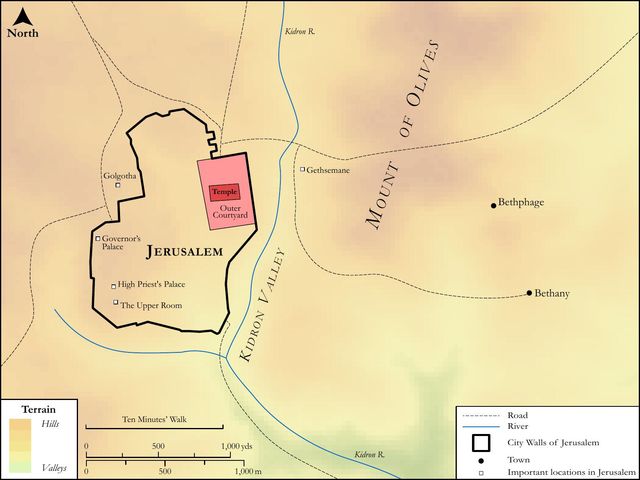
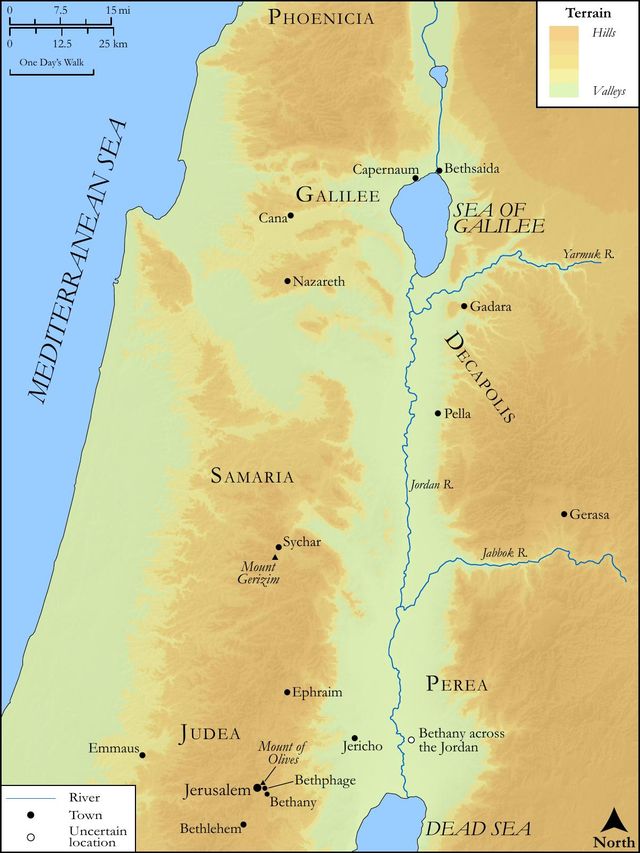
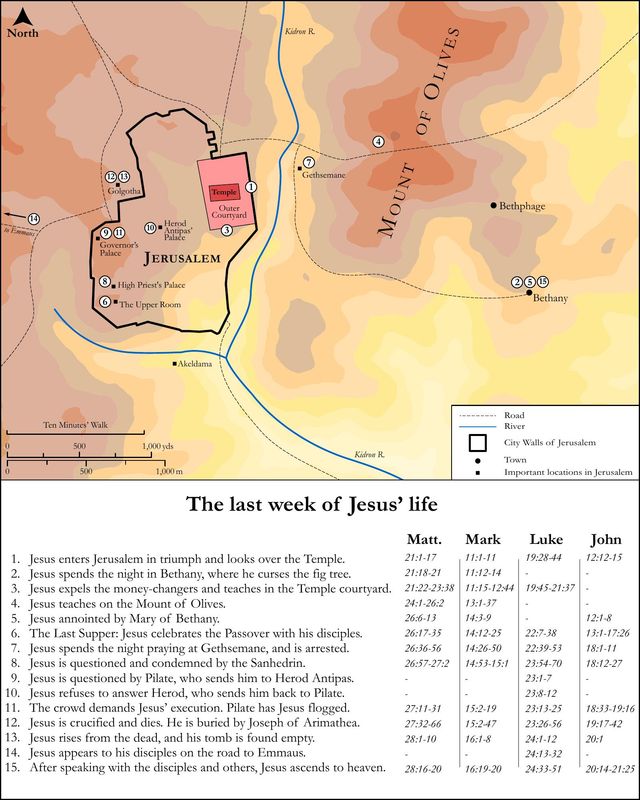
See on the biblical-era maps
Study this verse
Public-domain commentary
Matthew Henry
From his Commentary on the Whole Bible. Henry comments on passages, not single verses — this entry covers John 20:19–25. His four-level outline is real structure in the source text, so it is rendered as structure.
The infallible proof of Christ's resurrection was his showing himself alive, Act 1:3. In these verses, we have an account of his first appearance to the college of the disciples, on the day on which he rose. He had sent them the tidings of his resurrection by trusty and credible messengers; but to show his love to them, and confirm their faith in him, he came himself, and gave them all the assurances they could desire of the truth of it, that they might not have it by hearsay only, and at second hand, but might themselves be eye-witnesses of his being alive, because they must attest it to the world, and build the church upon that testimony. Now observe here,
I.When and where this appearance was, Joh 20:19.
It was the same day that he rose, being the first day of the week, the day after the Jewish sabbath, at a private meeting of the disciples, ten of them, and some more of their friends with them, Luk 24:33.
There are three secondary ordinances (as I may call them) instituted by our Lord Jesus, to continue in his church, for the support of it, and for the due administration of the principal ordinances - the word, sacraments, and prayer; these are, the Lord's day, solemn assemblies, and standing ministry. The mind of Christ concerning each of these is plainly intimated to us in these verses; of the first two, here, in the circumstances of this appearance, the other Joh 20:21. Christ's kingdom was to be set up among men, immediately upon his resurrection; and accordingly we find the very day he arose, though but a day of small things, yet graced with those solemnities which should help to keep up a face of religion throughout all the ages of the church.
1.Here is a Christian sabbath observed by the disciples, and owned by our Lord Jesus. The visit Christ made to his disciples was on the first day of the week. And the first day of the week is (I think) the only day of the week, or month, or year, that is ever mentioned by number in all the New Testament; and this is several times spoken of as a day religiously observed. Though it was said here expressly (Joh 20:1) that Christ arose on the first day of the week, and it might have been sufficient to say here (Joh 20:19), he appeared the same day at evening; yet, to put an honour upon the day, it is repeated, being the first day of the week; not that the apostles designed to put honour upon the day (they were yet in doubt concerning the occasion of it), but God designed to put honour upon it, by ordering it that they should be altogether, to receive Christ's first visit on that day. Thus, in effect, he blessed and sanctified that day, because in it the Redeemer rested.
2.Here is a Christian assembly solemnized by the disciples, and also owned by the Lord Jesus. Probably the disciples met here for some religious exercise, to pray together; or, perhaps, they met to compare notes, and consider whether they had sufficient evidence of their Master's resurrection, and to consult what was now to be done, whether they should keep together or scatter; they met to know one another's minds, strengthen one another's hands, and concert proper measures to be taken in the present critical juncture. This meeting was private, because they durst not appear publicly, especially in a body. They met in a house, but they kept the door shut, that they might not be seen together, and that no one might come among them but such as they knew; for they feared the Jews, who would prosecute the disciples as criminals, that they might seem to believe the lie they would deceive the world with, that his disciples came by night, and stole him away. Note,
(1.)The disciples of Christ, even in difficult times, must not forsake the assembling of themselves together, Heb 10:25. Those sheep of the flock were scattered in the storm; but sheep are sociable, and will come together again. It is no new thing for the assemblies of Christ's disciples to be driven into corners, and forced into the wilderness, Rev 12:14; Pro 28:12.
(2.)God's people have been often obliged to enter into their chambers, and shut their doors, as here, for fear of the Jews. Persecution is allotted them, and retirement from persecution is allowed them; and then where shall we look for them but in dens and caves of the earth. It is a real grief, but no real reproach, to Christ's disciples, thus to abscond.
II.What was said and done in this visit Christ made to his disciples, and his interview between them.
When they were assembled, Jesus came among them, in his own likeness, yet drawing a veil over the brightness of his body, now begun to be glorified, else it would have dazzled their eyes, as in his transfiguration. Christ came among them, to give them a specimen of the performance of his promise, that, where two or three are gathered together in his name, he will be in the midst of them. He came, though the doors were shut. This does not at all weaken the evidence of his having a real human body after his resurrection; though the doors were shut, he knew how to open them without any noise, and come in so that they might not hear him, as formerly he had walked on the water, and yet had a true body. It is a comfort to Christ's disciples, when their solemn assemblies are reduced to privacy, that no doors can shut out Christ's presence from them. We have five things in this appearance of Christ: -
(1.)His kind and familiar salutation of his disciples: He said, Peace be unto you. This was not a word of course, though commonly used so at the meeting of friends, but a solemn, uncommon benediction, conferring upon them all the blessed fruits and effects of his death and resurrection. The phrase was common, but the sense was now peculiar. Peace be unto you is as much as, All good be to you, all peace always by all means. Christ had left them his peace for their legacy, Joh 14:27. By the death of the testator the testament was become of force, and he was now risen from the dead, to prove the will, and to be himself the executor of it. Accordingly, he here makes prompt payment of the legacy: Peace be unto you. His speaking peace makes peace, creates the fruit of the lips, peace; peace with God, peace in your own consciences, peace with one another; all this peace be with you; not peace with the world, but peace in Christ. His sudden appearing in the midst of them when they were full of doubts concerning him, full of fears concerning themselves, could not but put them into some disorder and consternation, the noise of which waves he stills with this word, Peace be unto you.
(2.)His clear and undeniable manifestation of himself to them, Joh 20:20. And here observe,
[1.]The method he took to convince them of the truth of his resurrection, They now saw him alive whom multitudes had seen dead two or three days before. Now the only doubt was whether this that they saw alive was the same individual body that had been seen dead; and none could desire a further proof that it was so than the scars or marks of the wounds in the body. Now, First, The marks of the wounds, and very deep marks (though without any pain or soreness), remained in the body of the Lord Jesus even after his resurrection, that they might be demonstrations of the truth of it. Conquerors glory in the marks of their wounds. Christ's wounds were to speak on earth that it was he himself, and therefore he arose with them; they were to speak in heaven, in the intercession he must ever live to make, and therefore he ascended with them, and appeared in the midst of the throne, a Lamb as it had been slain, and bleeding afresh, Rev 5:6. Nay, it should seem, he will come again with his scars, that they may look on him whom they pierced. Secondly, These marks he showed to his disciples, for their conviction. They had not only the satisfaction of seeing him look with the same countenance, and hearing him speak with the same voice they had been so long accustomed to, Sic oculos, sic ille manus, sic ora, ferebat - Such were his gestures, such his eyes and hands! but they had the further evidence of these peculiar marks: he opened his hands to them, that they might see the marks of the wounds on them; he opened his breast, as the nurse hers to the child, to show them the wound there. Note, The exalted Redeemer will ever show himself open-handed and open-hearted to all his faithful friends and followers. When Christ manifests his love to believers by the comforts of his Spirit, assures them that because he lives they shall live also, then he shows them his hands and his side.
[2.]The impression it made upon them, and the good it did them. First, They were convinced that they saw the Lord: so was their faith confirmed. At first, they thought they saw an apparition only, a phantasm; but now they knew it was the Lord himself. Thus many true believers, who, while they were weak, feared their comforts were but imaginary, afterwards find them, through grace, real and substantial. They ask not, Is it the Lord? but are assured, it is he. Secondly, Then they were glad; that which strengthened their faith raised their joy; believing they rejoice. The evangelist seems to write it with somewhat of transport and triumph. Then! then! were the disciples glad, when they saw the Lord, If it revived the spirit of Jacob to hear that Joseph was yet alive, how would it revive the heart of these disciples to hear that Jesus is again alive? It is life from the dead to them. Now that word of Christ was fulfilled (Joh 16:22), I will see you again, and your heart shall rejoice. This wiped away all tears from their eyes. Note, A sight of Christ will gladden the heart of a disciple at any time; the more we see of Christ, the more we shall rejoice in him; and our joy will never be perfect till we come where we shall see him as he is.
(3.)The honourable and ample commission he gave them to be his agents in the planting of his church, Joh 20:21. Here is,
[1.]The preface to their commission, which was the solemn repetition of the salutation before: Peace be unto you. This was intended, either, First, To raise their attention to the commission he was about to give them. The former salutation was to still the tumult of their fear, that they might calmly attend to the proofs of his resurrection; this was to reduce the transport of their joy, that they might sedately hear what he had further to say to them; or, Secondly, To encourage them to accept of the commission he was giving them. Though it would involve them in a great deal of trouble, yet he designed their honour and comfort in it, and, in the issue, it would be peace to them. Gideon received his commission with this word, Peace be unto thee, Jdg 6:22, Jdg 6:23. Christ is our Peace; if he is with us, peace is to us. Christ was now sending the disciples to publish peace to the world (Isa 52:7), and he here not only confers it upon them for their own satisfaction, but commits it to them as a trust to be by them transmitted to all the sons of peace, Luk 10:5, Luk 10:6.
[2.]The commission itself, which sounds very great: As my Father hath sent me, even so send I you.
First, It is easy to understand how Christ sent them; he appointed them to go on with his work upon earth, and to lay out themselves for the spreading of his gospel, and the setting up of his kingdom, among men. He sent them authorized with a divine warrant, armed with a divine power, - sent them as ambassadors to treat of peace, and as heralds to proclaim it, - sent them as servants to bid to the marriage. Hence they were called apostles - men sent.
Secondly, But how Christ sent them as the Father sent him is not so easily understood; certainly their commissions and powers were infinitely inferior to his; but, 1. Their work was of the same kind with his, and they were to go on where he left off. They were not sent to be priests and kings, like him, but only prophets. As he was sent to bear witness to the truth, so were they; not to be mediators of the reconciliation, but only preachers and publishers of it. Was he sent, not to be ministered to, but to minister? not to do his own will, but the will of him that sent him? not to destroy the law and the prophets, but to fill them up? So were they. As the Father sent him to the lost sheep of the house of Israel, so he sent them into all the world. 2. He had a power to send them equal to that which the Father had to send him. Here the force of the comparison seems to lie. By the same authority that the Father sent me do I send you. This proves the Godhead of Christ; the commissions he gave were of equal authority with those which the Father gave, and as valid and effectual to all intents and purposes, equal with those he gave to the Old Testament prophets in visions. The commissions of Peter and John, by the plain word of Christ, are as good as those of Isaiah and Ezekiel, by the Lord sitting on his throne; nay, equal with that which was given to the Mediator himself for his work. Had he an incontestable authority, and an irresistible ability, for his work? so had they for theirs. Or thus, As the Father hath sent me is, as it were, the recital of his power; by virtue of the authority given him as a Mediator, he gave authority to them, as his ministers, to act for him, and in his name, with the children of men; so that those who received them, or rejected them, received or rejected him, and him that sent him, Joh 13:20.
(4.)The qualifying of them for the discharge of the trust reposed in them by their commission (Joh 20:22): He breathed on them, and said, Receive ye the Holy Ghost. Observe,
[1.]The sign he used to assure them of, and affect them with, the gift he was now about to bestow upon them: He breathed on them; not only to show them, by this breath of life, that he himself was really alive, but to signify to them the spiritual life and power which they should receive from him for all the services that lay before them. Probably he breathed upon them all together, not upon each severally and, though Thomas was not with them, yet the Spirit of the Lord knew where to find him, as he did Eldad and Medad, Num 11:26. Christ here seems to refer to the creation of man at first, by the breathing of the breath of life into him (Gen 2:7), and to intimate that he himself was the author of that work, and that the spiritual life and strength of ministers and Christians are derived from him, and depend upon him, as much as the natural life of Adam and his seed. As the breath of the Almighty gave life to man and began the old world, so the breath of the mighty Saviour gave life to his ministers, and began a new world, Job 33:4. Now this intimates to us, First, That the Spirit is the breath of Christ, proceeding from the Son. The Spirit, in the Old Testament, is compared to breath (Eze 37:9), Come, O breath; but the New Testament tells us it is Christ's breath. The breath of God is put for the power of his wrath (Isa 11:4; Isa 30:33); but the breath of Christ signifies the power of his grace; the breathing of threatenings is changed into the breathings of love by the mediation of Christ. Our words are uttered by our breath, so the word of Christ is spirit and life. The word comes from the Spirit, and the Spirit comes along with the word. Secondly, That the Spirit is the gift of Christ. The apostles communicated the Holy Ghost by the laying on of hands, those hands being first lifted up in prayer, for they could only beg this blessing, and carry it as messengers; but Christ conferred the Holy Ghost by breathing, for he is the author of the gift, and from him it comes originally. Moses could not give his Spirit, God did it (Num 11:17); but Christ did it himself.
[2.]The solemn grant he made, signified by this sign, Receive ye the Holy Ghost, in part now, as an earnest of what you shall further receive not many days hence." They now received more of the Holy Ghost than they had yet received. Thus spiritual blessings are given gradually; to him that has shall be given. Now that Jesus began to be glorified more of the Spirit began to be given: see Joh 7:39. Let us see what is contained in this grant. First, Christ hereby gives them assurance of the Spirit's aid in their future work, in the execution of the commission now given them: "I send you, and you shall have the Spirit to go along with you." Now the Spirit of the Lord rested upon them to qualify them for all the services that lay before them. Whom Christ employs he will clothe with his Spirit, and furnish with all needful powers. Secondly, He hereby gives them experience of the Spirit's influences in their present case. He had shown them his hands and his side, to convince them of the truth of his resurrection; but the plainest evidences will not of themselves work faith, witness the infidelity of the soldiers, who were the only eye-witnesses of the resurrection. "Therefore receive ye the Holy Ghost, to work faith in you, and to open your understandings." They were now in danger of the Jews: "Therefore receive ye the Holy Ghost, to work courage in you." What Christ said to them he says to all true believers, Receive ye the Holy Ghost, Eph 1:13. What Christ gives we must receive, must submit ourselves and our whole souls to the quickening, sanctifying, influences of the blessed Spirit - receive his motions, and comply with them - receive his powers and make use of them: and those who thus obey this word as a precept shall have the benefit of it as a promise; they shall receive the Holy Ghost as the guide of their way and the earnest of their inheritance.
(5.)One particular branch of the power given them by their commission particularized (Joh 20:23): "Whosesoever sins you remit, in the due execution of the powers you are entrusted with, they are remitted to them, and they may take the comfort of it; and whosesoever sins you retain, that is, pronounce unpardoned and the guilt of them bound on, they are retained, and the sinner may be sure of it, to his sorrow." Now this follows upon their receiving the Holy Ghost; for, if they had not had an extraordinary spirit of discerning, they had not been fit to be entrusted with such an authority; for, in the strictest sense, this is a special commission to the apostles themselves and the first preachers of the gospel, who could distinguish who were in the gall of bitterness and bond of iniquity, and who were not. By virtue of this power, Peter struck Ananias and Sapphira dead, and Paul struck Elymas blind. Yet it must be understood as a general charter to the church and her ministers, not securing an infallibility of judgment to any man or company of men in the world, but encouraging the faithful stewards of the mysteries of God to stand to the gospel they were sent to preach, for that God himself will stand to it. The apostles, in preaching remission, must begin at Jerusalem, though she had lately brought upon herself the guilt of Christ's blood: "Yet you may declare their sins remitted upon gospel terms." And Peter did so, Act 2:38; Act 3:19. Christ, being risen for our justification, sends his gospel heralds to proclaim the jubilee begun, the act of indemnity now passed; and by this rule men shall be judged, Joh 12:48; Rom 2:16; Jam 2:12. God will never alter this rule of judgment, nor vary from it; those whom the gospel acquits shall be acquitted, and those whom the gospel condemns shall be condemned, which puts immense honour upon the ministry, and should put immense courage into ministers. Two ways the apostles and ministers of Christ remit and retain sin, and both as having authority: - [1.] By sound doctrine. They are commissioned to tell the world that salvation is to be had upon gospel terms, and no other, and they shall find God will say Amen to it; so shall their doom be. [2.] By a strict discipline, applying the general rule of the gospel to particular persons. "Whom you admit into communion with you, according to the rules of the gospel, God will admit into communion with himself; and whom you cast out of communion as impenitent, and obstinate in scandalous and infectious sins, shall be bound over to the righteous judgment of God."
III.The incredulity of Thomas, when the report of this was made to him, which introduced Christ's second appearance.
1.Here is Thomas's absence from this meeting, Joh 20:24. He is said to be one of the twelve, one of the college of the apostles, who, though now eleven, had been twelve, and were to be so again. They were but eleven, and one of them was missing: Christ's disciples will never be all together till the general assembly at the great day. Perhaps it was Thomas's unhappiness that he was absent - either he was not well, or had not notice; or perhaps it was his sin and folly - either he was diverted by business or company, which he preferred before this opportunity, or he durst not come for fear of the Jews; and he called that his prudence and caution which was his cowardice. However, by his absence he missed the satisfaction of seeing his Master risen, and of sharing with the disciples in their joy upon that occasion. Note, Those know not what they lose who carelessly absent themselves from the stated solemn assemblies of Christians.
2.The account which the other disciples gave him of the visit their Master had made them, Joh 20:25. The next time they saw him they said unto him, with joy enough, We have seen the Lord; and no doubt they related to him all that had passed, particularly the satisfaction he had given them by showing them his hands and his side. It seems, though Thomas was then from them, he was not long from them; absentees for a time must not be condemned as apostates for ever: Thomas is not Judas. Observe with what exultation and triumph they speak it: "We have seen the Lord, the most comfortable sight we ever saw." This they said to Thomas,
(1.)To upbraid him with his absence: "We have seen the Lord, but thou hast not." Or rather,
(2.)To inform him: "We have seen the Lord, and we wish thou hadst been here, to see him too, for thou wouldest have seen enough to satisfy thee." Note, The disciples of Christ should endeavour to build up one another in their most holy faith, both by repeating what they have heard to those that were absent, that they may hear it at second hand, and also by communicating what they have experienced. Those that by faith have seen the Lord, and tasted that he is gracious, should tell others what God has done for their souls; only let boasting be excluded.
3.The objections Thomas raised against the evidence, to justify himself in his unwillingness to admit it. "Tell me not that you have seen the Lord alive; you are too credulous; somebody has made fools of you. For my part, except I shall not only see in his hands the print of the nails, but put my finger into it, and thrust my hand into the wound in his side, I am resolved I will not believe." Some, by comparing this with what he said (Joh 11:16; Joh 14:5), conjecture him to have been a man of a rough, morose temper, apt to speak peevishly; for all good people are not alike happy in their temper. However, there was certainly much amiss in his conduct at this time.
(1.)He had either not heeded, or not duly regarded, what Christ had so often said, and that too according to the Old Testament, that he would rise again the third day; so that he ought to have said, He is risen, though he had not seen him, nor spoken with any that had.
(2.)He did not pay a just deference to the testimony of his fellow-disciples, who were men of wisdom and integrity, and ought to have been credited. He knew them to be honest men; they all ten of them concurred in the testimony with great assurance; and yet he could not persuade himself to say that their record was true. Christ had chosen them to be his witnesses of this very thing to all nations; and yet Thomas, one of their own fraternity, would not allow them to be competent witnesses, nor trust them further than he could see them. It was not, however, their veracity that he questioned, but their prudence; he feared they were too credulous.
(3.)He tempted Christ, and limited the Holy One of Israel, when he would be convinced by his own method, or not at all. He could not be sure that the print of the nails, which the apostles told him they had seen, would admit the putting of his finger into it, or the wound in his side the thrusting in of his hand; nor was it fit to deal so roughly with a living body; yet Thomas ties up his faith to this evidence. Either he will be humoured, and have his fancy gratified, or he will not believe; see Mat 16:1; Mat 27:42.
(4.)The open avowal of this in the presence of the disciples was an offence and discouragement to them. It was not only a sin, but a scandal. As one coward makes many, so does one believer, one sceptic, making his brethren's heart to faint like his heart, Deu 20:8. Had he only thought this evil, and then laid his hand upon his mouth, to suppress it, his error had remained with himself; but his proclaiming his infidelity, and that so peremptorily, might be of ill consequence to the rest, who were as yet but weak and wavering.
Historical interpretation
Four Centuries of Reception
22 surviving comments on this verse. Each one is dated, so this reads as a timeline rather than a list.
Select a marker to jump to its quote. Markers stagger vertically where authors wrote within a few decades of each other.
And as He was the servant of God, so is He the Son of God, and Lord of the universe. And as He was spit upon ignominiously, so also did He breathe the Holy Spirit into His disciples.
Whose soever sins ye remit, are remitted unto them; and whose soever sins ye retain, they are retained."
If any one consider and examine these things, there is no need for lengthened discussion and arguments. There is easy proof for faith in a short summary of the truth. The Lord speaks to Peter, saying, "I say unto thee, that thou art Peter; and upon this rock I will build my Church, and the gates of hell shall not prevail against it. And I will give unto thee the keys of the kingdom of heaven; and whatsoever thou shalt bind on earth shall be bound also in heaven, and whatsoever thou shalt loose on earth shall be loosed in heaven." And again to the same He says, after His resurrection, "Feed nay sheep." And although to all the apostles, after His resurrection, He gives an equal power, and says, "As the Father hath sent me, even so send I you: Receive ye the Holy Ghost: Whose soever sins ye remit, they shall be remitted unto him; and whose soever sins ye retain, they shall be retained; " yet, that He might set forth unity, He arranged by His authority the origin of that unity, as beginning from one. Assuredly the rest of the apostles were also the same as was Peter, endowed with a like partnership both of honour and power; but the beginning proceeds from unity. Which one Church, also, the Holy Spirit in the Song of Songs designated in the person of our Lord, and says, "My dove, my spotless one, is but one. She is the only one of her mother, elect of her that bare her." Does he who does not hold this unity of the Church think that he holds the faith? Does he who strives against and resists the Church trust that he is in the Church, when moreover the blessed Apostle Paul teaches the same thing, and sets forth the sacrament of unity, saying, "There is one body and one spirit, one hope of your calling, one Lord, one faith, one baptism, one God?"
But what is the greatness of his error, and what the depth of his blindness, who says that remission of sins can be granted in the synagogues of heretics, and does not abide on the foundation of the one Church which was once based by Christ upon the rock, may be perceived from this, that Christ said to Peter alone, "Whatsoever thou shall bind on earth shall be bound in heaven, and whatsoever thou shall loose on earth shall be loosed in heaven." And again, in the Gospel, when Christ breathed on the apostles alone, saying, "Receive ye the Holy Ghost: whose soever sins ye remit they are remitted unto them, and whose soever sins ye retain they are retained." Therefore the power of remitting sins was given to the apostles, and to the churches which they, sent by Christ, established, and to the bishops who succeeded to them by vicarious ordination. But the enemies of the one Catholic Church in which we are, and the adversaries of us who have succeeded the apostles, asserting for themselves, in opposition to us, unlawful priesthoods, and setting up profane altars, what else are they than Korah, Dathan, and Abiram, profane with a like wickedness, and about to suffer the same punishments which they did, as well as those who agree with them, just as their partners and abettors perished with a like death to theirs?
[He gave the Spirit] to the disciples, demonstrating his Godhead and his majesty and intimating that he was not inferior but equal to the Spirit. And so, he gave the Spirit, saying, “Receive the Holy Spirit,” and “I send him,” and “he shall glorify me,” and “Whatever he hears is what he shall speak.” … Through whom then and from whom is it that the Spirit should be given but through the Son, to whom also the Spirit belongs? And when were we enabled to receive it, except when the Word became man?
Christ is the true Son, and so when we receive the Spirit, we are made sons. For it says; ‘you did not receive the spirit of slavery leading you back into fear, but you have received the Spirit of adopted sonship’ [Romans 8:15]. But when we are made sons in the Spirit, it is clear that we are called children of God in Christ... And when the Spirit is given to us-the Saviour said: ‘Receive the Holy Spirit’ (John 20:22)- God [The Father] is in us... But when God is in us, the Son is also in us. For the Lord Himself said: ‘I and the Father will come and make our home with him’ [John 14:23]. Next, the Son is life-for He said: ‘I am the life’ [John 14:6]- and so we are said to be given life in the Spirit... But when we are given life in the Spirit, Christ Himself is said to live in us. For it says: ‘I am crucified with Christ. It is no longer I who live, but Christ who lives in me.’ [Galatians 2:19-20]. - "Letters to Separion On the Spirit, Letter 1, Chapter 19"
This was the second time he breathed on human beings—his first breath having been stifled through willful sins. … But though he bestowed his grace then, he was to lavish it yet more bountifully. And he says to them, I am ready to give it even now, but the vessel cannot yet hold it. For awhile therefore receive as much grace as you can bear. And look forward for yet more. “But stay in the city, until you are clothed with power from on high.” Receive it in part now. Then, you shall wear it in its fullness. For the one who receives often possesses only a part of the gift. But the one who is clothed is completely enfolded by his robe.
[Christ’s disciples] were able to receive [the Spirit] on three occasions: before he was glorified by the passion, after he was glorified by the resurrection and after his ascension.… Now the first of these manifests him—the healing of the sick and casting out of evil spirits and so does that breathing on them after the resurrection, which was clearly a divine inspiration. And so too the present distribution of the fiery tongues. But the first manifested him indistinctly, the second more expressly, this present one more perfectly, since he is no longer present only in energy but … substantially, associating with us and dwelling in us.
Since then it was likely that the disciples on hearing these things would either not believe the woman, or, believing, would grieve that He had not deemed them worthy of the vision, though He promised to meet them in Galilee; in order that they might not by dwelling on this be unsettled, He let not a single day pass, but having brought them to a state of longing, by their knowledge that He was risen, and by what they heard from the woman, when they were thirsting to see Him, and were greatly afraid, (which thing itself especially made their yearning greater,) He then, when it was evening, presented Himself before them, and that very marvelously. And why did He appear in the "evening"? Because it was probable that they would then especially be very fearful. But the marvel was, why they did not suppose Him to be an apparition; for He entered, "when the doors were shut," and suddenly. The chief cause was, that the woman beforehand had wrought great faith in them; besides, He showed His countenance to them dear and mild. He came not by day, in order that all might be collected together. For great was the amazement; for neither did He knock at the door but all at once stood in the midst, and showed His side and His hands. At the same time also by His Voice He smoothed their tossing thought, by saying, "Peace be unto you." That is, "Be not troubled"; at the same time reminding them of the word which He spake to them before the Crucifixion, "My peace I leave unto you"; and again, "In me ye have peace, but in the world ye shall have tribulation."
But this comes to pass, that thou mayest learn that the gift and the power of the Father, the Son, and the Holy Ghost, is One. For things which appear to be peculiar to the Father, these are seen also to belong to the Son, and to the Holy Ghost. "How then," saith some one, "doth none come to the Son, except the Father draw him?" Why, this very thing is shown to belong to the Son also. "I," He saith, "am the Way: no man cometh unto the Father but by Me." And observe that it belongeth to the Spirit also; for "No man can call Jesus Christ Lord, but by the Holy Ghost." Again, we see that the Apostles were given to the Church at one time by the Father, at another by the Son, at another by the Holy Ghost, and that the "diversities of gifts" belong to the Father, the Son, and the Holy Ghost.
(Hom. lxxxvi) The disciples, when they heard what Mary told them, were obliged either to disbelieve, or, if they believed, to grieve that He did not count them worthy to have the sight of Him. He did not let them however pass a whole day in such reflections, but in the midst of their longing trembling desires to see Him, presented Himself to them: Then the same day at evening, being the first day of the week, when the doors were shut where the disciples were assembled for fear of the Jews.
(Hom. lxxxvi) It is wonderful that they did not think him a phantom. But Mary had provided against this, by the faith she had wrought in them. And He Himself too showed Himself so openly, and strengthened their wavering minds by His voice: And saith unto them, Peace he unto you, i. e. Be not disturbed. Wherein too He reminds them of what He had said before His crucifixion; My peace I give to you; (c. 14:27; 16:33) and again, In Me ye shall have peace.
(Hom. lxxxvi) And what He had promised before the crucifixion, I shall see you again, and your heart shall rejoice, is now fulfilled: Then were the disciples glad when they saw the Lord.
(Hom. lxxxvi) All these things brought them to a most confident faith. As they were in endless war with the Jews, He says again, Then said Jesus unto them again, Peace be unto you.
(Hom. lxxxvi. 3) At the same time He shows the efficacy of the cross, by which He undoes all evil things, and gives all good things; which is peace. To the women above there was announced joy; for that sex was in sorrow, and had received the curse, In sorrow shalt thou bring forth. (Gen. 3:16) All hindrances then being removed, and every thing made straight, (πατωρθωται.) he adds, As My Father hath sent Me, even so send I you.
(Hom. lxxxvi. 2) Having then given them confidence by His own miracles, and appealing to Him who sent Him, He uses a prayer to the Father, but of His own authority gives them power: And when He had said thus, He breathed on them, and saith unto them, Receive ye the Holy Ghost.
(Hom. lxxxvi) Some say that by breathing He did not give them the Spirit, but made them meet to receive the Spirit. For if Daniel's senses were so overpowered by the sight of the Angel, how would they have been overwhelmed in receiving that unutterable gift, if He had not first prepared them for it! It would not be wrong however to say that they received then the gift of a certain spiritual power, not to raise the dead and do miracles, but to remit sins: Whosesoever sins ye remit, they are remitted unto them, and whosesoever sins ye retain, they are retained.
(Hom. lxxxvi. 4) A priest though he may have ordered well his own life, yet, if he have not exercised proper vigilance over others, is sent to hell with the evil doers. Wherefore, knowing the greatness of their danger, pay them all respect, even though they be not men of notable goodness. For they who are in rule, should not be judged by those who are under them. And their incorrectness of life will not at all invalidate what they do by commission from God. For not only cannot a priest, but not even angel or archangel, do any thing of themselves; the Father, Son, and Holy Ghost do all. The priest only furnishes the tongue, and the hand. For it were not just that the salvation of those who come to the Sacraments in faith, should be endangered by another's wickedness.
Let us then do all we can to have the Holy Spirit with ourselves, and let us treat with much honor those into whose hands its operation hath been committed. For great is the dignity of the priests. "Whosesoever sins," it saith, "ye remit, they are remitted unto them"; wherefore also Paul saith, "Obey them that have the rule over you, and submit yourselves." And hold them very exceedingly in honor; for thou indeed carest about thine own affairs, and if thou orderest them well, thou givest no account for others, but the priest even if he rightly order his own life, if he have not an anxious care for thine, yea and that of all those around him, will depart with the wicked into hell; and often when not betrayed by his own conduct, he perishes by yours, if he have not rightly performed all his part. Knowing therefore the greatness of the danger, give them a large share of your goodwill; which Paul also implied when he said, "For they watch for your souls," and not simply so, but, "as they that shall give account."
Seest thou the words issuing in deeds? For what He said before the Crucifixion, that "I will see you again, and your heart shall rejoice, and your joy no man taketh from you," this He now accomplished in deed; but all these things led them to a most exact faith. For since they had a truceless war with the Jews, He continually repeated the, "Peace be unto you," giving them, to counterbalance the war, the consolation. And so this was the first word that He spake to them after the Resurrection, (wherefore also Paul continually saith, "Grace be unto you and peace,") and to women He giveth good tidings of joy, because that sex was in sorrow, and had received this as the first curse. Therefore He giveth good tidings suitable respectively, to men, peace, because of their war; joy to women, because of their sorrow. Then having put away all painful things, He telleth of the successes of the Cross, and these were the "peace." "Since then all hindrances have been removed," He saith, "and I have made My victory glorious, and all hath been achieved," (then He saith afterwards,) "As My Father hath sent Me, so send I you." "Ye have no difficulty, owing to what hath already come to pass, and to the dignity of Me who send you." Here He lifteth up their souls, and showeth them their great cause of confidence, if so be that they were about to undertake His work. And no longer is an appeal made to the Father, but with authority He giveth to them the power.
"He breathed on them, and said, Receive ye the Holy Ghost. Whosesoever sins ye remit, they are remitted unto them, and whosesoever sins ye retain, they are retained." As a king sending forth governors, gives power to cast into prison and to deliver from it, so in sending these forth, Christ investeth them with the same power. But how saith He, "If I go not away, He will not come," and yet giveth them the Spirit? Some say that He gave not the Spirit, but rendered them fit to receive It, by breathing on them. For if Daniel when he saw an Angel was afraid, what would not they have suffered when they received that unspeakable Gift, unless He had first made them learners? Wherefore He said not, "Ye have received the Holy Ghost," but, "Receive ye the Holy Ghost." Yet one will not be wrong in asserting that they then also received some spiritual power and grace; not so as to raise the dead, or to work miracles, but so as to remit sins. For the gifts of the Spirit are of different kinds; wherefore He added, "Whosesoever sins ye remit, they are remitted unto them," showing what kind of power He was giving. But in the other case, after forty days, they received the power of working miracles. Wherefore He saith, "Ye shall receive power, after that the Holy Ghost is come upon you, and ye shall be My witnesses both in Jerusalem, and in all Judaea." And witnesses they became by means of miracles, for unspeakable is the grace of the Spirit and multiform the gift.
With these words he teaches them the identity of the giver and the distributor of all these goods. His “breathing” convinces them to have no doubt about this because the body was created in the beginning as immobile and inanimate but then received life, which it did not have in itself when the soul entered into it through “breathing,” as the blessed Moses said. After Jesus breathed for the first time, he mentioned the Spirit in order to show that, as then nothing prevented the body from living even though it did not by nature possess [life], which the soul by entering gave it, so now they had to believe that the body of human beings was made imperishable through resurrection, because the Spirit who gives it this strength is powerful. Therefore he said to them, You must truly believe in what has been said to you and must have no doubts about the resurrection. You must not reject the honor of the apostolate because you are scared of being sent as messengers of a new doctrine into the world. You will indeed receive the effect of the Spirit, which, at the right time, will confer on you resurrection and immortality.Through the Spirit, you will receive in this life an amazing, supernatural strength to perform unheard-of miracles by a mere word. You will be able to face easily any afflictions that may befall you because of those who oppose your preaching. And even though there were many other things to be accomplished in them through the Spirit, without mentioning them, he mentioned the most important argument of all. Here, he says, is what will clearly demonstrate to you the strength of the Spirit. Indeed, as soon as you receive it, you will be able to absolve the sins of whomever you want, as well as to pronounce a sentence of condemnation against anyone. If you, who are human, after receiving the gift of the Spirit, will be able to do all those things that are of God—indeed, only he has the power to judge—I leave to you to consider what the effectiveness of the Spirit is. Once you have received it, you must no longer doubt.
"And when He had said this, He breathed on them, and said unto them, Receive ye the Holy Ghost." By breathing on them He signified that the Holy Spirit was the Spirit, not of the Father alone, but likewise His own.
(iv. de Trin. c. xx) That corporeal breath was not the substance of the Holy Ghost, but to show, by meet symbol, that the Holy Ghost proceeded not only from the Father, but the Son. For who would be so mad as to say, that it was one Spirit which He gave by breathing, and another which He sent after His ascension?
But the reason why, after his resurrection, he both gave the Holy Spirit, first on earth, and afterward sent him from heaven, is in my judgment this: that “love is shed abroad in our hearts,” by that gift itself, whereby we love God and our neighbors, according to those two commandments, “on which hang all the law and the prophets.” And Jesus Christ signified this by giving them the Holy Spirit once on earth because of the love of our neighbor and a second time from heaven because of the love of God. And if some other reason may perhaps be given for this double gift of the Holy Spirit, at any rate we ought not to doubt that the same Holy Spirit was given when Jesus breathed on them, of whom he says, “Go, baptize all nations in the name of the Father, and of the Son and of the Holy Spirit,” where this Trinity is especially commended to us. It is therefore he who was also given from heaven on the day of Pentecost, that is, ten days after the Lord ascended into heaven.
After dignifying the holy Apostles with the glorious distinction of the apostleship, and appointing them ministers and priests of the Divine Altar, as I have just said, He at once sanctifies them by vouchsafing His Spirit unto them, through the outward sign of His Breath, that we might be firmly convinced that the Holy Spirit is not alien to the Son, but Consubstantial with Him, and through Him proceeding from the Father; He shows that the gift of the Spirit necessarily attends those who are ordained by Him to be Apostles of God. And why? Because they could have done nothing pleasing unto God, and could not have triumphed over the snares of sin, if they had not been clothed with power from on high, and been transformed into something other than they were before. Therefore, also, it was said to one of old time: The Spirit of the Lord will come upon thee, and thou shalt be turned into another man; and the Prophet Isaiah also declared that those who waited upon the Lord should renew their strength. The wise Paul, too, when he says that he surpassed some in his labours, that is, in the deeds of an Apostle, adds at once: Yet not I, but the grace of God which was with me. Besides, we say this, that the disciples would never at all have understood the mystery that is in Christ, nor have been true guides in this knowledge, if they had not advanced in the light of the Spirit to a revelation of things which surpass man's reason and understanding, a revelation which is able to point out to them the heights to which they were bound to ascend; for no man can say Jesus is Lord, as Paul says, but in the Holy Spirit. As, then, they were destined to proclaim that Jesus was the Lord, that is, to preach that He was God and Lord of necessity, therefore they received the grace of the Holy Spirit in immediate connection with the office of apostleship, Christ granting Him unto them, not ministering to the desires of another, but rather vouchsafing Him of Himself; for the Spirit could only come down unto us from the Father through the Son. The old and written Law, however, which contained shadows and types of the reality, ordained that the appointment of priests should be performed in a more physical way, so to say, and that their appointment should be attended with more outward display. For the blessed Moses, by God's command, bade Aaron and the Levites wash themselves with water: then he slew the ram of consecration and anointed with the blood the tip of Aaron's right ear, as is written, and also put of the blood upon the thumb of the right hand, and upon the big toe of the right foot, giving an outline and type, as in a picture, of the mystery concerning Christ. For in the presence here of water and blood, the instruments of sanctification, how can there be any question that in an obscure type an outline was given of the fair beauty of the reality? Our Lord Jesus Christ, transforming into the power of truth the figure of the Law, consecrates through Himself the ministers of the Divine Altar. For He is the Lamb of consecration, and He consecrates by actual sanctification, making men partakers in His Nature, through participation in the Spirit, and in some sort strengthening the nature of man into a power and glory that is superhuman.
And there can be no doubt that the explanation I have here given can be proved not to err from the truth. But, perhaps, someone will come and say as follows, with a praiseworthy desire for knowledge, it may be, putting to us the question, "Where then, and when, did the Saviour's disciples receive the grace of the Spirit? When the Saviour appeared unto them in the house, immediately after the Resurrection, and breathed upon them, saying: Receive ye the Holy Ghost; or in the days of the holy Pentecost, when, as they were again assembled together in one place, suddenly there came from heaven a sound as of the rushing of a mighty wind. And there appeared unto them tongues parting asunder, like as of fire; and it sat upon each one of them. And they began to speak with other tongues, as the Spirit gave them utterance?" For either, such an one will say, we must suppose that a double grace was given unto them, or we must remain in ignorance of the occasion on which they, in fact, became partakers in the Holy Spirit; if indeed our Saviour's saying, and that which is written in the Acts of the holy Apostles, is found to be true. And, indeed, the question may well excite our perplexity, especially as Christ Himself said: It is expedient for you that I go away; for if I go not away the Comforter cannot come unto you; but when I depart, I will send Him unto you; for the inquirer will perhaps go on to say, "The Truth, that is, Christ, cannot lie. When, then, He said in plain words that the Comforter would not come unto the disciples unless He were taken up unto the Father, but of a surety He would send Him then, when He was in heaven at His side; how, then, can He be supposed to grant the gift of the Spirit, though His journey from hence was not yet accomplished?" Still, though the inquiry is very obscure, and very likely to cause perplexity, it yet allows of an appropriate solution, when we remember our faith that Christ is not as one of ourselves, but rather is God, and of God, and so exercises dominion over His own Words, and moulds them to suit His purposes.
For He proclaimed that He would send down to us from heaven the Comforter, when He was ascended to God the Father; and this, indeed, He did, when He had gone away to the Father, and vouchsafed to shed forth the Spirit abundantly upon all who were willing to receive it. For any man could receive it, through faith, that is, and Holy Baptism; and then was fulfilled that which was spoken by the voice of the Prophet: I will pour out of My Spirit upon all flesh. But it was necessary that the Son should appear as co-operating with the Father in granting the Spirit; it was necessary that those who believed on Him should understand that He is the Power of the Father, That has created this whole world, and called man out of nothing into being. For God the Father, at the beginning, by His own Word, took of the dust of the ground, as is written, and fashioned the animal, that is man, and endowed him with a soul, according to His Will, and illuminated him with a share of His own Spirit; for He breathed into his nostrils the breath of life, as is written. And when it came to pass that through disobedience man fell under the power of death, and lost his ancient honour, God the Father built him up and restored him to newness of life, through the Son, as at the beginning. And how did the Son restore him? By the death of His own Flesh He slew death, and brought the race of man back again into incorruption; for Christ rose again for us. In order, then, that we might learn that He it was Who at the beginning created our nature, and sealed us with the Holy Spirit, our Saviour again grants the Spirit, through the outward sign of His Breath, to the holy disciples, as being the firstfruits of renewed nature. For Moses writes concerning our creation of old, that God breathed into man's nostrils the breath of life. As, then, at the beginning, man was formed and came into being, so likewise is he renewed; and as he was then formed in the Image of his Creator, so likewise now, by participation in the Spirit, is he transformed into the Likeness of his Maker. For that the Spirit impresses the Saviour's Image on the hearts of those who receive Him surely does not admit of question; for Paul plainly exhorteth those who had fallen through weakness into observance of the Law, in the words: My little children, of whom I am again in travail until Christ be formed in you. For he says that Christ will not be formed in them save by partaking of the Holy Spirit, and living according to the law of the Gospel. Therefore, as in the firstfruits of creation, which is made regenerate into incorruption and glory and into the Image of God, Christ establishes anew His own Spirit in His disciples. For it was necessary that we should also perceive this truth, namely, that He brings down and grants the Spirit unto us. Therefore, also, He said: All things, whatsoever the Father hath, are Mine. And as the Father hath, of Himself and in Himself, His own Spirit, so also the Son hath the Spirit in Himself, because He is Consubstantial with Him, and essentially proceeded from Him, having by Nature in Himself all the attributes of His Father.
From the following fact we can prove that, many as were the actions that He repeatedly promised us that He would perform in due season, He even in part anticipated the appointed time in the performance of them, for our edification, that we might be fully convinced that whatsoever He has spoken will assuredly come to pass. He declared that He would raise up the dead, and bring back again to life those who are lying in the earth and in tombs. The hour cometh, He says, when the dead shall hear the voice of the Son of God, and shall come forth; they that have done good, unto the resurrection of life; and they that have done ill, unto the resurrection of judgment. And, desiring to satisfy us that He could readily accomplish this, He taught, saying: I am the Resurrection and the Life. But, inasmuch as the vastness of the miracle made it difficult of belief that the dead could ever be restored to life, He anticipated to our profit the time of the Resurrection, and gave us a sign by raising Lazarus and the widow's son and the daughter of Jairus. And what else besides? As He said that full of glory would be the resurrection of the Saints, for then, He says, shall the righteous shine forth as the sun in the Kingdom of their Father, in order that here again He might be believed to speak truth, He granted the sight thereof before the time to the disciples. For He took Peter and James and John, and went up into the mountain, and was transfigured before them: and His Face did shine as lightning, and His garments became white as snow. Just as, then, although He promised to accomplish these things in their season, yet He performed the works in part and with a limited scope even out of due time, as an earnest and foretaste of that which was expected to come to pass and to affect the whole world, so doing in order that faith in Him might not be shaken; even so, likewise, after having said that He would send the Comforter to us when He went away to the Father, and having fixed this occasion for granting this grace universally, He performed in the persons of His disciples the first instalment, as it were, of the promise, for the many just and sufficient reasons we have previously given.
They, therefore, partook of the Holy Spirit when He breathed on them, saying, Receive ye the Holy Ghost; for it were impossible for Christ to lie, and He would never have said "Receive" without giving; but in the days of Holy Pentecost, when God more openly proclaimed His grace, and manifested the stablishment of the Holy Spirit in their hearts, there appeared unto them tongues through flame, not signifying the beginning of the gift of the Spirit in their hearts, but rather having reference to the time when they were first endowed with the gift of languages. It is written, indeed, that they began to speak with other tongues, as the Spirit gave them utterance. Note, that they began to speak, not to receive sanctification, and that the gift of divers tongues came down upon them; and this was the working of the Spirit that was in them. For just as the Father spake from heaven, and bare witness to His Son, saying, This is My beloved Son, in Whom I am well pleased; and did this to satisfy the minds of those who heard, uttering, or causing to be uttered, a sound as of some instrument which fell upon the ear; even so, also, in the case of the holy disciples He made the manifestation of the grace given them more public, sending down upon them tongues as of fire, and causing the descent of the Holy Spirit to resemble the sound of the rushing of a mighty wind. And that this very portent was given unto the Jews by way of a sign, you will readily see, if you listen to God, the Lord of all, saying by the mouth of the |678 Prophet: By men of strange tongues, and by the lips of strangers, will I speak unto this people, and yet will they not believe. And to the intent that we might believe that the blessed disciples did, in fact, partake of the Holy Spirit, and were from henceforth honoured with the grace of Christ from above, and that they were able to expound the truth, and that the glory of their apostleship was worthy all admiration, witness being borne thereto by the gift from on high, therefore it was that fire came down in the form of tongues.
I think, indeed, that I have here said enough to accurately explain the meaning of the passage; but, inasmuch as we are bound to take every precaution in our treatise, that no stumblingblock spring up to offend the brethren through the carping spirit of any amongst us, let us make this addition to what we have said, and refute the vain talk that we may expect will be started. We shall find, then, in the passage that follows, the words: Thomas, called Didymus, was not with the disciples when Jesus came. How, then, someone may not unreasonably inquire, if he were away, was he in fact made partaker in the Holy Spirit when the Saviour appeared unto the disciples and breathed on them, saying: Receive ye the Holy Ghost? We reply that the power of the Spirit pervaded every man who received grace, and fulfilled the aim of the Lord Who gave Him unto them; and Christ gave the Spirit not to some only but to all the disciples. Therefore, if any were absent, they also received Him, the munificence of the Giver not being confined to those only who were present, but extending to the entire company of the holy Apostles. And that this interpretation is not strained, or our idea extravagant, we may convince you from Holy Writ itself, bringing forward as a proof a passage in the Books of Moses. The Lord God commanded the all-wise Moses to select elders, to the number of seventy, from the assembly of the Jews, and plainly declared: I will take of the Spirit which is upon thee and will put it upon them. Moses, as he was bidden, brought them together, and fulfilled the Divine decree. Two only of the men who were included in the number of the seventy elders were left behind, and remained in the assembly, to wit, Eldad and Medad. Then when God put upon them all the Divine Spirit, as He had promised, those whom Moses had collected together immediately received grace, and prophesied; but none the less also the two who were in the assembly prophesied, and, in fact, the grace from above came upon them first. Nay, further, Joshua, that was called the son of Nun, who was the constant attendant of Moses, not understanding at once the meaning of the mystery, but thinking that after the manner of Dathan and Abiram they were rivals in the art of prophecy to those whom Moses had brought together, said unto him: Eldad and Medad do prophesy in the camp; my lord Moses, forbid them. And what answered that truly wise and great man, seeing in his wisdom the working of the grace given unto them, and the power of the Spirit? Enviest thou for my sake? Would God that all the Lord's people were prophets, and that the Lord would put His Spirit upon them! Observe how he rebukes the saying of Joshua, who knew not what had been done. Would that, he says, the Spirit were given to all the people! Nay, this will indeed come to pass in due season, when the Lord, that is, Christ, will grant unto them His Spirit; breathing upon His holy Apostles as upon the firstfruits of those whose due it is to receive Him, and saying: Receive ye the Holy Ghost. Then, if Thomas were absent, he was not cut off from receiving the Spirit, for the Spirit pervaded all whose due it was to receive Him, and who were included among the number of His honoured disciples.
The Son, sharing the same nature as God the Father, has the Spirit in the same manner that the Father would be understood to have the Spirit. In other words, the Spirit is not something added or which comes from without, for it would be naïve—even insane—to hold such an opinion. But God the Father has the Spirit, just as each one of us has our own breath within us that pours forth from the innermost parts of the body. This is why Christ physically breathed on his disciples, showing that as the breath proceeds physically from the human mouth, so too does Christ, in a manner befitting God, pour forth the [Spirit] from the divine essence.
(Hom. xxvi.) But why is He first given to the disciples on earth, and afterwards sent from heaven? Because there are two commandments of love, to love God, and to love our neighbour. The spirit to love our neighbour is given on earth, the spirit to love God is given from heaven. As then love is one, and there are two commandments; so the Spirit is one, and there are two gifts of the Spirit. And the first is given by our Lord while yet upon earth, the second from heaven, because by the love of our neighbour we learn how to arrive at the love of God.
When he had said this, he breathed on them and said to them: Receive the Holy Spirit. We must ask why it is that our Lord gave the Holy Spirit once while standing on earth, and once while presiding from heaven? For in no other place is the giving of the Holy Spirit openly shown, except now when it is received through breathing, and afterward when, coming from heaven, it is demonstrated in various tongues. Why then is it first given to the disciples on earth, and afterward sent from heaven, unless because there are two precepts of charity, namely the love of God and the love of neighbor? The Spirit is given on earth so that the neighbor may be loved; the Spirit is given from heaven so that God may be loved. Therefore, just as there is one charity and two precepts, so there is one Spirit and two givings. First from the Lord standing on earth, afterward from heaven, because in the love of neighbor one learns how to arrive at the love of God. Hence the same John says: He who does not love his brother whom he sees, how can he love God whom he does not see? And indeed the same Holy Spirit was previously in the minds of the disciples for faith, but nevertheless he was not given by manifest giving except after the resurrection. Hence it is also written: The Spirit was not yet given, because Jesus had not yet been glorified. Hence also it is said through Moses: They sucked honey from the rock, and oil from the solid rock. For nothing of this kind is read according to history, if the whole sequence of the Old Testament is reviewed. Nowhere did that people suck honey from the rock, nowhere oil. But because according to Paul's words: The rock was Christ, they sucked honey from the rock who saw the deeds and miracles of our same Redeemer. But they sucked oil from the solid rock, because by the outpouring of the Holy Spirit after his resurrection they deserved to be anointed. Therefore, as it were, the weak rock gave honey, when the Lord, still mortal, showed to his disciples the sweetness of his miracles. But the solid rock poured forth oil, because, after his resurrection now made impassible, through the breathing of the Spirit he sent forth the gift of holy anointing.
Continue studying John 20:22 across the web’s major study libraries — every link below opens this exact verse, chapter, or book on the destination site.
Read & Compare
 BibleGatewayThis verse in more than 200 translations and 70 languages.
 Bible.comThe YouVersion reader — hundreds of translations, reading plans, and highlights.
 ESV.orgCrossway's official English Standard Version reader.
 NET BibleThe NET translation with 60,000+ translators' notes on every rendering decision.
 STEP BibleTyndale House's free study tool — original text, vocabulary, and scholarly resources.
 BibliaLogos Bible Software's free web reader.
 USCCBThe New American Bible (Revised Edition) with the U.S. bishops' study notes.
Commentaries
 BibleHub CommentariesDozens of classic commentaries on this verse, gathered on one page.
 StudyLightMore than 100 commentary sets — the largest collection on the web.
 BibleRefPlain-English commentary on what this verse means, verse by verse.
 Enduring WordDavid Guzik's free commentary on this chapter, widely used by Bible teachers.
 Bible Study ToolsVerse commentary alongside Greek and Hebrew study aids.
Original Language & Research
- BibleHub InterlinearThe verse word by word — original language, transliteration, and English.
- BibleHub LexiconEvery word's original-language definition and Strong's entry.
 Blue Letter BibleDeep-study tools — Strong's numbers, concordance, and word studies.
 CNTR CollationThe earliest Greek manuscripts of this verse, collated letter by letter.
Sermons, Hymns & Audio


TrulyRandomVerse is not affiliated with these sites and doesn’t control their content. They’re linked because they’re genuinely useful.
Summary
John 20:22 captures a profound post-resurrection encounter where the risen Jesus, having commissioned His disciples, performs a symbolic act of breathing on them, thereby imparting the Holy Spirit. This pivotal moment signifies a new spiritual creation, empowering them with spiritual understanding, peace, and the necessary authority for their immediate mission, laying the groundwork for the broader outpouring of the Spirit at Pentecost.
Context
ShowHideLiterary Context
This verse is situated on the evening of Resurrection Day, immediately following Jesus' first appearance to His disciples in the upper room. The disciples are gathered behind locked doors, gripped by fear (implied by their hiding, John 20:19). Jesus suddenly appears, pronounces peace, and then shows them His hands and side, confirming His physical resurrection (John 20:20). Having calmed their fears and established His identity, Jesus reiterates their mission, stating, "As my Father hath sent me, even so send I you" (John 20:21). The act of breathing on them and imparting the Holy Spirit in verse 22 is thus presented as the direct, immediate enablement for this newly reiterated commission, providing the divine capacity for the task ahead.
Historical & Cultural Context
The act of breathing carries profound significance in both Old Testament and ancient Near Eastern thought, often symbolizing the impartation of life, spirit, or divine power. Most notably, it directly echoes the creation account in Genesis 2:7, where God "breathed into his nostrils the breath of life; and man became a living soul." This cultural and theological backdrop imbues Jesus' action with the weight of a new creation, a spiritual re-birthing. Furthermore, the Jewish people eagerly awaited the outpouring of the Spirit prophesied in the Old Testament, particularly concerning the New Covenant (e.g., Jeremiah 31:31-34 and Ezekiel 36:26-27). While not the full, public Pentecostal outpouring, this moment in John 20 represents a crucial initial fulfillment of these long-held expectations, providing personal spiritual life and understanding to the disciples.
Key Themes
ShowHideJohn 20:22 contributes significantly to several key themes within the Gospel of John and broader biblical theology. Firstly, it underscores the theme of New Creation and Spiritual Rebirth, echoing the Genesis account and signaling the dawn of a new spiritual order inaugurated by Christ's resurrection. Secondly, it highlights the theme of Divine Empowerment for Mission. The impartation of the Spirit is directly linked to the disciples' commission, emphasizing that their ministry is not by human strength but by divine enablement, a theme consistently present throughout John's Gospel. Thirdly, it distinguishes between an Initial Impartation of the Spirit for spiritual understanding and peace, and the later Pentecostal Outpouring for public power and witness (Acts 2:1-4). This verse marks the beginning of the Spirit's indwelling in the New Covenant community, essential for comprehending the resurrection and the subsequent ministry of reconciliation mentioned in John 20:23.
Exposition and Analysis
ShowHideKey Word Analysis
ShowHideThis verb (G1720) is derived from "en" (in) and "physao" (to puff or blow). As per the Strong's data, it means "to blow at or on." Its specific usage here, particularly in light of its rare appearance in the Septuagint (Greek Old Testament) in Genesis 2:7 where God breathes life into Adam, powerfully evokes the idea of a divine life-giving act. Jesus' action is not merely symbolic; it is an active, creative impartation, signaling a new spiritual genesis for His disciples.
This verb (G2983) is a primary verb meaning "to take" or "to get hold of" in a wide range of applications, both literal and figurative. In this context, it is an imperative, a command to "take" or "receive" the Holy Spirit. It implies an active reception on the part of the disciples, a willingness to accept the divine gift that Jesus is bestowing. This is not a passive experience but an active appropriation of what is being given, essential for their spiritual vitality and future ministry.
This noun (G4151) primarily refers to "a current of air, i.e. breath (blast) or a breeze." By analogy or figuratively, it extends to "a spirit," encompassing the human rational soul, vital principle, mental disposition, or, as here, a superhuman or divine spirit. When combined with "Holy" (G40, hágios), "Holy Ghost" (or Holy Spirit) refers to the third person of the Trinity, the divine presence and power of God. The connection between "breath" and "spirit" in the Greek (and Hebrew, ruach) is profound, reinforcing that Jesus is imparting not merely an influence but a divine, life-giving Person.
Verse Breakdown
ShowHide"And when he had said this,"
This phrase emphasizes the direct connection between Jesus' commission in John 20:21 and the subsequent impartation of the Spirit. The Spirit is given precisely for the fulfillment of the mission Jesus has just articulated, indicating that divine enablement is prerequisite for divine calling.
"he breathed on [them],"
This is the central, highly symbolic action of the verse. As discussed in the Key Word Analysis, Jesus' act of breathing echoes God's life-giving breath in Genesis 2:7, signifying a new spiritual creation. It is a physical manifestation of a spiritual reality, a tangible act demonstrating the divine origin and nature of the gift He is about to bestow.
"and saith unto them,"
This introduces Jesus' verbal command, making explicit the nature of the gift being imparted. The spoken word accompanies the symbolic action, clarifying its purpose and significance to the disciples.
"Receive ye the Holy Ghost:"
This is Jesus' direct command and impartation. The "Holy Ghost" (Holy Spirit) is presented as a gift to be received, indicating that the Spirit is a distinct person of the Godhead, capable of being given and received. This moment marks the initial indwelling of the Spirit in the disciples, providing them with spiritual life, understanding, and the foundational empowerment needed for their immediate post-resurrection period, distinct from the later public outpouring at Pentecost.
Literary Devices
ShowHideThe verse employs several potent literary devices. Symbolism is paramount, as Jesus' act of breathing directly symbolizes the impartation of divine life and the Holy Spirit. This action is a powerful Allusion to the creation narrative in Genesis 2:7, casting Jesus as the new Adam, the source of new spiritual life for humanity. This connection highlights the theme of New Creation, implying that just as God breathed physical life into the first man, Jesus breathes spiritual life into His new covenant community. Furthermore, the event serves as Foreshadowing for the greater, public outpouring of the Holy Spirit at Pentecost (Acts 2), indicating that this initial impartation is a foundational step in the Spirit's work in the church. The direct command, "Receive ye the Holy Ghost," functions as a Divine Imperative, emphasizing the authority of Jesus as the one who bestows the Spirit and the necessity for the disciples to actively embrace this gift.
Theological and Thematic Connections
ShowHideJohn 20:22 is a foundational text for understanding the work of the Holy Spirit in the new covenant. It demonstrates that the resurrected Christ is the source of the Spirit, and that the Spirit's impartation is intrinsically linked to the new life and mission of believers. This moment, occurring before Pentecost, signifies an initial, personal reception of the Spirit, likely for spiritual illumination, peace, and the ability to comprehend the resurrection and their new identity in Christ. It underscores the truth that true spiritual life and effective ministry are impossible apart from the indwelling and empowering presence of the Holy Spirit, making every believer a participant in Christ's ongoing mission through divine enablement.
Reflection and Application
ShowHideJohn 20:22 profoundly reminds us that spiritual life and effective service in God's kingdom are not self-generated but are gifts from the risen Christ, mediated by the Holy Spirit. Just as the disciples, despite having walked with Jesus, needed a fresh impartation of the Spirit to understand the resurrection and embark on their mission, so too do believers today rely entirely on the Spirit for spiritual vitality. The Spirit empowers us to grasp the truths of God's Word, to live lives that reflect Christ's character, and to participate in His redemptive work in the world. This verse calls us to a conscious reliance on the Holy Spirit for guidance, strength, discernment, and the courage to proclaim the Gospel, knowing that our sufficiency comes from God alone through His Spirit. It invites us to continually "receive" and yield to the Spirit's transforming power in our daily lives.
Questions for Reflection
ShowHideFAQ
ShowHideWas this the same event as Pentecost?
ShowHideNo, John 20:22 is distinct from the event of Pentecost described in Acts 2. While both involve the impartation of the Holy Spirit, they serve different purposes and manifest in different ways. John 20:22 describes an initial, personal impartation to the disciples for spiritual understanding, peace, and the authority to comprehend the resurrection and their immediate commission. It was an internal, life-giving breath. Pentecost, occurring 50 days later, was a public, corporate outpouring of the Spirit, accompanied by powerful signs (tongues of fire, speaking in other languages), equipping the disciples with power for public witness and evangelism to establish the church (Acts 1:8). John 20:22 was a foundational, private empowerment, whereas Pentecost was a public, missional empowerment.
What does it mean to "receive ye the Holy Ghost"?
ShowHideTo "receive ye the Holy Ghost" in this context means to accept and experience the impartation of the Holy Spirit from Jesus Christ. For the disciples on that Resurrection evening, it signified a profound spiritual transformation and enablement. It was the fulfillment of Jesus' promises to send the Comforter or Spirit of Truth (John 14:16-17). This reception provided them with inner peace, spiritual understanding of Christ's finished work, and the authority necessary for their immediate post-resurrection ministry, including the understanding of sin and forgiveness mentioned in the very next verse (John 20:23). For believers today, while we do not experience the Spirit's coming in the same physical manner, every believer receives the Holy Spirit upon faith in Christ, marking them as God's own and empowering them for life and service (Ephesians 1:13-14).
Christ-Centered Fulfillment
ShowHideJohn 20:22 stands as a profound Christ-centered fulfillment, demonstrating that Jesus, as the resurrected Lord, is the ultimate source and bestower of the Holy Spirit. This act of breathing on His disciples directly connects to His completed work on the cross and His triumph over death, for it is only through His atoning sacrifice and resurrection that the Spirit could be fully poured out. Jesus, the "last Adam," breathes new spiritual life into humanity, just as the first Adam received physical life from God (1 Corinthians 15:45). This moment fulfills Old Testament prophecies concerning the Spirit's outpouring in the Messianic age (Joel 2:28-29), with Christ Himself being the one who "baptizes with the Holy Ghost" (Matthew 3:11). By imparting the Spirit, Jesus empowers His disciples to continue His mission, making them living witnesses to His resurrection and the transforming power of His finished work, thereby establishing the church as the Spirit-indwelt body of Christ, equipped to carry the Gospel to the ends of the earth (Acts 1:8).