


John 14:27
Bible text: King James Version (1769 Blayney text) · Public domain
Bible text: King James Version with Strong's numbers · Public domain
Bible text: Berean Standard Bible · Public domain
Bible text: American Standard Version (1901) · Public domain
Bible text: World English Bible, Messianic edition · Public domain
Bible text: Geneva Bible (1599) · Public domain
Bible text: Young's Literal Translation · Public domain
- ΕἰρήνηνEirēnēnPeaceG1515N-ASFNoun Accusative Singular Feminine
- ἀφίημιaphiēmiI leaveG863V-PAI-1SVerb Present Active Indicative 1st Singular
- ὑμῖνhuminwith youG4771P-2DPPersonal pronoun Dative 2nd Plural
- εἰρήνηνeirēnēnpeaceG1515N-ASFNoun Accusative Singular Feminine
- τὴνtēn<the>G3588T-ASFDefinite article Accusative Singular Feminine
- ἐμὴνemēnof MineG1473S-1SASFPossessive pronoun Accusative 1st Person Singular Feminine
- δίδωμιdidōmiI giveG1325V-PAI-1SVerb Present Active Indicative 1st Singular
- ὑμῖν·huminto youG4771P-2DPPersonal pronoun Dative 2nd Plural
- οὐounotG3756PRT-NNegative Particle Negative
- καθὼςkathōseven asG2531CONJConjunction
- ὁhotheG3588T-NSMDefinite article Nominative Singular Masculine
- κόσμοςkosmosworldG2889N-NSMNoun Nominative Singular Masculine
- δίδωσινdidōsingivesG1325V-PAI-3SVerb Present Active Indicative 3rd Singular
- ἐγὼegōI myselfG1473P-1NSPersonal pronoun Nominative 1st Singular
- δίδωμιdidōmigiveG1325V-PAI-1SVerb Present Active Indicative 1st Singular
- ὑμῖνhuminto youG4771P-2DPPersonal pronoun Dative 2nd Plural
- μὴmēNotG3361PRT-NNegative Particle Negative
- ταρασσέσθωtarassesthōshould be troubledG5015V-PPM-3SVerb Present Passive Imperative 3rd Singular
- ὑμῶνhumōnof youG4771P-2GPPersonal pronoun Genitive 2nd Plural
- ἡhētheG3588T-NSFDefinite article Nominative Singular Feminine
- καρδίαkardiaheartG2588N-NSFNoun Nominative Singular Feminine
- μηδὲmēdenorG3366CONJ-NConjunction Negative
- δειλιάτωdeiliatōshould it fearG1168V-PAM-3SVerb Present Active Imperative 3rd Singular
English is a literal word-by-word gloss of the Greek, not the KJV's wording. Why?
This is the original text the KJV's translators worked from — each Greek word with its own literal English meaning in this verse, prepared by scholars at Tyndale House, Cambridge. The KJV translates whole sentences, not word by word, so its wording differs: one Greek word can become several English words, and the KJV may choose “charity” where the gloss reads “love”. Both are faithful — they answer different questions. For the KJV's own rendering, switch to the KJV text.
Details
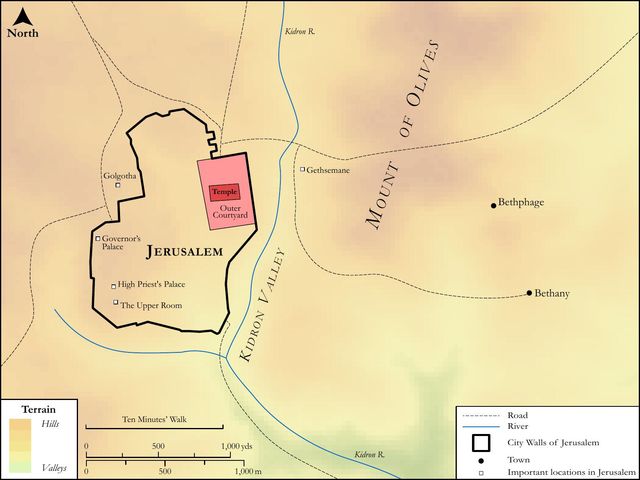
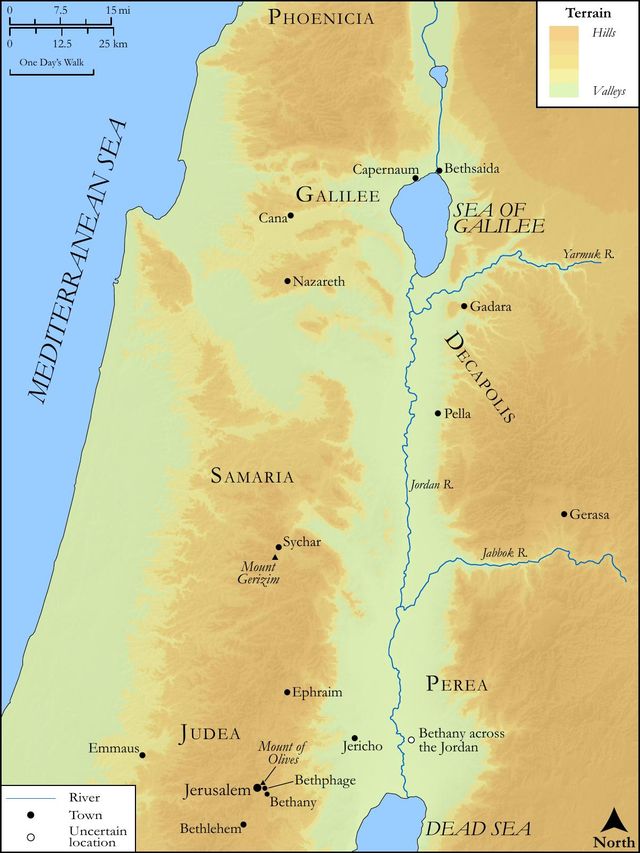
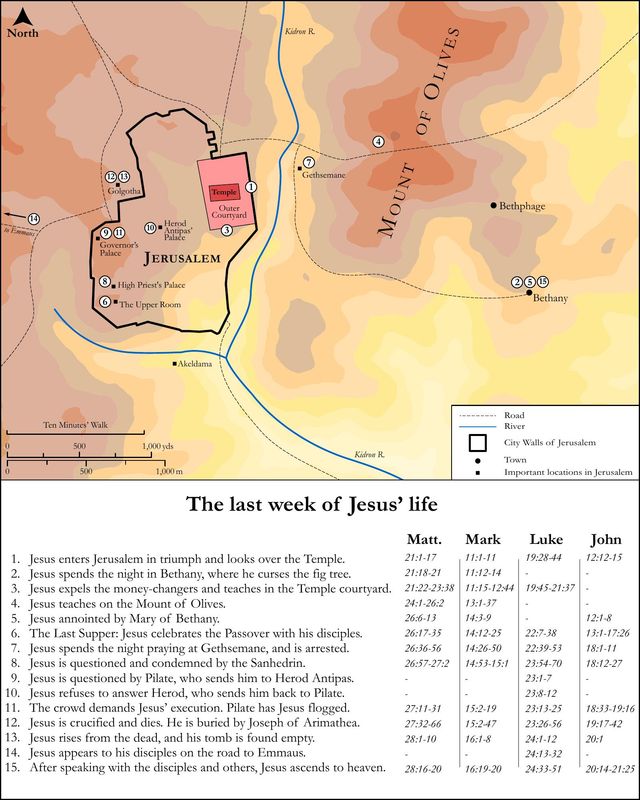
See on the biblical-era maps
Study this verse
Public-domain commentary
Matthew Henry
From his Commentary on the Whole Bible. Henry comments on passages, not single verses — this entry covers John 14:25–27. His three-level outline is real structure in the source text, so it is rendered as structure.
Two things Christ here comforts his disciples with: -
I.That they should be under the tuition of his Spirit, Joh 14:25, Joh 14:26, where we may observe,
1.The reflection Christ would have them make upon the instructions he had given them: These things have I spoken unto you (referring to all the good lessons he had taught them, since they entered themselves into his school), being yet present with you. This intimates,
(1.)That what he had said he did not retract nor unsay, but ratify it, or stand to it. What he had spoken he had spoken, and would abide by it.
(2.)That he had improved the opportunity of his bodily presence with them to the utmost: "As long as I have been yet present with them, you know I have lost no time." Note, When our teachers are about to be removed from us we should call to mind what they have spoken, being yet present with us.
2.The encouragement given them to expect another teacher, and that Christ would find out a way of speaking to them after his departure from them, Joh 14:26. He had told them before that the Father would give them this other comforter (Joh 14:16), and here he returns to speak of it again; for as the promise of the Messiah had been, so the promise of the Spirit now was, the consolation of Israel. Two things he here tells them further concerning the sending of the Holy Ghost: -
(1.)On whose account he should be sent: "The Father will send him in my name; that is, for my sake, at my special instance and request:" or, "as my agent and representative." He came in his Father's name, as his ambassador: the Spirit comes in his name, as resident in his absence, to carry on his undertaking, and to ripen things for his second coming. Hence he is called the Spirit of Christ, for he pleads his cause, and does his work.
(2.)On what errand he should be sent; two things he shall do: - [1.] He shall teach you all things, as a Spirit of wisdom and revelation Christ was a teacher to his disciples; if he leave them now that they have made so little proficiency, what will become of them? Why, the Spirit shall teach them, shall be their standing tutor. He shall teach them all things necessary for them either to learn themselves, or to teach others. For those that would teach the things of God must first themselves be taught of God; this is the Spirit's work. See Isa 59:21. [2.] He shall bring all things to your remembrance whatsoever I have said unto you. Many a good lesson Christ had taught them, which they had forgotten, and which would be to seek when they had occasion for it. Many things they did not retain the remembrance of, because they did not rightly understand the meaning of them. The Spirit shall not teach them a new gospel, but bring to their minds that which they had been taught, by leading them into the understanding of it. The apostles were all of them to preach, and some of them to write, the things that Jesus did and taught, to transmit them to distant nations and future ages; now, if they had been left to themselves herein, some needful things might have been forgotten, others misrepresented, through the treachery of their memories; therefore the Spirit is promised to enable them truly to relate and record what Christ said unto them. And to all the saints the Spirit of grace is given to be a remembrancer, and to him by faith and prayer we should commit the keeping of what we hear and know.
II.That they should be under the influence of his peace (Joh 14:27):
Peace I leave with you. When Christ was about to leave the world he made his will. His soul he committed to his Father; his body he bequeathed to Joseph, to be decently interred; his clothes fell to the soldiers; his mother he left to the care of John: but what should he leave to his poor disciples, that had left all for him? Silver and gold he had none; but he left them that which was infinitely better, his peace. "I leave you, but I leave my peace with you. I not only give you a title to it, but put you in possession of it." He did not part in anger, but in love; for this was his farewell, Peace I leave with you, as a dying father leaves portions to his children; and this is a worthy portion. Observe,
1.The legacy that is here bequeathed Peace, my peace. Peace is put for all good, and Christ has left us all needful good, all that is really and truly good, as all the purchased promised good. Peace is put for reconciliation and love; the peace bequeathed is peace with God, peace with one another; peace in our own bosoms seems to be especially meant; a tranquillity of mind arising from a sense of our justification before God. It is the counterpart of our pardons, and the composure of our minds. This Christ calls his peace, for he is himself our peace, Eph 2:14. It is the peace he purchased for us and preached to us, and on which the angels congratulated men at his birth, Luk 2:14.
2.To whom this legacy is bequeathed: "To you, my disciples and followers, that will be exposed to trouble, and have need of peace; to you that are the sons of peace, and are qualified to receive it." This legacy was left to them as the representatives of the church, to them and their successors, to them and all true Christians in all ages.
3.In what manner it is left: Not as the world giveth, give I unto you. That is, (1.) "I do not compliment you with Peace be unto you; no, it is not a mere formality, but a real blessing." (2.) "The peace I give is of such a nature that the smiles of the world cannot give it, nor the frowns of the world take it away." Or, (3.) "The gifts I give to you are not such as this world gives to its children and votaries, to whom it is kind." The world's gifts concern only the body and time; Christ's gifts enrich the soul for eternity: the world gives lying vanities, and that which will cheat us; Christ gives substantial blessings, which will never fail us: the world gives and takes; Christ gives a good part that shall never be taken away. (4.) The peace which Christ gives is infinitely more valuable than that which the world gives. The world's peace begins in ignorance, consists with sin, and ends in endless troubles; Christ's peace begins in grace, consists with no allowed sin, and ends at length in everlasting peace. As is the difference between a killing lethargy and a reviving refreshing sleep, such is the difference between Christ's peace and the world's.
4.What use they should make of it: Let not your heart be troubled, for any evils past or present, neither let it be afraid of any evil to come. Note, Those that are interested in the covenant of grace, and entitled to the peace which Christ gives, ought not to yield to overwhelming griefs and fears. This comes in here as the conclusion of the whole matter; he had said (Joh 14:1), Let not your heart be troubled, and here he repeats it as that for which he had now given sufficient reason.
Historical interpretation
Four Centuries of Reception
16 surviving comments on this verse. Each one is dated, so this reads as a timeline rather than a list.
Select a marker to jump to its quote. Markers stagger vertically where authors wrote within a few decades of each other.
Between the two echo psalms and hymns; and they mutually challenge each other which shall better chant to their Lord. Such things when Christ sees and hears, He joys. To these He sends His own I peace. Where two (are), there withal (is) He Himself.
The Holy Spirit warns us, and says, "What man is he that desireth to live, and would fain see good days? Refrain thy tongue from evil, and thy lips that they speak no guile. Eschew evil, and do good; seek peace, and ensue it." The son of peace ought to seek peace and ensue it. He who knows and loves the bond of charity, ought to refrain his tongue from the evil of dissension. Among His divine commands and salutary teachings, the Lord, when He was now very near to His passion, added this one, saying, "Peace I leave with you, my peace I give unto you." He gave this to us as an heritage; He promised all the gifts and rewards of which He spoke through the preservation of peace. If we are fellow-heirs with Christ, let us abide in the peace of Christ; if we are sons of God, we ought to be peacemakers. "Blessed," says He, "are the peacemakers; for they shall be called the sons of God." It behoves the sons of God to be peacemakers, gentle in heart, simple in speech, agreeing in affection, faithfully linked to one another in the bonds of unanimity.
That charity and brotherly affection are to be religiously and stedfastly practised. In Malachi: "Hath not one God created us? Is there not one Father of us all? Why have ye certainly deserted every one his brother? " Of this same thing according to John: "Peace I leave with you, my peace I give unto you." Also in the same place: "This is my commandment, That ye love one another, even as I have loved you. Greater love than this has no man, than that one should lay down his life for his friends." Also in the same place: "Blessed are the peacemakers, for they shall be called the sons of God." Also in the same place: "Verily I say unto you, That if two of you shall agree on earth concerning everything, whatever you shall ask it shall be given you from my Father which is in heaven. For wherever two or three are gathered together in my name, I am with them." Of this same thing in the first Epistle to the Corinthians: "And I indeed, brethren, could not speak unto you as to spiritual, but as to carnal, as to babes in Christ. I have given you milk for drink, not meat: for while ye were yet little ye were not able to bear it, neither now are ye able. For ye are still carnal: for where there are in you emulation, and strife, and dissensions, are ye not carnal, and walk after man? " Likewise in the same place: "And if I should have all faith, so that I can remove mountains, but have not charity, I am nothing. And if I should distribute all my goods for food, and if I should deliver up my body to be burned, but have not charity, I avail nothing. Charity is great-souled; charity is kind; charity envieth not; charity dealeth not falsely; is not puffed up; is not irritated; thinketh not evil; rejoiceth not in injustice, but rejoiceth in the truth. It loveth all things, believeth all things, hopeth all things, beareth all things. Charity shall never fail." Of this same thing to the Galatians: "Thou shalt love thy neighbour as thyself. But if ye bite and accuse one another, see that ye be not consumed one of another." Of this same thing in the Epistle of John: "In this appear the children of God and the children of the devil. Whosoever is not righteous is not of God, and he who loveth not his brother. For he who hateth his brother is a murderer; and ye know that no murderer hath eternal life abiding in him." Also in the same place: "If any one shall say that he loves God, and hates his brother, he is a liar: for he who loveth not his brother whom he seeth, how can he love God whom he seeth not? " Of this same thing in the Acts of the Apostles: "But the multitude of them that had believed acted with one soul and mind: nor was there among them any distinction, neither did they esteem as their own anything of the possessions that they had; but all things were common to them." Of this same thing in the Gospel according to Matthew: If thou wouldest offer thy gift at the altar, and there rememberest that thy brother hath ought against thee; leave thou thy gift before the altar, and go; first be reconciled to thy brother, and then come and offer thy gift at the altar." Also in the Epistle of John: "God is love l and he that dwelleth in love dwelleth in God, and God in him." Also in the same place: "He who saith he is in the light, and hateth his brother, is a liar, and walketh in darkness even until now."
If, then, the Father is greater through His authority to give, is the Son less through the confession of receiving? The Giver is greater: but the Receiver is not less, for to Him it is given to be one with the Giver. If it is not given to Jesus to be confessed in the glory of God the Father, He is less than the Father. But if it is given Him to be in that glory, in which the Father is, we see in the prerogative of giving, that the Giver is greater, and in the confession of the gift, that the Two are One. The Father is, therefore, greater than the Son: for manifestly He is greater, Who makes another to be all that He Himself is, Who imparts to the Son by the mystery of the birth the image of His own unbegotten nature, Who begets Him from Himself into His own form, and restores Him again from the form of a servant to the form of God.
Christ stopped those who were waging war and established peace by destroying the might of those waging war. Those opposing powers have no power against those of the household of Christ who came out of captivity as soon as they learned to know the Redeemer. Therefore, they have an unshakeable peace because it is a peace of the soul that has been led to freedom and has put off fear and shed all trouble. Since these good things of the soul have been assured and cannot be taken away, the peace of the soul has been made sure.
The God of peace is Christ, who said, “My peace I give you, my peace I leave you.” … But the peace of God is one thing, the peace of the world another, because even malignant and foul people have peace, but [this is] to their damnation. The peace of Christ is free from sins. For it flees faithlessness, spurns trickery and rejects evil deeds. This peace is pleasing and congenial to God, hostile to the devil. A person who has peace will also have love and the God of both to keep him safely guarded forever.
For it belongs to the perfect not to be easily moved by worldly matters, not to be disturbed by fear, not to be agitated by suspicion, not to be shaken by terror, not to be harassed by sorrow: but rather, to calm the unchanging mind, like a safe seashore against the rising waves of worldly storms, with steadfast faith and unwavering devotion. This firmament, Christ introduced into the minds of Christians, bringing internal peace to the souls of the righteous; so that our heart is not troubled, nor our mind disturbed. The Apostle, the teacher, affirmed that this peace is above every mind, saying: And the peace of God, which surpasses all understanding, shall keep your hearts and minds in Christ Jesus (Philippians 4:7). Therefore, the fruit of peace is not to be disturbed in one's heart. In conclusion, the life of the just is calm, while the unjust is full of unrest and disturbance. Therefore, the wicked is afflicted more by his own suspicions than by the blows of others; and the wounds in his mind are greater than those on the body of one who is beaten by others.
(Hom. lxxiv. 3) Peace I leave with you, My peace I give unto you: He says this to console His disciples, who were now troubled at the prospect of the hatred and opposition which awaited them after His departure.
(Hom. lxxv. 3) External peace is often even hurtful, rather than profitable to those who enjoy it.
"Arise, let us go hence." "But why, tell me? Did he not know the hour at which Judas would come upon Him? Or perhaps He feared lest he should come and seize them, and lest the plotters should be upon him before he had furnished his most excellent teaching." Away with the thought! these things are far from His dignity. "If then He did not fear, why did He remove them, and then after finishing His discourse lead them into a garden known to Judas? And even had Judas come, could He not have blinded their eyes, as He also did when the traitor was not present? Why did He remove them?" He alloweth the disciples a little breathing time. For it was likely that they, as being in a conspicuous place, would tremble and fear, both on the account of the time and the place, (for it was the depth of night,) and would not give heed to His words, but would be continually turning about, and imagining that they heard those who were to set upon them; and that more especially when their Master's speech made them expect evil. For, "yet a little while," He saith, "and I am not with you," and, "the ruler of this world cometh." Since now when they heard these and the like words they were troubled, as though they should certainly be taken immediately, He leadeth them to another place, in order that thinking themselves in safety, they might listen to Him without fear. For they were about to hear lofty doctrines.
(Hom. lxxv. 3) After saying, Peace I leave with you, which was like taking farewell, He consoles them: Let not your heart be troubled, neither let it be afraid: the two feelings of love and fear were now the uppermost in them.
(Hom. lxxv. 4) Or thus: The Apostles did not yet know what the resurrection was of which He spoke when He said, I go, and come again to you; or what they ought to think of it. They only knew the great power of the Father. So He tells them: Though ye fear I shall not be able to save Myself, and do not trust to My appearing again after My crucifixion; yet when ye hear that I go to My Father, ye should rejoice, because I go to one greater, one able to dissolve and change all things. All this is said in accommodation to their weakness: as we see from the next words; And now I have told you before it come to pass; that when it does come to pass, ye may believe.
(Hom. lxxvi. 1) Arise, let us go hence, is the beginning of the sentence which follows. The time and the place (they were in the midst of a town, and it was night time) had excited the disciples' fears to such a degree, that they could not attend to any thing that was said, but rolled their eyes about, expecting persons to enter and assault them; especially when they heard our Lord say, Yet a little while I am with you; and, The prince of this world cometh. To quiet their alarm then, He takes them to another place, where they imagine themselves safe, and would be able to attend to the great doctrines which He was going to set before them.
"Peace," He said, "I leave with you, my peace I give unto you." It is here we read in the prophet, "Peace upon peace:" peace He leaves with us when going away, His own peace He will give us when He cometh in the end. Peace He leaveth with us in this world, His own peace He will give us in the world to come. His own peace He leaveth with us, and abiding therein we conquer the enemy. His own peace He will give us when, with no more enemies to fight, we shall reign as kings. Peace He leaveth with us, that here also we may love one another: His own peace will He give us, where we shall be beyond the possibility of dissension. Peace He leaveth with us, that we may not judge one another of what is secret to each, while here on earth: His own peace will He give us, when He "will make manifest the counsels of the heart; and then shall every man have praise of God." And yet in Him and from Him it is that we have peace, whether that which He leaveth with us when going to the Father, or that which He will give us when we ourselves are brought by Him to the Father. And what is it He leaveth with us, when ascending from us, save His own presence, which He never withdraweth? For He Himself is our peace who hath made both one. It is He, therefore, that becomes our peace, both when we believe that He is, and when we see Him as He is. For if, so long as we are in this corruptible body that burdens the soul, and are walking by faith, not by sight, He forsaketh not those who are sojourning at a distance from Himself; how much more, when we have attained to that sight, shall He fill us with Himself?
But why is it that, when He said, "Peace I leave with you," He did not add, "my;" but when He said, "I give unto you," He there made use of it? Is "my" to be understood even where it is not expressed, on the ground that what is expressed once may have a reference to both? Or may it not be that here also we have some underlying truth that has to be asked and sought for, and opened up to those who knock thereat? For what, if by His own peace He meant such to be understood as that which He possesses Himself? whereas the peace, which He leaves us in this world, may more properly be termed our peace than His. For He, who is altogether without sin, has no elements of discord in Himself; while the peace we possess, meanwhile, is such that in the midst of it we have still to be saying, "Forgive us our debts." A certain kind of peace, accordingly, we do possess, inasmuch as we delight in the law of God after the inward man: but it is not a full peace, for we see another law in our members warring against the law of our mind. In the same way we have peace in our relations with one another, just because, in mutually loving, we have a mutual confidence in one another: but no more is such a peace as that complete, for we see not the thoughts of one another's hearts; and we have severally better or worse opinions in certain respects of one another than is warranted by the reality. And so that peace, although left us by Him, is our peace: for were it not from Him, we should not be possessing it, such as it is; but such is not the peace He has Himself. And if we keep what we received to the end, then such as He has shall we have, when we shall have no elements of discord of our own, and we shall have no secrets hid from one another in our hearts. But I am not ignorant that these words of the Lord may be taken so as to seem only a repetition of the same idea, "Peace I leave with you, my peace I give unto you:" so that after saying "peace," He only repeated it in saying "my peace;" and what He had meant in saying "I leave with you," He simply repeated in saying "I give unto you." Let each one understand it as he pleases; but it is my delight, as I believe it is yours also, my beloved brethren, to keep such hold of that peace here, where our hearts are making common cause against the adversary, that we may be ever longing for the peace which there will be no adversary to disturb.
But when the Lord proceeded to say, "Not as the world giveth, give I unto you," what else does He mean but, Not as those give who love the world, give I unto you? For their aim in giving themselves peace is that, exempt from the annoyance of lawsuits and wars, they may find enjoyment, not in God, but in the friendship of the world; and although they give the righteous peace, in ceasing to persecute them, there can be no true peace where there is no real harmony, because their hearts are at variance. For as one is called a consort who unites his lot with another, so may he be termed concordant whose heart has entered into a similar union. Let us, therefore, beloved, with whom Christ leaveth peace, and to whom He giveth His own peace, not after the world's way, but in a way worthy of Him by whom the world was made, that we should be of one heart with Himself, having our hearts run into one, that this one heart, set on that which is above, may escape the corruption of the earth.
(Tract. lxxvii. 2) He left no peace in this world; in which we conquer the enemy, and have love one to another: He will give us peace in the world to come, when we shall reign without an enemy, and where we shall be able to avoid disagreement. This peace is Himself, both when we believe that He is, and when we shall see Him as He is. But why does He say, Peace I leave with you, without the My, whereas He puts in My in, My peace I give unto you? Are we to understand My in the former; or is it not rather left out with a meaning? His peace is such peace as He has Himself; the peace which He left us in this world is rather our peace than His. He has nothing to fight against in Himself, because He has no sin: but ours is a peace in which we still say, Forgive us our debts. (Matt. 6:12) And in like manner we have peace between ourselves, because we mutually trust one another, that we mutually love one another. But neither is that a perfect peace; for we do not see into each other's minds. I could not deny however that these words of our Lord's may be understood as a simple repetition. He adds, Not as the world giveth, give I unto you: i. e. not as those men, who love the world, give. They give themselves peace, i. e. free, uninterrupted enjoyment of the world. And even when they allow the righteous peace, so far as not to persecute them, yet there cannot be true peace, where there is no true agreement, no union of heart.
(de Verb. Dom. serm. ix) But there is a peace which is serenity of thought, tranquillity of mind, simplicity of heart, the bond of love, the fellowship of charity. None will be able to come to the inheritance of the Lord who do not observe this testament of peace; none be friends with Christ, who are at enmity with the Christians.
This peace he left, after a fashion, in his last will and testament to his disciples, our apostles. As he was about to go to the Father, you see, he said, "My peace I give, my peace I leave to you." And he did not separate Judas from himself, though he would not have been making a mistake if he had wished to separate him. I mean he would never separate an innocent person instead of a guilty one, or by separating the guilty forsake the innocent.… It was Judas himself who separated himself from the Lord. He was tolerated to the very end. He gave the kiss of peace, though he did not have peace in his heart. And yet he accepted the kiss of peace. That kiss did not bind him to Christ. It condemned him.
Herein when He reminds His holy Apostles of His ascension into heaven, and prepares them for the knowledge that they will be left thereby alone by the saying: These things have I spoken unto you while yet abiding with you, He was stricken at heart by the knowledge, being as He was by nature God, that the saying gave them no small alarm, and put them into great fear and trembling, and by laying a burden of grief upon them had stirred the mind of each to its depths. For what could be more grievous than their sorrow, and what so burdensome as to be robbed of the highest blessings and to undergo the unexpected loss of that which was most dear to them? He therefore stablishes them when they were disturbed by grief and fear. For the cause and root of their sorrow, His being about to leave them and go to His Father, was most well-grounded. But He considered their apprehension of unknown suffering as the cause of their grief, and very readily, as He Who was strong to save was no longer present, according to the actual vision of the body. And how does He stablish them, and in what way does He produce in them the brightness of a cheerful spirit, and how are their minds lulled again into a Divine calm? Peace I give unto you, He says, My peace I leave with you. I have often told you, He says, that I will not leave you desolate, nor will you dwell alone in the earth, stripped and robbed of your defender; nay, rather, I will be with you, and though absent in the flesh will again edify you by My consolations as God, and will set you above every terror, and no man shall surpass you in boldness; for all fear shall dwindle away, and cowardice shall vanish from your path, and a Divine power shall spring up in you, bringing you with peaceful mind, and heart at rest, to the revelation of those things which pass man's understanding. And now, He says, Peace I give unto you, not simply, but My peace. And this was clearly nothing else but saying: I will bring the Spirit, and of Myself will abide with those who receive Him.
For that the peace of Christ is His Spirit, it needs no long argument to completely demonstrate. But I suppose one ought to say this, if He is peace in heaven and on the earth, how can it fail to be clear to everyone, that as we have said, the peace is certainly His Spirit? And indeed the inspired Paul said to some: And the peace of God which passeth all understanding shall guard your hearts and your thoughts. And surely it is right to reflect, that it is not about that peace which has reference to common thought and action that He says this. For that disposition which loathes dispute and strife has and works peace, so far as its own waverings and inclinations will allow it. And we shall not think that the peace which is here meant is something which has not a real and independent existence; but we must suppose that it is found in the temper of those who love it. How then can one think that such a peace as this surpasses all understanding? For that which nowhere and nohow has an independent existence, how could that be thought better and nobler than men, or angels, or even higher beings? for these too we say are mind. The peace therefore that is above all principality, and power, and thrones, and sovereignties, and excels all intellectual existence, is the Spirit of Christ, by Which the Son reconciles all things to God the Father, by willing the things that are His and by wishing to think and do them, and not by being perverted or falling away through turning aside to wickedness. And it is easy and expedient to reflect on this. For just in the same way as since the Son is by nature life, and wisdom, and power, and the Spirit is called and is His, the Spirit is of life, and wisdom, and power; so since the true and sovereign peace is He Himself and no other, His Spirit might rightly be named and thought as He is----" peace." For this reason and in a special manner referring His own peace, that is to say the Spirit, to His own nature, He says concerning Him, My peace I leave with you. That also in the holy prophets the Spirit of Christ has been so named, you will easily perceive, when you hear this from the mouth of Isaiah: O Lord our God grant us peace: for Thou hast given us all things. For as the Law brought nothing to completion, and righteousness according to it did not suffice to bring men to perfect piety, He entreats that the Holy Spirit be vouchsafed, by Whom, reconciled to God the Father, we have been admitted into fellowship with Him, who have before been shown to be reprobates through the sin that reigneth in us. Grant us then peace, he says, Lord; for Thou hast given us all things. And what he wants to show, I say, is this: "Grant us too, Lord, the peace; for we shall then confess that we have all things, and no blessing will be found lacking to him that has once for all reached the fulness of Christ. For it is the completion of all good that God should dwell in us by the Spirit." For since the Spirit is fully sufficient to allay all tumult of the mind, and to dispel all cowardice in us, He promises to give us as provision by the way, that which is needful to maintain our courage and peace, when He says, My peace I leave with you: let not your heart be troubled, neither let it be fearful.
Peace, indeed, is serenity of mind, tranquility of soul, simplicity of heart, the bond of love, the fellowship of charity. It removes hatred, settles wars, restrains wrath, tramples on pride, loves the humble, pacifies the discordant and makes enemies agree. For it is pleasing to everyone. It does not seek what belongs to another or consider anything as its own. It teaches people to love because it does not know how to get angry, or to extol itself or become inflated with pride. It is meek and humble to everyone, possessing rest and tranquility within itself. When the peace of Christ is exercised by a Christian, it is brought to perfection by Christ. If anyone loves it, he will be an heir of God, while anyone who despises it rebels against Christ. When our Lord Jesus Christ was returning to the Father, he left his peace to his followers as their inherited good, teaching them and saying, “My peace I give to you, my peace I leave with you.” Anyone who has received this peace should keep it, and one who has destroyed it should look for it, while anyone who has lost it should seek it. For if anyone is not found with it, he will be disinherited by the Father and deprived of his inheritance.
Peace I leave with you, my peace I give to you. Here "I leave," there "I give." I leave to those who follow, I give to those who arrive.
Continue studying John 14:27 across the web’s major study libraries — every link below opens this exact verse, chapter, or book on the destination site.
Read & Compare
 BibleGatewayThis verse in more than 200 translations and 70 languages.
 Bible.comThe YouVersion reader — hundreds of translations, reading plans, and highlights.
 ESV.orgCrossway's official English Standard Version reader.
 NET BibleThe NET translation with 60,000+ translators' notes on every rendering decision.
 STEP BibleTyndale House's free study tool — original text, vocabulary, and scholarly resources.
 BibliaLogos Bible Software's free web reader.
 USCCBThe New American Bible (Revised Edition) with the U.S. bishops' study notes.
Commentaries
 BibleHub CommentariesDozens of classic commentaries on this verse, gathered on one page.
 StudyLightMore than 100 commentary sets — the largest collection on the web.
 BibleRefPlain-English commentary on what this verse means, verse by verse.
 Enduring WordDavid Guzik's free commentary on this chapter, widely used by Bible teachers.
 Bible Study ToolsVerse commentary alongside Greek and Hebrew study aids.
Original Language & Research
- BibleHub InterlinearThe verse word by word — original language, transliteration, and English.
- BibleHub LexiconEvery word's original-language definition and Strong's entry.
 Blue Letter BibleDeep-study tools — Strong's numbers, concordance, and word studies.
 CNTR CollationThe earliest Greek manuscripts of this verse, collated letter by letter.
Sermons, Hymns & Audio


TrulyRandomVerse is not affiliated with these sites and doesn’t control their content. They’re linked because they’re genuinely useful.
Summary
In this profound farewell discourse, Jesus bestows upon His disciples a unique and enduring gift of peace, distinct from any tranquility the world can offer. He assures them that this divine peace, rooted in His very nature and presence, is the antidote to the fear and anxiety that naturally arise from His impending departure and the trials they are destined to face. This promise serves as a foundational comfort, empowering believers to maintain inner calm and trust, regardless of external circumstances.
Context
ShowHideLiterary Context
John 14:27 is nestled within Jesus' extensive farewell discourse to His disciples, spanning chapters 13-17 of John's Gospel. This particular chapter begins with Jesus comforting His disciples, who are troubled by His announcement of departure and the betrayal of Judas (John 14:1). He promises them a place in His Father's house, reveals Himself as "the way, the truth, and the life" (John 14:6), and assures them of the Father's love and the coming of the Holy Spirit, the Advocate (John 14:16-17). The gift of peace in John 14:27 directly follows His promise that He and the Father will make their dwelling with those who love Him and keep His word (John 14:23), and precedes His final instructions and the declaration that the "prince of this world" is coming (John 14:30). Thus, the peace offered is a divine provision for the intense spiritual warfare and personal distress that lie ahead.
Historical & Cultural Context
In the ancient world, "peace" (Hebrew: shalom; Greek: eirḗnē) was a highly valued concept, often signifying the absence of war, political stability, and material prosperity. However, this worldly peace was always precarious, dependent on shifting alliances, military strength, or favorable circumstances. For the Jewish people, shalom carried a deeper, holistic meaning encompassing well-being, wholeness, completeness, and right relationship with God and others. Jesus' disciples, living under Roman occupation and facing the imminent loss of their Messiah, would have understood the fragility of worldly peace. Their immediate context was one of fear, confusion, and impending persecution. Jesus' declaration of "my peace" would have resonated profoundly, distinguishing His gift from the superficial and fleeting peace offered by human systems or the temporary cessation of conflict. It pointed to a peace that transcended their current anxieties and the turbulent world around them.
Key Themes
ShowHideThis verse contributes significantly to several overarching themes within John's Gospel and biblical theology. Firstly, it highlights Jesus' Divine Authority and Unique Nature, as He alone possesses and can impart a peace that surpasses worldly understanding. This peace is not merely a feeling but a spiritual reality, a direct outflow of His divine essence. Secondly, it underscores the theme of Comfort and Assurance in the Face of Adversity. Jesus anticipates the disciples' distress and provides a divine remedy, teaching them that true tranquility is an internal state sustained by faith, not by external conditions. This theme is echoed later when Jesus declares, "In the world ye shall have tribulation: but be of good cheer; I have overcome the world" (John 16:33). Finally, the verse speaks to the Transformative Power of Christ's Presence. The peace Jesus gives is intrinsically linked to His abiding presence through the Holy Spirit, enabling believers to overcome fear and anxiety and live with steadfast hearts, even amidst chaos.
Exposition and Analysis
ShowHideKey Word Analysis
ShowHideFrom a primary verb meaning "to join," this term signifies more than the absence of conflict. It encompasses wholeness, well-being, harmony, prosperity, and a deep sense of contentment and security. In a theological sense, it denotes reconciliation with God and an inner completeness, a state of spiritual tranquility that Jesus uniquely provides.
A versatile verb meaning "to give" in a very wide application, whether literally or figuratively. Here, it emphasizes Jesus' active impartation of this unique peace, not merely an offer but a divine bestowal. It highlights His sovereign authority and generosity in bestowing a gift that is intrinsically His own.
Of uncertain affinity, this word means "to stir or agitate," like roiling water. It describes an inner disturbance, anxiety, or emotional turmoil. Jesus' command to "let not your heart be troubled" directly addresses the disciples' inner disquiet, urging them to resist this agitation by embracing His peace.
Verse Breakdown
ShowHide"Peace I leave with you, my peace I give unto you:"
This clause highlights Jesus' deliberate act of bequeathing peace as a legacy to His disciples. The repetition of "peace" emphasizes its profound importance, and the possessive "my peace" distinguishes it as uniquely His, a divine quality rather than a human construct. The use of both "leave" (ἀφίημι, aphíēmi) and "give" (δίδωμι, dídōmi) underscores the intentionality and permanence of this gift, suggesting both a spiritual inheritance and an active, ongoing impartation.
"not as the world giveth, give I unto you."
This stark contrast defines the nature of Jesus' peace. Worldly peace is conditional, external, and fleeting, often dependent on the absence of conflict or favorable circumstances. In contrast, Jesus' peace is unconditional, internal, and enduring, flowing from His divine nature and presence. It is a peace that transcends external turmoil and is not contingent upon the world's standards or provisions.
"Let not your heart be troubled, neither let it be afraid."
This is a direct command and a profound invitation to trust. It addresses the disciples' immediate fear and anxiety regarding Jesus' impending departure and the trials they would face. The peace He gives empowers them to resist inner agitation (ταράσσω, tarássō) and timidity (δειλιάω, deiliáō), fostering a profound inner calm rooted in faith and reliance on His divine provision. It is an exhortation to actively choose peace over fear.
Literary Devices
ShowHideJohn 14:27 employs several potent literary devices to convey its profound message. The most prominent is Contrast, specifically the antithesis between "my peace" and the peace "as the world giveth." This sharp distinction underscores the unique and superior nature of Jesus' divine gift, highlighting its spiritual depth and enduring quality compared to the superficial and transient tranquility offered by worldly conditions. Repetition of the word "peace" (εἰρήνη, eirḗnē) emphasizes its centrality and significance as Jesus' farewell bequest. The repeated verb "give" (δίδωμι, dídōmi) further reinforces the active, intentional, and generous impartation of this peace by Jesus. Finally, the verse concludes with a powerful Imperative Mood in the commands "Let not your heart be troubled, neither let it be afraid." These are not mere suggestions but direct exhortations, calling the disciples to an active response of faith and trust in the peace Jesus has provided, thereby empowering them to overcome fear and anxiety.
Theological and Thematic Connections
ShowHideThe peace Jesus offers in John 14:27 is a profound theological concept, deeply rooted in the biblical understanding of shalom and God's redemptive plan. It is not merely a psychological state but a spiritual reality, a gift of reconciliation with God and an inner wholeness that flows from His presence. This peace is a fruit of the Holy Spirit and a hallmark of the new covenant, enabling believers to stand firm amidst tribulation because their ultimate security rests in Christ. It anticipates the peace that Christ would secure through His atoning work, establishing a right relationship between God and humanity, and reconciling all things to Himself. This divine tranquility empowers believers to live without fear, knowing that God's sovereign hand is at work, even in the most challenging circumstances.
Reflection and Application
ShowHideJohn 14:27 offers an enduring source of comfort and a powerful call to faith for believers across all generations. In a world often characterized by anxiety, uncertainty, and conflict, Jesus' promise of "my peace" stands as an unwavering anchor. It reminds us that true tranquility is not found in the absence of external trouble, but in the abiding presence of Christ within us. To "let not your heart be troubled, neither let it be afraid" is an active choice, a conscious decision to trust in God's sovereignty and His unfailing love, even when circumstances seem overwhelming. This peace enables us to navigate life's storms with a quiet confidence, knowing that the Prince of Peace Himself indwells us, guarding our hearts and minds. It challenges us to surrender our fears to Him, to cultivate a spirit of reliance, and to allow His divine peace to rule in our hearts, transforming our perspective and empowering our witness.
Questions for Reflection
ShowHideFAQ
ShowHideWhat is the significance of Jesus saying "my peace" instead of just "peace"?
ShowHideWhen Jesus says "my peace," He is emphasizing that the peace He gives is fundamentally different and superior to any peace the world can offer. Worldly peace (or the absence of conflict) is external, temporary, and dependent on circumstances. "My peace" (Greek: eirḗnē) is an internal, spiritual, and enduring tranquility that flows from His divine nature. It is the peace He Himself possesses, a perfect wholeness and reconciliation with God, which He now imparts to His followers. This peace is independent of external conditions and remains even amidst tribulation, as He later states in John 16:33.
How can I "let not my heart be troubled, neither let it be afraid" when facing difficult circumstances?
ShowHideThis command is not a denial of natural human emotions but an exhortation to actively choose faith over fear, trusting in Jesus' promise and presence. It involves several spiritual disciplines. Firstly, it requires a conscious decision to surrender anxieties to God through prayer and supplication, as encouraged in Philippians 4:6-7. Secondly, it means fixing your thoughts on Christ and His truth, rather than dwelling on the problems, as urged in Colossians 3:2. Thirdly, it relies on the indwelling Holy Spirit, whom Jesus promised as the Comforter (John 14:16), who empowers believers to experience inner calm. Ultimately, it is an act of faith, trusting that Jesus has overcome the world and is sovereign over all circumstances.
Christ-Centered Fulfillment
ShowHideJohn 14:27 finds its ultimate fulfillment in the person and work of Jesus Christ, who is Himself the embodiment of peace. He is the "Prince of Peace" prophesied in Isaiah 9:6, and His entire mission was to establish true peace between God and humanity. Through His atoning sacrifice on the cross, Jesus broke down the wall of hostility, making peace with God possible for all who believe (Romans 5:1). He is "our peace," having reconciled both Jew and Gentile into one body through the cross (Ephesians 2:14). The peace Jesus leaves and gives is not merely a concept but a spiritual reality made possible by His finished work, allowing believers to have "peace with God" and the "peace of God" that surpasses all understanding (Philippians 4:7). His resurrection and ascension further solidify this peace, as He now reigns as Lord, interceding for His people and ensuring that His divine tranquility remains accessible through the Holy Spirit, enabling believers to live in confident assurance amidst a troubled world.