


John 16:33
Bible text: King James Version (1769 Blayney text) · Public domain
Bible text: King James Version with Strong's numbers · Public domain
Bible text: Berean Standard Bible · Public domain
Bible text: American Standard Version (1901) · Public domain
Bible text: World English Bible, Messianic edition · Public domain
Bible text: Geneva Bible (1599) · Public domain
Bible text: Young's Literal Translation · Public domain
- ταῦταtautaThese thingsG3778D-APNDemonstrative pronoun Accusative Plural Neuter
- λελάληκαlelalēkaI have spokenG2980V-RAI-1SVerb Perfect Active Indicative 1st Singular
- ὑμῖνhuminto youG4771P-2DPPersonal pronoun Dative 2nd Plural
- ἵναinaso thatG2443CONJConjunction
- ἐνeninG1722PREPPreposition
- ἐμοὶemoiMe myselfG1473P-1DSPersonal pronoun Dative 1st Singular
- εἰρήνηνeirēnēnpeaceG1515N-ASFNoun Accusative Singular Feminine
- ἔχητεechēteyou may haveG2192V-PAS-2PVerb Present Active Subjunctive 2nd Plural
- ἐνenInG1722PREPPreposition
- τῷtōtheG3588T-DSMDefinite article Dative Singular Masculine
- κόσμῳkosmōworldG2889N-DSMNoun Dative Singular Masculine
- θλῖψινthlipsintribulationG2347N-ASFNoun Accusative Singular Feminine
- ἔχετε·echeteyou haveG2192V-PAI-2PVerb Present Active Indicative 2nd Plural
- ἀλλὰallaButG235CONJConjunction
- θαρσεῖτεtharseitetake courage!G2293V-PAM-2PVerb Present Active Imperative 2nd Plural
- ἐγὼegōI myselfG1473P-1NSPersonal pronoun Nominative 1st Singular
- νενίκηκαnenikēkahave overcomeG3528V-RAI-1SVerb Perfect Active Indicative 1st Singular
- τὸνtontheG3588T-ASMDefinite article Accusative Singular Masculine
- κόσμονkosmonworldG2889N-ASMNoun Accusative Singular Masculine
English is a literal word-by-word gloss of the Greek, not the KJV's wording. Why?
This is the original text the KJV's translators worked from — each Greek word with its own literal English meaning in this verse, prepared by scholars at Tyndale House, Cambridge. The KJV translates whole sentences, not word by word, so its wording differs: one Greek word can become several English words, and the KJV may choose “charity” where the gloss reads “love”. Both are faithful — they answer different questions. For the KJV's own rendering, switch to the KJV text.
Details
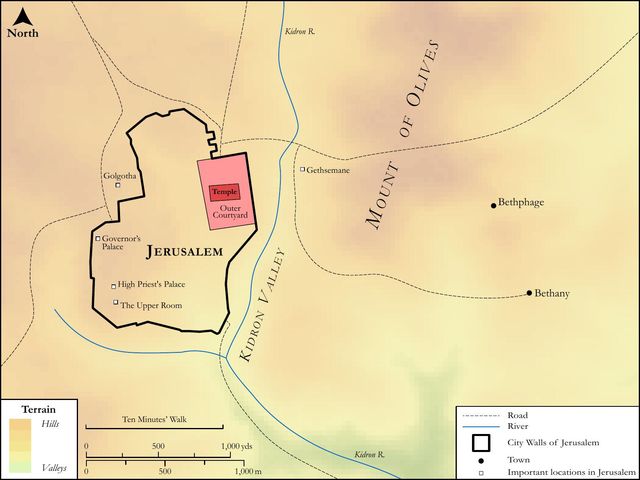
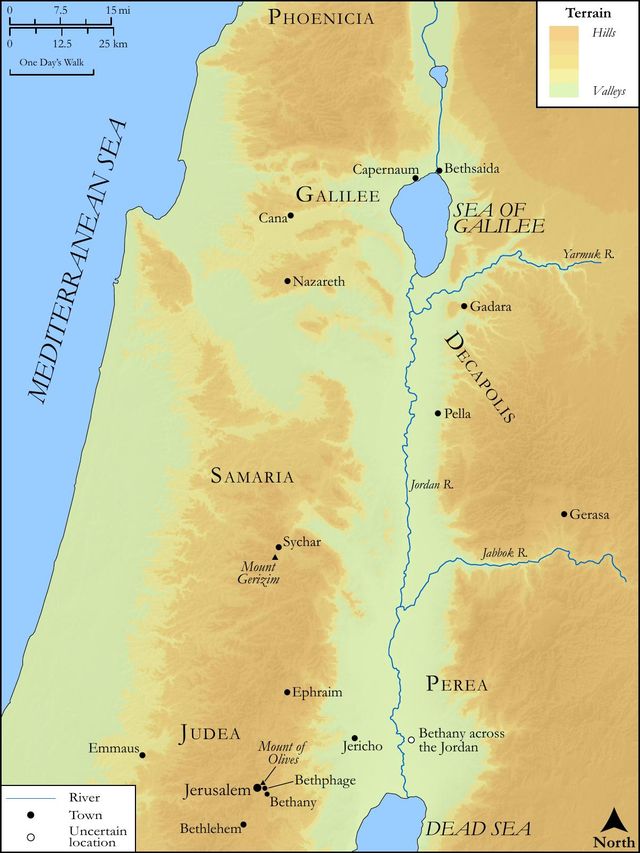
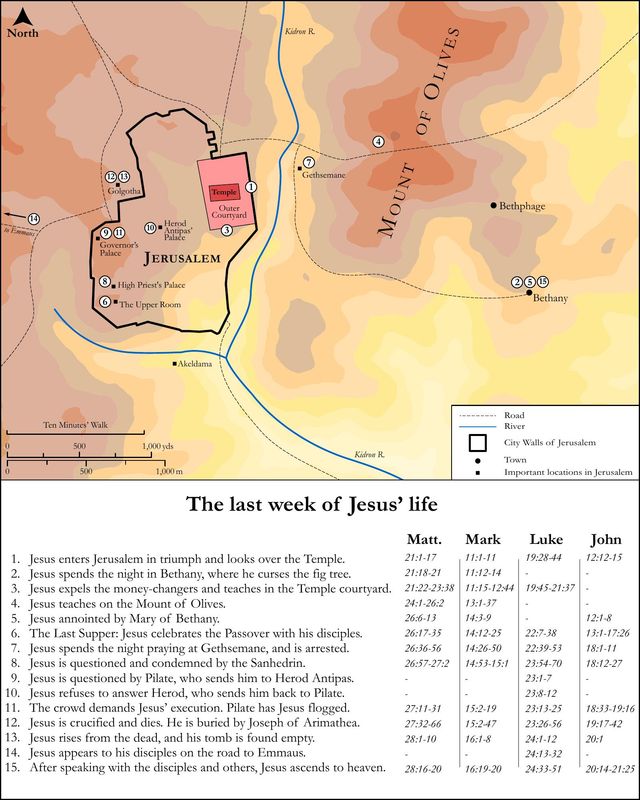
See on the biblical-era maps
Study this verse
Public-domain commentary
Matthew Henry
From his Commentary on the Whole Bible. Henry comments on passages, not single verses — this entry covers John 16:28–33. His four-level outline is real structure in the source text, so it is rendered as structure.
Two things Christ here comforts his disciples with: -
I.With an assurance that, though he was leaving the world, he was returning to his Father, from whom he came forth Joh 16:28-32, where we have,
1.A plain declaration of Christ's mission from the Father, and his return to him (Joh 16:28): I came forth from the Father, and am come, as you see, into the world. Again, I leave the world, as you will see shortly, and go to the Father. This is the conclusion of the whole matter. There was nothing he had more inculcated upon them than these two things - whence he came, and whither he went, the Alpha and Omega of the mystery of godliness (Ti1 3:16), that the Redeemer, in his entrance, was God manifest in the flesh, and in his exit was received up into glory.
(1.)These two great truths are here,
[1.]Contracted, and put into a few words. Brief summaries of Christian doctrine are of great use to young beginners. The principles of the oracles of God brought into a little compass in creeds and catechisms have, like the beams of the sun contracted in a burning glass, conveyed divine light and heat with a wonderful power. Such we have, Job 28:28; Ecc 12:13; Ti1 1:15; Tit 2:11, Tit 2:12; Jo1 5:11; much in a little.
[2.]Compared, and set the one over against the other. There is an admirable harmony in divine truths; they both corroborate and illustrate one another; Christ's coming and his going do so. Christ had commended his disciples for believing that he came forth from God (Joh 16:27), and thence infers the necessity and equity of his returning to God again, which therefore should not seem to them either strange or sad. Note, The due improvement of what we know and own would help us into the understanding of that which seems difficult and doubtful.
(2.)If we ask concerning the Redeemer whence he came, and whither he went, we are told, [1.] That he came from the Father, who sanctified and sealed him; and he came into this world, this lower world, this world of mankind, among whom by his incarnation he was pleased to incorporate himself. Here his business lay, and hither he came to attend it. He left his home for this strange country; his palace for this cottage; wonderful condescension! [2. That, when he had done his work on earth, he left the world, and went back to his Father at his ascension. He was not forced away, but made it his own act and deed to leave the world, to return to it no more till he comes to put an end to it; yet still he is spiritually present with his church, and will be to the end.
2.The disciples' satisfaction in this declaration (Joh 16:29, Joh 16:30): Lo, now speakest though plainly. It should seem, this one word of Christ did them more good than all the rest, though he had said many things likely enough to fasten upon them. The Spirit, as the wind, blows when and where, and by what word he pleases; perhaps a word that has been spoken once, yea twice, and not perceived, yet, being often repeated, takes hold at last. Two things they improved in by this saying: -
(1.)In knowledge: Lo, now speakest thou plainly. When they were in the dark concerning what he said, they did not say, Lo, now speakest thou obscurely, as blaming him; but now that they apprehend his meaning they give him glory for condescending to their capacity: Lo, now speakest thou plainly. Divine truths are most likely to do good when they are spoken plainly, Co1 2:4. Observe how they triumphed, as the mathematician did with his heurēka, heurēka, when he had hit upon a demonstration he had long been in quest of: I have found it, I have found it. Note, When Christ is pleased to speak plainly to our souls, and to bring us with open face to behold his glory, we have reason to rejoice in it.
(2.)In faith: Now are we sure. Observe,
[1.]What was the matter of their faith: We believe that thou camest forth from God. He had said (Joh 16:27) that they did believe this; "Lord" (say they) "we do believe it, and we have cause to believe it, and we know that we believe it, and have the comfort of it."
[2.]What was the motive of their faith - his omniscience. This proved him a teacher come from God, and more than a prophet, that he knew all things, which they were convinced of by this that he resolved those doubts which were hid in their hearts, and answered the scruples they had not confessed. Note, Those know Christ best that know him by experience, that can say of his power, It works in me; of his love, He loved me. And this proves Christ not only to have a divine mission, but to be a divine person, that he is a discerner of the thoughts and intents of the heart, therefore the essential, eternal Word, Heb 4:12, Heb 4:13. He has made all the churches to know that he searches the reins and the heart, Rev 2:23. This confirmed the faith of the disciples here, as it made the first impression upon the woman of Samaria that Christ told her all the things that ever she did (Joh 4:29), and upon Nathanael that Christ saw him under the fig-tree, Joh 1:48, Joh 1:49.
These words, and needest not that any man should ask thee, may bespeak either, First, Christ's aptness to teach. He prevents us with his instructions, and is communicative of the treasures of wisdom and knowledge that are hid in him, and needs not to be importuned. Or, Secondly, His ability to teach: "Thou needest not, as other teachers, to have the learners' doubts told thee, for thou knowest, without being told, what they stumble at." The best of teachers can only answer what is spoken, but Christ can answer what is thought, what we are afraid to ask, as the disciples were, Mar 9:32. Thus he can have compassion, Heb 5:2.
3.The gentle rebuke Christ gave the disciples for their confidence that they now understood him, Joh 16:31, Joh 16:32. Observing how they triumphed in their attainments, he said, "Do you now believe? Do you now look upon yourselves as advanced and confirmed disciples? Do you now think you shall make no more blunders? Alas! you know not your own weakness; you will very shortly be scattered every man to his own," etc. Here we have,
(1.)A question, designed to put them upon consideration: Do you now believe? [1.] "If now, why not sooner? Have you not heard the same things many a time before?" Those who after many instructions and invitations are at last persuaded to believe have reason to be ashamed that they stood it out so long. [2.] "If now, why not ever? When an hour of temptation comes, where will your faith be then?" As far as there is inconstancy in our faith there is cause to question the sincerity of it, and to ask, "Do we indeed believe?"
(2.)A prediction of their fall, that, how confident soever they were now of their own stability, in a little time they would all desert him, which was fulfilled that very night, when, upon his being seized by a party of the guards, all his disciples forsook him and fled, Mat 26:56. They were scattered,
[1.]From one another; they shifted every one for his own safety, without any care or concern for each other. Troublous times are times of scattering to Christian societies; in the cloudy and dark day the flock of Christ is dispersed, Eze 34:12. So Christ, as a society, is not visible.
[2.]Scattered for him: You shall leave me alone. They should have been witnesses for him upon his trial, should have ministered to him in his sufferings; if they could have given him no comfort they might have done him some credit; but they were ashamed of his chain, and afraid of sharing with him in his sufferings, and left him alone. Note, Many a good cause, when it is distressed by its enemies, is deserted by its friends. The disciples had continued with Christ in his other temptations and yet turned their back upon him now; those that are tried, do not always prove trusty. If we at any time find our friends unkind to us, let us remember that Christ's were so to him. When they left him alone, they were scattered every man to his own; not to their own possessions or habitations, these were in Galilee; but to their own friends and acquaintance in Jerusalem; every one went his own way, where he fancied he should be most safe. Every man to secure his own; himself and his own life. Note, Those will not dare to suffer for their religion that seek their own things more than the things of Christ, and that look upon the things of this world as their ta idia - their own property, and in which their happiness is bound up. Now observe here, First, Christ knew before that his disciples would thus desert him in the critical moment, and yet he was still tender of them, and in nothing unkind. We are ready to say of some, "If we could have foreseen their ingratitude, we would not have been so prodigal of our favours to them;" Christ did foresee theirs, and yet was kind to them. Secondly, He told them of it, to be a rebuke to their exultation in their present attainments: "Do you now believe? Be not high-minded, but fear; for you will find your faith so sorely shaken as to make it questionable whether it be sincere or no, in a little time." Note, even when we are taking the comfort of our graces, it is good to be reminded of our dangers from our corruptions. When our faith is strong, our love flaming, and our evidences are clear, yet we cannot infer thence that tomorrow shall be as this day. Even when we have most reason to think we stand, yet we have reason enough to take heed lest we fall. Thirdly, He spoke of it as a thing very near. The hour was already come, in a manner, when they would be as shy of him as ever they had been fond of him. Note, A little time may produce great changes, both concerning us and in us.
(3.)An assurance of his own comfort notwithstanding: Yet I am not alone. He would not be thought to complain of their deserting him, as if it were any real damage to him; for in their absence he should be sure of his Father's presence, which was instar omnium - every thing: The Father is with me. We may consider this,
[1.]As a privilege peculiar to the Lord Jesus; the Father was so with him in his sufferings as he never was with any, for still he was in the bosom of the Father. The divine nature did not desert the human nature, but supported it, and put an invincible comfort and an inestimable value into his sufferings. The Father had engaged to be with him in his whole undertaking (Psa 89:21 etc.), and to preserve him (Isa 49:8); this emboldened him, Isa 50:7. Even when he complained of his Father's forsaking him, yet he called him My God, and presently after was so well assured of his favourable presence with him as to commit his Spirit into his hand. This he had comforted himself with all along (Joh 8:29), He that sent me is with me, the Father hath not left me alone, and especially now at last. This assists our faith in the acceptableness of Christ's satisfaction; no doubt, the Father was well pleased in him, for he went along with him in his undertaking from first to last.
[2.]As a privilege common to all believers, by virtue of their union with Christ; when they are alone, they are not alone, but the Father is with them. First, When solitude is their choice, when they are alone, as Isaac in the field, Nathanael under the fig-tree, Peter upon the house-top, meditating and praying, the Father is with them. Those that converse with God in solitude are never less alone than when alone. A good God and a good heart are good company at any time. Secondly, When solitude is their affliction, their enemies lay them alone, and their friends leave them so, their company, like Job's, is made desolate; yet they are not so much alone as they are thought to be, the Father is with them, as he was with Joseph in his bonds and with John in his banishment. In their greatest troubles they are as one whom his father pities, as one whom his mother comforts. And, while we have God's favourable presence with us, we are happy, and ought to be easy, though all the world forsake us. Non deo tribuimus justum honorem nisi solus ipse nobis sufficiat - We do not render due honour to God, unless we deem him alone all-sufficient. - Calvin.
II.He comforts them with a promise of peace in him, by virtue of his victory over the world, whatever troubles they might meet with in it (Joh 16:33): "These things have I spoken, that in me you might have peace; and if you have it not in me you will not have it at all, for in the world you shall have tribulation; you must expect no other, and yet may cheer up yourselves, for I have overcome the world." Observe,
1.The end Christ aimed at in preaching this farewell sermon to his disciples: That in him they might have peace. He did not hereby intend to give them a full view of that doctrine which they were shortly to be made masters of by the pouring out of the Spirit, but only to satisfy them for the present that his departure from them was really for the best. Or, we may take it more generally: Christ had said all this to them that by enjoying him they might have the best enjoyment of themselves. Note,
(1.)It is the will of Christ that his disciples should have peace within, whatever their troubles may be without.
(2.)Peace in Christ is the only true peace, and in him alone believers have it, for this man shall be the peace, Mic 5:5. Through him we have peace with God, and so in him we have peace in our own minds.
(3.)The word of Christ aims at this, that in him we may have peace. Peace is the fruit of the lips, and of his lips, Isa 57:19.
2.The entertainment they were likely to meet with in the world: "You shall not have outward peace, never expect it." Though they were sent to proclaim peace on earth, and good-will towards men, they must expect trouble on earth, and ill-will from men. Note, It has been the lot of Christ's disciples to have more or less tribulation in this world. Men persecute them because they are so good, and God corrects them because they are no better. Men design to cut them off from the earth, and God designs by affliction to make them meet for heaven; and so between both they shall have tribulation.
3.The encouragement Christ gives them with reference hereto: But be of good cheer, tharseite. "Not only be of good comfort, but be of good courage; have a good heart on it, all shall be well." Note, In the midst of the tribulations of this world it is the duty and interest of Christ's disciples to be of good cheer, to keep up their delight in God whatever is pressing, and their hope in God whatever is threatening; as sorrowful indeed, in compliance with the temper of the climate, and yet always rejoicing, always cheerful (Co2 6:10), even in tribulation, Rom 5:3.
4.The ground of that encouragement: I have overcome the world. Christ's victory is a Christian triumph. Christ overcame the prince of this world, disarmed him, and cast him out; and still treads Satan under our feet. He overcame the children of this world, by the conversion of many to the faith and obedience of his gospel, making them the children of his kingdom. When he sends his disciples to preach the gospel to all the world, "Be of good cheer," says he, "I have overcome the world as far as I have gone, and so shall you; though you have tribulation in the world, yet you shall gain your point, and captivate the world," Rev 6:2. He overcame the wicked of the world, for many a time he put his enemies to silence, to shame; "And be you of good cheer, for the Spirit will enable you to do so too." He overcame the evil things of the world by submitting to them; he endured the cross, despising it and the shame of it; and he overcame the good things of it by being wholly dead to them; its honours had no beauty in his eye, its pleasures no charms. Never was there such a conqueror of the world as Christ was, and we ought to be encouraged by it,
(1.)Because Christ has overcome the world before us; so that we may look upon it as a conquered enemy, that has many a time been baffled. Nay,
(2.)He has conquered it for us, as the captain of our salvation. We are interested in his victory; by his cross the world is crucified to us, which bespeaks it completely conquered and put into our possession; all is yours, even the world. Christ having overcome the world, believers have nothing to do but to pursue their victory, and divide the spoil; and this we do by faith, Jo1 5:4. We are more than conquerors through him that loved us.
Historical interpretation
Seventeen Centuries of Reception
19 surviving comments on this verse. Each one is dated, so this reads as a timeline rather than a list.
Select a marker to jump to its quote. Markers stagger vertically where authors wrote within a few decades of each other.
We are not to suppose that each individual must contend with all these adversaries, which would be impossible for anyone.… For I think that human nature has definite limitations, even though there is a Paul, of whom it is said, “He is a chosen vessel unto me,” or a Peter against whom “the gates of hell shall not prevail,” or a Moses, “the friend of God.” For not even one of these could face the whole crowd of opposing powers at once without destruction to himself, except perhaps on the condition that there was working within him the power of him who said, “Be of good cheer, I have overcome the world.” …I do not think that human nature alone can maintain a contest with angels and with the powers of the “height” and of the “depth” or with “any other creature.” But when it feels the presence of the Lord dwelling within it, confidence in the divine help will lead it to say, “The Lord is my light and my salvation; whom shall I fear? The Lord is the protector of my life; of whom shall I be afraid?”
We are persecuted when God allows the tempter the power to persecute us. But when God does not want us to suffer this, even in the world that hates us, we wondrously have peace and are of good cheer because of him who said, “Be of good cheer, I have overcome the world.” And truly he has overcome the world, because the world is strong only insofar as its Victor wants it to be. He has received from the Father the victory over the world. And because of his victory we can indeed be of good cheer.
Whence every one of us, when he is born and received in the inn of this world, takes his beginning from tears; and, although still unconscious and ignorant of all things, he knows nothing else in that very earliest birth except to weep. By a natural foresight, the untrained soul laments the anxieties and labours of the mortal life, and even in the beginning bears witness by its wails and groans to the storms of the world which it is entering. For the sweat of the brow and labour is the condition of life so long as it lasts. Nor can there be supplied any consolations to those that sweat and toil other than patience; which consolations, while in this world they are fit and necessary for all men, are especially so for us who are more shaken by the siege of the devil, who, daily standing in the battle-field, are wearied with the wrestlings of an inveterate and skilful enemy; for us who, besides the various and continual battles of temptations, must also in the contest of persecutions forsake our patrimonies, undergo imprisonment, bear chains, spend our lives, endure the sword, the wild beasts, fires, crucifixions-in fine, all kinds of torments and penalties, to be endured in the faith and courage of patience; as the Lord Himself instructs us, and says, "These things have I spoken unto you, that in me ye might have peace. But in the world ye shall have tribulation; yet be confident, for I have overcome the world." And if we who have renounced the devil and the world, suffer the tribulations and mischiefs of the devil and the world with more frequency and violence, how much more ought we to keep patience, wherewith as our helper and ally, we may bear all mischievous things!
Thus Job, after the loss of his wealth, after the death of his children, grievously afflicted, moreover, with sores and worms, was not overcome, but proved; since in his very struggles and anguish, showing forth the patience of a religious mind, he says, "Naked came I out of my mother's womb, naked also I shall go under the earth: the Lord gave, the Lord hath taken away; as it seemed fit to the Lord, so it hath been done. Blessed be the name of the Lord." And when his wife also urged him, in his impatience at the acuteness of his pain, to speak something against God with a complaining and envious voice, he answered and said, "Thou speakest as one of the foolish women. If we have received good from the hand of the Lord, why shall we not suffer evil? In all these things which befell him, Job sinned not with his lips in the sight of the Lord." Therefore the Lord God gives him a testimony, saying, "Hast thou considered my servant Job? for there is none like him in all the earth, a man without complaint, a true worshipper of God." And Tobias, after his excellent works, after the many and glorious illustrations of his merciful spirit, having suffered the loss of his sight, fearing and blessing God in his adversity, by his very bodily affliction increased in praise; and even him also his wife tried to pervert, saying, "Where are thy righteousnesses? Behold what thou sufferest!" But he, stedfast and firm in respect of the fear of God, and armed by the faith of his religion to all endurance of suffering, yielded not to the temptation of his weak wife in his trouble, but rather deserved better from God by his greater patience; and afterwards Raphael the angel praises him, saying, "It is honourable to show forth and to confess the works of God. For when thou didst pray, and Sara thy daughter-in-law, I did offer the remembrance of your prayer in the presence of the glory of God. And when thou didst bury the dead in singleness of heart, and because thou didst not delay to rise up and leave thy dinner, and wentest and didst bury the dead, I was sent to make proof of thee. And God again hath sent me to heal thee and Sara thy daughter-in-law. For I am Raphael, one of the seven holy angels, who are present, and go in and out before the glory of God."
That it was before predicted that the world would hold us in abhorrence, and that it would stir up persecutions against us, and that no new thing is happening to the Christians, since from the beginning of the world the good have suffered, and the righteous have been oppressed and slain by the unrighteous. The Lord in the Gospel forewarns and foretells, saying: "If the world hates you, know that it first hated me. If ye were of the world, the world would love what is its own: but because ye are not of the world, and I have chosen you out of the world, therefore the world hateth you. Remember the word that I spoke unto you, The servant is not greater than his master. If they have persecuted me, they will persecute you also." And again: "The hour will come, that every one that killeth you will think that he doeth, God service; but they will do this because they have not known the Father nor me. But these things have I told you, that when the hour shall come ye may remember them, because I told you." And again: "Verily, verily, I say unto yon, That ye shall weep and lament, but the world shall rejoice; ye shall be sorrowful, but your sorrow shall be turned into joy." And again: "These things have I spoken unto you, that in me ye may have peace; but in the world ye shall have tribulation: but be of good confidence, for I have overcome the world."
That all good and righteous men suffer more, but ought to endure because they are proved. In Solomon: "The furnace proveth the vessels of the potter, and the trial of tribulation righteous men." Also in the fiftieth Psalm: "The sacrifice to God is a contrite spirit; a contrite and humbled heart God will not despise." Also in the thirty-third Psalm: "God is nearest to them that are contrite in heart, and He will save the lowly in spirit." Also in the same place: "Many are the afflictions of the righteous, but out of them all the Lord will deliver them." Of this same matter in Job: "Naked came I out of my mother's womb, naked also shall I go under the earth: the Lord gave, and the Lord hath taken away: as it hath pleased the Lord, so it is done; blessed be the name of the Lord. In all these things which happened to him Job sinned in nothing with his lips in the sight of the Lord." Concerning this same thing in the Gospel according to Matthew: "Blessed are they that mourn, for they shall be comforted." Also according to John: "These things have I spoken unto you, that in me ye may have peace. But in the world ye shall have affliction; but have confidence, for I have overcome the world." Concerning this same thing in the second Epistle to the Corinthians: "There was given to me a thorn in the flesh, a messenger of Satan to buffet me, that I should not be exalted. For which thing I thrice besought the Lord, that it should depart from me. And He said unto me, My grace is sufficient for thee; for strength is perfected in weakness." Concerning this same thing to the Romans: "We glory in hope of the glory of God. And not only so, but we also glory in afflictions: knowing that affliction worketh patience; and patience, experience; and experience, hope: and hope does not confound; because the love of God is infused in our hearts by the Holy Spirit, which is given unto us." On this same subject, according to Matthew: "How broad and spacious is the way which leadeth unto death, and many there are who go in thereby: how straight and narrow is the way that leadeth to life, and few there are that find it!" Of this same thing in Tobias: "Where are thy righteousnesses? behold what thou sufferest." Also in the Wisdom of Solomon: "In the places of the wicked the righteous groan; but at their ruin the righteous will abound."
And most of all indeed is this world a scene of pain to the saints, to whom He addresses this word, and He cannot lie in uttering it: "In the world ye shall have tribulation." And to the same effect also He says by the prophet, "Many are the afflictions of the righteous." But I suppose that He refers to this entering not into temptation, when He speaks in the prophet's words of being delivered out of the afflictions. For He adds, "The Lord will deliver him out of them all." And this is just in accordance with the Saviour's word, whereby He promises that they will overcome their afflictions, and that they will participate in that victory which He has won for them. For after saying, "In the world ye shall have tribulation," He added, "But be of good cheer, I have overcome the world."
[Christ] says, “Be of good cheer, I have overcome the world.” And he said this not as holding before us any contest proper only to God but as showing our own flesh in its capacity to overcome suffering, and death and corruption.
And besides the pious opinion concerning the Father and the Son, we confess to one Holy Spirit, as the divine Scriptures teach us; who hath inaugurated both the holy men of the Old Testament, and the divine teachers of that which is called the New. And besides, also, one only Catholic and Apostolic Church, which can never be destroyed, though all the world should seek to make war with it; but it is victorious over every most impious revolt of the heretics who rise up against it. For her Goodman hath confirmed our minds by saying, "Be of good cheer, I have overcome the world."
When the Master gave them gloomy prophecies, if they paid attention to the things he said to them … they demonstrated the strength and depth of their nature, since it is evident they had no fear of disciplining the body, nor did they run after pleasure. And their master too, as one who himself would not soothe them by deceit, was like them in renouncing his property. And so, when he prophesied about the future in such an open and honest way, he convinced them to choose his way of life. These were prophecies of what would happen to them for his name’s sake that told how they would be brought before rulers and kings and undergo all sorts of punishments, not for any wrong they had done due to any reasonable charge, but solely for this: his name’s sake. And we who see it now fulfilled ought to be struck by the prediction. For the confession of the name of Jesus always inflames the minds of rulers. And even though one who confesses Christ has done no evil, they still punish him with every kind of contempt “for his name’s sake,” as the worst of evildoers. But if someone else swears away the name and denies that he is one of Christ’s disciples, he is let off scot-free, even if he has been convicted of many crimes.
For in the world ye have tribulation: for they shall deliver you into the synagogues; and ye shall be brought before rulers and kings for my sake, and for a testimony to them."
(Hom. lxxix. 2) These things have I said unto you, that ye might have peace: i. e. that ye may not reject Me from your minds. For not only when I am taken shall ye suffer tribulation, but so long as ye are in the world: In the world ye shall have tribulation.
(Hom. lxxx) i. e. raise up your spirits again: when the Master is victorious, the disciples should not be dejected; I have overcome the world.
(Tr. cii. c. 3) But this sense seems to be interfered with by what follows: At that day ye shall ask in My name. What shall we have to ask for in a future life, when all our desires shall be satisfied? Asking implies the want of something. It remains then that we understand the words of Jesus going to make His disciples spiritual, from being carnal and natural beings. The natural man so understands whatever he hears of God in a bodily sense, as being unable to conceive any other. Wherefore whatever Wisdom saith of the incorporeal, immutable substance are proverbs to him, not that he accounts them proverbs, but understands them as if they were proverbs. But when, become spiritual, he hath begun to discern all things, though in this life he see but in a glass and in part, ye doth he perceive, not by bodily sense, not by idea of the imagination, but by most sure intelligence of the mind, perceive and hold that God is not body, but spirit: the Son showeth so plainly of the Father, that He who showeth is seen to be of the same nature with Him who is shewn. Then they who ask, ask in His name, because by the sound of that name they understand nothing but the thing itself which is expressed by that name. These are able to think that our Lord Jesus Christ, in so far as He is man, intercedes with the Father for us, in so far as He is God, hears us together with the Father: which I think is His meaning when He says, And I say not unto you that I will pray the Father for you. To understand this, viz. how that the Son does not ask the Father, but Father and Son together hear those who ask, is beyond the reach of any but the spiritual vision.
(Tr. ciii) But why do they say so, when the hour in which He was to speak without proverbs was yet future, and only promised? Because, our Lord's communications still continuing proverbs to them, they are so far from understanding them, that they do not even understand their not understanding them.
(Tr. ciii. 2) Why this remark? To one Who knew all things, instead of saying, Thou needest not that any man should ask Thee; it would have been more appropriate to have said, Thou needest not to ask any man: yet we know that both of these were done, viz. that our Lord both asked questions, and was asked. But this is soon explained; for both were for the benefit, not of Himself, but of those whom He asked questions of, or by whom He was asked. He asked questions of men not in order to learn Himself, but to teach them: and in the case of those who asked questions of Him, such questions were necessary to them in order to gain the knowledge they wanted; but they were not necessary to Him to tell Him what that was, because He knew the wish of the enquirer, before the question was put. Thus to know men's thoughts beforehand was no great thing for the Lord, but to the minds of babes it was a great thing: By this we know that Thou camest, forth from God.
(Tr. ciii) Lastly, He reminds them of their weak tender age in respect of the inner man. Jesus answered them, Do ye now believe?
(Tr. ciii) For they did not only with their bodies leave His body, when He was taken, but with their minds the faith.
(Tr. ciii) He wishes to advance them so far as to understand that He had not separated from the Father because He had come forth from the Father.
(Tract. ciii. 3) The tribulation of which He speaks was to commence thus, i. e. in every one being scattered to his home, but was not to continue so. For in saying, And leave Me alone, He does not mean this to apply to them in their sufferings after His ascension. They were not to desert Him then, but to abide and have peace in Him. Wherefore He adds, Be of good cheer.
When the Holy Spirit was given them, they were of good cheer, and, in His strength, victorious. For He would not have overcome the world, had the world overcome His members. When He says, These things have I spoken to you, that in Me ye might have peace, He refers not only to what He has just said, but to what He had said all along, either from the time that He first had disciples, or since the supper, when He began this long and wonderful discourse. He declares this to be the object of His whole discourse, viz. that in Him they might have peace. And this peace shall have no end, but is itself the end of every pious action and intention.
And then, in bringing to a close this weighty and protracted discourse, He said, "These things have I spoken unto you, that in me ye might have peace. In the world ye shall have tribulation; but be of good cheer, I have overcome the world." The beginning of such tribulation was to be found in that whereof, in order to show that they were infants, to whom, as still wanting in intelligence, and mistaking one thing for another, all the great and divine things He had said were little better than proverbs, He had previously said, "Do ye now believe? Behold, the hour cometh, yea, is now come, that ye shall be scattered, every man to his own." Such, I say, was the beginning of the tribulation, but not in the same measure of their perseverance. For in adding, "and ye shall leave me alone," He did not mean that they would be of such a character in the subsequent tribulation, which they should have to endure in the world after His ascension, as thus to desert Him; but that in Him they should have peace by still abiding in Him.
But in that tribulation, which they encountered after His glorification and they themselves had received the Holy Spirit, they did not leave Him: and though they fled from city to city, from Himself they did not flee; but in order that, while having tribulation in the world, they might have peace in Him, instead of being fugitives from Him, it was rather Himself that they made their refuge. For in receiving the Holy Spirit, there was wrought in them the very state described to them now in the words, "Be of good cheer, I have overcome the world." They were of good cheer, and they conquered. But in whom, save in Him? For He had not overcome the world, were it still to overcome His members. Hence said the apostle, "Thanks be unto God, who giveth us the victory;" and immediately added, "through our Lord Jesus Christ:" through Him who had said to His own, "Be of good cheer, I have overcome the world."
Christ herein, so to say, well sums up to our profit His discourse to them; and, compressing into a few words the meaning of what He had said, sets before them in brief the knowledge of His Will. For I have now, He says, spoken these words unto you, exhorting you to have peace in Me, and that ye may also know clearly that you will meet with trouble in the world, and will be involved in many tribulations for My sake. But you will not be vanquished by the perils that encompass you, for I have overcome the world.
But that I may make what I have said as clear as possible unto you, come let me first explain what "having peace in Christ" means. For the world, or those who are enamoured of the things in the world, are continually at peace among themselves, but in nowise have they peace in Christ. As, for example, the dissolute seekers of the pleasures of sense are therefore most dear and acceptable to those of similar pursuits; and the man who covets riches that do not belong to him, and is for this reason grasping or thievish, will be altogether to the taste of those who practise a kindred vice. For every creature loves his kind, according to the saying, and man will be attracted to his like. But in all connections of this sort the holy name of peace is put to base uses; and the proverb is true, but it is not with the Saints as it is with the wicked. For sin is not the bond of peace, but faith, hope, love, and the power of piety towards God. And this is in Christ. The chiefest then of all good gifts towards us is clearly peace in Christ, which brings in its train brotherly love as near akin to itself. Paul says that love is the perfect fulfilling of the Divine Law; and that to those who love one another will surely come the love of God Himself above all things else is beyond question, as John says that if a man love his brother he will as a consequence love God Himself.
He points out also another truth, I mean in the words: In the world ye have tribulation: but be of good cheer; I have overcome the world. Any one choosing to construe these words in a simple sense might reason thus: Christ appeared superior to, and stronger than, every sin and worldly hindrance; and since He has conquered, He will also bestow the power to conquer upon such as attempt the struggle for His sake. And if any man seek to find a more recondite meaning for the words, he might reflect in this wise: Just as we have hereby overcome corruption and death, since as Man, for us and for our sakes Christ became alive again, making His own Resurrection the beginning of the conquest over death, the power of His Resurrection will surely extend even unto us, since He that overcame death was one of us, insomuch as He was Incarnate Man; and as we overcome sin, and as we overcome death that wholly died in Christ first, Christ, that is, being the purveyor to us of the blessing as His own kindred, so also we ought to be of good cheer, because we shall overcome the world; for Christ as Man overcame it for our sakes, being herein the Beginning and the Gate and the Way for the race of man. For they who once were fallen and vanquished have now overcome and are conquerors, through Him Who conquered as one of ourselves, and for our sakes. For if He conquered as God, then it profiteth us nothing; but if as man, we are herein conquerors. For He is to us the Second Adam come from heaven, according to the Scripture. Just as then we have borne the image of the earthy, according to its likeness falling under the yoke of sin, so likewise also shall we bear the image of the heavenly, that is Christ, overcoming the power of sin and triumphing over all the tribulation of the world; for Christ has overcome the world.
(xxvi. Moral. c. xi.) As if He said, Have Me within you to comfort you, because you will have the world without you.
Rebelling as we do against God through the passions and agreeing to pay tribute in the form of evil to that cunning tyrant and murderer of souls, the devil, we cannot be reconciled with God until we have first begun to fight against the devil with all our strength. For even though we assume the name of faithful Christians, until we have made ourselves the devil’s enemies and fight against him, we continue by deliberate choice to serve the shameful passions. And nothing of profit will come to us from our peace in the world, for our soul is in an evil state, rebelling against its own maker and unwilling to be subject to his kingdom. It is still sold into bondage to hordes of savage masters who urge it toward evil and treacherously contrive to make it choose the way that leads to destruction instead of that which brings salvation.God made us so that we might become “partakers of the divine nature” and sharers in his eternity, and so that we might come to be like him through deification by grace. It is through deification that all things are reconstituted and achieve their permanence. And it is for its sake that what is not is brought into being and given existence. If we desire to belong to God in both name and reality, let us struggle not to betray the Word to the passions. … To deny the Word is to fail through fear to do what is good. To betray him is deliberately to choose and commit sin. The outcome of every affliction endured for the sake of virtue is joy, the outcome of every labor is rest, and the outcome of every shameful treatment is glory. In short, the outcome of all sufferings for the sake of virtue is to be with God, to remain with him forever and to enjoy eternal rest.
Which of the religions of the world gives to its followers the greatest happiness? While it lasts, the religion of worshiping oneself is the best. I have an elderly acquaintance of about eighty, who has lived a life of unbroken selfishness and self-admiration from the earliest years, and is, more or less, I regret to say, one of the happiest men I know. From the moral point of view it is very difficult! I am not approaching the question from that angle. As you perhaps know, I haven't always been a Christian. I didn't go to religion to make me happy. I always knew a bottle of port would do that. If you want a religion to make you feel really comfortable, I certainly don't recommend Christianity.
Continue studying John 16:33 across the web’s major study libraries — every link below opens this exact verse, chapter, or book on the destination site.
Read & Compare
 BibleGatewayThis verse in more than 200 translations and 70 languages.
 Bible.comThe YouVersion reader — hundreds of translations, reading plans, and highlights.
 ESV.orgCrossway's official English Standard Version reader.
 NET BibleThe NET translation with 60,000+ translators' notes on every rendering decision.
 STEP BibleTyndale House's free study tool — original text, vocabulary, and scholarly resources.
 BibliaLogos Bible Software's free web reader.
 USCCBThe New American Bible (Revised Edition) with the U.S. bishops' study notes.
Commentaries
 BibleHub CommentariesDozens of classic commentaries on this verse, gathered on one page.
 StudyLightMore than 100 commentary sets — the largest collection on the web.
 BibleRefPlain-English commentary on what this verse means, verse by verse.
 Enduring WordDavid Guzik's free commentary on this chapter, widely used by Bible teachers.
 Bible Study ToolsVerse commentary alongside Greek and Hebrew study aids.
Original Language & Research
- BibleHub InterlinearThe verse word by word — original language, transliteration, and English.
- BibleHub LexiconEvery word's original-language definition and Strong's entry.
 Blue Letter BibleDeep-study tools — Strong's numbers, concordance, and word studies.
 CNTR CollationThe earliest Greek manuscripts of this verse, collated letter by letter.
Sermons, Hymns & Audio


TrulyRandomVerse is not affiliated with these sites and doesn’t control their content. They’re linked because they’re genuinely useful.
Summary
In this climactic verse, Jesus concludes His Farewell Discourse by offering His disciples a profound paradox: peace in Him amidst inevitable tribulation in the world. He clarifies that His preceding teachings aim to establish an inner tranquility rooted in their union with Him, a peace distinct from worldly calm. While acknowledging the certainty of suffering and opposition, Jesus provides the ultimate ground for courage and hope by declaring His decisive, comprehensive victory over the world system, assuring His followers that their ultimate triumph is secured through His.
Context
ShowHideLiterary Context
John 16:33 serves as the powerful culmination of Jesus' extensive Farewell Discourse, delivered to His disciples in the Upper Room just hours before His arrest and crucifixion. This discourse (John 13-16) is a deeply intimate and instructive series of teachings designed to prepare His closest followers for His imminent departure, the coming of the Holy Spirit, and the profound challenges they would face in a world hostile to Him and His message. Throughout these chapters, Jesus has moved from comforting promises of His return and the Spirit's presence to stark warnings about persecution and the world's hatred. This final verse synthesizes these themes, offering a summary of His purpose in speaking ("that in me ye might have peace") and grounding their future courage in His accomplished victory. It transitions directly into Jesus' High Priestly Prayer in John 17, where He further intercedes for His disciples' protection and unity amidst the very world He has just declared He has overcome.
Historical & Cultural Context
The disciples, largely Galilean Jews, were living under Roman occupation, a context rife with political tension and messianic expectations that often intertwined with nationalistic hopes. They had just witnessed Jesus' profound teachings and miracles, yet they were also grappling with His increasingly clear pronouncements of His impending suffering and departure, which contradicted their understanding of a conquering Messiah. Their world was about to be turned upside down by Jesus' arrest and crucifixion, events that would shatter their immediate hopes and expose them to intense fear and confusion. Furthermore, the "world" (Greek: kosmos) in John's Gospel often refers not merely to the physical earth or its inhabitants, but to the fallen, rebellious human system organized apart from God, dominated by sin and hostile to divine truth. Jesus' words prepare them for the inevitable conflict with this spiritual and societal opposition, a reality that would manifest in various forms of persecution, social ostracization, and martyrdom for early Christians.
Key Themes
ShowHideThis verse encapsulates several major theological and narrative themes prevalent throughout John's Gospel and the broader New Testament. Firstly, it highlights the nature of true peace, which is not the absence of external conflict but an internal, spiritual wholeness (eirḗnē) found exclusively in union with Christ, contrasting sharply with the fleeting peace the world offers (John 14:27). Secondly, it underscores the inevitability of tribulation (thlîpsis) for those who follow Christ. Jesus does not promise an easy life but realistically warns that suffering, pressure, and persecution are an expected part of the journey in a fallen world that opposes God's kingdom. This theme is echoed in other New Testament writings, such as when Paul speaks of tribulation producing endurance in Romans 5:3. Finally, and most importantly, the verse proclaims Christ's decisive victory over the world. This victory (nikáō) is comprehensive, encompassing triumph over sin, death, Satan, and the world system's opposition to God. This theme of overcoming is central to the Christian hope, providing the ultimate foundation for the believer's courage and perseverance, as seen in the promise that our faith overcomes the world.
Exposition and Analysis
ShowHideKey Word Analysis
ShowHideThis term, derived from a primary verb meaning "to join," signifies far more than merely the absence of conflict. In a biblical context, eirḗnē denotes wholeness, well-being, spiritual tranquility, harmony, and prosperity in the fullest sense. It describes a state of right relationship with God and inner calm, a profound spiritual gift that Christ bestows upon His followers, independent of external circumstances.
From a root meaning "to press" or "to crush," thlîpsis vividly describes intense pressure, distress, affliction, or suffering. It conveys the experience of being squeezed or burdened by external forces. Jesus' use of this word indicates that hardship, persecution, and opposition are not accidental but an anticipated reality for His disciples living in a world hostile to God's truth.
This powerful verb means "to subdue," "to conquer," "to prevail," or "to gain the victory." It implies a decisive and complete triumph over an adversary. When Jesus declares, "I have overcome the world," He asserts His definitive conquest over the fallen world system, its power, its sin, and its opposition to God, thereby securing the ultimate victory for Himself and His followers.
Verse Breakdown
ShowHide"These things I have spoken unto you, that in me ye might have peace."
Jesus explicitly states the purpose of His preceding Farewell Discourse (John 13-16). His extensive teaching, warnings, and promises are not merely informational but are designed to lead His disciples into a profound, abiding peace. This peace is not found in external circumstances or worldly security but is a spiritual reality experienced "in me" – through union with Christ, His presence, and His teachings. It is an inner tranquility and spiritual wholeness that transcends the chaos of the world.
"In the world ye shall have tribulation:"
This is a stark and realistic prophecy. Jesus does not sugarcoat the future. He unequivocally declares that His followers will experience "tribulation" – pressure, distress, and suffering – specifically "in the world." This acknowledges the inherent conflict between the kingdom of God and the fallen world system, promising that discipleship will involve hardship, persecution, and opposition from a world that rejected Christ Himself.
"but be of good cheer;"
Immediately following the sobering warning of tribulation, Jesus issues a powerful command for courage and confidence. The Greek phrase implies "take heart," "be brave," or "have courage." This is not a call for naive optimism or stoicism, but an exhortation to find inner strength and resolve despite the impending difficulties.
"I have overcome the world."
This triumphant declaration provides the ultimate foundation for the disciples' courage. Jesus' victory is presented as a completed action ("I have overcome," perfect tense), signifying a decisive and enduring triumph. This victory is over the "world" – not merely the physical planet, but the spiritual system of sin, death, and rebellion against God. His overcoming ensures that despite the tribulation His followers will face, the ultimate battle has already been won, guaranteeing their final peace and security.
Literary Devices
ShowHideJohn 16:33 masterfully employs several literary devices to convey its profound message. The most prominent is Contrast, setting "peace" in Christ against "tribulation" in the world. This antithesis highlights the unique nature of Christ's peace, which is not dependent on external circumstances but is an internal reality sustained amidst adversity. There is also a powerful use of Exhortation ("be of good cheer"), which is immediately followed by its Grounding ("I have overcome the world"), providing the logical and theological basis for the command. This structure reinforces that the believer's courage is not self-generated but derived from Christ's accomplished work. Furthermore, the "world" functions as a potent Symbolism, representing not just humanity or the physical earth, but the fallen, anti-God system that opposes Christ and His followers. Jesus' declaration of having "overcome" this symbolic entity carries immense theological weight, signifying His victory over all forces of evil.
Theological and Thematic Connections
ShowHideJohn 16:33 stands as a foundational statement of Christian eschatology and discipleship. It articulates the paradox of the Christian life: an experience of peace and victory that coexists with the reality of suffering and opposition in the present age. This verse underscores God's sovereignty even amidst chaos, asserting that Christ's victory is not merely a future hope but a present reality that empowers believers to endure. It teaches that true peace is a spiritual gift, not a worldly commodity, and that tribulation, though painful, is a refining process that does not negate God's presence or power. Ultimately, it points to Christ as the ultimate Victor, whose triumph over sin, death, and the world system ensures the ultimate security and hope of His followers.
Reflection and Application
ShowHideJohn 16:33 offers timeless and profound encouragement for every believer navigating the complexities of life. It serves as a vital reminder that suffering and opposition are not anomalies in the Christian journey but an expected part of following Christ in a fallen world. This understanding can reframe our perspective on trials, moving us from confusion or despair to a posture of prepared endurance. The peace Jesus offers is not a superficial calm but a deep, abiding spiritual tranquility rooted in our relationship with Him, enabling us to remain steadfast even when external circumstances are turbulent. Our courage and hope are not to be found in our own strength, resilience, or ability to manipulate circumstances, but solely in the finished work of Jesus Christ. Because He has already secured the decisive victory over all the forces of darkness and the world system, we can face any tribulation with confidence, knowing that our ultimate triumph is assured through Him. This empowers us to live with a confident joy, even amidst sorrow, and an unwavering hope, even amidst despair, knowing that Christ's victory is our victory.
Questions for Reflection
ShowHideFAQ
ShowHideWhat kind of peace is Jesus offering in this verse?
ShowHideThe peace Jesus offers ("that in me ye might have peace") is not a worldly peace, which is typically defined as the absence of conflict or external tranquility. Instead, it is a profound, internal, spiritual peace (eirḗnē) that stems from a right relationship with God through Him. This peace is a state of wholeness, well-being, and inner calm that remains steadfast regardless of external circumstances or the presence of tribulation. It is the peace of God that transcends all understanding, a gift from Christ that anchors the believer's soul amidst life's storms.
Does "tribulation" mean God is punishing believers?
ShowHideNo, the "tribulation" Jesus speaks of in John 16:33 does not imply divine punishment for believers. Rather, it refers to the inevitable pressure, distress, and suffering that followers of Christ will experience as they live in a fallen world system that is inherently hostile to God and His kingdom. This tribulation can arise from various sources, including persecution for one's faith, the general brokenness of a sinful world, or the refining process God uses to strengthen character and deepen faith (Romans 5:3-5). It is an anticipated reality of discipleship, not a sign of God's disapproval.
How has Jesus "overcome the world"?
ShowHideJesus' declaration, "I have overcome the world," signifies His comprehensive and decisive victory over the entire fallen system that opposes God. This victory was accomplished through His sinless life, His atoning death on the cross, and His glorious resurrection. Through these acts, He triumphed over sin, death, the power of Satan, and the spiritual forces that dominate the world system. His victory is not merely a moral example but a decisive conquest that disarmed the powers of darkness (Colossians 2:15). Because He has conquered, His followers can share in His victory, experiencing peace and hope even amidst tribulation.
Christ-Centered Fulfillment
ShowHideJohn 16:33 finds its ultimate and profound fulfillment in the person and work of Jesus Christ. His declaration, "I have overcome the world," is the linchpin upon which all Christian hope and endurance rest. This is not a mere statement of future intent but a triumphant announcement of an accomplished fact, even before His crucifixion. Jesus' victory is comprehensive: He overcame the world's sin through His perfect obedience and atoning sacrifice on the cross, becoming the Lamb of God who takes away the sin of the world. He overcame death through His resurrection, demonstrating His power over the grave and securing eternal life for all who believe (Revelation 1:18). Furthermore, He disarmed the spiritual powers and authorities that hold the world captive, triumphing over them by the cross (see Colossians 2:15). Therefore, the peace believers have "in Him" is not an abstract concept but a direct result of His decisive victory, which has broken the power of sin and death. His overcoming means that even though His followers will face tribulation in a world still under the sway of evil, the ultimate battle has been won. This truth empowers believers to "be of good cheer," knowing that the one who conquered the world is their Lord, and through Him, they too are more than conquerors (Romans 8:37). His victory is the guarantee of their final deliverance and the promise that one day, God will wipe away every tear.