


1 Timothy 3:16
Bible text: King James Version (1769 Blayney text) · Public domain
Bible text: King James Version with Strong's numbers · Public domain
Bible text: Berean Standard Bible · Public domain
Bible text: American Standard Version (1901) · Public domain
Bible text: World English Bible, Messianic edition · Public domain
Bible text: Geneva Bible (1599) · Public domain
Bible text: Young's Literal Translation · Public domain
- ΚαὶKaiAndG2532CONJConjunction
- ὁμολογουμένωςhomologoumenōsconfessedlyG3672ADVAdverb
- μέγαmegagreatG3173A-NSNAdjective Nominative Singular Neuter
- ἐστὶνestinisG1510V-PAI-3SVerb Present Active Indicative 3rd Singular
- τὸtotheG3588T-NSNDefinite article Nominative Singular Neuter
- τῆςtēs<the>G3588T-GSFDefinite article Genitive Singular Feminine
- εὐσεβείαςeusebeiasof godlinessG2150N-GSFNoun Genitive Singular Feminine
- μυστήριονmustērionmysteryG3466N-NSNNoun Nominative Singular Neuter
- ὃςhosWhoG3739R-NSMRelative pronoun Nominative Singular Masculine
- ἐφανερώθηephanerōthēwas revealedG5319V-API-3SVerb Aorist Passive Indicative 3rd Singular
- ἐνeninG1722PREPPreposition
- σαρκίsarki[the] fleshG4561N-DSFNoun Dative Singular Feminine
- ἐδικαιώθηedikaiōthēwas justifiedG1344V-API-3SVerb Aorist Passive Indicative 3rd Singular
- ἐνeninG1722PREPPreposition
- πνεύματιpneumati[the] SpiritG4151N-DSNNoun Dative Singular Neuter
- ὤφθηōphthēbeheldG3700V-ADI-3SVerb Aorist Middle Deponent Indicative 3rd Singular
- ἀγγέλοιςangeloisby angelsG32N-DPMNoun Dative Plural Masculine
- ἐκηρύχθηekēruchthēwas proclaimedG2784V-API-3SVerb Aorist Passive Indicative 3rd Singular
- ἐνenamongG1722PREPPreposition
- ἔθνεσινethnesin[the] nationsG1484N-DPNNoun Dative Plural Neuter
- ἐπιστεύθηepisteuthēwas believed onG4100V-API-3SVerb Aorist Passive Indicative 3rd Singular
- ἐνeninG1722PREPPreposition
- κόσμῳkosmō[the] worldG2889N-DSMNoun Dative Singular Masculine
- ἀνελήμφθηanelēmphthēwas taken upG353V-API-3SVerb Aorist Passive Indicative 3rd Singular
- ἐνeninG1722PREPPreposition
- δόξῃdoxēgloryG1391N-DSFNoun Dative Singular Feminine
English is a literal word-by-word gloss of the Greek, not the KJV's wording. Why?
This is the original text the KJV's translators worked from — each Greek word with its own literal English meaning in this verse, prepared by scholars at Tyndale House, Cambridge. The KJV translates whole sentences, not word by word, so its wording differs: one Greek word can become several English words, and the KJV may choose “charity” where the gloss reads “love”. Both are faithful — they answer different questions. For the KJV's own rendering, switch to the KJV text.
Details
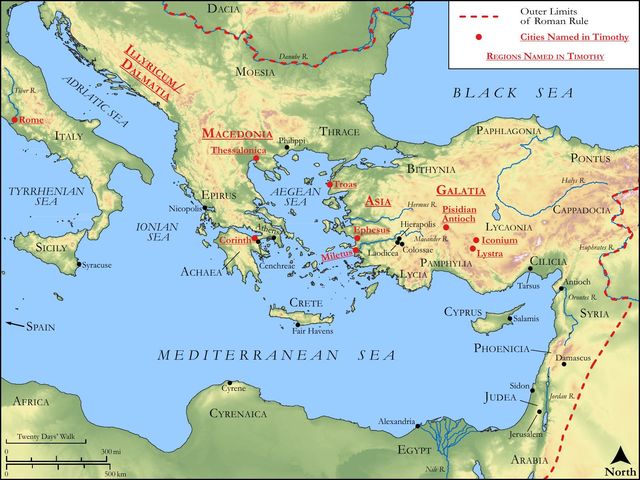
See on the biblical-era maps

Study this verse
Public-domain commentary
Matthew Henry
From his Commentary on the Whole Bible. Henry comments on passages, not single verses — this entry covers 1 Timothy 3:14–16. His four-level outline is real structure in the source text, so it is rendered as structure.
He concludes the chapter with a particular direction to Timothy. He hoped shortly to come to him, to give him further directions and assistance in his work, and to see that Christianity was well planted, and took root well, at Ephesus; he therefore wrote the more briefly to him. But he wrote lest he should tarry long, that Timothy might know how to behave himself in the house of God, how to conduct himself as became an evangelist, and the apostle's substitute. Observe,
I.Those who are employed in the house of God must see to it that they behave themselves well, lest they bring reproach upon the house of God, and that worthy name by which they are called. Ministers ought to behave themselves well, and to look not only to their praying and preaching, but to their behaviour: their office binds them to their good behaviour, for any behaviour will not do in this case. Timothy must know how to behave himself, not only in the particular church where he was now appointed to reside for some time, but being an evangelist, and the apostle's substitute, he must learn how to behave himself in other churches, where he should in like manner be appointed to reside for some time; and therefore it is not the church of Ephesus, but the catholic church, which is here called the house of God, which is the church of the living God. Observe here,
1.God is the living God; he is the fountain of life, he is life in himself, and he gives life, breath, and all things to his creatures; in him we live, and move, and have our being, Act 17:25, Act 17:28.
2.The church is the house of God, he dwells there; the Lord has chosen Zion, to dwell there. "This is my rest, here will I dwell, for I have chosen it;" there may we see God's power and glory, Psa 63:2.
II.It is the great support of the church that it is the church of the living God, the true God in opposition to false gods, dumb and dead idols.
1.As the church of God, it is the pillar and ground of truth; that is, either,
(1.)The church itself is the pillar and ground of truth. Not that the authority of the scriptures depends upon that of the church, as the papists pretend, for truth is the pillar and ground of the church; but the church holds forth the scripture and the doctrine of Christ, as the pillar to which a proclamation is affixed holds forth the proclamation. Even to the principalities and powers in heavenly places is made known by the church the manifold wisdom of God, Eph 3:10.
(2.)Others understand it of Timothy. He, not he himself only, but he as an evangelist, he and other faithful ministers, are the pillars and ground of truth; it is their business to maintain, hold up, and publish, the truths of Christ in the church. It is said of the apostles that they seemed to be pillars, Gal 2:9.
[1.]Let us be diligent and impartial in our own enquiries after truth; let us buy the truth at any rate, and not think much of any pains to discover it.
[2.]Let us be careful to keep and preserve it. "Buy the truth, and sell it not (Pro 23:23), do not part with it on any consideration." [3.] Let us take care to publish it, and to transmit it safe and uncorrupted unto posterity. [4.] When the church ceases to be the pillar and ground of truth, we may and ought to forsake her; for our regard to truth should be greater than our regard to the church; we are no longer obliged to continue in the church than she continues to be the pillar and ground of truth.
2.But what is the truth which the churches and ministers are the pillars and grounds of? He tells us (Ti1 3:16) that without controversy great is the mystery of godliness. The learned Camero joins this with what goes before, and then it runs thus: "The pillar and ground of the truth, and without controversy great is the mystery of godliness." He supposes this mystery to be the pillar, etc. Observe,
(1.)Christianity is a mystery, a mystery that could not have been found out by reason or the light of nature, and which cannot be comprehended by reason, because it is above reason, though not contrary thereto. It is a mystery, not of philosophy or speculation; but of godliness, designed to promote godliness; and herein it exceeds all the mysteries of the Gentiles. It is also a revealed mystery, not shut up and sealed; and it does not cease to be a mystery because now in part revealed. But,
(2.)What is the mystery of godliness? It is Christ; and here are six things concerning Christ, which make up the mystery of godliness.
[1.]That he is God manifest in the flesh: God was manifest in the flesh. This proves that he is God, the eternal Word, that was made flesh and was manifest in the flesh. When God was to be manifested to man he was pleased to manifest himself in the incarnation of his own Son: The Word was made flesh, Joh 1:14.
[2.]He is justified in the Spirit. Whereas he was reproached as a sinner, and put to death as a malefactor, he was raised again by the Spirit, and so was justified from all the calumnies with which he was loaded. He was made sin for us, and was delivered for our offences; but, being raised again, he was justified in the Spirit; that is, it was made to appear that his sacrifice was accepted, and so he rose again for our justification, as he was delivered for our offences, Rom 4:25. He was put to death in the flesh, but quickened by the Spirit, Pe1 3:18.
[3.]He was seen of angels. They worshipped him (Heb 1:6); they attended his incarnation, his temptation, his agony, his death, his resurrection, his ascension; this is much to his honour, and shows what a mighty interest he had in the upper world, that angels ministered to him, for he is the Lord of angels.
[4.]He is preached unto the Gentiles. This is a great part of the mystery of godliness, that Christ was offered to the Gentiles a Redeemer and Saviour; that whereas, before, salvation was of the Jews, the partition-wall was now taken down, and the Gentiles were taken in. I have set thee to be a light of the Gentiles, Act 13:47.
[5.]That he was believed on in the world, so that he was not preached in vain. Many of the Gentiles welcomed the gospel which the Jews rejected. Who would have thought that the world, which lay in wickedness, would believe in the Son of God, would take him to be their Saviour who was himself crucified at Jerusalem? But, notwithstanding all the prejudices they laboured under, he was believed on, etc.
[6.]He was received up into glory, in his ascension. This indeed was before he was believed on in the world; but it is put last, because it was the crown of his exaltation, and because it is not only his ascension that is meant, but his sitting at the right hand of God, where he ever lives, making intercession, and has all power, both in heaven and earth, and because, in the apostasy of which he treats in the following chapter, his remaining in heaven would be denied by those who pretend to bring him down on their altars in the consecrated wafers. Observe, First, He who was manifest in flesh was God, really and truly God, God by nature, and not only so by office, for this makes it to be a mystery. Secondly, God was manifest in flesh, real flesh. Forasmuch as the children are partakers of flesh and blood, he also himself likewise took part of the same, Heb 2:14. And, what is more amazing, he was manifest in the flesh after all flesh had corrupted his way, though he himself was holy from the womb. Thirdly, Godliness is a mystery in all its parts and branches, from the beginning to the end, from Christ's incarnation to his ascension. Fourthly, It being a great mystery, we should rather humbly adore it, and piously believe it, than curiously pry into it, or be too positive in our explications of it and determinations about it, further than the holy scriptures have revealed it to us.
Historical interpretation
Eight Centuries of Reception
9 surviving comments on this verse. Each one is dated, so this reads as a timeline rather than a list.
Select a marker to jump to its quote. Markers stagger vertically where authors wrote within a few decades of each other.
Well, I on my side will first explain the reason of his offence, that I may the more easily explode the scandal of our heretic. Now, that the very Lord Himself of all might, the Word and Spirit of the Father, was operating and preaching on earth, it was necessary that the portion of the Holy Spirit which, in the form of the prophetic gift, had been through John preparing the ways of the Lord, should now depart from John, and return back again of course to the Lord, as to its all-embracing original.
Behold the Savior’s greatness. It extends to all the world.… Go up to the heavens. See how he fills the celestial regions, “He appeared to the angels.” Go down in your mind to the nether world. See that he went down there, too.… Ponder the Lord’s power, how it has filled the world—that is, the heavens, the earth and the nether regions.
We hold it necessary to honor, even as the Father is honored, the God who was manifested by the cross. They [the Eunomians] find the passion a hindrance to glorifying the Only-Begotten God equally with the Father that begat him.… Eunomius makes the suffering of the cross to be a sign of divergence in essence, in the sense of inferiority, considering, I know not how, the surpassing act of power, by which he was able to perform this, to be an evidence of weakness. He fails to perceive the fact that, while nothing which moves according to its own nature is looked upon as surprisingly wonderful, all things that overpass the limitations of their own nature become especially the objects of admiration. Indeed, to them every ear is turned, every mind is attentive, in wonder at the marvel. And hence it is that all who preach the word point out the wonderful character of the mystery in this respect—that “God was manifested in the flesh,” that “the light shined in the darkness,” “the Life tasted death”—and all such declarations which the heralds of the faith are prone to make. By these is increased the marvelous character of him who manifested the superabundance of his power by means external to his own nature.
“If you knew my essence and dignity, you would also know that of the Father. And henceforth you will know him, and you have seen him” (the former in future, the latter at present), that is, “through me.” Moreover by “sight” he meant knowledge by means of the understanding. For we can both see and fail to know persons whom we actually see, but we cannot both know and fail to know at the same time persons whom we know. That is why he declared, “And you have seen him,” just as Scripture says, “as he has been seen by angels also.” Even though his very essence was not, of course, seen, it said that he “has been seen,” clearly meaning “seen” in such a way as it was possible for the angels to see.
"And without controversy great is the mystery of godliness; God [He who] was manifest in the flesh, justified in the Spirit."
Here he speaks of the Dispensation in our behalf. Tell me not of the bells, nor of the holy of holies, nor of the high priest. The Church is the pillar of the world. Consider this mystery, and thou mayest be struck with awe: for it is indeed "a great mystery," and "a mystery of godliness," and that "without controversy" or question, for it is beyond all doubt. Since in his directions to the Priests he had required nothing like what is found in Leviticus he refers the whole matter to Another, saying, "God was manifest in the flesh." The Creator was seen incarnate. "He was justified in the Spirit." As it is said, "Wisdom is justified of her children," or because He practiced no guile, as the Prophet says, "Because he had done no violence, neither was guile found in his mouth." (Isa. liii. 9; 1 Pet. ii. 22) "Seen of Angels." So that Angels together with us saw the Son of God, not having before seen Him. Great, truly great, was this mystery! "Preached unto the Gentiles, believed on in the world." He was heard of and believed in through all parts of the world, as the Prophet foreshowed, saying, "Their sound is gone out into all the world." (Ps. xix. 4) Think not that these things are mere words, for they are not, but full of hidden realities. "Received up into glory." He ascended upon clouds. "This Jesus," it is said, "Who is taken up from you, shall so come in like manner as ye have seen Him go into heaven." (Acts i. 11)
The dispensation in our behalf he calls a "mystery," and well may it be so called, since it is not manifest to all, nay, it was not manifest to the Angels, for how could it, when it was "made known by the Church"? (Eph. iii. 10) Therefore he says, "without controversy great is the mystery." Great indeed was it. For God became Man, and Man became God. A Man was seen without sin! A Man was received up, was preached in the world! Together with us the Angels saw Him. This is indeed a mystery! Let us not then expose this mystery. Let us not lay it forth everywhere, but let us live in a manner worthy of the mystery. They to whom a mystery is intrusted are great persons. We account it a mark of favor, if a king intrusts a secret to us. But God has committed His mystery to us, yet are we ungrateful to our Benefactor, as if we had not received the greatest benefits. Our insensibility to such a kindness should strike us with horror. And how is that a mystery which all know? In the first place all do not know it, and before then too they knew it not, but now it is made manifest.
But when the fullness of time came, Wisdom was sent in the flesh, not to fill angels nor to be an angel, except insofar as she announced the Father’s plan which was also her own. She was sent not to be with men and in men, for this too had been done before, both in the Fathers and in the prophets, but that the Word itself might become flesh, that is, that it might become a man. This future mystery, when revealed, would likewise be the salvation of those wise and saintly men, who had been born of women before he himself was born of a virgin, and ever since it has been accomplished and preached, it is the salvation of all who believe, hope and love.
The “mystery” is the sacred object of reverence, namely, that what was foreordained from the beginning and afterward became manifest.
No, indeed, it is not that God has just recently come up with a plan for attending to human affairs, nor that it has taken him this long to show compassion. Rather, he laid down from the very “foundation of the world” one and the same “cause of salvation” for all. For, the grace of God—by which the entire assembly of saints has always been justified—was not initiated at the time that Christ was born but augmented. This “mystery of great compassion,” with which the whole world has now been filled, was so powerful even in its prefigurations that those who believed it when promised attained to it no less than those who received it when actually given.
And confessedly, great is the mystery of godliness: God was revealed in the flesh, justified in the Spirit, seen by angels, preached among the nations, believed on in the world, received up in glory.
confessedly. For no one doubts this. And faith which is in us is both great and a mystery, and a mystery of devotion, and it has no hesitation. Do you see the steps?
God was revealed in the flesh, etc. Then Paul speaks of the mystery. For He who was revealed to men in the flesh was not judged righteous by human eyes, but by the eyes of the Spirit, who also searches the depths of God. (1 Cor. 2:10)
But he says: He was justified because of the flesh. For since God is God, he is not justified but justifies. This is also what the prophet said: "He who has not committed sin, nor deceit found in his mouth." (1 Peter 2:22) Saint Cyril in the twelfth chapter of the Scholia says: "’He who was revealed in the flesh was justified in the Spirit.’ For in no way was he subjected to our weaknesses.”
seen by angels. For they did not disregard His birth according to the flesh.
— [OECUMENIUS] He was justified in spirit. And by what justification is he justified who is righteousness itself and redemption, the Sun of righteousness according to Malachi? Which indicates the most pure and perfect righteousness, the fulfillment evidently of the legal rights; concerning which John said: "Let it be so now; for thus it is fitting for us to fulfill all righteousness." (Matt. 3:15) For since the law also commanded concerning baptisms, He came to the Jordan to fulfill this as well, just as He fulfilled circumcision and the offerings for the firstborn. But what does He mean by "In spirit"? Israel was bound in the spirit of slavery through the punishing law. For it did not have the spirit of adoption; this has been granted to Christians, as Paul also says: "What is above is Jerusalem the free, which is the mother of us all." (Gal. 4:26) He says therefore, Even if he fulfilled the legal righteous requirements, but not with the spirit of slavery (for how, he who also frees others?), but with the Holy Spirit of adoption, which the genuine Son received according to the human nature, bestowing the gift upon us, and consubstantial with the Spirit, and not for Himself. Just as He cared for and prayed, making our prayers acceptable, and called His own body a temple, causing us to become temples of God. [end of the excerpt by Oecumenius] —
For indeed, the righteous according to the Gospel, truly spiritual, have long surpassed many of those who are justified by the law.
— [PHOTIUS] Instead of being justified legally, he was justified spiritually. For he fulfilled the legal commandments not legally, but spiritually. The fact that he was not considered justified by the fleshly and hard-hearted (for they said, "Glutton and drunkard") but was justified by those who are established in the Spirit of God. "For we have seen his glory, glory as of the only begotten," and so on. (Jn. 1:14) [end of the excerpt by Photius] —
seen by angels. (O the mystery! The angels saw Christ with us, when before they had not seen.) Not as by men. Thus Clement in book seven of the Hypotyposes. "He was believed in the world." Truly great is the mystery. For everywhere in the inhabited world he was believed.
received up in glory. For the angels ministered to him as he was taken up on the clouds. Therefore he says, "in glory," because even the ascension itself is glorious.
Continue studying 1 Timothy 3:16 across the web’s major study libraries — every link below opens this exact verse, chapter, or book on the destination site.
Read & Compare
 BibleGatewayThis verse in more than 200 translations and 70 languages.
 Bible.comThe YouVersion reader — hundreds of translations, reading plans, and highlights.
 ESV.orgCrossway's official English Standard Version reader.
 NET BibleThe NET translation with 60,000+ translators' notes on every rendering decision.
 STEP BibleTyndale House's free study tool — original text, vocabulary, and scholarly resources.
 BibliaLogos Bible Software's free web reader.
 USCCBThe New American Bible (Revised Edition) with the U.S. bishops' study notes.
Commentaries
 BibleHub CommentariesDozens of classic commentaries on this verse, gathered on one page.
 StudyLightMore than 100 commentary sets — the largest collection on the web.
 BibleRefPlain-English commentary on what this verse means, verse by verse.
 Enduring WordDavid Guzik's free commentary on this chapter, widely used by Bible teachers.
 Bible Study ToolsVerse commentary alongside Greek and Hebrew study aids.
Original Language & Research
- BibleHub InterlinearThe verse word by word — original language, transliteration, and English.
- BibleHub LexiconEvery word's original-language definition and Strong's entry.
 Blue Letter BibleDeep-study tools — Strong's numbers, concordance, and word studies.
 CNTR CollationThe earliest Greek manuscripts of this verse, collated letter by letter.
Sermons, Hymns & Audio


TrulyRandomVerse is not affiliated with these sites and doesn’t control their content. They’re linked because they’re genuinely useful.
Summary
First Timothy 3:16 presents a profound, ancient confession of faith, often considered an early Christian hymn or creed, encapsulating the foundational truths of the gospel. It declares the unparalleled "mystery of godliness" – the astonishing reality of God's manifestation in human flesh through Jesus Christ, His divine vindication, His cosmic recognition, the universal proclamation and acceptance of His message, and His glorious ascension. This verse serves as a concise summary of Christ's person and work, providing the theological bedrock for the church's faith, conduct, and mission.
Context
ShowHideLiterary Context
This verse stands as a climactic, poetic declaration within Paul's first letter to Timothy, serving as a theological anchor for the practical instructions on church order and leadership that precede it. Immediately prior to this verse, Paul meticulously outlines the qualifications for overseers and deacons in 1 Timothy 3:1-13, emphasizing the need for godly leadership to preserve sound doctrine and maintain the integrity of the church, which Paul describes as "the pillar and ground of the truth" in 1 Timothy 3:15. Verse 16 then reveals the very truth that the church is called to uphold and proclaim: the mystery of Christ. Its hymnic structure suggests it may have been a well-known confession or liturgical piece used in early Christian worship, providing a concise summary of the gospel for both instruction and adoration.
Historical & Cultural Context
Timothy was ministering in Ephesus, a prominent city in Asia Minor, known for its diverse religious landscape, including the pervasive cult of Artemis and various philosophical schools. The early church in Ephesus faced challenges from false teachers who promoted asceticism, myths, and endless genealogies, undermining the core tenets of the faith (1 Timothy 1:3-7). In this environment, Paul's emphasis on "sound doctrine" (e.g., 1 Timothy 1:10) and the clear articulation of Christological truth was crucial. This confession would have provided a stable, authoritative summary of Christian belief, serving as a bulwark against syncretism and heresy, and reinforcing the unique identity and mission of the nascent Christian community amidst pagan influences.
Key Themes
ShowHideFirst Timothy 3:16 profoundly contributes to several key themes within the epistle and broader biblical theology. Foremost is Christology, presenting a robust summary of Jesus's divine nature and redemptive work, from His incarnation to His ascension. It highlights the Incarnation as the central "mystery" of God's self-revelation. The phrase "justified in the Spirit" points to Christ's Vindication and Resurrection, affirming His sinlessness and divine approval, a theme also seen in Romans 1:4. The verse underscores the Universal Scope of the Gospel, emphasizing that Christ's message was "preached unto the Gentiles" and "believed on in the world," echoing the Great Commission found in Matthew 28:19. Finally, it culminates in Christ's Exaltation and Glorification through His ascension, a truth foundational to Christian hope and the understanding of Christ's present reign (Acts 1:9-11).
Exposition and Analysis
ShowHideKey Word Analysis
ShowHideThis term, in biblical usage, does not refer to something incomprehensible or unknowable, but rather a truth previously hidden or partially revealed in the Old Testament, now fully disclosed and made plain through God's redemptive work in Christ. It signifies a divine secret, once concealed, but now openly declared for all to understand and believe. In this context, the "mystery of godliness" is the stunning revelation of God in Christ.
Derived from a word meaning "well-revering," eusébeia denotes true piety, reverence, and devotion to God that manifests in right living and conduct. It encompasses not merely outward religious observance but an inner disposition of reverence that shapes one's entire life. Here, the "mystery of godliness" refers to the profound truth of the gospel itself, which is the source and standard of all true piety.
From the root meaning "righteous," dikaióō means "to render (i.e. show or regard as) just or innocent." In the context of Christ, it speaks to His vindication. It signifies that Christ was declared righteous, proven to be without sin, and confirmed as God's Son through the power of the Holy Spirit, particularly in His resurrection. This is not about Christ needing to be made righteous, but about His inherent righteousness being publicly affirmed and demonstrated.
This word refers to glory as "very apparent" and can denote dignity, honor, praise, or worship. When applied to Christ's ascension, "received up into glory" signifies His exaltation to the highest honor and majesty in the presence of God. It speaks of His return to His rightful place of divine splendor and authority, demonstrating His ultimate triumph and reign.
Verse Breakdown
ShowHide"And without controversy great is the mystery of godliness:"
This opening phrase sets the stage, emphasizing the undisputed and profound nature of the truth that follows. The "mystery of godliness" is the central, revealed truth of Christian faith, which is of immense significance and beyond dispute among true believers. It is the core of what it means to live a life devoted to God.
"God was manifest in the flesh,"
This is the foundational declaration of the Incarnation. It states that God Himself, the Supreme Divinity, became visibly apparent and took on human nature. This refers directly to Jesus Christ, affirming His full deity and true humanity – the infinite God dwelling among humanity in a physical body.
"justified in the Spirit,"
This clause speaks to Christ's vindication. It means that Christ's sinless life, His divine claims, and His redemptive work were confirmed and authenticated by the Holy Spirit, most notably through His resurrection from the dead. The Spirit bore witness to His righteousness and power, proving Him to be the Son of God.
"seen of angels,"
This highlights the cosmic significance of Christ's earthly ministry. Heavenly beings, angels, observed with wonder and adoration the unfolding of God's redemptive plan through Christ's life, death, resurrection, and ascension. Their witness underscores the universal import of these events.
"preached unto the Gentiles,"
This emphasizes the universal scope of the gospel message. The good news of Christ, initially revealed within a Jewish context, was proclaimed to all nations, transcending ethnic and cultural boundaries. This reflects the apostolic mission to spread the message globally.
"believed on in the world,"
This clause attests to the transformative power and widespread acceptance of the gospel. Despite opposition, the message of Christ found faith and adherence among people from diverse backgrounds across the globe, demonstrating its efficacy and divine origin.
"received up into glory."
This climactic statement refers to Christ's ascension into heaven. After His resurrection, Jesus was bodily taken up into the divine presence, exalted to the right hand of God. This signifies His ultimate triumph, His reign as Lord, and His return to the full splendor and majesty of His divine glory.
Literary Devices
ShowHideThis verse is rich in literary artistry, functioning as a concise theological summary. Its rhythmic and balanced structure, particularly the six parallel clauses beginning with a passive verb, strongly suggests it is a Hymn or Creedal Form, likely an early Christian confession of faith. This Parallelism enhances its memorability and theological impact, presenting a series of declarative statements about Christ's person and work. The entire passage serves as a Doxology, a hymn of praise to God, specifically to Christ, for His magnificent work of salvation. The opening phrase, "great is the mystery of godliness," immediately signals the profound, divinely revealed truth that is about to be unfolded, elevating the significance of the subsequent declarations. The progression from incarnation to glorification also exhibits a Chiasm or concentric structure in some interpretations, where the central points are framed by the initial and final statements, emphasizing the journey of Christ.
Theological and Thematic Connections
ShowHideThis verse is a cornerstone of Christian theology, encapsulating the very essence of the gospel. It presents a comprehensive Christology, moving from the profound truth of the Incarnation – God becoming flesh – to the ultimate glorification of Christ in His ascension. It affirms both the full deity and true humanity of Jesus, making Him the unique mediator between God and humanity. The sequence of events – manifestation, vindication, angelic witness, global proclamation, worldwide belief, and glorious ascension – paints a complete picture of God's redemptive plan centered on Christ. This "mystery of godliness" is not an abstract concept but the living reality of God's saving presence and power revealed in His Son, providing the foundation for all Christian worship, doctrine, and ethical living. It highlights that true godliness is rooted in understanding and responding to who Christ is and what He has accomplished.
Reflection and Application
ShowHideFirst Timothy 3:16 calls believers to a profound contemplation of the person and work of Jesus Christ, recognizing that the "mystery of godliness" is not merely a theological concept but the living truth that animates our faith and shapes our lives. Understanding that God Himself was manifest in the flesh should inspire awe and humble adoration, reminding us of the immense love and condescension of our Creator. Christ's vindication in the Spirit assures us of His perfect righteousness and the efficacy of His atoning work, providing a firm foundation for our hope and salvation. The cosmic witness of angels and the global spread of the gospel should ignite our passion for evangelism and missions, knowing that this glorious truth is meant for all the world. Finally, Christ's ascension into glory provides assurance of His present reign and future return, empowering us to live lives of faithful obedience and confident expectation. This verse compels us to root our entire existence in the reality of Christ, allowing His story to define our identity, inform our worship, and direct our mission in the world.
Questions for Reflection
ShowHideFAQ
ShowHideWhat is the "mystery of godliness" mentioned in 1 Timothy 3:16?
ShowHideThe "mystery of godliness" refers to the profound, divinely revealed truth about God's saving work, which was once hidden but is now fully disclosed in the person and work of Jesus Christ. It is "godliness" because this revealed truth is the very foundation and source of all true piety and devotion to God. It encompasses the entire arc of Christ's redemptive journey: His incarnation ("God was manifest in the flesh"), His vindication by the Holy Spirit ("justified in the Spirit"), His cosmic recognition ("seen of angels"), the universal proclamation of His message ("preached unto the Gentiles"), its acceptance by humanity ("believed on in the world"), and His glorious ascension ("received up into glory"). This mystery is the core of the Christian faith, making God accessible to humanity and providing the means for true relationship with Him.
Why is 1 Timothy 3:16 considered so significant in Christian theology?
ShowHideThis verse is immensely significant because it provides one of the most concise and comprehensive summaries of Christology found in the New Testament. It affirms the full deity of Christ ("God was manifest in the flesh") and His true humanity, which is foundational to understanding His role as mediator and savior. It outlines the key stages of His redemptive work, from His earthly life and vindication to His universal impact and ultimate exaltation. Because of its hymnic or creedal structure, it is believed to be an early confession of faith, reflecting the core beliefs of the apostolic church. It serves as a theological anchor for the church, defining the truth it is called to uphold and proclaim, and providing a bulwark against false teachings that might deny Christ's nature or work. Its rich content underpins doctrines such as the Incarnation, Resurrection, Ascension, and the universal mission of the church, making it a pivotal text for understanding Christian orthodoxy and the nature of salvation.
Christ-Centered Fulfillment
ShowHideFirst Timothy 3:16 stands as a powerful testament to the Christ-centered nature of God's redemptive plan, revealing how all "godliness" flows from and finds its ultimate meaning in Jesus. The "mystery" is not merely a concept but the living reality of God Himself entering human history in the person of Christ, fulfilling ancient prophecies and inaugurating a new covenant. Jesus is the very manifestation of God in the flesh, the Word who became flesh and dwelt among us, making the invisible God visible and comprehensible. His life, death, and resurrection were not merely human events but divine acts, justified and confirmed by the Holy Spirit, proving His perfect righteousness and His victory over sin and death. This cosmic drama, observed with wonder by angels, culminates in the universal proclamation of His gospel, as the good news is preached to all nations and believed on in the world. Finally, His reception up into glory signifies His exaltation as Lord of all, reigning at the Father's right hand until He returns, ensuring that all true godliness is eternally rooted in His finished work and ongoing reign.