


Acts 17:28
- ἐνenInG1722PREPPreposition
- αὐτῷautōHimG846P-DSMPersonal pronoun Dative Singular Masculine
- γὰρgarforG1063CONJConjunction
- ζῶμενzōmenwe liveG2198V-PAI-1PVerb Present Active Indicative 1st Plural
- καὶkaiandG2532CONJConjunction
- κινούμεθαkinoumethamoveG2795V-PPI-1PVerb Present Passive Indicative 1st Plural
- καὶkaiandG2532CONJConjunction
- ἐσμένesmenare,’G1510V-PAI-1PVerb Present Active Indicative 1st Plural
- ὡςhōsAsG5613PRTParticle or Disjunctive
- καίkaialsoG2532CONJConjunction
- τινεςtinessomeG5100X-NPMIndefinite pronoun Nominative Plural Masculine
- τῶνtōnof theG3588T-GPMDefinite article Genitive Plural Masculine
- καθ᾽kath᾽amongG2596PREPPreposition
- ὑμᾶςhumasyouG4771P-2APPersonal pronoun Accusative 2nd Plural
- ποιητῶνpoiētōnpoetsG4163N-GPMNoun Genitive Plural Masculine
- εἰρήκασιν·eirēkasinhave saidG2046V-RAI-3PVerb Perfect Active Indicative 3rd Plural
- τοῦtouof [Him]G3588T-GSMDefinite article Genitive Singular Masculine
- γὰρgarForG1063CONJConjunction
- καὶkaialsoG2532CONJConjunction
- γένοςgenosoffspringG1085N-NSNNoun Nominative Singular Neuter
- ἐσμένesmenwe are.’G1510V-PAI-1PVerb Present Active Indicative 1st Plural
English is a literal word-by-word gloss of the Greek, not the KJV's wording. Why?
This is the original text the KJV's translators worked from — each Greek word with its own literal English meaning in this verse, prepared by scholars at Tyndale House, Cambridge. The KJV translates whole sentences, not word by word, so its wording differs: one Greek word can become several English words, and the KJV may choose “charity” where the gloss reads “love”. Both are faithful — they answer different questions. For the KJV's own rendering, switch to the KJV text.
Details
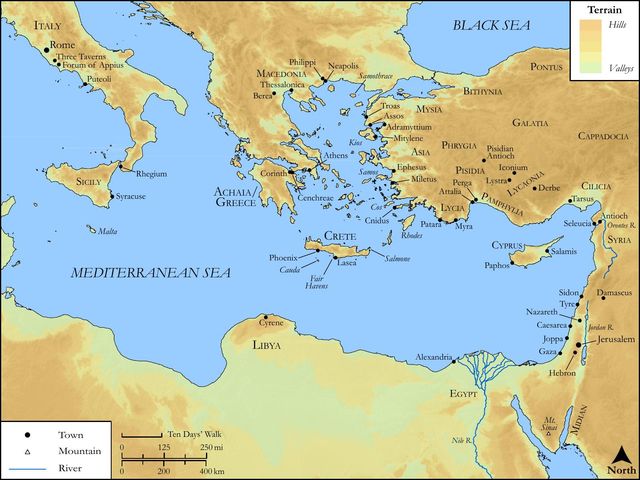
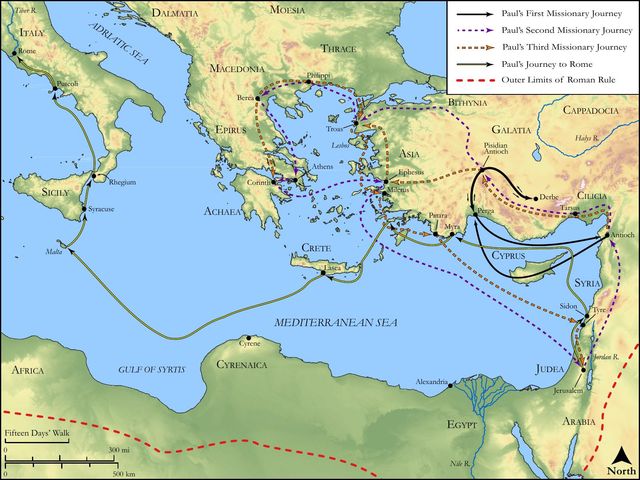
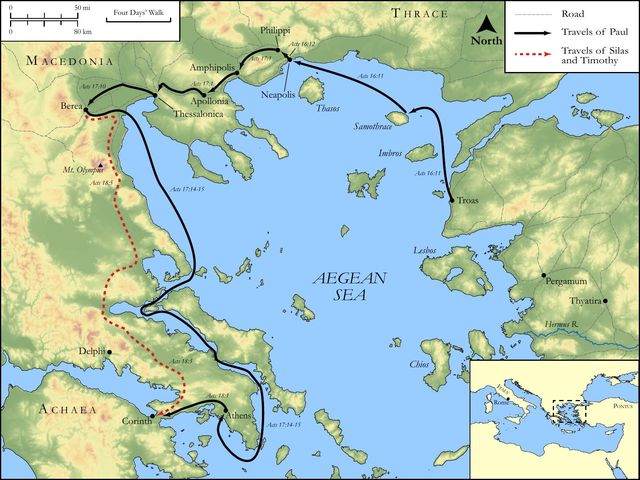
See on the biblical-era map
Study this verse
Public-domain commentary
Matthew Henry
From his Commentary on the Whole Bible. Henry comments on passages, not single verses — this entry covers Acts 17:22–31. His four-level outline is real structure in the source text, so it is rendered as structure.
We have here St. Paul's sermon at Athens. Divers sermons we have had, which the apostles preached to the Jews, or such Gentiles as had an acquaintance with and veneration for the Old Testament, and were worshippers of the true and living God; and all they had to do with them was to open and allege that Jesus is the Christ; but here we have a sermon to heathens, that worshipped false gods, and were without the true God in the world, and to them the scope of their discourse was quite different from what it was to the other. In the former case their business was to lead their hearers by prophecies and miracles to the knowledge of the Redeemer, and faith in him; in the latter it was to lead them by the common works of providence to the knowledge of the Creator, and the worship of him. One discourse of this kind we had before to the rude idolaters of Lystra that deified the apostles (Act 14:15); this recorded here is to the more polite and refined idolaters at Athens, and an admirable discourse it is, and every way suited to his auditory and the design he had upon them.
I.He lays down this, as the scope of his discourse, that he aimed to bring them to the knowledge of the only living and true God, as the sole and proper object of their adoration. He is here obliged to lay the foundation, and to instruct them in the first principle of all religion, that there is a God, and that God is but one. When he preached against the gods they worshipped, he had no design to draw them to atheism, but to the service of the true Deity. Socrates, who had exposed the pagan idolatry, was indicted in this very court, and condemned, not only because he did not esteem those to be gods whom the city esteemed to be so, but because he introduced new demons; and this was the charge against Paul. Now he tacitly owns the former part of the charge, but guards against the latter, by declaring that he does not introduce any new gods, but reduce them to the knowledge of one God, the Ancient of days. Now,
1.He shows them that they needed to be instructed herein; for they had lost the knowledge of the true God that made them, in the worship of false gods that they had made (Deos qui rogat ille facit - He who worships the gods makes them): I perceive that in all things you are too superstitious. The crime he charges upon them is giving that glory to others which is due to God only, that they feared and worshipped demons, spirits that they supposed inhabited the images to which they directed their worship. "It is time for you to be told that there is but one God who are multiplying deities above any of your neighbours, and mingle your idolatries with all your affairs. You are in all things too superstitious - deisidaimonesteroî you easily admit every thing that comes under a show of religion, but it is that which corrupts it more and more; I bring you that which will reform it." Their neighbours praised them for this as a pious people, but Paul condemns them for it. Yet it is observable how he mollifies the charge, does not aggravate it, to provoke them. He uses a word which among them was taken in a good sense: You are every way more than ordinarily religious, so some read it; you are very devout in your way. Or, if it be taken in a bad sense, it is mitigated: "You are as it were (hōs) more superstitious than you need be;" and he says no more than what he himself perceived; theōrō - I see it, I observe it. They charged Paul with setting forth new demons: "Nay," says he, "you have demons enough already; I will not add to the number of them."
2.He shows them that they themselves had given a fair occasion for the declaring of this one true God to them, by setting up an altar, To the unknown God, which intimated an acknowledgment that there was a God who was yet to them an unknown God; and it is sad to think that at Athens, a place which was supposed to have the monopoly of wisdom, the true God was an unknown God, the only God that was unknown. "Now you ought to bed Paul welcome, for this is the God whom he comes to make known to you, the God whom you tacitly complain that you are ignorant of." There, where we are sensible we are defective and come short, just there, the gospel takes us up, and carries us on.
(1.)Various conjectures the learned have concerning this altar dedicated to the unknown God.
[1.]Some think the meaning is, To the God whose honour it is to be unknown, and that they intended the God of the Jews, whose name is ineffable, and whose nature is unsearchable. It is probable they had heard from the Jews, and from the writings of the Old Testament, of the God of Israel, who had proved himself to be above all gods, but was a God hiding himself, Isa 45:15. The heathen called the Jews' God, Deus incertus, incertum Mosis Numen - an uncertain God, the uncertain Deity of Moses, and the God without name. Now this God, says Paul, this God, who cannot by searching be found out to perfection, I now declare unto you.
[2.]Others think the meaning is, To the God whom it is our unhappiness not to know, which intimates that they would think it their happiness to know him. Some tell us that upon occasion of a plague that raged at Athens, when they had sacrificed to all their gods one after another for the staying of the plague, they were advised to let some sheep go where they pleased, and, where they lay down, to build an altar, tō prosēkonti Theō - to the proper God, or the God to whom that affair of staying the pestilence did belong; and, because they knew not how to call him, they inscribed it, To the unknown God. Others, from some of the best historians of Athens, tell us they had many altars inscribed, To the gods of Asia, Europe, and Africa - To the unknown God: and some of the neighbouring countries used to swear by the God that was unknown at Athens; so Lucian.
(2.)Observe, how modestly Paul mentions this. That he might not be thought a spy, nor one that had intruded himself more than became a stranger into the knowledge of their mysteries, he tells them that he observed it as he passed by, and saw their devotions, or their sacred things. It was public, and he could not forbear seeing it, and it was proper enough to make his remarks upon the religion of the place; and observe how prudently and ingeniously he takes occasion from this to bring in his discourse of the true God. [1.] He tells them that the God he preached to them was one that they did already worship, and therefore he was not a setter forth of new or strange gods: "As you have a dependence upon him, so he has had some kind of homage from you." [2.] He was one whom they ignorantly worshipped, which was a reproach to them, who were famous all the world over for their knowledge. "Now," says he, "I come to take away that reproach, that you may worship him understandingly whom how you worship ignorantly; and it cannot but be acceptable to have your blind devotion turned into a reasonable service, that you may not worship you know not what."
II.He confirms his doctrine of one living and true God, by his works of creation and providence:
"The God whom I declare unto you to be the sole object of your devotion, and call you to the worship of, is the God that made the world and governs it; and, by the visible proofs of these, you may be led to this invisible Being, and be convinced of his eternal power and Godhead." The Gentiles in general, and the Athenians particularly, in their devotions were governed, not by their philosophers, many of whom spoke clearly and excellently well of one supreme Numen, of his infinite perfections and universal agency and dominion (witness the writings of Plato, and long after of Cicero); but by their poets, and their idle fictions. Homer's works were the Bible of the pagan theology, or demonology rather, not Plato's; and the philosophers tamely submitted to this, rested in their speculations, disputed them among themselves, and taught them to their scholars, but never made the use they ought to have made of them in opposition to idolatry; so little certainty were they at concerning them, and so little impression did these things make upon them! Nay, they ran themselves into the superstition of their country, and thought they ought to do so. Eamus ad communem errorem - Let us embrace the common error. Now Paul here sets himself, in the first place, to reform the philosophy of the Athenians (he corrects the mistakes of that), and to give them right notions of the one only living and true God, and then to carry the matter further than they ever attempted for the reforming of their worship, and the bringing them off from their polytheism and idolatry. Observe what glorious things Paul here says of that God whom he served, and would have them to serve.
1.He is the God that made the world, and all things therein; the Father almighty, the Creator of heaven and earth. This was admitted by many of the philosophers; but those of Aristotle's school denied it, and maintained "that the world was from eternity, and every thing always was from eternity, and every thing always was what now it is." Those of the school of Epicurus fancied "that the world was made by a fortuitous concourse of atoms, which, having been in perpetual motion, at length accidentally jumped into this frame." Against both these Paul here maintains that God by the operations of an infinite power, according to the contrivance of an infinite wisdom, in the beginning of time made the world and all things therein, the origin of which was owing, not as they fancied to an eternal matter, but to an eternal mind.
2.He is therefore Lord of heaven and earth, that is, he is the rightful owner, proprietor, and possessor, of all the beings, powers, and riches of the upper and lower world, material and immaterial, visible and invisible. This follows from his making heaven and earth. If he created all, without doubt he has the disposing of all: and, where he gives being, he has an indisputable right to give law.
3.He is, in a particular manner, the Creator of men, of all men (Act 17:26): He made of one blood all nations of men. He made the first man, he makes every man, is the former of every man's body and the Father of every man's spirit. He has made the nations of men, not only all men in the nations, but as nations in their political capacity; he is their founder, and disposed them into communities for their mutual preservation and benefit. He made them all of one blood, of one and the same nature; he fashions their heart alike. Descended from one and the same common ancestor, in Adam they are all akin, so they are in Noah, that hereby they might be engaged in mutual affection and assistance, as fellow-creatures and brethren. Have we not all one Father? Hath not one God created us? Mal 2:10. He hath made them to dwell on all the face of the earth, which, as a bountiful benefactor, he has given, with all its fulness, to the children of men. He made them not to live in one place, but to be dispersed over all the earth; one nation therefore ought not to look with contempt upon another, as the Greeks did upon all other nations; for those on all the face of the earth are of the same blood. The Athenians boasted that they sprung out of their own earth, were aborigines, and nothing akin by blood to any other nation, which proud conceit of themselves the apostle here takes down.
4.That he is the great benefactor of the whole creation (Act 17:25): He giveth to all life, and breath, and all things. He not only breathed into the first man the breath of life, but still breathes it into every man. He gave us these souls he formed the spirit of man within him. He not only gave us our life and breath, when he brought us into being, but he is continually giving them to us; his providence is a continued creation; he holds our souls in life; every moment our breath goes forth, but he graciously gives it us again the next moment; it is no only his air that we breathe in, but it is in his hand that our breath is, Dan 5:23. He gives to all the children of men their life and breath; for as the meanest of the children of men live upon him, and receive from him, so the greatest, the wisest philosophers and mightiest potentates, cannot live without him. He gives to all, not only to all the children of men, but to the inferior creatures, to all animals, every thing wherein is the breath of life (Gen 6:17); they have their life and breath from him, and where he gives life and breath he gives all things, all other things needful for the support of life. The earth is full of his goodness, Psa 104:24, Psa 104:27.
5.That he is the sovereign disposer of all the affairs of the children of men, according to the counsel of his will (Act 17:26): He hath determined the times before appointed, and the bounds of their habitation. See here,
(1.)The sovereignty of God's disposal concerning us: he hath determined every event, horisas, the matter is fixed; the disposals of Providence are incontestable and must not be disputed, unchangeable and cannot be altered.
(2.)The wisdom of his disposals; he hath determined what was before appointed. The determinations of the Eternal Mind are not sudden resolves, but the counterparts of an eternal counsel, the copies of divine decrees. He performeth the thing that is appointed for me, Job 23:14. Whatever comes forth from God was before all worlds hid in God.
(3.)The things about which his providence is conversant; these are time and place: the times and places of our living in this world are determined and appointed by the God that made us.
[1.]He has determined the times that are concerning us. Times to us seem changeable, but God has fixed them. Our times are in his hand, to lengthen or shorten, embitter or sweeten, as he pleases. He has appointed and determined the time of our coming into the world, and the time of our continuance in the world; our time to be born, and our time to die (Ecc 3:1, Ecc 3:2), and all that little that lies between them - the time of all our concernments in this world. Whether they be prosperous times or calamitous times, it is he that has determined them; and on him we must depend, with reference to the times that are yet before us.
[2.]He has also determined and appointed the bounds of our habitation. He that appointed the earth to be a habitation for the children of men has appointed to the children of men a distinction of habitations upon the earth, has instituted such a thing as property, to which he has set bounds to keep us from trespassing one upon another. The particular habitations in which our lot is cast, the place of our nativity and of our settlement, are of God's determining and appointing, which is a reason why we should accommodate ourselves to the habitations we are in, and make the best of that which is.
6.That he is not far from every one of us, Act 17:27. He is every where present, not only is at our right hand, but has possessed our reins (Psa 139:13), has his eye upon us at all times, and knows us better than we know ourselves. Idolaters made images of God, that they might have him with them in those images, the absurdity of which the apostle here shows; for he in an infinite Spirit, that is not far from any of us, and never the nearer, but in one sense the further off from us, for our pretending to realize or presentiate him to ourselves by any image. He is nigh unto us, both to receive the homage we render him and to give the mercies we ask of him, wherever we are, though near no altar, image, or temple. The Lord of all, as he is rich (Rom 10:12), so he is nigh (Deu 4:7), to all that call upon him. He that wills us to pray every where, assures us that he is no where far from us; whatever country, nation, or profession we are of, whatever our rank and condition in the world are, be we in a palace or in a cottage, in a crowd or in a corner, in a city or in a desert, in the depths of the sea or afar off upon the sea, this is certain, God is not far from every one of us.
7.That in him we live, and move, and have our being, Act 17:28. We have a necessary and constant dependence upon his providence, as the streams have upon the spring, and the beams upon the sun.
(1.)In him we live; that is, the continuance of our lives is owing to him and the constant influence of his providence; he is our life, and the length of our days. It is not only owing to his patience and pity that our forfeited lives are not cut off, but it is owing to his power, and goodness, and fatherly care, that our frail lives are prolonged. There needs not a positive act of his wrath to destroy us; if he suspend the positive acts of his goodness, we die of ourselves.
(2.)In him we move; it is by the uninterrupted concourse of his providence that our souls move in their outgoings and operations, that our thoughts run to and fro about a thousand subjects, and our affections run out towards their proper objects. It is likewise by him that our souls move our bodies; we cannot stir a hand, or foot, or a tongue, but by him, who, as he is the first cause, so he is the first mover.
(3.)In him we have our being; not only from him we had it at first, but in him we have it still; to his continued care and goodness we owe it, not only that we have a being and are not sunk into nonentity, but that we have our being, have this being, were and still are of such a noble rank of beings, capable of knowing and enjoying God; and are not thrust into the meanness of brutes, nor the misery of devils.
8.That upon the whole matter we are God's offspring; he is our Father that begat us (Deu 32:6, Deu 32:18), and he hath nourished and brought us up as children, Isa 1:2. The confession of an adversary in such a case is always looked upon to be of use as argumentum ad hominem - an argument to the man, and therefore the apostle here quotes a saying of one of the Greek poets, Aratus, a native of Cilicia, Paul's countryman, who, in his Phenomena, in the beginning of his book, speaking of the heathen Jupiter, that is, in the poetical dialect, the supreme God, says this of him, tou gar kai genos esmen - for we are also his offspring. And he might have quoted other poets to the purpose of what he was speaking, that in God we live and move: -
Spiritus intus alit, totamque infusa per artus
Mens agitat molem.
This active mind, infus'd through all the space,
Unites and mingles with the mighty mass.
- Virgil, Aeneid 6
Est Deus in nobis, agitante calescimus illo.
'Tis the Divinity that warms our hearts.
- Ovid, Fast. 6
Jupiter est quodeunque vides,
Quocunque moveris.
Where'er you look, where'er you rove
'The spacious scene is full of Jove.
- Lucan, lib. 2
But he chooses this of Aratus, as having much in a little. By this it appears not only that Paul was himself a scholar, but that human learning is both ornamental and serviceable to a gospel minister, especially for the convincing of those that are without; for it enables him to beat them at their own weapons, and to cut off Goliath's head with his own sword. How can the adversaries of truth be beaten out of their strong-holds by those that do not know them? It may likewise shame God's professing people, who forget their relation to God, and walk contrary to it, that a heathen poet could say of God, We are his offspring, formed by him, formed for him, more the care of his providence than ever any children were the care of their parents; and therefore are obliged to obey his commands, and acquiesce in his disposals, and to be unto him for a name and a praise. Since in him and upon him we live, we ought to live to him; since in him we move, we ought to move towards him; and since in him we have our being, and from him we receive all the supports and comforts of our being, we ought to consecrate our being to him, and to apply to him for a new being, a better being, an eternal well-being.
III.From all these great truths concerning God, he infers the absurdity of their idolatry, as the prophets of old had done. If this be so,
1.Then God cannot be represented by an image. If we are the offspring of God, as we are spirits in flesh, then certainly he who is the Father of our spirits (and they are the principal part of us, and that part of us by which we are denominated God's offspring) is himself a Spirit, and we ought not to think that the Godhead is like unto gold, or silver, or stone, graven by art and man's device, Act 17:29. We wrong God, and put an affront upon him, if we think so. God honoured man in making his soul after his own likeness; but man dishonours God if he makes him after the likeness of his body. The Godhead is spiritual, infinite, immaterial, incomprehensible, and therefore it is a very false and unjust conception which an image gives us of God, be the matter ever so rich, fold or silver; be the shape ever so curious, and be it ever so well graven by art or man's device, its countenance, posture, or dress, ever so significant, it is a teacher of lies.
2.Then he dwells not in temples made with hands, Act 17:24. He is not invited to any temple men can build for him, nor confined to any. A temple brings him never the nearer to us, nor keeps him ever the longer among us. A temple is convenient for us to come together in to worship God; but God needs not any place of rest or residence, nor the magnificence and splendour of any structure, to add to the glory of his appearance. A pious, upright heart, a temple not made with hands, but by the Spirit of God, is that which he dwells in, and delights to dwell in. See Kg1 8:27; Isa 66:1, Isa 66:2.
3.Then he is not worshipped, therapeuetai, he is not served, or ministered unto, with men's hands, as though he needed any thing, Act 17:25. He that made all, and maintains all, cannot be benefited by any of our services, nor needs them. If we receive and derive all from him, he is all-sufficient, and therefore cannot but be self-sufficient, and independent. What need can God have of our services, or what benefit can he have by them, when he has all perfection in himself, and we have nothing that is good but what we have from him? The philosophers, indeed, were sensible of this truth, that God has no need of us or our services; but the vulgar heathen built temples and offered sacrifices to their gods, with an opinion that they needed houses and food. See Job 35:5-8; Psa 50:8, etc.
4.Then it concerns us all to enquire after God (Act 17:27): That they should seek the Lord, that is, fear and worship him in a right manner. Therefore God has kept the children of men in a constant dependence upon him for life and all the comforts of life, that he might keep them under constant obligations to him. We have plain indications of God's presence among us, his presidency over us, the care of his providence concerning us, and his bounty to us, that we might be put upon enquiring, Where is God our Maker, who giveth songs in the night, who teacheth us more than the beasts of the earth, and maketh us wiser than the fowls of heaven? Job 35:10, Job 35:11. Nothing, one would think, should be more powerful with us to convince us that there is a God, and to engage us to seek his honour and glory in our services, and to seek our happiness in his favour and love, than the consideration of our own nature, especially the noble powers and faculties of our own souls. If we reflect upon these, and contemplate these, we may perceive both our relation and obligation to a God above us. Yet so dark is this discovery, in comparison with that by divine revelation, and so unapt are we to receive it, that those who have no other could but haply feel after God and find him.
(1.)It was very uncertain whether they could by this searching find out God; it is but a peradventure: if haply they might.
(2.)If they did find out something of God, yet it was but some confused notions of him; they did but feel after him, as men in the dark, or blind men, who lay hold on a thing that comes in their way, but know not whether it be that which they are in quest of or no. It is a very confused notion which this poet of theirs has of the relation between God and man, and very general, that we are his offspring: as was also that of their philosophers. Pythagoras said, Theion genos esti brotoios - Men have a sort of a divine nature. And Heraclitus (apud Lucian) being asked, What are men? answered, Theoi thnētoi - Mortal gods; and, What are the gods? answered, athanatoi anthrōpoi - Immortal men. And Pindar saith (Nemean, Ode 6), En andrōn hen theōn genos - God and man are near a-kin. It is true that by the knowledge of ourselves we may be led to the knowledge of God, but it is a very confused knowledge. This is but feeling after him. We have therefore reason to be thankful that by the gospel of Christ we have notices given us of God much clearer than we could have by the light of nature; we do not now feel after him, but with open face behold, as in a glass, the glory of God.
IV.He proceeds to call them all to repent of their idolatries, and to turn from them, Act 17:30, Act 17:31.
This is the practical part of Paul's sermon before the university; having declared God to them (Act 17:23), he properly presses upon them repentance towards God, and would also have taught them faith towards our Lord Jesus Christ, if they had had the patience to hear him. Having shown them the absurdity of their worshipping other gods, he persuades them to go on no longer in that foolish way of worship, but to return from it to the living and true God. Observe,
1.The conduct of God towards the Gentile world before the gospel came among them: The times of this ignorance God winked at.
(1.)They were times of great ignorance. Human learning flourished more than ever in the Gentile world just before Christ's time; but in the things of God they were grossly ignorant. Those are ignorant indeed who either know not God or worship him ignorantly; idolatry was owing to ignorance.
(2.)These times of ignorance God winked at. Understand it,
[1.]As an act of divine justice. God despised or neglected these times of ignorance, and did not send them his gospel, as now he does. It was very provoking to him to see his glory thus given to another; and he detested and hated these times. So some take it. Or rather,
[2.]As an act of divine patience and forbearance. He winked at these times; he did not restrain them from these idolatries by sending prophets to them, as he did to Israel; he did not punish them in their idolatries, as he did Israel; but gave them the gifts of his providence, Act 14:16, Act 14:17. These things thou hast done, and I kept silence, Psa 50:21. He did not give them such calls and motives to repentance as he does now. He let them alone. Because they did not improve the light they had, but were willingly ignorant, he did not send them greater lights. Or, he was not quick and severe with them, but was long-suffering towards them, because they did it ignorantly, Ti1 1:13.
2.The charge God gave to the Gentile world by the gospel, which he now sent among them: He now commandeth all men every where to repent - to change their mind and their way, to be ashamed of their folly and to act more wisely, to break off the worship of idols and bind themselves to the worship of the true God. Nay, it is to turn with sorrow and shame from every sin, and with cheerfulness and resolution to every duty.
(1.)This is God's command. It had been a great favour if he had only told us that there was room left for repentance, and we might be admitted to it; but he goes further, he interposes his own authority for our good, and has made that our duty which is our privilege.
(2.)It is his command to all men, every where, - to men, and not to angels, that need it not, - to men, and not to devils, that are excluded the benefit of it, - to all men in all places; all men have made work for repentance, and have cause enough to repent, and all men are invited to repent, and shall have the benefit of it. The apostles are commissioned to preach this every where. The prophets were sent to command the Jews to repent; but the apostles were sent to preach repentance and remission of sins to all nations.
(3.)Now in gospel times it is more earnestly commanded, because more encouraged than it had been formerly. Now the way of remission is more opened than it had been, and the promise more fully confirmed; and therefore now he expects we should all repent. "Now repent; now at length, now in time, repent; for you have too long gone on in sin. Now in time repent, for it will be too late shortly."
3.The great reason to enforce this command, taken from the judgment to come. God commands us to repent, because he hath appointed a day in which he will judge the world in righteousness (Act 17:31), and has now under the gospel made a clearer discovery of a state of retribution in the other world than ever before. Observe,
(1.)The God that made the world will judge it; he that gave the children of men their being and faculties will call them to an account for the use they have made of them, and recompense them accordingly, whether the body served the soul in serving God or the soul was a drudge to the body in making provision for the flesh; and every man shall receive according to the things done in the body, Co2 5:10. The God that now governs the world will judge it, will reward the faithful friends of his government and punish the rebels.
(2.)There is a day appointed for this general review of all that men have done in time, and a final determination of their state for eternity. The day is fixed in the counsel of God, and cannot be altered; but it is his there, and cannot be known. A day of decision, a day of recompence, a day that will put a final period to all the days of time.
(3.)The world will be judged in righteousness; for God is not unrighteous, who taketh vengeance; far be it from him that he should do iniquity. His knowledge of all men's characters and actions is infallibly true, and therefore his sentence upon them incontestably just. And, as there will be no appeal from it, so there will be no exception against it.
(4.)God will judge the world by that man whom he hath ordained, who can be no other than the Lord Jesus, to whom all judgment is committed. By him God made the world, by him he redeemed it, by him he governs it, and by him he will judge it.
(5.)God's raising Christ from the dead is the great proof of his being appointed and ordained the Judge of quick and dead. His doing him that honour evidenced his designing him this honour. His raising him from the dead was the beginning of his exaltation, his judging the world will be the perfection of it; and he that begins will make an end. God hath given assurance unto all men, sufficient ground for their faith to build upon, both that there is a judgment to come and that Christ will be their judge; the matter is not left doubtful, but is of unquestionable certainty. Let all his enemies be assured of it, and tremble before him; let all his friends be assured of it, and triumph in him.
(6.)The consideration of the judgment to come, and of the great hand Christ will have in that judgment, should engage us all to repent of our sins and turn from them to God. This is the only way to make the Judge our friend in that day, which will be a terrible day to all who live and die impenitent; but true penitents will then lift up their heads with joy, knowing that their redemption draws nigh.
Historical interpretation
Seventeen Centuries of Reception
11 surviving comments on this verse. Each one is dated, so this reads as a timeline rather than a list.
Select a marker to jump to its quote. Markers stagger vertically where authors wrote within a few decades of each other.
It is clear that by using poetic examples from the Phaenomena of Aratus [Paul] approves the best statements of the Greeks. Besides, he refers to the fact that in the person of the unknown god the Greeks are indirectly honoring God the Creator and need to receive him and learn about him with full knowledge through the Son. “I sent you to the gentiles for this purpose,” says Scripture, “to open their eyes, for them to turn from darkness to light and from the power of Satan to God, for them to receive release from sins and an inheritance among those who are sanctified by faith in me.” So these are the “opened eyes of the blind,” which means the clear knowledge of the Father through the Son, the direct grasp of the thing to which the Greeks indirectly allude.
Paul, in the Acts of the Apostles, is recorded to have said to the Areopagites, "I perceive that ye are more than ordinarily religious. For as I passed by, and beheld your devotions, I found an altar with the inscription, To The Unknown God. Whom therefore ye ignorantly worship, Him declare I unto you. God, that made the world and all things therein, seeing that He is Lord of heaven and earth, dwelleth not in temples made with hands; neither is worshipped with men's hands, as though He needed anything, seeing He giveth to all life, and breath, and all things; and hath made of one blood all nations of men to dwell on all the face of the earth, and hath determined the times before appointed, and the bounds of their habitation; that they should seek God, if haply they might feel after Him, and find Him; though He be not far from every one of us: for in Him we live, and move, and have our being; as certain also of your own poets have said, For we also are His offspring." Whence it is evident that the apostle, by availing himself of poetical examples from the Phenomena of Aratus, approves of what had been well spoken by the Greeks; and intimates that, by the unknown God, God the Creator was in a roundabout way worshipped by the Greeks; but that it was necessary by positive knowledge to apprehend and learn Him by the Son.
“Being as one outside the law to those outside the law.” He came to Athens, he found philosophers, and he did not use the words of the prophets or from the law, but as one perhaps recalling this pagan teaching from a school of rhetoric he spoke to the men of Athens. For [Paul] said, “Just as some of your poets have said, ‘For we are his offspring too.’ ” In this place, he was as one outside the law to those outside the law, in order to gain the lawless. It is as if he were to say “I was doing nothing contrary to the law in making this concession to them, but I was keeping myself bound by the law of Christ, in order to gain the lawless.”
I believe that if He is given the name ‘Son’, it is because He is of the same essence as the Father and also because He comes from the Father… He is called Logos (Word) because He is, in relation to the Father, what the word is to the mind… The Son makes known the nature of the Father quickly and easily, because everything begotten is an unspoken definition of the one who got it. If, on the other hand, we wish to call Him ‘Word’ because He is in everything, we shall not be mistaken: did not the Word create all that is?… He is called ‘Life’… because He gives life to everything. Indeed, ‘in Him we live and move and have our being’ (Acts 17.28)… It is from Him that we all receive the breath of life and the Holy Spirit Whom our soul contains to the limit of its openness. - "Fourth Theological Oration, 20-21"
"In him;" to put it by way of corporeal similitude, even as it is impossible to be ignorant of the air which is diffused on every side around us, and is "not far from every one of us," nay rather, which is in us. For it was not so that there was a heaven in one place, in another none, nor yet a heaven at one time, at another none. So that both at every "time" and at every "bound" it was possible to find Him. He so ordered things, that neither by place nor by time were men hindered. For of course even this, if nothing else, of itself was a help to them - that the heaven is in every place, that it stands in all time. See how he declares His Providence, and His upholding power; the existence of all things from Him, from Him their working, from Him their preservation that they perish not. And he does not say, "Through Him," but, what was nearer than this, "In him."
"As certain also of your own poets have said, For we are also His offspring." This is said by Aratus the poet. Observe how he draws his arguments from things done by themselves, and from sayings of their own.
That poet said nothing equal to this, "For we are His offspring." He, however, spake it of Jupiter, but Paul takes it of the Creator, not meaning the same being as he, God forbid! but meaning what is properly predicated of God: just as he spoke of the altar with reference to Him, not to the being whom they worshipped. As much as to say, "For certain things are said and done with reference to this true God, but ye know not that they are with reference to Him."
As some of your poets have said. This is what he says elsewhere: I determined to know nothing among you except Jesus Christ, and him crucified. For to those who did not accept the faith of the prophets, not Moses, not Isaiah, or any of the prophets, but he speaks by the testimonies of their own authors, citing the verse of Aratus, confirming his truth from their falsities, which they could not contradict. Indeed, it is of great knowledge to give food to fellow servants at the right time, and to consider the persons of the hearers.
For in Him we live and move and have our being. This verse, because it is difficult to understand, should be explained by the words of blessed Augustine. "The Apostle shows," he says, "that God works unceasingly in the things He has created. For indeed we do not exist in Him as in His substance, as it is said that He has life in Himself; but certainly, since we are something other than Him, we exist in Him only because He works this. And this is His work by which He contains all things, and which His wisdom extends from end to end mightily and orders all things sweetly. Through this arrangement, we live, move, and exist in Him. From this it is inferred that if He withdrew this work from things, we would neither live, nor move, nor exist." And a little later: "For neither heaven nor earth, and all things in them, namely the whole of spiritual and bodily creation, remain in themselves, but surely in Him of whom it is said: For in Him we live and move and have our being. For although each part can exist in the whole, which it is a part of, the whole itself does not exist except in Him by whom it was made." The same blessed Augustine elsewhere says: "This, if the Apostle were speaking according to the body, could also be understood of this corporeal world. For in it according to the body we live, move, and exist." Hence, according to the mind which is made in His image, this should be taken in a certain more excellent and not visible but intelligible mode. For what is not in Him, of whom it is divinely written: For from Him and through Him and to Him are all things (Rom. XI)?
For we are indeed his offspring. We are most rightly called the offspring of God, not born of His nature, but voluntarily created through His spirit, and recreated by adoption.
I can't say for certain which bits came into Christianity from earlier religions. An enormous amount did. I should find it hard to believe Christianity if that were not so. I couldn't believe that nine hundred and ninety-nine religions were completely false and the remaining one true. In reality, Christianity is primarily the fulfillment of the Jewish religion, but also the fulfillment of what was vaguely hinted in all the religions at their best. What was vaguely seen in them all comes into focus in Christianity—just as God Himself comes into focus by becoming a man.
Continue studying Acts 17:28 across the web’s major study libraries — every link below opens this exact verse, chapter, or book on the destination site.
Read & Compare
 BibleGatewayThis verse in more than 200 translations and 70 languages.
 Bible.comThe YouVersion reader — hundreds of translations, reading plans, and highlights.
 ESV.orgCrossway's official English Standard Version reader.
 NET BibleThe NET translation with 60,000+ translators' notes on every rendering decision.
 STEP BibleTyndale House's free study tool — original text, vocabulary, and scholarly resources.
 BibliaLogos Bible Software's free web reader.
 USCCBThe New American Bible (Revised Edition) with the U.S. bishops' study notes.
Commentaries
 BibleHub CommentariesDozens of classic commentaries on this verse, gathered on one page.
 StudyLightMore than 100 commentary sets — the largest collection on the web.
 BibleRefPlain-English commentary on what this verse means, verse by verse.
 Enduring WordDavid Guzik's free commentary on this chapter, widely used by Bible teachers.
 Bible Study ToolsVerse commentary alongside Greek and Hebrew study aids.
Original Language & Research
- BibleHub InterlinearThe verse word by word — original language, transliteration, and English.
- BibleHub LexiconEvery word's original-language definition and Strong's entry.
 Blue Letter BibleDeep-study tools — Strong's numbers, concordance, and word studies.
 CNTR CollationThe earliest Greek manuscripts of this verse, collated letter by letter.
Sermons, Hymns & Audio


TrulyRandomVerse is not affiliated with these sites and doesn’t control their content. They’re linked because they’re genuinely useful.
Summary
Acts 17:28, delivered by the Apostle Paul on Mars' Hill in Athens, profoundly articulates humanity's absolute dependence on God for existence and sustenance, asserting that "in him we live, and move, and have our being." This pivotal verse also highlights humanity's unique relationship with the Creator, declaring that "we are also his offspring," a truth Paul strategically affirmed by quoting their own revered Greek poets to bridge the gap between pagan philosophy and the gospel message of the one true God.
Context
ShowHideLiterary Context
Acts 17:28 is a central declaration within Paul's renowned sermon to the Athenian philosophers on the Areopagus, detailed in Acts 17:16-34. Having observed the city's pervasive idolatry and the altar "To the Unknown God" (Acts 17:23), Paul seizes this opportunity to introduce them to the God who made the world and everything in it, who does not dwell in temples made by human hands, and who gives life and breath to all. This verse serves as a foundational theological statement, explaining who this God is in relation to humanity before Paul transitions to the call for repentance and the resurrection of Jesus Christ. It builds directly upon the preceding verses that establish God's sovereignty as Creator and Sustainer.
Historical & Cultural Context
Athens in the first century AD was the intellectual and cultural heart of the Roman Empire, a city renowned for its philosophical schools (Stoics, Epicureans), rhetoric, and numerous idols. Paul, distressed by the city's idolatry (Acts 17:16), engaged with these diverse philosophical groups. Epicureans believed in a detached, indifferent god and a universe governed by chance, while Stoics posited an impersonal, immanent divine reason or "world-soul" that permeated all things. Paul's genius lay in his contextualized evangelism; rather than directly condemning their beliefs, he found common ground. He quoted or paraphrased lines from their own esteemed poets—Epimenides of Crete ("In him we live and move and have our being") and Aratus of Soli's Phaenomena ("For we are also his offspring"), possibly also Cleanthes' Hymn to Zeus. By appealing to their own intellectual heritage, Paul demonstrated that even their traditions contained glimpses of the truth about the one true God, thereby dismantling their intellectual defenses and preparing them to hear the gospel.
Key Themes
ShowHideThis verse contributes significantly to several key themes within Acts and broader biblical theology. Foremost is the theme of God's Sovereignty and Immanence: He is not a distant deity but the active, present Sustainer of all creation, in whom all life originates and is maintained. This directly challenges the prevailing philosophical views of the time. Another crucial theme is Humanity's Divine Origin and Dignity: The declaration "we are also his offspring" underscores that humans are not random products of evolution or impersonal forces, but bear a unique relationship to their Creator, echoing the biblical truth of humanity being created in God's image. This inherent connection bestows immense dignity and value upon every human life. Finally, Paul's method exemplifies Contextualized Evangelism, demonstrating how to engage with diverse worldviews, finding points of contact and using familiar concepts to introduce radical truths without compromising the core message, a principle Paul himself articulated in 1 Corinthians 9:22.
Exposition and Analysis
ShowHideKey Word Analysis
ShowHideA primary verb meaning "to live (literally or figuratively)." In this context, it refers to the biological and spiritual animation of human existence. Paul asserts that the very breath and vitality of life are derived directly from God.
The first person plural indicative of eimi, meaning "we are." This term signifies not just biological existence but the very essence of being, our fundamental reality. It points to the ontological dependence of humanity on God, emphasizing that our existence itself is contingent upon Him.
Meaning "kin" (abstract or concrete, literal or figurative, individual or collective). Here, it denotes lineage, race, or kind, reinforcing the idea of a shared origin with God as our ultimate Creator and Father. It implies a common source, not a shared divine nature in a pantheistic sense, but a created relationship.
Verse Breakdown
ShowHide"For in him we live, and move, and have our being"
This profound statement asserts humanity's absolute and continuous dependence on God. "In him" (Greek en autō) signifies the sphere or source of all existence. "Live" (zōmen) refers to our very life force and animation. "Move" (kinoumetha) speaks to our physical activity, agency, and ability to interact with the world. "Have our being" (esmen) points to our fundamental existence, our essence, and our ontological reality. Together, these three verbs convey the totality of human dependence, emphasizing that every aspect of our existence—biological, physical, and essential—is sustained by God. He is not merely a creator who set the world in motion and then withdrew, but an ever-present Sustainer.
"as certain also of your own poets have said, For we are also his offspring."
Paul strategically cites Greek poets (Epimenides and Aratus, among others) to validate his point using their own cultural authorities. This demonstrates his awareness of their intellectual tradition and his ability to find common ground. The phrase "For we are also his offspring" (Greek tou gar kai genos esmen) reinforces the idea that humanity has a unique, direct relationship with God as Creator. It highlights a shared origin and a familial connection, distinguishing humanity from other created beings. While the pagan poets might have understood "offspring" in a polytheistic or pantheistic sense, Paul recontextualizes it to mean that humanity derives its existence and nature from the one true God, implying a special dignity and accountability.
Literary Devices
ShowHidePaul's sermon on the Areopagus is a masterful display of Rhetorical Strategy and Contextualization. He begins by acknowledging their religious devotion, specifically the altar "To the Unknown God," which serves as a powerful Point of Contact for introducing the true God. The direct Allusion and quotation of their own poets (Epimenides and Aratus) is a brilliant move, establishing common ground and demonstrating that even their own revered traditions implicitly acknowledged aspects of the one true God. This approach disarms his audience and invites them to consider a deeper truth. The phrase "live, and move, and have our being" employs a Tripartite Expression, a literary technique that emphasizes the totality and comprehensiveness of human dependence on God by listing three distinct but related aspects of existence. This holistic description underscores God's pervasive immanence and sustaining power over every facet of human life.
Theological and Thematic Connections
ShowHideActs 17:28 is a cornerstone passage for understanding God's relationship with humanity, emphasizing His active providence and the inherent dignity of human life. It asserts that God is not a distant, deistic creator but an intimately involved Sustainer who upholds all things. This truth lays the groundwork for understanding humanity's accountability to God and the universal need for repentance. The concept of being "His offspring" underscores the imago Dei, the truth that humans are uniquely created in God's image, possessing a capacity for relationship with Him that sets them apart from the rest of creation. This divine origin provides the basis for human dignity, value, and purpose, moving beyond the deterministic views of some Greek philosophies.
Reflection and Application
ShowHideActs 17:28 calls us to a profound and continuous awareness of our utter dependence on God. Every breath we take, every movement we make, and our very existence is a gracious gift sustained by Him. This understanding should cultivate deep humility, recognizing that we are not self-sufficient, and profound gratitude for His ceaseless provision and care. It reminds us that our lives are not random or meaningless, but are rooted in our relationship with our Creator, endowing us with inherent purpose and dignity. Furthermore, Paul's example encourages us to engage with our contemporary culture with wisdom and sensitivity, finding common ground and using accessible language to communicate the timeless truths of God's sovereignty and humanity's need for Him. We are called to be courageous witnesses, confident that God is not far from any of us (Acts 17:27) and that He is the ultimate source of all life and being.
Questions for Reflection
ShowHideFAQ
ShowHideWho were the poets Paul quoted in Acts 17:28?
ShowHidePaul's statement "as certain also of your own poets have said, For we are also his offspring" is a direct reference to revered Greek poets. The first part, "For in him we live, and move, and have our being," is often attributed to Epimenides of Crete (c. 6th century BC), from his work Cretica. The second part, "For we are also his offspring," is a direct quotation from Aratus of Soli (c. 310-240 BC), found in his astronomical poem Phaenomena. Some scholars also suggest a possible influence from Cleanthes' Hymn to Zeus. Paul's use of these pagan sources was a brilliant rhetorical strategy, demonstrating his familiarity with their culture and using their own accepted wisdom to introduce them to the one true God, thereby building a bridge for the gospel message.
Does "we are also his offspring" imply that humans are divine or part of God?
ShowHideNo, the phrase "we are also his offspring" does not imply that humans are divine in essence or pantheistically part of God. In the context of Paul's sermon and biblical theology, it signifies that humanity derives its origin, existence, and nature from God as Creator. It highlights that humans are uniquely created by God, distinct from the rest of creation, and bear a special relationship to Him. This aligns with the biblical teaching that humans are created in God's image, possessing rationality, morality, and a spiritual capacity to relate to their Creator. It underscores human dignity and accountability to God, rather than suggesting an inherent divinity or a merging of human and divine natures.
Christ-Centered Fulfillment
ShowHideActs 17:28, while spoken in a pre-Christian context to a pagan audience, finds its ultimate and most profound fulfillment in the person and work of Jesus Christ. The declaration "in him we live, and move, and have our being" is fully realized in Christ, who is not only the agent through whom all things were created but also the one who actively sustains the cosmos. As the Word of God, "all things were made through him, and without him was not anything made that was made" (John 1:3). Furthermore, the New Testament explicitly states that "in him all things hold together" (Colossians 1:17), and that Christ "upholds the universe by the word of his power" (Hebrews 1:3). Thus, the very life, movement, and being of humanity, and indeed all creation, are continuously dependent upon Christ. Moreover, while all humanity is God's "offspring" by creation, in Christ, believers are granted a new and deeper spiritual sonship, being "children of God, through faith in Christ Jesus" (Galatians 3:26). Through His redemptive work, Christ restores and elevates humanity's relationship with God, transforming a general created "offspring" into adopted sons and daughters, bringing true life and purpose.