


1 Timothy 2:5
- ΕἷςHeisOneG1520A-NSMAdjective Nominative Singular Masculine
- γὰρgarforG1063CONJConjunction
- θεόςtheosGod [there is]G2316N-NSM-TNoun Nominative Singular Masculine Title
- εἷςheisoneG1520A-NSMAdjective Nominative Singular Masculine
- καὶkaithenG2532CONJConjunction
- μεσίτηςmesitēsmediatorG3316N-NSMNoun Nominative Singular Masculine
- θεοῦtheoubetween GodG2316N-GSM-TNoun Genitive Singular Masculine Title
- καὶkaiandG2532CONJConjunction
- ἀνθρώπωνanthrōpōnmenG444N-GPMNoun Genitive Plural Masculine
- ἄνθρωποςanthrōpos[the] manG444N-NSMNoun Nominative Singular Masculine
- ΧριστὸςChristosChristG5547N-NSM-TNoun Nominative Singular Masculine Title
- ἸησοῦςIēsousJesusG2424N-NSM-PNoun Nominative Singular Masculine Individual
English is a literal word-by-word gloss of the Greek, not the KJV's wording. Why?
This is the original text the KJV's translators worked from — each Greek word with its own literal English meaning in this verse, prepared by scholars at Tyndale House, Cambridge. The KJV translates whole sentences, not word by word, so its wording differs: one Greek word can become several English words, and the KJV may choose “charity” where the gloss reads “love”. Both are faithful — they answer different questions. For the KJV's own rendering, switch to the KJV text.
Details
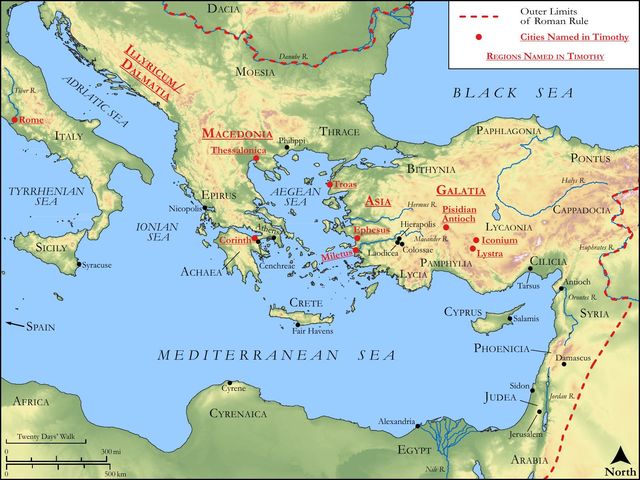
See on the biblical-era map

Study this verse
Public-domain commentary
Matthew Henry
From his Commentary on the Whole Bible. Henry comments on passages, not single verses — this entry covers 1 Timothy 2:1–8. His three-level outline is real structure in the source text, so it is rendered as structure.
Here is, I. A charge given to Christians to pray for all men in general, and particularly for all in authority. Timothy must take care that this be done. Paul does not send him any prescribed form of prayer, as we have reason to think he would if he had intended that ministers should be tied to that way of praying; but, in general, that they should make supplications, prayers, intercessions, and giving of thanks: supplications for the averting of evil, prayers for the obtaining of good, intercessions for others, and thanksgivings for mercies already received. Paul thought it enough to give them general heads; they, having the scripture to direct them in prayer and the Spirit of prayer poured out upon them, needed not any further directions. Observe, The design of the Christian religion is to promote prayer; and the disciples of Christ must be praying people. Pray always with all prayer, Eph 6:18. There must be prayers for ourselves in the first place; this is implied here. We must also pray for all men, for the world of mankind in general, for particular persons who need or desire our prayers. See how far the Christian religion was from being a sect, when it taught men this diffusive charity, to pray, not only for those of their own way, but for all men. Pray for kings (Ti1 2:2); though the kings at this time were heathens, enemies to Christianity, and persecutors of Christians, yet they must pray for them, because it is for the public good that there should be civil government, and proper persons entrusted with the administration of it, for whom therefore we ought to pray, yea, though we ourselves suffer under them. For kings, and all that are in authority, that is, inferior magistrates: we must pray for them, and we must give thanks for them, pray for their welfare and for the welfare of their kingdoms, and therefore must not plot against them, that in the peace thereof we may have peace, and give thanks for them and for the benefit we have under their government, that we may lead a quiet and peaceable life in all godliness and honesty. Here see what we must desire for kings, that God will so turn their hearts, and direct them and make use of them, that we under them may lead a quiet and peaceable life. He does not say, "that we may get preferments under them, grow rich, and be in honour and power under them;" no, the summit of the ambition of a good Christian is to lead a quiet and peaceable life, to get through the world unmolested in a low private station. We should desire that we and others may lead a peaceable life in all godliness and honesty, implying that we cannot expect to be kept quiet and peaceable unless we keep in all godliness and honesty. Let us mind our duty, and then we may expect to be taken under the protection both of God and the government. In all godliness and honesty. Here we have our duty as Christians summed up in two words: godliness, that is, the right worshipping of God; and honesty, that is, a good conduct towards all men. These two must go together; we are not truly honest if we are not godly, and do not render to God his due; and we are not truly godly if we are not honest, for God hates robbery for burnt-offering. Here we may observe, 1. Christians are to be men much given to prayer: they ought to abound herein, and should use themselves to prayers, supplications, etc. 2. In our prayers we are to have a generous concern for others as well as for ourselves; we are to pray for all men, and to give thanks for all men; and must not confine our prayers nor thanksgiving to our own persons or families. 3. Prayer consists of various parts, of supplications, intercessions, and thanksgivings; for we must pray for the mercies we want, as well as be thankful for mercies already received; and we are to deprecate the judgments which our own sins or the sins of others have deserved. 4. All men, yea, kings themselves, and those who are in authority, are to be prayed for. They want our prayers, for they have many difficulties to encounter, many snares to which their exalted stations expose them. 5. In praying for our governors, we take the most likely course to lead a peaceable and quiet life. The Jews at Babylon were commanded to seek the peace of the city whither the Lord had caused them to be carried captives, and to pray to the Lord for it; for in the peace thereof they should have peace, Jer 29:7. 6. If we would lead a peaceable and quiet life, we must live in all godliness and honesty; we must do our duty to God and man. He that will love life, and see good days, let him refrain his tongue from evil, and his lips that they speak no guile; let him eschew evil, and do good; let him seek peace, and pursue it, Pe1 3:10, Pe1 3:11. Now the reason he gives for this is because this is good in the sight of God our Saviour; that is, the gospel of Christ requires this. That which is acceptable in the sight of God our Saviour we should do, and should abound in.
II.As a reason why we should in our prayers concern ourselves for all men, he shows God's love to mankind in general, Ti1 2:4.
1.One reason why all men are to be prayed for is because there is one God, and that God bears a good will to all mankind. There is one God (Ti1 2:5), and one only, there is no other, there can be no other, for there can be but one infinite. This one God will have all men to be saved; he desires not the death and destruction of any (Eze 33:11), but the welfare and salvation of all. Not that he has decreed the salvation of all, for then all men would be saved; but he has a good will to the salvation of all, and none perish but by their own fault, Mat 23:37. He will have all to be saved, and to come to the knowledge of the truth, to be saved in the way that he has appointed and not otherwise. It concerns us to get the knowledge of the truth, because that is the way to be saved; Christ is the way and the truth, and so he is the life.
2.There is one Mediator, and that mediator gave himself a ransom for all. As the mercy of God extends itself to all his works, so the mediation of Christ extends itself thus far to all the children of men that he paid a price sufficient for the salvation of all mankind; he brought mankind to stand upon new terms with God, so that they are not now under the law as a covenant of works, but as a rule of life. They are under grace; not under the covenant of innocence, but under a new covenant: He gave himself a ransom. Observe, The death of Christ was a ransom, a counter-price. We deserved to have died. Christ died for us, to save us from death and hell; he gave himself a ransom voluntarily, a ransom for all; so that all mankind are put in a better condition than that of devils. He died to work out a common salvation: in order hereunto, he put himself into the office of Mediator between God and man. A mediator supposes a controversy. Sin had made a quarrel between us and God; Jesus Christ is a Mediator who undertakes to make peace, to bring God and man together, in the nature of an umpire or arbitrator, a days - man who lays his hand upon u both, Job 9:33. He is a ransom that was to be testified in due time; that is, in the Old Testament times, his sufferings and the glory that should follow were spoken of as things to be revealed in the last times, Pe1 1:10, Pe1 1:11. And they are accordingly revealed, Paul himself having been ordained a preacher and an apostle, to publish to the Gentiles the glad tidings of redemption and salvation by Jesus Christ. This doctrine of Christ's mediation Paul was entrusted to preach to every creature, Mar 16:15. He was appointed to be a teacher of the Gentiles; besides his general call to the apostleship, he was commissioned particularly to preach to the Gentiles, in faith and truth, or faithfully and truly. Note,
(1.)It is good and acceptable in the sight of God and our Saviour that we pray for kings and for all men, and also that we lead a peaceable and quiet life; and this is a very good reason why we should do the one as well as the other.
(2.)God has a good will to the salvation of all; so that it is not so much the want of a will in God to save them as it is a want of will in themselves to be saved in God's way. Here our blessed Lord charges the fault: You will not come unto me that you may have life, Joh 5:40. I would have gathered you, and you would not.
(3.)Those who are saved must come to the knowledge of the truth, for this is God's appointed way to save sinners. Without knowledge the heart cannot be good; if we do not know the truth, we cannot be ruled by it.
(4.)It is observable that the unity of God is asserted, and joined with the unity of the Mediator; and the church of Rome might as well maintain a plurality of gods as a plurality of mediators.
(5.)He that is a Mediator in the New Testament sense, gave himself a ransom. Vain then is the pretence of the Romanists that there is but one Mediator of satisfaction, but many of intercession; for, according to Paul, Christ's giving himself a ransom was a necessary part of the Mediator's office; and indeed this lays the foundation for his intercession.
(6.)Paul was ordained a minister, to declare this to the Gentiles, that Christ is the one Mediator between God and men, who gave himself a ransom for all. This is the substance of which all ministers are to preach, to the end of the world; and Paul magnified his office, as he was the apostle of the Gentiles, Rom 11:13.
(7.)Ministers must preach the truth, what they apprehend to be so, and they must believe it themselves; they are, like our apostle, to preach in faith and verity, and they must also be faithful and trusty.
III.A direction how to pray, Ti1 2:8.
1.Now, under the gospel, prayer is not to be confined to any one particular house of prayer, but men must pray every where: no place is amiss for prayer, no place more acceptable to God than another, Joh 4:21. Pray every where. We must pray in our closets, pray in our families, pray at our meals, pray when we are on journeys, and pray in the solemn assemblies, whether more public or private.
2.It is the will of God that in prayer we should lift up holy hands: Lifting up holy hands, or pure hands, pure from the pollution of sin, washed in the fountain opened for sin and uncleanness. I will wash my hands, etc., Psa 26:6.
3.We must pray in charity: Without wrath, or malice, or anger at any person.
4.We must pray in faith without doubting (Jam 1:6), or, as some read it, without disputing, and then it falls under the head of charity.
Historical interpretation
Nine Centuries of Reception
29 surviving comments on this verse. Each one is dated, so this reads as a timeline rather than a list.
Select a marker to jump to its quote. Markers stagger vertically where authors wrote within a few decades of each other.
And [know ye, moreover], that He who was born of a woman was the Son of God, and He that was crucified was "the first-born of every creature," and God the Word, who also created all things. For says the apostle, "There is one God, the Father, of whom are all things; and one Lord Jesus Christ, by whom are all things." And again, "For there is one God, and one Mediator between God and man, the man Christ Jesus; " and, "By Him were all things created that are in heaven, and on earth, visible and invisible; and He is before all things, and by Him all things consist."
The Evangelists, too, when they declared that the one Father was "the only true God," did not omit what concerned our Lord, but wrote: "In the beginning was the Word, and the Word was with God, and the Word was God. The same was in the beginning with God. All things were made by Him, and without Him was not anything made that was made." And concerning the incarnation: "The Word," says [the Scripture], "became flesh, and dwelt among us." And again: "The book of the generation of Jesus Christ, the son of David, the son of Abraham." And those very apostles, who said "that there is one God," said also that "there is one Mediator between God and men." Nor were they ashamed of the incarnation and the passion. For what says [one]? "The man Christ Jesus, who gave Himself" for the life and salvation of the world.
And therefore in the last times the Lord has restored us into friendship through His incarnation, having become "the Mediator between God and men; "
Wherever it may be, it is in safe keeping in God's presence, through that most faithful "Mediator between God and man, (the man) Jesus Christ," who shall reconcile both God to man, and man to God; the spirit to the flesh, and the flesh to the spirit.
Valentinus, indeed, on the strength of his heretical system, might consistently fantasize a spiritual flesh for Christ. Any who refused to believe that that flesh was human might then pretend it to be anything he liked. This pretense characterizes all heresies. For if his flesh was not human and was not born of man, I do not see of what substance Paul himself spoke, when he said “The man Christ Jesus is the one mediator between God and man.”
The Apostle Paul likewise says: "The man Christ Jesus is the one Mediator between God and man." Also Peter, in the Acts of the Apostles, speaks of Him as verily human (when he says), "Jesus Christ was a man approved of God among you.
Designated, as He is, "the Mediator between God and man," He keeps in His own self the deposit of the flesh which has been committed to Him by both parties-the pledge and security of its entire perfection.
of the flesh; of the Spirit, God-and the angel designated Him as "the Son of God," in respect of that nature, in which He was Spirit, reserving for the flesh the appellation "Son of Man." In like manner, again, the apostle calls Him "the Mediator between God and Men," and so affirmed His participation of both substances.
Now, in order that He might be shown to have together in Himself at once the nature of God and that of man,-as the apostle, too, says: "Mediator between God and men, the man Christ Jesus.
Through his body the church has been allied to Christ and has been enabled to become a partaker in the Word of God. We know this both from the fact that he is called the “mediator of God and humanity,” and from the apostle’s saying that “in him we have access through faith in the hope of the glory of God.”
Let men therefore learn and understand why the Most High God, when He sent His ambassador and messenger to instruct mortals with the precepts of His righteousness, willed that He should be clothed with mortal flesh, and be afflicted with torture, and be sentenced to death. For since there was no righteousness on earth, He sent a teacher, as it were a living law, to found a new name and temple, that by His words and example He might spread throughout the earth a true and holy worship. But, however, that it might be certain that He was sent by God, it was befitting that He should not be born as man is born, composed of a mortal on both sides; but that it might appear that He was heavenly even in the form of man, He was born without the office of a father. For He had a spiritual Father, God; and as God was the Father of His spirit without a mother, so a virgin was the mother of His body without a father. He was therefore both God and man, being placed in the middle between God and man. From which the Greeks call Him Mesites, that He might be able to lead man to God-that is, to immortality: for if He had been God only (as we have before said), He would not have been able to afford to man examples of goodness; if He had been man only, He would not have been able to compel men to righteousness, unless there had been added an authority and virtue greater than that of man.
For, since man is composed of flesh and spirit, and the spirit must earn immortality by works of righteousness, the flesh, since it is earthly, and therefore mortal, draws with itself the spirit linked to it, and leads it from immortality to death. Therefore the spirit, apart from the flesh, could by no means be a guide to immortality for man, since the flesh hinders the spirit from following God. For it is frail, and liable to sin; but sin is the food and nourishment of death. For this cause, therefore, a mediator came-that is, God in the flesh-that the flesh might be able to follow Him, and that He might rescue man from death, which has dominion over the flesh.
O how beautiful and mystical and kind! For to intercede does not imply to seek for vengeance, as is most men’s way (for in that there would be something of humiliation), but it is to plead for us by reason of his mediatorship, just as the Spirit is also said to make intercession for us. For “there is one God, and one mediator between God and men, the man Christ Jesus.” For he still pleads even now as man for my salvation. He continues to wear the body which he assumed, until he makes me divine by the power of his incarnation; although he is no longer known after the flesh—the same as ours, except for sin.
By the distinction implied in the word mediator he reveals to us the whole aim of the mystery of godliness. Now the aim is this. Humanity once revolted through the malice of the enemy, and, brought into bondage to sin, was also alienated from the true Life. After this the Lord of the creature calls back to him his own creature and becomes Man while still remaining God, being both God and man in the entirety of the two separate natures. Thus humanity was indissolubly united to God, the man that is in Christ conducting the work of mediation, to whom, by the firstfruits assumed for us, all the lump is potentially united.
But what is he who is at once the Most High and man, what but “the Mediator between God and man, the man Christ Jesus who gave himself as a ransom for us”? This text indeed refers properly to his incarnation, for our redemption was made by his blood, our pardon comes through his power, our life is secured through his grace. He gives as the Most High; he prays as man. The one is the office of the Creator; the other of a redeemer. Be the gifts as distinct as they may, yet the Giver is one, for it was fitting that our Maker should be our Redeemer.
Let not the venom of Apollinaris flatter itself because it is written, “And in appearance he was found as a man,” for the manhood of Jesus is not thereby denied but confirmed, since elsewhere Paul himself speaks of him as “Mediator of God and men, himself man, Christ Jesus.” It is the customary manner of Scripture so to express itself as we also read in the Gospel, “And we saw his glory—glory as of the only-begotten of the Father.” As he is there called only-begotten Son of God, so he is said to be man, and the fullness of humanity that was in him is not denied.
He had before said, "to come to the knowledge of the truth," implying that the world is not in the truth. Now he says, "that there is one God," that is, not as some say, many, and that He has sent His Son as Mediator, thus giving proof that He will have all men to be saved. But is not the Son God? Most truly He is; why then does he say, "One God"? In contradistinction to the idols; not to the Son. For he is discoursing about truth and error. Now a mediator ought to have communion with both parties, between whom he is to mediate. For this is the property of a mediator, to be in close communion with each of those whose mediator he is. For he would be no longer a mediator, if he were connected with one but separated from the other. If therefore He partakes not of the nature of the Father, He is not a Mediator, but is separated. For as He is partaker of the nature of men, because He came to men, so is He partaker of the nature of God, because He came from God. Because He was to mediate between two natures, He must approximate to the two natures; for as the place situated between two others is joined to each place, so must that between natures be joined to either nature. As therefore He became Man, so was He also God. A man could not have become a mediator, because he must also plead with God. God could not have been mediator, since those could not receive Him, toward whom He should have mediated. And as elsewhere he says, "There is one God the Father, ...and one Lord Jesus Christ"; so also here "One" God, and "One" Mediator; he does not say two; for he would not have that number wrested to Polytheism, of which he was speaking. So he wrote "One" and "One." You see how accurate are the expressions of Scripture! For though one and one are two, we are not to say this, though reason suggests it. And here thou sayest not one and one are two, and yet thou sayest what reason does not suggest. "If He begat He also suffered." "For there is one God," he says, "and one Mediator between God and men, the Man Christ Jesus."
This refers to the perfect humanity by which salvation is wrought. The fact that Jesus shares a common humanity with us is the whole key to salvation.
Christ Jesus, himself man, is the true Mediator, for, inasmuch as he took the “form of a slave,” he became “the Mediator between God and men.” In his character as God, he received sacrifices in union with the Father, with whom he is one God. Yet he chose, in his character as a slave, to be himself the sacrifice rather than to receive it, lest any one might take occasion to think that sacrifice could be rendered to a creature. Thus it is that he is both the Priest who offers and the Oblation that is offered.
Hence we respond to this objection of theirs, which they propose from the gospel, in a way which allows no man to be so lacking in understanding that he thinks we are compelled by this text to believe and confess that the mediator between God and men, the man Christ Jesus, did not have a human soul. In the same way I inquire how they respond to objections so palpable as ours, whereby we show through countless places in the Gospel writings what was narrated of him by the Evangelists, namely, that he was found with feelings that are impossible without a soul.
Now, we could not be redeemed, even through “the one mediator between God and man, Man himself, Christ Jesus,” if he were not also God. For when Adam was made—being made an upright man—there was no need for a mediator. Once sin, however, had widely separated the human race from God, it was necessary for a mediator, who alone was born, lived and was put to death without sin, to reconcile us to God and provide even for our bodies a resurrection to life eternal—and all this in order that a man’s pride might be exposed and healed through God’s humility.
But how are we reconciled unless what separates us and him is broken? For he says through the prophet, “The Lord’s ear is not dull, that it cannot hear, but your sins separate you and your God.” Therefore, because we are not reconciled unless what is in the middle has been removed and what should be in the middle has been put there—for there is a separating middle, but over against it is a reconciling mediator. The separating middle is sin. The reconciling mediator is the Lord Jesus Christ, “For there is one God and one mediator of God and man, the man Christ Jesus.” And so, in order that the separating wall which is sin may be taken away, that Mediator has come, and the Priest himself has become the sacrifice.
It was in order to make the mind able to advance more confidently toward the truth that Truth itself, the divine Son of God, put on humanity without putting off his divinity and built this firm path of faith so that man, by means of the God-Man, could find his way to man’s God. I speak of the “mediator between God and men, himself man, Christ Jesus.” For it is as man that he is the Mediator and as man that he is the way.
Who can so organize what he does as this man organized what he suffered? But the man, the Mediator of God and man, was the man about whom one reads that it was foretold, “And he is a man and who will know him?” For the men through whom these things happened did know the man of God. For he who was hidden as God was apparent as man. He who was apparent suffered these things. He who was hidden is the very same One who ordered these things. Therefore he saw that all the things were finished which were necessary to be done before he took the vinegar and delivered over his spirit.
There is one conciliator of peace, who joins in himself what has been in disjunction. Paul calls Christ man precisely because he is the Mediator, the one in whom human and divine natures are joined in friendship.
For there were two lives, of which we knew one and did not know the other. One indeed is mortal, the other immortal; one of corruption, the other of incorruption; one of death, the other of resurrection. But the Mediator between God and men, the man Christ Jesus, came, took up the one, and showed forth the other. He endured the one by dying, and showed forth the other by rising again. If therefore He had promised us, who knew only mortal life, the resurrection of the flesh, and yet had not visibly displayed it, who would believe His promises? Therefore, having been made man, He appeared in the flesh, deigned to die by His own will, rose again by His own power, and showed by example what He promised us as a reward.
But Simon Peter came following him and entered the tomb, because the Church of the Gentiles, coming after, both recognized the mediator between God and men, the man Jesus Christ, dead in the flesh, and believed him to be the living God.
May attention to the economy of God which ministered to those of former times be reckoned by you as precious medicine for weak eyes. Let the memory of it stay with you at all times of the day. Meditate, apply your mind, and learn wisdom from it, that you may be able to receive into your soul with honor the memory of the greatness of God and find eternal life for yourself in Christ Jesus, the Mediator between God and mankind and the Uniter in his two natures.
We have heard from the Gospel reading [commenting on Lk 2:1-14], dearly beloved brothers, that when the Redeemer of the world, our Lord and God, Jesus Christ, was about to be born into the world, an edict went out from Caesar Augustus, who then held the highest place with respect to worldly reigns. The edict said that the entire world was to be enrolled. We must not suppose that this happened by chance, but we must understand that it was provided through a most certain divinely arranged plan of this same Redeemer of ours. And, indeed, just as in his divinity the Mediator between God and human beings foresaw the mother of whom he willed to be born when he should so will, so also in his humanity he chose the time when he wished for his nativity. Moreover, he himself granted that this time should be such as he willed, namely, that in a calm among the storm of wars a singular tranquillity of unusual peace should cover the whole world.
For there is one God, and one mediator between God and men, the man Christ Jesus.
For there is one God, and one mediator. Note that he did not say, Two, but, One and one, thus avoiding the multiplication of gods. Since the one who was to mediate was absent, to partake of both so that He could also mediate, the Son of God, the eternal Logos [ὁ προαιώνιος Λόγος], having become incarnate, came forth, existing from two natures, namely from divinity and humanity, and is understood and worshiped in one person after the union. For if the Only Begotten had appeared to us in bare divinity, creation would not have shown Him, where the sons of Israel were not able to see the face of Moses. But the phrase "One God" is not placed in opposition to the Son or the Spirit—far from it!—but against those who are not, called gods. It is asked why the Spirit is not mentioned. Because the discussion was about the Greeks. For concerning them is the phrase, "and to come to the knowledge of the truth." (1 Tim. 2:4) Among them there was polytheism, and he carefully guarded the economy of remembering the "Spirit," lest somehow he introduce the appearance of polytheism. Since he converses there with the faithful, he continually remembers Him, often even alone, not bringing to mind the Father and the Son.
the man Christ Jesus. As He was man, so He was also God, indivisibly, inseparably.
Continue studying 1 Timothy 2:5 across the web’s major study libraries — every link below opens this exact verse, chapter, or book on the destination site.
Read & Compare
 BibleGatewayThis verse in more than 200 translations and 70 languages.
 Bible.comThe YouVersion reader — hundreds of translations, reading plans, and highlights.
 ESV.orgCrossway's official English Standard Version reader.
 NET BibleThe NET translation with 60,000+ translators' notes on every rendering decision.
 STEP BibleTyndale House's free study tool — original text, vocabulary, and scholarly resources.
 BibliaLogos Bible Software's free web reader.
 USCCBThe New American Bible (Revised Edition) with the U.S. bishops' study notes.
Commentaries
 BibleHub CommentariesDozens of classic commentaries on this verse, gathered on one page.
 StudyLightMore than 100 commentary sets — the largest collection on the web.
 BibleRefPlain-English commentary on what this verse means, verse by verse.
 Enduring WordDavid Guzik's free commentary on this chapter, widely used by Bible teachers.
 Bible Study ToolsVerse commentary alongside Greek and Hebrew study aids.
Original Language & Research
- BibleHub InterlinearThe verse word by word — original language, transliteration, and English.
- BibleHub LexiconEvery word's original-language definition and Strong's entry.
 Blue Letter BibleDeep-study tools — Strong's numbers, concordance, and word studies.
 CNTR CollationThe earliest Greek manuscripts of this verse, collated letter by letter.
Sermons, Hymns & Audio


TrulyRandomVerse is not affiliated with these sites and doesn’t control their content. They’re linked because they’re genuinely useful.
Summary
First Timothy 2:5 stands as a foundational statement of Christian theology, asserting the singular nature of God and the exclusive role of Jesus Christ as the sole mediator between the divine and humanity. This verse underpins the necessity and efficacy of prayer for all people, establishing the unique pathway to reconciliation and access to God through the incarnate Son, who bridges the chasm between a holy God and sinful mankind.
Context
ShowHideLiterary Context
This verse is embedded within Paul's practical instructions to Timothy concerning order and conduct in the church at Ephesus. Immediately preceding 1 Timothy 2:5 are exhortations for prayer for all people, including kings and those in authority, so that believers may live peaceful and quiet lives in all godliness and dignity (1 Timothy 2:1-2). Paul then declares that such prayer is "good and pleasing in the sight of God our Savior, who desires all people to be saved and to come to a knowledge of the truth" (1 Timothy 2:3-4). Verse 5, therefore, serves as the theological bedrock for these preceding statements, explaining why God desires all to be saved and how that salvation is made possible—through the singular God and the singular mediator. It transitions from the general call to prayer to the specific theological truth that enables it.
Historical & Cultural Context
Paul wrote this letter to Timothy around 62-64 AD, likely from Macedonia, while Timothy was leading the church in Ephesus. Ephesus was a major metropolitan center, a hub of diverse religious and philosophical thought, including the prominent worship of Artemis (Diana) and various mystery cults. In such a polytheistic environment, the assertion of "one God" and "one mediator" would have been a radical and exclusive claim, directly challenging the prevailing syncretism and multiplicity of deities and spiritual intermediaries. The emphasis on "the man Christ Jesus" also countered Gnostic tendencies that might deny Christ's full humanity or present alternative paths to divine knowledge. Paul's teaching here provides a clear, uncompromising theological framework for a nascent Christian community navigating a complex religious landscape.
Key Themes
ShowHideThe overarching themes in 1 Timothy 2, which 1 Timothy 2:5 profoundly contributes to, include the universality of God's saving will (1 Timothy 2:4), the exclusivity of the gospel, and the unique role of Jesus Christ as the sole means of reconciliation. This verse firmly establishes the oneness of God (monotheism) in contrast to pagan polytheism, and the singular mediatorial work of Christ, which is central to Christian soteriology. It also highlights Christ's dual nature—fully God and fully man—which is essential for His mediatorial function, bridging the gap between the divine and human. These themes are foundational to understanding Christian access to God and the basis for evangelism.
Exposition and Analysis
ShowHideKey Word Analysis
ShowHideThis term, G2316, refers to a deity, specifically (with the definite article) the supreme Divinity. In the context of 1 Timothy 2:5, it emphasizes the singular, ultimate, and sovereign Creator of the universe, distinct from the myriad of gods worshipped in the Greco-Roman world. The declaration of "one God" is a fundamental tenet of monotheism, inherited from the Old Testament and affirmed in the New, asserting His absolute uniqueness and authority.
This word, G3316, denotes a "go-between," an "internunciator," or, by implication, a "reconciler" or "intercessor." It describes one who stands between two parties to bring them together, settle a dispute, or facilitate an agreement. In this verse, it profoundly signifies Jesus' unique role as the sole agent who bridges the infinite chasm between a holy God and sinful humanity, making reconciliation and peace possible. His mediatorial work is not merely advisory but active and redemptive.
This term, G444, refers to a human being, emphasizing the full humanity of Christ. It is derived from words meaning "man-faced" or "human being." The specification "the man Christ Jesus" is crucial because it highlights that the mediator is not an angelic being or a disembodied spirit, but one who fully participated in human experience, including suffering and death. This shared humanity enables Him to truly represent humanity before God and to offer a perfect, atoning sacrifice on their behalf.
Verse Breakdown
ShowHide"For there is one God,"
This opening clause establishes the absolute monotheism of Christian faith. It asserts the singular, unique, and supreme nature of God, the Creator and Sustainer of all things. This declaration stands in stark contrast to the polytheistic beliefs prevalent in the ancient world, affirming that the Christian God is not one among many, but the one true and living God.
"and one mediator between God and men,"
Following the declaration of one God, this clause introduces the exclusive means of access to Him. The term "mediator" signifies one who stands between two estranged parties to bring them into reconciliation. The emphasis on "one mediator" underscores the singularity and exclusivity of this role, meaning there is no other path, no other person, and no other ritual that can bridge the gap between a holy God and sinful humanity. This mediator alone possesses the authority and capacity to reconcile.
"the man Christ Jesus;"
This final phrase identifies the specific individual who fulfills the role of the unique mediator. The designation "the man Christ Jesus" is profoundly significant. It highlights His full humanity, which was essential for Him to represent humanity and to offer a vicarious sacrifice for sin. Simultaneously, "Christ Jesus" points to His divine identity and messianic office, indicating that He is the anointed Son of God, uniquely qualified to mediate between God and humankind. His dual nature—fully God and fully man—makes Him the perfect and only bridge.
Literary Devices
ShowHideThe verse employs Repetition to emphasize the exclusivity of God and Christ's mediatorial role, using "one" twice ("one God, and one mediator"). This rhetorical device underscores the singular nature of both the divine being and the pathway to Him, leaving no room for alternatives. Furthermore, the phrase "the man Christ Jesus" functions as a powerful Appellation or Title, clearly identifying the mediator and highlighting His incarnate nature. The structure of the verse itself, moving from the universal truth of God's oneness to the specific, personal identity of the mediator, creates a sense of Logical Progression, building a theological argument that grounds the possibility of salvation and prayer in these fundamental truths.
Theological and Thematic Connections
ShowHideFirst Timothy 2:5 is a cornerstone of Christian soteriology, asserting that salvation and access to God are exclusively through Jesus Christ. This declaration of "one God" and "one mediator" directly counters any notion of multiple paths to the divine or the efficacy of other spiritual intermediaries. It underscores the unique nature of God's plan for redemption, centered entirely on the person and work of Jesus. The verse highlights the necessity of Christ's incarnation—His full humanity—to serve as a representative for mankind, and His divine nature to offer a sufficient sacrifice and to perfectly represent God. This theological truth forms the basis for the universal call to repentance and faith, as God desires all people to be saved, and Christ has provided the sole means for that salvation.
Reflection and Application
ShowHideThe profound truth of 1 Timothy 2:5 calls believers to a deep appreciation for the unique and exclusive work of Jesus Christ. In a world that often promotes spiritual pluralism or suggests many paths to God, this verse stands as an unwavering declaration of Christ's singular authority and sufficiency. For personal application, it encourages us to rely solely on Christ for our reconciliation with God, to approach God with confidence through His mediation, and to live in light of this exclusive truth. It also fuels our evangelistic passion, knowing that the "one mediator" is the only hope for a lost world, compelling us to share the good news with conviction and clarity. This verse reminds us that our access to the Father is not earned through works or rituals, but is a gracious gift secured by the perfect, once-for-all sacrifice of "the man Christ Jesus."
Questions for Reflection
ShowHideFAQ
ShowHideWhy is it important that there is "one God" and "one mediator"?
ShowHideThe declaration of "one God" is fundamental to Christian monotheism, distinguishing the biblical God from the many deities of pagan religions. It asserts His absolute sovereignty and uniqueness. The "one mediator" is equally crucial because it emphasizes the exclusivity of salvation and access to God through Jesus Christ. In a world offering various spiritual paths, this verse declares that only Jesus, through His perfect life, atoning death, resurrection, can bridge the infinite gap between a holy God and sinful humanity. This singularity ensures that reconciliation is achieved by God's provision, not human effort, and that the path to Him is clear and unambiguous.
Christ-Centered Fulfillment
ShowHideFirst Timothy 2:5 finds its ultimate Christ-centered fulfillment in the person and work of Jesus as the unique bridge between God and humanity. The Old Testament foreshadowed the need for a mediator through figures like Moses, who interceded for Israel (Exodus 32:30-32), and the Levitical priesthood, which offered sacrifices on behalf of the people (Leviticus 16). However, these were temporary and imperfect, pointing forward to the perfect and eternal mediator. Jesus, as "the man Christ Jesus," perfectly embodies this role because He is both fully God and fully human. His humanity enables Him to represent us before God, experiencing our temptations and sufferings yet without sin (Hebrews 4:15). His divinity ensures His sacrifice is of infinite value, sufficient to atone for the sins of the world (1 John 2:2). Through His death on the cross, He offered Himself as the ultimate sacrifice, establishing a new covenant (Hebrews 9:15), and through His resurrection and ascension, He now continually intercedes for us at the right hand of the Father (Romans 8:34). Thus, Jesus is not merely a mediator, but the mediator, fulfilling all prior types and shadows, providing the singular, perfect, and eternal access to God.