


1 Peter 1:11
Bible text: King James Version (1769 Blayney text) · Public domain
Bible text: King James Version with Strong's numbers · Public domain
Bible text: Berean Standard Bible · Public domain
Bible text: American Standard Version (1901) · Public domain
Bible text: World English Bible, Messianic edition · Public domain
Bible text: Geneva Bible (1599) · Public domain
Bible text: Young's Literal Translation · Public domain
- ἐραυνῶντεςeraunōntesinquiringG2045V-PAP-NPMVerb Present Active Participle Nominative Plural Masculine
- εἰςeisintoG1519PREPPreposition
- τίναtinawhatG5101I-ASMInterrogative pronoun Accusative Singular Masculine
- ἢēorG2228CONJConjunction
- ποῖονpoionwhat manner ofG4169I-ASMInterrogative pronoun Accusative Singular Masculine
- καιρὸνkairontimeG2540N-ASMNoun Accusative Singular Masculine
- ἐδήλουedēlouwas signifyingG1213V-IAI-3SVerb Imperfect Active Indicative 3rd Singular
- τὸtotheG3588T-NSNDefinite article Nominative Singular Neuter
- ἐνeninG1722PREPPreposition
- αὐτοῖςautoisthemG846P-DPMPersonal pronoun Dative Plural Masculine
- πνεῦμαpneumaSpiritG4151N-NSNNoun Nominative Singular Neuter
- ΧριστοῦChristouof ChristG5547N-GSM-TNoun Genitive Singular Masculine Title
- προμαρτυρόμενονpromarturomenontestifying beforehandG4303V-PNP-NSNVerb Present Middle Or Passive Deponent Participle Nominative Singular Neuter
- τὰta<the>G3588T-APNDefinite article Accusative Plural Neuter
- εἰςeisuntoG1519PREPPreposition
- ΧριστὸνChristonChrist'sG5547N-ASM-TNoun Accusative Singular Masculine Title
- παθήματαpathēmatasufferingsG3804N-APNNoun Accusative Plural Neuter
- καὶkaiandG2532CONJConjunction
- τὰςtastheG3588T-APFDefinite article Accusative Plural Feminine
- μετὰmetaafterG3326PREPPreposition
- ταῦταtautatheseG3778D-APNDemonstrative pronoun Accusative Plural Neuter
- δόξας·doxasgloriesG1391N-APFNoun Accusative Plural Feminine
English is a literal word-by-word gloss of the Greek, not the KJV's wording. Why?
This is the original text the KJV's translators worked from — each Greek word with its own literal English meaning in this verse, prepared by scholars at Tyndale House, Cambridge. The KJV translates whole sentences, not word by word, so its wording differs: one Greek word can become several English words, and the KJV may choose “charity” where the gloss reads “love”. Both are faithful — they answer different questions. For the KJV's own rendering, switch to the KJV text.
Details
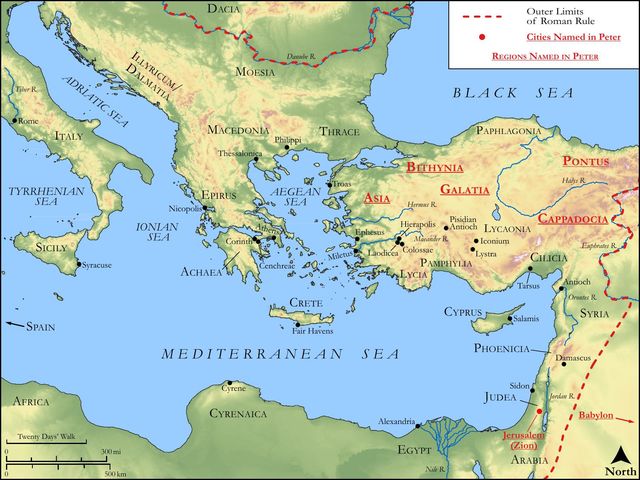
See on the biblical-era maps

Study this verse
Public-domain commentary
Matthew Henry
From his Commentary on the Whole Bible. Henry comments on passages, not single verses — this entry covers 1 Peter 1:10–12. His three-level outline is real structure in the source text, so it is rendered as structure.
The apostle having described the persons to whom he wrote, and declared to them the excellent advantages they were under, goes on to show them what warrant he had for what he had delivered; and because they were Jews, and had a profound veneration for the Old Testament, he produces the authority of the prophets to convince them that the doctrine of salvation by faith in Jesus Christ was no new doctrine, but the same which the old prophets did enquire and search diligently into. Note,
I.Who made this diligent search - the prophets, who were persons inspired by God either to do or to say things extraordinary, above the reach of their own studies and abilities, as foretelling things to come, and revealing the will of God, by the direction of the Holy Spirit.
II.The object of their search, which was salvation, and the grace of God which should come unto you; the general salvation of men of all nations by Jesus Christ, and more especially the salvation afforded to the Jews, the grace that should come to them from him who was not sent but to the lost sheep of the house of Israel. They foresaw glorious times of light, grace, and comfort, coming upon the church, which made the prophets and righteous men desire to see and hear the things which came to pass in the days of the gospel.
III.The manner of their enquiry:
they enquired and searched diligently. The words are strong and emphatic, alluding to miners, who dig to the bottom, and break through not only the earth, but the rock, to come to the ore; so these holy prophets had an earnest desire to know, and were proportionably diligent in their enquiries after the grace of God, which was to be revealed in the days of the Messiah: their being inspired did not make their industrious search needless; for, notwithstanding their extraordinary assistance from God, they were obliged to make use of all the ordinary methods of improvement in wisdom and knowledge. Daniel was a man greatly beloved and inspired, yet he understood by books and study the computations of time, Dan 9:2. Even their own revelation required their study, meditation, and prayer; for many prophecies had a double meaning: in their first intention they aimed at some person or event near at hand, but their ultimate design was to describe the person, sufferings, or kingdom of Christ. Observe,
1.The doctrine of man's salvation by Jesus Christ has been the study and admiration of the greatest and wisest of men; the nobleness of the subject, and their own concern in it, have engaged them, with most accurate attention and seriousness to search into it.
2.A good man is much affected and pleased with the grace and mercy of God to others, as well as to himself. The prophets were highly delighted with the prospects of mercy to be shown both to Jews and Gentiles at the coming of Christ.
3.Those who would be acquainted with this great salvation, and the grace that shines therein, must enquire and search diligently into it: if it was necessary for an inspired prophet to do so, much more for persons so weak and injudicious as we are.
4.The grace that came by the gospel excels all that was before it; the gospel dispensation is more glorious, evident, intelligible, extensive, and effectual, than any dispensation that ever did precede it.
IV.The particular matters which the ancient prophets chiefly searched into, which are expressed in Pe1 1:11.
Jesus Christ was the main subject of their studies; and, in relation to him, they were most inquisitive into,
1.His humiliation and death, and the glorious consequences of it: The sufferings of Christ, and the glories that should follow. This enquiry would lead them into a view of the whole gospel, the sum whereof is this, that Christ Jesus was delivered for our offences and raised again for our justification.
2.The time, and the manner of the times, wherein the Messiah was to appear. Undoubtedly these holy prophets earnestly desired to see the days of the Son of man; and therefore, next to the thing itself, their minds were set upon the time of its accomplishment, so far as the Spirit of Christ, which was in them, had signified any thing towards that purpose. The nature of the times was also under their strict consideration, whether they would be quiet or troublesome times, times of peace or times of war. Learn,
(1.)Jesus Christ had a being before his incarnation; for his Spirit did then exist in the prophets, and therefore he whose that Spirit then was must be in being also.
(2.)The doctrine of the Trinity was not wholly unknown to the faithful in the Old Testament. The prophets knew that they were inspired by a Spirit that was in them; this Spirit they knew to be the Spirit of Christ, and consequently distinct from Christ himself: here is a plurality of persons, and from other parts of the Old Testament a Trinity may be collected.
(3.)The works here ascribed to the Holy Ghost prove him to be God. He did signify, discover, and manifest to the prophets, many hundred years beforehand, the sufferings of Christ, with a multitude of particular circumstances attending them; and he did also testify, or give proof and evidence beforehand, of the certainty of that event, by inspiring the prophets to reveal it, to work miracles in confirmation of it, and by enabling the faithful to believe it. These works prove the Spirit of Christ to be God, since he is possessed of almighty power and infinite knowledge.
(4.)From the example of Christ Jesus learn to expect a time of services and sufferings before you are received to glory. It was so with him, and the disciple is not above his Lord. The suffering time is but short, but the glory is everlasting; let the suffering season be ever so sharp and severe, it shall not hinder, but work for us a far more exceeding and eternal weight of glory.
V.The success with which their enquiries were crowned.
Their holy endeavours to inform themselves were not slighted, for God gave them a satisfactory revelation to quiet and comfort their minds. They were informed that these things should not come to pass in their time, but yet all was firm and certain, and should come to pass in the times of the apostles: Not unto themselves, but to us; and we must report them, under the infallible direction of the Holy Ghost, to all the world. Which things the angels, etc.
You have here three sorts of students, or enquirers into the great affair of man's salvation by Jesus Christ: - 1. The prophets, who searched diligently into it. 2. The apostles, who consulted all the prophecies, and were witnesses of the accomplishment of them, and so reported what they knew to others in the preaching of the gospel. 3. The angels, who most attentively pry into these matters. Learn, (1.) A diligent endeavour after the knowledge of Christ and our duty will certainly be answered with good success. The prophets are answered with a revelation. Daniel studies, and receives information: the Bereans search the scriptures, and are confirmed. (2.) The holiest and best of men sometimes have their lawful and pious requests denied. It was both lawful and pious for these prophets to desire to know more than they were permitted to know about the time of the appearance of Christ in the world, but they were denied. It is lawful and pious for good parents to pray for their wicked children, for the poor to pray against poverty, for a good man to pray against death; yet, in these honest requests, they often are denied. God is pleased to answer our necessities rather than our requests. (3.) It is the honour and practice of a Christian to be useful to others, in many cases, rather than to himself. The prophets ministered to others, not unto themselves. None of us liveth to himself, Rom 14:7. Nothing is more contrary to man's nature nor to Christian principles than for a man to make himself his own end, and live to himself. (4.) The revelations of God to his church, though gradual, and given by parcels, are all perfectly consistent; the doctrine of the prophets and that of the apostles exactly agree, as coming from the same Spirit of God. (5.) The efficacy of the evangelical ministry depends upon the Holy Ghost sent down from heaven. The gospel is the ministration of the Spirit; the success of it depends upon his operation and blessing. (6.) The mysteries of the gospel, and the methods of man's salvation, are so glorious that the blessed angels earnestly desire to look into them; they are curious, accurate, and industrious in prying into them; they consider the whole scheme of man's redemption with deep attention and admiration, particularly the points the apostle had been discoursing of: Which things the angels desire to stoop down and look into, as the cherubim did continually towards the mercy-seat.
Historical interpretation
Eight Centuries of Reception
5 surviving comments on this verse. Each one is dated, so this reads as a timeline rather than a list.
Select a marker to jump to its quote. Markers stagger vertically where authors wrote within a few decades of each other.
Here is it stated that the prophets spoke with wisdom and that the Spirit of God was in them because they belonged and were subject to Christ. For the Lord works through archangels and their associate angels, who are called the spirit of Christ.
Let none think it was with some other, because no other exists, except that of Christ subsequently; which at that time, of course, could not be given by His disciples, inasmuch as the glory of the Lord had not yet been fully attained, nor the efficacy of the font established through the passion and the resurrection; because neither can our death see dissolution except by the Lord's passion, nor our life be restored without His resurrection.
The apostle insists that the one who spoke by the prophets was the Holy Spirit of Christ. Nor was Christ a mere man, as the heretics say, but he was the incarnate Son of God, consubstantial with the Father. “Christ the power of God and the wisdom of God.” … For this reason the Savior said: “Many prophets and righteous men desired to see what you are seeing, and they did not see it.”
Inquiring into what or what kind of time the Spirit of Christ in them was indicating, etc. The evangelist indicated these glories when he said: "For the Spirit had not yet been given, because Jesus had not yet been glorified" (John VII). There are, however, two glorifications of the Lord, according to the form of the assumed man: one, by which He rose from the dead; and the other, by which He ascended into heaven before the eyes of His disciples. A third remains, also in the sight of men, when He will come in His majesty and that of the Father and the holy angels to render to each according to their works.
Concerning this salvation, the prophets who prophesied about the grace that was to come to you searched and investigated carefully, inquiring what person or time the Spirit of Christ within them was indicating when he testified in advance about the sufferings that would come upon Christ and the glories that would follow. It was revealed to them that they were not serving themselves but you, in the things that have now been announced to you through those who preached the Gospel to you by the Holy Spirit sent from heaven; into which angels long to see.
Since Peter had made mention of the salvation of the soul: however, this was not clear, but he brings forth the prophets who inquired and studied about it. For they inquired about future events: as Daniel did, who was called a man of desires by the angel, who gave him divine responses. (Dan. 9:23)
"inquiring what person or time the Spirit." To that, namely the consummation of the age: such as when the Jews, through various captivities, deviating from the perfect worship of God, were constituted towards the mystery of Christ. Note, however, that the spirit of Christ openly contemplates and discusses Christ. Moreover, this Spirit signified the afflictions of Christ, as Isaiah indeed says: "He was led like a sheep to the slaughter." (Isa. 53:7) And through Jeremiah: "Come, let us put wood in his bread." (Jer. 11:19) Moreover, the resurrection through Hosea: "On the third day we will be raised up before Him, and we will pursue Him to know the Lord; as the dawn is ready, we will find Him." (Hos. 6:2-3) However, it has been revealed not for Himself, but for you. Moreover, these two things he does with these words: Peter shows the providence of the prophets, and that those who are now called to the faith of Christ were foreknown by God before the foundation of the world. Indeed, through the foresight of the prophets, he leads them, so that they are not unbelieving regarding those whom the prophets greatly cared for, for their own benefit: for neither do wise sons despise their father's labors. Indeed, if they sought and found these things, when they would not benefit themselves, and committed the findings to books, as if transmitting an inheritance to us, we would act unjustly, he says, if we were negligent in these matters: therefore, do not show our gospel as empty, leading you who announce these things to you, as rejected and insignificant. Therefore, these things are from the providence of the prophets. Through this, however, that they were foreknown by God, they are terrified lest they present themselves as unworthy by divine foreknowledge or by His calling, but they urge and inspire each other, so that they may be deemed worthy of the gift of Christ.
"through those who preached the Gospel to you." If both the prophets and these have effectively worked through the Holy Spirit: indeed, those in prophecy, and these in the Gospel: nothing is different from the prophets for them: therefore, you must bring the same diligence that those who were obedient to the prophets, lest you be subjected to the same punishment as those who were unbelieving towards the prophets.
It must be noted, however, that through this mystery of the Trinity, Peter reveals: the Son and the Spirit when he says "the Spirit of Christ," but the Father in what follows, "from heaven." Moreover, when he says "from heaven," do not take it according to place, but understand it as excellence, because it especially applies to God.
"by the Holy Spirit sent from heaven." Peter speaks of what had happened on the day of Pentecost.
However, that "into which angels longed to see" means that which angels also desire; for this reason, even while such things were happening, they sang out of abundant joy: "Glory to God in the highest." (Luke 1:14)
Continue studying 1 Peter 1:11 across the web’s major study libraries — every link below opens this exact verse, chapter, or book on the destination site.
Read & Compare
 BibleGatewayThis verse in more than 200 translations and 70 languages.
 Bible.comThe YouVersion reader — hundreds of translations, reading plans, and highlights.
 ESV.orgCrossway's official English Standard Version reader.
 NET BibleThe NET translation with 60,000+ translators' notes on every rendering decision.
 STEP BibleTyndale House's free study tool — original text, vocabulary, and scholarly resources.
 BibliaLogos Bible Software's free web reader.
 USCCBThe New American Bible (Revised Edition) with the U.S. bishops' study notes.
Commentaries
 BibleHub CommentariesDozens of classic commentaries on this verse, gathered on one page.
 StudyLightMore than 100 commentary sets — the largest collection on the web.
 BibleRefPlain-English commentary on what this verse means, verse by verse.
 Enduring WordDavid Guzik's free commentary on this chapter, widely used by Bible teachers.
 Bible Study ToolsVerse commentary alongside Greek and Hebrew study aids.
Original Language & Research
- BibleHub InterlinearThe verse word by word — original language, transliteration, and English.
- BibleHub LexiconEvery word's original-language definition and Strong's entry.
 Blue Letter BibleDeep-study tools — Strong's numbers, concordance, and word studies.
 CNTR CollationThe earliest Greek manuscripts of this verse, collated letter by letter.
Sermons, Hymns & Audio


TrulyRandomVerse is not affiliated with these sites and doesn’t control their content. They’re linked because they’re genuinely useful.
Summary
First Peter 1:11 reveals the diligent inquiry of Old Testament prophets, who, inspired by the Spirit of Christ, sought to understand the timing and nature of the Messiah's coming. This verse highlights that the Spirit within them foretold two pivotal aspects of Christ's redemptive work: His atoning sufferings and the subsequent glory that would follow, encompassing His resurrection, ascension, and exaltation. It underscores the divine origin of prophecy and the coherent, unfolding plan of God for salvation, culminating in Jesus.
Context
ShowHideLiterary Context
This verse stands as a crucial bridge within Peter's opening exhortation, following directly from 1 Peter 1:10. In the preceding verses, Peter has established the profound nature of the believers' salvation, describing it as a "living hope" and an "inheritance incorruptible" (1 Peter 1:3-4). He emphasizes that this salvation is guarded by God's power and is ready to be revealed in the last time (1 Peter 1:5). The mention of "prophets" in 1 Peter 1:10 introduces the idea that this glorious salvation was not a New Testament novelty but the culmination of a long-foretold divine plan. Verse 11 elaborates on how these prophets received and wrestled with this revelation, setting the stage for Peter's subsequent call to holy living and steadfast faith in light of such a magnificent salvation.
Historical & Cultural Context
The audience of Peter's epistle consisted of scattered believers in Asia Minor (modern-day Turkey), facing various trials and persecutions (1 Peter 1:1). These early Christians, many of whom were Jewish converts or Gentiles familiar with Old Testament prophecy, would have understood the significance of prophets as God's spokespersons. The concept of a suffering Messiah followed by a glorious one was a point of contention and theological wrestling for many Jews, as the prevailing expectation was often solely for a conquering, glorious king. Peter's emphasis on the Spirit foretelling both sufferings and glory directly addresses this, affirming that Christ's path was precisely as God had planned and revealed through His ancient prophets. This context would have provided immense comfort and theological grounding for believers enduring hardship, reminding them that their own suffering in Christ was part of a divinely ordained pattern leading to ultimate glory.
Key Themes
ShowHide1 Peter 1:11 contributes significantly to several overarching themes in the epistle. Firstly, it underscores the Divine Origin and Authority of Scripture, particularly Old Testament prophecy, by stating that the "Spirit of Christ" was the ultimate source of their foresight. This firmly roots the Christian message in God's eternal plan, not human invention. Secondly, it highlights the Mystery and Progressive Revelation of God's Plan, showing that even the prophets themselves did not fully grasp the "what, or what manner of time" of their own prophecies, demonstrating God's sovereign control over the unfolding of His redemptive history. Thirdly, and most centrally, it establishes the Pattern of Suffering Leading to Glory as foundational to the Messiah's work and, by extension, to the Christian life. This theme, explicitly stated as "the sufferings of Christ, and the glory that should follow," is a cornerstone of Peter's encouragement to his suffering audience throughout the entire letter, echoing the path of Christ Himself (1 Peter 2:21, 1 Peter 4:13).
Exposition and Analysis
ShowHideKey Word Analysis
ShowHideMeaning "to seek, i.e. (figuratively) to investigate." This word conveys a diligent, earnest, and inquisitive effort on the part of the prophets. It implies a thorough examination, not a casual glance, reflecting their profound desire to comprehend the divine messages they were given. This "searching" was not for the content of the prophecy itself, which was revealed, but for the specific "time" and "manner" of its fulfillment.
And G5547, referring to "a spirit... or (divine) God, Christ's spirit, the Holy Spirit" and "anointed, i.e. the Messiah, an epithet of Jesus." This crucial phrase identifies the divine agent inspiring the Old Testament prophets as none other than the Holy Spirit, intimately linked with Christ Himself. It powerfully asserts the pre-existence and divine nature of Jesus, indicating that the third person of the Trinity, the Spirit, was actively revealing Christ's future work centuries before His incarnation, demonstrating the unity of the Godhead in the plan of salvation.
Meaning "to be a witness in advance i.e. predict." This compound verb emphasizes the prophetic nature of the Spirit's work. The Spirit did not merely hint or suggest; He "testified beforehand," acting as a divine witness to future events concerning Christ. This highlights the predictive power and reliability of Old Testament prophecy, confirming that God's plan for redemption was not an afterthought but a predetermined and divinely revealed course of action.
Verse Breakdown
ShowHide"Searching what, or what manner of time"
This phrase describes the intense intellectual and spiritual diligence of the Old Testament prophets. While they received divine revelation, they did not fully comprehend the precise chronological context ("what manner of time," G2540 kairós, a set or proper time) or the specific circumstances ("what," G5101 tís, what kind) of the Messiah's advent and suffering. Their inquiry underscores the profound mystery surrounding God's unfolding plan, even for those through whom He spoke.
"the Spirit of Christ which was in them did signify"
This identifies the divine source and agent of the prophetic revelation. It was not the prophets' own insight or speculation, but the "Spirit of Christ" – the Holy Spirit, uniquely tied to the pre-existent Messiah – who was indwelling and actively revealing truth through them. The verb "did signify" (G1213 dēlóō, to make plain) indicates that the Spirit was actively communicating and making known these future events.
"when it testified beforehand"
This clause reiterates the predictive nature of the Spirit's work. The Spirit's activity was not merely general inspiration but a specific "testimony" or "witness" given in advance. This emphasizes the foretelling aspect of Old Testament prophecy, establishing its divine authority and its direct connection to the future work of Christ.
"the sufferings of Christ"
This refers to the first major theme of the Spirit's prophecy: the Messiah's atoning work, encompassing His rejection, humiliation, crucifixion, and death. This aspect of Christ's mission, though clearly prophesied in the Old Testament (e.g., the Suffering Servant passages in Isaiah), was often overlooked or misunderstood by those expecting only a conquering king.
"and the glory that should follow"
This refers to the second major theme, inextricably linked to the first: the subsequent exaltation of Christ after His sufferings. This includes His resurrection from the dead, ascension into heaven, enthronement at the right hand of God, and ultimate return in power and majesty. This "glory" is the divine vindication and triumph that follows His redemptive sacrifice, completing the prophetic picture.
Literary Devices
ShowHideThe verse employs several significant literary devices. Personification is evident in the depiction of "the Spirit of Christ" actively "searching," "signifying," and "testifying beforehand"; the Spirit is presented as an active agent with intention and communication. A strong Antithesis or Contrast is established between "the sufferings of Christ" and "the glory that should follow." This juxtaposition highlights the two distinct yet inseparable phases of Christ's redemptive work, emphasizing that the path to glory for the Messiah (and for believers) necessarily involves suffering. The entire verse functions as a powerful example of Foreshadowing and Prophecy, demonstrating how God's plan for salvation through Christ was not a spontaneous event but was meticulously foretold and progressively revealed through His chosen prophets centuries in advance. This underscores the divine intentionality and coherence of redemptive history.
Theological and Thematic Connections
ShowHideFirst Peter 1:11 profoundly connects the Old Testament prophetic witness to the New Testament fulfillment in Jesus Christ, emphasizing the continuity of God's redemptive plan. It reveals the Holy Spirit as the unifying agent across dispensations, inspiring prophets to foretell the very events that would culminate in Christ's life, death, and resurrection. This highlights the divine authorship of Scripture and the precise, predetermined nature of God's saving work. The dual focus on "sufferings" and "glory" establishes a foundational theological pattern that is not only central to Christ's mission but also serves as a model for believers, who are called to share in Christ's sufferings with the hope of sharing in His glory. This truth provides immense comfort and perspective for Christians enduring trials, assuring them that their present hardships are purposeful and lead to an ultimate, glorious vindication.
Reflection and Application
ShowHideThis verse offers profound insights for believers today, inviting us to marvel at the depth of God's redemptive plan and the meticulous way He revealed it through the ages. We stand in a privileged position, looking back at the fulfillment of prophecies that the Old Testament prophets themselves earnestly searched to understand. This should cultivate a deep appreciation for the complete revelation we possess in Christ, compelling us to study and cherish the New Testament, which illuminates the Old. Furthermore, the pattern of "sufferings... and the glory that should follow" is not just a historical account of Christ but a living principle for our own lives. It reminds us that our trials and tribulations are not meaningless but can be understood within God's sovereign plan, leading to greater spiritual maturity and ultimate glory. This perspective transforms our understanding of hardship, enabling us to endure with hope, knowing that just as Christ was vindicated after His suffering, so too will we experience God's ultimate triumph.
Questions for Reflection
ShowHideFAQ
ShowHideWhat does "the Spirit of Christ" mean in this context?
ShowHide"The Spirit of Christ" in 1 Peter 1:11 refers to the Holy Spirit, emphasizing His intimate connection and unity with Jesus Christ. It highlights the pre-existence of Christ and the active role of the Holy Spirit, the third person of the Trinity, in revealing God's plan for the Messiah throughout Old Testament history. This phrase underscores that the same divine Spirit who inspired the prophets to speak of Christ's coming is intrinsically linked to Christ Himself, demonstrating the seamless continuity of God's redemptive purpose from ancient times to its fulfillment in Jesus.
Why did the prophets "search" if the Spirit was revealing things to them?
ShowHideThe prophets "searching what, or what manner of time" does not imply a lack of divine revelation, but rather a profound human curiosity and diligence in understanding the details and timing of the prophecies they received. The Spirit revealed the content of the sufferings and glory of Christ, but the precise chronological placement and specific circumstances of these events remained somewhat veiled. This "searching" highlights their earnest desire to comprehend God's unfolding plan, demonstrating that even those chosen to deliver divine messages did not always fully grasp the complete picture, emphasizing God's sovereign control over the timing of His revelations.
Christ-Centered Fulfillment
ShowHideFirst Peter 1:11 finds its ultimate and glorious fulfillment in the person and work of Jesus Christ. The "sufferings of Christ" testified beforehand by the Spirit were precisely those He endured on the cross, culminating in His atoning death for the sins of humanity. This includes His rejection by His own people (John 1:11), His betrayal, crucifixion, and burial, all meticulously detailed in the Gospels. Yet, these sufferings were not the end; they were the necessary prelude to "the glory that should follow." This glory was spectacularly realized in His triumphant resurrection from the dead (Romans 1:4), His ascension into heaven (Acts 1:9-11), and His exaltation to the right hand of God the Father, where He now reigns as Lord and Christ (Philippians 2:9-11). Every prophecy concerning the Messiah's dual path of suffering and subsequent triumph, inspired by the Spirit of Christ, was perfectly and completely fulfilled in Jesus, validating His identity as the promised Savior and demonstrating God's unwavering faithfulness to His ancient promises. This fulfillment provides the bedrock of Christian hope and the assurance of salvation for all who believe.