


Zechariah 14:9
Bible text: King James Version (1769 Blayney text) · Public domain
Bible text: Berean Standard Bible · Public domain
Bible text: American Standard Version (1901) · Public domain
Bible text: World English Bible, Messianic edition · Public domain
Bible text: Geneva Bible (1599) · Public domain
Bible text: Young's Literal Translation · Public domain
- וְהָיָהve·ha·Yahand he will becomeH1961Conj-w ¦ V-Qal-ConsecPerf-3msVerb Qal Consecutive Perfect 3rd Singular Masculineוְandהָיָהhe will become
- יְהוָהYah·wehYahwehH3068N-properNoun Proper Title
- לְמֶלֶךְle·Me·lekh<into> kingH4428Prep-l ¦ N-msNoun Singular Masculine Absoluteלְ<into>מֶלֶךְking
- עַל'aloverH5921PrepPreposition
- כָּלkolallH3605N-mscNoun Singular Masculine Construct
- הָאָרֶץha·'A·retzthe earthH776Art ¦ N-fsNoun Singular Feminine Absoluteהָtheאָרֶץearth
- בַּיּוֹםbai·Yomon the dayH3117Prep-b ¦ N-msNoun Singular Masculine Absoluteבַּon theיּוֹםday
- הַהוּאha·Hu'<the> thatH1931Art ¦ Pro-3msPronoun Personal 3rd Singular Masculineהַ<the>הוּאthat
- יִהְיֶהyih·Yehhe will beH1961V-Qal-Imperf-3msVerb Qal Imperfect 3rd Singular Masculine
- יְהוָהYah·wehYahwehH3068N-properNoun Proper Title
- אֶחָד'e·ChadoneH259N-fsNoun Singular Feminine Absolute
- וּשְׁמוֹu·she·Moand his nameH8034Conj-w ¦ N-msc ¦ 3msNoun Singular Masculine Constructוּandשְׁמnameוֹhis
- אֶחָד'e·ChadoneH259N-fsNoun Singular Feminine Absolute
English is a literal word-by-word gloss of the Hebrew, not the KJV's wording. Why?
This is the original text the KJV's translators worked from — each Hebrew word with its own literal English meaning in this verse, prepared by scholars at Tyndale House, Cambridge. The KJV translates whole sentences, not word by word, so its wording differs: one Hebrew word can become several English words, and the KJV may choose “the LORD” where the gloss reads “Yahweh”. Both are faithful — they answer different questions. For the KJV's own rendering, switch to the KJV text.
Details
See on the biblical-era map
Study this verse
Public-domain commentary
Matthew Henry
From his Commentary on the Whole Bible. Henry comments on passages, not single verses — this entry covers Zechariah 14:8–15. His three-level outline is real structure in the source text, so it is rendered as structure.
Here are, I. Blessings promised to Jerusalem, the gospel-Jerusalem, in the day of the Messiah, and to all the earth, by virtue of the blessings poured out on Jerusalem, especially to the land of Israel.
1.Jerusalem shall be a spring of living waters to the world; it was made so when there the Spirit was poured out upon the apostles, and thence the word of the Lord diffused itself to the nations about (Zac 14:8): Living waters shall go out from Jerusalem; for there they began, and thence those set out who were to preach repentance and remission of sins unto all nations, Luk 24:47. Note, Where the gospel goes, and the graces of God's Spirit go along with it, there living waters go; those streams that make glad the city of our God make glad the country also, and make it like paradise, like the garden of the Lord, which was well watered. It was the honour of Jerusalem that thence the word of the Lord went forth (Isa 2:3); and thus far, even in its worst and most degenerate age, for old acquaintance-sake, it was made a blessing, and to be so is to be blessed. Half of these waters shall go towards the former sea and half towards the hinder sea, as all rivers bend their course towards some sea or other, some eastward, others westward. The gospel shall spread into all parts of the world, into some that lie remote from Jerusalem one way and others that lie as far off another way; for the dominion of the Redeemer, which was thereby to be set up, must be from sea to sea (Psa 72:8), and the earth must be full of the knowledge of the Lord, as the waters cover the sea, and as the waters that in various channels run to the sea. The knowledge of God shall diffuse itself,
(1.)Every way. These living waters shall produce both eastern churches and western churches, that shall each of them in its turn be illustrious.
(2.)Every day: In summer and in winter it shall be. Note, Those who are employed in spreading the gospel may find themselves work both winter and summer, and are to serve the Lord therein at all seasons, Act 20:18. And such a divine power goes along with these living waters that they shall not be dried up, nor the course of them be obstructed, either by the droughts in summer or by the frosts in winter.
2.The kingdom of God among men shall be a universal and united kingdom, Zac 14:9.
(1.)It shall be a universal kingdom: The Lord shall be King over all the earth. He is, and ever was, so of right, and in the sovereign disposals of his providence his kingdom does rule over all and none are exempt from his jurisdiction; but it is here promised that he shall be so by actual possession of the hearts of his subjects; he shall be acknowledged King by all in all places; his authority shall be owned and submitted to, and allegiance sworn to him. This will have its accomplishment with that word (Rev 11:15), The kingdoms of this world have become the kingdoms of our Lord and of his Christ.
(2.)It shall be a united kingdom: There shall be one Lord, and his name one. All shall worship one God only, and not idols, and shall be unanimous in the worship of him. All false gods shall be abandoned, and all false ways of worship abolished; and as God shall be the centre of their unity, in whom they shall all meet, so the scripture shall be the rule of their unity, by which they shall all walk.
3.The land of Judea, and Jerusalem, its mother-city, shall be repaired and replenished, and taken under the special protection of Heaven, Zac 14:10, Zac 14:11. Some think this denotes particular favour to the people of the Jews, and points at their conversion and restoration in the latter days; but it is rather to be understood figuratively of the gospel-church, typified by Judah and Jerusalem, and it signifies the abundant graces with which the church shall be crowned, and the fruitfulness of its members, and the vast numbers of them.
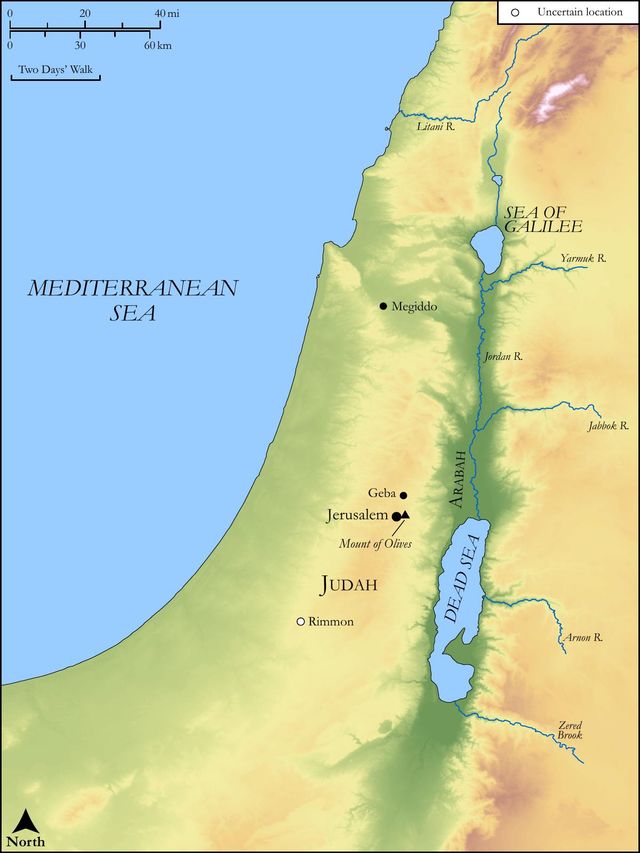
(1.)The church shall be like a fruitful country, abounding in all the rich products of the soil. The whole land of Judea, which is naturally uneven and hilly, shall be turned as a plain; it shall become a smooth level valley, from Geba, or Gibeah, its utmost border north, to Rimmon, which lay south of Jerusalem and was the utmost southern limit of Judea. The gospel of Christ, where it comes in its power, levels the ground; mountains and hills are brought low by it, that the Lord alone may be exalted.
(2.)It shall be like a populous city. As the holy land shall be levelled, so the holy city shall be peopled, shall be rebuilt and replenished. Jerusalem shall be lifted up out of its low estate, shall be raised out of its ruins; when the land is turned as a plain, and not only the mount of Olives removed (Zac 14:4), but other mountains too, then Jerusalem shall be lifted up, that is, shall appear the more conspicuous; she shall be inhabited in her place, even in Jerusalem, Zac 12:6. The whole city shall be inhabited in the utmost extent of it, and no part of it left to lie waste. The utmost limits of it are here mentioned, between which there shall be no ground lost, but all built upon, from Benjamin's-gate north-east to the corner-gate north-west, and from the tower of Hananeel in the south to the king's wine-presses in the north; when the churches of Christ in all places are replenished with great numbers of holy, humble, serious Christians, and many such are daily added to it, then this promise is fulfilled.
(3.)This country and this city shall both be safe, both the meat in the country and the mouths in the city: Those that dwell in it shall dwell securely, and there shall be none to make them afraid; there shall be no more of that utter destruction that has laid both town and country waste, no more anathema (as some read it), no more cutting off, no more curse, or separation from God to evil, no more such desolating judgments as you have been groaning under, but Jerusalem shall be safely inhabited; there shall be no danger, nor any apprehension of it; neither shall its friends be fearful to disquiet themselves nor its enemies formidable to disquiet them. That promise of Christ explains this - that the gates of hell shall not prevail against the church; and so do the holy security and serenity of mind which believers enjoy in relying on the divine protection.
II.Here are judgments threatened against the enemies of the church, that have fought, or do fight, against Jerusalem; and the threatening of these judgments is in order to the preservation of the church in safety. Men that read and hear of these plagues will be afraid of fighting against Jerusalem, much more when these threatenings are fulfilled in some will others hear and fear. Those that fight against the city of God, and his people, will be found fighting against God, against whom none ever hardened his heart and prospered (Zac 14:12): This shall be the plague wherewith the Lord will smite all the people that have fought against Jerusalem; whoever they are, God will punish them for the affront done to him, and avenge Jerusalem upon them.
1.They shall waste away under grievous and languishing diseases: Their flesh shall consume away, and they shall be miserably emaciated, even while they stand on their feet, so that they shall be walking skeletons; nothing shall remain but skin and bones. The flesh which they pampered and indulged, and made provision for, when they were fed to the full with the spoils of God's people, shall now consume away, that it cannot be seen, and the bones that were not seen shall stick out, Job 33:21. They keep their feet, and hope to keep their ground, crawling about as long as they can; but they must yield at last. The organs of sight, the outlets of sin, their eyes, shall consume away in their holes, shall sink into their heads or perhaps start out of them; their envious malicious, adulterous eyes, the eyes they had so often fed with spectacles of misery, these shall consume, which shall make not only their countenances ghastly, but their lives wretched. The organs of speech, the outlets of sin, their tongue, shall consume away in their mouth, whereby God will reckon with them for all their blasphemies against himself and invectives against his people. Thus their own tongues shall fall upon them, and their punishment shall be legible in their sin, as his was whose tongue was tormented in hell-flames. Thus Antiochus and Herod consumed away.
2.They shall be dashed in pieces one against another (Zac 14:13): A great tumult from the Lord shall be among them. But are tumults from the Lord, who is the God of order, and not of confusion? As they are the sin of those that raise them they are not from the Lord, but from the wicked one, and from men's own lusts; but, as they are the punishment of those that suffer by them, they are from the Lord, who serves his own purposes, and carries on his intentions, by the sins, and follies, and restless spirits, of men. It is of themselves that they bite and devour one another, but it is of the Lord, the righteous Judge, that thus they are consumed one of another (Gal 5:15); as Ahab was deceived by a lying spirit from the Lord, so Abimelech and the men of Shechem were divided, and so destroyed, by an evil spirit from the Lord, Jdg 9:23. Note, Those that are confederate and combined against the church will justly be separated, and set against one another; and their tumults raised against God will be avenged in tumults among themselves. And they shall lay hold every one on the hand of his neighbour, to hold him from striking, or to bind him as his prisoner; nay, his hand shall rise up against the hand of his neighbour, to strike and wound him. Note, Those that aim to destroy the church are often made to destroy one another; and every man's sword is sometimes set against his fellow, by him whose sword they all are. Some think this was fulfilled in the factions and dissensions that were among the Jews, when the Romans were destroying them all; for they had fought against the spiritual Jerusalem, the gospel-church; and to that well enough agrees Zac 14:14, Thou also, O Judah! shalt fight against Jerusalem; the Jewish nation shall be ruined by itself, shall die by its own hands; the city and country shall be at war with each other, and so both shall be destroyed. Suis et ipsa Roma viribus ruit - Rome was urged into ruin by its very strength.
3.The plunder of their camp shall greatly enrich the people of God, or the spoils of their country (Zac 14:14): Judah also shall eat at Jerusalem (so one learned interpreter reads it); people shall come from all parts to share in the prey; as when Sennacherib's army was routed before Jerusalem there was the prey of a great spoil divided (Isa 33:23), so it shall be now; the wealth of all the heathen round about, that had spoiled Jerusalem, shall be gathered together, gold, and silver, and apparel, in great abundance, that an equal dividend may be made among all the parties entitled to a share of the prize. Note, The wealth of the sinner is often laid up for the just, and the Israel of God enriched with the spoil of the Egyptians.
4.The very cattle shall share in the plague with which the enemies of God's church shall be cut off, as they did in divers of the plagues of Egypt (Zac 14:15): All the beasts that shall be in the tents of these wicked men, when God comes to contend with them, shall perish with them, not only beasts used in war, as the horse, but those used for travel, or in the plough, as the mule, the camel, and the ass. Note, The inferior creatures often suffer for the sin of man and in his plagues. Thus God will show his indignation against sin, and will make the creature that is thus subject to vanity groan to be delivered into the glorious liberty of the children of God, Rom 8:21, Rom 8:22.
Historical interpretation
Historical reception
2 surviving comments on this verse. Each one is dated, so this reads as a timeline rather than a list.
Select a marker to jump to its quote. Markers stagger vertically where authors wrote within a few decades of each other.
It is clear that this passage refers to the glorious time of the Maccabees when, after the idolatry that Antiochus had introduced had been rejected, all of Judea embraced the cult of the one God. At the same time, the things which you see here to be foreshadowed were fulfilled and perfected by Christ. Therefore the prophet calls summer the very happy time of the manifestation of Christ to the whole world, because Nisan aptly represents the end of the winter month and the beginning of the fruitful summer. On the other hand, he calls winter the night, which constantly oppresses the devil, after the birth of Christ. Again the words “as it was in the ancient times” appear to be suitable to the day, which brought salvation to Moses and the children of Israel. Indeed, it opened a splendid summer for them, whom it carried safe and uninjured through the sea, while it generated a sorrowful winter to the Egyptians by submerging and suffocating their army. On that day the Lord will be one and his name one. What I said to refer to the time of the Maccabees and the dominion of the Jews was brought to its completion all over the world, when, after the promulgation of the gospel of Christ, the whole world believed in him and recognized that he is God and the true king.
(Verse 9 and following). In that day there will be one Lord, and his name will be one: and all the land will return to the desert from the hill of Remmon to the South of Jerusalem: and it will be exalted, and it will be inhabited in its place, from the Benjamin gate to the place of the former gate, to the corner gate: and from the Tower of Ananeel to the king's winepresses, and they will dwell in it, and there will no longer be a curse, but Jerusalem will sit securely. LXX: In that day there will be one Lord, and his name will be one: encircling all the land, and the desert from Gabaa to Remmon to the South of Jerusalem: But Rama will remain in place, from the Benjamin gate to the first gate, to the corner gate, and to the tower of Anamael, to the king's winepresses they will dwell in it, and there will no longer be a curse, and Jerusalem will dwell confidently. The destruction of the city of Jerusalem, and the flowing forth of the waters from its midst, which flow to both seas, the Jews and the Judaizing Christians promise to themselves in the last times, when circumcision will again be practiced, and victims will be sacrificed, and all the precepts of the Law will be observed, so that Christians become not Jews, but Jews become Christians. On that day, they say, when Christ will sit in Jerusalem, golden and adorned, reigning, there will be no idols nor diverse worship of divinity, but there will be one Lord, and all the earth will return to solitude, that is, to its ancient state. And he sets forth the names of the places from which place to which place Jerusalem is to be built: from the hill Remmon (for this is what Gabaa means, where the Maligranati tree is) to the southern region of Jerusalem. And what follows: However, Rama will remain in its place, which Aquila and others have better interpreted to mean, it will be exalted. For Rama means exaltation, according to that prophetic and gospel saying: A voice was heard in Rama, that is, it sounded on high (Matthew 2:18). Therefore, Jerusalem will be exalted and rebuilt in its original place, from the Gate of Benjamin to the Gate called the Corner Gate, and from the Tower of Ananeel (not as the Greeks and Latins wrongly read it as Anamael) to the Winepresses of the King, which in Hebrew is written Ammelech (or, according to some, Amalech). And it is said that they will dwell in it, that is, in Jerusalem, and there will no longer be any curse: no hostile attack, no fear; but Jerusalem will sit or be inhabited in eternal peace and rest. The Jews dream literally and our chiliasts, who desire to hear again: Increase and multiply, and fill the earth (Gen. 1:28), and for the sake of continence of this life and brief fasting, they promise themselves onions, and vulvas, and the birds of Phasis, and the attagen, not the Ionic, but the Jewish ones, concerning which the Lord can truly say: My spirit shall not remain in these men, because they are flesh (Gen. 6:3). For the flesh lusts against the spirit, and the spirit against the flesh (Galatians. V, 17). And let not the book of Revelation (Chapter XX) be opposed to us, for it must also be interpreted spiritually. But we shall interpret the heavenly Jerusalem as the Church, which, though walking in the flesh, does not live according to the flesh, whose citizenship is in heaven (Philippians. III). For when the Lord Jesus shall reign over all the earth, of whom the Holy Spirit speaks to the Father through the Prophet: O God, give Your judgment to the king, and Your justice to the king's son (Psalm. LXXI, 1): then there will be one Lord, of whom it is written: Know that the Lord Himself is God (Deuteronomy. IV, 35): And His name will be one, with all false religion trampled underfoot, according to what the Prophet sings: O Lord, our Lord, how admirable is your name in all the earth (Psalm. VIII, 1)! And again: You have magnified your holy name above all (Psalm 137:3). And elsewhere: As is your name, O God, so is your praise unto the ends of the earth (Psalm 48:11); of which Habakkuk also speaks: The earth is full of his praise (Habakkuk 3:5). Of the glory of his name, God himself speaks: Apart from me, you will not know God, and besides my name, which is magnified above all (Isaiah 44:8). Then all the earth will return, in which the Jews dwelt up to the desert, that is, up to the people of the Gentiles, which was formerly deserted and did not have knowledge of the Law: from Geba to Rimmon, that is, from the hill to the high place, for we ascend from the earth and the desert to the hills, and from the hills to the mountains. And the bridegroom in the Song of Songs passes over the smaller hills and leaps upon the tall mountains (Song 1), of which it is written: He makes the mountains skip like deer (Psalm 104). But if we wish to understand the Remmon, which both words signify in Hebrew, let us say that the limits of the Church begin from the hills, so that the whole ecclesiastical order be constructed, as we have said above, when we interpreted the lament of the only-begotten, and the lament like Adadremmon. And the Church is not content with this end; but it will reach as far as the South in the fullest light, as we have previously explained. And now we remain silent about it, so as not to annoy the reader by repeating the same things often. And the Church which began from the hills will be exalted and will reach the South; and it will dwell in its place, as it is written: 'He has set me in a place of pasture' (Psalm 22:1). From the gate of Benjamin, which is interpreted as the Son of the right hand, and not the Son of days, as some suspect wrongly: for it is one thing if it ends with the letter Nun, another if it ends with the letter Mem. And it shall come to the place of the eastern and former gate, even to the gate of the corners. We begin with virtue, for this indeed signifies the right hand, and we arrive at the former gate, so that we may enter through it to the others. And immediately we encounter the gate of the corners, where the corner stone is, which the builders rejected and has become the head of the corner (Ps. CXVII, 22). This corner stone connects both walls and brings two peoples into one (Ephes. II), about which God speaks through Isaiah: Behold, I will place in Zion a corner stone, chosen and precious in its foundation; and whoever believes in him will not be put to shame (Isai. XXVIII, 16). Here the cornerstone and other cornerstones wanted to be built, so that the apostle Paul might freely say: Built upon the foundation of the apostles and prophets, Jesus Christ himself being the chief cornerstone (Ephesians 2:20). These stones do not imitate the heretics, who do everything for the sake of glory and profit, and pray in the corners of the streets, leaving the straight path. For every corner breaks the straight line, and therefore the prostitute in Proverbs (Chapter 7), however we may understand her, whose feet do not rest at home, but wanders outside or lies in wait in all the corners of the streets, when she sees a foolish young man (for she does not invite one whom she perceives to be wise and mature in age, of whom it is written: The wisdom of an old man is his gray hair), she immediately seizes him, and kisses and flatters him, and leads him to the brothel, and invites him to have intercourse. Let us therefore leave behind false angles and pass on to the firm and robust angles of Christ, to which when we have arrived, we are immediately met by the Tower of Ananeel, which is interpreted as the favor of God. For what is more pleasing than the Tower of Solomon? of which it is said to the bride: 'Your neck is like the tower of David, which is built with bulwarks; a thousand shields hang upon it; all the spears of the mighty are upon it' (Song of Solomon 4:4). The Lord wants this tower to be built in the Gospel (Chapter XIV), with previous expenses and costs computed: and about which it is said to Jerusalem: Let there be peace within your walls, and abundance within your towers (Psalm 122:7), about which the saint also speaks to the Lord: You have led me, for you have become my hope: a tower of strength against the enemy (Psalm 60:4). From the Tower of Ananeel, we come to the king's wine press, for which three psalms also have a title. And the Lord says in Isaiah: I have trodden the winepress alone (Isa. LXIII, 3), so that our vineyard may abound in them, and we may press out the grapes, and in Christ's blood we may trample the reddened juice; so that we may drink the wine that gladdens the heart of man (Ps. CIII); and the bride desires the companions of the bridegroom, saying: Lead me into the wine cellar, set love upon me (Cant. II, 4). If we are made drunk by such winepresses, we will dwell in Jerusalem, where there will no longer be anathema, namely curse and abomination. And the Apostle says: If anyone does not love the Lord, let him be accursed (I Cor. XVI, 2). And in another place: No one speaking in the Spirit of God says 'Jesus be accursed' (I Cor. XII). And for the sake of the salvation of his brothers, he desires to be accursed, imitating his Lord who, though he was not a curse, became a curse for us (Rom. IX). But when all the curse is removed, Jerusalem will dwell secure and confident, and she will fulfill that which is said of her: 'Blessed is the one who trusts in the Lord.' And: It is better to trust in the Lord than to trust in man (Ps. CXVII, 8): about this security and confidence the prophet Jeremiah also mentions: Blessed is the man who trusts in the Lord (Jerem. XVII, 7).
Continue studying Zechariah 14:9 across the web’s major study libraries — every link below opens this exact verse, chapter, or book on the destination site.
Read & Compare
 BibleGatewayThis verse in more than 200 translations and 70 languages.
 Bible.comThe YouVersion reader — hundreds of translations, reading plans, and highlights.
 ESV.orgCrossway's official English Standard Version reader.
 NET BibleThe NET translation with 60,000+ translators' notes on every rendering decision.
 STEP BibleTyndale House's free study tool — original text, vocabulary, and scholarly resources.
 BibliaLogos Bible Software's free web reader.
 USCCBThe New American Bible (Revised Edition) with the U.S. bishops' study notes.
Commentaries
 BibleHub CommentariesDozens of classic commentaries on this verse, gathered on one page.
 StudyLightMore than 100 commentary sets — the largest collection on the web.
 BibleRefPlain-English commentary on what this verse means, verse by verse.
 Enduring WordDavid Guzik's free commentary on this chapter, widely used by Bible teachers.
 Bible Study ToolsVerse commentary alongside Greek and Hebrew study aids.
Original Language & Research
- BibleHub InterlinearThe verse word by word — original language, transliteration, and English.
- BibleHub LexiconEvery word's original-language definition and Strong's entry.
 Blue Letter BibleDeep-study tools — Strong's numbers, concordance, and word studies.
 SefariaThe Hebrew text with Rashi and centuries of Jewish commentary.
Sermons, Hymns & Audio


TrulyRandomVerse is not affiliated with these sites and doesn’t control their content. They’re linked because they’re genuinely useful.
Summary
Zechariah 14:9 stands as a pivotal prophetic declaration, serving as the climactic vision within Zechariah 14's intense eschatological narrative. It vividly portrays the ultimate triumph of God's universal sovereignty, where His reign is fully established and universally acknowledged across the entire earth. This verse offers profound hope and deep insight into the culmination of God's redemptive plan for creation, pointing to a future era of undisputed divine rule and unified worship.
Context
ShowHideLiterary Context
Zechariah 14 is a highly apocalyptic and eschatological chapter, forming the culmination of Zechariah's prophetic book. It describes "the Day of the LORD," a recurring biblical motif signifying a time of divine intervention, judgment, and salvation. The preceding verses (Zechariah 14:1-8) detail a final, cataclysmic battle against Jerusalem, disturbances in the heavens, and God's miraculous defense of His people. The Mount of Olives splits, living waters flow from Jerusalem, and light replaces darkness. Against this backdrop of dramatic divine action and global upheaval, Zechariah 14:9 serves as the triumphant and definitive declaration of the ultimate outcome: God's undisputed, universal, and eternal kingship, establishing the new order following these transformative events. It is the theological climax, explaining the purpose and result of the preceding divine judgments and interventions.
Historical & Cultural Context
Zechariah prophesied during the early post-exilic period, roughly 520-518 BC, when the Jewish people had returned from Babylonian captivity and were rebuilding the Temple in Jerusalem. This was a time of national vulnerability, political uncertainty under Persian rule, and spiritual discouragement. The people longed for the restoration of their national glory and the fulfillment of God's covenant promises, particularly the establishment of a Davidic king and God's sovereign rule. Prophecies like Zechariah 14:9 spoke directly to these aspirations, offering a grand vision of God's ultimate triumph over all earthly powers and the establishment of His kingdom, far exceeding their immediate political realities. It provided hope that despite their present humble circumstances, Yahweh, the God of Israel, would ultimately be recognized as the supreme ruler of all nations, fulfilling ancient promises of a global reign (e.g., Psalm 2:8 and Psalm 47:8).
Key Themes
ShowHideZechariah 14:9 contributes significantly to several major theological and narrative themes within Zechariah and the broader prophetic tradition. The most prominent is the Universal Sovereignty of God, explicitly stating that "the LORD shall be king over all the earth." This theme underscores God's absolute dominion, extending His authority beyond Israel to every nation and corner of the world, signifying a future where all earthly powers submit to His divine rule, as also envisioned in Daniel 7:14. Closely related is the theme of Divine Unity and Recognition, conveyed by "in that day shall there be one LORD, and his name one." This emphasizes the singularity and unique identity of God, implying the abolition of all false gods, idolatry, and competing loyalties. It echoes the foundational declaration of God's oneness found in the Shema (Deuteronomy 6:4) and projects its universal acknowledgment. Finally, the verse strongly points to the Establishment of the Messianic Kingdom, often interpreted as the future, literal reign of the Messiah on earth. It anticipates a time when God's perfect justice and peace will govern the world directly, fulfilling prophecies of a righteous king ruling over all creation, as seen in Isaiah 9:6-7.
Exposition and Analysis
ShowHideKey Word Analysis
ShowHideThis is the Tetragrammaton, YHWH (H3068), God's personal, covenantal name. It signifies "the self-Existent or Eternal," emphasizing God's absolute being, unchanging nature, and His unique relationship with His people. In this context, it underscores that the one who will be King over all the earth is the very God who revealed Himself to Israel, the eternal and sovereign Creator.
The term (H4428) denotes a sovereign ruler, one who exercises ultimate authority and dominion. The declaration that YHWH "shall be king" is not merely a statement of future reality but a powerful affirmation of His inherent right and ultimate triumph over all other claimants to power, establishing a definitive and absolute reign.
This numeral (H259) means "united" or "one," but its usage here goes beyond mere numerical singularity. When applied to "LORD" and "name," it conveys uniqueness, unity, and universal acknowledgment. It implies that in that day, there will be no other gods, no competing authorities, and no division in the worship or understanding of God's character. His identity and authority will be singular, unified, and universally confessed.
Verse Breakdown
ShowHide"And the LORD shall be king over all the earth"
This opening clause is a declarative prophecy of God's ultimate and undisputed universal sovereignty. It envisions a future state where Yahweh, the God of Israel, will exercise direct and absolute rule not just over His chosen people, but over every nation, every land, and every inhabitant of the globe. This is a definitive statement of divine triumph, signifying the end of all human rebellion and the full establishment of God's righteous governance across creation.
"in that day shall there be one LORD"
The phrase "in that day" points to the eschatological period described throughout Zechariah 14, the culmination of God's redemptive plan. The declaration "shall there be one LORD" emphasizes the absolute monotheism that will characterize this future era. It signifies the complete eradication of idolatry, polytheism, and any rival claims to deity. All peoples will acknowledge and worship the one true God, Yahweh, without deviation or competition, fulfilling the foundational truth of Israel's faith on a global scale.
"and his name one"
This final clause reinforces and expands upon the preceding statement. "His name one" refers not just to a singular appellation, but to God's unified character, reputation, and recognized authority. It means that God's identity, attributes, and worship will be uniformly understood and acknowledged by all humanity. There will be no diverse interpretations, no divided loyalties, and no confusion regarding who God is or how He is to be honored. His singular, unique, and glorious character will be universally confessed and revered.
Literary Devices
ShowHideZechariah 14:9 employs several powerful literary devices to convey its profound message. The most prominent is Prophecy, as the verse declares a future state of affairs, moving from the present reality of fragmented human rule to the ultimate reign of God. Symbolism is evident in "the earth," representing the entirety of creation and humanity, over which God's dominion will extend. The phrase "in that day" is a key eschatological motif, signaling a specific, climactic period of divine intervention and transformation. Repetition is used effectively with the word "one" ("one LORD, and his name one"), which serves as a powerful emphasis on the singularity, unity, and universal recognition of God. This repetition creates a sense of definitive closure and absolute truth, underscoring the abolition of all competing deities and the establishment of an undivided worship. The verse functions as a climax to the preceding narrative of conflict and divine judgment in Zechariah 14, providing the ultimate resolution and purpose for God's actions.
Theological and Thematic Connections
ShowHideZechariah 14:9 is a foundational text for understanding God's ultimate sovereignty and the eschatological hope of His kingdom. It affirms the biblical truth that God is not merely the God of Israel but the Creator and rightful King of all the earth, whose universal dominion will one day be fully manifested and acknowledged by all creation. This declaration stands against all forms of idolatry and humanistic rebellion, asserting the singular identity and authority of the one true God. It speaks to the fulfillment of God's redemptive plan, where the chaos of sin and human governance gives way to the perfect order and justice of His divine rule, leading to a unified worship of His holy name.
Reflection and Application
ShowHideZechariah 14:9 offers immense hope and comfort to believers across all generations. In a world often characterized by political instability, moral decay, and spiritual confusion, this verse provides a steadfast anchor, reminding us that despite present chaos and the apparent triumph of evil, God's ultimate plan is for His absolute sovereignty to be recognized and established over all creation. This grand vision calls us to live with an eternal perspective, fostering resilience in the face of temporal difficulties. It compels us not only to anticipate this future reality but also to acknowledge and submit to God's present kingship in our own lives, recognizing that His authority is already supreme even if not yet universally acknowledged. Furthermore, the declaration of "one LORD, and his name one" serves as a powerful reminder of the unique truth of the one true God, encouraging us to boldly proclaim His singular identity and character in a pluralistic world, inviting others to join in the worship of the only King worthy of all honor.
Questions for Reflection
ShowHideFAQ
ShowHideDoes Zechariah 14:9 refer to a literal future reign of God on earth?
ShowHideYes, many biblical scholars and theologians interpret Zechariah 14:9 as a prophecy pointing to a literal, future reign of God on earth, often associated with the millennial kingdom described in Revelation 20. The vivid, concrete imagery throughout Zechariah 14, including the splitting of the Mount of Olives and the flow of living waters from Jerusalem, suggests a physical manifestation of God's rule. While God is always sovereign, this verse anticipates a time when His kingship will be universally recognized and directly exercised, bringing perfect justice and peace to the earth in a new, tangible way.
What is the significance of "one LORD, and his name one"?
ShowHideThis phrase emphasizes both the singularity and the unified recognition of God. "One LORD" (Hebrew: ʼechâd_ _Yᵉhôvâh') affirms absolute monotheism, declaring that in that future day, there will be no other gods or competing deities acknowledged by humanity. It signifies the complete eradication of idolatry and false worship. "And his name one" means that God's character, reputation, and authority will be uniformly understood and honored across the entire earth. There will be no confusion or division regarding His identity or how He is to be worshipped. It speaks to a universal, unified worship of the one true God, fulfilling the essence of the Shema (Deuteronomy 6:4) on a global scale.
Christ-Centered Fulfillment
ShowHideZechariah 14:9 finds its ultimate and glorious fulfillment in the person and work of Jesus Christ. As the Son of God, Jesus is the physical manifestation of the invisible God (Colossians 1:15), and it is through Him that the LORD's universal kingship will be fully established. The New Testament consistently presents Jesus as the promised King, born to reign (Matthew 2:2), to whom all authority in heaven and on earth has been given (Matthew 28:18). His first coming inaugurated His kingdom, but Zechariah 14:9 anticipates His second coming, when He will return in power and glory to fully establish His righteous rule over all the earth (Revelation 19:11-16). In that day, every knee will bow and every tongue confess that Jesus Christ is Lord, to the glory of God the Father (Philippians 2:9-11), thus fulfilling the prophecy that there shall be "one LORD, and his name one." Through Christ, the one true God is revealed, and His name, which is above every name, becomes the singular focus of universal worship and adoration, bringing all things under His dominion (Ephesians 1:20-22).