


Zechariah 14:12
- וְזֹאתve·Zotand thisH2063Conj-w ¦ PrtParticle Demonstrativeוְandזֹאתthis
- תִּהְיֶהtih·Yehit will beH1961V-Qal-Imperf-3fsVerb Qal Imperfect 3rd Singular Feminine
- הַמַּגֵּפָהha·ma·ge·Fahthe plagueH4046Art ¦ N-fsNoun Singular Feminine Absoluteהַtheמַּגֵּפָהplague
- אֲשֶׁר'a·SherwhichH834RelParticle Relative
- יִגֹּףyi·Gofhe will strikeH5062V-Qal-Imperf-3msVerb Qal Imperfect 3rd Singular Masculine
- יְהוָהYah·wehYahwehH3068N-properNoun Proper Title
- אֶת'et<obj.>H853DirObjMParticle Object Indicator
- כָּלkolallH3605N-mscNoun Singular Masculine Construct
- הָעַמִּיםha·'a·Mimthe peoplesH5971Art ¦ N-mpNoun Plural Masculine Absoluteהָtheעַמִּיםpeoples
- אֲשֶׁר'a·SherwhichH834RelParticle Relative
- צָבְאוּtza·ve·'Uthey have waged warH6633V-Qal-Perf-3cpVerb Qal Perfect 3rd Plural common gender
- עַל'alonH5921PrepPreposition
- יְרוּשָׁלִָםye·ru·sha·LimJerusalemH3389N-properNoun Proper Location
- הָמֵקha·Mekhe will cause to rotH4743V-Hiphil-InfVerb Hiphil Infinitive Construct
- בְּשָׂרוֹbe·sa·Roits fleshH1320N-msc ¦ 3msNoun Singular Masculine Constructבְּשָׂרfleshוֹits
- וְהוּאve·Hu'and itH1931Conj-w ¦ Pro-3msPronoun Personal 3rd Singular Masculineוְandהוּאit
- עֹמֵד'o·Med[is] standingH5975V-Qal-Prtcpl-msVerb Qal Participle Singular Masculine Absolute
- עַל'alonH5921PrepPreposition
- רַגְלָיוrag·Lavits feetH7272N-fdc ¦ 3msNoun Dual Feminine Constructרַגְלָיfeetוits
- וְעֵינָיוve·'ei·Navand its eyesH5869Conj-w ¦ N-fdc ¦ 3msNoun Dual Feminine Constructוְandעֵינָיeyesוits
- תִּמַּקְנָהti·Mak·nahthey will rotH4743V-Niphal-Imperf-3fpVerb Niphal Imperfect 3rd Plural Feminine
- בְחֹרֵיהֶןve·cho·rei·Henin their socketsH2356Prep-b ¦ N-mpc ¦ 3fpNoun Plural Masculine Constructבְinחֹרֵיsocketsהֶןtheir
- וּלְשׁוֹנוֹu·le·sho·Noand its tongueH3956Conj-w ¦ N-csc ¦ 3msNoun Singular common gender Constructוּandלְשׁוֹנtongueוֹits
- תִּמַּקti·Makit will rotH4743V-Niphal-Imperf-3fsVerb Niphal Imperfect 3rd Singular Feminine
- בְּפִיהֶםbe·fi·Hemin their mouthH6310Prep-b ¦ N-msc ¦ 3mpNoun Singular Masculine Constructבְּinפִיmouthהֶםtheir
English is a literal word-by-word gloss of the Hebrew, not the KJV's wording. Why?
This is the original text the KJV's translators worked from — each Hebrew word with its own literal English meaning in this verse, prepared by scholars at Tyndale House, Cambridge. The KJV translates whole sentences, not word by word, so its wording differs: one Hebrew word can become several English words, and the KJV may choose “the LORD” where the gloss reads “Yahweh”. Both are faithful — they answer different questions. For the KJV's own rendering, switch to the KJV text.
Details
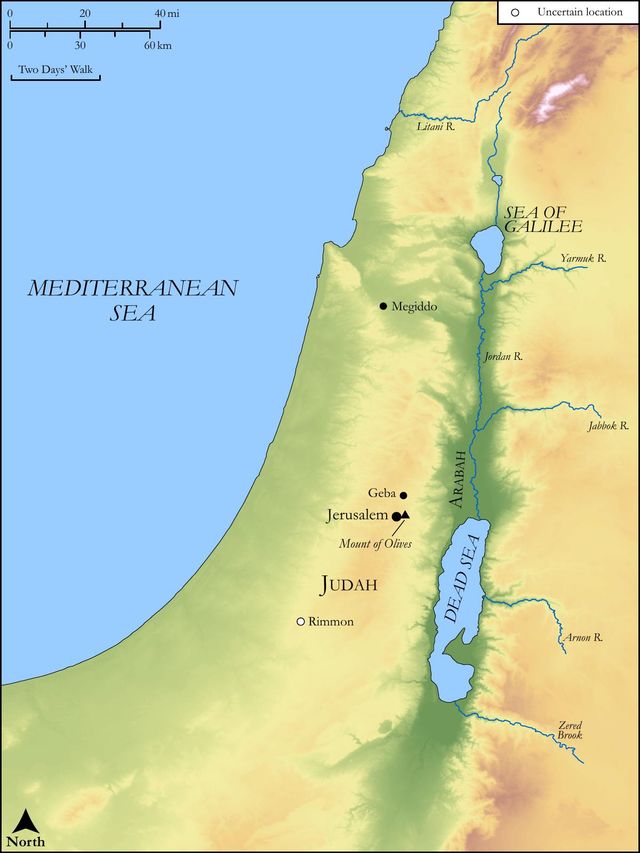
See on the biblical-era map
Study this verse
Public-domain commentary
Matthew Henry
From his Commentary on the Whole Bible. Henry comments on passages, not single verses — this entry covers Zechariah 14:8–15. His three-level outline is real structure in the source text, so it is rendered as structure.
Here are, I. Blessings promised to Jerusalem, the gospel-Jerusalem, in the day of the Messiah, and to all the earth, by virtue of the blessings poured out on Jerusalem, especially to the land of Israel.
1.Jerusalem shall be a spring of living waters to the world; it was made so when there the Spirit was poured out upon the apostles, and thence the word of the Lord diffused itself to the nations about (Zac 14:8): Living waters shall go out from Jerusalem; for there they began, and thence those set out who were to preach repentance and remission of sins unto all nations, Luk 24:47. Note, Where the gospel goes, and the graces of God's Spirit go along with it, there living waters go; those streams that make glad the city of our God make glad the country also, and make it like paradise, like the garden of the Lord, which was well watered. It was the honour of Jerusalem that thence the word of the Lord went forth (Isa 2:3); and thus far, even in its worst and most degenerate age, for old acquaintance-sake, it was made a blessing, and to be so is to be blessed. Half of these waters shall go towards the former sea and half towards the hinder sea, as all rivers bend their course towards some sea or other, some eastward, others westward. The gospel shall spread into all parts of the world, into some that lie remote from Jerusalem one way and others that lie as far off another way; for the dominion of the Redeemer, which was thereby to be set up, must be from sea to sea (Psa 72:8), and the earth must be full of the knowledge of the Lord, as the waters cover the sea, and as the waters that in various channels run to the sea. The knowledge of God shall diffuse itself,
(1.)Every way. These living waters shall produce both eastern churches and western churches, that shall each of them in its turn be illustrious.
(2.)Every day: In summer and in winter it shall be. Note, Those who are employed in spreading the gospel may find themselves work both winter and summer, and are to serve the Lord therein at all seasons, Act 20:18. And such a divine power goes along with these living waters that they shall not be dried up, nor the course of them be obstructed, either by the droughts in summer or by the frosts in winter.
2.The kingdom of God among men shall be a universal and united kingdom, Zac 14:9.
(1.)It shall be a universal kingdom: The Lord shall be King over all the earth. He is, and ever was, so of right, and in the sovereign disposals of his providence his kingdom does rule over all and none are exempt from his jurisdiction; but it is here promised that he shall be so by actual possession of the hearts of his subjects; he shall be acknowledged King by all in all places; his authority shall be owned and submitted to, and allegiance sworn to him. This will have its accomplishment with that word (Rev 11:15), The kingdoms of this world have become the kingdoms of our Lord and of his Christ.
(2.)It shall be a united kingdom: There shall be one Lord, and his name one. All shall worship one God only, and not idols, and shall be unanimous in the worship of him. All false gods shall be abandoned, and all false ways of worship abolished; and as God shall be the centre of their unity, in whom they shall all meet, so the scripture shall be the rule of their unity, by which they shall all walk.
3.The land of Judea, and Jerusalem, its mother-city, shall be repaired and replenished, and taken under the special protection of Heaven, Zac 14:10, Zac 14:11. Some think this denotes particular favour to the people of the Jews, and points at their conversion and restoration in the latter days; but it is rather to be understood figuratively of the gospel-church, typified by Judah and Jerusalem, and it signifies the abundant graces with which the church shall be crowned, and the fruitfulness of its members, and the vast numbers of them.
(1.)The church shall be like a fruitful country, abounding in all the rich products of the soil. The whole land of Judea, which is naturally uneven and hilly, shall be turned as a plain; it shall become a smooth level valley, from Geba, or Gibeah, its utmost border north, to Rimmon, which lay south of Jerusalem and was the utmost southern limit of Judea. The gospel of Christ, where it comes in its power, levels the ground; mountains and hills are brought low by it, that the Lord alone may be exalted.
(2.)It shall be like a populous city. As the holy land shall be levelled, so the holy city shall be peopled, shall be rebuilt and replenished. Jerusalem shall be lifted up out of its low estate, shall be raised out of its ruins; when the land is turned as a plain, and not only the mount of Olives removed (Zac 14:4), but other mountains too, then Jerusalem shall be lifted up, that is, shall appear the more conspicuous; she shall be inhabited in her place, even in Jerusalem, Zac 12:6. The whole city shall be inhabited in the utmost extent of it, and no part of it left to lie waste. The utmost limits of it are here mentioned, between which there shall be no ground lost, but all built upon, from Benjamin's-gate north-east to the corner-gate north-west, and from the tower of Hananeel in the south to the king's wine-presses in the north; when the churches of Christ in all places are replenished with great numbers of holy, humble, serious Christians, and many such are daily added to it, then this promise is fulfilled.
(3.)This country and this city shall both be safe, both the meat in the country and the mouths in the city: Those that dwell in it shall dwell securely, and there shall be none to make them afraid; there shall be no more of that utter destruction that has laid both town and country waste, no more anathema (as some read it), no more cutting off, no more curse, or separation from God to evil, no more such desolating judgments as you have been groaning under, but Jerusalem shall be safely inhabited; there shall be no danger, nor any apprehension of it; neither shall its friends be fearful to disquiet themselves nor its enemies formidable to disquiet them. That promise of Christ explains this - that the gates of hell shall not prevail against the church; and so do the holy security and serenity of mind which believers enjoy in relying on the divine protection.
II.Here are judgments threatened against the enemies of the church, that have fought, or do fight, against Jerusalem; and the threatening of these judgments is in order to the preservation of the church in safety. Men that read and hear of these plagues will be afraid of fighting against Jerusalem, much more when these threatenings are fulfilled in some will others hear and fear. Those that fight against the city of God, and his people, will be found fighting against God, against whom none ever hardened his heart and prospered (Zac 14:12): This shall be the plague wherewith the Lord will smite all the people that have fought against Jerusalem; whoever they are, God will punish them for the affront done to him, and avenge Jerusalem upon them.
1.They shall waste away under grievous and languishing diseases: Their flesh shall consume away, and they shall be miserably emaciated, even while they stand on their feet, so that they shall be walking skeletons; nothing shall remain but skin and bones. The flesh which they pampered and indulged, and made provision for, when they were fed to the full with the spoils of God's people, shall now consume away, that it cannot be seen, and the bones that were not seen shall stick out, Job 33:21. They keep their feet, and hope to keep their ground, crawling about as long as they can; but they must yield at last. The organs of sight, the outlets of sin, their eyes, shall consume away in their holes, shall sink into their heads or perhaps start out of them; their envious malicious, adulterous eyes, the eyes they had so often fed with spectacles of misery, these shall consume, which shall make not only their countenances ghastly, but their lives wretched. The organs of speech, the outlets of sin, their tongue, shall consume away in their mouth, whereby God will reckon with them for all their blasphemies against himself and invectives against his people. Thus their own tongues shall fall upon them, and their punishment shall be legible in their sin, as his was whose tongue was tormented in hell-flames. Thus Antiochus and Herod consumed away.
2.They shall be dashed in pieces one against another (Zac 14:13): A great tumult from the Lord shall be among them. But are tumults from the Lord, who is the God of order, and not of confusion? As they are the sin of those that raise them they are not from the Lord, but from the wicked one, and from men's own lusts; but, as they are the punishment of those that suffer by them, they are from the Lord, who serves his own purposes, and carries on his intentions, by the sins, and follies, and restless spirits, of men. It is of themselves that they bite and devour one another, but it is of the Lord, the righteous Judge, that thus they are consumed one of another (Gal 5:15); as Ahab was deceived by a lying spirit from the Lord, so Abimelech and the men of Shechem were divided, and so destroyed, by an evil spirit from the Lord, Jdg 9:23. Note, Those that are confederate and combined against the church will justly be separated, and set against one another; and their tumults raised against God will be avenged in tumults among themselves. And they shall lay hold every one on the hand of his neighbour, to hold him from striking, or to bind him as his prisoner; nay, his hand shall rise up against the hand of his neighbour, to strike and wound him. Note, Those that aim to destroy the church are often made to destroy one another; and every man's sword is sometimes set against his fellow, by him whose sword they all are. Some think this was fulfilled in the factions and dissensions that were among the Jews, when the Romans were destroying them all; for they had fought against the spiritual Jerusalem, the gospel-church; and to that well enough agrees Zac 14:14, Thou also, O Judah! shalt fight against Jerusalem; the Jewish nation shall be ruined by itself, shall die by its own hands; the city and country shall be at war with each other, and so both shall be destroyed. Suis et ipsa Roma viribus ruit - Rome was urged into ruin by its very strength.
3.The plunder of their camp shall greatly enrich the people of God, or the spoils of their country (Zac 14:14): Judah also shall eat at Jerusalem (so one learned interpreter reads it); people shall come from all parts to share in the prey; as when Sennacherib's army was routed before Jerusalem there was the prey of a great spoil divided (Isa 33:23), so it shall be now; the wealth of all the heathen round about, that had spoiled Jerusalem, shall be gathered together, gold, and silver, and apparel, in great abundance, that an equal dividend may be made among all the parties entitled to a share of the prize. Note, The wealth of the sinner is often laid up for the just, and the Israel of God enriched with the spoil of the Egyptians.
4.The very cattle shall share in the plague with which the enemies of God's church shall be cut off, as they did in divers of the plagues of Egypt (Zac 14:15): All the beasts that shall be in the tents of these wicked men, when God comes to contend with them, shall perish with them, not only beasts used in war, as the horse, but those used for travel, or in the plough, as the mule, the camel, and the ass. Note, The inferior creatures often suffer for the sin of man and in his plagues. Thus God will show his indignation against sin, and will make the creature that is thus subject to vanity groan to be delivered into the glorious liberty of the children of God, Rom 8:21, Rom 8:22.
Historical interpretation
Fourteen Centuries of Reception
2 surviving comments on this verse. Each one is dated, so this reads as a timeline rather than a list.
Select a marker to jump to its quote. Markers stagger vertically where authors wrote within a few decades of each other.
(Verse 12) And this will be the plague with which the Lord will strike all the nations that have fought against Jerusalem. The flesh of each one standing on their feet will rot away, and their eyes will rot away in their sockets, and their tongue will rot away in their mouths (Septuagint: their mouths). The Scriptures testify to the nations that will suffer, those that will fight against the city of the Lord: 'They will stand,' it says, 'on their own feet, and their flesh will waste away and flow off, and their eyes will decay, and from their openings they will fall out; their arrogant tongue, which blasphemed against the people of God, will dissolve into pus, and within the fortification of their teeth it will decay. It is clear to everyone that the Romans who destroyed Jerusalem did not suffer these things, unless perhaps the Jews claim that those nations, which were to fight against the golden and jeweled Jerusalem, would suffer them.' But we will say that all the persecutors, who afflicted the Church of the Lord, received in the present age what they did, even if we remain silent about future tortures. Let us read the Ecclesiastical histories, what Valerian, what Decius, what Diocletian, what Maximian, what the cruelest of all Maximinus, and recently Julian, suffered: and then we will prove by facts, even according to the letter, that the truth of the prophecies has been fulfilled, that their flesh has rotted away, and their eyes have decayed, and their tongue has dissolved into filth and pus. Moreover, if the cruelty of God towards heretics seems to be shown in this saying, let it be understood that all these things happen so that good things may increase as evil things decrease. For whoever stands in the Lord and with the Lord, his carnal things flow away so that spiritual things may arise, and the eyes that were seeing poorly fall from their sockets so that others may be put in their place, who can receive the Lord with the prophet saying: To you I lift up my eyes, you who dwell in the heavens (Ps. 122:1). And the blaspheming tongue will decay, so that another tongue may be born, which glorifies God, and can say: My tongue shall meditate on your righteousness, your praise all day long (Ps. LXX, 15). Therefore Simeon, receiving the Infant in his arms and foretelling the future, says: Behold, this Child is set for the fall and rise of many (Luke II, 34), so that the evil may fall, and the good may rise. Therefore the Lord also said: For judgment I have come into this world, that those who do not see may see, and those who see may become blind (John IX, 39). The people of the Gentiles did not see, but after the faith of Christ, they began to behold the light of truth, which speaks through the prophet: The Spirit of the Lord is upon me, for which reason he has anointed me to bring good news to the poor, to proclaim release to the captives, and recovery of sight to the blind, and to set at liberty those who are oppressed (Isaiah 61:1-2), of which it is written: The wisdom of a man enlightens his face (Ecclesiastes 8:1). And in the Psalms we read: The Lord gives sight to the blind, or makes them wise (Psalm 146). For this signifies more the wise. The Jews saw; and because they did not want to receive the light, they were covered in eternal blindness.
The flesh of every one shall consume: Such judgments as these have often fallen upon the persecutors of God's church, as appears by many instances in history.
Continue studying Zechariah 14:12 across the web’s major study libraries — every link below opens this exact verse, chapter, or book on the destination site.
Read & Compare
 BibleGatewayThis verse in more than 200 translations and 70 languages.
 Bible.comThe YouVersion reader — hundreds of translations, reading plans, and highlights.
 ESV.orgCrossway's official English Standard Version reader.
 NET BibleThe NET translation with 60,000+ translators' notes on every rendering decision.
 STEP BibleTyndale House's free study tool — original text, vocabulary, and scholarly resources.
 BibliaLogos Bible Software's free web reader.
 USCCBThe New American Bible (Revised Edition) with the U.S. bishops' study notes.
Commentaries
 BibleHub CommentariesDozens of classic commentaries on this verse, gathered on one page.
 StudyLightMore than 100 commentary sets — the largest collection on the web.
 BibleRefPlain-English commentary on what this verse means, verse by verse.
 Enduring WordDavid Guzik's free commentary on this chapter, widely used by Bible teachers.
 Bible Study ToolsVerse commentary alongside Greek and Hebrew study aids.
Original Language & Research
- BibleHub InterlinearThe verse word by word — original language, transliteration, and English.
- BibleHub LexiconEvery word's original-language definition and Strong's entry.
 Blue Letter BibleDeep-study tools — Strong's numbers, concordance, and word studies.
 SefariaThe Hebrew text with Rashi and centuries of Jewish commentary.
Sermons, Hymns & Audio


TrulyRandomVerse is not affiliated with these sites and doesn’t control their content. They’re linked because they’re genuinely useful.
Summary
Zechariah 14:12 delivers a chilling prophecy of divine judgment, detailing a horrific plague that the LORD will unleash upon all nations that have arrayed themselves against Jerusalem in the end times. This graphic depiction underscores God's absolute sovereignty and His unwavering commitment to defend His chosen city and people, revealing the severe consequences awaiting those who dare to oppose His ultimate purposes.
Context
ShowHideLiterary Context
Zechariah 14 forms the climactic conclusion to the book's prophetic visions, specifically the "Burden of the Word of the LORD" (chapters 9-14). Chapter 14 describes the ultimate "Day of the LORD," a pivotal eschatological event where all nations gather against Jerusalem, leading to divine intervention. The chapter opens with the siege, followed by the LORD's dramatic return to the Mount of Olives, causing geological upheaval and establishing His universal kingdom. Verse 12 is a specific, terrifying detail of the judgment meted out to the hostile nations, immediately following the description of the LORD's direct engagement in battle (Zechariah 14:3-5) and preceding the establishment of Jerusalem as the center of global worship (Zechariah 14:16-21). It serves as a stark illustration of the destructive power of God's wrath before the dawn of His peaceful reign.
Historical & Cultural Context
While Zechariah's prophecies often draw on historical events (like the return from exile and temple rebuilding), chapter 14 transcends immediate historical circumstances, projecting into a future, eschatological conflict. The concept of "nations gathered against Jerusalem" has historical echoes in various sieges and conflicts throughout Israel's history, but Zechariah 14 describes a final, universal confrontation. The "plague" imagery would have resonated with ancient Near Eastern audiences familiar with divine judgments, often involving pestilence or natural disasters. The vivid, physical decay described in the verse emphasizes a direct, supernatural act of God, distinct from conventional warfare, highlighting His unique power to inflict judgment beyond human means.
Key Themes
ShowHideThis verse powerfully contributes to several key themes within Zechariah and broader biblical prophecy. It highlights Divine Judgment and Retribution, demonstrating God's unwavering justice against those who defy Him and oppress His people. It underscores God's Sovereignty and Protection over Jerusalem, asserting that despite overwhelming opposition, the LORD will ultimately intervene to defend His city and establish His reign, as seen in the broader context of Zechariah 14. Furthermore, it vividly portrays the Eschatological Warfare and Consequences, providing one of the most graphic biblical descriptions of the horrific outcome for those who participate in the final rebellion against God, a theme echoed in passages like Ezekiel 38-39. This plague is a central feature of the "Day of the LORD," a recurring prophetic motif signifying a time of both divine wrath and ultimate vindication for God's purposes, as also seen in Joel 3:14.
Exposition and Analysis
ShowHideKey Word Analysis
ShowHideFrom the root nâgaph (to strike, smite), this word denotes a divinely sent affliction, a pestilence, or a stroke. In this context, it signifies a supernatural, catastrophic judgment inflicted by God, not a natural disaster or a result of human warfare. It emphasizes the direct, intentional nature of the LORD's punitive action.
This is the covenant name of God, often translated "Jehovah" or "Yahweh," signifying the self-existent, eternal, and sovereign God. Its use here underscores that this devastating plague is not random but is specifically orchestrated and executed by the God of Israel, the one true God who is faithful to His covenant and just in His judgments.
A primitive root meaning "to melt," "to flow," "to dwindle," or "to vanish." Figuratively, it conveys the idea of rotting, decaying, or dissolving. The repetition of this verb three times in relation to flesh, eyes, and tongue emphasizes the rapid, complete, and horrifying decomposition of the bodies of those struck by the plague, highlighting the immediacy and totality of God's judgment.
Verse Breakdown
ShowHide"And this shall be the plague wherewith the LORD will smite all the people that have fought against Jerusalem;"
This opening clause sets the stage for the divine judgment. It identifies the agent of judgment as "the LORD" (Yᵉhôvâh), emphasizing His direct and sovereign involvement. The recipients of this judgment are "all the people that have fought against Jerusalem," indicating a universal scope of retribution for those who oppose God's chosen city and, by extension, His purposes. The "plague" (maggêphâh) is presented as the specific instrument of this divine smiting.
"Their flesh shall consume away while they stand upon their feet,"
This is the first and perhaps most shocking detail of the plague. The "flesh" (bâsâr), referring to the entire body, will "consume away" (mâqaq), meaning to rot or dissolve. The phrase "while they stand upon their feet" intensifies the horror, suggesting an instantaneous and ongoing process of decay that occurs even as the victims are still alive and upright, unable to flee or resist.
"and their eyes shall consume away in their holes,"
This clause specifies another part of the body affected. The "eyes" (ʻayin), vital for sight and often seen as windows to the soul, will also "consume away" (mâqaq) within their "holes" (chôwr), or sockets. This detail adds to the grotesque imagery, implying blindness and a complete disintegration of the sensory organs, further emphasizing the totality of the judgment.
"and their tongue shall consume away in their mouth."
The final specific detail of the plague focuses on the "tongue" (lâshôwn), essential for speech, taste, and communication. This organ will also "consume away" (mâqaq) within the "mouth" (peh). This particular decay could symbolize the silencing of their boasts, curses, or defiant words against God and Jerusalem, rendering them utterly helpless and unable to articulate their suffering or resistance.
Literary Devices
ShowHideZechariah 14:12 employs several powerful literary devices to convey the severity and horror of divine judgment. Vivid Imagery is paramount, painting a grotesque picture of rapid bodily decay: "flesh shall consume away while they stand upon their feet," "eyes shall consume away in their holes," and "tongue shall consume away in their mouth." This graphic detail is a form of Hyperbole, exaggerating the physical effects to emphasize the overwhelming and supernatural nature of the plague. The repetition of the phrase "shall consume away" (Hebrew, mâqaq) creates a strong sense of Anaphora (or a form of Parallelism), reinforcing the theme of decay and underscoring the comprehensive and inescapable nature of the judgment. The specific targeting of flesh, eyes, and tongue highlights the complete incapacitation and humiliation of the enemies, stripping them of their most basic human functions and dignity as a direct consequence of their defiance.
Theological and Thematic Connections
ShowHideZechariah 14:12 serves as a stark reminder of God's unwavering justice and His ultimate sovereignty over all nations and history. Theologically, it underscores that God will not tolerate perpetual rebellion against His purposes or His people. This divine plague is not merely a military defeat but a supernatural act demonstrating that the battle is ultimately the LORD's, and His judgment is both righteous and inescapable. It reinforces the biblical truth that while God is merciful and patient, there is a boundary to His forbearance, and those who persistently oppose His will face severe consequences. The passage speaks to the absolute certainty of God's final victory and the establishment of His kingdom, even through terrifying acts of judgment.
Reflection and Application
ShowHideWhile the imagery of Zechariah 14:12 is intensely graphic and points to a specific eschatological event, its profound message holds timeless spiritual significance for believers today. It calls us to a deeper understanding of God's character, reminding us that He is not only a God of love and mercy but also of perfect justice and righteous wrath. This should inspire both awe and reverence in our hearts. For those who trust in Christ, this passage offers a powerful assurance that God is ultimately in control of history, and His purposes will prevail, even amidst global turmoil and opposition to His kingdom. We are called to align ourselves with His will, not to stand in opposition, for the consequences of defying the Almighty are certain and severe. It also prompts us to consider the seriousness of sin and rebellion against God, recognizing that His patience has limits and His judgment is real.
Questions for Reflection
ShowHideFAQ
ShowHideWhat is the "plague" described in Zechariah 14:12?
ShowHideThe "plague" described in Zechariah 14:12 is a supernatural, divinely inflicted judgment upon all nations that fight against Jerusalem in the end times. It is not a conventional disease or weapon, but a direct act of God causing rapid and gruesome physical decay. The text vividly describes flesh, eyes, and tongue consuming away while the victims are still standing, highlighting its miraculous and terrifying nature as a demonstration of God's power and wrath. This plague is part of the larger eschatological events surrounding the "Day of the LORD" described in Zechariah 14.
Is this prophecy literal or symbolic?
ShowHideInterpreters hold various views on the literalness of this prophecy. Many evangelical scholars understand the description of the plague in Zechariah 14:12 to be a literal, physical judgment, given the highly specific and graphic details. The language describes a unique and supernatural event that defies natural explanation, suggesting a direct, miraculous intervention by God. While prophetic language can sometimes be symbolic, the specificity here often leads to a literal interpretation of the physical effects, emphasizing the severity and reality of God's judgment on His enemies in the final days, as part of the events leading to the establishment of the Messiah's kingdom on earth, as also alluded to in Revelation 19:21.
Christ-Centered Fulfillment
ShowHideWhile Zechariah 14:12 describes a future divine judgment on nations opposing Jerusalem, its ultimate Christ-centered fulfillment lies in the absolute authority and just judgment of Jesus Christ. The "LORD" who smites these nations is ultimately the returning Messiah, Jesus, who will execute perfect justice. The terrifying plague foreshadows the comprehensive and inescapable judgment that will befall all who reject God's rule and oppose His Anointed One. The New Testament reveals Jesus as the one to whom "all authority in heaven and on earth has been given" (Matthew 28:18), and He is explicitly depicted as the divine warrior who will return to judge the nations and establish His kingdom (e.g., Revelation 19:11-16). The horrific decay described in Zechariah 14:12 finds its spiritual parallel in the eternal separation and destruction that awaits those who do not bow the knee to Christ, as described in passages like Matthew 25:41. Thus, this Old Testament prophecy, while graphic, ultimately points to the righteous judgment that will be administered by the Lamb of God, who is also the Lion of Judah, ensuring that all evil and rebellion against God's purposes will be decisively overcome by His sovereign power.