


Ezekiel 39:17
Bible text: King James Version (1769 Blayney text) · Public domain
Bible text: King James Version with Strong's numbers · Public domain
Bible text: Berean Standard Bible · Public domain
Bible text: American Standard Version (1901) · Public domain
Bible text: World English Bible, Messianic edition · Public domain
Bible text: Geneva Bible (1599) · Public domain
Bible text: Young's Literal Translation · Public domain
- וְאַתָּהve·'a·Tahand youH859Conj-w ¦ Pro-2msPronoun Personal 2nd Singular Masculineוְandאַתָּהyou
- בֶןvenO son ofH1121N-mscNoun Singular Masculine Construct
- אָדָם'a·DamhumankindH120N-msNoun Singular Masculine Absolute
- כֹּהkohthusH3541AdvAdverb
- אָמַר'a·Marhe saysH559V-Qal-Perf-3msVerb Qal Perfect 3rd Singular Masculine
- אֲדֹנָי'a·do·Nai[the] LordH136N-properNoun Proper Title
- יְהֹוִהYah·wehYahwehH3069N-properNoun Proper Title
- אֱמֹר'e·MorsayH559V-Qal-Imp-2msVerb Qal Imperative 2nd Singular Masculine
- לְצִפּוֹרle·tzi·Porto bird[s] ofH6833Prep-l ¦ N-cscNoun Singular common gender Constructלְtoצִפּוֹרbird[s] of
- כָּלkoleveryH3605N-mscNoun Singular Masculine Construct
- כָּנָףka·NafwingH3671N-fsNoun Singular Feminine Absolute
- וּלְכֹלu·le·Kholand to everyH3605Conj-w ¦ Prep-l ¦ N-mscNoun Singular Masculine Constructוּandלְtoכֹלevery
- חַיַּתchai·Yat<the> animal ofH2416N-fscNoun Singular Feminine Construct
- הַשָּׂדֶהha·sa·Dehthe fieldH7704Art ¦ N-msNoun Singular Masculine Absoluteהַtheשָּׂדֶהfield
- הִקָּבְצוּhi·ka·ve·TzuassembleH6908V-Niphal-Imp-2mpVerb Niphal Imperative 2nd Plural Masculine
- וָבֹאוּva·Vo·'uand comeH935Conj-w ¦ V-Qal-Imp-2mpVerb Qal Imperative 2nd Plural Masculineוָandבֹאוּcome
- הֵאָסְפוּhe·'a·se·Fugather yourselvesH622V-Niphal-Imp-2mpVerb Niphal Imperative 2nd Plural Masculine
- מִסָּבִיבmi·sa·Vivfrom round aboutH5439Prep-m ¦ N-csNoun Singular common gender Absoluteמִfromסָּבִיבround about
- עַל'altoH5921PrepPreposition
- זִבְחִיziv·Chimy sacrificeH2077N-msc ¦ 1csNoun Singular Masculine Constructזִבְחִsacrificeיmy
- אֲשֶׁר'a·SherwhichH834RelParticle Relative
- אֲנִי'a·NiIH589Pro-1csPronoun Personal 1st Singular common gender
- זֹבֵחַzo·Ve·ach[am] sacrificingH2076V-Qal-Prtcpl-msVerb Qal Participle Singular Masculine Absolute
- לָכֶםla·Khemfor youPrep-l ¦ 2mpSuffix Personal 2nd Plural Masculineלָforכֶםyou
- זֶבַחZe·vacha sacrificeH2077N-msNoun Singular Masculine Absolute
- גָּדוֹלga·DolgreatH1419Adj-msAdjective Singular Masculine Absolute
- עַל'alonH5921PrepPreposition
- הָרֵיha·Rei[the] mountains ofH2022N-mpcNoun Plural Masculine Construct
- יִשְׂרָאֵלYis·ra·'ElIsraelH3478N-properNoun Proper Location
- וַאֲכַלְתֶּםva·'a·khal·Temand you will eatH398Conj-w ¦ V-Qal-ConsecPerf-2mpVerb Qal Consecutive Perfect 2nd Plural Masculineוַandאֲכַלְתֶּםyou will eat
- בָּשָׂרba·SarfleshH1320N-msNoun Singular Masculine Absolute
- וּשְׁתִיתֶםu·she·Ti·temand you will drinkH8354Conj-w ¦ V-Qal-ConsecPerf-2mpVerb Qal Consecutive Perfect 2nd Plural Masculineוּandשְׁתִיתֶםyou will drink
- דָּםDambloodH1818N-msNoun Singular Masculine Absolute
English is a literal word-by-word gloss of the Hebrew, not the KJV's wording. Why?
This is the original text the KJV's translators worked from — each Hebrew word with its own literal English meaning in this verse, prepared by scholars at Tyndale House, Cambridge. The KJV translates whole sentences, not word by word, so its wording differs: one Hebrew word can become several English words, and the KJV may choose “the LORD” where the gloss reads “Yahweh”. Both are faithful — they answer different questions. For the KJV's own rendering, switch to the KJV text.
Details
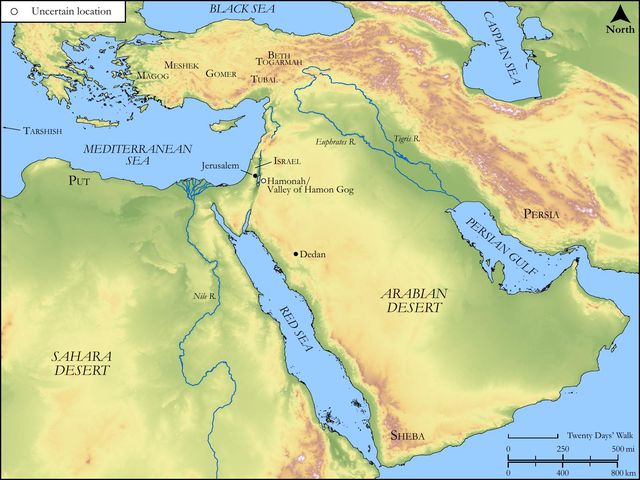
See on the biblical-era map
Study this verse
Public-domain commentary
Matthew Henry
From his Commentary on the Whole Bible. Henry comments on passages, not single verses — this entry covers Ezekiel 39:8–22. His three-level outline is real structure in the source text, so it is rendered as structure.
Though this prophecy was to have its accomplishment in the latter days, yet it is here spoken of as if it were already accomplished, because it is certain (Eze 39:8): "Behold it has come, and it is done; it is as sure to be done when the time shall come as if it were done already; this is the day whereof I have long and often spoken, and, though it has been long in coming, yet at length it has come." Thus it was said unto John (Rev 21:6), It is done. To represent the routing of the army of Gog as very great, here are three things specified as the consequences of it. It was God himself that gave the defeat; we do not find that the people of Israel drew a sword or struck a stroke: but,
I.They shall burn their weapons, their bows and arrows, which fell out of their hands (Eze 39:3), their shields and bucklers, their javelins, spears, leading staves, truncheons, and half-pikes, every thing that is combustible. They shall not lay them up in their armouries, nor reserve them for their own use, lest they should be tempted to put a confidence in them, but they shall burn them; not all at once, for a bonfire (to what purpose would be that waste?) but as they had occasion to use them for fuel in their houses, instead of other fire-wood, so that they should have no occasion to take wood out of the field or forests for seven years together (Eze 39:10), such vast quantities of weapons shall there be left upon the open field where the enemy fell, and in the roads which they passed in their flight. The weapons were dry and fitter for fuel than green wood; and, by saving the wood in their coppices and forests, they gave it time to grow. Though the mountains of Israel produce plenty of all good things, yet it becomes the people of Israel to be good husbands of their plenty and to save what they can for the benefit of those that come after them, as Providence shall give them opportunity to do so. We may suppose that when those who dwelt in the cities of Israel came forth to spoil those who spoiled them, and make reprisals upon them, they found upon them silver, and gold, and ornaments; yet no mention is made of any thing particularly that they converted to their own use but the wood of the weapons for fuel, which is one of the necessaries of human life, to teach us to think it enough if we be well supplied with those, though we have but little of the delights and gaieties of it and of those things which we may very well live without. And every time they put fuel to the fire, and warmed themselves at it, they would be put in mind of the number and strength of their enemies, and the imminent peril they were in of falling into their hands, which would help to enlarge their hearts in thankfulness to that God who had so wonderfully, so seasonably, delivered them. As they sat by the fire with their children about them (their fire-side), they might from it take occasion to tell them what great things God had done for them.
II.They shall bury their dead.
Usually, after a battle, when many are slain, the enemy desire time to bury their own dead. But here the slaughter shall be so general that there shall not be a sufficient number of the enemies left alive to bury the dead. And, besides, the slain lie so dispersed on the mountains of Israel that it would be a work of time to find them out; and therefore it is left to the house of Israel to bury them as a piece of triumph in their overthrow.
1.A place shall be appointed on purpose for the burying of them, the valley of the passengers, on the east of the sea, either the salt sea or the sea of Tiberias, a valley through which there was great passing and repassing of travellers between Egypt and Chaldea. There shall be such a multitude of dead bodies, putrefying above ground, with such a loathsome stench, that the travellers who go that way shall be forced to stop their noses. See what vile bodies ours are; when the soul has been a little while from them the smell of them becomes offensive, no smell more nauseous or more noxious. There therefore where the greatest number lay slain shall the burying-place be appointed. In the place where the tree falls there let it lie. And it shall be called, The valley of Hamon-gog, that is, of the multitude of Gog; for that was the thing which was in a particular manner to be had in remembrance. How numerous the forces of the enemy were which God defeated and destroyed for the defence of his people Israel!
2.A considerable time shall be spent in burying them, no less than seven months (Eze 39:12), which is a further intimation that the slain of the Lord in this action should be many and that great care should be taken by the house of Israel to leave none unburied, that so they might cleanse the land from the ceremonial pollution it contracted by the lying of so many dead corpses unburied in it, for the prevention of which it was appointed that those who were hanged on a tree should be speedily taken down and buried, Deut, Eze 21:23. This is an intimation that times of eminent deliverances should be times of reformation. The more God has done for the saving of a land from ruin the more the inhabitants should do for the cleansing of the land from sin.
3.Great numbers shall be employed in this work: All the people of the land shall be ready to lend a helping hand to it, Eze 39:13. Note, Every one should contribute the utmost he can in his place towards the cleansing of the land from the pollutions of it, and from every thing that is a reproach to it. Sin is a common enemy, which every man should take up arms against. In publico discrimine unusquisque homo miles est - In the season of public danger every man becomes a soldier. And whoever shall assist in this work it shall be to them a renown; though the office of grave-makers, or common scavengers of the country, seem but mean, yet, when it is for the cleansing and purifying of the land from dead works, it shall be mentioned to their honour. Note, Acts of humanity add much to the renown of God's Israel; it is a credit to religion when those that profess it are ready to every good work; and a good work it is to bury the dead, yea, though they be strangers and enemies to the commonwealth of Israel, for even they shall rise again. It shall be a renown to them in the day when God will be glorified. Note, It is for the glory of God when his Israel do that which adorns their profession; others will see their good works and glorify their Father, Mat 5:16. And when God is honoured he will put honour upon his people. His glory is their renown.
4.Some particular persons shall make it their business to search out the dead bodies, or any part of them that should remain unburied. The people of the land will soon grow weary of burying the pollutions of the country, and therefore they shall appoint men of continual employment, that shall apply themselves to it and do nothing else till the land be thoroughly cleansed; for, otherwise, that which is every one's work would soon become nobody's work. Note, Those that are engaged in public work, especially for the cleansing and reforming of a land, ought to be men of continual employments, men that will stick to what they undertake and go through with it, men that will apply themselves to it; and those that will do good according to their opportunities will find themselves continually employed.
5.Even the passengers shall be ready to give information to those whose business it is to cleanse the land of what public nuisances they meet with, which call for their assistance. Those that pass through the land, though they will not stay to bury the dead themselves, lest they should contract a ceremonial pollution, will yet give notice of those that they find unburied. If they but discover a bone, they will set up a sign, that the buriers may come and bury it, and that, till it is buried, others may take need of touching it, for which reason their sepulchres among the Jews were whitened, that people might keep at a distance from them. Note, When good work is to be done every one should lend a hand to further it, even the passengers themselves, who must not think themselves unconcerned, in a common calamity, or a common iniquity, to put a stop to it. Those whose work it is to cleanse the land must not countenance any thing in it that is defiling; though it were not the body, but only the bone, of a man, that was found unburied, they must encourage those who will give information of it (private information, by a sign, concealing the informer), that they may take it away, and bury it out of sight. Nay, after the end of seven months, which was allowed them for this work, when all is taken away that appeared at first view, they shall search for more, that what is hidden may be brought to light; they shall search out iniquity till they find none. In memory of this they shall give a new name to their city. It shall be called Hamonah - The multitude. O what a multitude of our enemies have we of this city buried! Thus shall they cleanse the land, with all this care, with all this pains, Eze 39:16. Note, After conquering there must be cleansing. Moses appointed those Israelites that had been employed in the war with the Midianites to purify themselves, Num 31:24. Having received special favours from God, let us cleanse ourselves from all filthiness.
III.The birds and beasts of prey shall rest upon the carcases of the slain while they remain unburied and it shall be impossible to prevent them, Eze 39:17, etc. We find a great slaughter represented by this figure, Rev 19:17, etc., which is borrowed from this.
1.There is a general invitation given, Eze 39:17. It is to the fowl of every wing and to every beast of the field, from the greatest to the least, that preys upon carcases, from the eagle to the raven, from the lion to the dog; let them all gather themselves on every side; here is meat enough for them, and they are all welcome. Let them come to God's sacrifice, to his feast; so the margin reads it. Note, The judgments of God, executed upon sin and sinners, are both a sacrifice and a feast, a sacrifice to the justice of God and a feast to the faith and hope of God's people. When God broke the head of leviathan, he gave him to be meat to Israel, Psa 74:14. The righteous shall rejoice as at a feast when he sees the vengeance, and shall wash his foot, as at a feast, in the blood of the wicked. This sacrifice is upon the mountains of Israel; these are the high places, the altars, where God has been dishonoured by the idolatries of the people, but where he will now glorify himself in the destruction of his enemies.
2.There is great preparation made: They shall eat the flesh of the mighty and drink the blood of the princes of the earth, Eze 39:18, Eze 39:19.
(1.)It is the flesh and blood of men that they shall be treated with. This has sometimes been an instance of the rebellion of the inferior creatures against man their master, which is an effect of his rebellion against God his Maker.
(2.)It is the flesh and blood of great men, here called rams, and bullocks, and great goats, all of them fatlings of Bashan. It is the blood of the princes of the earth that they shall regale themselves with. What a mortification is this to the princes of the blood, as they call themselves, that God can make that blood, that royal blood, which swells their veins, a feast for the birds and beasts of prey!
(3.)It is the flesh and blood of wicked men, the enemies of God's church and people, that they are invited to. They had accounted the Israel of God as sheep for the slaughter, and now they shall themselves be so accounted; they had thus used the dead bodies of Gods' servants (Psa 79:2), or would have done, and now it shall come upon themselves.
3.They shall all be fed, they shall all be feasted to the full (Eze 39:19, Eze 39:20): "You shall eat fat, and drink blood, which are satiating surfeiting things. The sacrifice is great and the feast upon the sacrifice is accordingly: You shall be filled at my table." Note, God keeps a table for the inferior creatures; he provides food for all flesh. The eyes of all wait upon him, and he satisfies their desires, for he keeps a plentiful table. And if the birds and beasts shall be filled at God's table, which he has prepared for them, much more shall his children be abundantly satisfied with the goodness of his house, even of his holy temple. They shall be filled with horses and chariots; that is, those who ride in the chariots, mighty men and men of war, who triumphed over nations, are now themselves triumphed over by the ravens of the valley and the young eagles, Pro 30:17. They thought to make an easy prey of God's Israel, and now they are themselves an easy prey to the birds and beasts. See how evil pursues sinners even after death. This exposing of their bodies to be a prey is but a type and sign of those terrors which, after death, shall prey upon their consciences (which the poetical fictions represented by a vulture continually pecking at the heart), and this shame is but an earnest of the everlasting shame and contempt they shall rise to.
IV.This shall redound very much both to the glory of God and to the comfort and satisfaction of his people.
1.It shall be much for the honour of God, for the heathen shall hereby be made to know that he is the Lord (Eze 39:21): All the heathen shall see and observe my judgments that I have executed, and thereby my glory shall be set among them. This principle shall be admitted and established among them more than ever, that the God of Israel is a great and glorious God. He is known to be so even among the heathen, that have not, or read not, his written word, by the judgments which he executes.
2.It shall be much for the satisfaction of his people; for they shall hereby be made to know that he is their God (Eze 39:22): The house of Israel shall know, abundantly to their comfort, that I am the Lord their God from that day and forward.
(1.)He will be so from that day and forward. God's present mercies are pledges and assurances of further mercies. If God evidence to us that he is our God he assures us that he will never leave us. This God is our God for ever and ever.
(2.)They shall know it with more satisfaction from that day and forward. They had sometimes been ready to question whether the Lord was with them or no; but the events of this day shall silence their doubts, and, the matter being thus settled and made clear, it shall not be doubted of for the future. As boasting in themselves is hereby for ever excluded, so boasting in God is hereby for ever secured.
Historical interpretation
Historical reception
1 surviving comment on this verse from the historical church.
(Verse 17 and following) 'Therefore, son of man, thus says the Lord God: Speak to every winged creature, to all the birds, and to all the beasts of the field or the countryside: Come together and hasten, gather from all around to my sacrifice that I have offered to you, a great sacrifice upon the mountains of Israel, so that you may eat flesh and drink blood. You shall eat the meat of the mighty or giants, and you shall drink the blood of the rulers of the land: of rams, lambs, goats, and of bulls, as well as of all the fatted ones.' And you shall eat the fat in abundance, and drink the blood to the full, of the offering that I have sacrificed for you. And you shall be filled at my table with horses and chariots, with mighty men and all kinds of warriors, says the Lord God. And I will display my glory among the nations, and all the nations shall see my judgment that I have executed, and my hand that I have laid upon them. And the house of Israel shall know that I am the Lord their God from that day forward. And all the nations shall know that the house of Israel were taken captive because of their iniquities, because they had forsaken me and I had hidden my face from them and given them into the hand of their enemies, and they all fell by the sword. According to their uncleanness and their transgressions, I dealt with them and hid my face from them. Therefore thus says the Lord God: Now I will bring back the captivity of Jacob, and have mercy on the whole house of Israel: and I will be zealous for my holy name. And they shall bear their confusion (or disgrace), and all their transgressions, whereby they have transgressed against me, when they dwelt confidently (or securely) in their own land, fearing no one. And I will bring them back from the peoples (or nations), and gather them out of the countries of their enemies (or from the regions of the nations), and I will be sanctified in them in the sight (or presence) of many nations. And they shall know that I am the Lord their God, when I have caused them to be carried away among the nations (or when I have appeared to them in the Gentiles), and have gathered them together upon their own land, and have not left any one of them there. Neither will I hide my face any more from them, for I have poured out my spirit (or fury) upon the house of Israel, saith the Lord God.' This which we have translated according to the Hebrew, and I will gather them together upon their own land, and will not leave any one of them there, is not found in the LXX. And again, what is placed at the end according to the Hebrews for a blessing, because I have poured out my spirit, the Septuagint translated as fury, which pertains to anger, especially since in Hebrew it is written as Ruhi, which properly means my spirit, and by no means my fury. However, everything up to that point, where the construction of the temple follows, those whom we have mentioned above, the Jews, and our Judaizing brethren, refer to the ultimate time: that Gog and all his army may be fattened like the choicest sacrifices of birds and beasts, and that Israel may be restored to its former state, and no longer be conquered by the nations, but that God may pour out his spirit upon them, so that they may dwell in their land: not all nations, but specifically the house of Israel. But following the initiated tropology, we will say this, that the Lord summons all birds and all beasts to devour the leaders of heretics as the fattest victims. Birds and beasts, however, are called so either because of their swiftness in running everywhere or because of their fierceness and cruelty, to which adversaries are handed over to be destroyed in the flesh, so that the spirit may be saved and they may learn not to blaspheme (I Tim. I). However, they will eat a large and fattest victim; not elsewhere, but on the mountains of Israel, which we ought to understand as the prophets and apostles, and holy men. For in them the teachers of contrary doctrines fall, and they perish wounded by themselves, upon whom the Church is built: and to speak more truly, upon the mountain of mountains, about which Isaiah and Micah speak: Come, let us go up to the mountain of the Lord, and to the house of the God of Jacob, and he will show us his ways (Isa. II, 3; Mic. IV, 2). But those birds and those animals, swift and cruel, will eat flesh and drink blood, which cannot possess the kingdom of God: the flesh of the mighty, or giants, who rebelled against the knowledge of God, and the blood of princes, not of heaven, but of the earth, they will drink, who have savored all earthly things: the blood of rams, and lambs, and goats, or according to the Septuagint, the blood of rams, calves, and goats, to signify the three animals that are sacrificed in the offerings to God. For heretics imitate the gentleness of the Church, but their offering does not profit for the worship of God, but for the food of demons, which is their fattest host, and they are satisfied with fatness and drink the blood of deceivers to the point of drunkenness. But God sacrifices this victim through ecclesiastical men, so that the guests of the worst kind may be satisfied with the multitude of deceivers, and they may drink to the point of vomiting and drunkenness. When you see holy men, instructed in divine Scriptures, cut down the horses of heretics and charioteers, of whom it is written: He threw the horse and its rider into the sea (Exodus XV, 1), and cut down all rebels and giants with his sword, and shed the blood of all warriors of false-named knowledge, then know that the table of the Lord has been prepared, that he may put his glory in all nations that believe in his name, and that they may understand the judgment of the Church of his holy ones, which they have performed against their adversaries, and the strong hand with which they have struck them; and let the house of Israel know and understand that he is their Lord God, who spoke: I am your Lord God, from the day of the Lord's victory until eternity; and let them recall that the house of Israel was once captured by heretics and scattered throughout the entire world of perverse doctrines, because they had abandoned him who had hidden momentarily or turned his face away from them, and delivered them into the hands of heretics, and they fell, pierced by their swords, because of their impurities and iniquities; and this was the reason why he hid and turned his face away from them. But after presenting the arguments, according to what is written: There must be heresies so that those who are approved may become manifest (I Cor. XI, 19), the captivity of Israel, namely the Church, in which those who see God dwell: now it promises that it will restore the captivity of Jacob to the Church, who had supplanted the Jewish people, and was later supplanted by the tricks of the heretics: and it will have mercy on the whole house of Israel, not according to the flesh, but according to the spirit. And I will take up my zeal for my holy name, which was blasphemed among the nations because of heretics: so that once I have delivered them, they may be ashamed and confounded, for why have they forsaken the faith of the Church, and transgressed against me. But let them be confounded and ashamed very quickly, when they have dwelt in their land, the land of the meek, and the land of the saints, and have dwelt confidently, whether in peace, not fearing the snares of heretics. Then they will be brought back from the peoples, and will be gathered from the lands of their enemies into their own land. And the Lord will be sanctified in them in the sight of many nations, who themselves will also believe in the Lord. And the end of blessedness will be to know and recognize that he is their Lord God, because he has appeared to them among the nations, or has brought them over from the nations, and has gathered them onto his own land, the land of Judah, the land of confession, the land of gentleness, and the land of the living, and he will not even leave a trace of heretical wickedness. And he will no longer hide his face from them, nor turn away from them, because he has poured out the spirit of his grace, of which the prophet Joel also speaks: 'In the last days, I will pour out from my spirit upon all flesh' (Joel 2:28), and he will pour it out upon all the house of Israel. But if we read 'fury' according to the Septuagint, which is not found in the Hebrew, it should be understood that he will no longer hide his face from those on whom he had previously poured out his fury. Up to this point in the prophet Ezekiel, with God aiding and opening our mouth, we have spoken: not destroying the opinion of others, if anyone has written, or in the future, if they are to write, but asserting whatever is ours. But in the construction of the temple, and the order of the priests, and the division of the holy land, and the river flowing out of the temple, and the trees on both banks always green, and the fruit brought forth every month, and all the rest that is contained in the prophetic volume until the end, we frankly confess our ignorance, deeming it better to say nothing than to say too little.
Continue studying Ezekiel 39:17 across the web’s major study libraries — every link below opens this exact verse, chapter, or book on the destination site.
Read & Compare
 BibleGatewayThis verse in more than 200 translations and 70 languages.
 Bible.comThe YouVersion reader — hundreds of translations, reading plans, and highlights.
 ESV.orgCrossway's official English Standard Version reader.
 NET BibleThe NET translation with 60,000+ translators' notes on every rendering decision.
 STEP BibleTyndale House's free study tool — original text, vocabulary, and scholarly resources.
 BibliaLogos Bible Software's free web reader.
 USCCBThe New American Bible (Revised Edition) with the U.S. bishops' study notes.
Commentaries
 BibleHub CommentariesDozens of classic commentaries on this verse, gathered on one page.
 StudyLightMore than 100 commentary sets — the largest collection on the web.
 BibleRefPlain-English commentary on what this verse means, verse by verse.
 Enduring WordDavid Guzik's free commentary on this chapter, widely used by Bible teachers.
 Bible Study ToolsVerse commentary alongside Greek and Hebrew study aids.
Original Language & Research
- BibleHub InterlinearThe verse word by word — original language, transliteration, and English.
- BibleHub LexiconEvery word's original-language definition and Strong's entry.
 Blue Letter BibleDeep-study tools — Strong's numbers, concordance, and word studies.
 SefariaThe Hebrew text with Rashi and centuries of Jewish commentary.
Sermons, Hymns & Audio


TrulyRandomVerse is not affiliated with these sites and doesn’t control their content. They’re linked because they’re genuinely useful.
Summary
Ezekiel 39:17 delivers a profound and stark prophetic summons from the Lord GOD to all birds of prey and wild beasts, inviting them to assemble on the mountains of Israel for a gruesome "sacrifice"—a divinely orchestrated feast upon the slain armies of Gog. This vivid and unsettling imagery serves to underscore the absolute totality of God's climactic judgment against those who oppose His divine will and His covenant people, powerfully declaring His ultimate sovereignty and the complete vindication of His holy name before all nations.
Context
ShowHideLiterary Context
This verse is deeply embedded within the climactic prophetic narrative against Gog of Magog, meticulously detailed in Ezekiel 38 and Ezekiel 39. Following the detailed description of Gog's massive, multi-national invasion of Israel and God's miraculous, cataclysmic intervention to utterly destroy his forces (as vividly portrayed in Ezekiel 38:18-23 and Ezekiel 39:1-8), verse 17 marks a dramatic and chilling transition to the aftermath. It initiates a graphic portrayal of the "clean-up" operation, where the sheer, unimaginable number of the fallen necessitates a divine invitation to scavengers. This emphasizes the overwhelming scale of the divine judgment and the complete annihilation of the enemy, leaving no survivors. This specific section, from Ezekiel 39:11-20, focuses intensely on the disposal of the dead, highlighting the comprehensive and inescapable nature of God's victory.
Historical & Cultural Context
Ezekiel prophesied during the traumatic period of the Babylonian exile (c. 593-571 BC), a time of profound despair, displacement, and spiritual questioning for the Israelites. His prophetic messages often alternated between severe pronouncements of judgment against Israel's sin and glorious, hope-filled visions of future restoration. The concept of a "sacrifice" (Hebrew: zebach) was absolutely central to Israelite worship and their covenant relationship with God, typically involving the voluntary offering of animals to God, often culminating in a communal meal shared between God and His people. By deliberately employing this sacred term to describe the consumption of enemy corpses by scavengers, Ezekiel utilizes a profound and shocking irony. This subversion of a sacred concept to depict utter desecration and divine wrath would have been deeply impactful and unsettling to his original audience, highlighting the severity of God's judgment. Furthermore, the "mountains of Israel" were not merely a geographical location but held deep symbolic significance as the very heartland of God's covenant people, the land He promised to restore them to. Making this hallowed ground the ironic stage for such a gruesome, yet divinely orchestrated, feast of judgment powerfully underscores God's reclaiming and purification of His land.
Key Themes
ShowHideEzekiel 39:17 contributes significantly to several overarching and interconnected themes that permeate the book of Ezekiel. Foremost among these is the theme of Divine Sovereignty and Judgment, which is powerfully showcased by God's absolute control over all nations, their movements, and their ultimate destinies. It demonstrates His unparalleled power to execute precise and overwhelming justice upon those who defiantly oppose Him. The explicit invitation to the birds and beasts underscores the Totality of God's Victory and the complete, irreversible annihilation of His enemies, leaving no doubt about the finality and comprehensiveness of their defeat. There is also a potent theme of the Vindication of God's Holy Name (as explicitly stated in passages like Ezekiel 39:7 and Ezekiel 39:25), as this dramatic judgment serves to reveal God's immense power, unwavering faithfulness, and righteous character to both the nation of Israel and the surrounding gentile nations. Finally, the Ironic "Sacrifice" stands out as a central thematic element, highlighting a profound reversal of roles: the invading armies, who sought to plunder and desecrate God's people and land, become the offering themselves, and the scavengers become the unexpected, macabre "guests" at a divinely prepared feast. This stark reversal of the typical sacrificial meal powerfully reinforces the severity and precision of God's retribution against unrighteousness and rebellion.
Exposition and Analysis
ShowHideKey Word Analysis
ShowHide"a son (as a builder of the family name), in the widest sense (of literal and figurative relationship, including grandson, subject, nation, quality or condition, etc., (like father or brother), etc.)." In the address "thou son of man" (Hebrew: ben adam), this term emphasizes Ezekiel's humanity and mortality, sharply contrasting him with the divine speaker, "the Lord GOD." It highlights his role as a humble, albeit chosen, human messenger tasked with delivering a divine, often overwhelming, and sometimes terrifying message to a rebellious people.
"properly, a slaughter, i.e. the flesh of an animal; by implication, a sacrifice (the victim or the act)." This word is absolutely central to the verse's profound and unsettling irony. While zebach typically denotes a voluntary, sacred offering of an animal to God as an act of worship, here it is radically subverted. It describes the involuntary slaughter of God's enemies, whose bodies become the "flesh" of a gruesome, divinely ordained feast for scavengers. This usage signifies utter destruction, desecration, and divine wrath, rather than an act of worship or propitiation.
"great (in any sense); hence, older; also insolent." The descriptor "great" applied to this "sacrifice" dramatically amplifies the scale, significance, and overwhelming nature of the event. It is not merely a sacrifice, but a great one, emphasizing the immense, uncountable number of the slain and the unparalleled magnitude of God's judgment and His decisive victory over His adversaries.
Verse Breakdown
ShowHide"And, thou son of man, thus saith the Lord GOD; Speak unto every feathered fowl, and to every beast of the field, Assemble yourselves, and come; gather yourselves on every side to my sacrifice that I do sacrifice for you"
This opening clause establishes the divine command and the unique recipient of the message. Ezekiel, addressed as the "son of man," is commanded by "the Lord GOD" (a combination of Adonai and Yahweh, emphasizing His sovereign mastery and covenant faithfulness) to issue a universal summons. The invitation is extended to all "feathered fowl" (specifically birds of prey and carrion-eaters) and "beast of the field" (wild predatory animals), instructing them to "assemble" and "gather yourselves on every side." This sets the stage for a divinely orchestrated, macabre feast, explicitly called "my sacrifice that I do sacrifice for you," powerfully highlighting God's active, intentional, and personal role in executing this judgment.
"even a great sacrifice upon the mountains of Israel,"
This phrase specifies the precise location and emphatically reiterates the nature of the event. The "mountains of Israel" are designated as the sacred yet ironic stage where this "great sacrifice" will occur. The repetition of "sacrifice" (echoing the previous clause) reinforces the profound ironic usage, while the adjective "great" underscores the immense, unprecedented scale of the slaughter. It signifies that the very land Gog sought to conquer and desecrate will become the site of his army's complete annihilation and consumption, a powerful reversal of their intentions.
"that ye may eat flesh, and drink blood."
This final, chilling clause clarifies the gruesome purpose of the assembly: to consume the remains of the fallen armies. "Flesh" and "blood" are the explicit and graphic elements of this "feast," completing the picture of total destruction, utter desecration, and the complete absence of any proper burial for the enemies of God. It is a stark, visceral image of the ultimate and inescapable consequences of opposing divine will.
Literary Devices
ShowHideEzekiel 39:17 is exceptionally rich in literary devices that amplify its powerful and unsettling message. The most prominent and impactful device is Irony, particularly in the shocking re-application of the term "sacrifice" (zebach). Traditionally a holy and propitiatory offering to God, it is here repurposed to describe the involuntary slaughter of His enemies, transforming a concept of worship into one of utter destruction and desecration. This profound subversion highlights the severity of God's judgment and the complete reversal of fortune for the invaders. Anthropomorphism is also powerfully present, as God directly addresses animals, commanding them and inviting them to a feast, which underscores His absolute and comprehensive sovereignty over all creation, including the natural order, which He marshals to fulfill His purposes. The vivid, almost grotesque imagery of birds and beasts feasting on human flesh employs Hyperbole to convey the overwhelming scale of the judgment and the countless, unimaginable number of the slain, emphasizing the totality of the defeat. Finally, the "mountains of Israel" serve as potent Symbolism, representing the land and people God has chosen, covenanted with, and promised to protect, making it the ironic and decisive stage for the complete annihilation of their would-be conquerors.
Theological and Thematic Connections
ShowHideEzekiel 39:17 powerfully articulates God's unwavering commitment to His covenant people and His righteous, unyielding judgment against all who oppose His divine will and desecrate His name. It speaks to the ultimate triumph of good over evil, demonstrating with terrifying clarity that no earthly force, however vast, formidable, or seemingly invincible, can ultimately stand against the sovereign Lord. This "great sacrifice" is not merely a physical event but a profound theological statement: God will meticulously defend His honor and His people, and His justice will be fully and irrevocably executed. The imagery, while undeniably gruesome, serves to underscore the certainty, finality, and totality of divine retribution, ensuring that God's name is not only vindicated but also supremely glorified among all nations. It stands as a powerful foreshadowing of a future day when all evil will be decisively and permanently defeated, and God's righteous kingdom will be fully and eternally established.
Reflection and Application
ShowHideEzekiel 39:17, despite depicting a scene of intense and overwhelming judgment, offers profound spiritual nourishment and a robust foundation for faith for believers. It serves as an undeniable reminder of God's absolute and unchallengeable sovereignty over all creation, all history, and all human affairs. We are assured that no matter how chaotic, threatening, or seemingly out of control world events may appear, God remains firmly and eternally in control, meticulously orchestrating all things according to His perfect, righteous, and redemptive will. This passage instills a deep confidence that ultimately, all evil, all injustice, and all opposition to God will be decisively and completely defeated. For those who trust in Him, it brings profound peace and security, knowing that our ultimate vindication, protection, and eternal destiny rest securely in His mighty and unfailing hands. For those who defiantly choose to oppose Him, it serves as a solemn and inescapable warning of the inevitable, dire consequences of defying the Creator of the universe. It calls all of us to live in reverent awe of God's immense power and perfect justice, to align our lives wholeheartedly with His righteous purposes, and to trust implicitly in His unfailing promises, knowing that His word will always stand.
Questions for Reflection
ShowHideFAQ
ShowHideWhy does God invite animals to this "sacrifice"?
ShowHideGod's explicit invitation to the "feathered fowl" and "beasts of the field" to partake in this "great sacrifice" serves several profound symbolic and practical purposes. Symbolically, it emphasizes the utter destruction, dishonor, and desecration of the enemy armies; their bodies are not afforded a proper burial but become carrion, signifying the complete and finality of their defeat and the absence of any dignity in their demise. Practically, it highlights the immense and unprecedented scale of the slaughter—so vast that conventional human burial would be utterly impossible, necessitating nature's scavengers to consume the countless dead. Theologically, it powerfully underscores God's absolute and comprehensive sovereignty over all creation, including the natural world, which He commands and marshals to participate directly in His divine judgment. This chilling imagery is powerfully echoed in other prophetic texts, such as Revelation 19:17-18, where a similar "supper of the great God" is proclaimed for scavengers to feast on the fallen armies of the beast.
What is the significance of the "mountains of Israel" as the location for this event?
ShowHideThe "mountains of Israel" are profoundly significant as the chosen stage for this "great sacrifice" of judgment. Throughout the book of Ezekiel, these mountains represent the promised land, the sacred inheritance, and the very heartland of God's covenant people. Gog's invasion is specifically directed at these mountains (e.g., Ezekiel 38:8), with the explicit aim to plunder, destroy, and subjugate Israel. By having the decisive battle and the subsequent, gruesome "feast" occur precisely on these mountains, God dramatically demonstrates His unwavering protection of His land and His people. It signifies that the very place targeted for desecration and conquest by the enemy becomes the site of their utter humiliation, destruction, and consumption, thereby powerfully vindicating God's holy name and securing Israel's future (as promised in Ezekiel 39:25-29).
Is this a literal event or symbolic prophecy?
ShowHideProphecies in the book of Ezekiel often intricately blend literal and symbolic elements, and the Gog and Magog prophecy is no exception. While the imagery of birds and beasts feasting on corpses is a vivid, almost literal, depiction of the aftermath of a massive, apocalyptic battle, the entire Gog and Magog prophecy (Ezekiel 38-39) is widely understood by scholars to possess significant symbolic and eschatological dimensions. Gog represents the ultimate, comprehensive forces of evil that will one day rise in a final, climactic rebellion against God's people. The "great sacrifice" is therefore a powerful symbolic representation of God's decisive, overwhelming, and absolute judgment against all such opposition in the end times. While the details are graphically presented, they primarily convey the profound theological truth of God's ultimate and unchallengeable victory and the complete annihilation of His enemies, whether this takes a precisely literal form or a divinely orchestrated event that perfectly fulfills the prophetic imagery in a way that transcends human expectation.
Christ-Centered Fulfillment
ShowHideEzekiel 39:17, with its striking imagery of a "great sacrifice" of judgment upon the mountains of Israel, finds its ultimate and profound Christ-centered fulfillment in the person and redemptive work of Jesus Christ, particularly in His dual role as both the perfect atoning sacrifice and the triumphant, righteous King. While this Old Testament passage speaks of a sacrifice of judgment enacted upon God's enemies, it powerfully foreshadows the greater spiritual reality of Christ's decisive victory over sin, death, and all spiritual adversaries. The "flesh" and "blood" consumed by the scavengers in Ezekiel point to a gruesome and final end for the wicked, but Christ's own "flesh" and "blood" were willingly given as the true, redemptive, and once-for-all sacrifice, establishing a new and eternal covenant for all who believe (as beautifully articulated in Luke 22:19-20). The ultimate defeat of Gog, orchestrated by God's divine power, prefigures Christ's final and absolute triumph over all evil powers, culminating in His glorious return where He will judge the nations with perfect righteousness and establish His eternal, unshakeable kingdom (as vividly described in Revelation 19:11-16). The "great sacrifice" on the mountains of Israel, a terrifying feast of judgment for God's foes, is ultimately subsumed and transformed by the joyous "marriage supper of the Lamb" (Revelation 19:9), where believers feast in fellowship with Christ, celebrating His victory, His reign, and the establishment of His righteous, eternal kingdom—a stark and glorious contrast to the judgment feast for His enemies. Thus, Ezekiel's vision of divine judgment ultimately points to the Lord Jesus Christ as the one who perfectly fulfills God's justice and brings about ultimate salvation and eternal peace for His redeemed people.