


Zephaniah 1:7
Bible text: King James Version (1769 Blayney text) · Public domain
Bible text: King James Version with Strong's numbers · Public domain
Bible text: Berean Standard Bible · Public domain
Bible text: American Standard Version (1901) · Public domain
Bible text: World English Bible, Messianic edition · Public domain
Bible text: Geneva Bible (1599) · Public domain
Bible text: Young's Literal Translation · Public domain
- הַסhashush!H2013V-Piel-Imp-2msVerb Piel Imperative 2nd Singular Masculine
- מִפְּנֵיmi·pe·Neifrom beforeH6440Prep-m ¦ N-mpcNoun Plural Masculine Constructמִfromפְּנֵיbefore
- אֲדֹנָי'a·do·Nai[the] LordH136N-properNoun Proper Title
- יְהוִהYah·wehYahwehH3069N-properNoun Proper Title
- כִּיkiforH3588PrtParticle Conditional
- קָרוֹבka·rOv[is] nearH7138Adj-msAdjective Singular Masculine Absolute
- יוֹםYom[the] day ofH3117N-mscNoun Singular Masculine Construct
- יְהוָהYah·wehYahwehH3068N-properNoun Proper Title
- כִּיkiforH3588PrtParticle Conditional
- הֵכִיןhe·Khinhe has preparedH3559V-Hiphil-Perf-3msVerb Hiphil Perfect 3rd Singular Masculine
- יְהוָהYah·wehYahwehH3068N-properNoun Proper Title
- זֶבַחZe·vacha sacrificeH2077N-msNoun Singular Masculine Absolute
- הִקְדִּישׁhik·Dishhe has consecratedH6942V-Hiphil-Perf-3msVerb Hiphil Perfect 3rd Singular Masculine
- קְרֻאָיוke·ru·'Avhis invited [ones]H7121V-Qal-PassPrtcpl-mp ¦ 3msVerb Qal Participle Passive Plural Masculine Constructקְרֻאָיinvited [ones]וhis
English is a literal word-by-word gloss of the Hebrew, not the KJV's wording. Why?
This is the original text the KJV's translators worked from — each Hebrew word with its own literal English meaning in this verse, prepared by scholars at Tyndale House, Cambridge. The KJV translates whole sentences, not word by word, so its wording differs: one Hebrew word can become several English words, and the KJV may choose “the LORD” where the gloss reads “Yahweh”. Both are faithful — they answer different questions. For the KJV's own rendering, switch to the KJV text.
Details
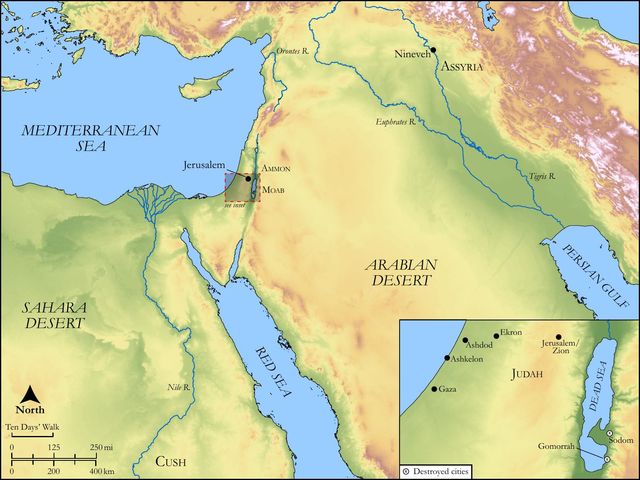
See on the biblical-era map
Study this verse
Public-domain commentary
Matthew Henry
From his Commentary on the Whole Bible. Henry comments on passages, not single verses — this entry covers Zephaniah 1:7–13. His three-level outline is real structure in the source text, so it is rendered as structure.
Notice is here given to Judah and Jerusalem that God is coming forth against them, and will be with them shortly; his presence, as a just avenger, his day, the day of his judgment and his wrath, are not far off, Zep 1:7. Those that improve not the presence of God with them as a Father, but sin away that presence, may expect his presence with them as a Judge, to call them to an account for the contempt put upon his grace. The day of the Lord will come. Men have their day now, when they take a liberty to do what they please; but God's day is at hand; it is here called his sacrifice, a sacrifice of his preparing, for the punishing of presumptuous sinners is a sacrifice to the justice of God, some reparation to his injured honour. Those that brought their offerings to other gods were themselves justly made victims to the true God. On a day of sacrifice great slaughter was made; so shall there be in Jerusalem; men shall be killed up as fast as lambs for the altar, with as little regret, with as much pleasure: The slain of the Lord shall be many. On a day of sacrifice great feasts were made upon the sacrifices; so the inhabitants of Judah and Jerusalem shall be feasted upon by their enemies the Chaldeans; these are the guests God has prepared and invited to come and glut themselves - their revenge with slaughter and their covetousness with plunder. Now observe,
I.Who those are that are marked to be sacrificed, that shall be visited and punished in this day of reckoning, and what it is they shall be called to an account for.
1.The royal family, because of the dignity of their place, shall be first reckoned with for their pride, and vanity, and affectation (Zep 1:8): I will punish the princes, and the king's children, who think themselves accountable to God, and that, high as they are, he is above them. They shall be punished, and all such as, like them, are clothed with strange apparel, such as, in contempt of their own country (where, probably, it was the custom to go in a very plain dress, as became the seed of Jacob that plain man), affected to appear in the fashion of other nations and introduced their modes in apparel, studying to resemble those from whom God had appointed them, even in their clothes, industriously to distinguish themselves. The princes and the king's children scorned to wear any home-made stuffs, though God had provided them fine linen and silks (Eze 16:10), but they must send abroad to strange countries for their clothes, which would not please unless they were far-fetched and dear-bought; and even those of inferior rank affected to imitate the princes and the king's children. Pride in apparel is displeasing to God, and a symptom of the degeneracy of a people.
2.The noblemen, and their stewards and servants, come next to be reckoned with (Zep 1:9): In the same day will I punish those that leap on the threshold, a phrase, no doubt, well understood then, and which probably signified the invading of their neighbour's rights. Entering their houses by force and violence, and seizing their possessions, they leap on the threshold, as much as to say that the house is their own and they will keep their hold of it; and, accordingly, they make all in it their own that they can lay their hands on, and so fill their masters' houses with goods gotten by violence and deceit and with all the guilt thereby contracted. Nor shall it suffice them to say that the ill-gotten gains were not for themselves but for their masters, and that what they did was by their order; for the obligations we lie under to keep God's commandments are prior and superior to the obligations we lie under to serve the interests of any master on earth.
3.The trading people, and the rich merchants, are next called to account. Iniquity is found in their end of the town, among the inhabitants of Maktesh, a low part of Jerusalem, deep like a mortar (for so the word signifies); the goldsmiths lived there (Neh 3:32) and the merchants; and they are now cut down (they are broken, and have shut up their shops, and become bankrupts); nay, All those that bear silver are cut off, in the first place, by the invaders, for the sake of the silver they carry, which is so far from being a protection to them that it will expose and betray them. The conquerors aimed at the wealthy men, and carried them off first, while the poor of the land escaped. Or it may be meant of a general decay of trade, which was a preface and introduction to the general destruction of the land. It is the token of a declining state when great dealers are cut down, and great bankers are cut off and become bankrupts, who cannot fall alone, but with themselves ruin many.
4.All the secure and careless people, the sons of pleasure, that live a loose idle life, are next reckoned with (Zep 1:12); they come from all parts of the country, to take up their quarters in the head-quarters of the kingdom, where they take private lodgings, and indulge themselves in ease and luxury; but God will find them out, and punish them: At that time I will search Jerusalem with candles, to discover them, that they may be brought out to condign punishment. This intimates that they conceal themselves, as being either ashamed of the sin or afraid of the punishment of it; when the judgments of God are abroad they hope to escape by absconding and getting out of the way, but God will search Jerusalem, as search is made for a malefactor in disguise, that is harboured by his accomplices. God's hand will find out all his enemies, wherever they lie hid, and will punish not only the secret idolaters, but the secret epicures and profane; and those are the persons that are here described, and marks are given by which they will be discovered when strict search is made for them.
(1.)Their dispositions are sensual: They are settled on their lees, intoxicated with their pleasures, strengthening themselves in their wealth and wickedness; they are secure and easy, and, because they have had no changes, they fear none, as Moab, Jer 48:11. They have not been emptied from vessel to vessel. They fill themselves with wine and strong drink, and banish all thought, saying, Tomorrow shall be as this day, Isa 56:12. Their being settled on their lees signifies the same with being enclosed in their own fat, Psa 17:10.
(2.)Their notions are atheistical. They could not live such loose lives but that they say in their heart, The Lord will not do good, neither will he do evil; that is, He will do nothing. They deny his providential government of the world: "What good and evil there is in the world comes by the wheel of fortune, and not by the disposal of a wise and supreme director." They deny his moral government, and his dispensing rewards and punishments: "The Lord will not do good to those that serve him, nor do evil to those that rebel against him; and therefore there is nothing got by religion, nor lost by sin." This was the effect of their sensuality; if they were not drowned in sense, they could not be thus senseless, nor could they be so stupid if they had not stupefied themselves with the love of pleasure. It was also the cause of their sensuality; men would not make a god of their belly if they had not at first become so vain, so vile, in their imaginations, as to think the God that made them altogether such a one as themselves. But God will punish them; their end is destruction, Phi 3:19.
II.What the destruction will be with which God will punish these sinners, and what course he will take with them.
1.He will silence them (Zep 1:7): Hold thy peace at the presence of the Lord. He will force them to hold their peace, will strike them dumb with horror and amazement. They shall be speechless. All the excuses of their sin, and exceptions against the sentence, will be overruled, and they shall not have a word to say for themselves.
2.He will sacrifice them, for it is the day of the Lord's sacrifice (Zep 1:8); he will give them into the hands of their enemies, and glorify himself thereby.
3.He will fill both city and country with lamentation (Zep 1:10): In that day there shall be a noise of a cry from the fish-gate, so called because near either to the fish-ponds or to the fish-market. It belonged to the city of David (Ch2 33:14; Neh 3:3); perhaps the same with that which is called the first gate (Zac 14:10), and, if so, it will explain what follows here, And a howling from the second, that is, the second gate, which was next to that fish-gate. The alarm shall go round the walls of Jerusalem from gate to gate; and there shall be a great crashing from the hills, a mighty noise from the mountains round about Jerusalem, from the acclamations of the victorious invaders, or from the lamentations of the timorous invaded, or from both. The inhabitants of the city, even of the closest safest part of the city, shall howl (Zep 1:11), so clamorous shall the grief be.
4.They shall be stripped of all they have; it shall be a prey to the enemy (Zep 1:13): Their household goods, and shop-goods, shall become a booty, and a rich booty they shall be; their houses shall be levelled with the ground and be a desolation; those of them that have built new houses shall not inherit them, but the invaders shall get and keep possession of them. And the vineyards they have planted they shall not drink the wine of, but, instead of having it for the relief of their friends that faint among them, they shall part with it for the animating of their foes that fight against them, Deu 28:30.
Historical interpretation
Historical reception
1 surviving comment on this verse from the historical church.
(Verse 7.) Be silent before the face of the Lord God, for the day of the Lord is near, for the Lord has prepared a sacrifice; He has sanctified His called ones. LXX: Fear before the face of the Lord God, for the day of the Lord is near, for the Lord has prepared His victim; He has sanctified His called ones. Because the LXX translated 'fear,' and we have put 'be silent,' in Hebrew it is an interjection of commanding silence, which is often used by the Comedians; but it is also commanded absolutely for all to be silent, because the day of the Lord is coming. But let us understand the day of the Lord as the day of captivity and vengeance upon the sinful people, and the destruction of Jerusalem, and the sanctification of those whom He has dedicated to be killed, according to what is said in Jeremiah: Sanctify them in the day of their slaughter (Jeremiah 12:3). And the meaning is: The predicted captivity will come upon the wicked people. It is now near. Under the reign of King Josiah, the prophecy is fulfilled: with him being killed, fear the face of the Lord God, for the day of the Lord is near, for the Lord has prepared His sacrifice, and sanctified His called ones. The whole devastation comes, from which also in Ezekiel: The end comes, he says, the end comes (Ezek. VII, 2), and so on. This sacrifice pleases me, these offerings I have sanctified. However, what he says can be understood as sanctifying his chosen ones, and even accepting those from Babylon whom he calls as his own servants for the vengeance of his people, avenging his injustice. I have called, he says, my servant Nebuchadnezzar (Jer. XXV, 9). And in the same volume, he not only calls him his servant, but also a dove: From the face of the sword a dove (Ibid., 30). Furthermore, according to the allegory, because the face of the Lord is upon those who do evil, to wipe their memory from the earth, and the day of judgment is near (for in comparison to eternity, the time of this world is brief), or the end of each individual: let everyone fear and be silent, lest the face of the Lord (of which the saint says (Ps. IV, 7): The light of your face, Lord, is shining upon us) consume the hay, straw, and wood of sins. For the Lord has prepared His sacrifice, the entire mystery of Leviticus, when through fire and the pouring out of blood, and the true offering, the saved ones will be made well and the called ones will be sanctified. Some of us understand the day of the Lord and His sacrifice, and the sanctification of the called ones, in the coming of the Savior, when the Lamb was sacrificed and the apostles and others who were called through them were sanctified in His blood.
Continue studying Zephaniah 1:7 across the web’s major study libraries — every link below opens this exact verse, chapter, or book on the destination site.
Read & Compare
 BibleGatewayThis verse in more than 200 translations and 70 languages.
 Bible.comThe YouVersion reader — hundreds of translations, reading plans, and highlights.
 ESV.orgCrossway's official English Standard Version reader.
 NET BibleThe NET translation with 60,000+ translators' notes on every rendering decision.
 STEP BibleTyndale House's free study tool — original text, vocabulary, and scholarly resources.
 BibliaLogos Bible Software's free web reader.
 USCCBThe New American Bible (Revised Edition) with the U.S. bishops' study notes.
Commentaries
 BibleHub CommentariesDozens of classic commentaries on this verse, gathered on one page.
 StudyLightMore than 100 commentary sets — the largest collection on the web.
 BibleRefPlain-English commentary on what this verse means, verse by verse.
 Enduring WordDavid Guzik's free commentary on this chapter, widely used by Bible teachers.
 Bible Study ToolsVerse commentary alongside Greek and Hebrew study aids.
Original Language & Research
- BibleHub InterlinearThe verse word by word — original language, transliteration, and English.
- BibleHub LexiconEvery word's original-language definition and Strong's entry.
 Blue Letter BibleDeep-study tools — Strong's numbers, concordance, and word studies.
 SefariaThe Hebrew text with Rashi and centuries of Jewish commentary.
Sermons, Hymns & Audio


TrulyRandomVerse is not affiliated with these sites and doesn’t control their content. They’re linked because they’re genuinely useful.
Summary
Zephaniah 1:7 issues a profound and urgent command for silence and reverence in the face of the imminent "Day of the LORD," a time of divine judgment. The verse dramatically portrays God not merely as a judge, but as one who prepares a solemn "sacrifice" and invites "guests" to this dreadful event, signaling the comprehensive and inescapable nature of His impending wrath upon Judah and the nations for their rebellion and idolatry.
Context
ShowHideLiterary Context
Zephaniah 1:7 serves as a pivotal introduction to the dire pronouncements of judgment that characterize the initial chapters of the book. Following a sweeping declaration of universal destruction in Zephaniah 1:2-3, the prophet narrows his focus to Judah and Jerusalem, specifically targeting their idolatry and syncretism in Zephaniah 1:4-6. The command to "Hold thy peace" in verse 7 marks a solemn transition, heightening the tension and underscoring the gravity of what is to follow—the detailed description of the "Day of the LORD" as a day of wrath, distress, and desolation in Zephaniah 1:14-18. This verse sets the stage for the dramatic unfolding of God's righteous indignation.
Historical & Cultural Context
Zephaniah prophesied during the reign of King Josiah (c. 640-609 BC), a period initially marked by significant religious reforms following decades of apostasy under Manasseh and Amon. While Josiah diligently worked to purge idolatry from Judah and restore proper worship of Yahweh (as detailed in 2 Kings 22-23), Zephaniah's prophecy reveals that deep-seated corruption, syncretistic practices (like Baal worship and astral cults mentioned in Zephaniah 1:4-5), and oppression persisted among the people. The "Day of the LORD" was a well-established concept in Israelite prophecy, often associated with divine intervention in history, but Zephaniah, like Amos before him (see Amos 5:18-20), emphasized its terrifying aspect as a day of judgment for sin, likely to be executed through emerging foreign powers such as the Babylonians, who were rapidly gaining dominance over the nations round about.
Key Themes
ShowHideThe verse powerfully contributes to several key themes within Zephaniah and broader prophetic literature. Foremost is the Divine Sovereignty and Imminence of Judgment, as the command to silence underscores God's absolute authority and the certainty that His long-foretold judgment is "at hand." This highlights God's active and decisive involvement in human history. Another crucial theme is Reverent Silence and Awe before God's presence, an imperative that transcends mere quietness to imply a profound spiritual submission and dread in the face of His overwhelming holiness and impending action. Finally, the central prophetic concept of the "Day of the LORD" as Judgment is vividly portrayed. While this day can also signify salvation for the righteous, in Zephaniah 1, the focus is squarely on God's wrath against sin, depicted with the shocking imagery of judgment as a "sacrifice" and its instruments as "guests," emphasizing the comprehensive and deliberate nature of God's justice against those who have rebelled against Him.
Exposition and Analysis
ShowHideKey Word Analysis
ShowHideThis primitive root (H2013) means "to hush," "to hold peace," "to keep silence," or "to be still." In this context, it is a forceful, almost fearful, imperative. It is not merely a suggestion to be quiet but a command demanding absolute cessation of activity and speech, implying a profound sense of awe, dread, and submission in the face of an overwhelming, impending divine event. It signifies the futility of resistance or argument before the Almighty.
While commonly meaning a literal "day" (H3117), this term can also denote a "space of time defined by an associated term," an "age," or a "season." In the prophetic phrase "Day of the LORD" (yôwm Yᵉhôvâh), it refers to a specific, decisive period of divine intervention in human history, often marked by judgment and vindication. Here, its meaning is intensified by "at hand," emphasizing the immediate and inescapable nature of this appointed time of reckoning.
Derived from a root meaning "to slaughter" (H2077), zebach properly refers to the flesh of an animal offered in sacrifice, or the act of sacrificing itself. In Zephaniah 1:7, the imagery is strikingly inverted. Instead of humans offering a sacrifice to God, God Himself "hath prepared a sacrifice." This "sacrifice" is not an animal but the wicked inhabitants of Judah and the nations, who will be consumed by His wrath. This metaphor underscores the deliberate, ritualistic, and comprehensive nature of God's judgment, transforming the act of judgment into a grim, divine feast.
Verse Breakdown
ShowHide"Hold thy peace at the presence of the Lord GOD:"
This opening clause is a dramatic, urgent imperative. The phrase "Hold thy peace" (Hebrew: has) conveys a forceful command for absolute silence and stillness, not just audibly but spiritually. It is a call to profound reverence and dread, acknowledging the overwhelming majesty and impending action of "the Lord GOD" (Hebrew: ʼĂdônây Yᵉhôvih, combining "Master" or "Sovereign" with the covenant name of God, emphasizing both His absolute authority and His personal relationship with His people, which they had violated). The "presence" signifies His active, manifest intervention.
"for the day of the LORD [is] at hand:"
The imperative is immediately justified by the imminence of "the Day of the LORD." This central prophetic concept, Yom Yahweh, is here presented as a terrifying, inescapable reality that is "at hand" (Hebrew: qârôwb, meaning "near" in time or place). This proximity demands an immediate and solemn response, as the time for repentance is short and the time for divine reckoning has arrived.
"for the LORD hath prepared a sacrifice,"
This clause introduces a shocking and powerful metaphor. Instead of a celebratory or atoning sacrifice offered by humans to God, God Himself is the one who "hath prepared a sacrifice." This "sacrifice" (Hebrew: zebach) is not an animal, but rather the wicked people and nations who will be offered up to destruction by divine decree. The verb "prepared" (Hebrew: kûwn) implies deliberate intention and thoroughness, indicating that this judgment is not accidental but a meticulously planned divine act.
"he hath bid his guests."
This final clause extends the sacrificial feast imagery. The "guests" (Hebrew: qârâʼ, those "called" or "invited") are those summoned by God to participate in or witness this terrifying event. These "guests" are likely the instruments of His judgment (e.g., invading armies like the Babylonians) or perhaps even the scavengers of the earth, underscoring the public, undeniable, and comprehensive nature of divine retribution. The image transforms a typical joyous feast into a grim, divinely orchestrated slaughter.
Literary Devices
ShowHideZephaniah 1:7 is rich in Imperative language ("Hold thy peace"), immediately grabbing the reader's attention and conveying the urgency and authority of the divine message. The verse employs striking Metaphor and Imagery, particularly in its depiction of God preparing a "sacrifice" and bidding "his guests." This is a powerful and unsettling Inversion of the typical sacrificial feast, where the "sacrifice" is not an animal offered to God, but the wicked themselves consumed by His wrath, and the "guests" are those who participate in or witness this gruesome judgment. This imagery creates a sense of dread and highlights the comprehensive and deliberate nature of God's justice. The repetition of "LORD" (Yahweh) emphasizes God's sovereign agency and covenant faithfulness, even in judgment. The phrase "Day of the LORD" functions as a Key Motif or Theological Term, signaling a decisive divine intervention.
Theological and Thematic Connections
ShowHideZephaniah 1:7 encapsulates a profound theological truth: God's absolute sovereignty over history and His unwavering commitment to justice. The command for silence underscores the creaturely response of awe and submission required in the face of divine majesty and impending judgment. This "Day of the LORD" is not merely a historical event but a theological principle, demonstrating that God holds nations and individuals accountable for their actions, particularly their rebellion and idolatry. The shocking imagery of God preparing a "sacrifice" of His own people and inviting "guests" to witness it reveals the depth of His righteous indignation against sin, transforming a sacred ritual into a terrifying act of divine retribution. This serves as a stark reminder that God's holiness demands a response, whether it be repentance leading to salvation or persistent rebellion leading to judgment.
Reflection and Application
ShowHideZephaniah 1:7 serves as a timeless and potent reminder of the gravity of God's holiness and the certainty of His justice. The call to "hold thy peace" is not just for ancient Judah but resonates powerfully with believers today, urging us to cultivate a profound sense of reverence and awe in God's presence. In a world often characterized by noise, distraction, and a casual approach to spiritual matters, this verse challenges us to pause, to be still, and to recognize the supreme authority of the Lord GOD. It prompts us to consider our own lives: are we living in alignment with His will, or are we, like ancient Judah, harboring idols or engaging in practices that provoke His righteous indignation? The "Day of the LORD" may refer to historical judgments, but it also points to the ultimate day of reckoning. This should not instill paralyzing fear in those who are in Christ, but rather a healthy fear of God that leads to humble obedience, genuine repentance, and a commitment to living lives that honor Him. It calls us to examine our hearts, confess our sins, and embrace the peace that comes from being reconciled to God through faith.
Questions for Reflection
ShowHideFAQ
ShowHideWhat is the "Day of the LORD" mentioned in Zephaniah 1:7?
ShowHideThe "Day of the LORD" (Hebrew: Yom Yahweh) is a significant prophetic concept throughout the Old Testament, referring to a specific time when God decisively intervenes in human history to execute judgment on His enemies and bring salvation to His people. In Zephaniah 1:7 and the surrounding context, it is predominantly portrayed as a day of terrifying wrath, destruction, and desolation for Judah and the surrounding nations due to their idolatry, rebellion, and injustice. It signifies God's direct, powerful, and inescapable intervention to set things right, often involving natural disasters or invading armies as instruments of His will, as seen in passages like Isaiah 13:6-9 and Joel 2:30-31.
Why does God "prepare a sacrifice" and "bid his guests" in this context?
ShowHideThis imagery is a powerful and shocking metaphor. Typically, a "sacrifice" in the Old Testament is an offering made by humans to God, often for atonement or thanksgiving. However, in Zephaniah 1:7, God Himself is preparing the "sacrifice." This signifies a grim reversal: the "sacrifice" is not an animal, but the wicked inhabitants of Judah and the nations who will be consumed by God's wrath. The "guests" are those whom God "bids" or invites to this dreadful event, likely referring to the foreign armies (e.g., the Babylonians) whom God will use as instruments of His judgment, or perhaps even the scavengers of the earth who will feast on the fallen. This vivid imagery underscores the deliberate, comprehensive, and public nature of God's righteous judgment, transforming a sacred ritual into a terrifying act of divine retribution against sin.
Christ-Centered Fulfillment
ShowHideZephaniah 1:7, with its solemn declaration of the "Day of the LORD" and the imagery of a divine "sacrifice" of judgment, finds its ultimate fulfillment and reinterpretation in the person and work of Jesus Christ. While Zephaniah points to a day of wrath against sin, the New Testament reveals that God's righteous judgment was fully poured out on His own Son, Jesus, on the cross. Christ became the ultimate "sacrifice" for sin, not as a victim of divine wrath against the wicked, but as the perfect, atoning Lamb of God who willingly bore the sins of the world (as proclaimed in John 1:29). Through His death, Jesus absorbed the judgment that humanity deserved, offering a path to reconciliation and peace with God. Thus, for those who believe in Him, the terrifying "Day of the LORD" as a day of condemnation is transformed into a "day of salvation" (2 Corinthians 6:2), where they are invited not to a feast of judgment, but to the joyous wedding feast of the Lamb (Revelation 19:7-9). While a future "Day of the Lord" will indeed bring final judgment for unbelievers (2 Peter 3:10), for believers, the judgment has already been satisfied in Christ, allowing them to stand in His presence not in dread, but in peace and hope (Romans 5:1).