


Zephaniah 1:14
Bible text: King James Version (1769 Blayney text) · Public domain
Bible text: King James Version with Strong's numbers · Public domain
Bible text: Berean Standard Bible · Public domain
Bible text: American Standard Version (1901) · Public domain
Bible text: World English Bible, Messianic edition · Public domain
Bible text: Geneva Bible (1599) · Public domain
Bible text: Young's Literal Translation · Public domain
- קָרוֹבka·Rov[is] nearH7138Adj-msAdjective Singular Masculine Absolute
- יוֹםyom[the] day ofH3117N-mscNoun Singular Masculine Construct
- יְהוָהYah·wehYahwehH3068N-properNoun Proper Title
- הַגָּדוֹלha·ga·Dol<the> greatH1419Art ¦ Adj-msAdjective Singular Masculine Absoluteהַ<the>גָּדוֹלgreat
- קָרוֹבka·RovnearH7138Adj-csAdjective Singular common gender Absolute
- וּמַהֵרu·ma·Herand hurryingH4118Conj-w ¦ V-Piel-InfVerb Piel Infinitive Constructוּandמַהֵרhurrying
- מְאֹדme·'OdexceedinglyH3966Adj-msAdjective Numerical Singular Masculine Absolute
- קוֹלKol[the] sound ofH6963N-mscNoun Singular Masculine Construct
- יוֹםYom[the] day ofH3117N-mscNoun Singular Masculine Construct
- יְהוָהYah·wehYahwehH3068N-properNoun Proper Title
- מַרmarbitterH4751Adj-msAdjective Singular Masculine Absolute
- צֹרֵחַtzo·Re·ach[is] shouting outH6873V-Qal-Prtcpl-msVerb Qal Participle Singular Masculine Absolute
- שָׁםshamthereH8033AdvAdverb
- גִּבּוֹרgi·Bora warriorH1368N-msNoun Singular Masculine Absolute
English is a literal word-by-word gloss of the Hebrew, not the KJV's wording. Why?
This is the original text the KJV's translators worked from — each Hebrew word with its own literal English meaning in this verse, prepared by scholars at Tyndale House, Cambridge. The KJV translates whole sentences, not word by word, so its wording differs: one Hebrew word can become several English words, and the KJV may choose “the LORD” where the gloss reads “Yahweh”. Both are faithful — they answer different questions. For the KJV's own rendering, switch to the KJV text.
Details
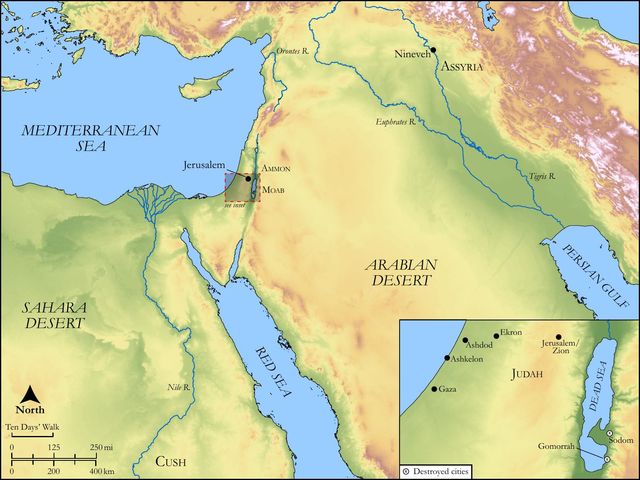
See on the biblical-era map
Study this verse
Public-domain commentary
Matthew Henry
From his Commentary on the Whole Bible. Henry comments on passages, not single verses — this entry covers Zephaniah 1:14–18. His two-level outline is real structure in the source text, so it is rendered as structure.
Nothing could be expressed with more spirit and life, nor in words more proper to startle and awaken a secure and careless people, than the warning here given to Judah and Jerusalem of the approaching destruction by the Chaldeans. That is enough to make the sinners in Zion tremble - that it is the day of the Lord, the day in which he will manifest himself by taking vengeance on them. It is the great day of the Lord, a specimen of the day of judgment, a kind of doom's-day, as the last destruction of Jerusalem by the Romans is represented to be in our Saviour's prediction concerning it, Mat 24:27.
I.This day of the Lord is here spoken of as very near.
The vision is not for a great while to come, as those imagine who put the evil day far from them. Those deceive themselves who look upon it as a thing at a distance, for it is near - it is near - it hastens greatly. The prophet gives the alarm like one that is in earnest, like one that awakens a family with the cry of Fire! fire! when it is at the next door that the danger is: "It is near! it is near! and therefore it is high time to bestir yourselves, and do what you can for your own safety before it be too late." It is madness for those to slumber whose damnation slumbers not, and to linger when it hastens.
II.It is spoken of as a very dreadful day.
The very voice of this day of the Lord, the noise of it, when it is coming, shall be so terrible as to make the mighty men cry there bitterly, cry for fear as children do. It shall be a vexation to hear the report of it. In the last great day of the Lord the mighty men shall cry bitterly to rocks and mountains to shelter them; but in vain. Observe how emphatically the prophet speaks of this day approaching (Zep 1:15): It is a day of wrath, God's wrath, wrath in perfection, wrath to the utmost. It will be a day of trouble and distress to the sinners; they shall be in pain, and shall see no ways of easing or helping themselves. The miseries of the damned are summed up (perhaps with reference to this) in the indignation and wrath of God, which are the cause, and the tribulation and anguish of the sinner's soul, which are the effect, Rom 2:8, Rom 2:9. It will be a day of trouble and distress to the inhabitants, and a day of wasteness and desolation to the whole land; that fruitful land shall be turned into a wilderness. It shall be a day of darkness and gloominess; every thing shall look dismal, and there shall not be the least gleam of comfort, or glimpse of hope; look round, and it is all black. It is a day of clouds and thick darkness; there is not only nothing encouraging, but every thing threatening; the thick clouds are big with storms and tempests.
III.It is spoken of as a destroying day, Zep 1:16, Zep 1:17. It shall be destroying,
1.To places, even the strongest and best fortified: A day of the trumpet and alarm against the fenced cities, to break into them, and against the high towers, to bring them down; for what forts, what fences, can hold out against the wrath of God?
2.To persons (Zep 1:17): "I will bring distress upon men, the strongest and stoutest of men; their hearts and hands shall fail them; they shall walk like blind men, wandering endlessly, because they have sinned against the Lord." Note, Those that walk as bad men will justly be left to walk as blind men, always in the dark, in doubt and danger, without any guide or comfort, and falling at length into the ditch. Because they have sinned against the Lord he will deliver them into the hands of cruel enemies, that shall pour out their blood as dust, so profusely, and with as little regret, and their flesh shall be thrown as dung upon the dunghill.
IV.The destruction of that day will be unavoidable and universal, Zep 1:18.
1.There shall be no escaping it by ransom: Neither their silver nor their gold, which they have hoarded up so covetously against the evil day, or which they have spent so prodigally to make friends for such a time, shall be able to deliver them in the day of the Lord's wrath. Another prophet borrowed these words from this, with reference to the same event, Eze 7:19. Note, Riches profit not in the day of wrath, Pro 11:4. Nay, riches expose to the wrath of men (Ecc 5:13.), and riches abused to the wrath of God.
2.There shall be no escaping it by flight or concealment; for the whole land shall be devoured by the fire of his jealousy, and where then can a hiding-place be found? See what the fire of God's jealousy is, and what the force of it; it will devour whole lands; how then can particular persons stand before it? He shall make riddance, a speedy riddance, of all those that dwell in the land, as the husbandman, when he rids his ground, cuts up all the briers and thorns for the fire. Note, Sometimes the judgments of God make riddance, even utter riddance, with sinful nations, a speedy riddance; their destruction is effected, is completed, in a little time. Let not sinners be laid asleep by the patience of God, for when the measure of their iniquity is full his justice will both overtake and overcome, will make quick work and thorough work.
Historical interpretation
Three Centuries of Reception
4 surviving comments on this verse. Each one is dated, so this reads as a timeline rather than a list.
Select a marker to jump to its quote. Markers stagger vertically where authors wrote within a few decades of each other.
But since these are light as perceived by the sense, which are said in Moses to have come into existence on the fourth day, they are not the true light because they enlighten the things on the earth. The Savior, on the other hand, is the light of the spiritual world because he shines on those who are rational and intellectual, that their mind may see its proper visions. Now I mean he is the light of those rational souls which are in the sensible world, of which the Savior teaches us that he is the Maker, being, perhaps its directing and principal part, and, so to speak, the sun of the great Day of the Lord.
The lust of possessions and money are not to be sought for. In Solomon, in Ecclesiastes: “He that loves silver shall not be satisfied with silver.” Also in Proverbs: “He who holds back the corn is cursed among the people; but blessing is on the head of him that communicates it.” Also in Isaiah: “Woe to them who join house to house, and lay field to field, that they may take away something from their neighbor. Will you dwell alone upon the earth?” Also, in Zephaniah: “They shall build houses, and shall not dwell in them; and they shall appoint vineyards, and shall not drink the wine of them, because the Day of the Lord is near.” Also in the Gospel according to Luke: “For what does it profit a man to make a gain of the whole world, but that he should lose himself?”
(Verse 13, 14.) And their strength shall be for plunder, and their houses for desolation. And they shall build houses, but not inhabit them; and they shall plant vineyards, but not drink their wine. The great day of the Lord is near, it is near and hastens quickly. LXX: And their strength shall be for robbery, and their houses shall be destroyed. And they shall build houses, but shall not live in them; and they shall plant vineyards, but shall not drink their wine, for the great day of the Lord is near; it is near and hastens quickly. It is evident that, according to both captivities, their entire army has been cut down and their houses have been destroyed, and the fields and vineyards have been laid waste: and no longer will God delay his patience towards them. But when they spoke to the prophets, they said, this will be in the time to come, and for many days, a great and exceedingly swift day of the Lord will come upon them. According to the interpretation, however, when the time of judgment comes, whether for the death of each individual or the departure from the world: then all their strength will be turned to ruin, so that what was once strong and lifted up against the Lord will become weak and broken, turned to something better. Just as if someone were to rob the strength of a bandit, a pirate, and a thief, and render them weak, their weakness benefits them: for their weakened limbs, which they were previously not using well, will cease from evil work. And that which follows: 'And their houses become a desert,' many in the Church are building Zion in blood, and Jerusalem in iniquity, to whom such houses being destroyed benefits. Let us read Leviticus, where it is commanded to destroy a leprous house (Lev. 14). And because leprosy remains and spreads, its stones and wood and all dust are commanded to be thrown outside the city into an unclean place. But also in the beginning of Jeremiah, something such is written, 'Behold, I have given my words in your mouth: behold, I have set you this day over the nations and over the kingdoms: to root out, and to pull down, and to destroy, and to build, and to plant' (Jeremiah 1:9-10). The wicked construction is destroyed so that later a good construction may be built: the unjust plantation is uprooted so that a righteous plantation may be placed nearby. And in Solomon we read: It is better to dwell under the open sky than in a disputed house with iniquity, and in a new house (Prov. 21:9). As if God, therefore, brought ruin upon the homes of those who were fixed in their own filth and said in their hearts: The Lord will not do good, nor will he do evil. He does not allow them to dwell in leprous and impure houses, nor does he allow them to drink wine from the vines they have planted. For if they had planted the vine of Sorek and the chosen vineyard, they would have drunk their wine and become intoxicated with the patriarch Noah and Joseph at noon (Gen. 9 and 43). But because they said: The Lord will not do good, nor will he do evil (Deut. 32:32-33), and their vineyard was the vineyard of Sodom, and their offspring was from Gomorrah, their grapes were grapes of gall, and their clusters were bitter, their wine was the fury of dragons and the incurable madness of asps (Jer. 9:23), therefore they planted vineyards and will not drink their wine. And mystically it is said of Sodom and Gomorrah, that all their plantation perished. For if they had remained in what they had begun, so as to be as it were the paradise of God, and had not ended in evil, so as to be as it were the land of Egypt, their plantation would certainly have remained. Such a thing and that sounds above the Egyptians in the Psalms: He destroyed their vineyards with hail, and their mulberry trees with frost. (Ps. LXXVII, 47). Indeed, as a most merciful God, He killed and overturned all the Egyptian plantation and little trees, which have blood-like fruits rooted in Egypt, so that those who planted evilly may not drink and eat from them. The day of the Lord is near and very swift, to which no one can resist: it is near either because of eternity, since nothing is long to it, or because of the magnitude of punishment, since to the one who endures, the punishment that is to be inflicted never seems far away. Whether near, as we have said, when we depart from the world, and the death of each person will bring about the end of the world; and not only near, but also very swift, as the speed of his coming is shown in the fact that it is added, very swift.
With reference to that day the prophet Amos says, “Woe to them that desire the Day of the Lord. To what end is this Day of the Lord for you? The day itself is darkness and not light.” The prophet Zephaniah says the same thing: “The voice of the Day of the Lord is grim and bitter.” That is why the penitent now introduced before us earnestly supplicates in the ordered divisions of his prayer that he may not be convicted for his deeds on that day of judgment. What is more beneficial and farsighted for the person who could have no hope in his own deserts because of the sins which he has committed than to decide to pray to God’s fatherly love while in this world, where there is opportunity for repentance?
Continue studying Zephaniah 1:14 across the web’s major study libraries — every link below opens this exact verse, chapter, or book on the destination site.
Read & Compare
 BibleGatewayThis verse in more than 200 translations and 70 languages.
 Bible.comThe YouVersion reader — hundreds of translations, reading plans, and highlights.
 ESV.orgCrossway's official English Standard Version reader.
 NET BibleThe NET translation with 60,000+ translators' notes on every rendering decision.
 STEP BibleTyndale House's free study tool — original text, vocabulary, and scholarly resources.
 BibliaLogos Bible Software's free web reader.
 USCCBThe New American Bible (Revised Edition) with the U.S. bishops' study notes.
Commentaries
 BibleHub CommentariesDozens of classic commentaries on this verse, gathered on one page.
 StudyLightMore than 100 commentary sets — the largest collection on the web.
 BibleRefPlain-English commentary on what this verse means, verse by verse.
 Enduring WordDavid Guzik's free commentary on this chapter, widely used by Bible teachers.
 Bible Study ToolsVerse commentary alongside Greek and Hebrew study aids.
Original Language & Research
- BibleHub InterlinearThe verse word by word — original language, transliteration, and English.
- BibleHub LexiconEvery word's original-language definition and Strong's entry.
 Blue Letter BibleDeep-study tools — Strong's numbers, concordance, and word studies.
 SefariaThe Hebrew text with Rashi and centuries of Jewish commentary.
Sermons, Hymns & Audio


TrulyRandomVerse is not affiliated with these sites and doesn’t control their content. They’re linked because they’re genuinely useful.
Summary
Zephaniah 1:14 issues a dire and urgent prophecy concerning the impending "Day of the LORD," portraying it as a moment of swift and overwhelming divine judgment. The verse emphasizes the rapid approach of this day, marked by a terrifying divine voice and universal distress, where even the most powerful and valiant individuals will be rendered helpless, crying out in bitter despair. It serves as a stark warning of the inescapable consequences for a nation steeped in sin.
Context
ShowHideLiterary Context
Zephaniah 1:14 stands as a pivotal declaration within the prophet's opening oracle of judgment against Judah and Jerusalem. The preceding verses (Zephaniah 1:2-13) systematically detail the comprehensive nature of this impending judgment, describing how God will "utterly consume all things from off the land" (Zephaniah 1:2), targeting idolaters, those who turn away from the Lord, and those who do not seek Him. Specific groups, including the princes, the king's children, and merchants, are singled out for their wickedness, emphasizing that no one will escape the divine wrath. Verse 14 intensifies this message by highlighting the immediate and inescapable nature of this "Day of the LORD," setting the stage for the vivid descriptions of its devastation that follow in Zephaniah 1:15-18. This verse acts as a dramatic crescendo, amplifying the urgency and severity of the judgment already introduced.
Historical & Cultural Context
Zephaniah prophesied during the early reign of King Josiah (c. 640-609 BC), likely before his significant religious reforms (2 Kings 22-23). At this time, Judah was still deeply entrenched in the idolatry and syncretistic practices inherited from the reigns of Manasseh and Amon. Foreign cults, Baal worship, and astral worship were rampant, even within the temple precincts (Zephaniah 1:4-5). Furthermore, oppression and spiritual apathy were widespread. The "Day of the LORD" in this context primarily refers to the impending invasion by a foreign power, most likely the Babylonians, who would serve as God's instrument of judgment against Judah's unfaithfulness. The cultural understanding of a "mighty man" (Hebrew: gibbôwr) would have evoked images of a formidable warrior, a champion, or a powerful leader, making their bitter crying a particularly shocking and impactful image of complete societal collapse and the failure of human strength.
Key Themes
ShowHideThe central theme in Zephaniah 1:14 is the imminent and inescapable "Day of the LORD." This phrase, Yom Yahweh, is a recurring prophetic motif signifying a time when God decisively intervenes in human history to execute judgment upon His enemies and bring about His righteous will. In Zephaniah, it is overwhelmingly depicted as a day of wrath, destruction, and darkness for the wicked, a time when divine indignation is poured out without restraint, as also seen in Amos's warning against desiring this day. Another key theme is universal distress and the futility of human strength in the face of divine judgment. The mention of the "mighty man" crying bitterly underscores that no one, regardless of their status, power, or presumed invincibility, will be exempt from the consequences of this judgment. Their usual sources of confidence and security will utterly fail them, leading to profound sorrow and lamentation, a theme also echoed in Jeremiah's prophecies of national mourning. Finally, the "voice of the day of the LORD" highlights the divine agency and terrifying authority behind this judgment, suggesting a direct, audible manifestation of God's wrath, perhaps through the sounds of war and destruction.
Exposition and Analysis
ShowHideKey Word Analysis
ShowHideThis adjective signifies something large, mighty, or important in any sense. When applied to the "Day of the LORD," it conveys the immense scale, significance, and overwhelming power of this coming judgment, distinguishing it as a momentous and unparalleled event.
While literally meaning a 24-hour period, in prophetic contexts like this, "day" often denotes a specific, defined period of time characterized by particular events or divine intervention. Here, it refers to a decisive era of God's judgment, not necessarily a single literal day, but a concentrated period of divine action.
This is the covenant name of God, Yahweh, emphasizing His self-existent, eternal, and personal nature. The "Day of the LORD" is thus not a random event but a deliberate, sovereign act initiated and executed by the one true God, underscoring His ultimate authority and righteousness.
This term refers to a powerful, valiant warrior, a champion, or a strong leader. Its inclusion here is highly significant, emphasizing that even those considered formidable and invincible in human terms will be utterly helpless and overwhelmed by the judgment, highlighting the absolute supremacy of God's power.
This adverb describes the intense, painful, and sorrowful nature of the crying. It denotes a profound and agonizing grief, indicating that the "mighty man's" lamentation will be born of deep anguish, despair, and the crushing realization of their utter defeat and loss.
Verse Breakdown
ShowHide"The great day of the LORD is near, it is near, and hasteth greatly"
This opening clause delivers a powerful, emphatic declaration of the judgment's imminence. The repetition of "is near" (Hebrew: qârôwb) creates a sense of urgency and inevitability, signaling that the time for repentance is short, if not past. The phrase "hasteth greatly" (Hebrew: mahêr mᵉʼôd) further intensifies this, suggesting a rapid, unstoppable approach, leaving no room for delay, escape, or mitigation. This emphasizes God's sovereign timing and the swiftness of His justice.
"even the voice of the day of the LORD"
This phrase personifies the "Day of the LORD" by attributing a "voice" to it. This "voice" is not merely a sound but an authoritative, terrifying manifestation of God's presence and judgment. It could refer to the clamor of war, the sound of destruction, or a direct divine pronouncement of doom, signifying the overwhelming and undeniable presence of God's wrath. It suggests a judgment that is both seen and heard, leaving no doubt about its divine origin.
"the mighty man shall cry there bitterly"
This concluding clause vividly portrays the devastating impact of the "Day of the LORD." Even the "mighty man" (Hebrew: gibbôwr), representing the strongest, most valiant, or most influential individuals, will be utterly broken. Their usual sources of strength, confidence, and security will fail them completely. Their "bitter" crying (Hebrew: mar) signifies a profound, agonizing lamentation born of despair, helplessness, and the crushing realization of their irreversible fate. This highlights the universal and inescapable nature of God's judgment, affecting all, regardless of their earthly power.
Literary Devices
ShowHideZephaniah 1:14 employs several potent literary devices to convey its urgent and terrifying message. Repetition is prominently used with "is near, it is near," which creates a sense of immediate urgency and emphasizes the inevitability of the impending judgment. This serves to impress upon the audience the critical nature of the moment. Personification is evident in "the voice of the day of the LORD," where an abstract concept ("the day") is given a human attribute ("voice"), making the judgment seem active, audible, and imposing. This amplifies the terror and divine authority associated with the coming day. Hyperbole is suggested by "the mighty man shall cry there bitterly," implying that the judgment will be so overwhelming that even the most powerful and resilient individuals will be reduced to utter despair and lamentation, underscoring the absolute futility of human strength against divine wrath. The phrase "hasteth greatly" also functions as intensification, stressing the rapid and unstoppable progression of this divine intervention.
Theological and Thematic Connections
ShowHideZephaniah 1:14 powerfully articulates the Old Testament concept of the "Day of the LORD," a recurring theological motif that signifies a decisive intervention by God in human history to execute judgment and establish His righteous rule. While often referring to specific historical events like the Babylonian invasion for Judah, it also carries eschatological weight, pointing to a future, ultimate day of reckoning for all humanity. This verse underscores God's absolute sovereignty, His intolerance for sin, and the certainty of divine justice, reminding us that His patience is not infinite. It challenges any human presumption of security based on strength, wealth, or status, affirming that all will ultimately stand before the Lord.
Reflection and Application
ShowHideZephaniah 1:14 serves as a timeless and sobering reminder of God's holiness and His unwavering commitment to justice. For us today, it calls for a profound seriousness about sin and a rejection of complacency. The "Day of the LORD," whether understood as a personal reckoning at death, a historical moment of divine intervention, or the ultimate eschatological judgment, is an inescapable reality. This verse challenges us to examine our lives: are we living in a way that reflects an awareness of God's ultimate authority? Are we relying on our own strength, status, or worldly possessions for security, or are we seeking refuge and salvation in the Lord? It compels us to cultivate spiritual vigilance and a readiness to meet our Creator, urging us to repent, turn from idolatry in all its forms (including the worship of self or material things), and live faithfully in light of His coming.
Questions for Reflection
ShowHideFAQ
ShowHideWhat is the "Day of the LORD" in Zephaniah?
ShowHideIn Zephaniah, the "Day of the LORD" primarily refers to God's impending judgment on Judah and Jerusalem, which would be carried out through the Babylonian invasion and subsequent exile. It is depicted as a specific, historical event (though also carrying broader eschatological implications) where God decisively intervenes to punish the nation for its idolatry, injustice, and spiritual apathy. It is a day of wrath, destruction, and darkness for the wicked, as described vividly in Zephaniah 1:15-18.
Why does Zephaniah emphasize the "mighty man" crying bitterly?
ShowHideThe emphasis on the "mighty man" (Hebrew: gibbôwr, a strong warrior or leader) crying bitterly highlights the universal and inescapable nature of God's judgment. It underscores that no one, regardless of their earthly power, strength, or status, will be able to withstand or escape the divine wrath. Their usual sources of confidence and security will prove utterly useless, leading to profound despair and lamentation. This serves to magnify the overwhelming power of God's judgment and the futility of human resistance against Him, echoing similar sentiments found in Revelation 6:15-17 concerning the final judgment.
Christ-Centered Fulfillment
ShowHideWhile Zephaniah 1:14 vividly portrays a day of judgment and wrath, its ultimate fulfillment and resolution are found in Jesus Christ. The "Day of the LORD" that Zephaniah prophesied pointed to God's righteous judgment against sin, a judgment that ultimately fell upon Christ on the cross. He became the Lamb of God, who takes away the sin of the world (John 1:29), bearing the full weight of divine wrath so that those who believe in Him might be spared. For believers, the "Day of the LORD" is no longer a day of dread but a day of salvation and vindication, because Christ has already endured the bitter crying and the ultimate separation from God on their behalf (Matthew 27:46). The swiftness and certainty of the "Day of the LORD" now point to Christ's promised return, which will be equally sudden and decisive (Matthew 24:36-44), bringing final judgment for the unrepentant and eternal salvation for His redeemed. Thus, Zephaniah's warning compels us to seek refuge in Christ, who is our only hope and deliverance from the wrath to come (1 Thessalonians 1:10).