


1 Thessalonians 4:16
Bible text: King James Version (1769 Blayney text) · Public domain
Bible text: King James Version with Strong's numbers · Public domain
Bible text: Berean Standard Bible · Public domain
Bible text: American Standard Version (1901) · Public domain
Bible text: World English Bible, Messianic edition · Public domain
Bible text: Geneva Bible (1599) · Public domain
Bible text: Young's Literal Translation · Public domain
- ὅτιhotibecauseG3754CONJConjunction
- αὐτὸςautosHimselfG846P-NSMPersonal pronoun Nominative Singular Masculine
- ὁhotheG3588T-NSMDefinite article Nominative Singular Masculine
- κύριοςkuriosLordG2962N-NSM-TNoun Nominative Singular Masculine Title
- ἐνenwithG1722PREPPreposition
- κελεύσματιkeleusmatia loud commandG2752N-DSNNoun Dative Singular Neuter
- ἐνenwithG1722PREPPreposition
- φωνῇphōnēa[the] voiceG5456N-DSFNoun Dative Singular Feminine
- ἀρχαγγέλουarchangelouof an archangelG743N-GSMNoun Genitive Singular Masculine
- καὶkaiandG2532CONJConjunction
- ἐνenwithG1722PREPPreposition
- σάλπιγγιsalpingi[the] trumpetG4536N-DSFNoun Dative Singular Feminine
- θεοῦtheouof GodG2316N-GSM-TNoun Genitive Singular Masculine Title
- καταβήσεταιkatabēsetaiwill descendG2597V-FDI-3SVerb Future Middle Deponent Indicative 3rd Singular
- ἀπ᾽ap᾽fromG575PREPPreposition
- οὐρανοῦouranouheavenG3772N-GSMNoun Genitive Singular Masculine
- καὶkaiandG2532CONJConjunction
- οἱhoitheG3588T-NPMDefinite article Nominative Plural Masculine
- νεκροὶnekroideadG3498A-NPMAdjective Nominative Plural Masculine
- ἐνeninG1722PREPPreposition
- ΧριστῷChristōChristG5547N-DSM-TNoun Dative Singular Masculine Title
- ἀναστήσονταιanastēsontaiwill riseG450V-FMI-3PVerb Future Middle Indicative 3rd Plural
- πρῶτονprōtonfirstG4413A-ASNAdjective Accusative Singular Neuter
English is a literal word-by-word gloss of the Greek, not the KJV's wording. Why?
This is the original text the KJV's translators worked from — each Greek word with its own literal English meaning in this verse, prepared by scholars at Tyndale House, Cambridge. The KJV translates whole sentences, not word by word, so its wording differs: one Greek word can become several English words, and the KJV may choose “charity” where the gloss reads “love”. Both are faithful — they answer different questions. For the KJV's own rendering, switch to the KJV text.
Details
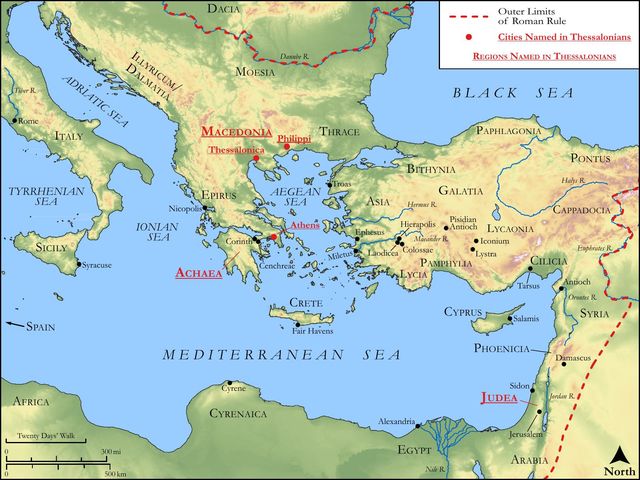
See on the biblical-era maps

Study this verse
Public-domain commentary
Matthew Henry
From his Commentary on the Whole Bible. Henry comments on passages, not single verses — this entry covers 1 Thessalonians 4:13–18. His three-level outline is real structure in the source text, so it is rendered as structure.
In these words the apostle comforts the Thessalonians who mourned for the death of their relations and friends that died in the Lord. His design is to dissuade them from excessive grief, or inordinate sorrow, on that account. All grief for the death of friends is far from being unlawful; we may weep at least for ourselves if we do not weep for them, weep for own loss, though it may be their fain. Yet we must not be immoderate in our sorrows, because,
I.This looks as if we had no hope, Th1 4:13.
It is to act too much like the Gentiles, who had no hope of a better life after this; whereas we Christians, who have a most sure hope, the hope of eternal life after this, which God who cannot lie hath promised us, should moderate all our joys and our sorrows on account of any worldly thing. This hope is more than enough to balance all our griefs upon account of any of the crosses of the present time.
II.This is an effect of ignorance concerning those who are dead, Th1 4:13.
There are some things which we cannot be ignorant of concerning those that are asleep; for the land they are removed to is a land of darkness, which we know but little of and have no correspondence with. To go among the dead is to go among we know not whom, and to live we know not how. Death is an unknown thing, and the state of the dead, or the state after death, we are much in the dark about; yet there are some things concerning those especially who die in the Lord that we need not, and ought not, to be ignorant of; and, if these things be really understood and duly considered, they will be sufficient to allay our sorrow concerning them.
1.They sleep in Jesus. They are asleep, Th1 4:13. They have fallen asleep in Christ, Co1 15:18. Death does not annihilate them. It is but a sleep to them. It is their rest, and undisturbed rest. They have retired out of this troublesome world, to rest from all their labours and sorrows, and they sleep in Jesus, Th1 4:14. Being still in union with him, they sleep in his arms and are under his special care and protection. Their souls are in his presence, and their dust is under his care and power; so that they are not lost, nor are they losers, but great gainers by death, and their removal out of this world is into a better.
2.They shall be raised up from the dead, and awakened out of their sleep, for God will bring them with him, Th1 4:14. They then are with God, and are better where they are than when they were here; and when God comes he will bring them with him. The doctrine of the resurrection and the second coming of Christ is a great antidote against the fear of death and inordinate sorrow for the death of our Christian friends; and this doctrine we have a full assurance of, because we believe that Jesus died and rose again, Th1 4:14. It is taken for granted that as Christians they knew and believed this. The death and resurrection of Christ are fundamental articles of the Christian religion, and give us hope of a joyful resurrection; for Christ, having risen from the dead, has become the first fruits of those that slept; and therefore those who have fallen asleep in him have not perished nor are lost, Co1 15:18, Co1 15:20. His resurrection is a full confirmation of all that is said in the gospel, or by the word of the Lord, which has brought life and immortality to light.
3.Their state and condition shall be glorious and happy at the second coming of Christ. This the apostle informs the Thessalonians of by the word of the Lord (Th1 4:15), by divine revelation from the Lord Jesus; for though the resurrection of the dead, and a future state of blessedness, were part of the creed of the Old Testament saints, yet they are much more clearly revealed in and by the gospel. By this word of the Lord we know,
(1.)That the Lord Jesus will come down from heaven in all the pomp and power of the upper world (Th1 4:16): The Lord himself shall descend from heaven with a shout. He ascended into heaven after his resurrection, and passed through these material heavens into the third heaven, which must retain him till the restitution of all things; and then he will come again, and appear in his glory. He will descend from heaven into this our air, Th1 4:17. The appearance will be with pomp and power, with a shout - the shout of a king, and the power and authority of a mighty king and conqueror, with the voice of the archangel; an innumerable company of angels will attend him. Perhaps one, as general of those hosts of the Lord, will give notice of his approach, and the glorious appearance of this great Redeemer and Judge will be proclaimed and ushered in by the trump of God. For the trumpet shall sound, and this will awaken those that sleep in the dust of the earth, and will summon all the world to appear. For,
(2.)The dead shall be raised: The dead in Christ shall rise first (Th1 4:16), before those who are found alive at Christ's coming shall be changed; and so it appears that those who shall then be found alive shall not prevent those that are asleep, Th1 4:15. The first care of the Redeemer in that day will be about his dead saints; he will raise them before the great change passes on those that shall be found alive: so that those who did not sleep in death will have no greater privilege or joy at that day than those who fell asleep in Jesus.
(3.)Those that shall be found alive will then be changed. They shall be caught up together with them in the clouds, to meet the Lord in the air, Th1 4:17. At, or immediately before, this rapture into the clouds, those who are alive will undergo a mighty change, which will be equivalent to dying. This change is so mysterious that we cannot comprehend it: we know little or nothing of it, Co1 15:51. Only, in the general, this mortal must put on immortality, and these bodies will be made fit to inherit the kingdom of God, which flesh and blood in its present state are not capable of. This change will be in a moment, in the twinkling of an eye (Co1 15:52), in the very instant, or not long after the raising up of those that sleep in Jesus. And those who are raised, and thus changed, shall meet together in the clouds, and there meet with their Lord, to congratulate him on his coming, to receive the crown of glory he will then bestow upon them, and to be assessors with him in judgment, approving and applauding the sentence he will then pass upon the prince of the power of the air, and all the wicked, who shall be doomed to destruction with the devil and his angels.
(4.)Here is the bliss of the saints at that day: they shall be ever with the Lord, Th1 4:17. It will be some part of their felicity that all the saints shall meet together, and remain together for ever; but the principal happiness of heaven is this, to be with the Lord, to see him, live with him, and enjoy him, for ever. This should comfort the saints upon the death of their friends, that, although death has made a separation, yet their souls and bodies will meet again; we and they shall meet together again: we and they shall meet together again: we and they with all the saints shall meet our Lord, and be with him for ever, no more to be separated wither from him or from one another for ever. And the apostle would have us comfort one another with these words, Th1 4:18. We should endeavour to support one another in times of sorrow, not deaden one another's spirits, nor weaken one another's hands, but should comfort one another; and this may be done by serious consideration and discourse on the many good lessons to be learned from the doctrine of the resurrection of the dead, the second coming of Christ, and the glory of the saints in that day.
Historical interpretation
Five Centuries of Reception
16 surviving comments on this verse. Each one is dated, so this reads as a timeline rather than a list.
Select a marker to jump to its quote. Markers stagger vertically where authors wrote within a few decades of each other.
But he says (elsewhere), "We shall be caught up together with them in the clouds, to meet the Lord (in the air)." Then, if we are to be caught up alone with them, surely we shall likewise be changed together with them.
Well, then, what difference is there between heathens and Christians, if the same prison awaits them all when dead? How, indeed, shall the soul mount up to heaven, where Christ is already sitting at the Father's right hand, when as yet the archangel's trumpet has not been heard by the command of God, -when as yet those whom the coming of the Lord is to find on the earth, have not been caught up into the air to meet Him at His coming, in company with the dead in Christ, who shall be the first to arise? To no one is heaven opened; the earth is still safe for him, I would not say it is shut against him.
Under the arms of prayer guard we the standard of our General; await we in prayer the angel's trump. The angels, likewise, all pray; every creature prays; cattle and wild beasts pray and bend their knees; and when they issue from their layers and lairs, they look up heavenward with no idle mouth, making their breath vibrate after their own manner.
For at that time the trumpet shall sound,
We think that those who have been perfected and who no longer commit sin are alive in Christ. The dead in Christ are those who are favorably disposed to the Christian faith and who prefer to live a good life but who have not, in fact, actually succeeded, but still sin, either in ignorance of the accurate true word of justice or in weakness, because their decisions are overcome by the flesh, which lusts against the spirit. And it is in conformity with these matters that Paul, conscious of himself, says, because he has already succeeded, “We who are alive.” But those whom we spoke of as dead have special need of the resurrection, since not even those who are alive can be taken up in the clouds to meet the Lord in the air before the dead in Christ first rise. This is why it has been written, “The dead in Christ shall rise first, then we who are alive,” etc.
"Behold the bridegroom cometh, go ye out to meet him "is the voice which shall be heard from heaven, and the trumpet, when the saints, all their bodies being raised, shall be caught up, and shall go on the clouds to meet the Lord.
says, that after the cry all the virgins arose, that is, that the dead shall be raised after the voice which comes from heaven, as also Paul intimates,
And afterwards shall be the voice of a trumpet by the archangel;
I believe the words of the wise, that every fair and God-beloved soul, when, set free from the bonds of the body, it departs hence, at once enjoys a sense and perception of the blessings which await it. This happens to the extent that whatever darkened that soul has been purged away, or laid aside—this is the only way I can express it—such that it feels a marvelous pleasure and exultation and goes rejoicing to meet its Lord. This soul has escaped, as it were, the grievous poison of life here and has shaken off the fetters which bound it and held down the wings of the mind. And so the soul enters upon the bliss laid up for it, a bliss of which it has even now some conception.… Why, then, be faint-hearted in my hopes? Why behave like a mere creature of the day? I await the voice of the archangel, the last trumpet, the transformation of the heavens, the transfiguration of the earth, the liberation of the elements, the renovation of the universe. Then shall I see Caesarius for myself, no longer in exile, no longer laid upon a bier, no longer the object of mourning and pity, but brilliant, glorious, heavenly, such as in my dreams I have often beheld you, dearest and most loving of brothers, pictured thus by my desire, if not by the truth itself. ON HIS BROTHER ST.
For truly death was no necessary part of the divine operation, since for those who were placed in paradise a continual succession of all good things streamed forth. Because of transgression, however, human life, condemned to lengthened labor, began to be wretched with intolerable groaning. Thus, it was fitting that an end should be set to the evils and that death should restore what life had lost. For immortality, unless grace breathed upon it, would be rather a burden than an advantage. And if one consider accurately, it is not the death of our being but of evil, for being continues, but it is evil that perishes.… So we shall either pay the penalty of our sins or attain to the reward of our good deeds. For the same being will rise again, now more honorably for having paid the tax of death. And then “the dead who are in Christ shall rise first. Then we who are alive will follow,” it is said, “and together with them be caught up in the clouds into the air to meet the Lord, and so we shall always be with the Lord.”
Shall we, then, think of festival days in terms of eating and drinking? On the contrary, let no one call us to account in respect to eating, “For we know that the law is spiritual.”“Let no one, therefore, call you to account for what you eat or drink in regard to a festival or a new moon or a sabbath. These are a shadow of things to come, but the body is of Christ.” So let us seek the body of Christ which is the voice of the Father from heaven, the last trumpet, as it were, showed to you on that occasion when the Jews said that it thundered for him. Let us seek, I repeat, the body of Christ which the last trumpet will reveal to us, “For the Lord himself with cry of command, with voice of archangel, and with trumpet of God will descend from heaven, and the dead in Christ will rise up first.”
"For the Lord Himself shall descend from heaven, with a shout, with the voice of the Archangel, and with the trump of God: and the dead in Christ shall rise first: then we that are alive, that are left, shall together with them be caught up in the clouds, to meet the Lord in the air: and so shall we ever be with the Lord."
But wherefore with the trumpet? For we see this on Mount Sinai too, and Angels there also. But what means the voice of the Archangel? As he said in the parable of the Virgins, Arise! "The Bridegroom cometh." (From Matt. xxv. 6) Either it means this, or that as in the case of a king, so also shall it then be, Angels ministering at the Resurrection. For He says, let the dead rise, and the work is done, the Angels not having power to do this, but His word. As if upon a king's commanding and saying it, those who were shut up should go forth, and the servants should lead them out, yet they do this not from their own power, but from that Voice. This also Christ says in another place: "He shall send forth his Angels with a great trumpet, and they shall gather together his Elect from the four winds, from one end of heaven to the other." (Matt. xxiv. 31) And everywhere you see the Angels running to and fro. The Archangel therefore I think is he, who is set over those who are sent forth, and who shouts thus: "Make all men ready, for the Judge is at hand." And what is "at the last trumpet"? Here he implies that there are many trumpets, and that at the last the Judge descends.
If He is about to descend, on what account shall we be caught up? For the sake of honor. For when a king drives into a city, those who are in honor go out to meet him; but the condemned await the judge within. And upon the coming of an affectionate father, his children indeed, and those who are worthy to be his children, are taken out in a chariot, that they may see and kiss him; but those of the domestics who have offended remain within. We are carried upon the chariot of our Father. For He received Him up in the clouds, and "we shall be caught up in the clouds." (Acts i. 9) Seest thou how great is the honor? and as He descends, we go forth to meet Him, and, what is more blessed than all, so we shall be with Him.
But as to the saying, that they are gathered together; they arise indeed everywhere, but are gathered together by the Angels. The former therefore is the work of the power of God commanding the earth to give up its deposit, and there is no one who ministers in it, as He then called Lazarus, "Lazarus, come forth" (John xi. 43); but the gathering is the work of ministers. But if Angels gather them together, and run to and fro, how are they caught up here? They are caught up after the descent, after that they are gathered together.
When at the awful trumpet’s sound
The earth will be consumed by fire,
And with a mighty rush the world
Unhinged, will crash in dreadful ruin.
Then at the sound of the trumpet the earth and its peoples shall tremble, but you shall rejoice. The world shall howl at the Lord who comes to judge it, and the tribes of the earth shall smite the breast. Once mighty kings shall tremble in their nakedness. Venus shall be exposed, and her son, too. Jupiter with his fiery bolts will be brought to trial. Plato, with his disciples, will be but a fool. Aristotle’s arguments shall be of no avail. You may seem a poor man and country-bred, but then you shall exult and laugh, and say, Behold my crucified Lord, behold my judge.
You ask how that which is written in the first Epistle to the Thessalonians should be understood: For this we say unto you by the word of the Lord, that we who are alive and remain unto the coming of the Lord shall not prevent them who are asleep. For the Lord himself shall descend from heaven with a shout, with the voice of the archangel, and with the trump of God: and the dead in Christ shall rise first: Then we who are alive and remain shall be caught up together with them in the clouds, to meet the Lord in the air: and so shall we ever be with the Lord. However, it must be said what seems to others, namely to Theodore, Apollinarius, and Diodorus, who follow one opinion: of whom Diodorus wrote this. "Paul the Apostle calls them remaining and living; not that it is intended to be understood that he and others will be found in the body at the time of the resurrection, but he said of what is, the just; of whom I am also counted. For they themselves will run to meet Christ, and not sinners. But by the figure of speech, we accept living saints, who have not died because of sin but all whom Christ finds coming in the body. And what follows: We should not refer 'we shall not precede those who have fallen asleep' to the sinners at all. For sinners will not be caught up with the just to meet Christ, but those whom death dissolves." But why do I seek such things, and make false accusations against the Apostles' words, when he himself clearly writes: who will remain at the coming of the Lord? And who the remaining ones are, we learn from the words of the Savior: As in the days of Noah they led wives and husbands, and they married; and suddenly the flood came, and took them all away: so it will be at the coming of the Son of Man (Matt. 24; and Luke 17). With these words it is approved, that at the end of the world many will be alive and still found in their bodies. Following this: At the command and voice of the Archangel, the dead shall rise first. And once again the Savior speaks of this in the Gospel: But at midnight there was a cry, 'Look, the bridegroom! Come out to meet him!' (Matt. 25:6); for he will certainly catch those who are living in their bodies when two are in one bed: one will be taken and the other will be left behind: and two women grinding together, one will be taken and the other will be left behind (Luke 17). From these words it is shown that at midnight, when all is calm, the end of the world will come.
"The hour cometh," saith He. Doubtless thou, imbued with a faith of the resurrection of the flesh, didst look for the hour of the end of the world, which, that thou shouldst not look for here, He added, "and now is." Therefore He saith not this, "The hour cometh," of that last hour, when "at the command and the voice of the archangel and the trump of God, the Lord Himself shall descend from heaven, and the dead in Christ shall rise first; then we who are alive and remain shall be caught up together with them in the clouds, to meet Christ in the air: and so shall we be ever with the Lord." That hour will come, but is not now. But consider what this hour is: "The hour cometh, and now is." What happens in that hour? What, but a resurrection of the dead? And what kind of resurrection? Such that they who rise live for ever. This will be also in the last hour.
Then after long seasons, Christ our God shall come to judge the world in awful glory, beyond words to tell. For fear of him the powers of heaven shall be shaken, and all the angel hosts shall stand beside him in dread. Then at the voice of the archangel, and at the trump of God, shall the dead arise and stand before his awful throne. Now the resurrection is the reuniting of soul and body. So that very body, which decays and perishes, shall arise incorruptible. And concerning this, take care not to be overwhelmed by unbelief, for it is not impossible for him, who at the beginning formed the body out of earth, when according to its maker’s judgment it had returned to earth whence it was taken, to raise the same again.
Continue studying 1 Thessalonians 4:16 across the web’s major study libraries — every link below opens this exact verse, chapter, or book on the destination site.
Read & Compare
 BibleGatewayThis verse in more than 200 translations and 70 languages.
 Bible.comThe YouVersion reader — hundreds of translations, reading plans, and highlights.
 ESV.orgCrossway's official English Standard Version reader.
 NET BibleThe NET translation with 60,000+ translators' notes on every rendering decision.
 STEP BibleTyndale House's free study tool — original text, vocabulary, and scholarly resources.
 BibliaLogos Bible Software's free web reader.
 USCCBThe New American Bible (Revised Edition) with the U.S. bishops' study notes.
Commentaries
 BibleHub CommentariesDozens of classic commentaries on this verse, gathered on one page.
 StudyLightMore than 100 commentary sets — the largest collection on the web.
 BibleRefPlain-English commentary on what this verse means, verse by verse.
 Enduring WordDavid Guzik's free commentary on this chapter, widely used by Bible teachers.
 Bible Study ToolsVerse commentary alongside Greek and Hebrew study aids.
Original Language & Research
- BibleHub InterlinearThe verse word by word — original language, transliteration, and English.
- BibleHub LexiconEvery word's original-language definition and Strong's entry.
 Blue Letter BibleDeep-study tools — Strong's numbers, concordance, and word studies.
 CNTR CollationThe earliest Greek manuscripts of this verse, collated letter by letter.
Sermons, Hymns & Audio


TrulyRandomVerse is not affiliated with these sites and doesn’t control their content. They’re linked because they’re genuinely useful.
Summary
First Thessalonians 4:16 offers a profound glimpse into the climactic event of Christ's return, specifically detailing the Lord's descent from heaven with powerful, authoritative declarations—a shout, the voice of an archangel, and the trump of God—culminating in the resurrection of deceased believers, who will be the first to rise. This verse serves as a cornerstone of Christian eschatology, providing comfort and assurance regarding the destiny of those who have died in faith.
Context
ShowHideLiterary Context
This verse is central to Paul's teaching on the eschatological hope in 1 Thessalonians 4:13-18. The Thessalonian believers were distressed, fearing that their loved ones who had died before Christ's return would miss out on the glorious future. Paul addresses this grief and misunderstanding directly, assuring them that death does not negate their participation in Christ's coming. He explains the sequence of events at the Parousia (Christ's second coming), emphasizing that the dead in Christ will be resurrected first, followed by living believers, all to be united with the Lord forever. This passage is immediately preceded by Paul's exhortations on living a holy life, reflecting the ethical implications of their eschatological hope.
Historical & Cultural Context
The city of Thessalonica was a major Roman port city, bustling with commerce and diverse religious practices, including emperor worship. The early Christian community there, comprised of both Jews and Gentiles, faced persecution and misunderstanding. Their concern about deceased believers likely stemmed from a combination of natural human grief and perhaps a misunderstanding of Christian teaching on resurrection, possibly influenced by pagan views of death or Jewish apocalyptic expectations. Paul's letter, written relatively early in his ministry, aims to provide pastoral comfort and clear theological instruction, countering anxieties and solidifying their faith in the face of uncertainty and opposition. The imagery of a "shout," "voice of the archangel," and "trump of God" would resonate with both Jewish apocalyptic traditions (e.g., divine interventions, trumpet calls for assembly or judgment) and Roman imperial imagery (e.g., a general's command, a king's arrival heralded by trumpets), signifying a public, authoritative, and triumphant event.
Key Themes
ShowHideThe primary themes in 1 Thessalonians 4 and particularly in this passage include the Resurrection of the Dead, offering profound comfort and hope to grieving believers. It underscores the Personal and Visible Return of Christ (the Parousia), emphasizing that Jesus Himself will descend, not merely His Spirit or influence. This event is portrayed with Divine Authority and Power, marked by a commanding shout, an angelic voice, and a divine trumpet, signifying its cosmic significance and God's sovereign control over history. The passage also highlights the Assurance of Believers' Future Glory, guaranteeing that all who are "in Christ" will participate fully in His glorious return, providing a powerful antidote to fear and despair, as seen in Paul's concluding words in 1 Thessalonians 4:18.
Exposition and Analysis
ShowHideKey Word Analysis
ShowHideFrom a root denoting supremacy, this term signifies supreme authority, a controller, or Master. Here, it emphatically refers to Jesus Christ, emphasizing His divine sovereignty and the authoritative nature of His return. The phrase "the Lord himself" underscores the personal, undeniable, and direct involvement of Jesus in this climactic event, rather than a mere spiritual manifestation or a delegated act.
This word denotes a cry of incitement or a command, often used in military or nautical contexts, such as a boatswain's call or a general's command to his troops. In this context, it signifies a powerful, authoritative summons or signal that initiates the resurrection and rapture. It is not a mere sound but an intentional, commanding utterance from the Lord Himself, demonstrating His power over life and death.
Meaning "to stand up" or "to raise up," this verb describes the act of resurrection. It implies a physical restoration to life, not merely a spiritual ascent. The use of this word here confirms the bodily nature of the resurrection of the dead in Christ, aligning with the broader biblical teaching that believers will receive glorified physical bodies.
Verse Breakdown
ShowHide"For the Lord himself shall descend from heaven with a shout,"
This clause establishes the central agent and the manner of His return. "The Lord himself" (Jesus Christ) underscores the personal and direct nature of His second coming. He will "descend from heaven," indicating a visible, physical return from the divine realm. This descent is accompanied "with a shout," a powerful, authoritative command or signal, likely from Christ Himself, marking the commencement of this grand eschatological event.
"with the voice of the archangel,"
This phrase adds another layer of divine authority and cosmic significance to Christ's return. The "voice of the archangel" (a chief angel) suggests a powerful, perhaps trumpet-like, proclamation that heralds the Lord's arrival and the subsequent events. While the specific archangel is not named, it signifies a divinely orchestrated announcement of immense importance, echoing angelic roles in biblical history as messengers of God's will.
"and with the trump of God:"
This final auditory element further emphasizes the divine, public, and climactic nature of the event. The "trump of God" evokes Old Testament imagery of divine intervention, covenant renewal, assembly, and judgment (e.g., at Mount Sinai, for battle, or for the gathering of Israel). It signifies a divine summons, a call to attention for all creation, and the inauguration of God's final redemptive acts, signaling the end of the age and the beginning of eternal glory for believers.
"and the dead in Christ shall rise first:"
This is the crucial point of comfort and assurance for the Thessalonians. It clarifies the sequence of events, guaranteeing that believers who have died will not be disadvantaged but will experience resurrection before living believers are caught up. The phrase "in Christ" is vital, indicating that this resurrection is specifically for those who are spiritually united with Jesus through faith, highlighting the salvific nature of this hope.
Literary Devices
ShowHideThe language of 1 Thessalonians 4:16 is rich with Imagery and Symbolism, painting a vivid and dramatic picture of Christ's return. The auditory imagery of a "shout," the "voice of the archangel," and the "trump of God" creates a powerful sense of an undeniable, public, and divinely orchestrated event, appealing directly to the reader's imagination and sense of awe. These sounds are not merely descriptive but Symbolic of divine authority, military command, and royal proclamation, underscoring the sovereignty of Christ. The verse also employs Anticipation, building a sense of climactic expectation for the Lord's descent and the subsequent resurrection, providing comfort and hope by clearly outlining the future for believers. The precise sequencing ("rise first") offers structural clarity and pastoral reassurance.
Theological and Thematic Connections
ShowHideThis verse is foundational for understanding Christian eschatology, particularly the doctrine of the resurrection and the Parousia. It affirms the bodily resurrection of believers, a central tenet of Christian faith, and emphasizes the personal, visible return of Jesus Christ. The events described signify God's ultimate victory over death and sin, bringing to fruition the redemptive work initiated by Christ's first coming. The "trump of God" and the "shout" evoke Old Testament themes of divine assembly and judgment, linking the New Covenant's hope to God's consistent character and plan throughout history. This passage powerfully underscores the hope that death is not the end for those united with Christ, but a transition to a glorious future with Him.
Reflection and Application
ShowHide1 Thessalonians 4:16 offers profound comfort and a clear vision of the future for believers, transforming our perspective on death and loss. It assures us that those who have died "in Christ" are not lost forever but are awaiting a glorious resurrection. This truth should alleviate our grief, replacing sorrow with a confident expectation of reunion with both our loved ones and the Lord Himself. Living with this hope should motivate us to live lives worthy of our calling, characterized by holiness, love, and earnest anticipation of Christ's return. It reminds us that our ultimate destiny is not in this transient world but in eternal fellowship with our resurrected Savior. This hope provides resilience in trials and a steadfast anchor for our souls, knowing that our future is secure in the hands of the returning Lord.
Questions for Reflection
ShowHideFAQ
ShowHideWho is the "archangel" mentioned in this verse?
ShowHideWhile the verse does not explicitly name the archangel, many biblical scholars believe it refers to Michael. Jude 1:9 mentions Michael as "the archangel," and Daniel 12:1 depicts him as a great prince who stands guard over God's people and will play a role in the resurrection at the end times. Regardless of the specific identity, the mention of an archangel's voice signifies a powerful, authoritative, and divinely commissioned proclamation accompanying Christ's return.
What is the significance of the "trump of God"?
ShowHideThe "trump of God" carries rich theological significance, drawing heavily on Old Testament imagery. In the Old Testament, trumpets often signaled divine presence (Exodus 19:16), called assemblies (Numbers 10:2), announced war or victory (Joshua 6:4-5), or heralded the Day of the Lord, a time of judgment and salvation. In the New Testament, the trumpet is associated with the resurrection and the final gathering of God's people (1 Corinthians 15:52; Matthew 24:31). Thus, the "trump of God" signifies a divine, authoritative, and climactic signal marking the culmination of God's redemptive plan and the resurrection of His people.
Christ-Centered Fulfillment
ShowHide1 Thessalonians 4:16 finds its ultimate Christ-centered fulfillment in the person and work of Jesus, who is not only the subject of this glorious return but also the very guarantee of its promise. His own resurrection from the dead, as described in passages like 1 Corinthians 15:20-23, serves as the "firstfruits" and the blueprint for the resurrection of all believers. Jesus, as the "Lord himself," is the one with the authority to descend from heaven, to utter the commanding "shout," and to orchestrate the "trump of God" that awakens the dead. He is the "resurrection and the life," as He declared in John 11:25, and it is "in Christ" that the dead shall rise, emphasizing that their hope and identity are inextricably linked to Him. This future event is not merely a historical occurrence but the final act of Christ's redemptive work, bringing His redeemed people into eternal fellowship with Himself, fulfilling the promise of John 14:3, "I will come again and receive you to Myself."