


1 Thessalonians 4:17
Bible text: King James Version (1769 Blayney text) · Public domain
Bible text: King James Version with Strong's numbers · Public domain
Bible text: Berean Standard Bible · Public domain
Bible text: American Standard Version (1901) · Public domain
Bible text: World English Bible, Messianic edition · Public domain
Bible text: Geneva Bible (1599) · Public domain
Bible text: Young's Literal Translation · Public domain
- ἔπειταepeitaThenG1899ADVAdverb
- ἡμεῖςhēmeiswe ourselvesG3165P-1NPPersonal pronoun Nominative 1st Plural
- οἱhoitheG3588T-NPMDefinite article Nominative Plural Masculine
- ζῶντεςzōnteslivingG2198V-PAP-NPMVerb Present Active Participle Nominative Plural Masculine
- οἱhoithoseG3588T-NPMDefinite article Nominative Plural Masculine
- περιλειπόμενοιperileipomenoiremainingG4035V-POP-NPMVerb Present Passive Deponent Participle Nominative Plural Masculine
- ἅμαhamatogetherG260ADVAdverb
- σὺνsunwithG4862PREPPreposition
- αὐτοῖςautoisthemG846P-DPMPersonal pronoun Dative Plural Masculine
- ἁρπαγησόμεθαharpagēsomethawe will be caught awayG726V-2FPI-1PVerb 2nd Future Passive Indicative 1st Plural
- ἐνeninG1722PREPPreposition
- νεφέλαιςnephelais[the] cloudsG3507N-DPFNoun Dative Plural Feminine
- εἰςeisforG1519PREPPreposition
- ἀπάντησινapantēsin[the] meetingG529N-ASFNoun Accusative Singular Feminine
- τοῦtouof theG3588T-GSMDefinite article Genitive Singular Masculine
- κυρίουkuriouLordG2962N-GSM-TNoun Genitive Singular Masculine Title
- εἰςeisinG1519PREPPreposition
- ἀέρα·aera[the] airG109N-ASMNoun Accusative Singular Masculine
- καὶkaiandG2532CONJConjunction
- οὕτωςhoutōssoG3779ADVAdverb
- πάντοτεpantotealwaysG3842ADVAdverb
- σὺνsunwithG4862PREPPreposition
- κυρίῳkuriō[the] LordG2962N-DSM-TNoun Dative Singular Masculine Title
- ἐσόμεθαesomethawe will beG1510V-FDI-1PVerb Future Middle Deponent Indicative 1st Plural
English is a literal word-by-word gloss of the Greek, not the KJV's wording. Why?
This is the original text the KJV's translators worked from — each Greek word with its own literal English meaning in this verse, prepared by scholars at Tyndale House, Cambridge. The KJV translates whole sentences, not word by word, so its wording differs: one Greek word can become several English words, and the KJV may choose “charity” where the gloss reads “love”. Both are faithful — they answer different questions. For the KJV's own rendering, switch to the KJV text.
Details
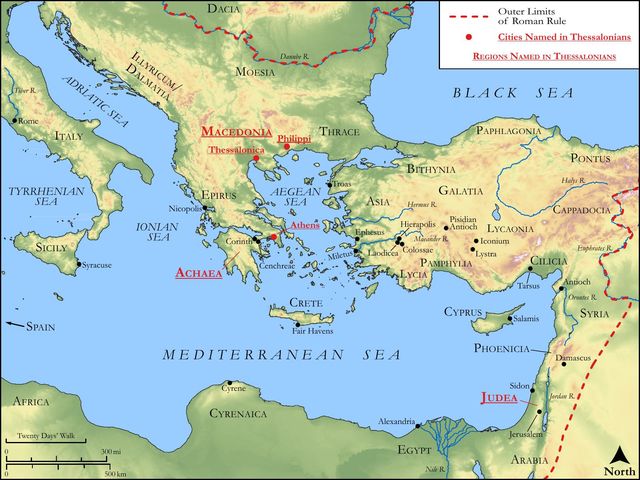
See on the biblical-era maps

Study this verse
Public-domain commentary
Matthew Henry
From his Commentary on the Whole Bible. Henry comments on passages, not single verses — this entry covers 1 Thessalonians 4:13–18. His three-level outline is real structure in the source text, so it is rendered as structure.
In these words the apostle comforts the Thessalonians who mourned for the death of their relations and friends that died in the Lord. His design is to dissuade them from excessive grief, or inordinate sorrow, on that account. All grief for the death of friends is far from being unlawful; we may weep at least for ourselves if we do not weep for them, weep for own loss, though it may be their fain. Yet we must not be immoderate in our sorrows, because,
I.This looks as if we had no hope, Th1 4:13.
It is to act too much like the Gentiles, who had no hope of a better life after this; whereas we Christians, who have a most sure hope, the hope of eternal life after this, which God who cannot lie hath promised us, should moderate all our joys and our sorrows on account of any worldly thing. This hope is more than enough to balance all our griefs upon account of any of the crosses of the present time.
II.This is an effect of ignorance concerning those who are dead, Th1 4:13.
There are some things which we cannot be ignorant of concerning those that are asleep; for the land they are removed to is a land of darkness, which we know but little of and have no correspondence with. To go among the dead is to go among we know not whom, and to live we know not how. Death is an unknown thing, and the state of the dead, or the state after death, we are much in the dark about; yet there are some things concerning those especially who die in the Lord that we need not, and ought not, to be ignorant of; and, if these things be really understood and duly considered, they will be sufficient to allay our sorrow concerning them.
1.They sleep in Jesus. They are asleep, Th1 4:13. They have fallen asleep in Christ, Co1 15:18. Death does not annihilate them. It is but a sleep to them. It is their rest, and undisturbed rest. They have retired out of this troublesome world, to rest from all their labours and sorrows, and they sleep in Jesus, Th1 4:14. Being still in union with him, they sleep in his arms and are under his special care and protection. Their souls are in his presence, and their dust is under his care and power; so that they are not lost, nor are they losers, but great gainers by death, and their removal out of this world is into a better.
2.They shall be raised up from the dead, and awakened out of their sleep, for God will bring them with him, Th1 4:14. They then are with God, and are better where they are than when they were here; and when God comes he will bring them with him. The doctrine of the resurrection and the second coming of Christ is a great antidote against the fear of death and inordinate sorrow for the death of our Christian friends; and this doctrine we have a full assurance of, because we believe that Jesus died and rose again, Th1 4:14. It is taken for granted that as Christians they knew and believed this. The death and resurrection of Christ are fundamental articles of the Christian religion, and give us hope of a joyful resurrection; for Christ, having risen from the dead, has become the first fruits of those that slept; and therefore those who have fallen asleep in him have not perished nor are lost, Co1 15:18, Co1 15:20. His resurrection is a full confirmation of all that is said in the gospel, or by the word of the Lord, which has brought life and immortality to light.
3.Their state and condition shall be glorious and happy at the second coming of Christ. This the apostle informs the Thessalonians of by the word of the Lord (Th1 4:15), by divine revelation from the Lord Jesus; for though the resurrection of the dead, and a future state of blessedness, were part of the creed of the Old Testament saints, yet they are much more clearly revealed in and by the gospel. By this word of the Lord we know,
(1.)That the Lord Jesus will come down from heaven in all the pomp and power of the upper world (Th1 4:16): The Lord himself shall descend from heaven with a shout. He ascended into heaven after his resurrection, and passed through these material heavens into the third heaven, which must retain him till the restitution of all things; and then he will come again, and appear in his glory. He will descend from heaven into this our air, Th1 4:17. The appearance will be with pomp and power, with a shout - the shout of a king, and the power and authority of a mighty king and conqueror, with the voice of the archangel; an innumerable company of angels will attend him. Perhaps one, as general of those hosts of the Lord, will give notice of his approach, and the glorious appearance of this great Redeemer and Judge will be proclaimed and ushered in by the trump of God. For the trumpet shall sound, and this will awaken those that sleep in the dust of the earth, and will summon all the world to appear. For,
(2.)The dead shall be raised: The dead in Christ shall rise first (Th1 4:16), before those who are found alive at Christ's coming shall be changed; and so it appears that those who shall then be found alive shall not prevent those that are asleep, Th1 4:15. The first care of the Redeemer in that day will be about his dead saints; he will raise them before the great change passes on those that shall be found alive: so that those who did not sleep in death will have no greater privilege or joy at that day than those who fell asleep in Jesus.
(3.)Those that shall be found alive will then be changed. They shall be caught up together with them in the clouds, to meet the Lord in the air, Th1 4:17. At, or immediately before, this rapture into the clouds, those who are alive will undergo a mighty change, which will be equivalent to dying. This change is so mysterious that we cannot comprehend it: we know little or nothing of it, Co1 15:51. Only, in the general, this mortal must put on immortality, and these bodies will be made fit to inherit the kingdom of God, which flesh and blood in its present state are not capable of. This change will be in a moment, in the twinkling of an eye (Co1 15:52), in the very instant, or not long after the raising up of those that sleep in Jesus. And those who are raised, and thus changed, shall meet together in the clouds, and there meet with their Lord, to congratulate him on his coming, to receive the crown of glory he will then bestow upon them, and to be assessors with him in judgment, approving and applauding the sentence he will then pass upon the prince of the power of the air, and all the wicked, who shall be doomed to destruction with the devil and his angels.
(4.)Here is the bliss of the saints at that day: they shall be ever with the Lord, Th1 4:17. It will be some part of their felicity that all the saints shall meet together, and remain together for ever; but the principal happiness of heaven is this, to be with the Lord, to see him, live with him, and enjoy him, for ever. This should comfort the saints upon the death of their friends, that, although death has made a separation, yet their souls and bodies will meet again; we and they shall meet together again: we and they shall meet together again: we and they with all the saints shall meet our Lord, and be with him for ever, no more to be separated wither from him or from one another for ever. And the apostle would have us comfort one another with these words, Th1 4:18. We should endeavour to support one another in times of sorrow, not deaden one another's spirits, nor weaken one another's hands, but should comfort one another; and this may be done by serious consideration and discourse on the many good lessons to be learned from the doctrine of the resurrection of the dead, the second coming of Christ, and the glory of the saints in that day.
Historical interpretation
Five Centuries of Reception
11 surviving comments on this verse. Each one is dated, so this reads as a timeline rather than a list.
Select a marker to jump to its quote. Markers stagger vertically where authors wrote within a few decades of each other.
For we shall, according to the apostle, be caught up into the clouds to meet the Lord (even the Son of man, who shall come in the clouds, according to Daniel ) and so shall we ever be with the Lord, so long as He remains both on the earth and in heaven, who, against such as are thankless for both one promise and the other, calls the elements themselves to witness: "Hear, O heaven, and give ear, O earth.
Well, then, what difference is there between heathens and Christians, if the same prison awaits them all when dead? How, indeed, shall the soul mount up to heaven, where Christ is already sitting at the Father's right hand, when as yet the archangel's trumpet has not been heard by the command of God, -when as yet those whom the coming of the Lord is to find on the earth, have not been caught up into the air to meet Him at His coming, in company with the dead in Christ, who shall be the first to arise? To no one is heaven opened; the earth is still safe for him, I would not say it is shut against him.
For they died, being put off by their souls. "Then we which are alive shall be caught up together with them "meaning our souls.
This Jesus that gathered and carried and brought with him of the fruit was longing for the Tree of Life to taste the fruit that quickens all. For him Rahab too was looking. For when the scarlet thread in type redeemed her from wrath, in type she tasted of the Truth. For him Elijah longed, and when he did not see him on earth, he, thoroughly cleansed through faith, mounted up to heaven to see him. Moses saw him and Elijah. The meek man from the depth ascended, the zealous from on high descended, and in the midst beheld the Son. They figured the mystery of his advent: Moses was a type of the dead, and Elijah a type of the living, that fly to meet him at his coming. For the dead that have tasted death, them he makes to be first: and the rest that are not buried, are at last caught up to meet him. HYMNS ON THE NATIVITY 1.The Venerable Bede: By Moses and Elijah [at the transfiguration] we can rightly understand everyone who is going to reign with the Lord. By Moses, who died and was buried, [we can understand] those who at the judgment are going to be raised up from death. By Elijah, on the other hand, who has not yet paid the debt of death, [we can understand] those who are going to be found alive in the flesh at the Judge’s coming. At one and the same moment, both of them, having been caught up “in clouds to meet the Lord in the air,” will be led into eternal life, as soon as the judgment is brought to completion.
Now the life that is really and truly life is God the Father, the fount of life, who pours out his heavenly gifts upon all his creatures through the Son and in the Holy Spirit, and the blessings of eternal life are faithfully promised even to us men, through his love for us. There must be no incredulity about the possibility of that. For we ought to believe, because our minds should be set on his power, not on our feebleness. For anything is possible with God, and that our eternal life is both possible and to be looked forward to by us is shown when Daniel says, “the understanding … from among the many righteous shall shine as the stars for ever and ever.” And Paul says, “And so shall we be ever with the Lord.” For “being ever with the Lord” means the same thing as eternal life.
For that which has taken place in Christ’s humanity is a common blessing on humanity generally. For we see in him the weight of the body, which naturally gravitates to earth, ascending through the air into the heavens. Therefore, we believe according to the words of the apostle, that we also “shall be caught up in the clouds to meet the Lord in the air.” Even so, when we hear that the true God and Father has become the God and Father of Christ, precisely as the firstfruits of the general resurrection, we no longer doubt that the same God has become our God and Father too. This is true inasmuch as we have learned that we shall come to the same place where Christ has entered for us as our forerunner.
"For the Lord Himself shall descend from heaven, with a shout, with the voice of the Archangel, and with the trump of God: and the dead in Christ shall rise first: then we that are alive, that are left, shall together with them be caught up in the clouds, to meet the Lord in the air: and so shall we ever be with the Lord."
But wherefore with the trumpet? For we see this on Mount Sinai too, and Angels there also. But what means the voice of the Archangel? As he said in the parable of the Virgins, Arise! "The Bridegroom cometh." (From Matt. xxv. 6) Either it means this, or that as in the case of a king, so also shall it then be, Angels ministering at the Resurrection. For He says, let the dead rise, and the work is done, the Angels not having power to do this, but His word. As if upon a king's commanding and saying it, those who were shut up should go forth, and the servants should lead them out, yet they do this not from their own power, but from that Voice. This also Christ says in another place: "He shall send forth his Angels with a great trumpet, and they shall gather together his Elect from the four winds, from one end of heaven to the other." (Matt. xxiv. 31) And everywhere you see the Angels running to and fro. The Archangel therefore I think is he, who is set over those who are sent forth, and who shouts thus: "Make all men ready, for the Judge is at hand." And what is "at the last trumpet"? Here he implies that there are many trumpets, and that at the last the Judge descends.
If He is about to descend, on what account shall we be caught up? For the sake of honor. For when a king drives into a city, those who are in honor go out to meet him; but the condemned await the judge within. And upon the coming of an affectionate father, his children indeed, and those who are worthy to be his children, are taken out in a chariot, that they may see and kiss him; but those of the domestics who have offended remain within. We are carried upon the chariot of our Father. For He received Him up in the clouds, and "we shall be caught up in the clouds." (Acts i. 9) Seest thou how great is the honor? and as He descends, we go forth to meet Him, and, what is more blessed than all, so we shall be with Him.
But as to the saying, that they are gathered together; they arise indeed everywhere, but are gathered together by the Angels. The former therefore is the work of the power of God commanding the earth to give up its deposit, and there is no one who ministers in it, as He then called Lazarus, "Lazarus, come forth" (John xi. 43); but the gathering is the work of ministers. But if Angels gather them together, and run to and fro, how are they caught up here? They are caught up after the descent, after that they are gathered together.
That the righteous shall ever abide with Christ our Lord, we have already demonstrated. This is where we have shown that the apostle says, “Then we who are alive and remain shall be caught up together with them in the clouds to meet Christ in the air, and so shall we ever be with the Lord.” And do not marvel that the flesh of the saints is to be changed into such a glorious condition at the resurrection as to be caught up to meet God, suspended in the clouds and borne in the air. Indeed, the same apostle, setting forth the great things which God bestows on them that love him, says, “Who shall change our vile body that it may be made like his glorious body.” It is in no way absurd, then, if the bodies of the saints are said to be raised up in the air, seeing that they are said to be renewed after the image of Christ’s body, which is seated at God’s right hand.
You ask how that which is written in the first Epistle to the Thessalonians should be understood: For this we say unto you by the word of the Lord, that we who are alive and remain unto the coming of the Lord shall not prevent them who are asleep. For the Lord himself shall descend from heaven with a shout, with the voice of the archangel, and with the trump of God: and the dead in Christ shall rise first: Then we who are alive and remain shall be caught up together with them in the clouds, to meet the Lord in the air: and so shall we ever be with the Lord. However, it must be said what seems to others, namely to Theodore, Apollinarius, and Diodorus, who follow one opinion: of whom Diodorus wrote this. "Paul the Apostle calls them remaining and living; not that it is intended to be understood that he and others will be found in the body at the time of the resurrection, but he said of what is, the just; of whom I am also counted. For they themselves will run to meet Christ, and not sinners. But by the figure of speech, we accept living saints, who have not died because of sin but all whom Christ finds coming in the body. And what follows: We should not refer 'we shall not precede those who have fallen asleep' to the sinners at all. For sinners will not be caught up with the just to meet Christ, but those whom death dissolves." But why do I seek such things, and make false accusations against the Apostles' words, when he himself clearly writes: who will remain at the coming of the Lord? And who the remaining ones are, we learn from the words of the Savior: As in the days of Noah they led wives and husbands, and they married; and suddenly the flood came, and took them all away: so it will be at the coming of the Son of Man (Matt. 24; and Luke 17). With these words it is approved, that at the end of the world many will be alive and still found in their bodies. Following this: At the command and voice of the Archangel, the dead shall rise first. And once again the Savior speaks of this in the Gospel: But at midnight there was a cry, 'Look, the bridegroom! Come out to meet him!' (Matt. 25:6); for he will certainly catch those who are living in their bodies when two are in one bed: one will be taken and the other will be left behind: and two women grinding together, one will be taken and the other will be left behind (Luke 17). From these words it is shown that at midnight, when all is calm, the end of the world will come.
"The hour cometh," saith He. Doubtless thou, imbued with a faith of the resurrection of the flesh, didst look for the hour of the end of the world, which, that thou shouldst not look for here, He added, "and now is." Therefore He saith not this, "The hour cometh," of that last hour, when "at the command and the voice of the archangel and the trump of God, the Lord Himself shall descend from heaven, and the dead in Christ shall rise first; then we who are alive and remain shall be caught up together with them in the clouds, to meet Christ in the air: and so shall we be ever with the Lord." That hour will come, but is not now. But consider what this hour is: "The hour cometh, and now is." What happens in that hour? What, but a resurrection of the dead? And what kind of resurrection? Such that they who rise live for ever. This will be also in the last hour.
And there appeared to them Elijah with Moses, and they were talking with Jesus. Moses and Elijah, one of whom we read was dead and the other taken up into the heavens, were seen in majesty with the Lord (as Luke writes), signifying the future glory of all the saints in Him. Evidently at the time of judgment, some will be found alive in the flesh, or also, having previously tasted death, will be resurrected and will reign together with Him. As the Apostle testifies: The dead in Christ will rise first; then we who are alive, who are left, will be caught up together with them to meet the Lord in the air, and so we will always be with the Lord (1 Thess. IV). Alternatively, Moses and Elijah, that is, the legislator and the eminent prophet, appear and speak with the Lord coming in the flesh, to show that He is the one whom all the oracles of the law and the prophets promised. However, they appear not in the lowly places, but on the mountain with Him, because, indeed, only those who transcend earthly desires in their mind perceive the majesty of Holy Scripture, which is fulfilled in the Lord. Finally, even the sons of Israel saw Moses, but they did not deserve to follow him as he went up to God on the mountain, and they saw him turned back to them not without a veil. They knew Elijah, but it was only Elisha who with the sons of the prophets contemplated his triumphant ascent. Because many of us widely read the words of Scripture; but how exalted it shines in the mysteries of Christ, very few more perfect ones understand.
Continue studying 1 Thessalonians 4:17 across the web’s major study libraries — every link below opens this exact verse, chapter, or book on the destination site.
Read & Compare
 BibleGatewayThis verse in more than 200 translations and 70 languages.
 Bible.comThe YouVersion reader — hundreds of translations, reading plans, and highlights.
 ESV.orgCrossway's official English Standard Version reader.
 NET BibleThe NET translation with 60,000+ translators' notes on every rendering decision.
 STEP BibleTyndale House's free study tool — original text, vocabulary, and scholarly resources.
 BibliaLogos Bible Software's free web reader.
 USCCBThe New American Bible (Revised Edition) with the U.S. bishops' study notes.
Commentaries
 BibleHub CommentariesDozens of classic commentaries on this verse, gathered on one page.
 StudyLightMore than 100 commentary sets — the largest collection on the web.
 BibleRefPlain-English commentary on what this verse means, verse by verse.
 Enduring WordDavid Guzik's free commentary on this chapter, widely used by Bible teachers.
 Bible Study ToolsVerse commentary alongside Greek and Hebrew study aids.
Original Language & Research
- BibleHub InterlinearThe verse word by word — original language, transliteration, and English.
- BibleHub LexiconEvery word's original-language definition and Strong's entry.
 Blue Letter BibleDeep-study tools — Strong's numbers, concordance, and word studies.
 CNTR CollationThe earliest Greek manuscripts of this verse, collated letter by letter.
Sermons, Hymns & Audio


TrulyRandomVerse is not affiliated with these sites and doesn’t control their content. They’re linked because they’re genuinely useful.
Summary
This pivotal verse from Paul's first letter to the Thessalonians offers profound comfort and clarity regarding the future hope of believers, specifically addressing the destiny of those who are alive at Christ's return and their reunion with departed saints. It describes a dramatic, instantaneous event where living believers will be transformed and ascend to meet the resurrected dead and the Lord Jesus in the atmosphere, thereby commencing an eternal, unbroken fellowship with Him.
Context
ShowHideLiterary Context
This verse is the culmination of Paul's teaching in 1 Thessalonians 4:13-18, which directly addresses the Thessalonian believers' grief and confusion concerning their fellow Christians who had died. They feared that those who had passed away would miss out on Christ's glorious return. Paul reassures them by revealing a specific sequence of events: the dead in Christ will rise first, followed by the living believers. Verse 17, therefore, provides the climax of this eschatological sequence, detailing the "catching up" that unites all believers with the Lord. This passage serves as a powerful source of comfort, as explicitly stated in 1 Thessalonians 4:18.
Historical & Cultural Context
The Thessalonian church was relatively young, founded during Paul's second missionary journey (Acts 17:1-9). They faced significant persecution and had a strong expectation of Christ's imminent return. Their concern about deceased believers likely stemmed from a misunderstanding of how the resurrection and Christ's advent would unfold, possibly thinking that only those alive would participate in the full glory of His coming. Paul's letter, written around A.D. 50-52, is one of his earliest epistles, providing foundational eschatological teaching to a nascent Christian community grappling with the realities of faith, suffering, and future hope in a pagan Roman world. The concept of a divine "meeting" (ἀπάντησις, apantēsis) was sometimes used in ancient Greek for a formal reception where citizens would go out from a city to meet an arriving dignitary and escort them back. This cultural nuance enriches the understanding of believers going "to meet the Lord."
Key Themes
ShowHideThe overarching theme in 1 Thessalonians is the hope of Christ's return and its implications for Christian living. This specific passage emphasizes resurrection and eternal life, assuring believers of a future beyond death. It also highlights the unity of believers, both living and dead, in Christ. The concept of comfort in grief is central, as Paul aims to alleviate the Thessalonians' sorrow by providing a clear, hope-filled vision of the future. Furthermore, the passage subtly underscores the sovereignty of God and the faithfulness of Christ to His promises, reinforcing the certainty of these future events.
Exposition and Analysis
ShowHideKey Word Analysis
ShowHideMeaning "to seize (in various applications):--catch (away, up), pluck, pull, take (by force)." This word conveys a sudden, forceful, and decisive action of removal or seizure. It implies an instantaneous and powerful event, not a gradual process. This is the Greek root from which the Latin Vulgate's raptura (and thus the English "rapture") is derived, signifying a forceful snatching away.
Meaning "a (friendly) encounter." This term often referred to the custom of citizens going out to meet an arriving dignitary or king and then escorting them back into the city. Here, it suggests a welcoming reception of the Lord, implying a return with Him, though the immediate context emphasizes the meeting "in the air."
Meaning "air (as naturally circumambient)." This refers to the lower atmosphere, the space above the earth's surface. It distinguishes this meeting from Christ's final descent to the earth (e.g., Zechariah 14:4). The meeting occurs in this atmospheric space, not on the earth itself.
Verse Breakdown
ShowHide"Then we which are alive [and] remain"
This refers to those believers who are still living on earth at the time of Christ's return, following the resurrection of the dead in Christ. The phrase "remain" (G4035, perileípō) emphasizes their survival up to that specific moment.
"shall be caught up together with them in the clouds"
This describes the instantaneous, supernatural event where living believers will be snatched away. "Together with them" explicitly links the living with the resurrected dead saints mentioned in 1 Thessalonians 4:16, emphasizing their unified experience. The "clouds" are a recurring biblical motif associated with divine presence, glory, and supernatural transportation (e.g., Exodus 13:21, Acts 1:9).
"to meet the Lord in the air"
This specifies the purpose and location of the "catching up." Believers ascend to encounter Jesus in the lower atmosphere, indicating a distinct event from His ultimate descent to earth. The term "meet" (G529, apántēsis) suggests a welcoming encounter, often followed by an escort.
"and so shall we ever be with the Lord."
This is the glorious, eternal outcome and the ultimate promise of the event. It signifies an unbroken, perpetual fellowship and presence with Christ, providing ultimate comfort and assurance to believers regarding their eternal destiny.
Literary Devices
ShowHidePaul employs several Literary Devices to convey his message with clarity and impact. The passage is rich in Imagery, particularly the vivid picture of believers being "caught up... in the clouds, to meet the Lord in the air." This creates a dramatic and awe-inspiring mental scene of a supernatural ascent. The use of Figurative Language is evident in "clouds" which, while literal, also carry symbolic weight, often representing God's presence and glory in biblical narratives (e.g., the Shekinah glory, Christ's ascension). The structure of the passage, moving from the resurrection of the dead to the transformation of the living, then to the meeting with the Lord, demonstrates a clear Narrative Sequence, building anticipation and providing a logical progression of events. Finally, the concluding phrase, "and so shall we ever be with the Lord," serves as a powerful Affirmation and Promise, providing ultimate comfort and summarizing the eternal hope.
Theological and Thematic Connections
ShowHide1 Thessalonians 4:17 stands as a cornerstone of Christian eschatology, providing explicit detail about the "rapture" or "catching up" of believers. Theologically, it affirms the bodily resurrection, not just of those who have died, but also the transformation of those who are alive at Christ's return, ensuring that all believers, regardless of their time of death, will share equally in the glorious advent of the Lord. This event is portrayed as a reunion—of believers with Christ, and of believers with each other—culminating in an eternal, unbroken fellowship with the Lord. It underscores God's faithfulness to His people and the ultimate triumph of life over death through Christ.
Reflection and Application
ShowHideThis passage offers profound comfort and hope, reminding us that our ultimate destiny is not merely to escape judgment, but to experience eternal, unbroken fellowship with the Lord. In a world fraught with uncertainty, loss, and the pain of separation, the promise that "we shall ever be with the Lord" serves as an anchor for the soul. It calls us to live with an eternal perspective, prioritizing what truly lasts and living in readiness for His return. This hope should not lead to passive waiting but to active, Spirit-filled living, marked by holiness, love for one another, and faithful witness. Knowing that we will be reunited with loved ones who died in Christ, and most importantly, with Christ Himself, transforms our grief into hopeful anticipation and empowers us to endure present trials with joy.
Questions for Reflection
ShowHideFAQ
ShowHideWhat is the "rapture" and is it explicitly mentioned in the Bible?
ShowHideThe term "rapture" itself is not found in the English Bible. However, the concept it describes, the "catching up" of believers, is clearly articulated in passages like 1 Thessalonians 4:17. The English word "rapture" comes from the Latin word raptura, which is derived from the Greek word harpázō (G726), meaning "to seize, snatch away, or carry off by force," as used in this verse. It refers to the sudden, supernatural event where living believers will be transformed and taken up to meet the Lord in the air, immediately following the resurrection of deceased believers.
Christ-Centered Fulfillment
ShowHideWhile 1 Thessalonians 4:17 describes a future event, its Christ-centered fulfillment lies in the person and work of Jesus Himself, who is the Resurrection and the Life (John 11:25). It is because Christ conquered death through His own resurrection (1 Corinthians 15:20-22) that believers can anticipate their own bodily resurrection and transformation. His ascension into heaven (Acts 1:9-11) foreshadows and guarantees His return, and the promise that "we shall ever be with the Lord" finds its ultimate security in Christ's finished work on the cross and His ongoing intercession for us (Hebrews 7:25). The "catching up" is not merely an escape, but a glorious union with the One who loved us and gave Himself for us, bringing to completion His promise to take us to be where He is (John 14:3). Thus, the hope of 1 Thessalonians 4:17 is entirely dependent on and fulfilled by the person and redemptive work of Jesus Christ.