


1 Thessalonians 4:14
Bible text: King James Version (1769 Blayney text) · Public domain
Bible text: King James Version with Strong's numbers · Public domain
Bible text: Berean Standard Bible · Public domain
Bible text: American Standard Version (1901) · Public domain
Bible text: World English Bible, Messianic edition · Public domain
Bible text: Geneva Bible (1599) · Public domain
Bible text: Young's Literal Translation · Public domain
- εἰeiIfG1487CONDConjunction
- γὰρgarforG1063CONJConjunction
- πιστεύομενpisteuomenwe believeG4100V-PAI-1PVerb Present Active Indicative 1st Plural
- ὅτιhotithatG3754CONJConjunction
- ἸησοῦςIēsousJesusG2424N-NSM-PNoun Nominative Singular Masculine Individual
- ἀπέθανενapethanendiedG599V-2AAI-3SVerb 2nd Aorist Active Indicative 3rd Singular
- καὶkaiandG2532CONJConjunction
- ἀνέστηanestērose againG450V-2AAI-3SVerb 2nd Aorist Active Indicative 3rd Singular
- οὕτωςhoutōssoG3779ADVAdverb
- καὶkaialsoG2532CONJConjunction
- ὁho<the>G3588T-NSMDefinite article Nominative Singular Masculine
- θεὸςtheosGodG2316N-NSM-TNoun Nominative Singular Masculine Title
- τοὺςtousthoseG3588T-APMDefinite article Accusative Plural Masculine
- κοιμηθένταςkoimēthentashaving fallen asleepG2837V-APP-APMVerb Aorist Passive Participle Accusative Plural Masculine
- διὰdiathroughG1223PREPPreposition
- τοῦtou<the>G3588T-GSMDefinite article Genitive Singular Masculine
- ἸησοῦIēsouJesusG2424N-GSM-PNoun Genitive Singular Masculine Individual
- ἄξειaxeiwill bringG71V-FAI-3SVerb Future Active Indicative 3rd Singular
- σὺνsunwithG4862PREPPreposition
- αὐτῷautōHimG846P-DSMPersonal pronoun Dative Singular Masculine
English is a literal word-by-word gloss of the Greek, not the KJV's wording. Why?
This is the original text the KJV's translators worked from — each Greek word with its own literal English meaning in this verse, prepared by scholars at Tyndale House, Cambridge. The KJV translates whole sentences, not word by word, so its wording differs: one Greek word can become several English words, and the KJV may choose “charity” where the gloss reads “love”. Both are faithful — they answer different questions. For the KJV's own rendering, switch to the KJV text.
Details
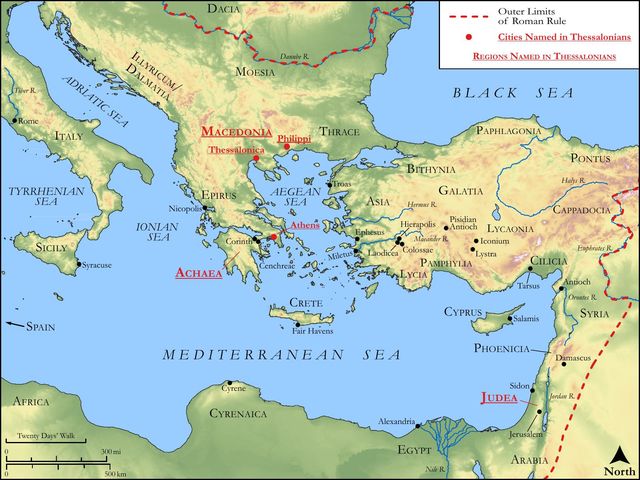
See on the biblical-era maps

Study this verse
Public-domain commentary
Matthew Henry
From his Commentary on the Whole Bible. Henry comments on passages, not single verses — this entry covers 1 Thessalonians 4:13–18. His three-level outline is real structure in the source text, so it is rendered as structure.
In these words the apostle comforts the Thessalonians who mourned for the death of their relations and friends that died in the Lord. His design is to dissuade them from excessive grief, or inordinate sorrow, on that account. All grief for the death of friends is far from being unlawful; we may weep at least for ourselves if we do not weep for them, weep for own loss, though it may be their fain. Yet we must not be immoderate in our sorrows, because,
I.This looks as if we had no hope, Th1 4:13.
It is to act too much like the Gentiles, who had no hope of a better life after this; whereas we Christians, who have a most sure hope, the hope of eternal life after this, which God who cannot lie hath promised us, should moderate all our joys and our sorrows on account of any worldly thing. This hope is more than enough to balance all our griefs upon account of any of the crosses of the present time.
II.This is an effect of ignorance concerning those who are dead, Th1 4:13.
There are some things which we cannot be ignorant of concerning those that are asleep; for the land they are removed to is a land of darkness, which we know but little of and have no correspondence with. To go among the dead is to go among we know not whom, and to live we know not how. Death is an unknown thing, and the state of the dead, or the state after death, we are much in the dark about; yet there are some things concerning those especially who die in the Lord that we need not, and ought not, to be ignorant of; and, if these things be really understood and duly considered, they will be sufficient to allay our sorrow concerning them.
1.They sleep in Jesus. They are asleep, Th1 4:13. They have fallen asleep in Christ, Co1 15:18. Death does not annihilate them. It is but a sleep to them. It is their rest, and undisturbed rest. They have retired out of this troublesome world, to rest from all their labours and sorrows, and they sleep in Jesus, Th1 4:14. Being still in union with him, they sleep in his arms and are under his special care and protection. Their souls are in his presence, and their dust is under his care and power; so that they are not lost, nor are they losers, but great gainers by death, and their removal out of this world is into a better.
2.They shall be raised up from the dead, and awakened out of their sleep, for God will bring them with him, Th1 4:14. They then are with God, and are better where they are than when they were here; and when God comes he will bring them with him. The doctrine of the resurrection and the second coming of Christ is a great antidote against the fear of death and inordinate sorrow for the death of our Christian friends; and this doctrine we have a full assurance of, because we believe that Jesus died and rose again, Th1 4:14. It is taken for granted that as Christians they knew and believed this. The death and resurrection of Christ are fundamental articles of the Christian religion, and give us hope of a joyful resurrection; for Christ, having risen from the dead, has become the first fruits of those that slept; and therefore those who have fallen asleep in him have not perished nor are lost, Co1 15:18, Co1 15:20. His resurrection is a full confirmation of all that is said in the gospel, or by the word of the Lord, which has brought life and immortality to light.
3.Their state and condition shall be glorious and happy at the second coming of Christ. This the apostle informs the Thessalonians of by the word of the Lord (Th1 4:15), by divine revelation from the Lord Jesus; for though the resurrection of the dead, and a future state of blessedness, were part of the creed of the Old Testament saints, yet they are much more clearly revealed in and by the gospel. By this word of the Lord we know,
(1.)That the Lord Jesus will come down from heaven in all the pomp and power of the upper world (Th1 4:16): The Lord himself shall descend from heaven with a shout. He ascended into heaven after his resurrection, and passed through these material heavens into the third heaven, which must retain him till the restitution of all things; and then he will come again, and appear in his glory. He will descend from heaven into this our air, Th1 4:17. The appearance will be with pomp and power, with a shout - the shout of a king, and the power and authority of a mighty king and conqueror, with the voice of the archangel; an innumerable company of angels will attend him. Perhaps one, as general of those hosts of the Lord, will give notice of his approach, and the glorious appearance of this great Redeemer and Judge will be proclaimed and ushered in by the trump of God. For the trumpet shall sound, and this will awaken those that sleep in the dust of the earth, and will summon all the world to appear. For,
(2.)The dead shall be raised: The dead in Christ shall rise first (Th1 4:16), before those who are found alive at Christ's coming shall be changed; and so it appears that those who shall then be found alive shall not prevent those that are asleep, Th1 4:15. The first care of the Redeemer in that day will be about his dead saints; he will raise them before the great change passes on those that shall be found alive: so that those who did not sleep in death will have no greater privilege or joy at that day than those who fell asleep in Jesus.
(3.)Those that shall be found alive will then be changed. They shall be caught up together with them in the clouds, to meet the Lord in the air, Th1 4:17. At, or immediately before, this rapture into the clouds, those who are alive will undergo a mighty change, which will be equivalent to dying. This change is so mysterious that we cannot comprehend it: we know little or nothing of it, Co1 15:51. Only, in the general, this mortal must put on immortality, and these bodies will be made fit to inherit the kingdom of God, which flesh and blood in its present state are not capable of. This change will be in a moment, in the twinkling of an eye (Co1 15:52), in the very instant, or not long after the raising up of those that sleep in Jesus. And those who are raised, and thus changed, shall meet together in the clouds, and there meet with their Lord, to congratulate him on his coming, to receive the crown of glory he will then bestow upon them, and to be assessors with him in judgment, approving and applauding the sentence he will then pass upon the prince of the power of the air, and all the wicked, who shall be doomed to destruction with the devil and his angels.
(4.)Here is the bliss of the saints at that day: they shall be ever with the Lord, Th1 4:17. It will be some part of their felicity that all the saints shall meet together, and remain together for ever; but the principal happiness of heaven is this, to be with the Lord, to see him, live with him, and enjoy him, for ever. This should comfort the saints upon the death of their friends, that, although death has made a separation, yet their souls and bodies will meet again; we and they shall meet together again: we and they shall meet together again: we and they with all the saints shall meet our Lord, and be with him for ever, no more to be separated wither from him or from one another for ever. And the apostle would have us comfort one another with these words, Th1 4:18. We should endeavour to support one another in times of sorrow, not deaden one another's spirits, nor weaken one another's hands, but should comfort one another; and this may be done by serious consideration and discourse on the many good lessons to be learned from the doctrine of the resurrection of the dead, the second coming of Christ, and the glory of the saints in that day.
Historical interpretation
Historical reception
7 surviving comments on this verse. Each one is dated, so this reads as a timeline rather than a list.
Select a marker to jump to its quote. Markers stagger vertically where authors wrote within a few decades of each other.
Therefore God discharged the office of a true father. He Himself formed the body; He Himself infused the soul with which we breathe. Whatever we are, it is altogether His work. In what manner He effected this He would have taught us, if it were right for us to know; as He taught us other things, which have conveyed to us the knowledge both of ancient error and of true light.
Man, therefore, was made from different and opposite substances, as the world itself was made from light and darkness, from life and death; and he has admonished us that these two things contend against each other in man: so that if the soul, which has its origin from God, gains the mastery, it is immortal, and lives in perpetual light; if, on the other hand, the body shall overpower the soul, and subject it to its dominion, it is in everlasting darkness and death. And the force of this is not that it altogether annihilates the souls of the unrighteous, but subjects them to everlasting punishment.
We term that punishment the second death, which is itself also perpetual, as also is immortality. We thus define the first death: Death is the dissolution of the nature of living beings; or thus: Death is the separation of body and soul. But we thus define the second death: Death is the suffering of eternal pain; or thus: Death is the condemnation of souls for their deserts to eternal punishments.
All men shall rise again, but let no one lose heart, and let not the just grieve at the common lot of rising again, since he awaits the chief fruit of his virtue. All indeed shall rise again, but, as says the apostle, “each in his own order.” The fruit of the divine mercy is common to all, but the order of merit differs. The day gives light to all, the sun warms all, the rain fertilizes the possessions of all with genial flowers. We are all born, and we shall all rise again. But each shall be in his proper state, whether of living or living again, for grace differs and the condition differs.… Therefore he is aroused that he may live, that he may be like to Paul, that he may be able to say, “For we that are alive shall not precede those that are asleep.” He speaks here not of the common manner of life and the breath which we all alike now enjoy but of the future merit of the resurrection.
"For if we believe that Jesus died and rose again, even so them also that are fallen asleep in Jesus will God bring with Him."
Where are they who deny the Flesh? For if He did not assume Flesh, neither did He die. If He did not die, neither did He rise again. How then does he exhort us from these things to faith? Was he not then according to them a trifler and a deceiver? For if to die proceeds from sin, and Christ did not sin, how does he now encourage us? And now, concerning whom does he say, O men, for whom do ye mourn? For whom do ye sorrow? for sinners, or simply for those who die? And why does he say, "Even as the rest, which have no hope"? For whom do the rest mourn? so that to them all these things are vapid? "The firstborn from the dead" (Col. i. 18), he says, the first-fruits. Therefore there must also be others left. And see how here he introduces nothing from reasonings, because they were docile. For in writing to the Corinthians, he started many things also from reasonings, and then he added, "Thou fool, that which thou sowest is not quickened." (1 Cor. xv. 36) For this is more authoritative, but it is when he converses with the believer. But with him who is without, what authority would this have? "Even so," he says, "them also that are fallen asleep in Jesus will God bring with Him." Again, "fallen asleep": he nowhere says, the dead. But with respect to Christ, his words are, "He died," because there followed mention of the Resurrection, but here "them that are fallen asleep." How "through Jesus"? Either that they fell asleep through Jesus, or that through Jesus will He bring them. The phrase "that fell asleep through Jesus" means the faithful.
And do you say, How is it possible for one that is human not to mourn?… Do not say then, “he is perished and shall no more be”; for these are the words of unbelievers; but say, “He sleeps and will rise again,” [or] “He is gone a journey and will return with the King.” Who speaks like this? He that has Christ speaking in him. “For,” Paul says, “if we believe that Jesus died and rose again,” and revived, “even so God will bring with him those also who sleep in Jesus.” If then you seek your son, seek him where the King is, where the army of the angels is; not in the grave; not in the earth; lest while he is so highly exalted, you yourself remain groveling on the ground.
Thus when we have to face the hard and cruel necessity of death, we are upheld by this consolation, that we shall shortly see again those whose absence we now mourn. For their end is not called death but a slumber and a falling asleep. Wherefore also the blessed apostle forbids us to sorrow concerning them which are asleep, [1 Thess. 4:13-14] telling us to believe that those whom we know to sleep now may hereafter be roused from their sleep, and when their slumber is ended may watch once more with the saints and sing with the angels: - "Glory to God in the highest and on earth peace among men of good will." [Luke 2:14, Vulg]
The apostle’s words show with the utmost clarity that there will be a resurrection of the dead when Christ comes; and assuredly the purpose of his coming will be to judge the living and the dead. But it is continually being asked whether those whom Christ is to find living in this world (represented in the apostle’s picture by himself and his contemporaries) are never to die at all, or whether in that precise moment of time when they are caught up in the clouds, along with those rising again, to meet Christ in the air, they will pass with marvelous speed through death to immortality. For it must not be said that it is impossible for them to die and come to life again in that space of time when they are being carried on high through the air.… The apostle himself seems to demand that we should take his words in this sense; that is, we should take it that those whom the Lord will find alive here will undergo death and receive immortality in that brief space of time. He confirms this interpretation when he says, “In Christ all men will be brought to life,” and by his statement in another passage, dealing directly with the resurrection of the body: “The seed you sow does not come to life unless it first dies.”
And after this he says to them, “Lazarus, our friend, is sleeping; but I am going that I may awaken him from sleep.” He spoke the truth. To the sisters he was dead; to the Lord he was sleeping. He was dead to men who were unable to raise him up; for the Lord roused him from the tomb with such ease as you would not rouse a sleeping person from his bed. Therefore, as regards his own power he spoke of him as sleeping; for other dead men, too, are often referred to in the Scriptures as sleeping, as the apostle says, “But I will not have you ignorant, brothers, about those who are asleep, so that you may not grieve, even as others who have no hope.” And so he, too, called them sleeping, because he foretold that they would rise again. Therefore, every dead man sleeps, both the good and the evil.
Continue studying 1 Thessalonians 4:14 across the web’s major study libraries — every link below opens this exact verse, chapter, or book on the destination site.
Read & Compare
 BibleGatewayThis verse in more than 200 translations and 70 languages.
 Bible.comThe YouVersion reader — hundreds of translations, reading plans, and highlights.
 ESV.orgCrossway's official English Standard Version reader.
 NET BibleThe NET translation with 60,000+ translators' notes on every rendering decision.
 STEP BibleTyndale House's free study tool — original text, vocabulary, and scholarly resources.
 BibliaLogos Bible Software's free web reader.
 USCCBThe New American Bible (Revised Edition) with the U.S. bishops' study notes.
Commentaries
 BibleHub CommentariesDozens of classic commentaries on this verse, gathered on one page.
 StudyLightMore than 100 commentary sets — the largest collection on the web.
 BibleRefPlain-English commentary on what this verse means, verse by verse.
 Enduring WordDavid Guzik's free commentary on this chapter, widely used by Bible teachers.
 Bible Study ToolsVerse commentary alongside Greek and Hebrew study aids.
Original Language & Research
- BibleHub InterlinearThe verse word by word — original language, transliteration, and English.
- BibleHub LexiconEvery word's original-language definition and Strong's entry.
 Blue Letter BibleDeep-study tools — Strong's numbers, concordance, and word studies.
 CNTR CollationThe earliest Greek manuscripts of this verse, collated letter by letter.
Sermons, Hymns & Audio


TrulyRandomVerse is not affiliated with these sites and doesn’t control their content. They’re linked because they’re genuinely useful.
Summary
1 Thessalonians 4:14 offers profound assurance to grieving believers, anchoring their hope for deceased loved ones in the foundational truth of Jesus Christ's death and resurrection. It declares that just as Christ triumphed over death, so too will God, at Christ's return, bring with Him those who have died in faith, ensuring their participation in the glorious future resurrection and eternal fellowship with the Lord. This verse serves as a pivotal statement on Christian eschatology, transforming sorrow into a confident expectation of reunion and ultimate victory over death.
Context
ShowHideLiterary Context
This verse is a crucial part of Paul's extended teaching on the Parousia, the second coming of Christ, which begins in 1 Thessalonians 4:13. The Thessalonian believers were distressed and confused about the fate of their fellow Christians who had died before Christ's anticipated return. They feared their deceased loved ones might miss out on the blessings of the Lord's coming. Paul addresses this directly, aiming to alleviate their sorrow and provide a clear, hopeful understanding of resurrection and reunion. The verses immediately following, 1 Thessalonians 4:15-18, elaborate on the mechanics of Christ's return and the resurrection event, with 1 Thessalonians 4:14 serving as the theological premise for that detailed explanation.
Historical & Cultural Context
The church in Thessalonica was a relatively young community, established during Paul's second missionary journey (Acts 17). As new converts from paganism, they lacked a developed understanding of Christian eschatology, particularly concerning death and the afterlife. Unlike their pagan neighbors who grieved without hope, the Thessalonians, though believers, were still struggling with the concept of death in light of Christ's imminent return. The prevailing philosophies of the Greeks and Romans often viewed the body as a prison and its dissolution as a release, but offered little hope for bodily resurrection. Jewish thought, while having a concept of resurrection, was diverse. Paul's teaching here provides a distinctly Christian perspective, rooted in the unique event of Christ's resurrection, offering a hope fundamentally different from either pagan despair or traditional Jewish expectations.
Key Themes
ShowHide1 Thessalonians 4 contributes significantly to several major theological themes. The Centrality of Christ's Resurrection is paramount, as the entire Christian hope for the future is predicated on Jesus' victory over death, as seen in 1 Corinthians 15:20-23. This verse also highlights the Hope for Deceased Believers, assuring that death is not a final separation but a temporary "sleep" for those united with Christ, a concept also found in John 11:11-13. Furthermore, the theme of God's Sovereign Action in Bringing Believers underscores divine faithfulness and power in fulfilling His promises, emphasizing that the ultimate reunion is a work of God, not dependent on human timing or understanding. This passage also addresses the broader theme of Comfort and Encouragement in the face of grief, providing a theological basis for enduring sorrow with Christian hope, as Paul explicitly states in 1 Thessalonians 4:18.
Exposition and Analysis
ShowHideKey Word Analysis
ShowHideMeaning "to have faith (in, upon, or with respect to, a person or thing), i.e., credit; by implication, to entrust (especially one's spiritual well-being to Christ)." In this context, "believe" signifies not merely intellectual assent to the facts of Jesus' death and resurrection, but a deep, trusting reliance upon Him. This active faith is the prerequisite for the promise that follows, indicating a personal union with Christ that extends beyond physical death.
Meaning "to put to sleep, i.e. (passively or reflexively) to slumber; figuratively, to decease." This term is a common biblical euphemism for the death of believers. It highlights the temporary nature of death for those in Christ, implying a peaceful rest from which they will awaken, much like one awakens from sleep. It contrasts sharply with the finality of death as understood by those without hope, underscoring the certainty of future resurrection.
Meaning "properly, to lead; by implication, to bring, drive, (reflexively) go, (specially) pass (time), or (figuratively) induce." Here, "bring" conveys God's active and powerful role in leading or accompanying deceased believers. It suggests that at Christ's return, God will not only raise them but will also present them, or bring them along with Christ, into His glorious presence, signifying their full participation in the eschatological triumph.
Verse Breakdown
ShowHide"For if we believe that Jesus died and rose again"
This opening clause establishes the bedrock of Christian hope. The "if" (G1487, ei) here functions not as an expression of doubt, but as a statement of logical premise, akin to "since" or "because." The belief in Jesus' historical death (G599, apothnḗskō) and powerful resurrection (G450, anístēmi) is the non-negotiable foundation of the gospel and the guarantee of future resurrection for believers. It links the believer's destiny directly to Christ's own triumph over death.
"even so them also which sleep in Jesus"
"Even so" (G3779, hoútō) indicates a direct correspondence or parallel. Just as Jesus died and rose, so too will those who "sleep in Jesus" experience a similar triumph. "Sleep in Jesus" (G2837, koimáō G1223, diá G2424, Iēsoûs) is a tender and hopeful euphemism for believers who have died. The phrase "in Jesus" signifies their spiritual union with Christ, indicating that their death does not sever this vital connection but rather confirms their ultimate security and participation in His victory.
"will God bring with him."
This final clause provides the ultimate assurance. It is God (G2316, theós) who will perform this sovereign act. The verb "bring" (G71, ágō) implies a powerful, purposeful action. "With him" (G4862, sýn G846, autós) refers to Christ. This means that when Christ returns, God will bring the resurrected believers along with Christ, ensuring their presence and participation in the glorious event. It does not mean their spirits are brought back from heaven, but rather that their resurrected bodies will be united with their spirits, and they will be present with the returning Lord.
Literary Devices
ShowHideThe verse employs several significant literary devices. Euphemism is prominently used in the phrase "sleep in Jesus" (G2837, koimáō). This gentle term for death among believers serves to soften the harsh reality of physical demise, transforming it from a fearful end into a temporary, peaceful rest with the promise of awakening. This contrasts starkly with the finality of death in a pagan worldview. Furthermore, there is a clear Parallelism established between Jesus' death and resurrection and the future experience of believers. The structure "if we believe that Jesus died and rose again, even so them also which sleep in Jesus will God bring with him" creates a symmetrical relationship, emphasizing that Christ's victory is the direct pattern and guarantee for His followers. This also functions as a powerful Argument from Analogy, where the known truth of Christ's resurrection provides the logical basis for believing in the future resurrection of His people.
Theological and Thematic Connections
ShowHide1 Thessalonians 4:14 is a cornerstone of Christian eschatology, offering a profound theological statement on the nature of death for believers and the certainty of future resurrection. It firmly establishes that the resurrection of believers is not merely a possibility but a divine certainty, directly grounded in the historical and theological reality of Jesus' own resurrection. This verse assures us that death does not separate believers from Christ's ultimate triumph but rather marks a transition into a state of rest, awaiting a glorious reunion. It underscores God's faithfulness to His covenant people and His power to overcome even death, ensuring that those united with Christ in life will also be united with Him in His glorious return. The hope presented here is not a vague wish but a confident expectation rooted in the very character and power of God.
Reflection and Application
ShowHideThis verse offers immense comfort and profound hope, especially in times of grief and loss. It transforms our understanding of death from a feared enemy into a temporary transition for those who are in Christ. For those mourning the loss of a loved one who died in faith, 1 Thessalonians 4:14 provides the assurance that their loved one is not lost forever but is "asleep in Jesus," awaiting a glorious awakening and reunion. This truth should empower believers to grieve with hope, not as those who have no hope (as Paul states in 1 Thessalonians 4:13). It calls us to live with an eternal perspective, knowing that our present sufferings are temporary and that a future of perfect fellowship with Christ and fellow believers awaits. Our belief in Jesus' resurrection is not just an intellectual assent but the living hope that guarantees our own future. This should motivate us to live lives worthy of this hope, sharing the good news of Christ's victory over death with a world that desperately needs it.
Questions for Reflection
ShowHideFAQ
ShowHideDoes "sleep in Jesus" mean that the souls of believers are unconscious until the resurrection?
ShowHideNo, the term "sleep" (G2837, koimáō) is a common biblical euphemism for the physical death of believers, emphasizing its temporary nature and the certainty of future awakening through resurrection. It does not imply soul sleep or an unconscious state. Other New Testament passages indicate that the spirits of believers go immediately to be with the Lord upon death. For example, Paul states in 2 Corinthians 5:8 that to be "absent from the body" is to be "present with the Lord." Similarly, Jesus assured the penitent thief on the cross, "Today you will be with me in Paradise" (Luke 23:43). Therefore, "sleep" refers to the body resting in the grave, awaiting resurrection, while the spirit is alive and conscious with Christ.
Christ-Centered Fulfillment
ShowHide1 Thessalonians 4:14 finds its ultimate fulfillment and meaning in the person and work of Jesus Christ. His resurrection is not merely a historical event but the firstfruits of all who will rise, as powerfully articulated in 1 Corinthians 15:20-23. Jesus' victory over death, hell, and the grave (as foreshadowed in Revelation 1:18) guarantees the future resurrection of all who believe in Him. He is the resurrection and the life (John 11:25), and because He lives, those united with Him by faith will also live (John 14:19). The promise that God will "bring with him" those who "sleep in Jesus" means that at Christ's glorious return, He will not come alone, but will be accompanied by His redeemed, resurrected people. This profound truth underscores that our hope is not in an abstract concept of immortality, but in the living, reigning Christ, who has overcome death and holds the keys to eternal life, ensuring that all who are "in Christ" will share in His ultimate triumph and eternal glory (Romans 8:11).