


Matthew 24:31
Bible text: King James Version (1769 Blayney text) · Public domain
Bible text: King James Version with Strong's numbers · Public domain
Bible text: Berean Standard Bible · Public domain
Bible text: American Standard Version (1901) · Public domain
Bible text: World English Bible, Messianic edition · Public domain
Bible text: Geneva Bible (1599) · Public domain
Bible text: Young's Literal Translation · Public domain
- καὶkaiAndG2532CONJConjunction
- ἀποστελεῖaposteleiHe will sendG649V-FAI-3SVerb Future Active Indicative 3rd Singular
- τοὺςtoustheG3588T-APMDefinite article Accusative Plural Masculine
- ἀγγέλουςangelousangelsG32N-APMNoun Accusative Plural Masculine
- αὐτοῦautouof HimG846P-GSMPersonal pronoun Genitive Singular Masculine
- μετὰmetawithG3326PREPPreposition
- σάλπιγγοςsalpingosa trumpet callG4536N-GSFNoun Genitive Singular Feminine
- φωνῆςphōnēsvoiceG5456N-GSFNoun Genitive Singular Feminine
- μεγάληςmegalēsgreatG3173A-GSFAdjective Genitive Singular Feminine
- καὶkaiandG2532CONJConjunction
- ἐπισυνάξουσινepisunaxousinthey will gather togetherG1996V-FAI-3PVerb Future Active Indicative 3rd Plural
- τοὺςtoustheG3588T-APMDefinite article Accusative Plural Masculine
- ἐκλεκτοὺςeklektouselectG1588A-APMAdjective Accusative Plural Masculine
- αὐτοῦautouof HimG846P-GSMPersonal pronoun Genitive Singular Masculine
- ἐκekfromG1537PREPPreposition
- τῶνtōntheG3588T-GPMDefinite article Genitive Plural Masculine
- τεσσάρωνtessarōnfourG5064A-GPMAdjective Genitive Plural Masculine
- ἀνέμωνanemōnwindsG417N-GPMNoun Genitive Plural Masculine
- ἀπ᾽ap᾽fromG575PREPPreposition
- ἄκρωνakrōn[the] endsG206N-GPNNoun Genitive Plural Neuter
- οὐρανῶνouranōnof the heavensG3772N-GPMNoun Genitive Plural Masculine
- ἕωςhe'ōsuntilG2193PREPPreposition
- ἄκρωνakrōnendsG206N-GPNNoun Genitive Plural Neuter
- αὐτῶνautōnof themG846P-GPMPersonal pronoun Genitive Plural Masculine
English is a literal word-by-word gloss of the Greek, not the KJV's wording. Why?
This is the original text the KJV's translators worked from — each Greek word with its own literal English meaning in this verse, prepared by scholars at Tyndale House, Cambridge. The KJV translates whole sentences, not word by word, so its wording differs: one Greek word can become several English words, and the KJV may choose “charity” where the gloss reads “love”. Both are faithful — they answer different questions. For the KJV's own rendering, switch to the KJV text.
Details
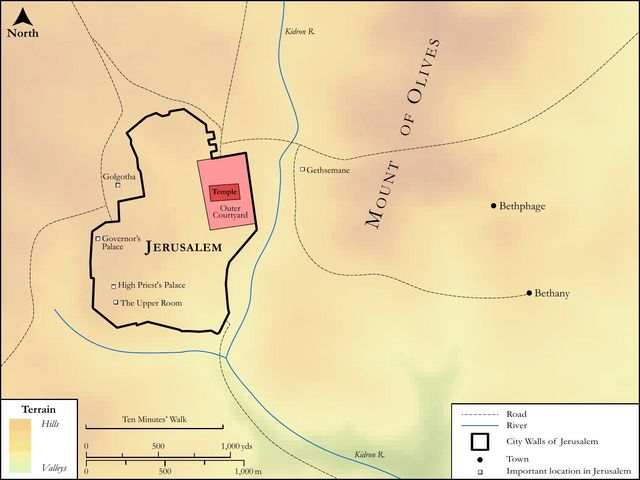
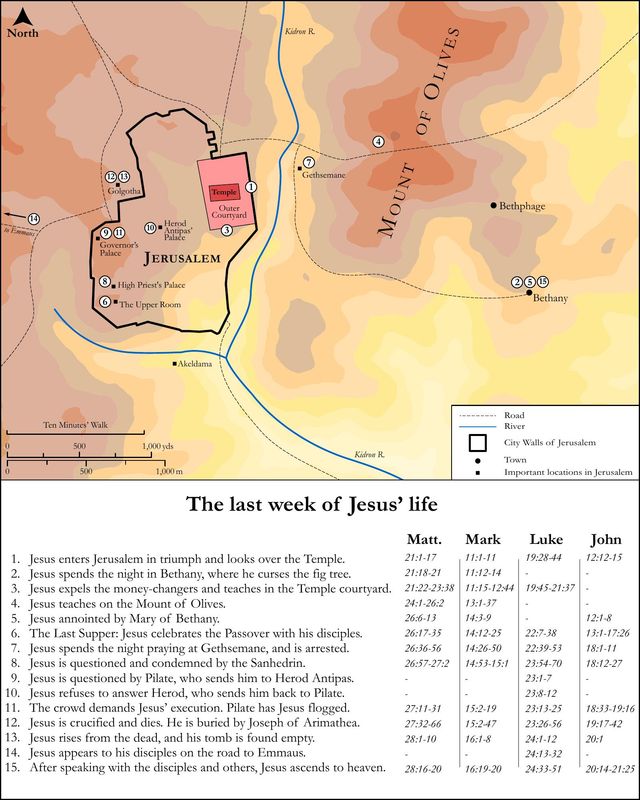
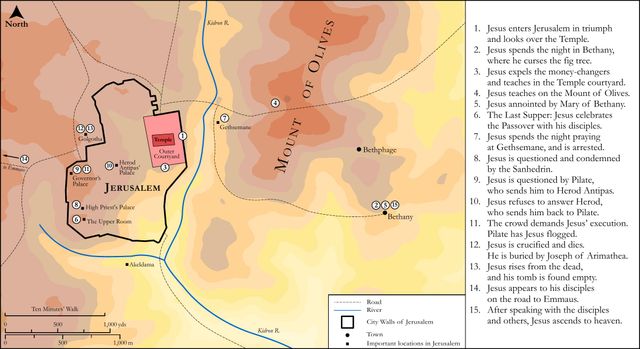
See on the biblical-era maps
Study this verse
Historical interpretation
Ten Centuries of Reception
10 surviving comments on this verse. Each one is dated, so this reads as a timeline rather than a list.
Select a marker to jump to its quote. Markers stagger vertically where authors wrote within a few decades of each other.
Watch for your life's sake. Let not your lamps be quenched, nor your loins unloosed; but be ye ready, for ye know not the hour in which our Lord cometh. But often shall ye come together, seeking the things which are befitting to your souls: for the whole time of your faith will not profit you, if ye be not made perfect in the last time. For in the last days false prophets and corrupters shall be multiplied, and the sheep shall be turned into wolves, and love shall be turned into hate; for when lawlessness increaseth, they shall hate and persecute and betray one another, and then shall appear the world-deceiver as Son of God, and shall do signs and wonders, and the earth shall be delivered into his hands, and he shall do iniquitous things which have never yet come to pass since the beginning. Then shall the creation of men come into the fire of trial, and many shall be made to stumble and shall perish; but they that endure in their faith shall be saved from under the curse itself. And then shall appear the signs of the truth; first, the sign of an out-spreading in heaven; then the sign of the sound of the trumpet; and the third, the resurrection of the dead; yet not of all, but as it is said: The Lord shall come and all His saints with Him. Then shall the world see the Lord coming upon the clouds of heaven.
Or He comes every day with great power to the mind of the believer in the clouds of prophecy, that is, in the Scriptures of the Prophets and the Apostles, who utter the word of God with a meaning above human nature. Also we say that to those who understand He comes with great glory, and that this is the more seen in the second coming of the Word which is to the perfect. 1And so it may be, that all which the three Evangelists have said concerning Christ's coming, if carefully compared together and thoroughly examined, would be found to apply to His continual daily coming in His body, which is the Church, of which coming He said in another place, Hereafter shall ye see the Son of Man sitting on the right hand of the power of God, and coming in the clouds of heaven, (Mat. 26:6.) excepting those places in which He promises that His last coming in His own person.
Because He had spoken of mourning, which shall be only that they may bear witness against themselves and condemn themselves, that none should suppose that that mourning will end their woes, He now adds, And he shall send his Angels with a trump and a loud voice.
It is written in Numbers (Numb. 10:3.), that the Priests shall summon by the sound of the trumpet from the four winds those who are of the camp of Israel, and it is in allusion to this that Christ speaks here of the Angels, And they shall gather together the elect from the four winds.
Some of little discernment think, that only those who shall then be found in the body shall be gathered together, but it is better to say that the Angels of Christ shall then gather together not only all who from the coming of Christ to the end of the world have been called and chosen, but all from the foundation of the world, who like Abraham have seen the day of Christ and rejoiced therein. (John 8:56.) And that He here means not only those that shall be found in the body, but those also who have quitted the body, the following words show, from one end of heaven to the other, which cannot be meant of any one upon earth. Or, the heavens are the divine Scriptures and their authors in which God dwells. One end of heaven is the beginning of the Scriptures, the other end is their conclusion. The saints there are gathered together from one end of heaven, that is, from those that live in the beginning of the Scriptures to those who live in the ends of them. They shall be gathered together with a trump and a loud voice, that they who hear and attend may prepare themselves for that way of perfection which leads to the Son of God.
You will understand why the saints are gathered “from the heights of the earth” if you consider the conduct of their lives and the perfection, insofar as possible, of their dealings with others. All who lived uprightly will be gathered not simply from the earth but “from the heights of the earth.” After their earthly lives have ended, their conduct in the next life will raise them not simply from the highest point in heaven, as it was from the highest level of earth, but from the “heights of the heavens” because each and every heaven has both a beginning and a conclusion or perfection. After their exemplary lives on earth, the saints’ conduct in the first heaven, once they have attained its perfection or conclusion, will elevate them still further. The same is true for the second heaven and the third heaven. It seems to me therefore that there are many heavens, each with its own initiation and perfection. It is from the beginnings and ends of these diverse heavens that God gathers his elect.“From the heights of the heavens to their ends.” It is also possible that the heavens here represent either the divine Scriptures or their authors, in both of which God dwells. In that case, the heights of the Scripture is its beginning, and the perfection of Scripture is its conclusion. To say that the saints will be gathered from “the heights of the heavens” means that they will be found from among those who live in the beginning of Scripture to those who live at its conclusion, or, if I may speak more profoundly, from the unskilled to the experts.
The angels who will be sent by the Savior to gather his elect will gather them not just with any ordinary voice but with what Scripture calls a “great trumpet.” It won’t be an uncertain voice but one that is definite and clear so that all who hear and learn will be established on the way of perfection which leads to the Son of God.
For in the last days false prophets shall be multiplied, and such as corrupt the word; and the sheep shall be changed into wolves, and love into hatred: for through the abounding of iniquity the love of many shall wax cold. For men shall hate, and persecute, and betray one another. And then shall appear the deceiver of the world, the enemy of the truth, the prince of lies, [2 Thessalonians 2:3-12] whom the Lord Jesus "shall destroy with the spirit of His mouth, who takes away the wicked with His lips; and many shall be offended at Him. But they that endure to the end, the same shall be saved. And then shall appear the sign of the Son of man in heaven;" [Isaiah 11:4; Matthew 24:1-51] and afterwards shall be the voice of a trumpet by the archangel; and in that interval shall be the revival of those that were asleep. And then shall the Lord come, and all His saints with Him, with a great concussion above the clouds, with the angels of His power, [Matthew 16:27] in the throne of His kingdom, to condemn the devil, the deceiver of the world, and to render to every one according to his deeds. "Then shall the wicked go away into everlasting punishment, but the righteous shall go into life eternal," [Matthew 25:46] to inherit those things "which eye has not seen, nor ear heard, nor have entered into the heart of man, such things as God has prepared for them that love Him;" [1 Corinthians 2:9] and they shall rejoice in the kingdom of God, which is in Christ Jesus.
By saying that the Son of man will send his angels, he demonstrates that the Son of man is God. For they are God’s angels, and to send them is solely God’s prerogative. The saying “from one end of the heavens to the other” teaches us that the extremes of earth and heaven are the same. Hence it is necessary to believe in Christ and not to be deceived as though the smallest part of earth, situated in the midst of the heavens, was surpassed by their infinite greatness.
The sound of the trump refers to the resurrection, and the rejoicing, and to represent the astonishment which shall be then, and the woe of those that shall be left, and shall not be snatched up into the clouds.
That the Lord calls His elect by His Angels pertains to the honour of the elect; and Paul also says that they shall be caught into the clouds; (1 Thes. 4:17.) that is, the Angels shall gather together those that have risen, and when they are gathered together, the clouds shall receive them.
And then again, "He will send His angels with a great trumpet, and they shall gather the elect from the four winds, from one end of Heaven to the other."
But when thou hast heard of this, consider the punishment of them that remain. For neither shall they suffer that former penalty only, but this too. And as above He said, that they should say, "Blessed is He that cometh in the name of the Lord," so here, that they shall mourn. For since He had spoken unto them of grievous wars, that they might learn, that together with the fearful things here, the torments there also await them, He brings them in mourning and separated from the elect, and consigned to hell; by this again rousing the disciples, and indicating from how many evils they should be delivered, and how many good things they shall enjoy.
And why now doth He call them by angels, if He comes thus openly? To honor them in this way also. But Paul saith, that they "shall be caught up in clouds." And He said this also, when He was speaking concerning a resurrection. "For the Lord Himself," it is said, "shall descend from Heaven with a shout, with the voice of an archangel." So that when risen again, the angels shall gather them together, when gathered together the clouds shall catch them up; and all these things are done in a moment, in an instant. For it is not that He abiding above calleth them, but He Himself cometh with the sound of a trumpet. And what mean the trumpets and the sound? They are for arousing, for gladness, to set forth the amazing nature of the things then doing, for grief to them that are left.
(Ver. 31.) And He will send His angels with a trumpet and a loud voice; and they will gather His chosen ones from the four winds, from the highest heavens to their ends. The Apostle speaks of this trumpet in I Corinthians XV; I Thessalonians IV: and we read in the Apocalypse of John (Apocalypse VIII): and in the Old Testament (Numbers X), we are instructed to make trumpets of gold, silver, and bronze, so that the lofty mysteries of doctrine may resound.
Here we are not to think of a real trumpet, but of the voice of the archangel, which shall be so loud that at its sound all the dead shall rise out of the dust of the earth.
That is, from the four quarters of the world, north, south, east, and west.
Or otherwise; Lest any one should suppose that they should be gathered only from the four quarters of the world, and not from the middle regions, The adds this, And from one end of heaven to the other. By the heights of heaven meaning the central regions of the earth, which are under the heights of heaven; and by the ends of heaven, meaning the extreme parts of the earth, where the land seems to join a very wide and distant horizon.
He will send the angels to gather together the saints and those risen from the dead, so that they can meet Him in the clouds. He also honors them by calling them with angels. And if Paul says that they will be caught up in the clouds (1Thess. 4:17), this is not contradictory. For when they have been gathered together by the angels, the clouds will snatch them up. There will be the trumpet, to cause the greater consternation.
Continue studying Matthew 24:31 across the web’s major study libraries — every link below opens this exact verse, chapter, or book on the destination site.
Read & Compare
 BibleGatewayThis verse in more than 200 translations and 70 languages.
 Bible.comThe YouVersion reader — hundreds of translations, reading plans, and highlights.
 ESV.orgCrossway's official English Standard Version reader.
 NET BibleThe NET translation with 60,000+ translators' notes on every rendering decision.
 STEP BibleTyndale House's free study tool — original text, vocabulary, and scholarly resources.
 BibliaLogos Bible Software's free web reader.
 USCCBThe New American Bible (Revised Edition) with the U.S. bishops' study notes.
Commentaries
 BibleHub CommentariesDozens of classic commentaries on this verse, gathered on one page.
 StudyLightMore than 100 commentary sets — the largest collection on the web.
 BibleRefPlain-English commentary on what this verse means, verse by verse.
 Enduring WordDavid Guzik's free commentary on this chapter, widely used by Bible teachers.
 Bible Study ToolsVerse commentary alongside Greek and Hebrew study aids.
Original Language & Research
- BibleHub InterlinearThe verse word by word — original language, transliteration, and English.
- BibleHub LexiconEvery word's original-language definition and Strong's entry.
 Blue Letter BibleDeep-study tools — Strong's numbers, concordance, and word studies.
 CNTR CollationThe earliest Greek manuscripts of this verse, collated letter by letter.
Sermons, Hymns & Audio


TrulyRandomVerse is not affiliated with these sites and doesn’t control their content. They’re linked because they’re genuinely useful.
Summary
Matthew 24:31 stands as a profound declaration within Jesus' Olivet Discourse, painting a vivid picture of the climactic event following His glorious return: the comprehensive gathering of His elect. This verse describes the Son of Man dispatching His angels with a resounding trumpet call to assemble His chosen people from every corner of the earth, signifying the ultimate triumph of God's sovereign plan and the secure destiny of His faithful followers.
Context
ShowHideLiterary Context
Matthew 24:31 concludes Jesus' detailed prophetic discourse on the Mount of Olives, often called the Olivet Discourse. It immediately follows descriptions of intense tribulation, disturbances in the heavens, and the unmistakable, visible appearance of the Son of Man in power and great glory (Matthew 24:29-30). This verse, therefore, depicts the immediate consequence and triumphant action of Christ's return: the gathering of His chosen people. It serves as the positive culmination of the preceding warnings and descriptions of judgment, transitioning into parables that emphasize readiness and vigilance in Matthew 25.
Historical & Cultural Context
The imagery in Matthew 24:31 resonates deeply with Old Testament prophetic traditions and Jewish expectations. The "four winds" (Jeremiah 49:36) and "ends of heaven" are common biblical idioms signifying the uttermost parts of the earth, emphasizing a universal scope. The trumpet call (Hebrew: shofar) was a significant instrument in ancient Israel, used to announce new moons, call assemblies, signal war, and proclaim divine intervention, such as at Mount Sinai (Exodus 19:16) or the Year of Jubilee (Leviticus 25:9-10). The concept of "the elect" (Greek: eklektos) also has roots in the Old Testament, referring to Israel as God's chosen people (Isaiah 43:20), now expanded in the New Testament to encompass all true believers in Christ.
Key Themes
ShowHideThis verse powerfully contributes to several major theological themes within Matthew and the broader biblical narrative. It underscores the sovereignty and authority of Jesus Christ as the one who "shall send his angels," demonstrating His divine power to orchestrate end-time events. The central action highlights the divine gathering of the elect, emphasizing God's faithfulness to His chosen people and their secure destiny amidst global upheaval. Furthermore, the explicit mention of angelic ministry showcases their crucial role as agents of God's will in executing His redemptive and judgmental purposes, a theme prevalent throughout the Bible (e.g., Hebrews 1:14). Finally, the trumpet call serves as a potent symbol of a definitive, universally recognized divine announcement, signaling the culmination of history and the commencement of a new, eternal order for God's people.
Exposition and Analysis
ShowHideKey Word Analysis
ShowHideThis verb, meaning "to collect upon the same place" or "gather together," emphasizes a deliberate and comprehensive assembly. It implies a drawing together from dispersion, signifying a complete and unified collection of individuals who were previously scattered. In this context, it highlights the effectiveness and totality of the angelic mission.
Derived from a verb meaning "to select" or "to choose out," eklektos means "select" or "chosen," and by implication, "favorite." This term underscores God's sovereign initiative and purpose in salvation. The "elect" are those whom God has chosen for Himself, setting them apart for a special relationship and destiny. Their gathering is not accidental but the fulfillment of divine election.
This noun refers to a "trumpet," specifically a war-trumpet or one used for summoning or announcing. Coupled with "great sound" (megas phōnē), it denotes a powerful, unmistakable, and universally heard signal. It is a sound of divine authority, signaling a momentous, decisive event—in this case, the final assembly of God's people.
Verse Breakdown
ShowHide"And he shall send his angels with a great sound of a trumpet"
This clause establishes the agent and the means of the gathering. "He" refers to the Son of Man, Jesus Christ, asserting His supreme authority. He dispatches "his angels," powerful celestial beings who serve as His emissaries. The accompanying "great sound of a trumpet" signifies a dramatic, public, and universally audible announcement, signaling the commencement of this pivotal event. It evokes divine power and the solemnity of the occasion.
"and they shall gather together his elect"
This is the core action of the verse. The angels, acting on Christ's command, will perform the task of "gathering together" those whom God has "chosen" or "selected." This gathering is not a human effort but a divinely orchestrated, supernatural event, ensuring that every one of God's elect is brought into His presence.
"from the four winds"
This phrase is a common biblical idiom denoting the four cardinal directions (north, south, east, west). It emphasizes the global scope of the gathering, indicating that the elect will be assembled from every part of the earth, wherever they may be dispersed.
"from one end of heaven to the other."
This concluding phrase further amplifies the universal and comprehensive nature of the gathering. "Heaven" here likely refers to the sky or the horizon, suggesting that the elect will be gathered from the farthest reaches of the visible world, leaving no one out. It underscores the totality and effectiveness of Christ's command and the angels' mission.
Literary Devices
ShowHideMatthew 24:31 employs several potent literary devices to convey its message. Imagery is central, painting a vivid mental picture of powerful angels descending, a trumpet blasting with a "great sound," and a vast multitude being gathered from the far corners of the earth and sky. This creates a sense of awe, grandeur, and inevitability. Symbolism is also prominent; the "trumpet" is not merely an instrument but a symbol of divine announcement, a call to assembly, and often, resurrection or judgment in eschatological contexts. The "four winds" and "one end of heaven to the other" are examples of Merism and Hyperbole, using two contrasting or extreme parts to represent the whole, thereby emphasizing the absolute universality and completeness of the gathering. The dramatic presentation contributes to the apocalyptic tone of the discourse, underscoring the finality and divine nature of these events.
Theological and Thematic Connections
ShowHideMatthew 24:31 is a cornerstone for understanding Christian eschatology, particularly concerning the blessed hope of the believer. It firmly establishes the personal, visible, and triumphant return of Jesus Christ as the catalyst for the ultimate redemption and glorification of His people. The gathering of the elect underscores God's unwavering faithfulness to His covenant promises and His sovereign power to bring all His chosen ones safely into His eternal kingdom. This event is not merely a physical relocation but a spiritual consummation, signifying the full realization of salvation and the unity of the redeemed with their Lord. It provides immense comfort and assurance, reminding believers that despite tribulation and dispersion, they are eternally secure in God's plan.
Reflection and Application
ShowHideMatthew 24:31 offers profound hope and a call to vigilant living for believers today. In a world often marked by uncertainty, division, and tribulation, this verse reminds us of the ultimate triumph of Christ and the secure, unified future awaiting His church. It assures us that no matter where we are, or what challenges we face, God's plan for His elect will be perfectly fulfilled. This divine gathering provides comfort, knowing that we are not forgotten but are part of a grand, eternal purpose. It encourages us to live with an eager anticipation of Christ's return, inspiring perseverance in faith, holiness in conduct, and diligence in sharing the Gospel, for the time of our ultimate gathering draws near.
Questions for Reflection
ShowHideFAQ
ShowHideWho are "his elect" mentioned in this verse?
ShowHide"His elect" refers to those whom God has sovereignly chosen for salvation through faith in Jesus Christ. While the term "elect" has roots in God's choice of Israel in the Old Testament, in the New Testament context, especially in passages like Matthew 24 and Romans 8:33, it encompasses all true believers—both Jewish and Gentile—who have been chosen by God before the foundation of the world (Ephesians 1:4). They are God's chosen people, set apart for a special relationship with Him and destined for eternal glory.
What is the significance of the "great sound of a trumpet"?
ShowHideThe "great sound of a trumpet" is highly significant, drawing on rich Old Testament imagery. In ancient Israel, trumpets (shofars) were used for various purposes: to call assemblies, signal war, announce important events, and mark divine intervention. In prophetic contexts, it often symbolizes a powerful, unmistakable divine announcement or a call to assembly, particularly associated with the Day of the Lord. In the New Testament, it is explicitly linked to the resurrection of the dead and the gathering of believers at Christ's return (1 Corinthians 15:52 and 1 Thessalonians 4:16). It signifies a public, audible, and universally recognized signal of Christ's glorious advent and the commencement of the final stage of salvation history.
Christ-Centered Fulfillment
ShowHideMatthew 24:31 finds its profound Christ-centered fulfillment in the person and work of Jesus Christ, who is not merely the subject of prophecy but its very orchestrator and ultimate goal. It is He who "shall send his angels," demonstrating His supreme authority as the resurrected and ascended Lord, to whom all authority in heaven and on earth has been given (Matthew 28:18). The gathering of "his elect" is a testament to His redemptive work, for it is through His atoning sacrifice that these chosen ones are made righteous and brought into God's family (2 Corinthians 5:21). This ultimate assembly fulfills Christ's own promise to gather His sheep into one flock (John 10:16) and to prepare a place for them, so that where He is, there they may be also (John 14:3). The trumpet call, signaling this grand assembly, is ultimately the voice of Christ, summoning His redeemed to their eternal home, culminating in the glorious union of the Bride with the Lamb (Revelation 19:7). Thus, Matthew 24:31 is a powerful declaration of Christ's sovereign power to complete the salvation He initiated, ensuring that not one of His own will be lost, but all will be brought into His glorious presence.