


Jeremiah 49:36
Bible text: King James Version (1769 Blayney text) · Public domain
Bible text: King James Version with Strong's numbers · Public domain
Bible text: Berean Standard Bible · Public domain
Bible text: American Standard Version (1901) · Public domain
Bible text: World English Bible, Messianic edition · Public domain
Bible text: Geneva Bible (1599) · Public domain
Bible text: Young's Literal Translation · Public domain
- וְהֵבֵאתִיve·he·ve·Tiand I will bringH935Conj-w ¦ V-Hiphil-ConsecPerf-1csVerb Hiphil Consecutive Perfect 1st Singular common genderוְandהֵבֵאתִיI will bring
- אֶל'elagainstH413PrepPreposition
- עֵילָם'ei·LamElamH5867N-properNoun Proper Location
- אַרְבַּע'ar·Ba'fourH702Adj-csAdjective Numerical Singular common gender Absolute
- רוּחוֹתru·ChotwindsH7307N-fpNoun Plural Feminine Absolute
- מֵאַרְבַּעme·'ar·Ba'from [the] fourH702Prep-m ¦ Adj-cscAdjective Numerical Singular common gender Constructמֵfromאַרְבַּע[the] four
- קְצוֹתke·Tzot[the] ends ofH7098N-fpcNoun Plural Feminine Construct
- הַשָּׁמַיִםha·sha·Ma·yimthe heavensH8064Art ¦ N-mpNoun Plural Masculine Absoluteהַtheשָּׁמַיִםheavens
- וְזֵרִתִיםve·Ze·ri·Timand I will scatter themH2219Conj-w ¦ V-Piel-ConsecPerf-1cs ¦ 3mpVerb Piel Consecutive Perfect 1st Singular common genderוְandזֵרִתִיI will scatterםthem
- לְכֹלle·Kholto allH3605Prep-l ¦ N-mscNoun Singular Masculine Constructלְtoכֹלall
- הָרֻחוֹתha·ru·Chotthe windsH7307Art ¦ N-fpNoun Plural Feminine Absoluteהָtheרֻחוֹתwinds
- הָאֵלֶּהha·'E·leh<the> theseH428Art ¦ PrtParticle Demonstrativeהָ<the>אֵלֶּהthese
- וְלֹאve·lo'and notH3808Conj-w ¦ NegParticle Negativeוְandלֹאnot
- יִהְיֶהyih·Yehit will beH1961V-Qal-Imperf-3msVerb Qal Imperfect 3rd Singular Masculine
- הַגּוֹיha·Goythe nationH1471Art ¦ N-msNoun Singular Masculine Absoluteהַtheגּוֹיnation
- אֲשֶׁר'a·SherwhereH834RelParticle Relative
- לֹאlo'notH3808NegParticle Negative
- יָבוֹאya·Vo'it will goH935V-Qal-Imperf-3msVerb Qal Imperfect 3rd Singular Masculine
- שָׁםshamthereH8033AdvAdverb
- נִדְּחֵיni·de·Chei[the] outcasts ofH5080V-Niphal-Prtcpl-mpVerb Niphal Participle Plural Masculine Construct
- עֵילָםo·lamElamH5867N-properNoun Proper Location
English is a literal word-by-word gloss of the Hebrew, not the KJV's wording. Why?
This is the original text the KJV's translators worked from — each Hebrew word with its own literal English meaning in this verse, prepared by scholars at Tyndale House, Cambridge. The KJV translates whole sentences, not word by word, so its wording differs: one Hebrew word can become several English words, and the KJV may choose “the LORD” where the gloss reads “Yahweh”. Both are faithful — they answer different questions. For the KJV's own rendering, switch to the KJV text.
Details
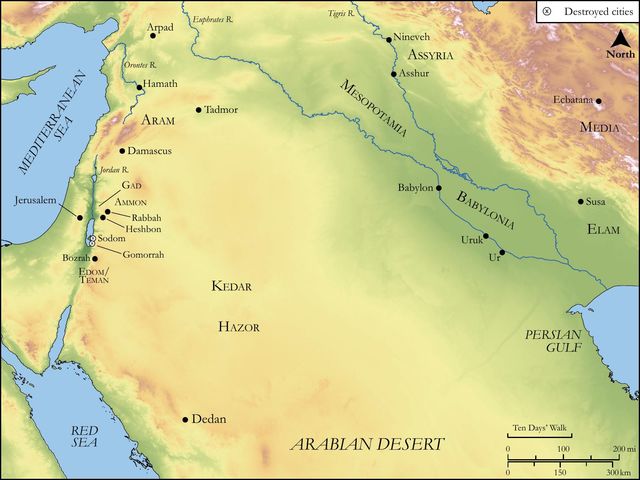
See on the biblical-era map
Study this verse
Public-domain commentary
Matthew Henry
From his Commentary on the Whole Bible. Henry comments on passages, not single verses — this entry covers Jeremiah 49:34–39.
This prophecy is dated in the beginning of Zedekiah's reign; it is probable that the other prophecies against the Gentiles, going before, were at the same time. The Elamites were the Persians, descended from Elam the son of Shem (Gen 10:22); yet some think it was only that part of Persia which lay nearest to the Jews which was called Elymais, and adjoined to Media-Elam, which, say they, had acted against God's Israel, bore the quiver in an expedition against them (Isa 22:6), and therefore must be reckoned with among the rest. It is here foretold, in general, that God will bring evil upon them, even his fierce anger, and that is evil enough, it has all evil in it, Jer 49:37. In particular, 1. Their forces shall be disabled, and rendered incapable of doing them any service. The Elamites were famous archers, but, Behold, I will break the bow of Elam (Jer 49:35), will ruin their artillery, and then the chief of their might is gone. God often orders it so that that which we most trust to first fails us, and that which was the chief of our might proves the least of our help. 2. Their people shall be dispersed. There shall come enemies against them from all parts of the world, and they shall all carry some of them away captive into their respective countries; while others shall flee, some one way and some another, to shift for themselves, so that there shall be no nation whither the outcasts of Elam shall not come, Jer 49:36. The four winds shall be brought upon them; the storm shall come sometimes from one point and sometimes from another, to toss and hurry them several ways. We know not from what point the wind of trouble may blow; but, if God encompass us with his favour, we are safe, and may be easy, which way soever the storm comes. Fear shall drive them into other countries; they shall be dismayed before their enemies; but, as if that were not enough, I will send the sword after them, Jer 49:37. Note, God can make his judgments follow those that think by flight to escape them and to get out of the reach of them. Evil pursues sinners. 3. Their princes shall be destroyed and the government quite changed (Jer 49:38): I will set my throne in Elam. The throne of Nebuchadnezzar shall be set there, or the throne of Cyrus, who began his conquests with Elymais. Or it may be meant of the throne on which God sits for judgment; he will make them know that he reigns, that he judges in the earth, that kings and princes are accountable to him, and that high as they are he is above them. The king of Elam was famous of old, Gen 14:1. Chedorlaomer was king of Elam, and a mighty man he was in his day; the nations about him served him; his successors, we may suppose, made a great figure; but the king of Elam is no more to God than another man. When God sets his throne in Elam he will destroy thence the king and the princes that are, and set up whom he pleases. 4. Yet the destruction of Elam shall not be perpetual (Jer 49:39): In the latter days I will bring again the captivity of Elam. When Cyrus had destroyed Babylon, brought the empire into the hands of the Persians, the Elamites no doubt returned in triumph out of all the countries whither they were scattered, and settled again in their own country. But this promise was to have its full and principal accomplishment in the days of the Messiah, when we find Elamites particularly among those who, when the Holy Ghost was given, heard spoken in their own tongues the wonderful works of God (Act 2:9, Act 2:11), and that is the most desirable return of the captivity. If the Son make you free, then you shall be free indeed.
Continue studying Jeremiah 49:36 across the web’s major study libraries — every link below opens this exact verse, chapter, or book on the destination site.
Read & Compare
 BibleGatewayThis verse in more than 200 translations and 70 languages.
 Bible.comThe YouVersion reader — hundreds of translations, reading plans, and highlights.
 ESV.orgCrossway's official English Standard Version reader.
 NET BibleThe NET translation with 60,000+ translators' notes on every rendering decision.
 STEP BibleTyndale House's free study tool — original text, vocabulary, and scholarly resources.
 BibliaLogos Bible Software's free web reader.
 USCCBThe New American Bible (Revised Edition) with the U.S. bishops' study notes.
Commentaries
 BibleHub CommentariesDozens of classic commentaries on this verse, gathered on one page.
 StudyLightMore than 100 commentary sets — the largest collection on the web.
 BibleRefPlain-English commentary on what this verse means, verse by verse.
 Enduring WordDavid Guzik's free commentary on this chapter, widely used by Bible teachers.
 Bible Study ToolsVerse commentary alongside Greek and Hebrew study aids.
Original Language & Research
- BibleHub InterlinearThe verse word by word — original language, transliteration, and English.
- BibleHub LexiconEvery word's original-language definition and Strong's entry.
 Blue Letter BibleDeep-study tools — Strong's numbers, concordance, and word studies.
 SefariaThe Hebrew text with Rashi and centuries of Jewish commentary.
Sermons, Hymns & Audio


TrulyRandomVerse is not affiliated with these sites and doesn’t control their content. They’re linked because they’re genuinely useful.
Summary
Jeremiah 49:36 delivers a profound prophetic declaration from the Lord concerning Elam, an ancient and militarily significant kingdom located east of Babylon. This verse foretells a comprehensive and divinely orchestrated judgment, symbolized by "the four winds from the four quarters of heaven," which will utterly scatter the people of Elam. The prophecy emphasizes the extreme thoroughness of this dispersion, asserting that Elamite exiles will be found in virtually every nation, signifying the complete dissolution of their national identity and power.
Context
ShowHideLiterary Context
Jeremiah 49:36 is situated within a larger prophetic section of the book, specifically chapters 46-51, which contains oracles of judgment against various foreign nations surrounding Judah. These prophecies serve as a theological counterpoint to the judgments pronounced against Judah and Israel, demonstrating God's universal sovereignty and justice over all peoples, not just His covenant nation. The oracle against Elam begins in Jeremiah 49:34 and continues through Jeremiah 49:39, detailing its impending destruction before offering a glimmer of future restoration. This particular verse, Jeremiah 49:36, focuses on the method and extent of Elam's downfall, emphasizing the divine agency and the global reach of its dispersion, highlighting the inescapability of God's decree.
Historical & Cultural Context
Elam was an ancient kingdom located in what is now southwestern Iran, known for its formidable military, particularly its archers (as mentioned in Jeremiah 49:35). Throughout history, Elam was a significant power in Mesopotamia, often a rival or an ally to major empires like Assyria and Babylon. At the time of Jeremiah's prophecy (late 7th to early 6th century BCE), Babylon was rising to prominence, and Elam would eventually fall under its sway, though the specific historical event perfectly matching this "four winds" dispersion is debated among scholars. The imagery of "winds from the four quarters of heaven" would have recalled Scripture's own picture of the winds as servants of the LORD, "stormy wind fulfilling his word," often symbolizing divine power, judgment, or the bringing of change from all directions. The scattering of a people was one of the most severe forms of judgment, leading to the loss of land, identity, and national cohesion, effectively dismantling a nation's very existence.
Key Themes
ShowHideThis verse powerfully contributes to several overarching themes in Jeremiah and the broader prophetic tradition. Firstly, it underscores Divine Sovereignty, asserting that God is the ultimate orchestrator of history, capable of raising and bringing down nations according to His will, as seen in Daniel 2:21. Secondly, it highlights the theme of Universal Judgment, demonstrating that God's justice extends beyond Israel to encompass all nations, holding them accountable for their actions and pride. Thirdly, the concept of Dispersion and Exile is central, portraying a complete and irreversible shattering of national unity, a fate also experienced by Israel due to their disobedience, as prophesied in Deuteronomy 28:64. Finally, the prophecy subtly introduces the theme of God's Control over Natural Forces, using the "four winds" as instruments of His divine decree, echoing His power over creation demonstrated in passages like Psalm 104:4.
Exposition and Analysis
ShowHideKey Word Analysis
ShowHideThis primitive root (H2219) implies tossing about, diffusing, or winnowing. In an agricultural context, it refers to the process of separating grain from chaff by throwing it into the wind. Here, it powerfully conveys a deliberate, comprehensive, and forceful dispersal of the Elamite people, suggesting a separation that leaves no part intact, much like chaff blown away by the wind. It emphasizes the thoroughness and divine agency of the judgment, leaving no concentrated remnant.
Derived from a primitive root (H5080) meaning "to push off," this term describes those who are expelled, driven away, or thrust out. It denotes a forced removal and banishment, highlighting the involuntary nature of the Elamites' dispersion. These are not people who leave by choice but are cast out, becoming refugees or exiles in foreign lands, stripped of their homeland, security, and former status.
This term (H1471) refers to a foreign nation, often used in contrast to Israel, or more generally, a people group. Its use here in the phrase "no nation whither the outcasts of Elam shall not come" underscores the global extent of the dispersion. It signifies that the Elamite exiles will be found among all other peoples, losing their distinct national identity and becoming absorbed or dispersed among the Gentiles, effectively ceasing to exist as a unified political entity.
Verse Breakdown
ShowHide"And upon Elam will I bring the four winds from the four quarters of heaven"
This opening clause establishes God as the active agent ("I bring") and the specific target of His judgment (Elam). The imagery of "the four winds from the four quarters of heaven" signifies a judgment that is universal in its origin and direction, coming from every conceivable point on the compass. It implies an inescapable, divinely orchestrated force that will utterly overwhelm Elam, indicating a comprehensive and inescapable divine assault.
"and will scatter them toward all those winds"
This continues the theme of divine action and the method of judgment. "Scatter" emphasizes the complete and violent dispersal of the Elamite people. The phrase "toward all those winds" reinforces the idea that the scattering will be in every direction, leaving no concentrated remnant. It speaks to the utter loss of national cohesion, geographic identity, and political power, mirroring the agricultural process of winnowing where the chaff is completely dispersed.
"and there shall be no nation whither the outcasts of Elam shall not come"
This final clause underscores the extreme thoroughness and pervasiveness of the dispersion. It is a hyperbolic statement emphasizing that the Elamite exiles will be found in every corner of the known world, among every other people group. This signifies the ultimate dissolution of Elam as a distinct, unified nation, its people becoming a scattered diaspora, stripped of their homeland and identity.
Literary Devices
ShowHideJeremiah 49:36 employs several potent Literary Devices to convey its message of comprehensive judgment. The most prominent is Symbolism, where "the four winds from the four quarters of heaven" symbolize a divinely orchestrated, all-encompassing force of judgment and dispersion. Winds in biblical literature often represent God's power, His breath, or agents of His will, and their origin from "four quarters" signifies totality, inevitability, and divine omnipotence. The act of "scattering" also carries symbolic weight, evoking the agricultural process of winnowing, where chaff is blown away, representing the removal and dispersal of the unwanted or judged, highlighting their utter powerlessness. Furthermore, the verse utilizes Hyperbole in the declaration that "there shall be no nation whither the outcasts of Elam shall not come." This exaggerated statement is not meant to be taken literally as every single nation, but rather to emphasize the extreme and unparalleled extent of the Elamite diaspora, signifying a complete and irreversible loss of national homeland and identity. This powerful imagery ensures the reader grasps the severity and finality of God's judgment.
Theological and Thematic Connections
ShowHideJeremiah 49:36 profoundly illustrates God's absolute sovereignty over all nations, not just His chosen people. It demonstrates that the rise and fall of empires are ultimately under His divine control, serving His purposes of justice and judgment. The prophecy against Elam, a powerful and proud nation, serves as a stark reminder that no earthly power is beyond God's reach or accountability. This universal scope of divine judgment underscores the consistent biblical theme that God is the Lord of history, orchestrating events to fulfill His righteous decrees. The scattering of Elam also foreshadows the broader biblical pattern of dispersion as a consequence of sin and rebellion, a fate that befell many nations, including Israel, and highlights the precariousness of human power in the face of divine will, ultimately pointing to the stability of God's eternal kingdom.
Reflection and Application
ShowHideJeremiah 49:36 offers enduring spiritual lessons for believers today, reminding us of God's unwavering sovereignty and justice in a world often characterized by geopolitical turmoil and the shifting sands of power. It challenges us to recognize that no nation, no matter how mighty or self-assured, stands outside the purview of God's ultimate authority. This should instill in us a profound reverence for God, tempering any misplaced trust in human institutions or military strength. It also calls us to consider our own accountability, both individually and corporately, before a holy God who judges righteously. In an age where national identity and security are often paramount, this verse redirects our gaze to the eternal kingdom and the King who rules over all. It encourages us to pray for our nations, seeking righteousness and justice, knowing that God holds all things in His hands and that His purposes will ultimately prevail, regardless of human machinations.
Questions for Reflection
ShowHideFAQ
ShowHideWhat was Elam and why was it judged by God?
ShowHideElam was an ancient kingdom located in what is now southwestern Iran, known for its significant military power, particularly its archers. While the specific reasons for Elam's judgment are not explicitly detailed in Jeremiah 49:36, the broader context of Jeremiah's prophecies against foreign nations (chapters 46-51) indicates that God judges nations for their pride, idolatry, violence, and opposition to His people or His will. Like other powerful empires of that day, Elam likely exhibited these characteristics, falling under the universal scope of God's righteous judgment, demonstrating that no nation is exempt from His divine scrutiny.
Does this prophecy imply that Elam would be completely annihilated?
ShowHideWhile the prophecy in Jeremiah 49:36 speaks of a complete and widespread scattering ("no nation whither the outcasts of Elam shall not come"), it does not necessarily imply total annihilation of its people. Rather, it signifies the dissolution of Elam's national identity, its political and military power, and the loss of its homeland. Interestingly, Jeremiah 49:39 offers a glimmer of hope, stating, "But it shall come to pass in the latter days, that I will bring again the captivity of Elam, saith the LORD." This suggests a future restoration, demonstrating God's ultimate prerogative to judge and to restore according to His sovereign plan and redemptive purposes.
Christ-Centered Fulfillment
ShowHideWhile Jeremiah 49:36 directly addresses God's judgment upon the ancient nation of Elam, its theological undercurrents find profound Christ-centered fulfillment. The prophecy underscores God's absolute sovereignty over all nations, a truth fully revealed in Christ, who is declared to be "King of kings and Lord of lords" (Revelation 19:16). The scattering of Elam, a powerful nation, serves as a testament to the fact that all earthly kingdoms and their might are transient and ultimately subject to the divine will, culminating in the eternal and unshakable kingdom of Christ (Daniel 2:44). The "outcasts" of Elam, dispersed among all nations, foreshadow the ultimate gathering of "every tribe and language and people and nation" into God's kingdom through Christ's redemptive work (Revelation 5:9). Jesus himself spoke of being lifted up to "draw all people to himself" (John 12:32), transcending national boundaries and gathering those who were once "outcasts" or "foreigners" into His body, the Church (Ephesians 2:19). Thus, the judgment on Elam, while historical, points to the universal scope of God's plan, which ultimately centers on Christ's reign over all creation and the ingathering of a redeemed people from all corners of the earth, demonstrating His power to judge and His grace to save.