


Jeremiah 49:35
- כֹּהkohthusH3541AdvAdverb
- אָמַר'a·Marhe saysH559V-Qal-Perf-3msVerb Qal Perfect 3rd Singular Masculine
- יְהוָהYah·wehYahwehH3068N-properNoun Proper Title
- צְבָאוֹתtze·va·'otof hostsH6635N-fpNoun Plural Feminine Absolute
- הִנְנִיhi·Nihere IH2005Prt ¦ 1csParticle InterjectionהִנְhereנִיI
- שֹׁבֵרsho·Ver[am] about to breakH7665V-Qal-Prtcpl-msVerb Qal Participle Singular Masculine Absolute
- אֶת'et<obj.>H853DirObjMParticle Object Indicator
- קֶשֶׁתKe·shet[the] bow ofH7198N-fscNoun Singular Feminine Construct
- עֵילָם'ei·LamElamH5867N-properNoun Proper Location
- רֵאשִׁיתre·Shit[the] beginning ofH7225N-fscNoun Singular Feminine Construct
- גְּבוּרָתָםge·vu·ra·Tamtheir strengthH1369N-fsc ¦ 3mpNoun Singular Feminine Constructגְּבוּרָתָstrengthםtheir
English is a literal word-by-word gloss of the Hebrew, not the KJV's wording. Why?
This is the original text the KJV's translators worked from — each Hebrew word with its own literal English meaning in this verse, prepared by scholars at Tyndale House, Cambridge. The KJV translates whole sentences, not word by word, so its wording differs: one Hebrew word can become several English words, and the KJV may choose “the LORD” where the gloss reads “Yahweh”. Both are faithful — they answer different questions. For the KJV's own rendering, switch to the KJV text.
Details
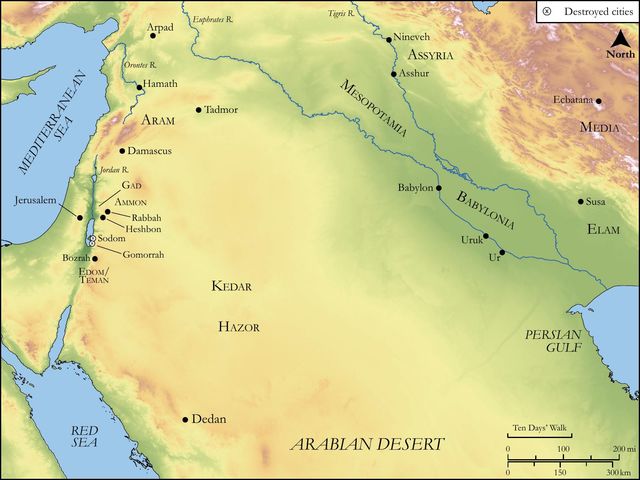
See on the biblical-era map
Study this verse
Public-domain commentary
Matthew Henry
From his Commentary on the Whole Bible. Henry comments on passages, not single verses — this entry covers Jeremiah 49:34–39.
This prophecy is dated in the beginning of Zedekiah's reign; it is probable that the other prophecies against the Gentiles, going before, were at the same time. The Elamites were the Persians, descended from Elam the son of Shem (Gen 10:22); yet some think it was only that part of Persia which lay nearest to the Jews which was called Elymais, and adjoined to Media-Elam, which, say they, had acted against God's Israel, bore the quiver in an expedition against them (Isa 22:6), and therefore must be reckoned with among the rest. It is here foretold, in general, that God will bring evil upon them, even his fierce anger, and that is evil enough, it has all evil in it, Jer 49:37. In particular, 1. Their forces shall be disabled, and rendered incapable of doing them any service. The Elamites were famous archers, but, Behold, I will break the bow of Elam (Jer 49:35), will ruin their artillery, and then the chief of their might is gone. God often orders it so that that which we most trust to first fails us, and that which was the chief of our might proves the least of our help. 2. Their people shall be dispersed. There shall come enemies against them from all parts of the world, and they shall all carry some of them away captive into their respective countries; while others shall flee, some one way and some another, to shift for themselves, so that there shall be no nation whither the outcasts of Elam shall not come, Jer 49:36. The four winds shall be brought upon them; the storm shall come sometimes from one point and sometimes from another, to toss and hurry them several ways. We know not from what point the wind of trouble may blow; but, if God encompass us with his favour, we are safe, and may be easy, which way soever the storm comes. Fear shall drive them into other countries; they shall be dismayed before their enemies; but, as if that were not enough, I will send the sword after them, Jer 49:37. Note, God can make his judgments follow those that think by flight to escape them and to get out of the reach of them. Evil pursues sinners. 3. Their princes shall be destroyed and the government quite changed (Jer 49:38): I will set my throne in Elam. The throne of Nebuchadnezzar shall be set there, or the throne of Cyrus, who began his conquests with Elymais. Or it may be meant of the throne on which God sits for judgment; he will make them know that he reigns, that he judges in the earth, that kings and princes are accountable to him, and that high as they are he is above them. The king of Elam was famous of old, Gen 14:1. Chedorlaomer was king of Elam, and a mighty man he was in his day; the nations about him served him; his successors, we may suppose, made a great figure; but the king of Elam is no more to God than another man. When God sets his throne in Elam he will destroy thence the king and the princes that are, and set up whom he pleases. 4. Yet the destruction of Elam shall not be perpetual (Jer 49:39): In the latter days I will bring again the captivity of Elam. When Cyrus had destroyed Babylon, brought the empire into the hands of the Persians, the Elamites no doubt returned in triumph out of all the countries whither they were scattered, and settled again in their own country. But this promise was to have its full and principal accomplishment in the days of the Messiah, when we find Elamites particularly among those who, when the Holy Ghost was given, heard spoken in their own tongues the wonderful works of God (Act 2:9, Act 2:11), and that is the most desirable return of the captivity. If the Son make you free, then you shall be free indeed.
Continue studying Jeremiah 49:35 across the web’s major study libraries — every link below opens this exact verse, chapter, or book on the destination site.
Read & Compare
 BibleGatewayThis verse in more than 200 translations and 70 languages.
 Bible.comThe YouVersion reader — hundreds of translations, reading plans, and highlights.
 ESV.orgCrossway's official English Standard Version reader.
 NET BibleThe NET translation with 60,000+ translators' notes on every rendering decision.
 STEP BibleTyndale House's free study tool — original text, vocabulary, and scholarly resources.
 BibliaLogos Bible Software's free web reader.
 USCCBThe New American Bible (Revised Edition) with the U.S. bishops' study notes.
Commentaries
 BibleHub CommentariesDozens of classic commentaries on this verse, gathered on one page.
 StudyLightMore than 100 commentary sets — the largest collection on the web.
 BibleRefPlain-English commentary on what this verse means, verse by verse.
 Enduring WordDavid Guzik's free commentary on this chapter, widely used by Bible teachers.
 Bible Study ToolsVerse commentary alongside Greek and Hebrew study aids.
Original Language & Research
- BibleHub InterlinearThe verse word by word — original language, transliteration, and English.
- BibleHub LexiconEvery word's original-language definition and Strong's entry.
 Blue Letter BibleDeep-study tools — Strong's numbers, concordance, and word studies.
 SefariaThe Hebrew text with Rashi and centuries of Jewish commentary.
Sermons, Hymns & Audio


TrulyRandomVerse is not affiliated with these sites and doesn’t control their content. They’re linked because they’re genuinely useful.
Summary
Jeremiah 49:35 presents a powerful oracle of divine judgment against Elam, an ancient kingdom renowned for its formidable military, particularly its archers. Through the prophet, the LORD of hosts declares His unalterable intention to shatter Elam's primary source of strength and confidence—its bow, which symbolizes its military might and national power. This pronouncement serves as a profound testament to God's absolute sovereignty over all nations, demonstrating that no earthly empire, regardless of its perceived strength or self-assurance, can withstand His ultimate will and decree.
Context
ShowHideLiterary Context
Jeremiah 49:35 is strategically positioned within a series of oracles against foreign nations (Jeremiah 46-51), a common feature in prophetic literature that underscores God's universal dominion. This collection demonstrates that Yahweh's authority and judgment extend beyond Israel to encompass all peoples and empires. Specifically, chapter 49 details judgments against Ammon, Edom, Damascus, Kedar, Hazor, and culminates with Elam (verses 34-39). The prophecy against Elam is one of the final pronouncements in this comprehensive series, emphasizing the breadth of God's sovereign reach. The verses immediately preceding 49:35 (Jeremiah 49:34) introduce the oracle as "the word of the LORD that came to Jeremiah the prophet concerning Elam in the beginning of the reign of Zedekiah king of Judah." The subsequent verses (Jeremiah 49:36-39) elaborate on the nature of Elam's downfall, describing how God will bring "four winds from the four quarters of heaven" upon them, scattering them and ultimately leading to their eventual restoration "in the latter days." Thus, verse 35 pinpoints the specific, decisive act of God that initiates Elam's demise, focusing on the core of their military might.
Historical & Cultural Context
Elam was an ancient civilization situated to the east of Babylon, primarily in what is now southwestern Iran, with its capital at Susa. Historically, Elam was a significant regional power, known for its formidable military capabilities, and especially for its highly skilled archers. Elamite archers were so renowned that they were often sought after as mercenaries by other armies, and their archery was deeply intertwined with their national identity and military reputation. The "bow of Elam" was therefore not merely a weapon but a potent symbol of their national strength, pride, and perceived invincibility. This particular prophecy is dated to the "beginning of the reign of Zedekiah" (Jeremiah 49:34), placing it around 597 BCE, a period of immense geopolitical instability in the ancient Near East following the first Babylonian siege of Jerusalem. God's judgment against such a militarily renowned power would have served as a stark and undeniable reminder to Judah and surrounding nations that no earthly kingdom, however mighty, was beyond His sovereign control or immune to His divine will.
Key Themes
ShowHideJeremiah 49:35 powerfully contributes to several overarching themes prevalent in the book of Jeremiah and the broader Old Testament. Foremost among these is Divine Sovereignty and Judgment. The emphatic declaration, "Thus saith the LORD of hosts," immediately establishes God's ultimate authority over all creation, including the rise and fall of nations. This theme is foundational throughout prophetic literature, underscoring that even the most powerful empires are merely instruments or objects within God's overarching divine plan, a truth vividly illustrated in Daniel's vision of successive kingdoms. Secondly, the prophecy highlights the Breaking of Human Power and Pride. By specifically targeting Elam's "bow" and "might," God directly confronts the source of their national confidence and perceived invincibility. This imagery of God breaking the instruments of war is a recurring biblical motif signifying complete defeat, the cessation of conflict, and the humbling of human arrogance, as powerfully echoed in Psalm 46:9. It serves as a profound reminder that all human strength is temporary and ultimately subservient to God's eternal purposes, a truth frequently emphasized by the prophets, as seen in Isaiah 2:22.
Exposition and Analysis
ShowHideKey Word Analysis
ShowHideA primitive root meaning "to burst (literally or figuratively); break (down, off, in pieces, up), broken (-hearted), crush, destroy, hurt, quench." This word conveys a sense of violent, decisive, and irreversible destruction. It signifies not merely a weakening but a complete shattering, rendering something utterly useless. In this context, it denotes the total dismantling of Elam's military capability and, by extension, its national power and confidence.
From the sense of bending; "a bow, for shooting (hence, figuratively, strength) or the iris." The bow was the quintessential weapon of the Elamites, symbolizing their military prowess, skill, and national might. To "break the bow" is to incapacitate their primary military asset, thereby disarming them and stripping them of their ability to wage war or defend themselves. It functions as a powerful metonymy for the destruction of their entire military force and the collapse of their national defense.
Feminine passive participle from the same as גִּבּוֹר; "force (literally or figuratively); by implication, valor, victory; force, mastery, might, mighty (act, power), power, strength." This term refers to the inherent strength, power, valor, and capacity for military action that defined Elam. The phrase "the chief of their might" emphasizes that the bow was not just one component of their strength, but the preeminent, foremost, and most defining aspect of their power and confidence. God's judgment is thus directed at the very core of what made Elam formidable and self-assured.
Verse Breakdown
ShowHide"Thus saith the LORD of hosts"
This opening formula is a classic prophetic declaration, serving to establish the divine origin and absolute authority of the message that follows. It unequivocally states that these are not Jeremiah's personal insights or political analyses, but the direct, unalterable decree of God Himself. The title "LORD of hosts" (Hebrew: Yahweh Sabaoth) profoundly emphasizes God's role as the supreme commander of all heavenly and earthly armies, highlighting His unmatched power and authority to execute His will against any earthly force or nation.
"Behold, I will break the bow of Elam"
The interjection "Behold" (Hebrew: hinneh) functions as an attention-grabbing device, drawing immediate focus to the impending, certain action. The declaration "I will break" clearly identifies God as the active agent, directly intervening to dismantle Elam's power. By specifically naming "the bow of Elam," the prophecy targets their most renowned military asset and symbol of strength, signifying not merely a defeat but a complete and devastating military incapacitation. This is depicted as a decisive, God-ordained shattering, rather than a gradual decline.
"the chief of their might"
This concluding phrase serves to amplify and clarify the profound significance of breaking the bow. It underscores that the bow was not merely one weapon among many, but the preeminent, most potent, and defining aspect of Elam's military and national strength. God's judgment is thus precisely aimed at the very heart of their power, ensuring a thorough and complete humbling of their national pride and confidence, leaving them utterly vulnerable.
Literary Devices
ShowHideJeremiah 49:35 employs several potent literary devices to convey its message with striking force and clarity. The most prominent is Metonymy, where "the bow of Elam" stands for the entire military force and, by extension, the national power and confidence of Elam. The act of breaking the bow thus represents the complete destruction of the nation's ability to wage war and its very source of perceived invincibility. This also functions as powerful Symbolism, with the bow representing not just a weapon, but Elam's identity, military prowess, and national pride. The phrase "Thus saith the LORD of hosts" is a quintessential Divine Fiat or Prophetic Formula, imbuing the pronouncement with absolute authority, certainty, and divine origin. The use of "Behold" (Hebrew: hinneh) serves as an Exclamatory Interjection, drawing the audience's immediate and urgent attention to the gravity and certainty of the impending divine action. The overall tone is one of unwavering Divine Judgment, delivered with precision, directly targeting the core of Elam's strength and pride.
Theological and Thematic Connections
ShowHideJeremiah 49:35 profoundly illustrates God's absolute sovereignty over all earthly powers and His unwavering commitment to justice. It underscores the theological truth that no nation, no matter how militarily formidable, technologically advanced, or self-assured, can ultimately stand against the sovereign will of the Almighty. The humbling of Elam, a proud and powerful kingdom, serves as a timeless reminder that human strength, military might, or national confidence are ultimately fleeting and entirely subservient to the divine plan. This passage powerfully reinforces the biblical principle that God alone is the true sovereign, actively orchestrating the rise and fall of empires according to His righteous purposes, often to humble the proud and demonstrate His unparalleled glory. It challenges any human tendency to place ultimate trust in earthly institutions, military capabilities, or national prowess rather than in the Creator and Sustainer of all things.
Reflection and Application
ShowHideJeremiah 49:35 offers both profound comfort and a sobering challenge for believers navigating the complexities of the modern world. In an era often characterized by geopolitical tensions, escalating military capabilities, and the shifting sands of global power dynamics, this verse serves as a powerful reminder that our ultimate security, stability, and hope do not rest in the strength of nations, economic prosperity, or human ingenuity. Instead, it directs our gaze to the "LORD of hosts," the One who holds all power in His hands and orchestrates all events according to His divine will. This foundational truth encourages a posture of humility, reminding us that pride in human achievements, national might, or personal capabilities is ultimately futile and misplaced. It calls us to place our unwavering trust and confidence in God's unfailing sovereignty, knowing that He is actively involved in the affairs of humanity, bringing about justice and fulfilling His eternal purposes. For those who feel overwhelmed by global events, the apparent strength of opposing forces, or personal struggles, this passage offers profound peace: God remains on His throne, and no power, earthly or spiritual, can ultimately thwart His perfect will. Our ultimate call is to align our lives with His eternal purposes, seeking His kingdom and righteousness above all else, and resting in His omnipotence.
Questions for Reflection
ShowHideFAQ
ShowHideWho was Elam and why was its bow significant?
ShowHideElam was an ancient civilization located to the east of Babylon, primarily in what is now southwestern Iran, with its capital at Susa. Historically, Elam was a significant regional power, widely renowned for its formidable military, and especially for its highly skilled archers. The "bow of Elam" was not merely a weapon; it was a powerful symbol of their national strength, military prowess, and perceived invincibility, deeply intertwined with their identity. Therefore, to "break the bow" was to dismantle their primary military asset and, by extension, their entire national confidence and power, signifying a complete and devastating defeat. This is precisely why God's judgment specifically targeted this symbol of their might, as clearly stated in Jeremiah 49:35.
What does the title "LORD of hosts" mean?
ShowHideThe title "LORD of hosts" (Hebrew: Yahweh Sabaoth) is a profound and frequently used divine title in the Old Testament that emphasizes God's supreme authority and power. The word "hosts" (Hebrew: tsâbâʼ) can refer to heavenly armies (angels), earthly armies, or by extension, to all creation—the entire ordered universe. Therefore, "LORD of hosts" portrays God as the supreme commander of all celestial and earthly forces, the sovereign ruler of the universe. It highlights His unmatched power and absolute authority to execute His decrees against any earthly force or nation, reinforcing that He is the ultimate power behind all events, as powerfully demonstrated throughout the Old Testament, such as in 1 Samuel 17:45 when David confronts Goliath.
Is this prophecy against Elam literally fulfilled?
ShowHideYes, historical evidence strongly suggests a literal fulfillment of this prophecy. While the precise timing and detailed circumstances are debated by scholars, Elam did suffer significant defeats and declines in power after Jeremiah's time, particularly at the hands of the Babylonians and later the Persians. The subsequent verses in Jeremiah 49:36-39 further detail the scattering of Elam's people and the eventual restoration of their fortunes "in the latter days," which some interpret as a spiritual or eschatological restoration, or a partial return of exiles. The immediate judgment, however, was a historical reality, demonstrating God's precise control over the destinies of nations, just as He foretold the fall of other mighty empires like Babylon in Jeremiah 50-51.
Christ-Centered Fulfillment
ShowHideJeremiah 49:35, with its declaration of God's sovereign power to break the might of nations, finds its ultimate and most profound fulfillment in the person and work of Jesus Christ. The "LORD of hosts" who shatters the bow of Elam is the same God who, in Christ, decisively broke the power of sin, death, and the spiritual forces of evil—the true "chief of their might" that held humanity captive. While earthly empires rise and fall, Christ established a kingdom that is eternal, unshakable, and transcends all human power structures. His crucifixion and resurrection represent the ultimate divine act of breaking the "bow" of the enemy, disarming principalities and powers and triumphing over them publicly (as powerfully described in Colossians 2:15). The earthly judgments pronounced by Jeremiah foreshadow the final and comprehensive judgment that Christ will execute upon all unrighteousness and rebellion at His glorious return, when He will come as the King of kings and Lord of lords, wielding ultimate authority and establishing His righteous, everlasting reign (as revealed in Revelation 19:11-16). Thus, the breaking of Elam's bow points to the comprehensive and cosmic victory of Christ, in whom all authority in heaven and on earth has been given (as declared in Matthew 28:18), ensuring that every knee will one day bow to Him and every tongue confess that Jesus Christ is Lord (as prophesied in Philippians 2:9-11).