


Jeremiah 49:37
- וְהַחְתַּתִּיve·hach·ta·Tiand I will shatterH2865Conj-w ¦ V-Hiphil-ConsecPerf-1csVerb Hiphil Consecutive Perfect 1st Singular common genderוְandהַחְתַּתִּיI will shatter
- אֶת'et<obj.>H853DirObjMParticle Object Indicator
- עֵילָם'Ei·lomElamH5867N-properNoun Proper Location
- לִפְנֵיlif·Nei<to> beforeH6440Prep-l ¦ N-mpcNoun Plural Masculine Constructלִ<to>פְנֵיbefore
- אֹיְבֵיהֶם'o·ye·vei·Hemtheir enemiesH341V-Qal-Prtcpl-mp ¦ 3mpVerb Qal Participle Plural Masculine Constructאֹיְבֵיenemiesהֶםtheir
- וְלִפְנֵיve·lif·Neiand <to> beforeH6440Conj-w ¦ Prep-l ¦ N-mpcNoun Plural Masculine Constructוְandלִ<to>פְנֵיbefore
- מְבַקְשֵׁיme·vak·Shei[those who] seekH1245V-Piel-Prtcpl-mpVerb Piel Participle Plural Masculine Construct
- נַפְשָׁםnaf·Sham<of> their lifeH5315N-fsc ¦ 3mpNoun Singular Feminine Constructנַפְשָׁ<of> lifeםtheir
- וְהֵבֵאתִיve·he·ve·Tiand I will bringH935Conj-w ¦ V-Hiphil-ConsecPerf-1csVerb Hiphil Consecutive Perfect 1st Singular common genderוְandהֵבֵאתִיI will bring
- עֲלֵיהֶם'a·lei·Hemon themH5921Prep ¦ 3mpPreposition Definiteעֲלֵיonהֶםthem
- רָעָהra·'AhcalamityH7451N-fsNoun Singular Feminine Absolute
- אֶת'et<obj.>H853DirObjMParticle Object Indicator
- חֲרוֹןcha·Ron[the] burning ofH2740N-mscNoun Singular Masculine Construct
- אַפִּי'a·Pimy angerH639N-msc ¦ 1csNoun Singular Masculine Constructאַפִּangerיmy
- נְאֻםne·'um[the] utterance ofH5002N-mscNoun Singular Masculine Construct
- יְהוָהYah·wehYahwehH3068N-properNoun Proper Title
- וְשִׁלַּחְתִּיve·shi·lach·Tiand I will sendH7971Conj-w ¦ V-Piel-ConsecPerf-1csVerb Piel Consecutive Perfect 1st Singular common genderוְandשִׁלַּחְתִּיI will send
- אַחֲרֵיהֶם'a·cha·rei·Hemafter themH310Adj-mpc ¦ 3mpAdjective Numerical Plural Masculine Constructאַחֲרֵיafterהֶםthem
- אֶת'et<obj.>H853DirObjMParticle Object Indicator
- הַחֶרֶבha·Che·revthe swordH2719Art ¦ N-fsNoun Singular Feminine Absoluteהַtheחֶרֶבsword
- עַד'aduntilH5704PrepPreposition
- כַּלּוֹתִיka·lo·TiI have made an end ofH3615V-Piel-Inf ¦ 1csVerb Piel Infinitive Constructכַּלּוֹתִhave made an end ofיI
- אוֹתָם'o·Tam<obj.> themH853DirObjM ¦ 3mpParticle Object Indicatorאוֹתָ<obj.>םthem
English is a literal word-by-word gloss of the Hebrew, not the KJV's wording. Why?
This is the original text the KJV's translators worked from — each Hebrew word with its own literal English meaning in this verse, prepared by scholars at Tyndale House, Cambridge. The KJV translates whole sentences, not word by word, so its wording differs: one Hebrew word can become several English words, and the KJV may choose “the LORD” where the gloss reads “Yahweh”. Both are faithful — they answer different questions. For the KJV's own rendering, switch to the KJV text.
Details
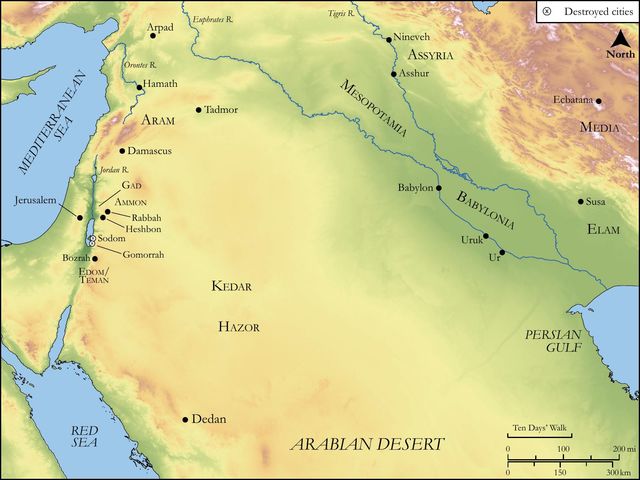
See on the biblical-era map
Study this verse
Public-domain commentary
Matthew Henry
From his Commentary on the Whole Bible. Henry comments on passages, not single verses — this entry covers Jeremiah 49:34–39.
This prophecy is dated in the beginning of Zedekiah's reign; it is probable that the other prophecies against the Gentiles, going before, were at the same time. The Elamites were the Persians, descended from Elam the son of Shem (Gen 10:22); yet some think it was only that part of Persia which lay nearest to the Jews which was called Elymais, and adjoined to Media-Elam, which, say they, had acted against God's Israel, bore the quiver in an expedition against them (Isa 22:6), and therefore must be reckoned with among the rest. It is here foretold, in general, that God will bring evil upon them, even his fierce anger, and that is evil enough, it has all evil in it, Jer 49:37. In particular, 1. Their forces shall be disabled, and rendered incapable of doing them any service. The Elamites were famous archers, but, Behold, I will break the bow of Elam (Jer 49:35), will ruin their artillery, and then the chief of their might is gone. God often orders it so that that which we most trust to first fails us, and that which was the chief of our might proves the least of our help. 2. Their people shall be dispersed. There shall come enemies against them from all parts of the world, and they shall all carry some of them away captive into their respective countries; while others shall flee, some one way and some another, to shift for themselves, so that there shall be no nation whither the outcasts of Elam shall not come, Jer 49:36. The four winds shall be brought upon them; the storm shall come sometimes from one point and sometimes from another, to toss and hurry them several ways. We know not from what point the wind of trouble may blow; but, if God encompass us with his favour, we are safe, and may be easy, which way soever the storm comes. Fear shall drive them into other countries; they shall be dismayed before their enemies; but, as if that were not enough, I will send the sword after them, Jer 49:37. Note, God can make his judgments follow those that think by flight to escape them and to get out of the reach of them. Evil pursues sinners. 3. Their princes shall be destroyed and the government quite changed (Jer 49:38): I will set my throne in Elam. The throne of Nebuchadnezzar shall be set there, or the throne of Cyrus, who began his conquests with Elymais. Or it may be meant of the throne on which God sits for judgment; he will make them know that he reigns, that he judges in the earth, that kings and princes are accountable to him, and that high as they are he is above them. The king of Elam was famous of old, Gen 14:1. Chedorlaomer was king of Elam, and a mighty man he was in his day; the nations about him served him; his successors, we may suppose, made a great figure; but the king of Elam is no more to God than another man. When God sets his throne in Elam he will destroy thence the king and the princes that are, and set up whom he pleases. 4. Yet the destruction of Elam shall not be perpetual (Jer 49:39): In the latter days I will bring again the captivity of Elam. When Cyrus had destroyed Babylon, brought the empire into the hands of the Persians, the Elamites no doubt returned in triumph out of all the countries whither they were scattered, and settled again in their own country. But this promise was to have its full and principal accomplishment in the days of the Messiah, when we find Elamites particularly among those who, when the Holy Ghost was given, heard spoken in their own tongues the wonderful works of God (Act 2:9, Act 2:11), and that is the most desirable return of the captivity. If the Son make you free, then you shall be free indeed.
Continue studying Jeremiah 49:37 across the web’s major study libraries — every link below opens this exact verse, chapter, or book on the destination site.
Read & Compare
 BibleGatewayThis verse in more than 200 translations and 70 languages.
 Bible.comThe YouVersion reader — hundreds of translations, reading plans, and highlights.
 ESV.orgCrossway's official English Standard Version reader.
 NET BibleThe NET translation with 60,000+ translators' notes on every rendering decision.
 STEP BibleTyndale House's free study tool — original text, vocabulary, and scholarly resources.
 BibliaLogos Bible Software's free web reader.
 USCCBThe New American Bible (Revised Edition) with the U.S. bishops' study notes.
Commentaries
 BibleHub CommentariesDozens of classic commentaries on this verse, gathered on one page.
 StudyLightMore than 100 commentary sets — the largest collection on the web.
 BibleRefPlain-English commentary on what this verse means, verse by verse.
 Enduring WordDavid Guzik's free commentary on this chapter, widely used by Bible teachers.
 Bible Study ToolsVerse commentary alongside Greek and Hebrew study aids.
Original Language & Research
- BibleHub InterlinearThe verse word by word — original language, transliteration, and English.
- BibleHub LexiconEvery word's original-language definition and Strong's entry.
 Blue Letter BibleDeep-study tools — Strong's numbers, concordance, and word studies.
 SefariaThe Hebrew text with Rashi and centuries of Jewish commentary.
Sermons, Hymns & Audio


TrulyRandomVerse is not affiliated with these sites and doesn’t control their content. They’re linked because they’re genuinely useful.
Summary
Jeremiah 49:37 powerfully declares the Lord's impending and comprehensive judgment against Elam, an ancient and formidable kingdom. This divine oracle unveils God's absolute sovereignty as He orchestrates Elam's utter dismay before its enemies, bringing upon them calamitous evil and the full force of His fierce anger. The prophecy culminates in the relentless pursuit of Elam by the sword, ensuring their complete consumption, thereby affirming that even the most powerful nations are subject to the righteous and unyielding decree of the Almighty.
Context
ShowHideLiterary Context
Jeremiah 49:37 is embedded within the "Oracles Against the Nations" (Jeremiah 46-51), a significant section of the book that underscores God's universal sovereignty extending beyond Israel to encompass all peoples and kingdoms. Specifically, this verse concludes a detailed prophecy against Elam, initiated in Jeremiah 49:34. The preceding verses describe Elam's pride and the Lord's resolve to break their power, particularly their renowned archers. The immediate literary flow sees this severe judgment followed by a surprising, yet characteristic, promise of future restoration for Elam in Jeremiah 49:39, demonstrating God's ultimate redemptive purposes even amidst pronouncements of judgment. This juxtaposition highlights the complex nature of divine justice, which often includes a horizon of future grace.
Historical & Cultural Context
Elam (Hebrew: ʻÊylâm, H5867), located in modern-day southwestern Iran, was an ancient civilization with a rich and often turbulent history, frequently clashing with Mesopotamian empires. Known for its formidable military, particularly its skilled archers, Elam had experienced periods of both regional dominance and subjugation. Jeremiah's prophecy, likely delivered during the late 7th or early 6th century BCE, would have resonated with the geopolitical realities of the time. The "enemies" mentioned in the verse most probably refer to the rising Neo-Babylonian Empire under Nebuchadnezzar, whom God often used as an instrument of judgment against various nations, including Judah and its neighbors. The cultural significance of Elam's military strength makes the divine declaration of their "dismay" and "consumption by the sword" a particularly devastating and ironic pronouncement of their utter defeat and humiliation, stripping them of their primary source of national pride and security.
Key Themes
ShowHideThis verse profoundly contributes to several overarching theological themes prevalent in Jeremiah and the broader prophetic corpus. Firstly, it powerfully asserts Divine Sovereignty, demonstrating that the Lord, Yahweh, is the supreme ruler of all nations, not merely a tribal deity. He raises up and casts down empires according to His sovereign will, a truth echoed in passages like Daniel 2:21. Secondly, it emphasizes Divine Judgment, illustrating that God's justice is universal and impartial, extending to all nations that engage in pride, idolatry, or opposition to His divine purposes, a principle clearly articulated in the oracles against nations found in Amos 1-2. Finally, the prophecy highlights the Consequences of Rebellion, underscoring that defiance against God's moral order or His chosen instruments of judgment inevitably leads to severe retribution, culminating in destruction and dismay, a recurring motif throughout the prophetic warnings in the book of Jeremiah.
Exposition and Analysis
ShowHideKey Word Analysis
ShowHideMeaning "to prostrate; hence, to break down, either (literally) by violence, or (figuratively) by confusion and fear; abolish, affright, be (make) afraid, amaze, beat down, discourage, (cause to) dismay, go down, scare, terrify." This word vividly conveys the psychological and spiritual impact of God's judgment on Elam. It signifies a complete collapse of courage, morale, and the will to resist, rendering them utterly helpless and terrified before their adversaries, far beyond mere military defeat.
(chârôwn) and H639 ('aph). Chârôwn denotes "a burning of anger; sore displeasure, fierce(-ness), fury, (fierce) wrath(-ful)." 'Aph literally refers to the "nose or nostril," but idiomatically signifies anger, stemming from the rapid breathing associated with intense passion. The combination chârôwn 'aph thus communicates an intense, consuming, and righteous indignation on God's part, signifying a powerful, unyielding, and holy wrath that will not subside until its destructive purpose is fully accomplished.
Meaning "to end, whether intransitive (to cease, be finished, perish) or transitived (to complete, prepare, consume); accomplish, cease, consume (away), determine, destroy (utterly), be (when... were) done, (be an) end (of), expire, (cause to) fail, faint, finish, fulfil, [idiom] fully, [idiom] have, leave (off), long, bring to pass, wholly reap, make clean riddance, spend, quite take away, waste." This word emphasizes the thoroughness, finality, and totality of the destruction God intends for Elam. It indicates that their power, identity, and existence as a significant national entity will be utterly brought to an end, leaving nothing remaining of their former strength.
Verse Breakdown
ShowHide"For I will cause Elam to be dismayed before their enemies"
This opening declaration immediately establishes the divine agency behind Elam's downfall. The Lord, Yahweh, asserts His active and direct role in orchestrating Elam's psychological and military collapse. He will ensure they are utterly terrified and rendered powerless, losing all courage and ability to resist in the presence of their adversaries. This is not a passive prediction but an active divine decree.
"and before them that seek their life"
This phrase intensifies the preceding declaration, specifying that Elam's profound dismay will occur directly in the face of those who are not merely seeking victory, but actively pursuing their very existence, their nephesh (H5315), aiming for their complete annihilation. It underscores the existential threat and the merciless nature of the impending judgment.
"and I will bring evil upon them, [even] my fierce anger"
Here, the Lord explicitly defines the nature of the "evil" (Hebrew: ra', H7451) He will inflict. This "evil" is not moral wickedness but calamitous judgment, a direct and devastating outpouring of God's intense, burning wrath (chârôwn 'aph, H2740, H639) against Elam. It is a righteous response to their actions or part of His sovereign plan for the nations.
"saith the LORD"
This is a critical prophetic formula, nᵉʼum Yᵉhôvâh (H5002, H3068), which authenticates the message as a direct, authoritative utterance from Yahweh, the covenant God of Israel and the sovereign ruler of all creation. It underscores the absolute certainty and divine authority of the prophecy, leaving no doubt about its origin or inevitable fulfillment.
"and I will send the sword after them"
This clause reveals the primary instrument of God's judgment: the sword (chereb, H2719), symbolizing warfare, violence, and military conquest. The phrase "send... after them" (ʼachar, H310) implies a relentless, pursuing judgment, indicating that the destructive force will follow Elam wherever they go, leaving no avenue of escape and ensuring their demise.
"till I have consumed them"
This concluding clause emphasizes the comprehensive and ultimate nature of the divine judgment. The sword will not merely wound or weaken Elam but will continue its destructive work until the nation is utterly "consumed" (kâlâh, H3615)—brought to an end, thoroughly devastated, or completely annihilated—thereby fulfilling the divine decree in its entirety.
Literary Devices
ShowHideJeremiah 49:37 is rich with powerful literary devices that amplify its message of divine judgment. The most prominent is Anthropomorphism, where God is described with human-like actions and emotions, such as "cause... to be dismayed," "bring evil," "my fierce anger," and "send the sword." This device makes God's active involvement, emotional intensity, and personal resolve in the judgment palpable and relatable. The phrase "fierce anger" is a vivid idiom (literally "burning of nose/face"), powerfully conveying intense, unyielding wrath. Metonymy is evident in "the sword," which stands for the entire apparatus and outcome of warfare, destruction, and military defeat. The entire verse functions as a prophecy of doom, a common genre in prophetic literature, characterized by its declarative and unalterable tone ("I will cause," "I will bring," "I will send") and its focus on future calamitous events as a direct result of divine decree. The repeated "I will" creates a strong sense of divine resolve and unwavering purpose, emphasizing God's absolute and unchallengeable sovereignty over the fate of nations.
Theological and Thematic Connections
ShowHideJeremiah 49:37 stands as a profound theological statement on God's universal sovereignty and His righteous judgment over all nations, not exclusively Israel. It unequivocally dismantles any limited view of divine jurisdiction, asserting that Yahweh is the supreme ruler of history, orchestrating the rise and fall of empires according to His perfect and unassailable will. The "fierce anger" mentioned is not a capricious outburst but a holy and just indignation against pride, injustice, and any opposition to His divine plan. This judgment, while severe and devastating, often serves a dual purpose: to punish sin and to clear the way for God's ultimate redemptive purposes, as subtly hinted at in the subsequent promise of Elam's future restoration. The verse serves as a stark reminder to all humanity that no nation, regardless of its power or perceived invincibility, is beyond divine accountability.
Reflection and Application
ShowHideJeremiah 49:37, though a prophecy of ancient judgment, carries profound and enduring relevance for contemporary reflection. It compels us to confront the undeniable reality of God's active involvement in human history and His unwavering commitment to justice. In a world often characterized by nationalistic pride, escalating geopolitical tensions, and the relentless pursuit of power, this verse serves as a sobering reminder that all earthly authorities and human endeavors are ultimately subordinate to the divine will. It challenges us to critically examine the moral and spiritual health of our own nations, recognizing that God's immutable principles of righteousness and accountability apply universally. For the individual believer, this prophecy fosters a deeper trust in God's sovereign control, even amidst global turmoil and uncertainty, and encourages profound humility, knowing that all human plans and achievements are subject to His ultimate decree. It also calls us to fervent intercession for our leaders and nations, seeking alignment with God's righteous purposes rather than defiance or self-reliance.
Questions for Reflection
ShowHideFAQ
ShowHideWhat was Elam, and why was it singled out for prophecy?
ShowHideElam (H5867, ʻÊylâm) was an ancient and powerful civilization located in what is now southwestern Iran, situated east of Mesopotamia. It had a long and often contentious history with its Mesopotamian neighbors, including Sumer, Akkad, and Babylon. Jeremiah singled out Elam, along with other surrounding nations such as Ammon, Edom, Damascus, and Kedar, to unequivocally demonstrate the Lord's universal sovereignty and His supreme authority over all peoples and kingdoms, not merely His covenant people, Judah. These prophecies served to illustrate that God's righteous judgment was not confined to Israel but extended to all who acted in pride, engaged in idolatry, or stood in opposition to His divine plan for history, often utilizing the rising Neo-Babylonian Empire as His instrument of judgment (as seen in Jeremiah 25:9).
Does God's "fierce anger" mean He is capricious or unjust?
ShowHideNo, God's "fierce anger" (H2740, chârôwn H639, 'aph) in this biblical context does not imply capriciousness, irrationality, or injustice. In biblical theology, divine anger is consistently portrayed as righteous, holy, and purposeful, a just response to human sin, rebellion, and unrighteousness. It is an expression of God's perfect and immutable character, which, by its very nature, cannot tolerate ungodliness or moral corruption. While such anger leads to severe and devastating judgment, it is always consistent with His moral law, His covenant faithfulness, and His overarching sovereign plan. In the case of nations like Elam, their judgment was often tied to their idolatry, violence, oppression, or direct opposition to God's people or His broader redemptive purposes, a pattern evident in various prophecies against nations found in Isaiah 13-23 and Ezekiel 25-32.
Christ-Centered Fulfillment
ShowHideWhile Jeremiah 49:37 speaks directly to God's judgment on an ancient nation, its foundational message of divine sovereignty and the ultimate accountability of all earthly powers finds its profound and ultimate fulfillment in Jesus Christ. Christ is revealed as the one through whom God's sovereign rule is fully established, extending not merely over individual nations but over all creation, both visible and invisible. The "fierce anger" of God against sin, so vividly portrayed in this verse, is supremely and paradoxically manifested in the cross. There, the righteous wrath due to humanity's rebellion against a holy God was poured out upon the Lamb of God, Jesus Christ, who willingly became sin for us (as explained in 2 Corinthians 5:21). Through His death and resurrection, Christ disarmed and triumphed over the spiritual powers and authorities (as described in Colossians 2:15), demonstrating His ultimate dominion over all forces, spiritual and earthly, that seek to oppose God. The "sword" of judgment, though literal for Elam, becomes a powerful metaphor for the "word of God, which is living and active, sharper than any two-edged sword" (Hebrews 4:12), by which Christ judges and rules. Ultimately, the King of kings and Lord of lords, Jesus Christ, will return in glory to execute final judgment and establish His eternal kingdom, where all nations and peoples will bow before Him, either in willing submission or in righteous judgment, thereby fulfilling the universal scope of God's sovereignty declared in Jeremiah 49:37 (as powerfully prophesied in Revelation 19:11-16).