


Jeremiah 48:2
- אֵין'einthere notH369N-mscNoun Singular Masculine Construct
- עוֹד'OdagainH5750Adj-msAdjective Numerical Singular Masculine Absolute
- תְּהִלַּתte·hi·Lat[will be] [the] praise ofH8416N-fscNoun Singular Feminine Construct
- מוֹאָבmo·'AvMoabH4124N-properNoun Proper Location
- בְּחֶשְׁבּוֹןbe·chesh·Bonin HeshbonH2809Prep-b ¦ N-properNoun Proper LocationבְּinחֶשְׁבּוֹןHeshbon
- חָשְׁבוּcha·she·Vupeople have plannedH2803V-Qal-Perf-3cpVerb Qal Perfect 3rd Plural common gender
- עָלֶיהָ'a·Lei·haon itH5921Prep ¦ 3fsPreposition Definiteעָלֶיonהָit
- רָעָהra·'AhcalamityH7451N-fsNoun Singular Feminine Absolute
- לְכוּle·KhucomeH1980V-Qal-Imp-2mpVerb Qal Imperative 2nd Plural Masculine
- וְנַכְרִיתֶנָּהve·nakh·ri·Te·nahand let us cut off itH3772Conj-w ¦ V-Hiphil-ConjImperf-1cp ¦ 3fsVerb Hiphil Conjunction+Imperfect 1st Plural common genderוְandנַכְרִיתֶlet us cut offנָּהit
- מִגּוֹיmi·Goyfrom a nationH1471Prep-m ¦ N-msNoun Singular Masculine Absoluteמִfromגּוֹיa nation
- גַּםgamalsoH1571AdvAdverb
- מַדְמֵןmad·MenO MadmenH4086N-properNoun Proper Location
- תִּדֹּמִּיti·Do·miyou will be silentH1826V-Qal-Imperf-2fsVerb Qal Imperfect 2nd Singular Feminine
- אַחֲרַיִךְ'a·cha·Ra·yikhafter youH310Adj-mpc ¦ 2fsAdjective Numerical Plural Masculine Constructאַחֲרַיִafterךְyou
- תֵּלֶךְTe·lekhit will goH1980V-Qal-Imperf-3fsVerb Qal Imperfect 3rd Singular Feminine
- חָרֶבCha·rev[the] swordH2719N-fsNoun Singular Feminine Absolute
English is a literal word-by-word gloss of the Hebrew, not the KJV's wording. Why?
This is the original text the KJV's translators worked from — each Hebrew word with its own literal English meaning in this verse, prepared by scholars at Tyndale House, Cambridge. The KJV translates whole sentences, not word by word, so its wording differs: one Hebrew word can become several English words, and the KJV may choose “the LORD” where the gloss reads “Yahweh”. Both are faithful — they answer different questions. For the KJV's own rendering, switch to the KJV text.
Details
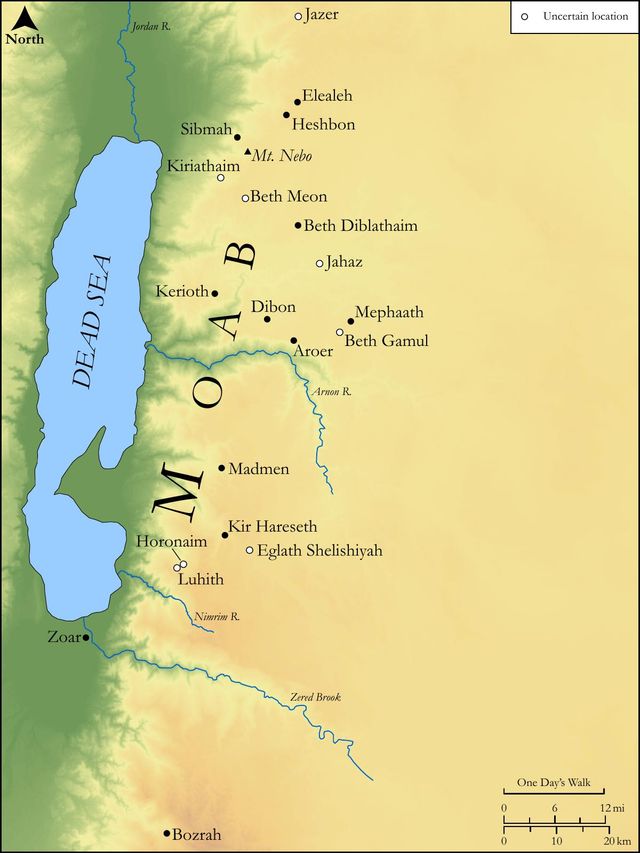
See on the biblical-era map
Study this verse
Public-domain commentary
Matthew Henry
From his Commentary on the Whole Bible. Henry comments on passages, not single verses — this entry covers Jeremiah 48:1–13. His three-level outline is real structure in the source text, so it is rendered as structure.
We may observe in these verses,
I.The author of Moab's destruction; it is the Lord of hosts, that has armies, all armies, at his command, and the God of Israel (Jer 48:1), who will herein plead the cause of his Israel against a people that have always been vexatious to them, and will punish them now for the injuries done to Israel of old, though Israel was forbidden to meddle with them (Deu 2:9), therefore the destruction of Moab is called the work of the Lord (Jer 48:10), for it is he that pleads for Israel; and his work will exactly agree with his word, Jer 48:8.
II.The instruments of it:
Spoilers shall come (Jer 48:8), shall come with a sword, a sword that shall pursue them, Jer 48:2. "I will send unto him wanderers, such as come from afar, as if they were vagrants, or had missed their way, but they shall cause him to wander; they seem as wanderers themselves, but they shall make the Moabites to be really wanderers, some to flee and others to be carried into captivity." These destroyers stir up themselves to do execution; they have devised evil against Heshbon, one of the principal cities of Moab, and they aim at no less than the ruin of the kingdom: Come, and let us cut it off from being a nation (Jer 48:2); nothing less will serve the turn of the invaders; they come, not to plunder it, but to ruin it. The prophet, in God's name, engages them to make thorough work of it (Jer 48:10): Cursed be he that does the work of the Lord deceitfully, this bloody work, this destroying work; though it goes against the grain with men of compassion, yet it is the work of the Lord, and must not be done by the halves. The Chaldeans have it in charge, by a secret instinct (says Mr. Gataker), to destroy the Moabites, and therefore they must not spare, must not, out of foolish pity, keep back their sword from blood; they would thereby bring a sword, and a curse with it, upon themselves, as Saul did by sparing the Amalekites and Ahab by letting Benhadad go. Thy life shall go for his life. To this work is applied that general rule given to all that are employed in any service for God, Cursed by he that does the work of the Lord deceitfully or negligently, that pretends to do it, but does it not to purpose, makes a show of serving God's glory, but is really serving his own ends and carries on the work of the Lord no further than will suit his own purposes, or that is slothful in business for God and takes neither care nor pains to do it as it should be done, Mal 1:14. Let not such deceive themselves, for God will not thus be mocked.
III.The woeful instances and effects of this destruction.
The cities shall be laid in ruins; they shall be spoiled (Jer 48:1) and cut down (Jer 48:2); they shall be desolate (Jer 48:9), without any to dwell therein; there shall be no houses to dwell in, or no people to dwell in them, or no safety and ease to those that would dwell in them. Every city shall be spoiled and no city shall escape. The strongest city shall not be able to secure itself against the enemies' power, nor shall the finest city be able to recommend itself to the enemies' pity and favour. The country also shall be wasted, the valley shall perish, and the plain be destroyed, Jer 48:8. The corn and the flocks, which used to cover the plains and make the valleys rejoice, shall all be destroyed, eaten up, trodden down, or carried off. The most sacred persons shall not escape: The priests and princes shall go together into captivity. Nay, Chemosh, the god they worship, who, they hope, will protect them, shall share with them in the ruin; his temples shall be laid in ashes and his image carried away with the rest of the spoil. Now the consequence of all this will be,
1.Great shame and confusion: Kirjathaim is confounded, and Misgah is so. They shall be ashamed of the mighty boasts they have sometimes made of their cities: There shall be no more vaunting in Moab concerning Heshbon (so it might be read, Jer 48:2); they shall no more boast of the strength of that city when the evil which is designed against it is brought upon it. Nor shall they any more boast of their gods (Jer 48:13); they shall be ashamed of Chemosh (ashamed of all the prayers they have made to and all the confidence they put in that dunghill deity), as Israel was ashamed of Beth-el, of the golden calf they had at Beth-el, which they confided in as their protector, but were deceived in, for it was not able to save them from the Assyrians; nor shall Chemosh be able to save the Moabites from the Chaldeans. Note, Those that will not be convinced and made ashamed of the folly of their idolatry by the word of God shall be convinced and made ashamed of it by the judgments of God, when they shall find by woeful experience the utter inability of the gods they have served to do them any service.
2.There will be great sorrow; there is a voice of crying heard (Jer 48:3) and the cry is nothing but spoiling and great destruction. Alas! alas! Moab is destroyed, Jer 48:4. The great ones having quitted the cities to shift for their own safety, even the little ones have caused a cry to be heard, the meaner sort of people, or the little children, the innocent harmless ones, whose cries at such a time are the most piteous. Go up to the hills, go down to the valleys, and you meet with continual weeping (weeping with weeping); all are in tears; you meet none with dry eyes. Even the enemies have heard the cry, from whom it would have been policy to conceal it, for they will be animated and encouraged by it; but it is so great that it cannot be hid,
3.There will be great hurry; they will cry to one another, "Away, away! flee; save your lives (Jer 48:6); shift for your own safety with all imaginable speed, though you escape as bare and naked as the heath, or grig, or dry shrub, in the wilderness; think not of carrying away any thing you have, for it may cost you your life to attempt it, Mat 24:16-18. Take shelter, though it be in a barren wilderness, that you may have your lives for a prey. The danger will come suddenly and swiftly; and therefore give wings unto Moab (Jer 48:9); that would be the greatest kindness you could do them; that is what they will call for, O that we had wings like a dove! for unless they have wings, and can fly, there will be no escaping."
IV.The sins for which God will now reckon with Moab, and which justify God in these severe proceedings against them.
1.It is because they have been secure, and have trusted in their wealth and strength, in their works and in their treasures, Jer 48:7. They had taken a great deal of pains to fortify their cities and make large works about them, and to fill their exchequer and private coffers, so that they thought themselves in as good a posture for war as any people could be and that none durst invade them, and therefore set danger at defiance. They trusted in the abundance of their riches and strengthened themselves in their wickedness, Psa 52:7. Now, for this reason, that they may have a sensible conviction of the vanity and folly of their carnal confidences, God will send an enemy that will master their works and rifle their treasures. Note, We forfeit the comfort of that creature which we repose that confidence in which should be reposed in God only. The reed will break that is leaned upon.
2.It is because they have not made a right improvement of the days of the peace and prosperity, Jer 48:11.
(1.)They had been long undisturbed: Moab has been at ease from his youth. It was an ancient kingdom before Israel was, and had enjoyed great tranquillity, though a small country and surrounded with potent neighbours. God's Israel were afflicted from their youth (Psa 129:1, Psa 129:2), but Moab at ease from his youth. He has not been emptied from vessel to vessel, has not known any troublesome weakening changes, but is as wine kept on the lees, and not racked or drawn off, by which it retains its strength and body. He has not been unsettled, nor any way made uneasy; he has not gone into captivity, as Israel have often done, and yet Moab is a wicked idolatrous nation, and one of the confederates against God's hidden ones, Psa 83:3, Psa 83:6. Note, There are many that persist in unrepented iniquity and yet enjoy uninterrupted prosperity.
(2.)They had been as long corrupt and unreformed: He has settled on his lees; he has been secure and sensual in his prosperity, has rested in it, and fetched all the strength and life of the soul from it, as the wine from the lees. His taste remained in him, and his scent is not changed; he is still the same, as bad as ever he was. Note, While bad people are as happy as they used to be in the world it is no marvel if they are bad as they used to be. They have no changes of their peace and prosperity, therefore fear not God, their hearts and lives are unchanged, Psa 55:19.
Continue studying Jeremiah 48:2 across the web’s major study libraries — every link below opens this exact verse, chapter, or book on the destination site.
Read & Compare
 BibleGatewayThis verse in more than 200 translations and 70 languages.
 Bible.comThe YouVersion reader — hundreds of translations, reading plans, and highlights.
 ESV.orgCrossway's official English Standard Version reader.
 NET BibleThe NET translation with 60,000+ translators' notes on every rendering decision.
 STEP BibleTyndale House's free study tool — original text, vocabulary, and scholarly resources.
 BibliaLogos Bible Software's free web reader.
 USCCBThe New American Bible (Revised Edition) with the U.S. bishops' study notes.
Commentaries
 BibleHub CommentariesDozens of classic commentaries on this verse, gathered on one page.
 StudyLightMore than 100 commentary sets — the largest collection on the web.
 BibleRefPlain-English commentary on what this verse means, verse by verse.
 Enduring WordDavid Guzik's free commentary on this chapter, widely used by Bible teachers.
 Bible Study ToolsVerse commentary alongside Greek and Hebrew study aids.
Original Language & Research
- BibleHub InterlinearThe verse word by word — original language, transliteration, and English.
- BibleHub LexiconEvery word's original-language definition and Strong's entry.
 Blue Letter BibleDeep-study tools — Strong's numbers, concordance, and word studies.
 SefariaThe Hebrew text with Rashi and centuries of Jewish commentary.
Sermons, Hymns & Audio


TrulyRandomVerse is not affiliated with these sites and doesn’t control their content. They’re linked because they’re genuinely useful.
Summary
Jeremiah 48:2 pronounces a decisive end to Moab's former glory and national identity, declaring that its esteemed status and the praise it once enjoyed will utterly cease. The verse reveals a malicious plot orchestrated in Heshbon by Moab's enemies to dismantle it completely as a nation, culminating in a relentless and inescapable military pursuit that will silence even smaller cities like Madmen, thereby underscoring the comprehensive and inescapable nature of God's judgment upon a proud and idolatrous people.
Context
ShowHideLiterary Context
Jeremiah 48 is a comprehensive oracle of judgment against Moab, forming a significant portion of the larger collection of prophecies against foreign nations found in Jeremiah 46-51. This section of Jeremiah's prophecy serves to demonstrate Yahweh's universal sovereignty, proving that His authority extends far beyond Israel to encompass all peoples and their destinies. Within this specific chapter, verse 2 introduces the overarching theme of Moab's utter humiliation and the active role of its enemies in bringing about its downfall. It sets the stage for the detailed descriptions of devastation that follow, impacting various cities and regions of Moab, and emphasizing the totality of the impending destruction through vivid, often poetic, pronouncements. The oracle contrasts Moab's self-exaltation with its coming ignominy.
Historical & Cultural Context
Moab was an ancient nation situated on the plateau east of the Dead Sea, a region known for its fertility and strategic trade routes. Descended from Lot (Genesis 19:37), the Moabites were often in conflict or uneasy alliance with Israel. They were notorious for their profound pride, their considerable wealth, and their deep-seated idolatry, particularly the worship of the detestable god Chemosh, to whom they offered human sacrifices (Numbers 21:29). Heshbon, mentioned in the verse, was a strategically important city, originally Amorite, later Moabite, and sometimes claimed by Reuben, situated on a key trade route. Madmen, though less prominent, is included to emphasize the widespread nature of the judgment, affecting both major and minor settlements. The "devised evil" likely refers to the military strategies of conquering powers, primarily Babylon, whom God would use as instruments of His righteous wrath against Moab's arrogance and idolatry.
Key Themes
ShowHideThis verse powerfully contributes to several overarching themes within Jeremiah and the broader prophetic literature. Firstly, it underscores the theme of Divine Judgment against national pride and idolatry, illustrating that no nation, however seemingly secure or powerful, is exempt from God's righteous wrath when it opposes His will or exalts itself. Secondly, it highlights the End of National Identity and Praise, as Moab's reputation, glory, and very existence as a distinct political entity are threatened. This loss of "praise" stands in stark contrast to Moab's historical self-exaltation, a theme also prominently addressed in Isaiah 16:6. Thirdly, the verse reveals God's use of Human Agents in Judgment, as the enemies "devise evil," demonstrating that even the malicious intentions and strategic plans of nations can serve God's ultimate sovereign purposes, bringing about His predetermined will. Finally, the repeated emphasis on "cutting off" and "pursuit by the sword" signifies Total Desolation and Inescapable Consequence, a recurring motif in prophecies of judgment against those who defy the Almighty.
Exposition and Analysis
ShowHideKey Word Analysis
ShowHideThis word, derived from a root meaning "to laud," refers to laudation, a hymn, or specifically a song of praise. In the context of Moab, it signifies their reputation, glory, or the accolades they received or sought among nations. The declaration "no more praise of Moab" means the complete cessation of their esteemed status, their national pride, and any recognition of their former achievements or strength. It implies a profound stripping away of their honor and a descent into ignominy, reflecting a loss of all that they boasted in.
A primitive root meaning "to plait or interpenetrate," which figuratively extends to "to plot or contrive," often in a malicious sense. It implies careful, deliberate planning, calculation, and forethought. When applied to Heshbon, it indicates that the enemies of Moab were not acting impulsively but had thoughtfully and strategically plotted the nation's downfall, intending great harm and destruction. This highlights the premeditated and calculated nature of the assault against Moab.
This term refers to a foreign nation or Gentile people, and sometimes figuratively to a troop of animals. Here, it denotes Moab's status as a distinct political and ethnic entity with its own sovereignty. The phrase "cut it off from being a nation" signifies the complete obliteration of Moab's national sovereignty, independence, and unique identity on the world stage. It is not merely a military defeat but an existential threat, aiming for their disappearance as a recognized people.
A primitive root meaning "to be dumb," "astonished," "to stop," or "to perish." In this context, it conveys the idea of being silenced, brought to an end, or utterly destroyed. Applied to Madmen, it emphasizes the sudden and complete cessation of life, activity, and existence in that specific city, highlighting the pervasive and devastating impact of the judgment across Moabite territory, leading to its utter desolation and quietness of death.
Verse Breakdown
ShowHide"[There shall be] no more praise of Moab
This opening clause declares the definitive and irreversible end of Moab's former glory, reputation, and any reason for self-exaltation. It signifies a profound humiliation and the stripping away of its standing among nations, directly contrasting with its notorious pride and self-sufficiency.
in Heshbon they have devised evil against it;
This identifies Heshbon, a significant city within or near Moabite territory, as the strategic center where Moab's enemies (likely the Babylonians, acting as God's instruments) meticulously plot its destruction. The "evil" refers to a comprehensive and malicious plan for military conquest and devastation.
come, and let us cut it off from [being] a nation.
This is a direct declaration of the enemies' intent, reflecting their resolute determination to utterly annihilate Moab's national identity and sovereignty. "Cutting off from being a nation" implies total dismemberment, loss of independence, and the cessation of its existence as a distinct political entity on the world stage.
Also thou shalt be cut down, O Madmen; the sword shall pursue thee."
This final clause personalizes the judgment, addressing a specific Moabite city, Madmen. It powerfully reinforces the theme of complete destruction ("cut down," implying silence or death) and the relentless, inescapable nature of the military pursuit by the "sword," which symbolizes violent conquest, slaughter, and death. The judgment is not just national but impacts individual cities and their inhabitants with pervasive devastation.
Literary Devices
ShowHideJeremiah 48:2 employs several potent literary devices to convey the severity and totality of Moab's impending judgment. Personification is evident in "no more praise of Moab," where "praise" (an abstract concept representing honor and reputation) is treated as something that can cease to exist, implying Moab itself will no longer be worthy of commendation or even existence as a distinct entity. The phrase "in Heshbon they have devised evil" utilizes Metonymy, where Heshbon, the city, stands in for the enemies or forces gathered within its walls who are planning Moab's destruction. The entire verse functions as a powerful Prophetic Oracle, a divine pronouncement delivered through the prophet, characterized by its declarative, authoritative, and irreversible tone. The repetition of the concept of "cutting off" ("cut it off from being a nation," "shalt be cut down") serves as a strong Repetitive Motif (or a form of Anaphora if the exact phrase were repeated at the beginning of clauses), powerfully emphasizing the totality and finality of Moab's destruction. Furthermore, the vivid image of "the sword shall pursue thee" is a striking example of Personification, giving the inanimate sword an active, relentless, and predatory quality, underscoring the inescapable and merciless nature of the judgment.
Theological and Thematic Connections
ShowHideJeremiah 48:2 powerfully illustrates God's absolute sovereignty over the nations, demonstrating that His judgment extends beyond Israel to encompass all peoples. It serves as a stark reminder that national pride, idolatry, and self-sufficiency ultimately lead to divine reckoning. Moab's downfall, meticulously planned by human adversaries but ultimately orchestrated by God, highlights that even the malicious intentions of men are subservient to His overarching purposes. This verse underscores the transient nature of earthly power and reputation when contrasted with the enduring power of God's word and His unwavering commitment to justice. The cessation of Moab's "praise" signifies the stripping away of all that they boasted in, revealing the emptiness and ultimate futility of glory apart from God.
Reflection and Application
ShowHideJeremiah 48:2 offers profound lessons for contemporary believers and nations alike. It serves as a powerful warning against the dangers of national pride, self-sufficiency, and the worship of anything other than the one true God. Just as Moab boasted in its wealth, strength, and perceived invincibility, modern societies often place their trust in economic power, military might, technological advancement, or cultural influence, forgetting their ultimate dependence on God. This verse reminds us that all earthly glory is fleeting and can be swiftly brought to nothing by divine decree. For individuals, it calls for profound humility, urging us not to boast in our achievements, status, or perceived self-sufficiency, but to recognize that true praise, lasting security, and enduring identity come only from God. It also reinforces the truth that God remains sovereign over all global events, using even the malicious schemes of wicked men to accomplish His righteous purposes. Therefore, our ultimate hope and allegiance must rest in His eternal kingdom, not in the shifting sands of earthly powers or the transient praises of human renown.
Questions for Reflection
ShowHideFAQ
ShowHideWhat was Moab's primary sin that led to this judgment?
ShowHideMoab's primary sins included excessive pride, self-sufficiency, and deep-seated idolatry, particularly the worship of the detestable god Chemosh. They often boasted in their wealth, perceived strength, and long-held peace, showing contempt for God's people and His ways. This pride and idolatry are recurring themes in the prophetic condemnations against them, as seen in Isaiah 16:6 and Jeremiah 48:29.
Who are "they" in Heshbon who devised evil against Moab?
ShowHideWhile the verse doesn't explicitly name them, the broader context of Jeremiah's prophecies against nations (Jeremiah 46-51) indicates that God would use the rising superpower of Babylon as His instrument of judgment. Therefore, "they" refers to the Babylonian forces and their strategists who would plan and execute the conquest of Moab, fulfilling God's predetermined judgment.
Did Moab truly cease to be a nation?
ShowHideYes, in the long term, Moab as a distinct political and ethnic entity eventually disappeared from history, absorbed into larger empires and losing its unique identity. While there might have been temporary periods of resurgence or habitation in the region, the prophetic declaration of being "cut off from being a nation" ultimately came to pass, signifying the end of their independent sovereignty and recognized national status. This fulfilled the divine decree that their "praise" would be no more.
Christ-Centered Fulfillment
ShowHideJeremiah 48:2, with its declaration of judgment against Moab's pride and the cessation of its praise, finds its ultimate Christ-centered fulfillment in the establishment of God's eternal kingdom, which stands in stark contrast to the fleeting nature of all earthly kingdoms. The pronouncement "no more praise of Moab" foreshadows the ultimate dismantling of all human systems, ideologies, and powers that exalt themselves against God. Christ, as the true King, came not to establish an earthly dominion built on pride, military might, or human glory, but a spiritual kingdom founded on humility, self-sacrifice, and divine love (John 18:36). The "evil devised" against Moab by human agents, yet sovereignly orchestrated by God, powerfully points to the cross, where the ultimate "evil" was devised by humanity against God's Son. Yet, God sovereignly used this act for the greatest good—the salvation of humanity, according to His predetermined plan (Acts 2:23). All earthly "nations" and their transient "praise" will eventually bow before the Lamb of God, whose praise endures forever. The "sword" that relentlessly pursues Moab finds its spiritual counterpart in the "sword" of God's living and active word, which judges all unrighteousness (Hebrews 4:12), and ultimately in the righteous judgment executed by Christ upon all who reject His rule at His glorious second coming (Revelation 19:15). Thus, Jeremiah 48:2 serves as a powerful reminder that all human glory fades, but the glory of Christ and His eternal kingdom is everlasting.