


Jeremiah 48:29
Bible text: King James Version (1769 Blayney text) · Public domain
Bible text: Berean Standard Bible · Public domain
Bible text: American Standard Version (1901) · Public domain
Bible text: World English Bible, Messianic edition · Public domain
Bible text: Geneva Bible (1599) · Public domain
Bible text: Young's Literal Translation · Public domain
- שָׁמַעְנוּsha·Ma'·nuwe have heardH8085V-Qal-Perf-1cpVerb Qal Perfect 1st Plural common gender
- גְאוֹןge·'on[the] pride ofH1347N-mscNoun Singular Masculine Construct
- מוֹאָבmo·'AvMoabH4124N-properNoun Proper Location
- גֵּאֶהge·'EhproudH1343Adj-msAdjective Singular Masculine Absolute
- מְאֹדme·'OdveryH3966Adj-msAdjective Numerical Singular Masculine Absolute
- גָּבְהוֹga·ve·Hoits haughtinessH1363N-msc ¦ 3msNoun Singular Masculine Constructגָּבְהhaughtinessוֹits
- וּגְאוֹנוֹu·ge·'o·Noand its prideH1347Conj-w ¦ N-msc ¦ 3msNoun Singular Masculine Constructוּandגְאוֹנprideוֹits
- וְגַאֲוָתוֹve·ga·'a·va·Toand its boastfulnessH1346Conj-w ¦ N-fsc ¦ 3msNoun Singular Feminine Constructוְandגַאֲוָתboastfulnessוֹits
- וְרֻםve·Rumand [the] loftiness ofH7312Conj-w ¦ N-mscNoun Singular Masculine Constructוְandרֻם[the] loftiness of
- לִבּוֹli·Boits heartH3820N-msc ¦ 3msNoun Singular Masculine Constructלִבּheartוֹits
English is a literal word-by-word gloss of the Hebrew, not the KJV's wording. Why?
This is the original text the KJV's translators worked from — each Hebrew word with its own literal English meaning in this verse, prepared by scholars at Tyndale House, Cambridge. The KJV translates whole sentences, not word by word, so its wording differs: one Hebrew word can become several English words, and the KJV may choose “the LORD” where the gloss reads “Yahweh”. Both are faithful — they answer different questions. For the KJV's own rendering, switch to the KJV text.
Details
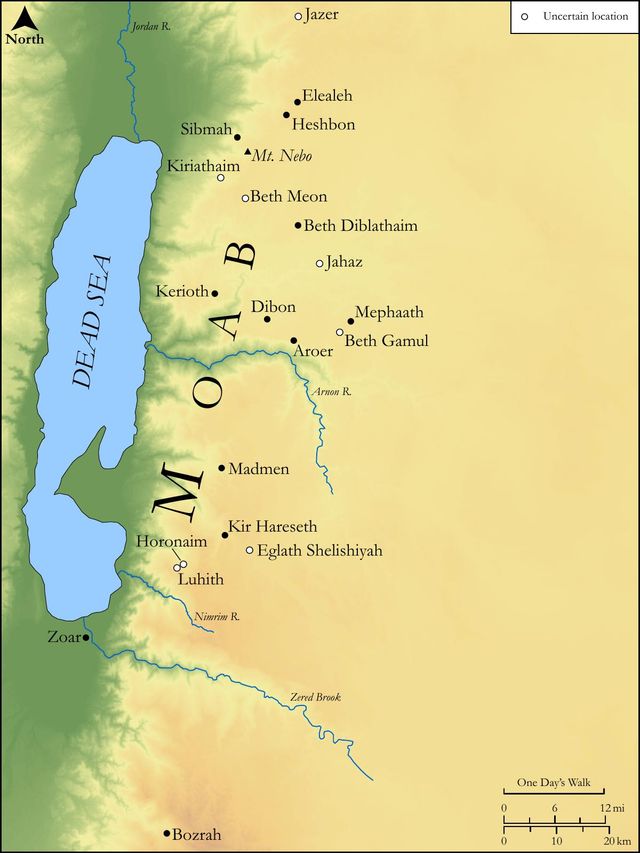
See on the biblical-era map
Study this verse
Public-domain commentary
Matthew Henry
From his Commentary on the Whole Bible. Henry comments on passages, not single verses — this entry covers Jeremiah 48:14–47. His two-level outline is real structure in the source text, so it is rendered as structure.
The destruction is here further prophesied of very largely and with a great copiousness and variety of expression, and very pathetically and in moving language, designed not only to awaken them by a national repentance and reformation to prevent the trouble, or by a personal repentance and reformation to prepare for it, but to affect us with the calamitous state of human life, which is liable to such lamentable occurrences, and with the power of God's anger and the terror of his judgments, when he comes forth to contend with a provoking people. In reading this long roll of threatenings, and meditating on the terror of them, it will be of more use to us to keep this in our eye, and to get our hearts thereby possessed with a holy awe of God and of his wrath, than to enquire critically into all the lively figures and metaphors here used.
I.It is a surprising destruction, and very sudden, that is here threatened.
They were very secure, thought themselves strong for war and able to deal with the most powerful enemy (Jer 48:14), and yet the calamity is near, and he is not able to keep it off, nor so much as to keep the enemy long in parley, for the affliction hastens fast (Jer 48:16) and will soon come to a crisis. The enemy shall fly as an eagle, so swiftly, so strongly shall he come (Jer 48:40), as an eagle flies upon his prey, and he shall spread his wings, the wings of his army, over Moab; he shall surround it, that none may escape. The strong-holds of Moab are taken by surprise (Jer 48:41), so that all their strength stood them in no stead; and this made the hearts even of their mighty men to fail, for they had not time to recollect the considerations that might have animated them. It requires a more than ordinary degree of courage not to be afraid of sudden fear.
II.It is an utter destruction, and such as lays Moab all in ruins:
Moab is spoiled (Jer 48:15), quite spoiled, is confounded and broken down (Jer 48:20); their cities are laid in ashes, or seized by the enemy so that they are forced to quit them, Jer 48:15. Divers cities are here named, upon which judgment has come, and the list concludes with an et cetera - and such like. What occasion was there for him to mention more particulars when it comes upon all the cities of Moab in general, far and near? Jer 48:21-24. Note, When iniquity is universal we have reason to expect that calamity should be so too. The kingdom is deprived of its dignity and authority: The horn of Moab is cut off, the horn of its strength and power, both offensive and defensive; his arm is broken, that he can neither give a blow nor prevent a blow, Jer 48:25. Is the youth of the kingdom the strength and beauty of it? His chosen young men have gone down to the slaughter, Jer 48:15. They went down to the battle promising themselves that they should return victorious; but God told them that they went down to the slaughter; so sure are those to fall against whom God fights. In a word, Moab shall be destroyed from being a people, Jer 48:42. Those that are enemies to God's people will soon be made no people.
III.It is a lamentable destruction; it will be just matter of mourning and will turn joy into heaviness.
1.The prophet that foretels it does himself lament it, and mourns at the very foresight of it, from a principle of compassion to his fellow-creatures and concern for human nature. The prophet will himself howl for Moab; his very heart shall mourn for them (Jer 48:31); he will weep for the vine of Sibmah (Jer 48:32); his heart shall sound like pipes for Moab, Jer 48:36. Though the destruction of Moab would prove him a true prophet, yet he could not think of it without trouble. The ruin of sinners is no pleasure to God, and therefore should be a pain to us; even those that give warning of it should lay it to heart. These passages, and many others in this chapter, are much the same with what Isaiah had used in his prophecies against Moab (Isa 15:1-9, Isa 16:1-14); for, though there was a long distance of time between that prophecy and this, yet they were both dictated by one and the same Spirit, and it becomes God's prophets to speak the language of those that went before them. It is no plagiarism sometimes to make use of old expressions, provided it be with new affections and applications.
2.The Moabites themselves shall lament it; it will be the greatest mortification and grief imaginable to them. Those that sat in glory, in the midst of wealth, and mirth, and all manner of pleasure, shall sit in thirst, in a dry and thirsty land, where no water, no comfort is, Jer 48:18. It is time for them to sit in thirst, and inure themselves to hardship, when the spoiler has come, who will strip them of all, and empty them. The Moabites in the remote corners of the country, that are furthest from the danger, will be inquisitive to know how the matter goes, what news from the army, will ask every one that escapes, What is done? Jer 48:19. And when they are told that all is gone, that the invader is the conqueror, they will howl and cry, in bitterness and anguish of spirit (Jer 48:20); they will abandon themselves to solitude, to lament the desolations of their country; they will leave the cities that used to be full of mirth, and dwell in the rock where they may have their full of melancholy; they shall no more be singing birds, but mourning birds, like the dove (Jer 48:28); the doves of the valley, Eze 7:16. Let those that give themselves up to mirth know that God can soon change their note. Their sorrow shall be so very extreme that they shall make themselves bald and cut themselves (Jer 48:37), which were expressions of a desperate grief, such as tempted men to be even their own destroyers. Job indeed rent his mantle and shaved his head, but he did not cut himself. When the flood of passion rises ever so high wisdom and grace must set bounds to it, set banks to it, to restrain it from such barbarities. The sorrow shall be universal (Jer 48:38): There shall be a general lamentation upon all the house-tops of Moab, where they worshipped their idols, to whom they shall in vain bemoan themselves, and in all the streets, where they conversed with one another, for they shall be free in communicating their grief and fears and in propagating them; for they see all lost: "I have broken Moab like a vessel wherein is no pleasure, which shall not be regarded and cannot be pieced again." That which Moab used to rejoice in was their pleasant fruits and the abundance of their rich wines. The delights of sense were all the matter of their joy. Take away these, destroy their gardens and vineyards, and you make all their mirth to cease, Hos 2:11, Hos 2:12. There is great weeping when their plants are transplanted, have gone over the sea (Jer 48:32), are carried into other countries, to be planted there. The spoiler has fallen upon thy summer-fruits and upon thy vintage, and it is this that makes the cry of Heshbon to reach even to Elealeh, Jer 48:34. Take joy and gladness from the plentiful field, and you take it from the land of Moab, Jer 48:33. If the wine fail from the wine-presses, that used to be trodden with acclamations of joy, all their gladness is cut off. Take away that shouting, and there shall be no shouting. Note, Those who make the delights of sense their chief joy, their exceeding joy, since these are things they may easily be deprived of in a little time subject themselves to the tyranny of the greatest grief; whereas those who rejoice in God may do that even when the fig-tree does not blossom and there is no fruit in the vine. These Moabites lost not only their wine, but their water too: Even the waters of Nimrim shall be desolate (Jer 48:34), and therefore their grief grew extravagantly loud and noisy, and their lamentations were heard in all placed like the lowing of a heifer of three years old. The expressions here are borrowed from Isa 15:5, Isa 15:6.
3.All their neighbours are called to mourn with them, and to condole with them on their ruin (Jer 48:17): All you that are about him bemoan him, Let him have that allay to his grief, let him see himself pities by the adjoining countries. Nay, let those at a distance, who do but know his name and have heard of his reputation, take notice of his fall, and say, How is the strong staff broken, whose strength was the terror of its enemies, and the beautiful rod, whose beauty was the pride of its friends! Let the nations take notice of this and receive instruction. Let none be puffed up with or put confidence in their strength or beauty, for neither will be a security against the judgments of God.
IV.It is a shameful destruction and such as shall expose them to contempt:
Moab is made drunk (Jer 48:26), and he that is made drunk is made vile; he shall wallow in his vomit, and become an odious spectacle, and shalljustly be in derision. Let the Moabites be intoxicated with the cup of God's wrath till they stagger and fall, and be brought to their wits' end, and make themselves ridiculous by the wildness not only of their passions but of their counsels. And again (Jer 48:39): Moab shall be a derision and a dismaying to all about him; they shall laugh at the fall of the pomp and power he was so proud of. Note, Those that are haughty are preparing reproach and ignominy for themselves.
V.It is the destruction of that which is dear to them, not only of their summer fruits and their vintage, but of their wealth (Jer 48:36):
The riches that he has gotten have perished, though he thought he had laid them up very safely, and promised himself a long enjoyment of them, yet they are gone. Note, The money that is hoarded in the chest is as liable to perishing as the summer-fruits that lie exposed in the open field. Riches are shedding things, and, like dust as they are, slip through our fingers even when we are in most care to hold them fast and gripe them hard. Yet this is not the worst; even those whose religion was false and foolish were fond of it above any thing, and, such as it was, would not part with it; and therefore, though it was really a promise, yet to them it was a threatening (Jer 48:35), that God will cause to cease him that offers in the high places, for the high places shall be destroyed, and the fields of offerings shall be laid waste, and the priests themselves, who burnt incense to their gods, shall be slain or carried into captivity, Jer 48:7. Note, It is only the true religion, and the worship and service of the true God, that will stand us in stead in a day of trouble.
VI.It is a just and righteous destruction, and that which they have deserved and brought upon themselves by sin.
1.The sin which they had been most notoriously guilty of, and for which God now reckoned with them, was pride. It is mentioned six times, Jer 48:29. We have all heard of the pride of Moab; his neighbours took notice of it; it has testified to his face, as Israel's did; he is exceedingly proud, and grows worse and worse. Observe his loftiness, his arrogancy, his pride, his haughtiness; the multiplying of words to the same purport intimates in how many instances he discovered his pride, and how offensive it was both to God and man. It was charged upon them Isa, Jer 16:6, but here it is expressed more largely that there. Since then they had been under humbling providences, and yet were unhumbled; nay, they grew more arrogant and haughty, which plainly marked them for that utter destruction of which pride is the forerunner. Two instances are here given of the pride of Moab: - (1.) He had conducted himself insolently towards God. He must be brought down with shame (Jer 48:26), for he has magnified himself against the Lord; and again (Jer 48:42), he shall be destroyed from being a people, for this very reason. The Moabites preferred Chemosh before Jehovah, and thought themselves a match for the God of Israel, whom they set at defiance. (2.) He had conducted himself scornfully towards Israel, particularly in their late troubles; therefore Moab shall fall into the same troubles; into the same hands, and be a derision, for Israel was a derision to him, Jer 48:26, Jer 48:27. The generality of the Moabites, when they heard of the calamities and desolations of their neighbours the Jews, instead of lamenting them, rejoiced in them, they skipped for joy. Many, in such a case, entertain in their minds a secret pleasure at the fall of those they had a dislike to, who yet have so much discretion as to conceal it; it is so invidious a thing. But the Moabites industriously proclaimed their joy, and avowed the enmity they had to Israel, triumphing over every Israelite they met with in distress and laughing at him, which was as inhuman as it was impious and an impudent affront both to man, whose nature they were of, and to God, whose name they were called by. Note, Those that deride others in distress will justly and certainly, sooner or later, come into distress themselves, and be had in derision. Those that are glad at calamities, especially the calamities of God's church, shall not long go unpunished.
2.Besides this they had been guilty of malice against God's people, and treachery in their dealings with them, Jer 48:30. They made a jest of the desolations of Judah and Jerusalem, and pretended, when they laughed at them, that it was but in sport and to make themselves merry; but, says God, "I know his wrath; I know it comes from the old enmity he has to the seed of Abraham and the worshippers of the true God. I know he thinks these calamities of the Jewish nation will end in their utter extirpation. He now tells the Chaldeans what bad people the Jews are, and irritates them against them; but it shall not be so as he expects; his lies shall not so effect it. The nation, whose fall they triumph in, shall recover itself." Some read it, I know his rage. Is it not so? Is he not very furious against the people of God? And his lies I know also. Do they not do so? Do they not belie them? Note, All the fury and all the falsehood of the church's enemies are perfectly known to God, whatever the pretenses are with which they think to cover them, Isa 37:28.
VII.It is a complicated destruction, and by one instance after another will at length be completed; for those that make their escape from one judgment shall perish by another: Fear, and the pit, and the snare, shall be upon them, Jer 48:43. There shall be fear to drive them into the pit, and a snare to hold them fast in it when they are in it; so that they shall neither escape from the destruction nor escape out of it. What was said of sinners in general (Isa 24:17, Isa 24:18), that those who flee from the fear shall fall into the pit and those who come up out of the pit shall be taken in the snare, is here particularly foretold concerning the sinners of Moab (Jer 48:44); for it is the year of their visitation, when God comes to reckon with them, and will be known by the judgments which he executes, for he is the King whose name is the Lord of hosts (Jer 48:15); he is not only the King who has authority to give judgment, but he is the Lord of hosts, who is able to do what he has determined. The figurative expressions used Jer 48:44 are explained in one instance (Jer 48:45): Those that fled out of the villages for fear of the enemy's forces put themselves under the shadow of Heshbon, stood there, and supposed they stood safely, as now armies sometimes retire under the cannon of a fortified city, and it is their protection; but here they should be disappointed, for, when they flee out of the pit, they fall into the snare; Heshbon, which they thought would shelter them, devours them as Moses had foretold long since (Num 21:28): A fire has gone out of Heshbon, and a flame from the city of Sihon, and devours those that come from all the corners of Moab, and fastens upon the crown of the head of the tumultuous noisy ones, or of the revellers, or children of noise, not meant of the rude clamorous multitude, but of the great men, who bluster, and hector, and make a noise; the judgments of God shall light on them. Shall we hear the conclusion of this whole matter? We have it (Jer 48:46): "Woe be to thee, O Moab! thou art undone; the people that worship Chemosh perish, and are gone; farewell, Moab. Thy sons and daughters, the hopes of the next generation, have gone into captivity after the Jews, whose calamities they rejoiced in."
VIII.Yet it is not a perpetual destruction.
The chapter concludes with a short promise of their return out of captivity in the latter days. God, who brings them into captivity, will bring again their captivity, Jer 48:47. Thus tenderly does God deal with Moabites, much more with his own people! Even with Moabites he will not contend for ever, nor be always wrath. When Israel returned, Moab did; and perhaps the prophecy was intended chiefly for the encouragement of God's people to hope for that salvation which even Moabites shall share in. Yet it looks further, to gospel times; the Jews themselves refer it to the days of the Messiah; then the captivity of the Gentiles, under the yoke of sin and Satan, shall be brought back by divine grace, which shall make them free, free indeed. This prophecy concerning Moab is long, but here it ends; it ends comfortably: Thus far is the judgment of Moab.
Historical interpretation
Historical reception
1 surviving comment on this verse from the historical church.
Let heretics give heed.… “His haughtiness and his arrogance and his pride and the loftiness of his heart I know,” says the Lord, “because his strength is not according to the loftiness of his boasts.”
Continue studying Jeremiah 48:29 across the web’s major study libraries — every link below opens this exact verse, chapter, or book on the destination site.
Read & Compare
 BibleGatewayThis verse in more than 200 translations and 70 languages.
 Bible.comThe YouVersion reader — hundreds of translations, reading plans, and highlights.
 ESV.orgCrossway's official English Standard Version reader.
 NET BibleThe NET translation with 60,000+ translators' notes on every rendering decision.
 STEP BibleTyndale House's free study tool — original text, vocabulary, and scholarly resources.
 BibliaLogos Bible Software's free web reader.
 USCCBThe New American Bible (Revised Edition) with the U.S. bishops' study notes.
Commentaries
 BibleHub CommentariesDozens of classic commentaries on this verse, gathered on one page.
 StudyLightMore than 100 commentary sets — the largest collection on the web.
 BibleRefPlain-English commentary on what this verse means, verse by verse.
 Enduring WordDavid Guzik's free commentary on this chapter, widely used by Bible teachers.
 Bible Study ToolsVerse commentary alongside Greek and Hebrew study aids.
Original Language & Research
- BibleHub InterlinearThe verse word by word — original language, transliteration, and English.
- BibleHub LexiconEvery word's original-language definition and Strong's entry.
 Blue Letter BibleDeep-study tools — Strong's numbers, concordance, and word studies.
 SefariaThe Hebrew text with Rashi and centuries of Jewish commentary.
Sermons, Hymns & Audio


TrulyRandomVerse is not affiliated with these sites and doesn’t control their content. They’re linked because they’re genuinely useful.
Summary
Jeremiah 48:29 serves as a potent divine indictment against the nation of Moab, specifically highlighting its pervasive and deeply ingrained pride. The verse, characterized by a forceful repetition of terms denoting arrogance, loftiness, and haughtiness, encapsulates the core spiritual malady that defined Moab's national character. This profound self-exaltation, rooted in the very "heart" of the people, is presented as the primary justification for the severe judgment prophesied against them, underscoring God's consistent opposition to human arrogance and self-sufficiency.
Context
ShowHideLiterary Context
Jeremiah 48 is a comprehensive prophetic oracle dedicated entirely to the impending judgment upon Moab. This chapter is part of a larger section within the book of Jeremiah (chapters 46-51) known as the "Oracles Against the Nations," where God declares His sovereign judgment over various surrounding peoples who had opposed Israel or exalted themselves. Verse 29 specifically follows a lament over Moab's impending desolation (Jeremiah 48:1-28) and precedes further details of their destruction and eventual restoration. The emphatic reiteration of terms for pride in this verse serves to underscore the fundamental sin that warranted such severe divine retribution, acting as a theological explanation for the preceding pronouncements of doom.
Historical & Cultural Context
Moab was an ancient nation located east of the Dead Sea, descended from Lot, as detailed in Genesis 19:37. Throughout its history, Moab frequently engaged in conflict with Israel, often displaying hostility and arrogance. Culturally, Moab was known for its fertile agricultural lands, its wealth, and its reliance on its national god, Chemosh. Their perceived security, derived from their strongholds and prosperity, fostered a deep-seated pride and self-sufficiency, leading them to believe they were invincible and independent of any higher authority, including the God of Israel. This nationalistic hubris, combined with their idolatry, formed the bedrock of their character, making them a prime example of a nation ripe for divine humbling.
Key Themes
ShowHideJeremiah 48:29 powerfully contributes to several overarching themes within the book of Jeremiah and the broader biblical narrative. Firstly, it highlights the destructive nature of pride, portraying it not merely as a character flaw but as a profound spiritual rebellion that invites divine judgment. The repeated emphasis on Moab's arrogance underscores how deeply this sin permeated their national identity, leading to their downfall. Secondly, the verse reinforces the theme of God's sovereign judgment over nations, demonstrating that no kingdom, regardless of its perceived strength or security, can escape the consequences of its defiance and self-exaltation. This serves as a universal warning that God "resists the proud but gives grace to the humble," a truth echoed in James 4:6. Finally, it implicitly touches upon the theme of idolatry, as Moab's pride was inextricably linked to their trust in their false god, Chemosh, and their own material prosperity, rather than in the one true God, as seen in Jeremiah 48:7.
Exposition and Analysis
ShowHideKey Word Analysis
ShowHideFrom the root meaning "to rise up" or "to be exalted," this term denotes arrogance, majesty, pomp, or swelling. In this context, it signifies an inflated sense of self-importance and an overbearing self-exaltation that characterized Moab's national spirit. It speaks to a pride that is both internal disposition and external display.
The word gêʼeh means lofty, arrogant, or proud. When combined with mᵉʼôd, an intensive adverb meaning "vehemently," "exceedingly," or "greatly," it creates a powerful superlative. This phrase emphasizes that Moab's pride was not merely present but overwhelming, extreme, and deeply ingrained, pervading every aspect of their being.
Rûwm signifies elevation or elation, here specifically "haughtiness" or "high-mindedness." Lêb refers to the "heart," which in Hebrew thought is the seat of intellect, will, emotion, and the very core of one's being. This phrase is crucial as it identifies the source of Moab's pride: it was not just a superficial trait but a deeply rooted internal disposition, originating from the very center of their national identity and character.
Verse Breakdown
ShowHide"We have heard the pride of Moab,"
This opening clause indicates a widely known or prophetically declared truth about Moab. The "we" likely refers to the prophetic voice, perhaps representing God's own observation or the common knowledge among nations regarding Moab's notorious arrogance. It sets the stage for the detailed description of this defining characteristic.
"(he is exceeding proud)"
This parenthetical interjection serves as a powerful amplification and intensification of the preceding statement. It emphasizes that Moab's pride is not merely a characteristic but an overwhelming and pervasive aspect of its very identity, a defining and extreme quality.
"his loftiness, and his arrogancy, and his pride, and the haughtiness of his heart."
This segment is an emphatic accumulation of synonyms, each adding a nuanced dimension to the description of Moab's self-exaltation. "Loftiness" (gôbahh) suggests an elevated self-perception, perhaps disdain for others. "Arrogancy" (gaʼăvâh) points to an overbearing, disdainful haughtiness. The repetition of "pride" (gâʼôwn) reiterates the general concept of self-importance. Finally, "the haughtiness of his heart" (rûwm lêb) points to the internal, deep-seated nature of this sin, indicating that it originated from the very core of their being and permeated their will and intellect.
Literary Devices
ShowHideJeremiah 48:29 employs several potent literary devices to underscore the pervasive nature of Moab's sin. The most prominent is Repetition and Accumulation of synonymous terms for pride ("pride," "exceeding proud," "loftiness," "arrogancy," "haughtiness"). This deliberate use of multiple, closely related words creates an overwhelming sense of Moab's utter saturation in self-exaltation, emphasizing that pride was not just a trait but their defining characteristic. The parenthetical phrase "(he is exceeding proud)" acts as an emphatic Interjection or Amplification, drawing immediate attention to the extreme degree of this pride. Furthermore, the phrase "haughtiness of his heart" utilizes Synecdoche or Metonymy, where "heart" (the core of one's being, will, and intellect) represents the entirety of Moab's inner disposition, highlighting that their pride was deeply ingrained and not merely a superficial outward display. The cumulative effect of these devices is to paint a vivid and damning portrait of a nation consumed by its own self-importance, setting the stage for the inevitable divine judgment.
Theological and Thematic Connections
ShowHideJeremiah 48:29 serves as a profound theological statement on the nature of pride and its consequences, aligning with a consistent biblical theme: God's unwavering opposition to arrogance. Moab's self-exaltation is presented not just as a moral failing but as a direct affront to God's sovereignty. Throughout Scripture, pride is depicted as the root of rebellion, a desire to be independent of God and to usurp His glory. It was the sin that led to the fall of Lucifer and the first human transgression, and it remains a fundamental barrier to a right relationship with the Creator. Moab's downfall, therefore, becomes a powerful object lesson, demonstrating that those who exalt themselves will ultimately be humbled, while those who humble themselves before God will be exalted. This divine principle is a cornerstone of biblical theology, revealing God's character as one who gives grace to the humble but sets Himself against the proud.
Reflection and Application
ShowHideThe prophetic denunciation of Moab's pride in Jeremiah 48:29 resonates deeply with the human condition across all ages. It serves as a timeless mirror, inviting us to critically examine the subtle and overt manifestations of pride in our own lives, communities, and nations. Pride, whether expressed as self-sufficiency, a refusal to acknowledge dependence on God, an inflated sense of self-importance, or a disdain for others, invariably leads to spiritual and relational downfall. This verse challenges us to cultivate a radical humility, recognizing that all true strength, wisdom, and blessing flow from God alone. It calls us to surrender our self-exaltation, to embrace our creatureliness, and to place our trust solely in the divine, understanding that genuine freedom and peace are found not in self-assertion but in humble submission to our Creator. Moab's judgment stands as a stark reminder that God is committed to humbling the proud, not out of malice, but to restore humanity to its proper posture of dependence and worship.
Questions for Reflection
ShowHideFAQ
ShowHideWhy is pride so strongly condemned in the Bible?
ShowHidePride is condemned so strongly in the Bible because it is fundamentally antithetical to God's nature and our proper relationship with Him. It represents an elevation of self above God, a denial of dependence, and an attribution of success or worth to human effort rather than divine grace. It was the original sin of Satan, as suggested in Isaiah 14:12-15, and the root of humanity's fall in Genesis 3:5, where the temptation was to "be like God." God resists the proud (James 4:6) because pride usurps His glory, denies His authority, and prevents genuine worship and submission. It is a spiritual disease that blinds individuals and nations to their need for God and His grace.
How does Moab's pride relate to its idolatry?
ShowHideMoab's pride was deeply intertwined with its idolatry, particularly the worship of Chemosh (Jeremiah 48:7). Idolatry is, at its core, an act of pride because it involves replacing the true God with something of one's own making or choosing—be it a physical idol, wealth, military might, or even self. By trusting in Chemosh and their own perceived strength and prosperity, Moab declared its self-sufficiency and rejected the sovereignty of the Lord. Their national pride led them to believe they could stand independent of the God of Israel, relying on their false gods and their own resources. Thus, their idolatry was an outward manifestation of their inward arrogance, a profound act of self-exaltation against the one true God.
Christ-Centered Fulfillment
ShowHideThe judgment against Moab's pride in Jeremiah 48:29 finds its ultimate Christ-centered fulfillment in the stark contrast between human arrogance and the profound humility of Jesus Christ. While Moab's pride led to its downfall, Christ's humility led to His exaltation and became the pathway to salvation for humanity. The Son of God, who existed in the form of God, did not consider equality with God as something to be grasped, but emptied Himself, taking the form of a servant, being born in the likeness of men, and humbling Himself by becoming obedient to the point of death, even death on a cross (Philippians 2:5-8). This radical self-abasement stands as the antithesis of Moab's self-exaltation. Furthermore, our salvation in Christ is entirely by grace through faith, "not of works, so that no one may boast" (Ephesians 2:8-9). This truth dismantles any human pride in self-righteousness or achievement, directing all glory to God alone. Jesus Himself taught that "whoever exalts himself will be humbled, and whoever humbles himself will be exalted" (Matthew 23:12). He is the perfect embodiment of this principle, demonstrating that true greatness is found in servant leadership and self-sacrifice (Mark 10:45). Therefore, the condemnation of Moab's pride in Jeremiah foreshadows the ultimate revelation of God's character in Christ, who not only judges human arrogance but also provides the perfect pattern and power for a life of humility, leading to true and lasting exaltation in Him.