


Documentation
How to Use TrulyRandomVerse
TrulyRandomVerse puts the entire Bible in front of you — with tools to help you study what you find. Random verses for discovery, an AI study assistant that cites its sources, chapter reading in 46 translations across 39 languages, and a search engine built for the KJV.
Quick start: Visit the homepage, receive a random verse, and click the reference to open its study page.
01Get a Random Verse
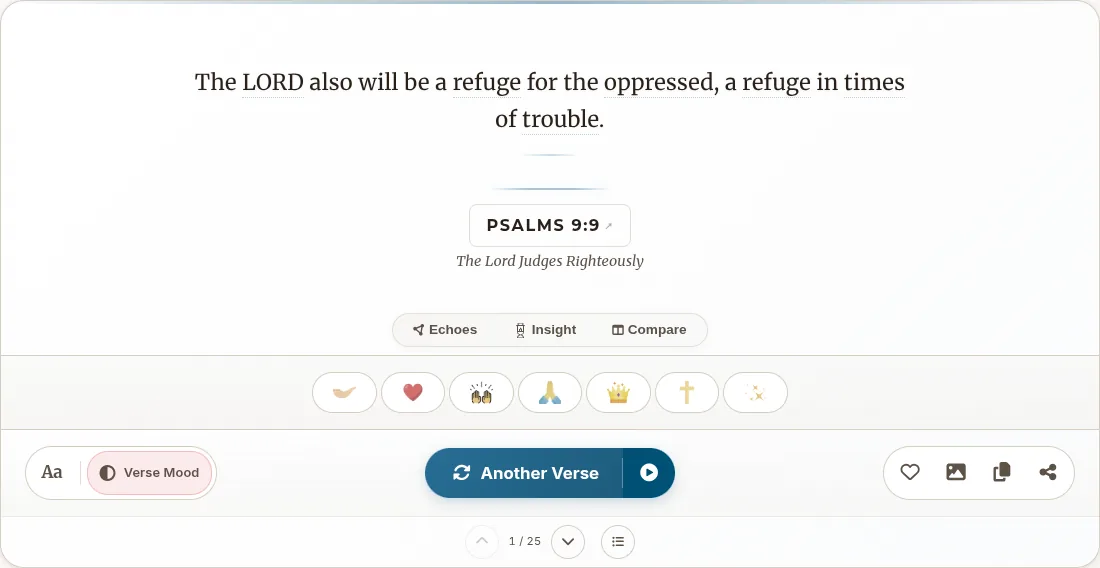
The homepage selects a verse at random from the entire Bible using a cryptographically secure algorithm. Each verse links to a full study page with commentary and cross-references.
Use the toolbar to copy the verse, share it, save it to your favorites, or shuffle to get another one. The Aa button opens typography and appearance options for the card. Below the reference, quick buttons open the verse's Insight (commentary), a Compare view of its parallel translations, and its Echoes — verses that resonate with it across Scripture.
The toolbar also includes a Verse Mood selector — a subtle, wordless slider that biases the random pool from a calming end (comfort, joy, love, hope) toward the full canon. Every one of the 31,102 verses is classified by mood, so the slider shifts you across ten underlying tones — from comforting verses on one side, through faith and courage in the middle, to harder texts of suffering and warning on the other. Leave it at default for everything; nudge it toward calm when you want gentler verses. Your setting saves to the browser.
02Study Any Verse
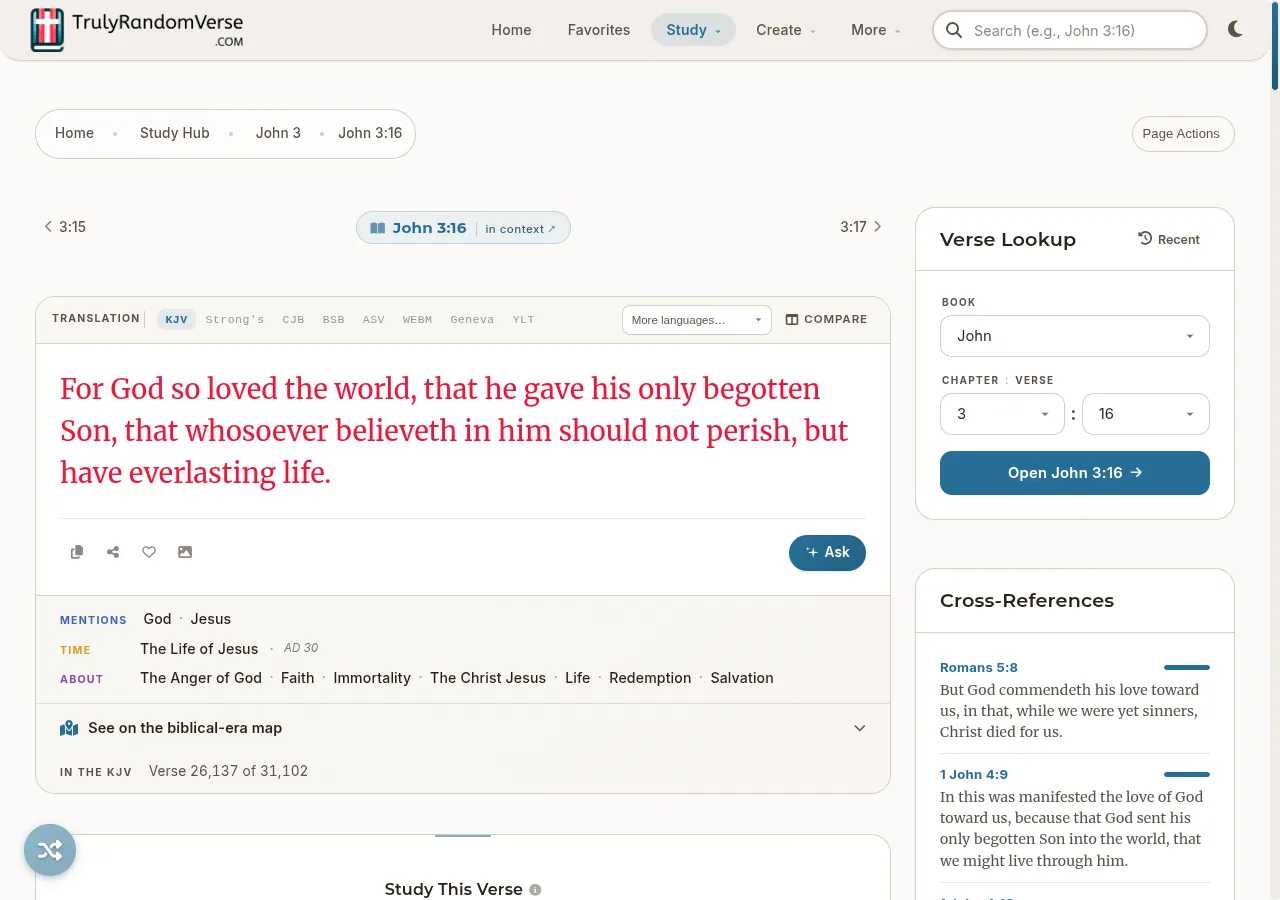
Click any verse reference to open its study page. Each page includes a 2,200+ word commentary covering historical context, exposition, theological connections, and practical reflection — generated from verified biblical sources.
Below the verse text, contextual tags show the people mentioned, timeline period, themes, cross-references, and key Hebrew or Greek words. Every tag is clickable — tap "David" to see all verses mentioning him, or tap a Strong's word to read its full lexicon entry.
The verse text is available in seven parallel English translations: KJV, BSB, ASV, CJB, WEBM, the Geneva Bible (1599), and Young's Literal Translation. A "KJV with Strong's" view links every word to its original Hebrew or Greek definition, and the More languages… menu opens the same verse in dozens of other translations.
The commentary itself sits under four tabs: Our Insight (the site's own exposition), Matthew Henry, the Church Fathers, and More Resources — a curated set of links out to trusted study tools for that passage.
Want to dig deeper? Tap Ask on any verse to open a follow-up conversation with the AI, grounded in the verse you're reading.
03Ask the AI
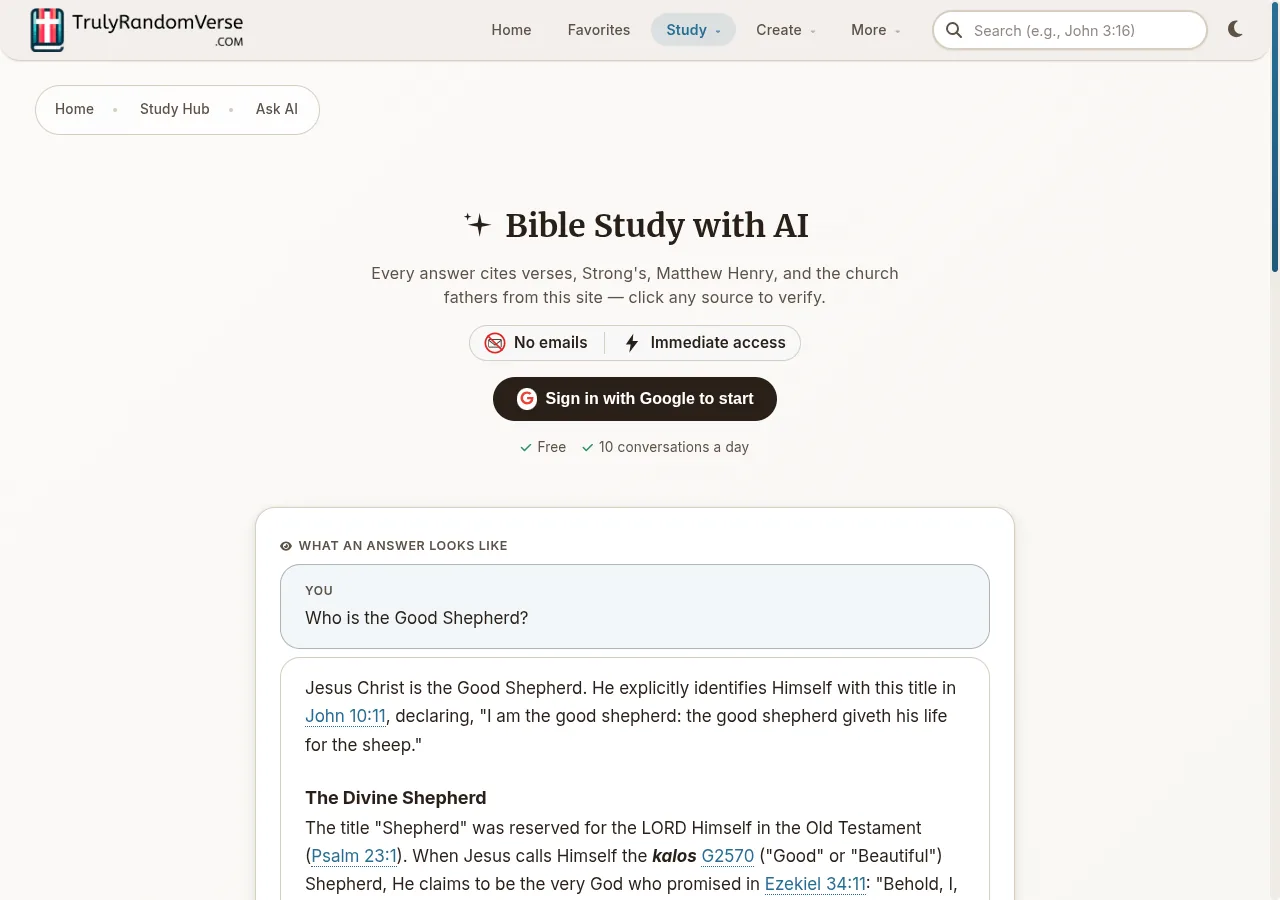
The AI study assistant answers questions about Scripture using a curated set of trusted sources — verses across multiple translations, Strong's word studies, Matthew Henry's commentary, the Church Fathers, and cross-references. Every claim links back to the verse, word, or quotation it came from. Click any citation to verify it yourself.
Ask anything: "What does agape mean and where does it appear?", "Compare KJV and ASV on John 3:16," "Walk me through the structure of Romans 8." Conversations are multi-turn, so you can drill deeper on each answer. The Choose for me button rolls a random verse, passage, or chapter to study.
It's free — sign in with Google for 10 conversations a day, 10 turns each, with no marketing emails ever and your past conversations saved. From your account, you can toggle Matthew Henry and Church Fathers as sources to match the tradition you study from.
04Read in Any Language
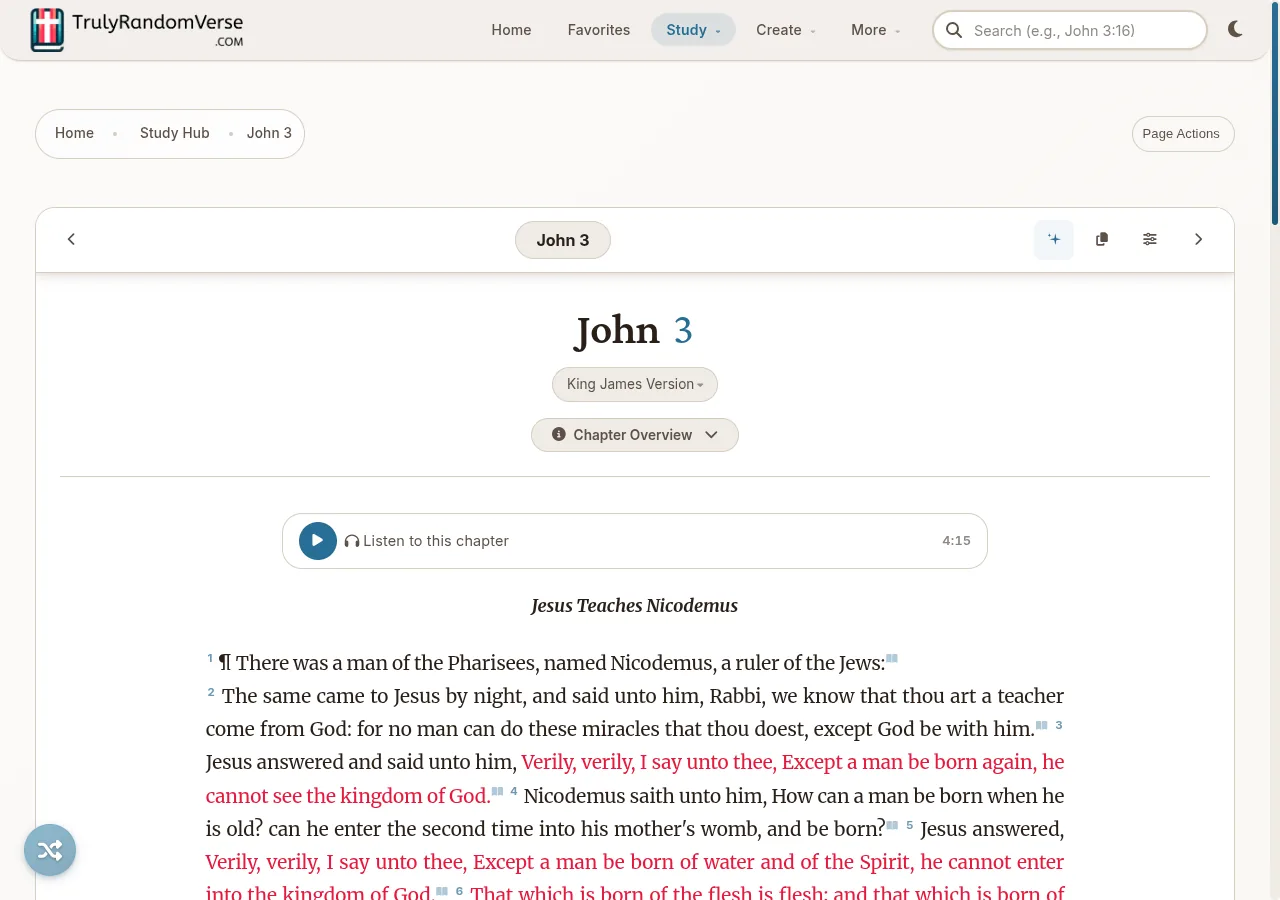
The chapter reader displays full chapters in 46 Bible translations across 39 languages — including Spanish, Arabic, Chinese (Simplified and Traditional), Hindi, Bengali, Korean, Japanese, Portuguese, Hebrew, Persian, and many more. Right-to-left languages render natively. Select a translation from the dropdown at the top of any chapter page.
Each English chapter can include AI-generated study notes that insert verse-by-verse headings and section markers into the text, making longer chapters easier to follow. The reader also offers typography controls for font family, size, weight, and style.
To reach the chapter reader: click a book name on any verse page, navigate from the Study Hub, or follow a link from the Ten Lists tracker.
05Search the Bible
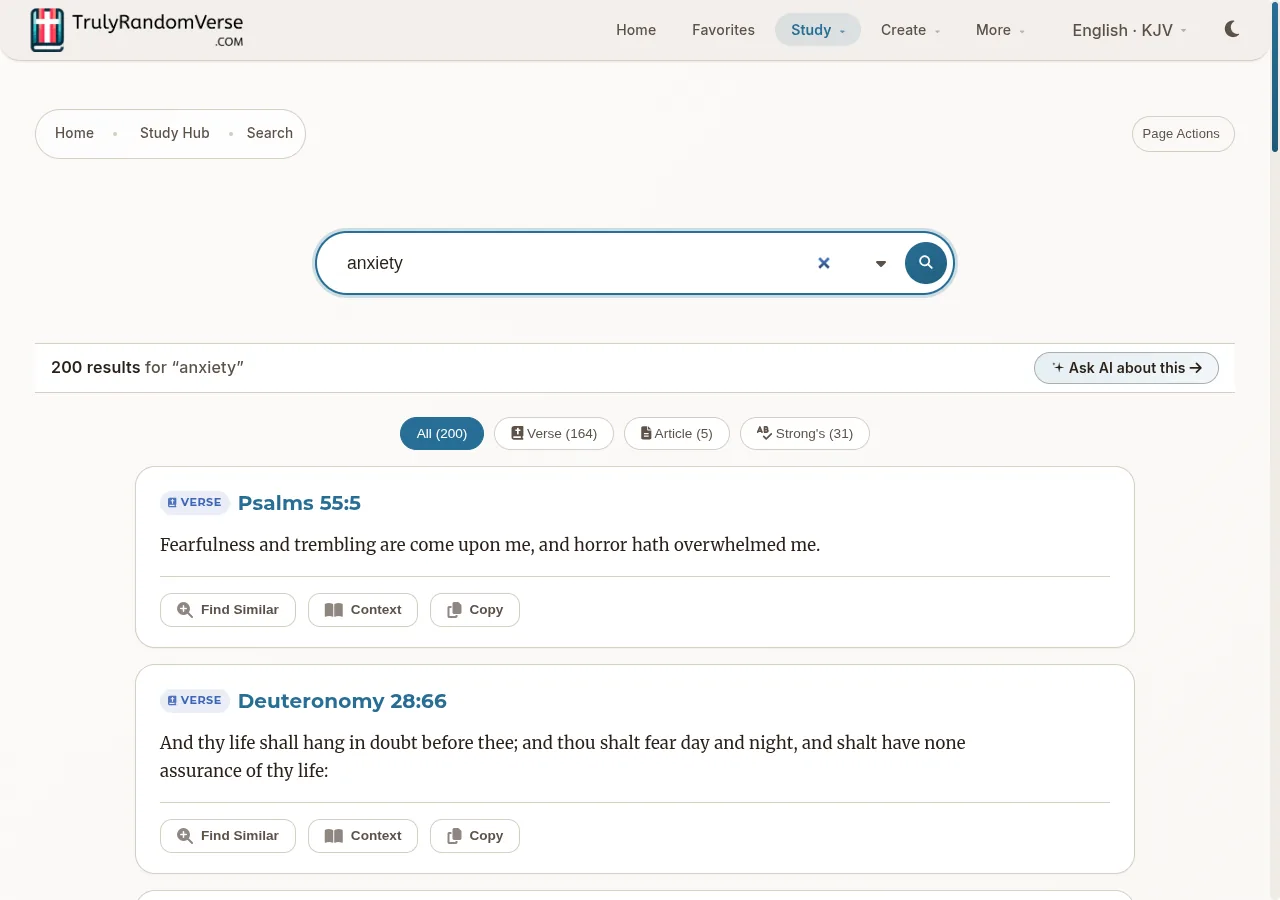
The KJV was published in 1611. Words like "anxiety" do not appear in the text. The search engine bridges this gap — searching "anxiety" returns KJV matches like "careful for nothing," "troubled," "heaviness," and "cumbered with much serving."
Results span three categories: verses, Strong's entries, and articles. You can search by verse reference ("John 3:16"), by Strong's number ("G25"), by topic, or by phrase. Filter results by book or Testament using the sidebar controls. For full conversational study, every results page links out to Ask the AI.
06The Ten Lists Reading System
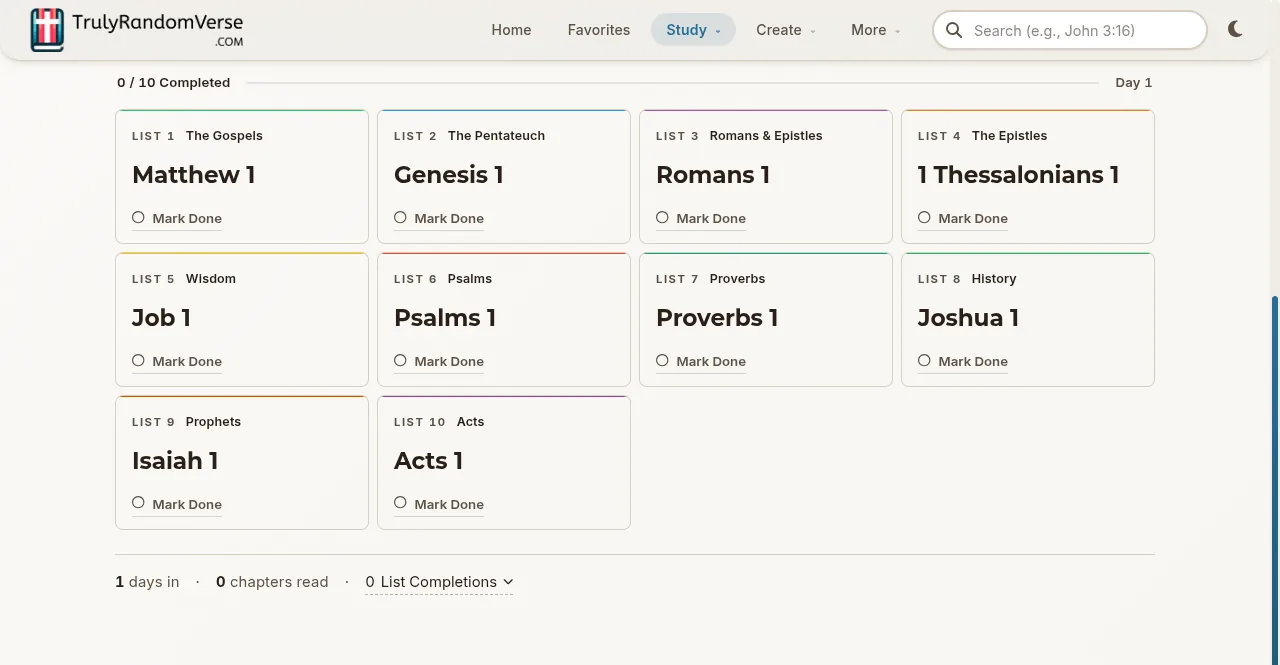
Developed by Professor Grant Horner, this method divides the Bible into ten genre-based lists. You read one chapter from each list every day — 10 chapters total. Because each list is a different length, the daily combination never repeats in your lifetime.
The built-in tracker manages everything: click a card to read the chapter, mark it done, and advance to the next. Your progress saves in the browser — no account needed. Sign in and it saves to your account instead, so it follows you to your phone.
07Explore by Topic
Every verse in the Bible is cross-linked to a tagging system covering nearly 5,000 topics, 3,000+ people, and 1,200+ places. Click any tag on a verse page to see every verse associated with it. Tap "Jerusalem" to trace it through Scripture, or browse all people, places, and topics from the tags index.
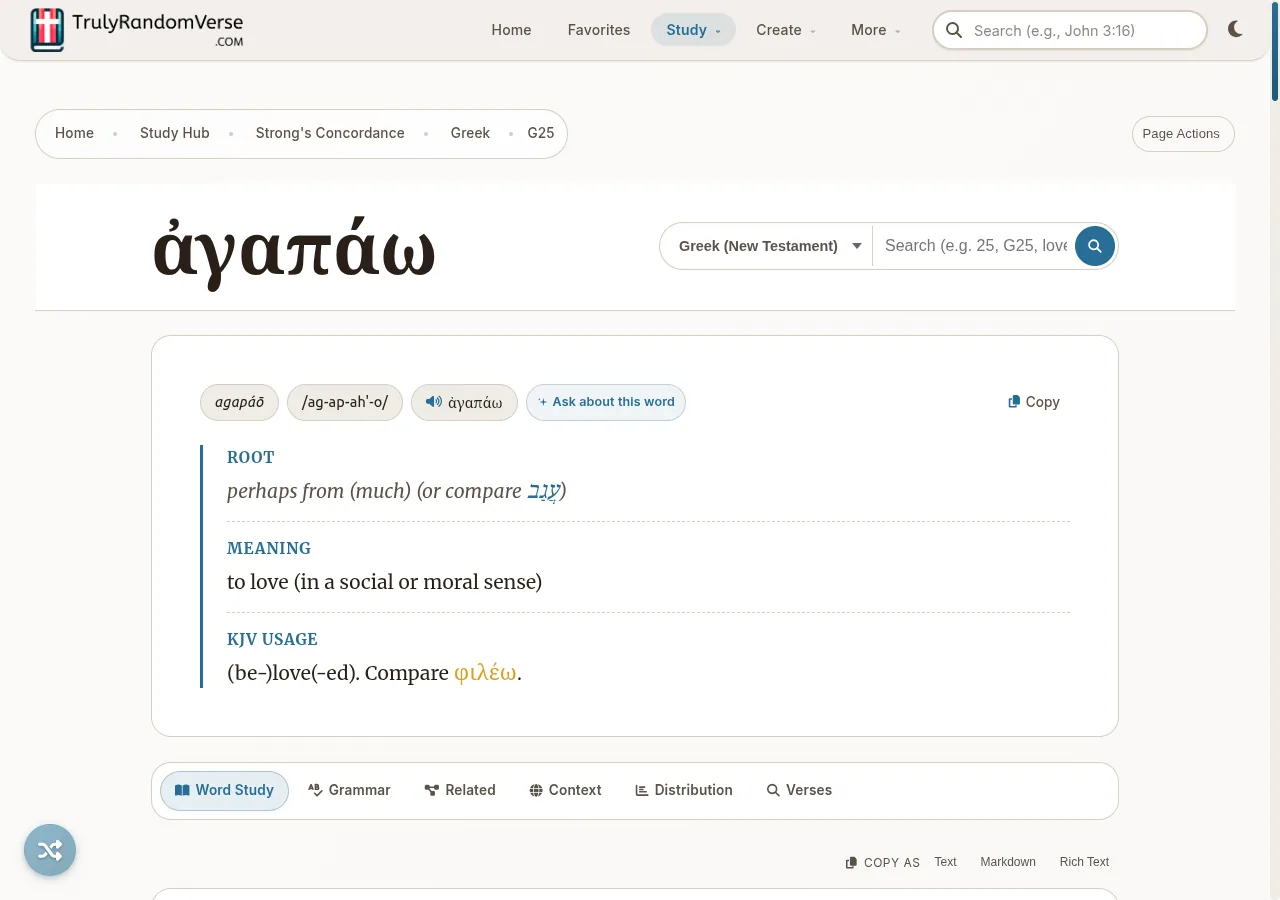
The article library contains 1,000+ articles on biblical stories, characters, themes, and theology — organized by category. The Strong's Concordance provides a full lexicon for all 14,000+ Hebrew and Greek words in the Bible, with definitions, etymology, grammar and morphology, distribution charts, and links to every verse where the word appears.
For daily reading, the devotional selects one verse each day with thematic commentary. The Study Hub offers random discovery buttons across all content types — verses, chapters, articles, Strong's entries, and timeline dates.
09Why This Approach Works
"The lot is cast into the lap, but its every decision is from the Lord." — Proverbs 16:33
Most Bible readers develop a "canon within a canon" — returning to the same passages while entire books remain unread. Reading plans that start at Genesis often lose momentum before Exodus ends.
Randomness removes that pattern. When you do not choose what comes next, comfort zones disappear. After hundreds of random encounters, themes and connections across Scripture begin to surface on their own.
Combine random verses for depth with the Ten Lists for breadth, and you get both horizontal coverage (knowing the whole Bible) and vertical understanding (studying individual passages closely).
Questions or feedback? Get in touch. This site is free, always.